Saturday, June 07, 2014

iPal: Capture Pictures and Videos with Your Eyes and Share with a Blink or Wink! | Indiegogo

Oh, my!


https://www.indiegogo.com/projects/ipal-capture-pictures-and-videos-with-your-eyes-and-share-with-a-blink-or-wink


~A.

Profound Jokes - Business Insider

Profound Jokes - Business Insider

16 Of The Most Profound Jokes Ever Told

Sometimes humor is the best way to drive a point home. It can communicate ideas that are lighthearted or serious.

In a Quora thread, users answered the question, "What are some of the most profound jokes ever?" Their responses touch on heavier topics like death, philosophy, and religion. Many of the punch lines are comments on how people live or instructions on how they should live.

Here are some of our favorites:

1. A young boy enters a barber shop and the barber whispers to his customer, "This is the dumbest kid in the world. Watch while I prove it to you."

The barber puts a dollar bill in one hand and two quarters in the other, then calls the boy over and asks, "Which do you want, son?" The boy takes the quarters and leaves.

"What did I tell you?" said the barber. "That kid never learns!"

Later, when the customer leaves, he sees the same young boy coming out of the ice cream parlor.

"Hey, son! May I ask you a question? Why did you take the quarters instead of the dollar bill?"

The boy licked his cone and replied: 

"Because the day I take the dollar the game is over!" —Vinaya Patil 

2. A boy and a man sit on a couch together. The boy says to the man, "Yeah, well, I didn't believe in reincarnation when I was your age either." —Akshat Anand 

3. A man is flying in a hot-air balloon and realizes he is lost. He reduces height and spots a man below. He lowers the balloon farther and shouts, "Excuse me! Can you tell me where I am?"

The man below says: "Yes, you're in a hot-air balloon, hovering 30 feet above this field."

"You must be an engineer," says the balloonist. 

"I am," replies the man. "How did you know?"

"Well," says the balloonist, "everything you have told me is technically correct, but it's no use to anyone."

The man below says, "You must be in management."

"I am," replies the balloonist, "but how did you know?"

"Well," says the man, "you don't know where you are or where you're going, but  you expect me to be able to help. You're in the same position you were before we met, but now it's my fault." —Amori Adesque

4. A climber fell off a cliff, and, as he tumbled down, he caught hold of a small branch.

"Help! Is there anybody up there?" he shouted.

A majestic voice boomed through the gorge:

"I will help you, my son, but first you must have faith in me."

"Yes, yes, I trust you!" cried the man.

"Let go of the branch," boomed the voice.

There was a long pause, and the man shouted up again, "Is there anybody else up there?" —Ahmet Kasan 

5. An MIT linguistics professor was lecturing his class the other day. "In English," he said, "a double negative forms a positive. However, in some languages, such as Russian, a double negative remains a negative. But there isn't a single language, not one, in which a double positive can express a negative."

A voice from the back of the room said, "Yeah, right." —Sai Kishore K

6. An American businessman was at the pier of a small coastal Mexican village when a small boat with just one fisherman docked. Inside the small boat were several large yellowfin tuna. The American complimented the fisherman on the quality of his fish and asked how long it took to catch them. The fisherman replied that it only took a little while. The American then asked why didn't he stay out longer and catch more fish. The fisherman said he had enough to support his family's immediate needs.

The American then asked, "But what do you do with the rest of your time?"

The fisherman said, "I sleep late, fish a little, play with my children, take siesta with my wife, Maria, stroll into the village each evening where I sip wine and play guitar with my amigos. I have a full and busy life, señor."

The American scoffed. "I am a Wharton MBA and could help you. You should spend more time fishing and with the proceeds, buy a bigger boat. With the proceeds from the bigger boat you could buy several boats. Eventually you would have a fleet of fishing boats. Instead of selling your catch to a middleman you would sell directly to the processor, eventually opening your own cannery. You would control the product, processing and distribution. You would need to leave this small coastal fishing village and move to Mexico City, then L.A., and eventually New York City, where you will run your expanding enterprise."

The fisherman asked, "But how long will this all take?"

To which the American replied, "Fifteen or 20 years."

"But what then?"

The American laughed and said, "That's the best part. When the time is right you would announce an IPO and sell your company stock to the public and become very rich. You would make millions."

"Millions? Then what?"

The American said, "Then you would retire. Move to a small coastal fishing village where you would sleep late, fish a little, play with your kids, take siesta with your wife, stroll to the village in the evenings where you could sip wine and play your guitar with your friends." —Andrew Udell

7. A masochist asks a sadist, "Please hurt me."

"No," replies the sadist. —Arnon Mishkin 

8. "Make me one with everything," says the Buddhist to the tofu hot dog vendor.

Then, after getting his tofu hot dog, the Buddhist hands the vendor a $20 bill.

The vendor takes the money and begins helping the next customer.

The Buddhist looks puzzled and asks the vendor, "Where is my change?"

The vendor replies, "Change comes from within." —Liam Gorman 

9. I'll stop at nothing to avoid using negative numbers. —Ren Walker

10. An engineer dies and reports to the pearly gates. St. Peter checks his dossier and says, "Ah, you're an engineer — you're assigned to hell."

So the engineer reports to the gates of hell and is let in. Pretty soon, the engineer gets dissatisfied with the level of accommodations and starts designing and building improvements.

After a while, they've got air-conditioning and flush toilets, escalators, elevators and so on ... and the engineer is a pretty popular guy.

One day, God calls Satan on the telephone.

"So, how's it going down there in hell?" God says.

"Hey, things are going great. We've got air-conditioning and flush toilets and escalators. There's no telling what our engineer is going to come up with next!" Satan says.

"What? You've got an engineer? That's a mistake — he should have never gotten down there. Send him back immediately!" God says.

"No way! I like having an engineer on the staff — I'm keeping him!" Satan says.

"Send him back up here or I'll sue!" God says.

Satan laughs uproariously and answers:

"Yeah, right. And just where are you going to get a lawyer?" —Sagar Shukla

11. A crow was sitting on a tree, doing nothing all day. A rabbit asked him, "Can I also sit like you and do nothing all day long?" The crow answered, "Sure, why not." So the rabbit sat on the ground below the crow and rested.

A fox jumped on the rabbit and ate it.

Moral of the story: To be sitting and doing nothing, you must be sitting very high up. —Saurav Maheshwary

12. A taxi passenger tapped the driver on the shoulder to ask him a question. 

The driver screamed, lost control of the car, nearly hit a bus, went up on the footpath, and stopped inches from a shop window. 

For a second, everything was quiet in the cab. Then the driver said, "Look, mate, don't ever do that again. You scared the living daylights out of me!"

The passenger apologized and said, "I didn't realize that a little tap would scare you so much." 

The driver replied, "Sorry, it's not really your fault. Today is my first day as a cab driver — I've been driving a funeral van for the last 25 years." —Salil Gupta

13. A guy said to God, "God, is it true that to you a billion years is like a second?"

God said yes.

The guy said, "God, is it true that to you a billion dollars is like a penny?"

God said yes.

The guy said, "God, can I have a penny?"

God said, "Sure, just a second." —Mark DeBolt


14. Two young salmon are swimming along one day. As they do, they are passed by a wiser, older fish coming the other way.

The wiser fish greets the two as he passes, saying, "Morning, boys! How's the water?"

The other two continue to swim in silence for a little while, until the first one turns to the other and asks, "What the hell is water?" —Craig Weiland

15. Pessimist: Oh, this can't get any worse! 

Optimist: Yes, it can! —Bharat Jakati

16. How many Freudian analysts does it take to change a light bulb? 

Two. One to change it, and the other to hold the penis.


LADDER. I MEANT LADDER. —Jade Roche  Of The Most Profound Jokes Ever Told

Sometimes humor is the best way to drive a point home. It can communicate ideas that are lighthearted or serious.

In a Quora thread, users answered the question, "What are some of the most profound jokes ever?" Their responses touch on heavier topics like death, philosophy, and religion. Many of the punch lines are comments on how people live or instructions on how they should live.

Here are some of our favorites:

1. A young boy enters a barber shop and the barber whispers to his customer, "This is the dumbest kid in the world. Watch while I prove it to you."

The barber puts a dollar bill in one hand and two quarters in the other, then calls the boy over and asks, "Which do you want, son?" The boy takes the quarters and leaves.

"What did I tell you?" said the barber. "That kid never learns!"

Later, when the customer leaves, he sees the same young boy coming out of the ice cream parlor.

"Hey, son! May I ask you a question? Why did you take the quarters instead of the dollar bill?"

The boy licked his cone and replied: 

"Because the day I take the dollar the game is over!" —Vinaya Patil 

2. A boy and a man sit on a couch together. The boy says to the man, "Yeah, well, I didn't believe in reincarnation when I was your age either." —Akshat Anand 

3. A man is flying in a hot-air balloon and realizes he is lost. He reduces height and spots a man below. He lowers the balloon farther and shouts, "Excuse me! Can you tell me where I am?"

The man below says: "Yes, you're in a hot-air balloon, hovering 30 feet above this field."

"You must be an engineer," says the balloonist. 

"I am," replies the man. "How did you know?"

"Well," says the balloonist, "everything you have told me is technically correct, but it's no use to anyone."

The man below says, "You must be in management."

"I am," replies the balloonist, "but how did you know?"

"Well," says the man, "you don't know where you are or where you're going, but  you expect me to be able to help. You're in the same position you were before we met, but now it's my fault." —Amori Adesque

4. A climber fell off a cliff, and, as he tumbled down, he caught hold of a small branch.

"Help! Is there anybody up there?" he shouted.

A majestic voice boomed through the gorge:

"I will help you, my son, but first you must have faith in me."

"Yes, yes, I trust you!" cried the man.

"Let go of the branch," boomed the voice.

There was a long pause, and the man shouted up again, "Is there anybody else up there?" —Ahmet Kasan 

5. An MIT linguistics professor was lecturing his class the other day. "In English," he said, "a double negative forms a positive. However, in some languages, such as Russian, a double negative remains a negative. But there isn't a single language, not one, in which a double positive can express a negative."

A voice from the back of the room said, "Yeah, right." —Sai Kishore K

6. An American businessman was at the pier of a small coastal Mexican village when a small boat with just one fisherman docked. Inside the small boat were several large yellowfin tuna. The American complimented the fisherman on the quality of his fish and asked how long it took to catch them. The fisherman replied that it only took a little while. The American then asked why didn't he stay out longer and catch more fish. The fisherman said he had enough to support his family's immediate needs.

The American then asked, "But what do you do with the rest of your time?"

The fisherman said, "I sleep late, fish a little, play with my children, take siesta with my wife, Maria, stroll into the village each evening where I sip wine and play guitar with my amigos. I have a full and busy life, señor."

The American scoffed. "I am a Wharton MBA and could help you. You should spend more time fishing and with the proceeds, buy a bigger boat. With the proceeds from the bigger boat you could buy several boats. Eventually you would have a fleet of fishing boats. Instead of selling your catch to a middleman you would sell directly to the processor, eventually opening your own cannery. You would control the product, processing and distribution. You would need to leave this small coastal fishing village and move to Mexico City, then L.A., and eventually New York City, where you will run your expanding enterprise."

The fisherman asked, "But how long will this all take?"

To which the American replied, "Fifteen or 20 years."

"But what then?"

The American laughed and said, "That's the best part. When the time is right you would announce an IPO and sell your company stock to the public and become very rich. You would make millions."

"Millions? Then what?"

The American said, "Then you would retire. Move to a small coastal fishing village where you would sleep late, fish a little, play with your kids, take siesta with your wife, stroll to the village in the evenings where you could sip wine and play your guitar with your friends." —Andrew Udell

7. A masochist asks a sadist, "Please hurt me."

"No," replies the sadist. —Arnon Mishkin 

8. "Make me one with everything," says the Buddhist to the tofu hot dog vendor.

Then, after getting his tofu hot dog, the Buddhist hands the vendor a $20 bill.

The vendor takes the money and begins helping the next customer.

The Buddhist looks puzzled and asks the vendor, "Where is my change?"

The vendor replies, "Change comes from within." —Liam Gorman 

9. I'll stop at nothing to avoid using negative numbers. —Ren Walker

10. An engineer dies and reports to the pearly gates. St. Peter checks his dossier and says, "Ah, you're an engineer — you're assigned to hell."

So the engineer reports to the gates of hell and is let in. Pretty soon, the engineer gets dissatisfied with the level of accommodations and starts designing and building improvements.

After a while, they've got air-conditioning and flush toilets, escalators, elevators and so on ... and the engineer is a pretty popular guy.

One day, God calls Satan on the telephone.

"So, how's it going down there in hell?" God says.

"Hey, things are going great. We've got air-conditioning and flush toilets and escalators. There's no telling what our engineer is going to come up with next!" Satan says.

"What? You've got an engineer? That's a mistake — he should have never gotten down there. Send him back immediately!" God says.

"No way! I like having an engineer on the staff — I'm keeping him!" Satan says.

"Send him back up here or I'll sue!" God says.

Satan laughs uproariously and answers:

"Yeah, right. And just where are you going to get a lawyer?" —Sagar Shukla

11. A crow was sitting on a tree, doing nothing all day. A rabbit asked him, "Can I also sit like you and do nothing all day long?" The crow answered, "Sure, why not." So the rabbit sat on the ground below the crow and rested.

A fox jumped on the rabbit and ate it.

Moral of the story: To be sitting and doing nothing, you must be sitting very high up. —Saurav Maheshwary

12. A taxi passenger tapped the driver on the shoulder to ask him a question. 

The driver screamed, lost control of the car, nearly hit a bus, went up on the footpath, and stopped inches from a shop window. 

For a second, everything was quiet in the cab. Then the driver said, "Look, mate, don't ever do that again. You scared the living daylights out of me!"

The passenger apologized and said, "I didn't realize that a little tap would scare you so much." 

The driver replied, "Sorry, it's not really your fault. Today is my first day as a cab driver — I've been driving a funeral van for the last 25 years." —Salil Gupta

13. A guy said to God, "God, is it true that to you a billion years is like a second?"

God said yes.

The guy said, "God, is it true that to you a billion dollars is like a penny?"

God said yes.

The guy said, "God, can I have a penny?"

God said, "Sure, just a second." —Mark DeBolt


14. Two young salmon are swimming along one day. As they do, they are passed by a wiser, older fish coming the other way.

The wiser fish greets the two as he passes, saying, "Morning, boys! How's the water?"

The other two continue to swim in silence for a little while, until the first one turns to the other and asks, "What the hell is water?" —Craig Weiland

15. Pessimist: Oh, this can't get any worse! 

Optimist: Yes, it can! —Bharat Jakati

16. How many Freudian analysts does it take to change a light bulb? 

Two. One to change it, and the other to hold the penis.

LADDER. I MEANT LADDER. —Jade Roche 


I just dont think these are very funny, but the look on your face is!!!
~A.

Korner - Home Security Anyone Can Use and Everyone Can Afford | Indiegogo

Korner - Home Security Anyone Can Use and Everyone Can Afford | Indiegogo

Korner - Home Security Anyone Can Use and Everyone Can Afford

A security product for your apartment or home, designed so anyone can use it and everyone can afford it.  Includes iOS and Android App.

Priced for everyone:

Normally - $59 up front, $39/year

Indiegogo campaign - Under $100 and no annual fee for life

Easy enough for anyone:

Our window and door sensors, or Tags, stick easily to your door or window!


Media Coverage


  Supporting Women's Shelter


Part of our mission is to bring home security to those who need it most, but who could never previously afford it.  Home security has traditionally been targeted at more affluent home owners, while middle and low income homeowners, along with renters, have been left to fend for themselves.  Even though these groups suffer higher rates of break-ins!

To that end, we have established a partnership with Domestic Abuse Women's Network, or DAWN (dawnonline.org), to provide survivors of domestic violence with a free home security system.  Our campaign will provide contributors an option to purchase a system on behalf of this great organization.  A terrific way to help those truly in need of safe and secure homes!

If you would like to support this initiative, look for our perk that allows you to purchase a system on behalf of DAWN.


Our Innovation

The corner-piece of our patent-pending innovation - The Tag.  It uses an combination of sensors that allows a slick one-piece design which, compared to the traditional two-piece sensors, works better, simplifies installation and enables an entirely new design ethos:
  • Looks better - Our unique design consumes less power, which permits smaller batteries, and a smaller Tag.  And it's one piece, no more fumbling with pairing and aligning.  And its contoured shape blends nicely with the surrounding frame!
  • Works better - We more effectively discern between vibrations and actual entry, so less false alarms!
  • Applies more easily - Stick them snugly into the corner of a door or window.  Then pop them off and put them in your pocket when you move!

Smartphone App

Once an intrusion is detected, two things will happen:

  • The Fob will let out a piercing screech to ward off the intruder and alert you if you are in your home (i.e. sleeping)
  • You will instantly receive an alert on your smartphone app that will include two buttons:  one to call the police, the other to forward the alert to your friends, family and neighbors.

We allow the user to pre-populate their app with contacts for friends, family and neighbors (we call this the user's "Security Circle"), such that any alerts can be instantly forwarded to the user's personal networks. This supports an inherently social form of Neighborhood Watch and provides a basic platform for communities to interact.

The App will allow you to Arm and Disarm the system from anywhere that you have smartphone reception.  In addition, you can set an Arm/Disarm schedule so the system will automatically Arm and Disarm around your regular working hours.

The App also monitors the battery life of the Tags.  You can check battery levels within each Tag at any time, and the App will automatically notify you when the batteries reach critical levels, and provide you a one-button option to order replacements.

Who Korner is For?

  • Renters
  • Homeowners looking for something affordable
  • Students
  • Parents - buy it for your kids who have moved out; buy it for grandparents living alone
  • Vacation home renters and owners
  • Traveling workers

How Korner Works

  • Ease of Use - The Tag sticks neatly into the corner of door or window, while the rounded edge contours nicely with the frame – no more aligning.
  • Detection - The Tags, once applied to a door or window (or anything else for that matter), will detect motion and wirelessly notify the Fob, which is plugged into a router and communicates with the Internet.
  • Notification - In the event of an intrusion, an alert will be sent to the user's App. The user will be provided the option of calling the police and/or forwarding the alert to their Security Circle – a pre-populated list of the user's family, friends and neighbors.
  • Alarm - The Fob also emits a piercing tone when an intrusion is detected, which can be disabled from the App.
  • Arming/Disarming - The system can be armed and disarmed remotely from the App.  In addition, the user can set auto arming and disarming based on a schedule.
  • Portable - When you move, just pop the Tags off your doors and windows, and re-apply them to your new place.
  • Control - The system can be controlled from either the App or a computer.

Patent-Pending Technology

  • Performance - Sensors in the Tags discern actual entry from heavy vibrations, thus reducing false alarms.
  • Power - Our innovative power management technique supports a 3-year battery life using a small quarter-sized battery (CR2032) that will be replaceable.  The Fob is powered by a standard USB charger.
  • Unique Design - Our Innovation enables an entirely new design ethos, compressing the old "paired" magnetic sensors into a "1-piece" Tag.
  • Wireless Protocol - Tag communicates with Fob using industry standard Zigbee

The Workshop (otherwise known as Chris' garage):

Why Did We Create Korner?

The original inspiration for Korner came from a conversation I had with a couple who were considering home security.  They were a dual-income couple, both college educated.  They were renting an apartment and recently had a child.  They had shopped around for home security for some time, and even had someone come to their home and provide them with a quote.  Yet they finally decided not to purchase anything, because all the alternatives cost more than they were willing to pay.

After hearing this story it struck me - if this dual-income, college educated couple can't afford home security, WHAT ABOUT EVERYBODY ELSE?!?  This thought sat with me for a number of weeks, until I finally decided to do some research.  Here's what I found:

  • Adoption of Home Security for homeowners with household incomes above $100K is over 30%, and climbs over 40% for higher income brackets
  • Adoption among renters and mid to lower income homeowners is in the low teens
  • The rate of break-ins rises steadily with each lower income bracket 

It was clear that the industry was failing to provide home security to those who needed it most.  The solution had to be both inexpensive and very easy to use.

So I assembled a bunch of engineers and we set to work on the problem. The first step was to identify a core set of features that are considered essential to Home Security. The second step was to use technology to make a solution with these basic features as cheap and easy to use as possible.

With a lot of hard work (and a little sensor and hardware expertise), we were finally able to come up with our patent-pending solution, comprised of our Fob and 1-piece Tag, controlled by a smartphone app.  All designed from the beginning to be as inexpensive and easy to use as possible.

But something interesting happened along the way.  An intense focus on simplicity produced an industry first, the 1-piece door and window sensor.  What surprised us was the wonderful design flexibility that sprung from this very functional innovation. Form follows function, as they say, and that was certainly the case for us.  Not only do we believe that we have created something practical and useful that will expand the adoption of Home Security, but it looks great too!

TEAM

Steve Hollis - CEO. Steve started out as an electronics manufacturing engineer.   He is most recently with Amazon in AWS cloud services, and was previously with their Retail Operations group.  In the interim, he was a banker covering communications technologies firms, ranging from early stage startups to large publicly traded companies. He has a BS in Mechanical Engineering from the University of Waterloo.

Chris Doughty - Director, Electrical Engineering. Chris' experience as an Electrical Engineer includes work with the original Xbox game controller, industrial and appliance controls, and solid state laser research.  More recently he was the Director of Electrical Engineering at X2 Biosystems, where he led the design and development of a radio telemetry system for monitoring head impacts to athletes.  He has a BS and MS from the University of Washington in Electrical Engineering.

Jed McCann - Director, Mechanical Engineering. Jed's background is in mechanical engineering and manufacturing.  For close to 2 decades he has worked in product development, helping to launch everything from wearable health devices to satellites.  Jed has held a number of roles, including Director of Product Development at X2 Biosystems, that designed a wireless, MEMS-based product to detect concussions for athletes.  He has an MS in Manufacturing Systems Engineering from Stanford.

Robert Snook - Director, Software Engineering. Rob is a veteran Firmware Engineer who has developed products such as head-mounted displays, hospital glucose meters, a 3-D charting platform, Xbox peripherals, optical tracker gaming mice, instrumented sports mouth guards, and a micro-fluidics lab platform.  Most recently, he was the Director of Software Engineering at X2 Biosystems writing software to track sports helmet impact telemetry from player to cloud. He has a BS in Physics and Astronomy from the University of Washington.

Robert Chung - Coordinator, Marketing. Robert is focused on marketing, including media outreach and social media strategy. He is a recent graduate from the University of Pennsylvania, Cum Laude. 

TIMELINE

APRIL

  • Indiegogo Launch

MAY

  • Firmware optimization

  • HW and ME design refinements

JUNE

  • Finalize Industrial Design

  • Firmware validation

  • Packaging design

  • UL/FCC/CE prescans

  • RF optimization

  • Design review with Contract Manufacturer

  • HW amd ME DFM

  • App Wire Framing

JULY

  • Full system Beta build

  • Firmware test and debug

  • App UI Design

  • App Development

AUGUST

  • Release parts to tooling

  • Finalize ME and HW

  • Production firmware

  • Tooling development

  • Manufacturing test setup

  • Release circuit boards to fabrication

  • App Testing

SEPTEMBER

  • First Article Inspection

  • Circuit board testing

  • Tooling refinement

  • Submit App to Apple and Android

OCTOBER

  • Production ramp up

  • UL/FCC/CE certification

  • App approval from Apple and Google Play

NOVEMBER

  • Production

DECEMBER

  • Distribution


FAQs

How can I support the Women's Shelter initiative?

Look for our perk that lets you buy Korner on behalf of a Women's Shelter. Pricing for these donations will remain at the reduced early bird pricing for the entire length of the campaign!  This is a great opportunity to improve the lives of those that are truly at risk, so we thank you for anything you can do to contribute to this great cause.Are the batteries in the Tags replaceable after their 3 year life?

Yes. And the CR2032 batteries are widely available in retail outlets everywhere. As part of our patent-pending approach, we carefully manage power consumption during the life of the Tag.  As a result, the tag is designed to last 3 years.  Our App will monitor the batteries and notify you when they need to be replaced.

Which smartphone operating systems will you support?

Initially we will support iOS and Android.  We will consider other operating systems based on demand.

What are the shipping costs?

Shipping and handling is free for the US and Canada.  Anywhere outside US and Canada will require an additional $20.

How big are the Tags?

As shown in the "How Korner Works" section, the long rounded edge of the Tag is 64mm, point to point, and the Tag is 6.3mm thick.

Where do the Tags go on the doors?

The Tags should be applied on the top corner of the door, away from the hinges (not above the hinges).  The Tags can go on either side of the door, as long as they are not exposed to the elements.  For external doors, they should be applied to the indoor side of the door, not the outdoor side.

What if I forgot to add International shipping to my order?

Go ahead and click on the Support perk and contribute another $20. If you can, note that your contribution is linked to another order. But regardless, we will connect your contributions prior to delivery and give you credit.

Do the Tags come in different colors, or can they be painted?

The Tags only come in white currently (although that may change), but they can be painted.  In fact, we have specifically chosen plastics so that they will be receptive to paint.

How are the Tags applied to Doors and Windows?

There is a reusable adhesive on the back of the Tag.  So all you need to do is stick the Tag on the corner of a door or window, and you're done!  And when you move, just unstick them, put them in your pocket, and then reapply in your new home.  It really is that easy!

Can I name each Tag during setup?

Yes indeed.  During setup your are given the option to name each Tag, after you have applied them (i.e. Front Door).

What is the range of your product within the home?

We are currently achieving ranges of 100ft from Fob to Tag, and we are pushing to increase that prior to final delivery.  In addition, we offer a repeater for those who have bigger homes (see as part of the "Large Home" perk)

How many Tags can a Fob support?

The Fob can currently handle at least 15 Tags, although we are looking to expand that prior to delivery. 

How do the Tags communicate with the Fob?

The Tags communicate with Fob wirelessly, using a standardized in-home wireless protocol called Zigbee.  Zigbee is a broadly used wireless protocol.  In fact, it is quite possible that you already have other electronics in your home that use Zigbee.

Is Korner difficult to install?

Not at all!  In fact we don't even like using the word install, because it sounds like too much hard work.  No more guys with tool belts rolling up to your house in a van.  Setup is super simple: plug our Fob in your router or modem, stick our Tags on your doors and windows, and download our app.  That's it, you're good to go in less than 2 minutes!

What if multiple people live in my home?

Not a problem, and no additional cost.  You just need to make sure everyone downloads the free App.  Then everyone can arm and disarm the system remotely.

How do I arm and disarm the system?

That can be done from either the App or our Website.  You can arm and disarm the system whenever you want to, from anywhere that you have smartphone or internet access.  And to make life easier, we offer a calendar where you tell our system to automatically arm and disarm the system based on your regular schedule, such as when you leave and come home from work.

Will pets set off the alarm?

No (unless they know how to open doors and windows).  Our system will only notify you if a door or window is opened, so pets inside the house will not set off the alarm.

Will my system interfere with a Neighbor's system?

No. At setup our system initiates a pairing process that ensures only your Tags will be allowed to communicate with your Fob.

Does Korner have other features such as power backup, communications backup, call center monitoring, etc.?

Not yet.  Our goal has been to build Home Security in its Simplest Form, so Anybody can use it and Everybody can afford it.  To keep the price as low as possible, we chose not to build in these other features to the core product.  But our intention is to offer add-on components over time, so many of these things are on our product roadmap, including temperature sensors, flood sensors, etc.  And of course, as we add these features we will maintain our focus on ease-of-use and low cost.

Will this product work outside of North America?

Yes.  This product should work for anyone who has a router or modem for their home internet service and a smartphone.  An Ethernet port is required, which is standard on all home routers and modems that we are aware of, 


~A.

Uh oh

Hitting the $1 million mark is more attainable today than ever — and more important. That's because, in order to live comfortably in retirement through your eighties, many people will need a nest egg of at least $1 million.

"A general rule of thumb is that you need to save $1 million for every $40,000 of annual income you need to replace at retirement, not including Social Security, pension income or any other retirement income," 

~A.hole

Friday, June 06, 2014

...

Magnetic Froth | thunderbolts.info

Magnetic Froth | thunderbolts.info

Magnetic Froth

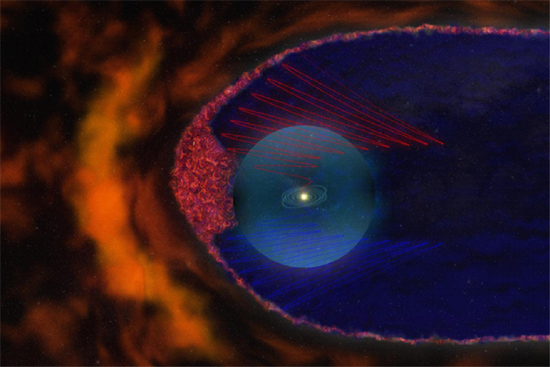
Artist's impression of "magnetic bubbles" surrounding the Solar System

Artist's impression of "magnetic bubbles" surrounding the Solar System. Credit: NASA

Jun 03, 2014

"Bubbles" of magnetic energy are said to surround the Sun's heliosheath.

"In all our quest of greatness, like wanton boys, whose pastime is their care, we follow after bubbles, blown in the air."

— John Webster

Shortly after the event, astronomer Merav Opher of Boston University's Voyager team announced: "The Voyager probes appear to have entered a strange realm of frothy magnetic bubbles. This is very surprising."

Voyager 1 encountered the heliosheath in December 2004, followed by Voyager 2 in August 2007. It was Voyager 1 that first detected fluctuations in the electron count as it traveled through the heliosphere, while Voyager 2 made similar observations later in 2008.

Since NASA's computer model of the heliosphere works only if the readings are assumed to come from flying in and out of the aforementioned bubbles, some means for their creation had to be concocted. Enter stage left, the old tried and true, magnetic reconnection.

As a press release from the time states, the Sun's "twisted and wrinkled" magnetic field lines far out in the heliosphere "bunch up," causing them to "reconnect" and explosively "reorganize" into long, sausage-shaped bubbles of magnetism.

The European Space Agency's Cluster mission recently observed anomalous bubbles that "grew and popped" around Earth, as well. The magnetic interactions were detected where Earth's magnetic field meets the barrage of charged particles known as the solar wind. In the same way as the bubbles around the Solar System are supposed to be created, magnetic reconnection was used to explain this case, as well.

Earth's magnetospheric "bubble" is known among space plasma physicists as a Langmuir sheath and is part of an electrical circuit coupled to currents flowing in the Sun's heliosphere. Langmuir sheaths are electrically charged double layers of plasma, in which opposite charges build up near each other, creating an electric field between them. Double layers can accelerate ions to extreme velocities that might easily be misinterpreted as high temperature.

The same conditions are most likely present where the solar magnetosphere, or heliosphere, meets the dissimilar charge of the Interstellar Medium (ISM). Two regions of dissimilar plasma will form a Langmuir sheath between them, which leads to a potential "bubble" formation.

Plasma in a laboratory isolates itself with thin walls of oppositely charged double layers, so it is probable that the same thing is happening around the Sun and around Earth. By extension, the same thing is most likely occurring around our galaxy, the galactic clusters, and the superclusters. At every scale, plasma behaves in the same way. Proving that case will be impossible for centuries to come, no doubt, because there is no way to know except by placing a Langmuir probe into each location and measuring the current differential.

Charged particles in motion comprise an electric current. That current wraps itself in a magnetic field. As more charged particles accelerate in the same direction the magnetic field gets stronger. A familiar idea to electrical engineers, but when astronomers find magnetism in space they are mystified. They resort to ironic ideas about voids with magnetic fields frozen inside them or so-called "magnetic reconnection."

Electric Universe advocate Wal Thornhill wrote: "…plasma in space forms a bubble, known as a 'virtual cathode'. Effectively it is the heliopause. In plasma terms, the heliopause is not a result of mechanical shock but is a Langmuir plasma sheath that forms between two plasmas of different charge densities and energies…Such 'bubbles' are seen at all scales, from the comas of comets to the 'magnetospheres' of planets and stars."

Although no specific data is yet forthcoming, Electric Universe scientists assume that plasma behaves in space the same way as it does in the laboratory. Armed with that insight, an electrically sensitive mind will see what otherwise remains invisible.

Stephen Smith


Zap.
~A.

Nurse Reveals the Top Five Regrets People Make on their Deathbed | Wake Up World

Nurse Reveals the Top Five Regrets People Make on their Deathbed | Wake Up World

Nurse Reveals the Top Five Regrets People Make on their Deathbed

By Bronnie Ware  

For many years I worked in palliative care. My patients were those who had gone home to die. Some incredibly special times were shared. I was with them for the last three to twelve weeks of their lives. People grow a lot when they are faced with their own mortality.

I learnt never to underestimate someone's capacity for growth. Some changes were phenomenal. Each experienced a variety of emotions, as expected, denial, fear, anger, remorse, more denial and eventually acceptance. Every single patient found their peace before they departed though, every one of them.

When questioned about any regrets they had or anything they would do differently, common themes surfaced again and again. Here are the most common five:

1. I wish I'd had the courage to live a life true to myself, not the life others expected of me.
This was the most common regret of all. When people realize that their life is almost over and look back clearly on it, it is easy to see how many dreams have gone unfulfilled. Most people had not honoured even a half of their dreams and had to die knowing that it was due to choices they had made, or not made.

It is very important to try and honour at least some of your dreams along the way. From the moment that you lose your health, it is too late. Health brings a freedom very few realise, until they no longer have it.

2. I wish I didn't work so hard.
This came from every male patient that I nursed. They missed their children's youth and their partner's companionship. Women also spoke of this regret. But as most were from an older generation, many of the female patients had not been breadwinners. All of the men I nursed deeply regretted spending so much of their lives on the treadmill of a work existence.

By simplifying your lifestyle and making conscious choices along the way, it is possible to not need the income that you think you do. And by creating more space in your life, you become happier and more open to new opportunities, ones more suited to your new lifestyle.

3. I wish I'd had the courage to express my feelings.
Many people suppressed their feelings in order to keep peace with others. As a result, they settled for a mediocre existence and never became who they were truly capable of becoming. Many developed illnesses relating to the bitterness and resentment they carried as a result.

We cannot control the reactions of others. However, although people may initially react when you change the way you are by speaking honestly, in the end it raises the relationship to a whole new and healthier level. Either that or it releases the unhealthy relationship from your life. Either way, you win.

4. I wish I had stayed in touch with my friends.

Often they would not truly realise the full benefits of old friends until their dying weeks and it was not always possible to track them down. Many had become so caught up in their own lives that they had let golden friendships slip by over the years. There were many deep regrets about not giving friendships the time and effort that they deserved. Everyone misses their friends when they are dying.

It is common for anyone in a busy lifestyle to let friendships slip. But when you are faced with your approaching death, the physical details of life fall away. People do want to get their financial affairs in order if possible. But it is not money or status that holds the true importance for them. They want to get things in order more for the benefit of those they love. Usually though, they are too ill and weary to ever manage this task. It is all comes down to love and relationships in the end. That is all that remains in the final weeks, love and relationships.

5. I wish that I had let myself be happier.
This is a surprisingly common one. Many did not realise until the end that happiness is a choice. They had stayed stuck in old patterns and habits. The so-called 'comfort' of familiarity overflowed into their emotions, as well as their physical lives. Fear of change had them pretending to others, and to their selves, that they were content. When deep within, they longed to laugh properly and have silliness in their life again. When you are on your deathbed, what  others think of you is a long way from your mind. How wonderful to be able to let go and smile again, long before you are dying.

Life is a choice. It is YOUR life. Choose consciously, choose wisely, choose honestly. Choose happiness.

Check out more of Bronnie's wisdom at bronnieware.com

~A.


How Intermittent Fasting Can Help You Live Healthier, Longer

How Intermittent Fasting Can Help You Live Healthier, Longer

How Intermittent Fasting Can Help You Live Healthier, Longer

Story at-a-glance +

By Dr. Mercola

In the featured documentary, Eat, Fast, and Live Longer, British author and journalist Dr. Michael Mosley documents his journey as he decides to try fasting, to see if it might improve his health.

At the outset, his blood work revealed he was borderline diabetic and his cholesterol was high, which his doctor wanted to treat with medication.

Concerned by this diagnosis—especially as he considers himself somewhat of an expert on conventional health strategies—Dr. Mosley sets out to investigate his alternatives.

"I have always been interested in self-experimentation as a research device because so many of the most important discoveries came from scientists and doctors who used themselves as test subjects," he says, "but I had never before performed a series of trials on my own health."

His journey takes him across the United States, where he meets with both long-lived, healthy folk, and health and longevity experts, to learn the secrets of their success.

Your Body Was Built for Periodic Cycles of 'Feast and Famine'

Fasting, it turns out, has a number of health benefits that most people seek: from improved cardiovascular health and reduced cancer risk, to gene repair and longevity.

In short, he discovers that part of what appears to be driving the disease process is the fact that we're eating too frequently. When you're in constant "feast mode," your body actually forgoes much of its natural "repair and rejuvenation programming."

It's true that severe calorie restriction promotes both weight loss and longevity in animal models, but this kind of "starvation diet" is not a very appealing strategy for most people.

However, newer research shows that you can get most if not all of the same benefits of severe calorie restriction through intermittent fasting, i.e. an eating schedule where you feast on some days, and dramatically cut calories on others.

This effectively mimics the eating habits of our ancestors, who did not have access to grocery stores or food around the clock. They would cycle through periods of feast and famine, and modern research shows this cycling produces a number of biochemical benefits. In short, by altering what and when you eat, you can rather dramatically alter how your body operates. And that's great news.

Health Benefits of Intermittent Fasting

Fasting is historically commonplace as it has been a part of spiritual practice for millennia. But modern science has confirmed there are many good reasons for fasting, including the following:

  • Normalizing your insulin and leptin sensitivity, and boosting mitochondrial energy efficiency: One of the primary mechanisms that makes intermittent fasting so beneficial for health is related to its impact on your insulin sensitivity.
  • While sugar is a source of energy for your body, it also promotes insulin resistance when consumed in the amounts found in our modern processed junk food diets. Insulin resistance, in turn, is a primary driver of chronic disease—from heart disease to cancer.

    Intermittent fasting helps reset your body to use fat as its primary fuel, and mounting evidence confirms that when your body becomes adapted to burning FAT instead of sugar as its primary fuel, you dramatically reduce your risk of chronic disease

  • Normalizing ghrelin levels, also known as "the hunger hormone"
  • Promoting human growth hormone (HGH) production: Research has shown fasting can raise HGH by as much as 1,300 percent in women, and 2,000 percent in men, which plays an important part in health, fitness, and slowing the aging process. HGH is also a fat-burning hormone, which helps explain why fasting is so effective for weight loss
  • Lowering triglyceride levels and improving other biomarkers of disease
  • Reducing oxidative stress: Fasting decreases the accumulation of oxidative radicals in the cell, and thereby prevents oxidative damage to cellular proteins, lipids, and nucleic acids associated with aging and disease

There's also plenty of research showing that fasting has a beneficial impact on longevity in animals. There are a number of mechanisms contributing to this effect. Normalizing insulin sensitivity is a major one, but fasting also inhibits the mTOR pathway, which plays an important part in driving the aging process.

Intermittent fasting is by far the most effective way I know of to shed unwanted fat and eliminate your sugar cravings. Since most of us are carrying excess fat we just can't seem to burn, this is a really important benefit. When sugar is not needed as a primary fuel, your body will also not crave it as much when your sugar stores run low.

As mentioned above, the other mechanisms that makes fasting so effective for weight loss is the fact that it provokes the secretion of HGH—a fat-burning hormone that has many well-recognized "anti-aging" health and fitness benefits.

Last but not least, intermittent fasting has also been identified as a potent ally for the prevention and perhaps even treatment of dementia. First, ketones are released as a byproduct of burning fat, and ketones (not glucose) are actually the preferred fuel for your brain.

In addition to that, intermittent fasting boosts production of a protein called brain-derived neurotrophic factor (BDNF), which activates brain stem cells to convert into new neurons, and triggers numerous other chemicals that promote neural health. It also protects your brain cells from changes associated with Alzheimer's and Parkinson's disease. Research by Dr. Mark Mattson, a senior investigator for the National Institute on Aging, suggests that alternate-day fasting (restricting your meal on fasting days to about 600 calories), can boost BDNF by anywhere from 50 to 400 percent, depending on the brain region.  

The 5:2 Intermittent Fasting Plan

Intermittent fasting is an umbrella term that covers a wide array of fasting schedules. As a general rule, it involves cutting calories in whole or in part, either a couple of days a week, every other day, or even daily. Dr. Mosley became so convinced of the health benefits of intermittent fasting he wrote a book on the subject, called The Fast Diet: Lose Weight, Stay Healthy, and Live Longer with the Simple Secret of Intermittent Fasting.

The fasting schedule he ultimately suggests in the book (after trying a couple of variations in the film), is to eat normally for five days a week, and fast for two. This schedule is sometimes referred to as the "5:2" intermittent fasting plan. On fasting days, he recommends cutting your food down to one-fourth of your normal daily calories, or about 600 calories for men and about 500 for women, along with plenty of water and tea. Dr. Mosley claims to have lost 19 pounds in two months by following this 5:2 intermittent fasting plan.

Alternate-Day Fasting—Another Alternative

Yet another variation that is quite common is the alternate-day fast. This fasting protocol is exactly as it sounds: one day off, one day on. When you include sleeping time, the fast can end up being as long as 32-36 hours. The drawback is that it requires you to go to bed with an empty stomach every other day, which can be tough for most people—at least initially.

However, according to Dr. Krista Varady, author of The Every-Other-Day Diet: The Diet That Lets You Eat All You Want (Half the Time) and Keep the Weight Off, the alternate-day fasting schedule does have a much higher compliance rate than many other fasting schedules. In the end, the best fasting schedule is the one that you will comply with. If you're constantly cheating, it won't work.

Dr. Varady's research shows that alternate-day fasting, where you consume about 500 calories on fasting days and can eat whatever you want on non-fasting days, works equally well for weight loss as complete fasting, and it's a lot easier to maintain this type of modified fasting regimen.

In her study, which was recently completed, participants ate their low-calorie fasting day meal either for lunch or dinner. Splitting the 500 calorie meal up into multiple smaller meals throughout the day was not as successful as eating just one meal, once a day. The main problem relates to compliance. If you're truly eating just 500 calories in a day, you will lose weight. But when eating tiny amounts of food multiple times a day, you're far more inclined to want more, so the cheat rate dramatically increases.

Download Interview Transcript

My Personal Recommendation

A third  version of intermittent fasting, and the one I recommend and personally use, is to simply restrict your daily eating to a specific window of time, such as an eight hour window. I have experimented with different types of scheduled eating for the past three years, and this is my personal preference as it's really easy to comply with once your body has shifted over from burning sugar to burning fat as its primary fuel.

Fat, being a slow-burning fuel, allows you to keep going without suffering from the dramatic energy crashes associated with sugar. And, if you're not hungry... well, then not eating for several hours is no big deal! You do this every day until your insulin/leptin resistance improves (weight, blood pressure, cholesterol ratios, or diabetes normalizes). Then you continue to do it as often as you need to maintain your healthy state. I used a six hour window until I was burning fat for fuel, and now eat in a 9-10 hour window, and will snack on macadamia nuts during that period. I rarely eat anything for four or more hours before going to bed.

Compliance is always a critical factor in any of these approaches and it seems this is one of the easiest intermittent fasting schedules to implement. It really is beyond amazing to me how the food cravings literally disappear once you have regained your ability to burn fat for fuel. You don't need iron willpower or enormous levels of self-discipline to maintain this eating schedule. Yes, you will get hungry, but your hunger will be appropriate and you will be surprised at how much less food will completely satisfy you once you regain your metabolic flexibility and no longer need to rely on stored sugar in your body for your primary fuel.

What Should You Eat on Non-Fasting Days?

In the featured documentary, Dr. Krista Varady takes Dr. Mosley out for lunch at a local fast food restaurant, noting that it doesn't seem to matter what you eat on your non-fasting day, as long as you're fasting properly every other day. I would caution against versions of intermittent fasting that gives you free reign to eat all the junk food you want when not fasting, as this seems awfully counterproductive. From my perspective, I simply cannot agree with or promote this idea.

I view intermittent fasting as a lifestyle, not a diet, and that means making healthy food choices every time you eat. Your goal is to seek to emulate the eating patterns of your ancient ancestors, which was a constant feast and famine pattern. Besides, if alternating between feasting on junk food and fasting can produce favorable metabolic results as in the video, just imagine the health benefits you'd get if you were actually making healthy food choices each time you ate!

Unfortunately, Dr. Varady doesn't appreciate the dangers of processed foods and trans fats in particular. She focuses mostly on the quantity, not the quality, of the calories. A healthy diet includes minimizing non-starchy, carb-rich processed foods and replacing them with healthy fats like coconut oil, olive oil, olives, butter, eggs, avocados, and nuts (macadamia are particularly beneficial, as they are high in fat and low in protein). I also recommend being moderate in your protein consumption, and making sure meat and other animal products like dairy and eggs come from organic, pasture-raised animals.

I would also caution against eating enormous amounts of fruit, like Joe Cordelli, the calorie restricter at the beginning of the film. He starts out his day with a supersized bowl of fruit, and even though he tosses out certain parts that are particularly high in fructose, I believe most people would be wise to refrain from excessively large amounts of fruit—at least until your weight and health has normalized. While a fruit-rich diet may work for some people, in the end you need to pay close attention to your metabolic parameters, and getting your vitamins and antioxidants from vegetables would be a more appropriate strategy for most.

Speaking of sugar, if you have a sweet tooth, don't despair. It typically takes several weeks to shift to burning fat as your primary fuel, but once you do, your cravings for unhealthy foods and carbs will automatically disappear. Again, this is because you're now actually able to burn your stored fat and don't have to rely on new fast-burning carbs for fuel. Once you are at your ideal body weight, and do not have diabetes, high blood pressure, or abnormal cholesterol levels, you can be less rigid with your fasting. However, it is probably best to resume some type of scheduled eating regimen once in a while, to make sure you don't slip back into old habits.

Who Should Use Extra Caution When Fasting, or Avoid It Altogether?

Intermittent fasting is appropriate for most people, but if you're hypoglycemic or diabetic, you need to be extra cautious. People that would be best served to avoid fasting include those living with chronic stress (adrenal fatigue), and those with cortisol dysregulation. Pregnant or nursing mothers should also avoid fasting. Your baby needs plenty of nutrients, during and after birth, and there's no research supporting fasting during this important time.

My recommendation would be to really focus on improving your nutrition instead. A diet with plenty of raw organic foods and foods high in healthy fats, coupled with high-quality proteins, will give your baby a head start on good health. You'll also want to be sure to include plenty of cultured and fermented foods to optimize your—and consequently your baby's—gut flora. For more information, please see this previous article that includes specific dietary recommendations for a healthy pregnancy, as well as my interview with Dr. Natasha Campbell-McBride.

Hypoglycemia is a condition characterized by an abnormally low level of blood sugar. It's commonly associated with diabetes, but you can be hypoglycemic even if you're not diabetic. Common symptoms of a hypoglycemic crash include headache, weakness, tremors, irritability, and hunger. As your blood glucose levels continue to plummet, more severe symptoms can set in, such as:

  • Confusion and/or abnormal behavior
  • Visual disturbances, such as double vision and blurred vision
  • Seizures
  • Loss of consciousness

One of the keys to eliminating hypoglycemia is to eliminate sugars, especially fructose from your diet. It will also be helpful to eliminate grains, and replace them with higher amounts of quality proteins and healthy fats. You can use coconut oil to solve some of these issues as it is a rapidly metabolized fat that can substitute for sugar, and since it does not require insulin, it can be used during your fast. However, it will take some time for your blood sugar to normalize. You'll want to pay careful attention to hypoglycemic signs and symptoms, and if you suspect that you're crashing, make sure to eat something, like coconut oil. Ideally, you should avoid fasting if you're hypoglycemic, and work on your overall diet to normalize your blood sugar levels first. Then try out one of the less rigid versions of fasting.


~A.