Tuesday, June 02, 2020

What to do at the Museum this month: Enjoy the Museum’s new website – FishersIsland.net

What to do at the Museum this month: Enjoy the Museum's new website – FishersIsland.net

What to do at the Fishers Island  Museum this month: Enjoy the Museum's new website

The H.L. Ferguson Museum has been busy during the past few months redesigning its website in order to showcase all aspects of its mission and display selections from its extensive archival collections. The website will also host a full schedule of virtual programs to engage children and adults in new ways during these challenging times.

The website redesign is scheduled to launch by June 6 and will be accessible at the same address: FergusonMuseum.org.

Also, mark your calendars for June 27th! It's opening day of the virtual 2020 Annual Exhibition—Coastal Defense Forts of Eastern Long Island Sound: Abandonment, Ruination and Repurposing. This year's exhibition chronicles the current state of five former fort properties stretching across the Sound from Napatree Point, RI, to Gardiner's Point Island, NY. The 2020 Annual Exhibition is sponsored by Altus Partners/Chubb.

Adapting to these changing times, the Museum will not be hosting its annual cocktail party, but, as always, you can enjoy walks on the Museum's trails that ramble through 350-plus acres of protected open space. Call the Museum at 631-788-7239 to arrange a contact-free pick up of the Museum's Land Trust trail guide. Be sure to follow the Museum on Facebook and Instagram, too.


~A.

How to Use Masks during the Coronavirus Pandemic - Scientific American

How to Use Masks during the Coronavirus Pandemic - Scientific American

How to Use Masks during the Coronavirus Pandemic

What kinds of face coverings work for protection against COVID-19? How do you use them safely? A series of simple steps outlines the answers

Credit: Brown Bird Design

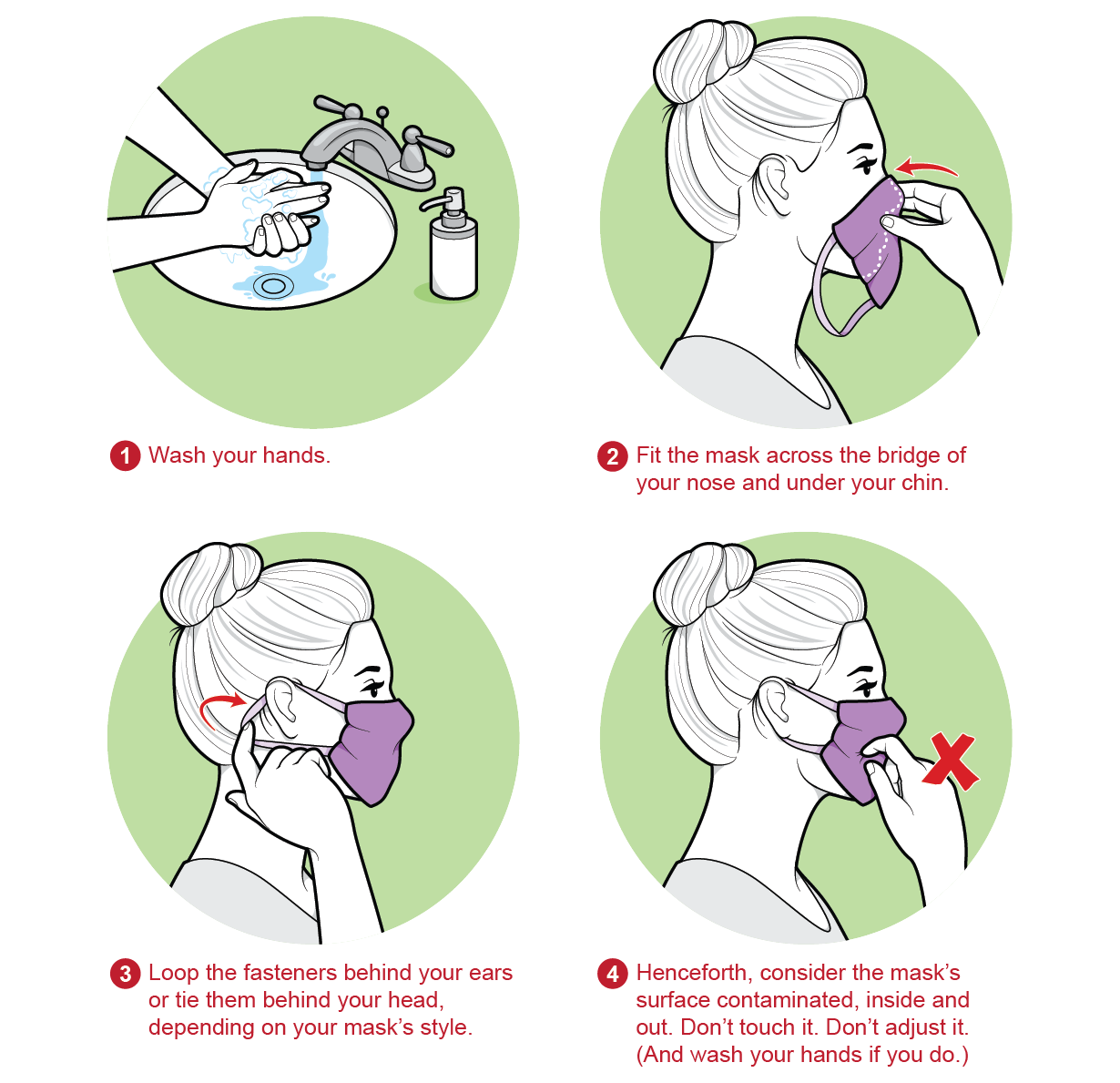
Any mask worn for day-to-day protection against COVID-19 is going to be imperfect, at least for now. Supplies of N95 respirators—the most effective mask type—should find their way to those in daily close contact with infected people. This requirement leaves the rest of us reusable cloth face coverings and single-use paper surgical masks. (The latter are also in high demand for frontline folks, so if you're looking to buy, try to acquire fabric masks.)

"These are not going to be perfectly efficient," says Kirsten Koehler, an occupational and public health expert who studies personal protection at Johns Hopkins University. But they can still help limit the virus's circulation, especially if they are worn by those infected with the novel coronavirus—many of whom may be asymptomatic. "We're trying to prevent spreading disease to other people," Koehler says. "Hopefully the mask is helping to protect us, too." Even with our faces covered, she adds, we should continue to perform social distancing and isolation. A handful of best practices can help make the most of our imperfect personal protection.

How to Put on a Mask

Advertisement
mask illustration
Credit: Brown Bird Design

How to Wear a Mask

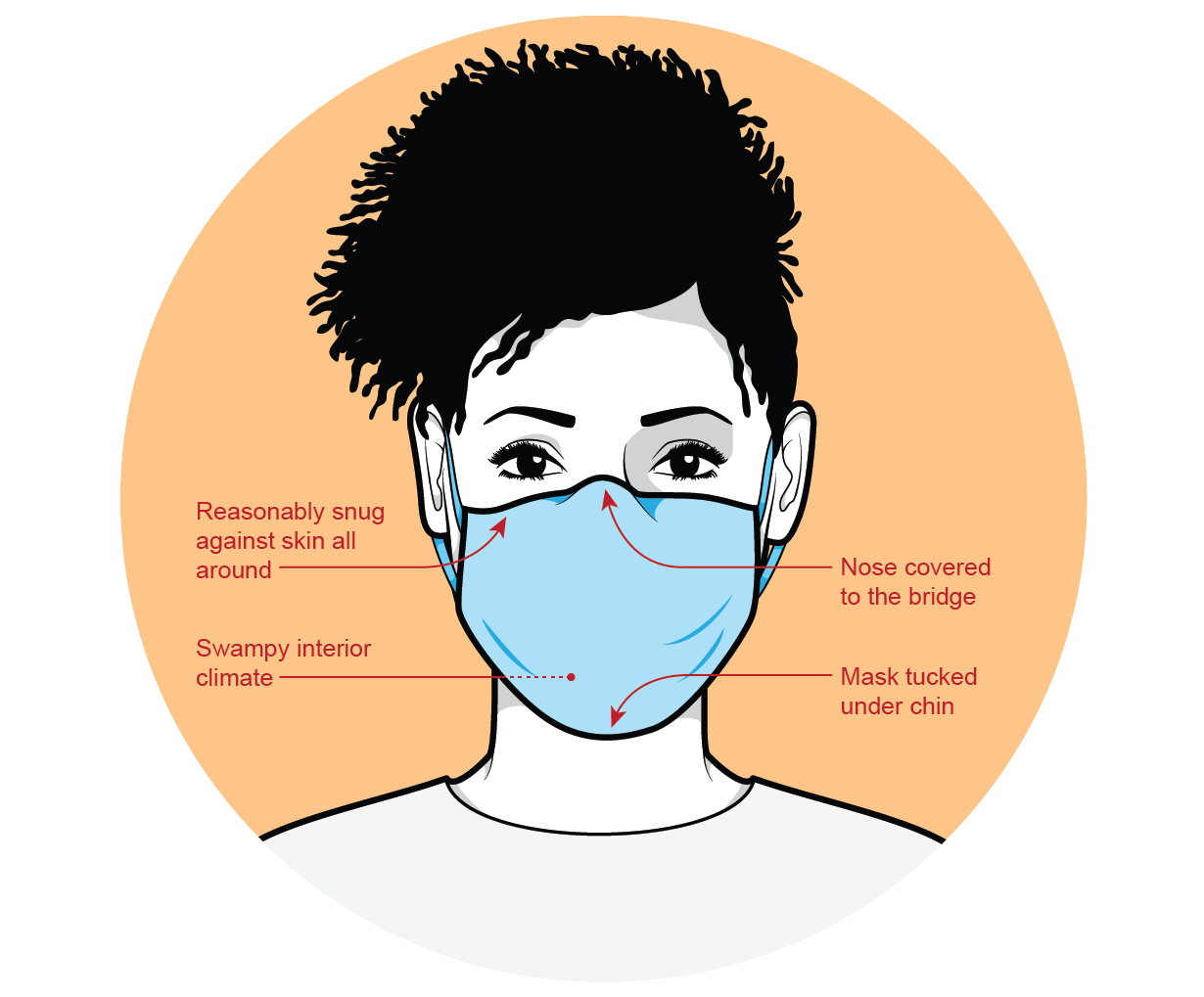
The mask should fit without gaps and fully cover your nose and mouth. Take special care to ensure a snug fit across the bridge of the nose. If your mask doesn't have a flexible wire built in, you may be able to MacGyver a pipe cleaner, a tie for a coffee bag or another object into the role.

Are there special precautions bearded individuals should take? Koehler doesn't think so. "None of us are getting a perfect seal around our nose anyway," she says. "It shouldn't make that big of a difference."

If the mask is on correctly, air will pass through it rather than around it. Your breath will probably make it feel kind of humid and "swampy" inside.

mask illustration

When to Take a Mask Off

There is not a lot of data on how long a mask can be effectively worn. According to the World Health Organization, a face covering should be replaced when you have breathed through it enough for it to become damp. That effect is only likely to happen after several hours: For a trip to the grocery store, one mask will probably do. If you will be out longer, bring a spare if possible.

How to Take a Mask Off

mask illustration
Credit: Brown Bird Design

How to Clean a Reusable Mask

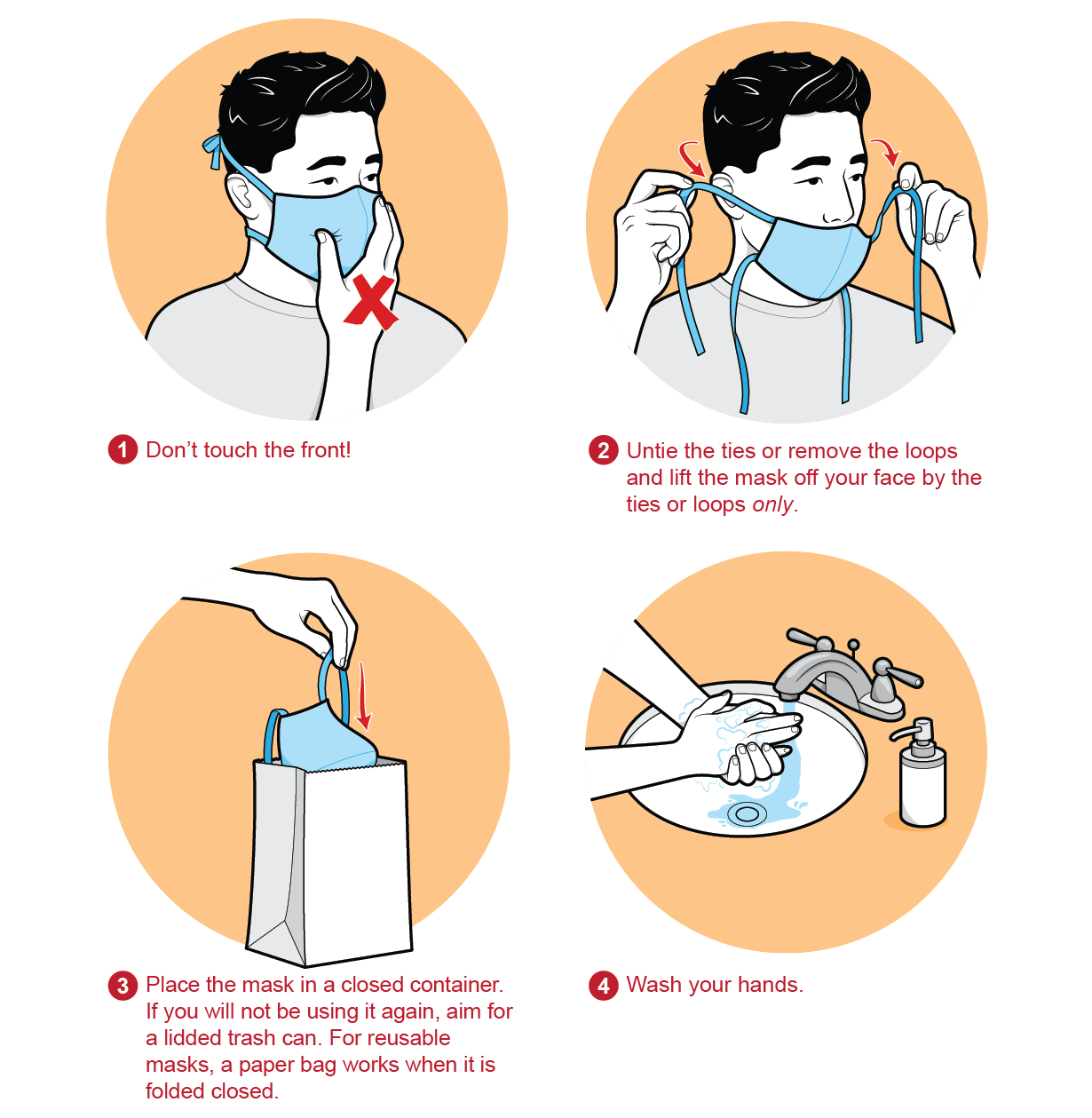
Placing a cloth mask in a paper bag immediately after taking it off has two purposes: the container isolates the mask from accidental handling, and the paper allows it to dry out. Before wearing the covering again, let it sit in a warm spot—still in that paper bag—for two or three days. (The science here is nascent, but one study found that the coronavirus reaches undetectable levels on fabric after two days. And after a week, levels were undetectable on the insides of surgical masks, though they remained detectable on the outsides. Koehler recommends setting the paper bag on a sunny windowsill or in the natural oven of your car because the virus becomes inert faster at higher temperatures. Alternatively, if you have your own laundry facilities, you can pop a used mask straight into the washing machine with the regular laundry. A bag for washing delicates will keep mask ties from making a knot of the whole load. You can also wash a mask by hand: soak it in bleach suitable for disinfection for five minutes and then rinse it thoroughly. Face coverings should be decontaminated after each use—so have a few on hand if you are going out more often than your decontamination schedule allows.

How to Keep Your Glasses from Fogging

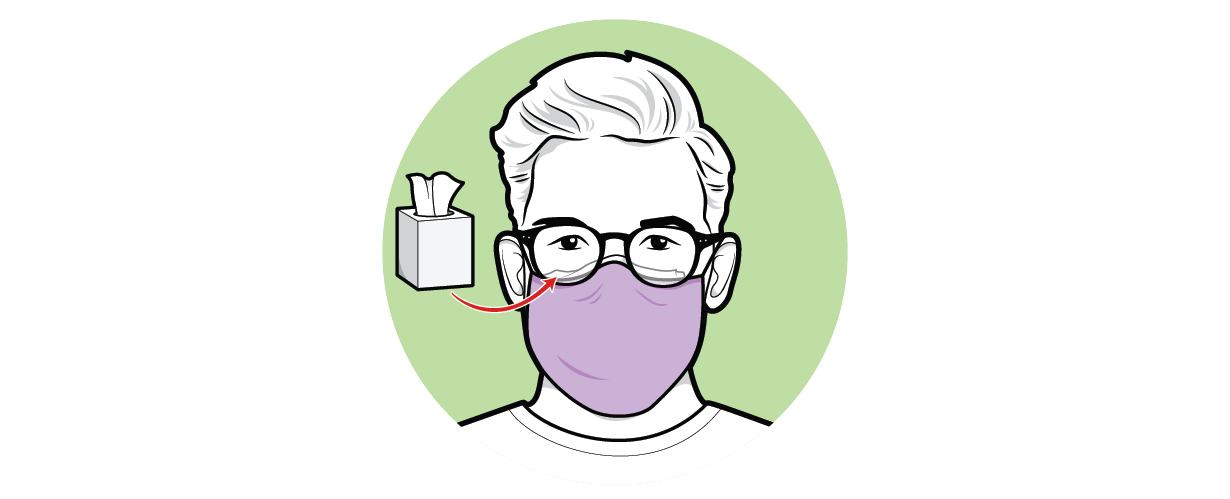
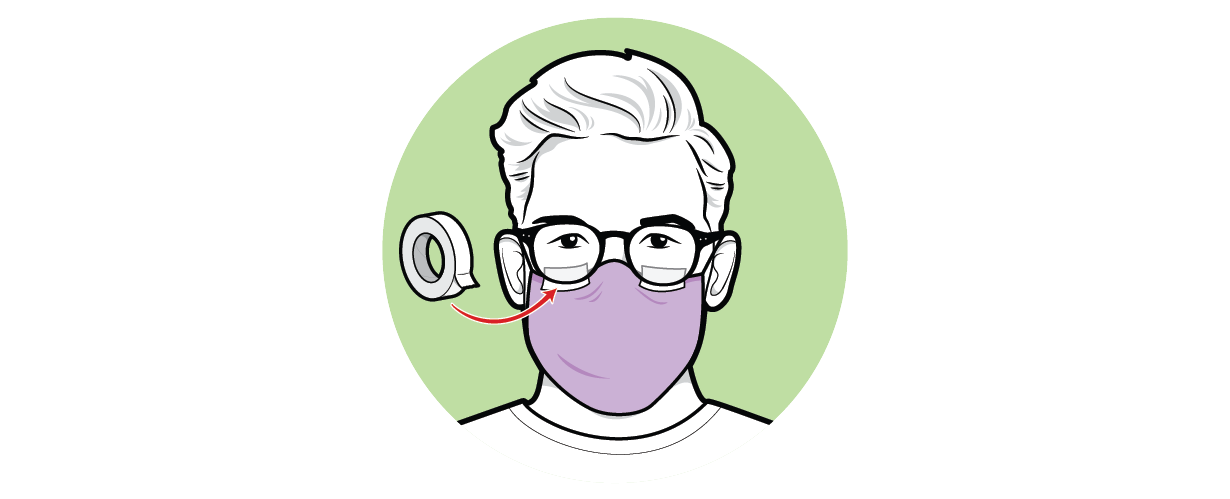
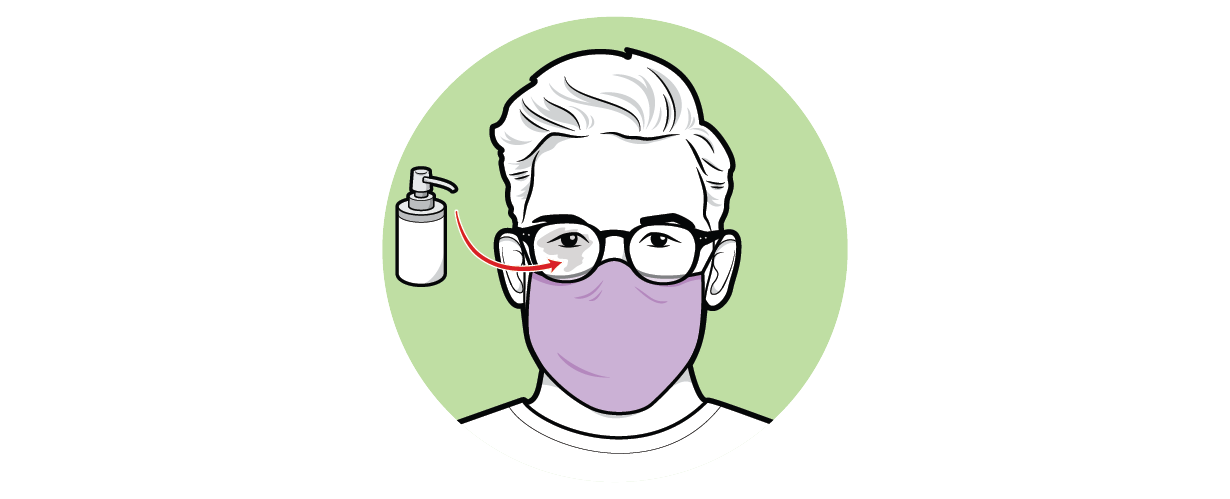
For the bespectacled among us, the foggy-glasses struggle is real. And in general, it means your mask isn't fitting super well. If the material were tight across your nose, air would not be leaking from the top in the first place. Here are a few ideas to improve that fit:

Tissue: A piece of facial tissue tucked between the glasses and the mask can both push the latter into a tighter fit and prevent exhaled vapor from rising.

mask illustration
Credit: Brown Bird Design

Tape: A bit of medical tape across the top of the mask can hold it more securely to your face at the cheeks.

mask illustration
Credit: Brown Bird Design

Soap: A little soap on the insides of the lenses can keep fog from forming. One paper recommends dousing the inner surface with soapy water and allowing it to air-dry. A pinky nail's worth of liquid soap, rubbed directly onto the insides of the lenses, is another option.

mask illustration
Credit: Brown Bird Design

Materials and Effectiveness

The science on mask efficacy is spotty. A few laboratory studies have examined how fabrics protect against particles of different sizes. They were mostly done in the pre-COVID-19 era to examine air pollution and the flu. But the medical gold standard—a randomized controlled trial of masks in daily use—is difficult and has ethical concerns, because it would require knowingly exposing people to pathogens or pollutants. That said, the existing lab studies have helped teach researchers a lot about how particles interact with fabrics and paper.

Advertisement

Are paper or fabric masks more effective?

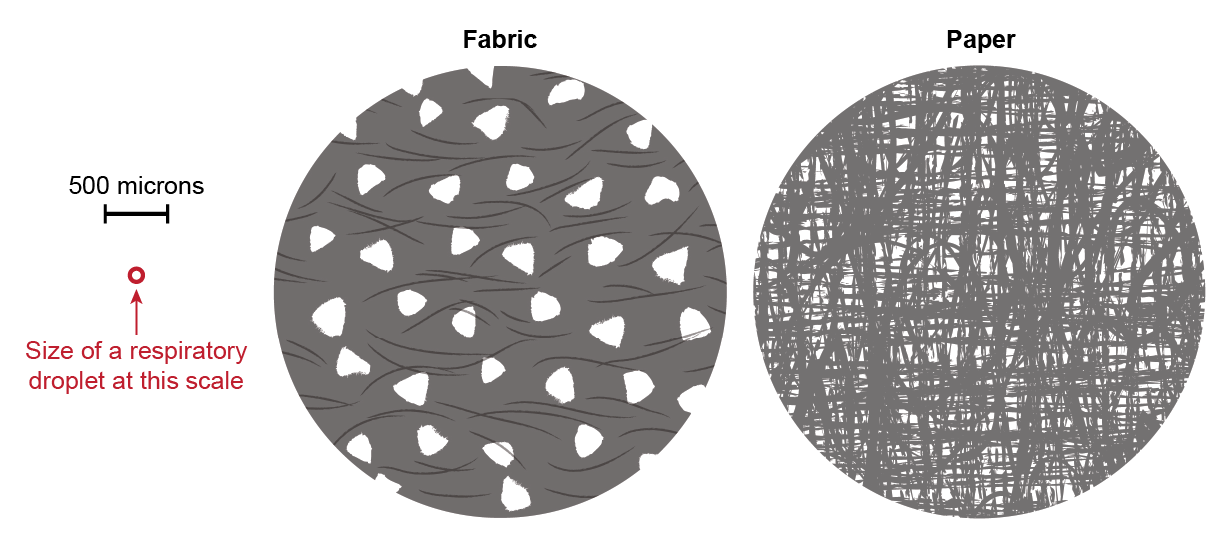
One study compared fabric and paper surgical masks' ability to filter air pollution. Researchers examined the materials under a microscope and found fabric had a more open structure with bigger holes—often larger than the droplets believed to transmit the coronavirus. These droplets cover a huge size range: they can be wider than 100 microns—big enough to see as they fly out—down to the submicron scale.

mask illustration
Credit: Brown Bird Design; Source: "Optical Microscopic Study of Surface Morphology and Filtering Efficiency of Face Masks," by Bhanu Bhakta Neupane et al., in PeerJ; June 26, 2019

Another study found paper masks were more effective than cloth ones at protecting against the flu. But there is more to consider than material. Fabric masks are typically sewn with two layers, which helps them trap more particles than a single cloth layer alone.

In general, even if paper face coverings are more effective, they have a shorter lifetime than cloth masks. And they are in high demand. Although the supply of surgical masks is starting to rebound, Koehler still advises the use of cloth ones. "We want to make sure that medical personnel have access to the supplies that they need," she explains.

Okay, so what should I look for in a cloth mask?

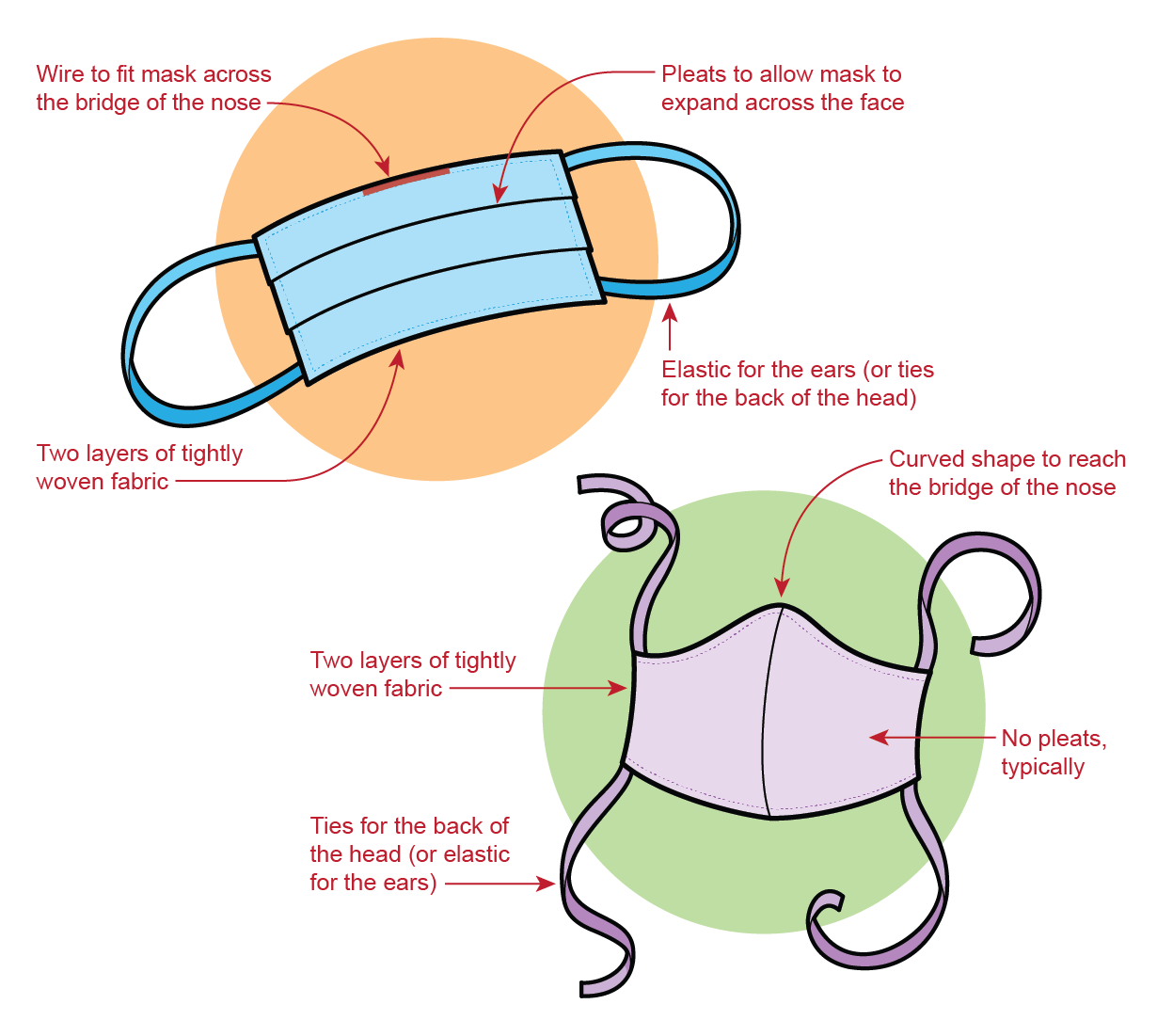
Whether you acquire one from someone else or make it yourself, there are a few things to pay attention to. The fabric should be high-quality and tightly woven. In woven fabric, the fibers cross at right angles, whereas a knit's structure involves tiny V's of thread. Look for a right-angle weave and avoid knits. A tight weave—such as one you might find in a fancy pillowcase—blocks most of the light if it is held up to a window. These are, of course, difficult properties to assess when buying online.

The shape of the mask should fit your face well. Rectangular coverings usually have a length of wire built into the top so they can be molded to your face, while those with a curved design rise up over the nose a little more.

mask illustration
Credit: Brown Bird Design

To make your own covering, the Centers for Disease Control and Prevention's Web site has several designs for different levels of crafting skill. Designs for curved-style cloth masks are fairly widespread as well.

Experts recommend the public should avoid masks with built-in valves. They are designed to release air when the wearer exhales, reducing humidity but also allowing unfiltered breath to exit the coverings.

Are masks for the protection of the wearer or those around that person?

Both. They are most effective at preventing an infected mask wearer from spreading the virus to others. But ideally, they can also provide some protection against incoming virus-laden droplets.

Droplets evaporate as they move through the air, so they are biggest when they are first coughed out. Because cloth masks are more effective at blocking larger particles, they are most efficient at stopping the spread if they stop the droplets at their source.

Have we proved that masks themselves significantly help? Or do mask wearers tend to simply be more careful in general?

Randomized controlled studies have shown mask wearing is indeed effective against the flu, but such trials do not currently exist for masks and the coronavirus. "The evidence isn't always as perfect as we would like it to be," Koehler says. "Based on the aerosol science, we know that the masks are going to help reduce the transmission of these particles. Can it be 100 percent effective? Maybe not. But can it help? I think so."

Read more about the coronavirus outbreak from Scientific American here. And read coverage from our international network of magazines here.


Holy moly.....😷 
~A.

Sunday, May 31, 2020

Stunning, Sensual Illustrations for a Rare 1913 Edition of Walt Whitman’s ‘Leaves of Grass’ by English Artist Margaret C. Cook – Brain Pickings

Stunning, Sensual Illustrations for a Rare 1913 Edition of Walt Whitman's 'Leaves of Grass' by English Artist Margaret C. Cook – Brain Pickings

Stunning, Sensual Illustrations for a Rare 1913 Edition of Walt Whitman's 'Leaves of Grass' by English Artist Margaret C. Cook

"Thoughts, silent thoughts, of Time and Space and Death…"

Stunning, Sensual Illustrations for a Rare 1913 Edition of Walt Whitman's 'Leaves of Grass' by English Artist Margaret C. Cook

When thirty-six-year-old Walt Whitman self-published Leaves of Grass in the summer of 1855, having poured the whole of his being into this unusual and daring labor of love, it fell upon unreceptive and downright hostile ears — a rejection that devastated the young poet. But over the coming decades, largely thanks to Emerson's extraordinary letter of endorsement and encouragement, it became one of the most beloved books in America — a proto-viral masterpiece that forever changed the face and spirit of literature, bold and fresh and replete with "incomparable things said incomparably," creaturely yet cosmic, bridging the earthly and the eternal yet larger than both.

Twenty-one years after Whitman's death, Everyman's Library series creator J.M. Dent published what remains the most beautiful edition of the Whitman classic — a large, lavish tome bound in green cloth, with the title emblazoned in gilt. But the crowning curio of this rare, spectacular 1913 edition — a surviving copy of which I was fortunate to acquire at the New York Antiquarian Book Fair — are twenty-four color plates by the English artist Margaret C. Cook.

"Two fishes swimming in the sea not more lawless than we"
(Available as a print)

Cook's stunning illustrations, shockingly sensual against the backdrop of Puritanism against which Whitman staged his rebellion in verse, bear something of William Blake — particularly his engravings for Paradise Lost; something of Maurice Sendak (who was, of course, shaped by Blake) — particularly his forgotten sensual illustrations for Pierre by Whitman's contemporary Herman Melville.

"You sea!… I behold… your crooked inviting fingers…,
I am integral with you, I too am of one phase and of all phase"
(Available as a print)
"We found our own, O my Soul, in the calm and cool of the daybreak"
(Available as a print)
"Whose happiest days were far and away through fields, … he and another wandering"
(Available as a print)
"How calm, how solemn it grows to ascend the atmosphere of lovers"
(Available as a print)
"Living beings, identities now doubtless near us in the air that we know not of"
(Available as a print)

Radiating from Cook's drawings is Whitman's insurgent insistence, as a queer man and a lover of all life, that romantic and erotic love transcends the tight parameters of the heteronormative — that the heart, too, contains multitudes.

"I will sing the song of companionship"
(Available as a print)
"The sun and stars that float in the open air,
The apple-shaped earth and we upon it, surely the drift of them is something grand,
I do not know what it is except that it is grand, and that it is happiness"
(Available as a print)

Most spectacular are Cook's nocturnal scenes, fusing the sultry with the celestial — a consonant complement to Whitman's lifelong fascination with astronomy, which would prompt him to write in Specimen Days a quarter century later:

To soothe and spiritualize, and, as far as may be, solve the mysteries of death and genius, consider them under the stars at midnight.

"Thoughts, silent thoughts, of Time and Space and Death"
(Available as a print)
"Give me nights perfectly quiet… and I looking up at the stars"
(Available as a print)
"The tender and growing night"
(Available as a print)
"The night follows along, with millions of suns, and sleep, and restoring darkness"
(Available as a print)
"We have voided all but freedom and all but our own joy"
(Available as a print)
"I see… great cloud-masses…
With at times half-dimm'd sadden'd far-off star"
(Available as a print)

I have digitized and restored Cook's striking illustrations, and made them available as art prints, all proceeds from which will help support The Universe in Verse.

"The sleepers are very beautiful as they lie unclothed,
They flow hand in hand over the whole earth from East to West"
(Available as a print)
"I will confront these shows of the day and night;
I will know if I am to be less than they,
I will see if I am not as majestic as they"
(Available as a print)
"They are calm, clear, well possess'd of themselves"
(Available as a print)
"I see my soul reflected in Nature,
As I see through a mist,
One with inexpressible completeness, sanity, beauty,
See the bent head and arms folded over the breast, the Female I see"
(Available as a print)
"The soul has that measureless pride which revolts from every lesson but its own"
(Available as a print)
"I too with my soul and body,
We, a curious trio, wandering on our way,
Through these shores amid the shadows, with the apparitions pressing"
(Available as a print)
"I musing late in the autumn day"
(Available as a print)
"The merriment of the two babes that crawl over the grass in the sun, the mother never turning her vigilant eyes from them"
(Available as a print)
"The yellow half-moon enlarged, sagging down, drooping, the face of the sea almost touching,
The boy ecstatic"
(Available as a print)
"I have taken my stand on the basest of peninsulas and on the high embedded rocks, to cry thence:
'Salut au monde!'"
(Available as a print)

For other stunning illustrations from special editions of literary classics, devour Ralph Steadman's illustrations for Orwell's Animal Farm, Aubrey Beardsley's gender-defying illustrations for Oscar Wilde's Salome, Harry Clarke's haunting illustrations for Goethe's Faust, and Salvador Dalí's paintings for Cervantes's Don Quixote, Dante's Divine Comedy, Shakespeare's Romeo and Juliet, and the essays of Montaigne.


~A.

I No Longer Need You. | elephant journal

I No Longer Need You. | elephant journal

I No Longer Need You.

I remember thinking we were soul mates, we would be best friends, and we would travel the world together.

We would endlessly explore France. Road trips, the sun, lightness, adventure, and you.

I also remember thinking that now that I was with you, you would be my joy—and that I was saved, and that I would be happy, because now I was with you.

You see, I was used to plenty of space, freedom, and autonomy as a single woman. But when we started to dive deeper as a couple, I think I started to lose this: I started to need you.

Love is fanciful, as attachment is.

I was starting to make promises to myself through you.

I was starting to feel better, not because of myself, but because of you.

It is an illusion to think that people heal us.

Men are not there to fill voids, in truth.

It is a princess dream to think that one day, a knight on a white horse will come for rescue.

It was a maiden mistake to think that a man can truly change a woman's life, and that woman can be fed through man.

So I have stopped needing you. And I think this is for the best.

You rarely talk, and I wonder why I am here. In your garden, in your life. Why we eat together if you choose to not talk to me about trees and stars and love anymore.

I'm getting little needle pains in the chest when this is what you do.

I wonder why we share a life if it is to not share words and thoughts. If it is to not be with you.

I wonder what it exactly means to be a couple with two beings on their respective individual journeys. What it signifies—if we are tangible, real. How does that work? And what does it mean when we are so autonomous and free that we never meet?

I remember feeling a little frozen, on some evenings, when I understood I should not be talking to you, that you didn't want it. It was summer, but I felt cold. So I heard my grandmother's voice, still fresh and alive in my ears: Don't shed too many tears for a man.

They all say that people need space in love. So, I'm giving that space to you.

I have stopped expecting anything from you.

The way you were looking at my work, admiring it even, some days—I don't need it anymore.

Your views of the world, your thoughts on what I did or what I do—I listen as an observer, as somebody who has an open mind, but I don't let it sink in any longer.

I have stopped merging with you.

I go to bed earlier or later than you, but I learn to not care.

I watch you moving without looking directly, so that it doesn't feel that I'm chasing you.

You are willing to communicate or not, and I remember: you need to give him space. He will talk when the stars align.

Sometimes you are sitting in the room just next to where I am, and I wonder if you'll come to say hello. So I look at the sun, at the fig tree's leaves playing gracefully in the morning and I remember—I don't need a man, even him.

My belly hurts.

It's the fear of losing you.

I miss our first weeks, our first months. I thought I would always be protected because I would always fall asleep with you.

Your arms were a shelter. Your skin was a nest.

Something was wrong there: I became enamoured to the protector in you. The lost little girl in me found a man to care for her, nurture her, give her more breaths. This may be why you are older too.

In truth, I was too attached to you.

There is a party, a Sinatra love song playing in the living room right now. We could dance: it will be your call to choose if you desire to join.

I want to see if you are still there.

On my end, I will take the easy road: I'll let you come. I need to know if I still matter to you.

The truth is, if I'm honest, you look at me sometimes as well. You bought me a dress yesterday. You still remember our songs. Sometimes you smile—and you talk, too. You said we would go out next Friday, if we had time, and that maybe we'd take some bicycles too.

You may be busy, or you may be gone.

It is hard to know.

Or maybe I'm growing, too.

Maturing, I would say.

Maybe I needed too much attention.

At least now, the maiden within me doesn't need rescue.

~

"And in the end, we were all just humans, drunk on the idea that love, only love, could heal our brokenness." ~ Christopher Poindexter


Bye, bye...
~A.