Friday, November 27, 2020

Mauritshuis becomes first gigapixel museum in the world - DutchNews.nl
Mauritshuis becomes first gigapixel museum in the world - DutchNews.nl

Mauritshuis becomes first gigapixel museum in the world

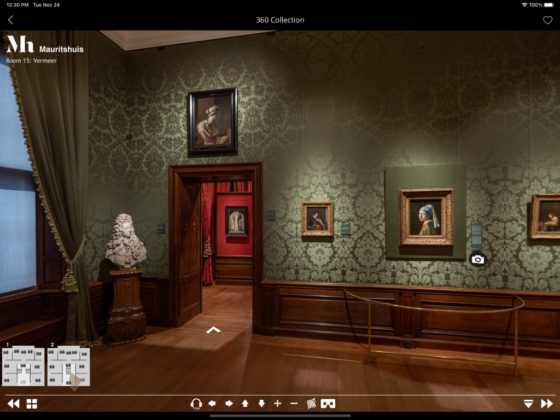
Virtual visitors get the museum to themselves. Photo: Mauritshuis

At 1000 megapixels, Vermeer's Girl with a Pearl Earring shows intimate details that visitors to the Mauritshuis museum in The Hague are not normally allowed close enough to see. Two casual dabs of paint are enough to bring moisture and shine to the corners of her slightly parted lips, and the famous earring itself is surprisingly translucent – more skin-toned than nacreous white.

On Thursday, the Mauritshuis in The Hague, home to 17th century masterpieces by Rembrandt, Vermeer and Jan Steen, became the first ever gigapixel museum in the world, inviting visitors across the globe to get up close and personal with the entire collection via their mobile phone or computer.

The 1000 megapixel images, which are 100 times sharper than a smartphone can achieve, were created in partnership with Spanish art digitisation company Madpixel, who mapped every inch of the former city palace using a robot, the Madpixel ROB.

Multi-media

Via Madpixel's Second Canvas app, visitors can enjoy a virtual 360° tour of the listed building and its world-famous works, supported by texts and an audio commentary. The app includes a zoom option for 36 of the pieces, including Van Haecht's epic Apelles Painting Campaspe 40+ paintings within a painting – where echoes of the love story between artist and subject in the foreground are revealed when the intricate artworks surrounding them are magnified.

Some of the museum's masterpieces also have an infrared option, allowing the viewer to peer beneath the paint and see original sketches and changes that the artist has made. In Rubens' The Garden of Eden with the Fall of Man, for example, two dogs are visible which were later edited out by the painter.

Several museums were eager to pioneer the technology on this scale, but for Madpixel CEO IƱaki Arredondo, the Mauritshuis had the edge. 'The Mauritshuis offers the perfect combination of the ability to move quickly, tremendous content and openness to innovation,' he said.

'We were the lucky ones,' Mauritshuis director Martine Gosselink told a press conference on Thursday, describing the new app as 'a fantastic invention'.

Hard hit

The app comes at a time when many museums, hit hard by the Covid-19 pandemic, have been forced to find alternative ways to attract visitors. According to a survey by museum association NMV published earlier this month, 260 museums in the Netherlands risk closure within a year. In September, the Dutch government promised a further €482m for the cultural sector, on top of the €300m earmarked in April.

While the technology has an important role to play during the corona crisis, Gosselink sees the new app as a tool for broadening engagement longer term. 'Some people cannot travel, for whatever reason, either they live far away or they are ill,' she said. 'But also for scholars and students … So many people study Dutch 17th century art, and for them it's also very helpful too.'

High resolution

Digitalising an entire museum is a world first, but the high-resolution technology is not new in the sector. In 2016, the Museum Boijmans van Beuningen in Rotterdam teamed up with the Google Cultural Institute to create gigapixel images of major works using Google's 'Art Camera', while this May, the Rijksmuseum published the most detailed photograph ever of Rembrandt's Night Watch.

Sandra Verdel, project manager for digital engagement at the Mauritshuis, sees the Second Canvas app as complementing, rather than replacing, a physical tour of the museum.

'We are not afraid that less people will go to the museum – we are convinced it's the opposite: everyone will want to visit the museum after this tour,' she told DutchNews.nl.

'Nothing beats seeing a Vermeer in real life, when you are standing in front of it. But at the same time, this tour gives you the opportunity to discover our collection in a whole new way.'

Thank you for donating to DutchNews.nl

The DutchNews.nl team would like to thank all the generous readers who have made a donation in recent weeks. Your financial support has helped us to expand our coverage of the coronavirus crisis into the evenings and weekends and make sure you are kept up to date with the latest developments.

DutchNews.nl has been free for 14 years, but without the financial backing of our readers, we would not be able to provide you with fair and accurate news and features about all things Dutch. Your contributions make this possible.

If you have not yet made a donation, but would like to,
you can do so via Ideal, credit card or Paypal.


~A.

Red dawn

Sunspot Cycle 25 could be among the strongest ever | Amateur Radio News

Sunspot Cycle 25 could be among the strongest ever | Amateur Radio News

Sunspot Cycle 25 could be among the strongest ever

The ARRL reports a research paper has concluded that Solar Cycle 25 will stronger than the just-ended Solar Cycle 24 and likely stronger than Solar Cycle 23

The League says:

A research paper, "Overlapping Magnetic Activity Cycles and the Sunspot Number: Forecasting Sunspot Cycle 25 Amplitude," by Scott W. McIntosh, Deputy Director of the National Center for Atmospheric Research in Boulder, et al., has concluded that Solar Cycle 25 could be among the strongest sunspot cycles ever observed, and will almost certainly be stronger than the just-ended Solar Cycle 24 (sunspot number of 116). The scientists say it will also most likely be stronger than Solar Cycle 23 (sunspot number of 180). As the abstract explains:

"The sun exhibits a well-observed modulation in the number of spots on its disk over a period of about 11 years. From the dawn of modern observational astronomy, sunspots have presented a challenge to understanding -- their quasi-periodic variation in number, first noted 175 years ago, stimulates community-wide interest to this day. A large number of techniques are able to explain the temporal landmarks, (geometric) shape, and amplitude of sunspot 'cycles;' however, forecasting these features accurately in advance remains elusive.

"Recent observationally motivated studies have illustrated a relationship between the sun's 22-year magnetic cycle and the production of the sunspot cycle landmarks and patterns, but not the amplitude of the sunspot cycle. Using (discrete) Hilbert transforms on more than 270 years of (monthly) sunspot numbers, we robustly identify the so-called 'termination' events that mark the end of the previous 11-year sunspot cycle, the enhancement/acceleration of the present cycle, and the end of 22-year magnetic activity cycles. Using these, we extract a relationship between the temporal spacing of terminators and the magnitude of sunspot cycles.

"Given this relationship and our prediction of a terminator event in 2020, we deduce that Sunspot Cycle 25 could have a magnitude that rivals the top few since records began. This outcome would be in stark contrast to the community consensus estimate of Sunspot Cycle 25 magnitude."

McIntosh's recorded presentation of the paper is available at this link
Use passcode z7qCn@3G

The research paper is at
https://arxiv.org/pdf/2006.15263.pdf

Source ARRL Letter November 19, 2020
http://www.arrl.org/arrlletter


~A.

Monday, November 23, 2020

Scientists discover how to use time crystals to power superconductors - Big Think

Scientists discover how to use time crystals to power superconductors - Big Think

Scientists discover how to use time crystals to power superconductors

Physicists propose using time crystals to bring about a quantum computing revolution.

Scientists discover how to use time crystals to power superconductors
  • A team of scientists proposes using time crystals to power topological superconductors.
  • The approach could lead to error-free quantum computers.
  • Time crystals appear to break laws of physics.

The concept of time crystals comes from the realm of counterintuitive mind-melding physics ideas that may actually turn out to have real-world applications. Now comes news that a paper proposes merging time crystals with topological superconductors for applications in error-free quantum computing, extremely precise timekeeping and more.

Time crystals were first proposed as hypothetical structures by the Nobel-Prize winning theoretical physicist Frank Wilczek and MIT physicists in 2012. The remarkable feature of time crystals is that they would would move without using energy. As such they would appear to break the fundamental physics law of time-translation symmetry. They would move while staying in their ground states, when they are at their lowest energy, appearing to be in a kind of perpetual motion. Wilczek offered mathematical proof that showed how atoms of crystallizing matter could regularly form repeating lattices in time, while not consuming or producing any energy.

Time crystals have since been experimentally created in various labs.

Now researchers at the California Institute of Technology (Caltech) and the Weizmann Institute in Israel found that theoretically you can create a system that combines time crystals with so-called topological superconductors.

The field of topology looks at the properties of objects that are unchangeable (or "invariant') despite deformations like stretching, twisting, or bending. In a topological insulator, the properties linked to the electron wave function would be considered topologically invariant.

As the scientists themselves explain, "Time crystals form when arbitrary physical states of a periodically driven system spontaneously break discrete time-translation symmetry." What the researchers noticed is that when they introduced "one-dimensional time-crystalline topological superconductors" they found a fascinating interaction where "time-translation symmetry breaking and topological physics intertwine—yielding anomalous Floquet Majorana modes that are not possible in free-fermion systems."

Majorana fermions are particles that have their own anti-particles.

How to tie a quantum knot

"Physicists Gil Refael and Jason Alicea explain the unique properties of electrons constrained to a 2 Dimensional world, and how they can be used to make noise-proof Quantum Computers."

The research was led by Jason Alicea and Aaron Chew from CalTech, as well as David Mross from the Weizmann Institute in Israel.

While studying Majorana fermions, the team observed that it is possible to enhance topological superconductors by coupling them to magnetic degrees of freedom that could be controlled. "Then we realized that by turning those magnetic degrees of freedom into a time crystal, topological superconductivity responds in remarkable ways," shared Alicea.

Aaron Chew (left) and David Mross (right).

Credit: Jason Alicea

One way the phenomen noticed by the scientists could be potentially exploited is to create more stable qubits - the bit of quantum information in quantum computing. The race to create qubits is at the threshold of bringing on a true quantum technology revolution, as writes Popular Mechanics.

"It's tempting to imagine generating some useful quantum operations by controlling the magnetic degrees of freedom that intertwine with the topological physics. Or perhaps certain noise channels can be suppressed by exploiting time crystals," said Alicea.

Check out their new paper in Physical Review Letters.


~A.

U.S. Government Makes New Nuclear Fuel - Uranium vs. Thorium

U.S. Government Makes New Nuclear Fuel - Uranium vs. Thorium

The U.S. Government Made a Powerful New Kind of Nuclear Fuel

It's part uranium, part thorium, and it may just save America's nuclear program.

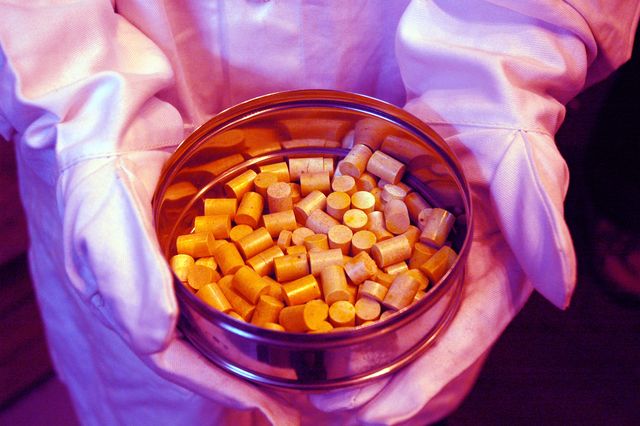
thorium pellets

Could a new blended thorium fuel improve U.S. nuclear power's outlook? Scientists at the Department of Energy's Idaho National Laboratory have a new fuel called Advanced Nuclear Energy for Enriched Life, or ANEEL. It's a proprietary mix of thorium and low-enriched uranium, and Forbes's James Conca says it could help close the gap in a near future where nuclear seems like the only option.

☢️ You like nuclear. So do we. Let's nerd out over it together.

The mix itself is a secret, but thorium—pictured above in pellet form—has continued to gain momentum as an alternative nuclear fuel.

"[T]horium has a higher melting point and lower operating temperature which makes it inherently safer than straight U and more resistant to core meltdowns," Conca explains:

"The ANEEL fuel has a very high fuel burn-up rate[, which] means the fuel stays in the reactor longer and gets more energy out of the same amount of fuel. [It's] prohibitively difficult to make into a weapon. [And] ANEEL fuel will reduce the waste by over 80% and end up with much less plutonium. Less spent fuel means less refueling, less cost, less fuel handling and less volume to dispose."

Thorium has a number of advantages over uranium, and especially over highly enriched uranium. Yes, thorium must be paired with at least a small amount of a fissile material, because it isn't naturally fissile on its own. But it's much more plentiful than uranium and found in high quantities in the kinds of developing markets where Conca says nuclear will be clutch in coming decades—starting with India.

Advertisement - Continue Reading Below

"India itself has more Th than U, particularly as monazite sands, a reason they have been pursuing Th in nuclear reactors for decades," Conca writes. This, he suggests, lends itself to a more mutually beneficial arrangement where Indian thorium can be turned into U.S.-made ANEEL fuel and then exported to India.

In turn, this can lead to improved diplomacy. "Whenever the United States is involved in another country's nuclear program, that country signs various agreements related to security, weapons nonproliferation and nuclear materials, including nuclear fuel," Conca explains.


šŸ“š Read Up: The Best Nuclear Books

Command and Control: Nuclear Weapons, the Damascus Accident, and the Illusion of Safety

Command and Control: Nuclear Weapons, the Damascus Accident, and the Illusion of Safety

Penguin Group amazon.com

$17.99

The Making of the Atomic Bomb

The Making of the Atomic Bomb

Simon & Schuster Amazon

$20.99

Midnight in Chernobyl: The Untold Story of the World's Greatest Nuclear Disaster

Midnight in Chernobyl: The Untold Story of the World's Greatest Nuclear Disaster

Simon & Schuster Amazon

$12.79

Rad Decision: A Novel of Nuclear Power

Rad Decision: A Novel of Nuclear Power

Impressive Imprint Amazon

$17.56


Idaho National Laboratory's partner in ANEEL include Texas A&M University and startup Clean Core Thorium Energy (CCTE). The company started fitting existing reactor designs to use ANEEL fuel, which it says can enter commercial use as early as 2024. Conca argues that having a ready-to-use solution will help clean up nuclear efforts in places where he believes nuclear is the only feasible option. Reactors also don't need to power down to refuel with ANEEL. He writes:

"[I]n developing nations, the need is urgent. Most do not have the infrastructure to install natural gas, wind or solar. Additionally, many do not have sufficient topography and river flow for hydro. So it's either coal or nuclear. If you care at all about the environment, then it better be nuclear."

One of the record holders for longest operating time for a nuclear plant, Conca says, is an Indian reactor that is already compatible with ANEEL. In a near future where humankind faces difficult energy decisions, he argues, this fuel is a good idea.


But they're shutting down the Indian plant......?
~A.