Friday, June 13, 2014

The Red Watch Cap | Mystic Seaport

The Red Watch Cap | Mystic Seaport
The Library is moved...on to the voyage! Happy B-Day Jacques!
http://www.mysticseaport.org/news/2014/the-red-watch-cap/

More Information

Cousteau's Read Watch Cap

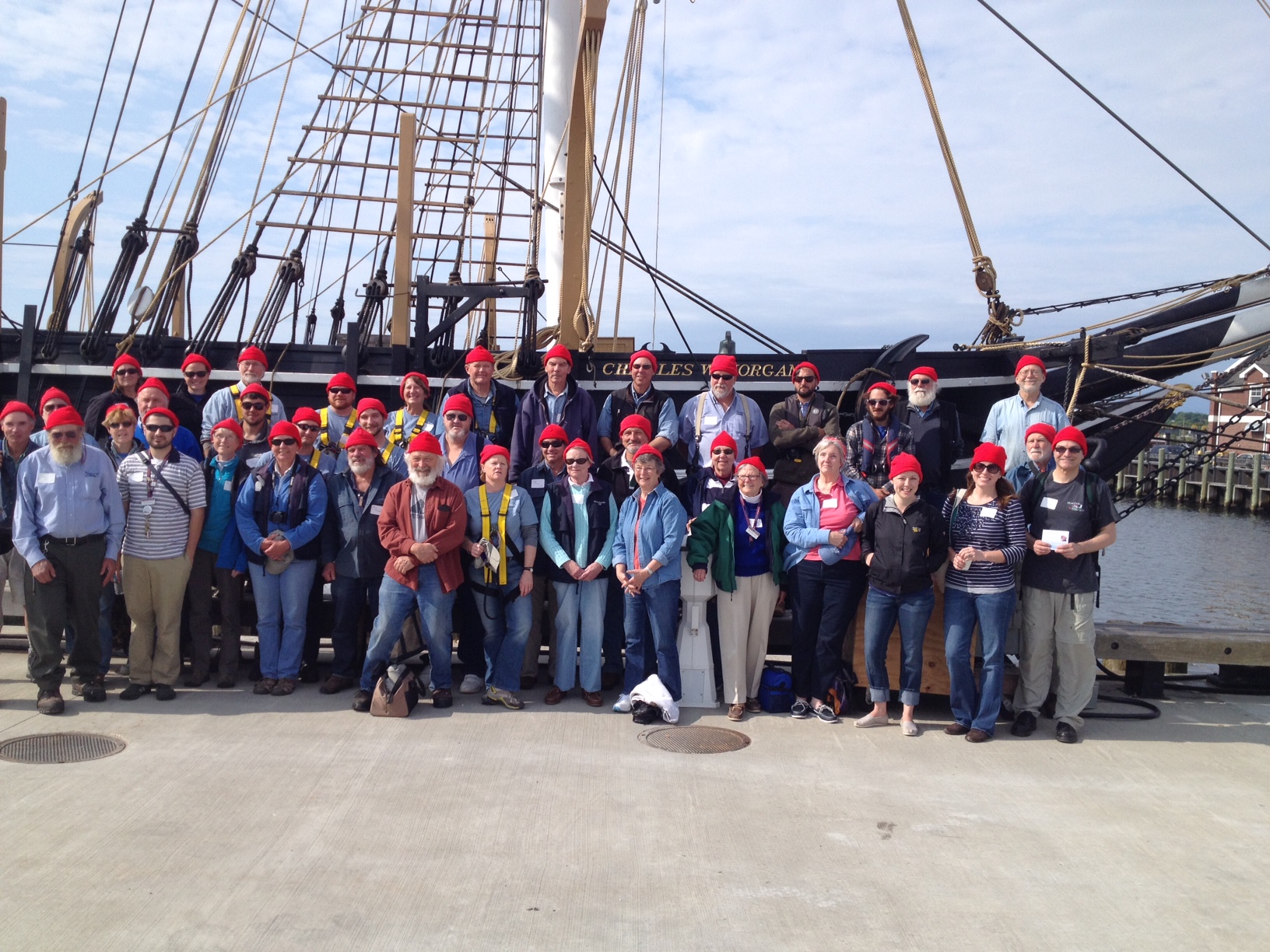
Mystic Seaport staff and guests don Jacques Cousteau's red watch cap in honor of the explorer and his work.

MYSTIC — Happy birthday to Jacques Cousteau!

The ocean explorer would have been 104 today. To honor the man and celebrate his work, those on board the Charles W. Morgan donned his iconic watch cap today.

Cousteau was a French naval officer, explorer, filmmaker, innovator, scientist, photographer, author, and researcher who studied the sea and all forms of life in water. He made an indelible impression of the importance of protecting our planet and its oceans.

Through his 120 documentaries and 50 books, the man made a lasting impact that still endures today.

The captain's red watch cap symbolizes his success as a personality that paved the way for generations to care about the oceans. Mystic Seaport's partner in the Morgan's 38th Voyage, NOAA's National Marine Sanctuaries, encourages everyone to put on the cap and take a pledge to help protect our oceans by doing the following:

  • Recycle used motor oil
  • Put garbage and recyclables in their proper place
  • Carry and use non-disposal bags
  • Use reusable coffee cups and water bottles when possible
  • Volunteer for community and coastal clean-ups
  • Respect vulnerable marine life
  • Conserve water and use it responsibly
  • Make smart seafood choices
  • Learn more about the ocean and how it impacts your life everyday
  • Tell 10 people you made the pledge and encourage them to do the same

Will you take the pledge?


Posted in Charles W. Morgan News, News on June 11, 2014.


~A.

Biology's 'dark matter' hints at fourth domain of life

Biology's 'dark matter' hints at fourth domain of life - life - 18 March 2011 - New Scientist

Biology's 'dark matter' hints at fourth domain of life - life - 18 March 2011 - New ScientistStep far enough back from the tree of life and it begins to look quite simple. At its heart are just three stout branches, representing the three domains of life: bacteria, archaea and eukaryotes. But that's too simple, according to a band of biologists who believe we may be on the verge of discovering the fourth domain of life.


The bold statement is the result of an analysis of water samples collected from the world's seas. Jonathan Eisen at the University of California, Davis, Genome Center has identified gene sequences hidden within these samples that are so unusual they seem to have come from organisms that are only distantly related to cellular life as we know it. So distantly related, in fact, that they may belong to an organism that sits in an entirely new domain.

Most species on the planet look like tiny single cells, and to work out where they fit on the tree of life biologists need to be able to grow them in the lab. Colonies like this give them enough DNA to run their genetic analyses. The problem is, the vast majority of these species – 99 per cent of them is a reasonable bet – refuse to be cultured in this way. "They really are the dark matter of the biological universe," says Eisen.

Life's dark matter

To probe life's dark matter, Eisen, Craig Venter of the J. Craig Venter Institute in Rockville, Maryland, and their colleagues have resorted to a relatively new technique called metagenomics. This can "sequence the crap out of any DNA samples", whether they are collected from the environment or come from lab cultures, says Eisen.

When Eisen and Venter used the technique on samples collected from the Global Ocean Sampling Expedition, they found that some sequences belonging to two superfamilies of genes – recA and rpoB – were unlike any seen before.

"The question is, what are they from?" says Eisen. Because the team has no idea what organism the genes belong to, the question remains unanswered. There are two possibilities, he says. "They could represent an unusual virus, which is interesting enough. More interestingly still, they could represent a totally new branch in the tree of life."

The exciting but controversial idea has met with mixed reactions. "It's a very good piece of careful work," says Eugene Koonin at the National Center for Biotechnology Information in Bethesda, Maryland.

Younger than they look?

But Koonin and others think any talk of a fourth domain of cellular life is premature. Radhey Gupta at McMaster University in Hamilton, Ontario, Canada, calls the finding "very exciting", but cautions that there are other explanations.

For instance, the sequences could be from cellular organisms living in unique habitats that caused their genes to undergo rapid evolution. That would give the false impression that the "new" life forms diverged from all others a very long time ago.

"There is still debate [over] how to clearly distinguish the three proposed domains of life, and how they are interrelated," Gupta says. "The suggestion [of] a fourth domain will only add to the confusion."

Eric Bapteste at Pierre and Marie Curie University in Paris, France, is far more receptive. "The facts are that there is lots of genetic diversity, and unquestionably most of it is unknown to us," he says. "It's legitimate to consider that there's genuinely new stuff out there."

Further analysis of the samples could determine whether the two gene families studied have evolved unusually rapidly or are from a cellular organism with a universally bizarre genome, he says.

Parent organism

Looking at the actual samples could also help pin down exactly which organism the strange genetic sequences belong to, says Eisen.

If Eisen's gene sequences did turn out to belong to a new domain of life, it wouldn't be the first time the tree of life has had to be redrawn. Until the 1990s, it had just two branches: one for eukaryotes – animals, plants, fungi and some other strange forms, including the slime moulds – and one for everything else. Then, gene analysis revealed that the "everything else" branch could be divided into two domains: bacteria and archaea.

Not only that, some believe that mimivirus, the largest known virus, may also represent a new domain of life: despite being recognised as a virus, it contains many genes found only in cellular organisms. "People have suggested they might be a fourth branch themselves," says Eisen. "If you think of those mimiviruses as a fourth branch, maybe our sequences represent a fifth branch – we just don't know yet."

Reused without permission, mimi.

~A.

Massive 'ocean' discovered towards Earth's core

Massive 'ocean' discovered towards Earth's core - environment - 12 June 2014 - New Scientist
How long will it take for them to tap this? (NOT).  Check out the link.
http://www.newscientist.com/article/dn25723-massive-ocean-discovered-towards-earths-core.html#.U5rvrdq9KSM

Environment

A reservoir of water three times the volume of all the oceans has been discovered deep beneath the Earth's surface. The finding could help explain where Earth's seas came from.

The water is hidden inside a blue rock called ringwoodite that lies 700 kilometres underground in the mantle, the layer of hot rock between Earth's surface and its core.

The huge size of the reservoir throws new light on the origin of Earth's water. Some geologists think water arrived in comets as they struck the planet, but the new discovery supports an alternative idea that the oceans gradually oozed out of the interior of the early Earth.

"It's good evidence the Earth's water came from within," says Steven Jacobsen of Northwestern University in Evanston, Illinois. The hidden water could also act as a buffer for the oceans on the surface, explaining why they have stayed the same size for millions of years.

Pinging the planet

Jacobsen's team used 2000 seismometers to study the seismic waves generated by more than 500 earthquakes. These waves move throughout Earth's interior, including the core, and can be detected at the surface. "They make the Earth ring like a bell for days afterwards," says Jacobsen.

By measuring the speed of the waves at different depths, the team could figure out which types of rocks the waves were passing through. The water layer revealed itself because the waves slowed down, as it takes them longer to get through soggy rock than dry rock.

Jacobsen worked out in advance what would happen to the waves if water-containing ringwoodite was present. He grew ringwoodite in his lab, and exposed samples of it to massive pressures and temperatures matching those at 700 kilometres down.

Sure enough, they found signs of wet ringwoodite in the transition zone 700 kilometres down, which divides the upper and lower regions of the mantle. At that depth, the pressures and temperatures are just right to squeeze the water out of the ringwoodite. "It's rock with water along the boundaries between the grains, almost as if they're sweating," says Jacobsen.

Damp down there

Jacobsen's finding supports a recent study by Graham Pearson of the University of Alberta in Edmonton, Canada. Pearson studied a diamond from the transition zone that had been carried to the surface in a volcano, and found that it contained water-bearing ringwoodite, the first strong evidence that there was lots of water in the transition zone.

(Nature, doi.org/s6h).

"Since our initial report of hydrous ringwoodite, we've found another ringwoodite crystal, also containing water, so the evidence is now very strong," says Pearson.

So far, Jacobsen only has evidence that the watery rock sits beneath the US. He now wants to find out if it wraps around the entire planet.

"We should be grateful for this deep reservoir," says Jacobsen. "If it wasn't there, it would be on the surface of the Earth, and mountain tops would be the only land poking out."

Journal reference: Science, DOI: 10.1126/science.1253358

If you would like to reuse any content from New Scientist, either in print or online, please contact the syndication department first for permission. New Scientist does not own rights to photos, but there are a variety of licensing options available for use of articles and graphics we own the copyright to.


~A.

No More Malls: 5 Disruptive Techs Transforming Retail | Singularity Hub

No More Malls: 5 Disruptive Techs Transforming Retail | Singularity Hub

NO MORE MALLS: 5 DISRUPTIVE TECHS TRANSFORMING RETAIL

augmented reality

Five technologies are converging to transform the retail shopping experience forever.

This is big. This isn't Amazon, it's Amazon x100. Very social, very local and very efficient.

This will impact multiple industries.

Though it applies to other retail, the example I'll share in this email is clothes shopping — specifically, a new approach that will give you back massive amounts of time in your life and make the experience fun, fast and super-personalized.

Gone are the wasted hours in dressing rooms or combing through racks and finding nothing in your preferred size or style.

The five converging technologies are:
1. 3D imaging
2. Body-motion sensors
3. Virtual reality headsets
4. Virtual worlds
5. Big data & AI

Let me give you a glimpse of the future.

Of course this doesn't just hit clothing. It hits every element related to retail, like buildings, labor and transportation.

First, let's look at the experience, and then we'll examine the tech behind it.

THE FUTURE RETAIL EXPERIENCE
Here's one future of clothes shopping…

You won't drive to a store. Ever.

Eventually, clothing stores will go away, dematerialized and significantly demonetized — just like Amazon has done to most bookstores.

Your body is scanned and the data file is private. It's your exact body on that exact day.

You put on your VR goggles, and appear in a virtual store. Zero time to get there. No traffic, no parking hassles, no walking across the mall to get to the store.

You enter YOUR personal clothing store. Everything in this store is your exact size. Everything fits. The store has every designer and every design on the planet. Forget "re"tail – this is "me"tail.

Your friend, who you called a few minutes ago, joins you via their VR headset, and he or she sees everything you see. The experience is social and fun.

You voice what you're looking for: "Red high-heeled shoes to match my new dress, which has a long black skirt." Suddenly (think the movie Matrix), racks of perfectly fitting products appear like magic.

You can ask an AI advisor (online and listening) for help.Presto, a fashion show materializes before your very eyes. Every model walking down the runway looks like you and is wearing a different combination of clothing.

When you see an outfit you like, you just point and instantly, your virtual self is wearing it. No frustration of getting undressed or dressed. Mirrors all around allow you to see your virtual self from every angle.

As you move in real life, your virtual reflection the mirror moves in exact sync. It feels and looks just like you are looking at yourself in the mirror.

You wonder aloud how these virtual shoes would look with a particular blouse in your closet at home. No problem: every piece of physical clothing you own in the real world is also available for you to wear in this virtual world. You ask, and instantly you're wearing it.

When you're done, and you have the exact, perfect clothes you need, you pay the bill and your clothes arrive the next day. (And, if the warehouse or robotic manufacturer is local, perhaps the same day.)

Oh, and by the way, the cost for an outfit is at least half of what they are today — no middle man.

THE TECH BEHIND IT
Let's begin with 3D imaging. It's now possible to have your body 3D imaged from head to toe at a sub-millimeter accuracy, showing every ripple of muscle or cellulite, to allow the perfect-fitting jeans or shoes.

How? This technology is breaking out (from deceptive to disruptive) right now. First, it may be derivatives of Microsoft's Kinect, or Google's new Project Tango. As Google demonstrated in February, this technology gives smartphones the ability to do realistic 3D mapping. Your phone will be able to create 250 million 3D measurements per second to build a 3D model.

Next, body motion sensors. Imagine wearing low-cost, lightweight sensors that pick up your body's precise movements and replicate them perfectly in a virtual world. As you raise your arms, twirl around, flex your muscles or do your best runway walk, the sensors gather real-time data and reflect those movements in a virtual world.

This technology exists. Developed originally for the video game world, PrioVR came out of, naturally, a successful Kickstarter campaign (see PrioVR in action here: www.priovr.com).

Next, let's consider the future of virtual reality worlds. In past blogs I've mentioned my friend Philip Rosedale, the creator of Second Life. His new company High Fidelity is working towards creating virtual worlds with the fidelity of James Cameron's movie Avatar. Remember how beautiful and real that animation looked? Imagine stepping into that world from your living room.

The next piece of tech is the Oculus Rift VR headset – virtual reality goggles you wear to enter into a virtual world. I recently wrote about this company, started by Palmer Luckey. Just 18 months after a $2.5 million Kickstarter campaign in Aug 2012, Facebook acquired Oculus VR for $2 billion. From what I've seen, their next generation of headgear, DK2, is nothing less than spectacular (check it out here: www.oculusvr.com).

Big data and artificial intelligence are the final pieces of converging technology. Imagine data on every piece of clothing available in the world, and artificial intelligence (think IBM's Watson) able to understand and advise you on fashion and fashion trends.

HOW YOU CAN LEARN MORE
So that's it: A glimpse at clothes shopping in the future.

This is the sort of content and conversations we discuss at Abundance 360 – the convergence of technology leading to the dematerialization, demonetization and democratization of products, services and industries.

How would you prepare your business and your family if you knew what the future would look like today?

If you'd like personal coaching from me on this and want to learn more, head to www.a360.com. And if you want a deep dive into any of these technologies, consider coming to Singularity University's Executive Programs.

Share this email with your friends, especially if they love to shop or are in the retail industry.

We are living toward incredible times where the only constant is change, and the rate of change is increasing.

[Credits: portrait of man courtesy of Shutterstock]

NOT going to S.U.
~A.

This is the Starship Enterprise of sea exploration | The Verge

This is the Starship Enterprise of sea exploration | The Verge

This is the Starship Enterprise of sea exploration

French architect and oceanographer Jacques Rougerie has spent more than 30 years researching underwater habitats, and even launched his own design firm for that purpose. His pet project, though, is considerably more ambitious. Drawing inspiration from Jules Verne's Twenty Thousand Leagues Under the Sea, Rougerie's SeaOrbiter is a 190-foot tall floating laboratory — complete with space simulator and submersible garage.


The SeaOrbiter has been in development for the better part of a decade. Meant to run on a combination of solar and wind power, Rougerie wants the vessel to be as sustainable and unobtrusive to oceanic ecosystems as possible. The facility would be run by a crew of at least 18 people, who would serve to observe life above and below water, manage data, and explore the depths in an array of submersibles that can be used to collect samples. In addition, the submerged part of the vessel houses simulators, meant to gauge how humans might cope with long-term space travel. The dream is for the ship to help better explore the world's oceans, 95 percent of which remain unexplored.


Already equipped with a clear vision, the only obstacle left is funding. While Rougerie managed to raise an impressive $466 thousand via French crowdfunding site KissKissBankBank earlier this year, the total cost of launching the SeaOrbiter is approximately $48 million. If he succeeds, he can launch the craft by year's end in 2016. Here's hoping he pulls it off.

Hint: Use the 's' and 'd' keys to navigate

  • A cross section of the SeaOrbiter, showing the crew at work.

  • The front of the SeaOrbiter hull, depicted a night.

  • Members of the crew on the Eye of the SeaOrbiter would observe animals and weather patterns. Solar panels keep the vessel running.

  • Aquanauts would able to explore the ocean by diving or relying on the SeaOrbiter's submersible crafts.

  • Those on the vessel could conduct research 24/7 anywhere in the world.


Definitely the newest Seaport.....
~A.

No human has seen tonight's full honey moon in almost 100 years

No human has seen tonight's full honey moon in almost 100 years

No human has seen tonight's full honey moon in almost 100 years

No human has seen tonight's full honey moon in almost 100 yearsAs the clock ticks over to 12:11am (EDT) tonight, the world will experience the first full honey moon on Friday the 13th in almost 100 years. It will appear golden and huge in the sky, so pay attention because it will not happen again until June 2098.


This Friday the 13th will be extra-beautiful (or creepy, depending on your perspective) because this month's full moon coincides with its perigee—when it's closest to earth during its orbit—so it will appear super large on the horizon. Pair that with the June summer solstice—when the sun cuts its highest path in the sky—and a smattering of atmospheric dust and pollution, and the whole thing will give off an amber—or "honey"—hue.

Now, obviously this is just a coincidence. There is absolutely no reason to suspect that somehow this rare lunar alignment—which we'll next experience in in June 2098—will signal some kind of larger global mayhem. Just to be safe, however: Lovelorn, luck-averse lycanthropes are advised to stay indoors, as this seems like the perfect start to a Jason Voorhees vs. Teenwolf slasher flick.

If you're fogged in or living in the wrong time zone, you can catch a live-feed here from Slooh's community observatories in the Canary Islands and Chile.

Photo of 2012 Supermoon from Toroweap via Flickr user Jason Hines.


SPLOID is a new blog about awesome stuff. 


Rain, rain and more.... Rain.
~A.

Thursday, June 12, 2014

38th Voyage Chart | Mystic Seaport

Watch!
http://www.mysticseaport.org/38thvoyage/chart/


~A.

Habits Of Stressed-Out People

Habits Of Stressed-Out People

13 Habits Of Stressed-Out People

We've all been there: hearts racing, palms sweating, and panic rising when we realize that there is too much to do and just not enough time. Stress can be immobilizing, and it can negatively affect many aspects of our lives. Sometimes we just need to step back, take a mental health day, and seek ways to de-stress. If you constantly feel like pulling your hair out, you may have some habits causing stress that need to be changed, and there's no better time than now!

Here are some things that stressed-out people tend to do and tips to break the habits.

Drink too much caffeine 

We aren't going to tell you to stop drinking caffeine altogether — we wouldn't do that to you! But downing several cups of coffee a day can overstimulate you and make you unnecessarily anxious and on edge. So keep the caffeine to a minimum, and try these tips for making your caffeinated drink healthier.

Constantly vent

Sometimes sitting down with a friend and letting it all out is exactly what we need. Venting is essential — but only in small doses. If negative things are all you talk about, they are going to be all you think about too. People who are stressed out usually talk excessively about a problem, drag it out, and don't let it go. It's best to rant your rant, get it off your chest, and then be done with it so that whatever was bothering you doesn't bog you down.

Obsess over things they can't change

We all need to accept what we can't change, and dwelling on mistakes isn't healthy or beneficial. There is no point worrying about things you most likely can't do anything about. It's best to move on and simply do better next time!

Eat food that isn't healthy

Sometimes when we're worried, turning to a giant cheesy pizza or pint of ice cream sounds like the best thing in the world. But feeding stressed feelings usually leaves us worse off, both mentally and physically. If you're tempted to snack while feeling anxious, try foods that may help with anxiety.

Get overwhelmed easily

Everyone feels overwhelmed sometimes, but the key is not to get panicked when you realize that you have more to do than you thought you did. Take a deep breath, choose one item on your list to start with, and go from there. Trying to multitask or do parts of things here and there will leave everything half-finished and sloppy.

Don't get enough sleep

Sleep deprivation makes you sluggish, cranky, and overall not your best self. Eliminate this contributing factor to stress by trying some tips to help you get the best sleep possible so that you wake up rejuvenated and ready to go! If you're feeling crafty, you can try making this DIY sleep spray.

Overanalyze

Ever spent hours after a conversation worrying if you said something wrong, should have said something differently, offended someone, or ruined your chances at a promotion? You're probably the only one who noticed any of that, but people who stress tend to pick apart every little thing in life (work or otherwise) and find problems where problems don't exist. Stay positive about yourself! You're awesome, and the worry is all in your head!

Don't exercise

When we are super busy and trying to eliminate tasks to lighten the load, exercise can be one of the first things that goes. Don't let that happen! It may take a little time out of your day, but it's a perfect way to get those endorphins flowing and that motivation going. You can always squeeze in some light exercises before bed to help de-stress and get a good night's sleep!

Overload their schedules

There are only 24 hours in one day, and sometimes we try to pack in more than we can realistically handle in that time. People who stress tend to bite off more than they can chew, and then realize after the fact that they are swamped. Plan out your day ahead of time so that you know what to expect. Take on what you know you can do, leave room in case something unexpected happens, and pace yourself for each task.

Try to do everything on their own

A lot of high-stress people have a "if you want something done right, you have to do it yourself" mentality, and they have too much on their plates sometimes because of this. But truthfully, you get by with a little help from your friends! Let other people give you a hand from time to time — you may be surprised at how well they do the task and how nice it is not to have to go it alone.

Focus on the bad instead of the good

Bad days will come, but they will also go. People who worry a lot tend to only focus on the negative, and they forget to leave room for contemplating the positive. Instead of clinging to the bad news, seek out the good news, and try to do more things that happy people do!

Procrastinate

Procrastination leads to panic — and that's when stress levels go to the next level. It's best to buckle down, suck it up, and get things done. Mapping out your tasks and making a plan can help make things seem more doable and less stressful.

Rush through life

Stressed-out people can get so consumed with being anxious about pretty much everything that they forget to enjoy the best things in life. What's the point of all that stressing if you can't even enjoy the hard work you're putting into things? Take a minute to slow down and find your own happiness, wherever that may be for you.

This article originally appeared at POPSUGAR Smart Living. Copyright 2014. Follow POPSUGAR Smart Living on Twitter.


Good luck and .... R E L A X!
~A.

Wednesday, June 11, 2014

Your life is going to change faster than ever before -

Your life is going to change faster than ever before -

Your life is going to change faster than ever before

  • Author: Maciamo Hay

In his landmark book The Singularity is NearRay Kurzweil explains how information-based technologies progress at an exponential rate. For example, in 1972, the microprocessor of a personal computer could only perform 100,000 instructions per second (0.1 MIPS). In 1978 it was one million instructions per second (1 MIPS). In 1993, the Intel Pentium reached a speed of 100 MIPS. By 2002, a processing speed of 10,000 MIPS had become common. In the 30 years from 1972 to 2002 the speed of PC's increased 100,000 times. This trend is accelerating over time in a hyperbolic fashion, known as exponential growth.

It took 21 years, from 1972 to 1993, for computation speed to increased 1000 fold, but only 10 more years to increase again by the same factor. In other words speed progressed twice faster. This phenomenon has been observed for in practically all technologies, be it for RAM memory, data storage, DNA sequencing cost, number of cell phone subscribers, number of people connected to the Internet, or the resolution of imaging technologies.

Ray Kurzweil predicts that a $1,000 personal computer will match human brain capability around 2020, and will be 1,000 times more powerful than the human brain by 2029. At that point, computers will have a conscience of their own and will be able to learn and create by themselves, without human supervision. Scientific and technological progress will be essentially conducted by computers. The manufacturing, agricultural and transportation sectors of the economy will be almost entirely automated and employ very few humans. We will live in a world of abundance, in which poverty, war and disease are almost nonexistent thanks to technology alleviating want.

Around 2045, a single personal computer will be a billion times more intelligent than every human brains combined. Everything will move so fast that there will be more technological progress in a day than in all the history of humanity until today. This moment in time is called the technological singularity. It is not a singularity in the strict mathematical sense of a value approaching infinity (like dividing by zero), but rather an explosion of artificial intelligence so fast that it becomes unfathomable to the human mind. It can also be construed as the tipping point beyond which humans won't be able to predict what will happen in the future, or the time when humans surrender control of their destiny to super-intelligent machines. The only way for humans to keep up will be to merge their brains with those supercomputers using neural implants (also known as brain-computer interfaces, or BCI).

WHAT WILL HAPPEN ?

In the meantime, human society will undergo profound transformation at an increasingly rapid rate. We will progressively merge with machines and become nearly immortal cyborgs. The advances in medicine will make it possible to print organs to replace damaged ones, regenerate organs with stem cell therapies, get rid of diseases and rejuvenate our bodies with gene therapies. We will be able to augment the capability of our senses, intellect and emotions, first with wearable devices, then with neural implants. We will also replace body parts, limbs and organs by superior robotic ones. It will become possible to save our thoughts and memories electronically, and eventually even to upload our mind onto a computer, thus creating a digital avatar or clone of ourselves.

In the next ten years, computer chips will become embedded in everything to create the Internet of Things (IoT). The Internet itself will become available for free everywhere in the world, and with 5G networks will be so fast that a full HD movie will be downloaded in one second.

Almost everything will be 3D printed at very low cost, and ultimately we will print all our stuff with 3-D printers at home. Even houses will be built by giant 3-D printers using such techniques as contour crafting.

The electricity produced by solar panels is already cheaper than the one from the grid in some regions (India, Italy, Spain, Germany, California) and will eventually replace all other forms of energy thanks to the exponential growth of solar power performance and plummeting cost of PV panels.

Self-driving vehicles like Google Car will quickly replace traditional ones. Supersonic commercial jets will travel over twice faster as current air planes.Vacuum tube trains will travel at speeds of up to 8,000 km/h, actually replacing even supersonic jets for long-distance journeys. There are already talks of a transatlantic tube linking New York to London in under an hour !

In the late 2020's, computers, robots and machines will have replaced humans in half of the jobs existing in 2014. In 2035, 90% of present jobs could have disappeared. The number of teachers will also drop with the advent of massive open online courses (MOOCs). Some predict that most university courses will go online by the beginning of the 2020s.

In 10 to 15 years, houses will be built in new smart materials and domestic robots will clean, iron, cook, and fix things around the house for us. Most food will be produced in eco-friendly and super-efficient vertical farms managed by robots. In-vitro meat will replace real meat, thus reducing the ecological footprint of stockbreeding.

We will have anti-aging drugs and enhanced organs, such as respirocytes, which will be smaller than red blood cells but will carry hundreds of times their amount of oxygen, making it possible to hold our breath for several hours at a time. Other nanobots could enhance or even replace our immune system by attacking viruses, harmful bacteria and even cancer cells. They could also repair the body from the inside or improve the connectivity between our neurons.

Neuroprosthetics will make brain-to-brain telepathy possible. This isn't science-fiction, it has already been tested. Fully immersive virtual reality with advanced haptics will make it possible to live in virtual worlds and touch virtual objects as if they were real. This could be compared to entering the Matrix, except our computer-enhanced brains will perceive more colours, more details, wider frequencies of sounds and perhaps also seen in more dimensions than we do now. The virtual and the real will merge and become superior to our unenhanced reality. Uploading one's mind to a computer may become possible, perhaps as early as the 2030's, but it won't make us immortal.

WHEN WILL IT ALL HAPPEN ?

Here is a timeline estimating the approximate first adoption of new technologies by society. Many of them already exist at experimental stages or in forms that are not yet ready for mass commercialization. The dates below indicate the time technologies will first be adopted, mostly by wealthier and more tech-conscious or health-conscious individuals. Like for everything else, it will takes years or decades before those technologies become widespread at every level of society across the globe, and there will always be people who reject change or refuse to adopt some or all new technologies, be it for religious reasons (Amish, fundamentalists, some forms of New Age) or just because they aren't comfortable with it.

Two major paradigm shifts will take place before the Singularity, a first one around 2019-2020, and the other around 2029-2030.

Life will change so much at each of these stages that I like to refer to them as the transformations toward Human Life 2.0 and Human Life 3.0, respectively. The Singularity, which could happen any time during the 2040's, will mark the shift to Human Life 4.0. This timeline stops at 2030 as it is too difficult to predict the rate of change after that.

2014

2015

  • $1,000 full genome sequencing
  • 3D TV and 3D printers become mainstream consumer products

2016

  • 1st generation smart grid
  • Computer simulation of the human brain (Human Brain Project)
  • Flexible screens
  • First extinct species brought back to life
  • Residential grid parity for photovoltaic panels in most developed countries
  • First vactrains (vacuum tube trains)
  • Wireless power (including wireless chargers)

2017

  • Proactive software agents
  • Solar panel positioning robots
  • Tricorder with medical diagnostics

2018

  • Augmented cognition
  • Labs-on-chip
  • Machine translation equals professional human translation
  • Self-cleaning clothes (omniphobic coating) become mainstream
  • Photovoltaic windows

2019

  • AI translators
  • Artificial neural network widely used
  • Autonomous cars
  • Biometric implants
  • Computers and pinhead-sized cameras embedded everywhere
  • Cybernetic implants for the disabled
  • Internet available everywhere on Earth
  • Machine vision
  • Micro nuclear reactors

2020

  • 3-D Virtual Reality projected in retina
  • VR haptics
  • Supersonic commercial jets

2021

  • Agricultural robots (agbots)
  • Botsourcing
  • Massive open online courses (MOOC)

2022

  • 2nd generation biofuels
  • Closed ecological systems
  • Genetically designed foods
  • WiGig and 5G networks

2023

  • Controlled self-assembly for DNA, RNA and proteins
  • Epigenetic therapy
  • Fabric embedded screens
  • Next-generation drugs
  • Personal computers can simulat human brain
  • Printed electronics

2024

  • Gene therapy becomes mainstream
  • Precision agriculture
  • Self-healing materials widely used

2025

  • Advanced nanotechnologies
  • Memristors widely used
  • Organ printing becomes mainstream
  • Prenatal genetic manipulation become common
  • Synthetic biology becomes mainstream

2026

  • 3rd generation biofuels
  • Stem-cell treatments become common
  • Telepresence becomes mainstream

2027

  • Domestic robots widely used
  • Smart materials widely used

2028

  • Next-generation BCI (assist/augment brain functions and repair brain)
  • Predictive group sentiment

2029

  • Anti-aging drugs become mainstream
  • Brain-to-brain telepathy and neuroprosthetics become mainstream
  • Computers 1000x more powerful than the human brain
  • Conscious AI that can learn and create on its own
  • Enhanced organs, medical nanobots and respirocytes
  • Genetic enhancements become common
  • Molecular assemblers used in nanofactories
  • Optogenetic implants
  • Smart energy network
  • Thermal storage
  • Thorium reactors become mainstream

2030

  • Vertical farming becomes main form of farming
  • Fully immersive Virtual Reality

Early 2030's

  • Brain nanobots & real-time brain transmission
  • Mind uploading & embodied avatars
  • Matrix-like VR worlds
  • Lunar outpost and Mars missions
  • Programmable matter (e.g. claytronics)

###

Maciamo Hay is a researcher in genetics, as well as a futurist, philosopher, historian, linguist, and travel writer. He is also deeply interested in neurosciences, psychology, anthropology and cultural studies. He has achieved fluency in six foreign languages.

Maciamo has lived in eight countries and currently resides in Brussels, Belgium.

This article originally appeared on his website on futurism and transhumanism here http://www.vitamodularis.org/articles/your_life_is_going_to_change_faster_than_ever_before.shtml


How To Become A Millionaire By Age 30 - Business Insider

How To Become A Millionaire By Age 30 - Business Insider

How To Become A Millionaire By Age 30

rich kids

richkidsofinstagram.tumblr.com

Want to be a Rich Kid of Instagram? Follow these 10 steps.

Getting rich and becoming a millionaire is a taboo topic. Saying it can be done by the age of 30 seems like a fantasy.

It shouldn't be taboo and it is possible. At the age of 21, I got out of college, broke and in debt, and by the time I was 30, I was a millionaire.

Here are the 10 steps that will guarantee you will become a millionaire by 30.

1. Follow the money. In today's economic environment you cannot save your way to millionaire status. The first step is to focus on increasing your income in increments and repeating that. My income was $3,000 a month and nine years later it was $20,000 a month. Start following the money and it will force you to control revenue and see opportunities.

2. Don't show off — show up! I didn't buy my first luxury watch or car until my businesses and investments were producing multiple secure flows of income. I was still driving a Toyota Camry when I had become a millionaire. Be known for your work ethic, not the trinkets that you buy.

3. Save to invest, don't save to save. The only reason to save money is to invest it.  Put your saved money into secured, sacred (untouchable) accounts. Never use these accounts for anything, not even an emergency. This will force you to continue to follow step one (increase income). To this day, at least twice a year, I am broke because I always invest my surpluses into ventures I cannot access.

4. Avoid debt that doesn't pay you. Make it a rule that you never use debt that won't make you money. I borrowed money for a car only because I knew it could increase my income. Rich people use debt to leverage investments and grow cash flows. Poor people use debt to buy things that make rich people richer.

5. Treat money like a jealous lover. Millions wish for financial freedom, but only those that make it a priority have millions. To get rich and stay rich you will have to make it a priority. Money is like a jealous lover. Ignore it and it will ignore you, or worse, it will leave you for someone who makes it a priority.

6. Money doesn't sleep. Money doesn't know about clocks, schedules or holidays, and you shouldn't either. Money loves people that have a great work ethic. When I was 26 years old, I was in retail and the store I worked at closed at 7 p.m. Most times you could find me there at 11 p.m. making an extra sale. Never try to be the smartest or luckiest person — just make sure you outwork everyone.

7. Poor makes no sense. I have been poor, and it sucks. I have had just enough and that sucks almost as bad. Eliminate any and all ideas that being poor is somehow OK. Bill Gates has said, "If you're born poor, it's not your mistake. But if you die poor, it is your mistake."

8. Get a millionaire mentor. Most of us were brought up middle class or poor and then hold ourselves to the limits and ideas of that group. I have been studying millionaires to duplicate what they did. Get your own personal millionaire mentor and study them. Most rich people are extremely generous with their knowledge and their resources.

9. Get your money to do the heavy lifting. Investing is the Holy Grail in becoming a millionaire and you should make more money off your investments than your work. If you don't have surplus money you won't make investments. The second company I started required a $50,000 investment. That company has paid me back that $50,000 every month for the last 10 years. My third investment was in real estate, where I started with $350,000, a large part of my net worth at the time. I still own that property today and it continues to provide me with income. Investing is the only reason to do the other steps, and your money must work for you and do your heavy lifting.

10. Shoot for $10 million, not $1 million. The single biggest financial mistake I've made was not thinking big enough. I encourage you to go for more than a million. There is no shortage of money on this planet, only a shortage of people thinking big enough.

Apply these 10 steps and they will make you rich. Steer clear of people that suggest your financial dreams are born of greed. Avoid get-rich-quick schemes, be ethical, never give up, and once you make it, be willing to help others get there too.

This article originally appeared at Entrepreneur. Copyright 2014. Follow Entrepreneur on Twitter.


~A.

Ringly Wearable Tech - Business Insider

Ringly Wearable Tech - Business Insider

This Stylish Wearable Tech Solves An Annoying Problem For Women

ringly

Courtesy of Ringly

Into the Woods is a Ringly model made with an emerald.

The latest in wearable tech doesn't look much like tech at all. 

Ringly is an 18k-gold plated ring that connects with a smartphone to discreetly notify the wearer when she gets a call or text.

The idea is to incorporate tech into women's everyday accessories so that they can enjoy the moment without missing something important  even when they're not wearing pockets or holding a bag.

"It started with me being frustrated from leaving my phone in my purse and missing a bunch of calls and texts," Ringly cofounder Christina Mercando said to Business Insider. "It turns out a lot of other people have a similar problem." 

Ringly offers a selection of four different stones set in gold plating, which vibrate and light up when activated.

In a way, it's the anti-Google Glass.

As they were designing Ringly, Mercando and cofounder Logan Munro wanted all of the technology — accelerometer, Bluetooth LE, motor, and LEDs — to be incorporated into the ring as discreetly as possible. 

"We were going for something that was simple, classic, something that a lot of women could get behind," she said. "It's so small and discreet that people wouldn't know the technology is there."

ringly

Courtesy of Ringly

Even those who don't care about subtlety could make use of Ringly.

Once you connect the ring to your smartphone through the Ringly app — available for both iOS and Android — you can customize the way you want to be notified. Blinking lights and vibration patterns are adjustable, as well as which apps you want to receive notifications from.

You can even customize notifications for certain people — if you wanted, for example, to only have Ringly light up when your significant other is calling, you could do that.

To charge the ring, all you have to do is drop it back into its box.

Mercando comes from a background in computer interaction and product design. She served as head of product at machine learning startup Hunch, which was acquired by eBay in 2011, when she was introduced to Munro. 

"We were both excited about wearables and the future of the space," she said.

ringly

Courtesy of Ringly

But it turned out that designing Ringly meant they would have to learn about a host of new techniques, including stone-cutting, sourcing, plating, and casting, among others. They've enlisted the help of jewelry designer Annie Van Harlingen to guide them through the process. 

"There's jewelry design, mechanical design, industrial design ... lots of stuff to learn about," Mercando said. "But even our engineering team loves learning about jewelry now." 

The project has come together rather quickly — Mercando quit her job to focus on Ringly in April of 2013, and by August the team had received $1 million in funding from Mesa+, First Round Capital, PCH, and Andreessen Horowitz. They then spent four months in San Francisco working on the prototype.

Ringly launches today, with each ring costing $145 on preorder. The price will go up to $195 once it ships in the fall.


We'll see...
~A.

NASA's real life Enterprise may take us to other star systems one day

NASA's real life Enterprise may take us to other star systems one day

NASA's real life Enterprise may take us to other star systems one day

NASA's real life Enterprise may take us to other star systems one day

Dr. Harold "Sonny" White is still working on a warp drive at NASA's Johnson Space Center. Their work is still in the experimental stages but that doesn't mean they can't imagine already what the real life Enterprise ship should look like according to their math. You're looking at it right now.

NASA's real life Enterprise may take us to other star systems one day

NASA's real life Enterprise may take us to other star systems one day

This is the starship that may take us where no human has gone before. And it has me screaming like a little Klingon girl.

NASA's real life Enterprise may take us to other star systems one day

Concept 3D artist Mark Rademaker told io9 that "he worked with White to create the updated model, which includes a sleek ship nestled at the center of two enormous rings, which create the warp bubble."

The updated model is the one you can see above, a variation of the original concept which, according to Dr. White, was rendered by Rademaker based on an idea by Matthew Jeffries, the guy who came with "the familiar Star Trek look." This is the original warp drive spaceship concept:

NASA's real life Enterprise may take us to other star systems one day

Dr. White—whose daily life is working in future propulsion solutions for interplanetary travel in the near future, like ion and plasma thrusters—developed new theoretical work that solved the problems of the Alcubierre Drive concept, a theory that allowed faster-than-light travel based on Einstein's field equations in general relativity, developed by theoretical physicist Miguel Alcubierre.

A spaceship equipped with a warp drive would allow faster-than-light travel by bending the space around it, making distances shorter. At the local level, however, the spaceship wouldn't be moving faster than light. Therefore, warp drive travel doesn't violate the first Einstein commandment: Thou shall not travel faster than light.

Here's more views of the IXS Enterprise during its construction phase, the concept that Dr. White developed with Rademaker:

You can watch the fascinating talk that Dr. White gave at the SpaceVision 2013 conference here:

The spacecraft reminds me a bit to the spaceship in Chris Nolan's Interstellar, a film that—in theory—will portrait realistic faster-than-light travel. This is partial view of the ship in the movie, which also has a ring of some sort around it.

NASA's real life Enterprise may take us to other star systems one day

Not a fantasy, but real science

But Interstellar is just science fiction. Dr. White's work at the Advanced Propulsion Theme Lead for the NASA Engineering Directorate is science. And while his department only gets peanuts compared to NASA's budget (not to talk about the Pentagon's) I find his words comforting:

Perhaps a Star Trek experience within our lifetime is not such a remote possibility.

See, Dr. White and his colleagues aren't making a movie or coming up with 3D renders for the sake of it. They just don't just believe a real life warp drive is theoretically possible; they've already started the work to create one:

Working at NASA Eagleworks—a skunkworks operation deep at NASA's Johnson Space Center—Dr. White's team is trying to find proof of those loopholes. They have "initiated an interferometer test bed that will try to generate and detect a microscopic instance of a little warp bubble" using an instrument called the White-Juday Warp Field Interferometer.

It may sound like a small thing now, but the implications of the research huge. In his own words:

Although this is just a tiny instance of the phenomena, it will be existence proof for the idea of perturbing space time-a "Chicago pile" moment, as it were. Recall that December of 1942 saw the first demonstration of a controlled nuclear reaction that generated a whopping half watt. This existence proof was followed by the activation of a ~ four megawatt reactor in November of 1943. Existence proof for the practical application of a scientific idea can be a tipping point for technology development.

The roadmap to the warp drive

According to Dr. White, this is a roadmap that they need to follow to achieve that final objective of rapid interstellar travel. He explains this roadmap in the video above.

NASA's real life Enterprise may take us to other star systems one day

If his work is successful, he says that we would be able to create an engine that will get us to Alpha Centauri "in two weeks as measured by clocks here on Earth." The time will be the same in the spaceship and on Earth, he claims, and there will not be "tidal forces inside the bubble, no undue issues, and the proper acceleration is zero. When you turn the field on, everybody doesn't go slamming against the bulkhead, which would be a very short and sad trip."

Every time I read that paragraph I smile—and these renders just make my smile so wide it looks stupid.

OK, Dr. White, you got our attention. Make it so.


SPLOID is a new blog about awesome stuff. Join us on Facebook


~A.