Tuesday, March 26, 2019

Kimbal Musk's Square Roots partners with Gordon Food Service

Kimbal Musk's Square Roots partners with Gordon Food Service

These shipping container farms will soon be in grocery store lots across the U.S.

Kimbal Musk's Square Roots' partnership with Gordon Food Service will bring hundreds of container-style farms directly to distribution centers and stores.

These shipping container farms will soon be in grocery store lots across the U.S.

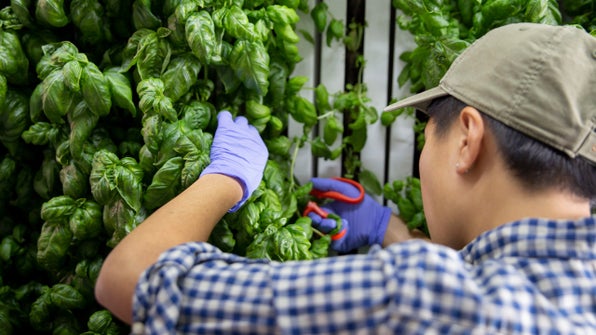
Since 2016, Square Roots–the indoor urban farming startup founded by Kimbal Musk and entrepreneur Tobias Peggs–has been producing a steady output of fresh herbs and greens. In 10 shipping containers in a Brooklyn parking lot, the Square Roots team harvests the produce for local distribution to New York grocery stores, and educates young people interested in learning this new, tech-driven method of agriculture.

Musk and Peggs aren't the only entrepreneurs growing greens indoors and hydroponically: AeroFarms and Bowery, both based in New Jersey, are just a two of the many other companies using similar tactics to grow kale and basil. It's an increasingly popular idea: Bowery and AeroFarms have raised $118 and $138 million, respectively. But some more traditional organic agriculture advocates, like Dan Barber, have criticized the method for failing to contribute to the effort to remake farming in a more environmentally healthy way, in favor of leaning on new technology.
[Photo: Square Roots]
But despite that criticism, enthusiasm for a more sci-fi approach to growing greens does not appear to be slowing down. In fact, it will only become more mainstream, and Square Roots' newest collaboration will play a critical role in that.

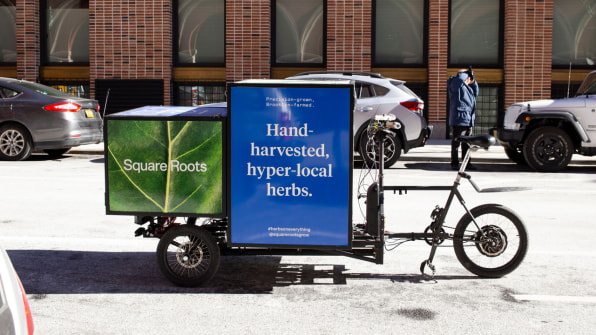
The farming tech company (or "accelerator," as Musk and Peggs call it) is partnering with Gordon Food Service, which manages distribution facilities across North America as well as 175 retail store locations. Through the partnership, Square Roots will set up its shipping container farming systems on or very near GFS's distribution and retail locations. The idea is to create a very short pipeline for fresh, local greens to reach GFS customers. And through Square Roots' Next-Gen Farmer Training Program, which will expand along with the growing operations, Peggs says the number of young people the company will be able to train and employ will increase dramatically.
[Photo: Square Roots]

The way the partnership came about, Peggs says, is tied up with another project of Musk's: his nonprofit Big Green, which educates young kids about food and growing by installing gardens in schools. GFS, which is based in Grand Rapids, Michigan, sponsors Big Green in Detroit. Around nine months ago, GFS's CEO, Rich Wolowski, traveled to Brooklyn to visit the Square Roots facility to investigate the possibility of a partnership.

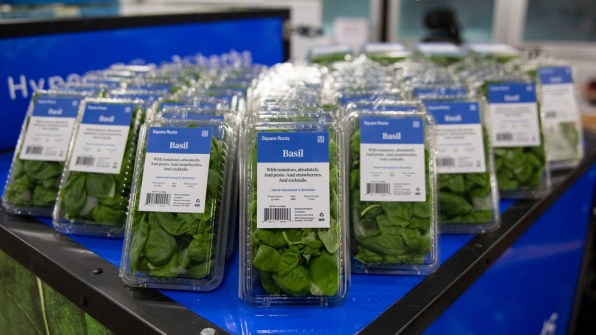
"GFS understands that there's an increasing consumer demand for locally grown food, and changes in climate mean that we need to be thinking about new and innovative forms of agriculture," Peggs says. "So they came to the farm and literally tasted the basil. It was obvious that the companies were mission-aligned: We both want to bring good quality food to a great number of people."
[Photo: Square Roots]

The partnership evolved very quickly, and not all of the details are final. Square Roots and GFS, for now, are not announcing which distribution centers and retail stores will be the first to get a farm on their property. But they do have a sense of what the impact could be: Each Square Roots farm "campus" might contain 10 shipping containers, each of which will create one job for a local person interested in the Next-Gen Farmer Training Program. Each campus can grow around 50,000 pounds of produce per year, which will feed directly into the local food supply. The farms are all connected, so as more come online, Peggs says the company will receive more data about what conditions lead to the best yields, and will be able to use that knowledge to increase efficiencies and introduce more diverse crops to their operations.

Square Roots and GFS are not placing a ceiling on how many farm containers each property might receive: That, Peggs says, can quickly develop in accordance with customer demand. "We'll start with putting 10 containers down in a market, and as demand for locally grown produce increases, we can very quickly expand our footprint by adding more modules," he says.

The greatest potential for the partnership between GFS and Square Roots, perhaps, is that it represents a truly localized supply chain for fresh produce. In the U.S., food travels an average of 1,500 miles to reach people's plates. Those 1,500 miles represent excess carbon emissions from transport and electricity use from cooling needs along the way. If food, instead, can be grown and distributed in the place it is produced, as the GFS and Square Roots partnership aims to accomplish, we could begin to walk back some of the environmental costs of accessing food. "It's going to take more than Square Roots and GFS to fix the food system," Peggs says, but he's hopeful that the partnership and prospective growth signal a real shift toward more localized food production and distribution.

Me too😊

~A.

Sunday, March 24, 2019

Human Contact Is Now a Luxury Good - The New York Times

Human Contact Is Now a Luxury Good - The New York Times

Human Contact Is Now a Luxury Good

news analysis

Screens used to be for the elite. Now avoiding them is a status symbol.

Marta Monteiro

By Nellie Bowles

Ms. Bowles is a technology reporter for The New York Times.

SAN FRANCISCO — Bill Langlois has a new best friend. She is a cat named Sox. She lives on a tablet, and she makes him so happy that when he talks about her arrival in his life, he begins to cry.

All day long, Sox and Mr. Langlois, who is 68 and lives in a low-income senior housing complex in Lowell, Mass., chat. Mr. Langlois worked in machine operations, but now he is retired. With his wife out of the house most of the time, he has grown lonely.

Sox talks to him about his favorite team, the Red Sox, after which she is named. She plays his favorite songs and shows him pictures from his wedding. And because she has a video feed of him in his recliner, she chastises him when she catches him drinking soda instead of water.

Mr. Langlois knows that Sox is artifice, that she comes from a start-up called Care.Coach. He knows she is operated by workers around the world who are watching, listening and typing out her responses, which sound slow and robotic. But her consistent voice in his life has returned him to his faith.

"I found something so reliable and someone so caring, and it's allowed me to go into my deep soul and remember how caring the Lord was," Mr. Langlois said. "She's brought my life back to life."

Sox has been listening. "We make a great team," she says.

Sox is a simple animation; she barely moves or emotes, and her voice is as harsh as a dial tone. But little animated hearts come up around her sometimes, and Mr. Langlois loves when that happens.

Mr. Langlois is on a fixed income. To qualify for Element Care, a nonprofit health care program for older adults that brought him Sox, a patient's countable assets must not be greater than $2,000.

Such programs are proliferating. And not just for the elderly.

Life for anyone but the very rich — the physical experience of learning, living and dying — is increasingly mediated by screens.

Not only are screens themselves cheap to make, but they also make things cheaper. Any place that can fit a screen in (classrooms, hospitals, airports, restaurants) can cut costs. And any activity that can happen on a screen becomes cheaper. The texture of life, the tactile experience, is becoming smooth glass.

The rich do not live like this. The rich have grown afraid of screens. They want their children to play with blocks, and tech-free private schools are booming. Humans are more expensive, and rich people are willing and able to pay for them. Conspicuous human interaction — living without a phone for a day, quitting social networks and not answering email — has become a status symbol.

All of this has led to a curious new reality: Human contact is becoming a luxury good.

As more screens appear in the lives of the poor, screens are disappearing from the lives of the rich. The richer you are, the more you spend to be offscreen.

Milton Pedraza, the chief executive of the Luxury Institute, advises companies on how the wealthiest want to live and spend, and what he has found is that the wealthy want to spend on anything human.

"What we are seeing now is the luxurification of human engagement," Mr. Pedraza said.

Anticipated spending on experiences such as leisure travel and dining is outpacing spending on goods, according to his company's research, and he sees it as a direct response to the proliferation of screens.

"The positive behaviors and emotions human engagement elicits — think the joy of a massage. Now education, health care stores, everyone, is starting to look at how to make experiences human," Mr. Pedraza said. "The human is very important right now."

This is a swift change. Since the 1980s personal computer boom, having technology at home and on your person had been a sign of wealth and power. Early adopters with disposable income rushed to get the newest gadgets and show them off. The first Apple Mac shipped in 1984 and cost about $2,500 (in today's dollars, $6,000). Now the very best Chromebook laptop, according to Wirecutter, a New York Times-owned product reviews site, costs $470.

"Pagers were important to have because it was a signal that you were an important, busy person," said Joseph Nunes, chairman of the marketing department at the University of Southern California, who specializes in status marketing.

Today, he said, the opposite is true: "If you're truly at the top of the hierarchy, you don't have to answer to anyone. They have to answer to you."

The joy — at least at first — of the internet revolution was its democratic nature. Facebook is the same Facebook whether you are rich or poor. Gmail is the same Gmail. And it's all free. There is something mass market and unappealing about that. And as studies show that time on these advertisement-support platforms is unhealthy, it all starts to seem déclassé, like drinking soda or smoking cigarettes, which wealthy people do less than poor people.

The wealthy can afford to opt out of having their data and their attention sold as a product. The poor and middle class don't have the same kind of resources to make that happen.

Screen exposure starts young. And children who spent more than two hours a day looking at a screen got lower scores on thinking and language tests, according to early results of a landmark study on brain development of more than 11,000 children that the National Institutes of Health is supporting. Most disturbingly, the study is finding that the brains of children who spend a lot of time on screens are different. For some kids, there is premature thinning of their cerebral cortex. In adults, one study found an association between screen time and depression.

A toddler who learns to build with virtual blocks in an iPad game gains no ability to build with actual blocks, according to Dimitri Christakis, a pediatrician at Seattle Children's Hospital and a lead author of the American Academy of Pediatrics' guidelines on screen time.

In small towns around Wichita, Kan., in a state where school budgets have been so tight that the State Supreme Court ruled them inadequate, classes have been replaced by software, much of the academic day now spent in silence on a laptop. In Utah, thousands of children do a brief, state-provided preschool program at home via laptop.

Tech companies worked hard to get public schools to buy into programs that required schools to have one laptop per student, arguing that it would better prepare children for their screen-based future. But this idea isn't how the people who actually build the screen-based future raise their own children.

In Silicon Valley, time on screens is increasingly seen as unhealthy. Here, the popular elementary school is the local Waldorf School, which promises a back-to-nature, nearly screen-free education.

So as wealthy kids are growing up with less screen time, poor kids are growing up with more. How comfortable someone is with human engagement could become a new class marker.

Human contact is, of course, not exactly like organic food or a Birkin bag. But with screen time, there has been a concerted effort on the part of Silicon Valley behemoths to confuse the public. The poor and the middle class are told that screens are good and important for them and their children. There are fleets of psychologists and neuroscientists on staff at big tech companies working to hook eyes and minds to the screen as fast as possible and for as long as possible.

And so human contact is rare.

"But the holdup is this: Not everyone wants it, unlike other kinds of luxury products," said Sherry Turkle, professor of the social studies of science and technology at the Massachusetts Institute of Technology.

"They flee to what they know, to screens," Ms. Turkle said. "It's like fleeing to fast food."

Just as skipping fast food is harder when it's the only restaurant offering in town, separating from screens is harder for the poor and middle class. Even if someone is determined to be offline, that is often not possible.

Coach seat backs have screen ads autoplaying. Public school parents might not want their kids learning on screens, but that is not an option when many classes are now built on one-to-one laptop programs. There is a small movement to pass a "right to disconnect" bill, which would allow workers to turn their phones off, but for now a worker can be punished for going offline and not being available.

There is also the reality that in our culture of increasing isolation, in which so many of the traditional gathering places and social structures have disappeared, screens are filling a crucial void.

Many enrolled in the avatar program at Element Care were failed by the humans around them or never had a community in the first place, and they became isolated, said Cely Rosario, the occupational therapist who frequently checks in on participants. Poor communities have seen their social fabric fray the most, she said.

The technology behind Sox, the Care.Coach cat keeping an eye on Mr. Langlois in Lowell, is quite simple: a Samsung Galaxy Tab E tablet with an ultrawide-angle fisheye lens attached to the front. None of the people operating the avatars are in the United States; they mostly work in the Philippines and Latin America.

The Care.Coach office is a warrenlike space above a massage parlor in Millbrae, Calif., on the edge of Silicon Valley. Victor Wang, the 31-year-old founder and chief executive, opens the door, and as he's walking in he tells me that they just stopped a suicide. Patients often say they want to die, he said, and the avatar is trained to then ask if they have an actual plan of how to do it, and that patient did.

The voice is whatever the latest Android text-to-speech reader is. Mr. Wang said people can form a bond very easily with anything that talks with them. "Between a semi-lifelike thing and a tetrahedron with eyeballs, there's no real difference in terms of building a relationship," he said.

Mr. Wang knows how attached patients become to the avatars, and he said he has stopped health groups that want to roll out large pilots without a clear plan, since it is very painful to take away the avatars once they are given. But he does not try to limit the emotional connection between patient and avatar.

"If they say, 'I love you,' we'll say it back," he said. "With some of our clients, we'll say it first if we know they like hearing it."

Early results have been positive. In Lowell's first small pilot, patients with avatars needed fewer nursing visits, went to the emergency room less often and felt less lonely. One patient who had frequently gone to the emergency room for social support largely stopped when her avatar arrived, saving the health care program an estimated $90,000.

Humana, one of the country's largest health insurers, has begun using Care.Coach avatars.

For a sense of where things could be headed, look to the town of Fremont, Calif. There, a tablet on a motorized stand recently rolled into a hospital room, and a doctor on a video feed told a patient, Ernest Quintana, 78, that he was dying.

Back in Lowell, Sox has fallen asleep, which means her eyes are closed and a command center somewhere around the world has tuned into other seniors and other conversations. Mr. Langlois's wife wants a digital pet, and his friends do too, but this Sox is his own. He strokes her head on the screen to wake her up.

Nellie Bowles covers tech and internet culture. Follow her on Twitter: @nelliebowles

No remote death announcements, please.


~A.