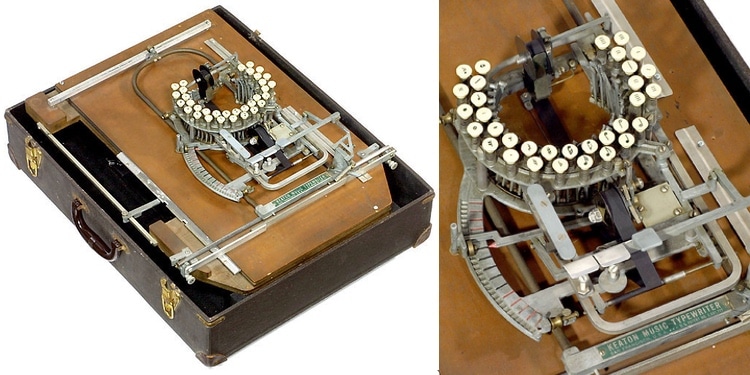
While most composers like to handwrite their sheet music, over the years there have been all types of machines invented to help print music. Perhaps one of the coolest is the Keaton Music Typewriter. First patented in 1936, it definitely doesn't look like an ordinary typewriter. Robert H. Keaton from San Francisco, California created the machine, which has now become something of a rare collector's item.
The original patent was for a 14-key typewriter, which was then upgraded to 33 keys in an improved 1953 patent. Marketed in the 1950s and sold for about $255, the machine has a distinct look thanks to its circular keyboard. In creating his design, Keaton was looking to create something that would be able to print characters precisely on a staff and indicate exactly where the next character would be printed to ensure accuracy.
The unique keyboard arrangement was born of a desire to separate two types of characters. "One keyboard is adapted to type one class of music characters such as bar lines and ledger lines, which, when repeated, always appear in the same relative spaced positions with respect to the [staff] lines… and a second keyboard adapted to type another class of musical characters, such as the notes, rest signs and sharp and flat signs etc., which may, when repeated, appear in various spaced positions with respect to the [staff] lines," Keaton wrote.
It's an interesting arrangement that gives the Keaton Music Typewriter its distinctive look. In terms of engineering, thanks to a curved meter on the left that Keaton called the Scale Shift Handle and Scale Shift Indicator, it's easy to control exactly where the notes and characters fall on the page. By moving the handle up or down a notch, the typewriter adjusts to print 1/24 inch in either direction. Moving one notch up or down will cause the character to fall one musical step either way.
In order to make sure that musicians could see where they were about to print, Keaton included a long needle next to the ribbon that leaves nothing up to chance. Interestingly, the two keyboards work in different ways with the Scale Shift Handle. The larger keyboard with the notes, scales, sharps, and flats moves freely in tandem with the Scale Shift Handle. The smaller keyboard, which contains items like bar lines and ledger lines, stays in place since these characters always appear in the same place with respect to the staff lines.
Due to the niche nature of the product, it's unclear if it was a big commercial success. Now, the Keaton Music Typewriter is a beloved collectible and can sometimes be found on eBay as well as other online auctions. Its beautiful design and nostalgic appeal for the pre-digital era certainly make it an invention worthy of rediscovery.
The distinctive Keaton Music Typewriter was produced in the 1950s to make it easier for musicians to create legible sheet music.
Drawing in 1953 Patent
It's now a beloved collectible by musicians and lovers of innovative design.
The Race To Crack Battery Recycling—Before It's Too Late
Millions of EVs will soon hit the road, but the world isn't ready for their old batteries. A crop of startups wants to crack this billion-dollar problem.
Every day, millions of lithium-ion batteries roll off the line at Tesla's Gigafactory in Sparks, Nevada. These cells, produced on site by Panasonic, are destined to be bundled together by the thousands in the battery packs of new Teslas. But not all the batteries are cut out for a life on the road. Panasonic ships truckloads of cells that don't pass their qualification tests to a facility in Carson City, about a half hour's drive south. This is the home of Redwood Materials, a small company founded in 2017 with an ambition to become the anti-Gigafactory, a place where batteries are cooked down into raw materials that will serve as the grist for new cells.
Redwood is part of a wave of new startups racing to solve a problem that doesn't really exist yet: How to recycle the mountains of batteries from electric vehicles that are past their prime. Over the past decade, the world's lithium-ion production capacity has increased tenfold to meet the growing demand for EVs. Now vehicles from that first production wave are just beginning to reach the end of their lifespan. This marks the beginning of a tsunami of spent batteries, which will only get worse as more electric cars hit the road. The International Energy Agency predicts an 800 percent increase in the number of EVs over the next decade, each car packed with thousands of cells. The dirty secret of the EV revolution is that it created an e-waste timebomb—and cracking lithium-ion recycling is the only way to defuse it.
Redwood's CEO and founder J. B. Straubel understands the problem better than most. After all, he played a significant role in creating it. Straubel is cofounder and, until last year, was the CTO at Tesla, a company he joined when it was possible to count all of its employees on one hand. During his time there, the company grew from a scrappy startup peddling sports cars to the most valuable auto manufacturer on the planet. Along the way, Tesla also became one of the world's largest battery producers. But the way Straubel sees it, those batteries aren't really a problem. "The major opportunity is to think of this material for reuse and recovery," he says. "With all these batteries in circulation, it just seems super obvious that eventually we're going to build a remanufacturing ecosystem."
There are two main ways to deactivate lithium-ion batteries. The most common technique, called pyrometallurgy, involves burning them to remove unwanted organic materials and plastics. This method leaves the recycler with just a fraction of the original material—typically just the copper from current collectors and nickel or cobalt from the cathode. A common pyro method, called smelting, uses a furnace powered with fossil fuels, which isn't great for the environment, and it loses a lot of aluminum and lithium in the process. But it is simple, and smelting factories that currently exist to process ore from the mining industry are already able to handle batteries. Of the small fraction of lithium-ion batteries that are recycled in the US—just 5 percent of all spent cells—most of them end up in a smelting furnace.
The other approach is called hydrometallurgy. A common form of this technique, called leaching, involves soaking lithium-ion cells in strong acids to dissolve the metals into a solution. More materials, including lithium, can be recovered this way. But leaching comes with its own challenges. Recyclers must preprocess the cells to remove unwanted plastic casings and drain the charge on the battery, which increases cost and complexity. It's part of the reason why spent lithium-ion batteries have been treated as waste ever since the first commercial cells hit the market in the early 1990s. It was often several times cheaper to mine new material, especially lithium, than recover it with leaching.
Redwood uses a combination of pyrometallurgy and hydrometallurgy to recover these valuable materials. First, technicians wearing reflective silver heat suits cook the batteries in converters to separate the metals. Rather than using fossil fuels to burn the material, like in a conventional smelting process, Redwood's pyro technique uses residual energy in the batteries, such as the organics in the electrolyte, to drive the conversion process. The stuff that's left over is a metal alloy that is filtered through a hydrometallurgical process to recover individual compounds.
Straubel declined to go into the specifics of the company's recovery techniques, but he claims that it can recover between 95 and 98 percent of a battery's nickel, cobalt, copper, aluminum, and graphite, and more than 80 percent of its lithium. By the time a battery has made it through Redwood's recycling facility, it has been broken down into its basic ingredients—lithium carbonate, cobalt sulfate, and nickel sulfate—that are ready to be reintegrated into the battery manufacturing process. "We're going to build a remanufacturing ecosystem for all those batteries," says Straubel. "Material can get reused almost infinitely. There's no inherent degradation to the metal atoms."
Many of the challenges that come with lithium-ion recycling stem from the fact that the facilities that process them weren't designed specifically for cooking down batteries. But people at the vanguard of battery recycling expect that creating dedicated facilities will improve the industry's economics. "We're focused on a bespoke process that is specifically designed for lithium ion batteries because we're starting to see increased volumes," says Tim Johnston, the cofounder of Li-Cycle, a Canadian battery recycler. "Historically, batteries were viewed as waste, and we seek to turn that on its head by focusing on them as a resource."
Courtesy of Li-Cycle
Li-Cycle bills itself as the largest lithium-ion recycler in North America and takes a different approach to recovery than Redwood. Their process skips the pyro step entirely and refines the battery with leaching alone. First, they drop the batteries into a vat that simultaneously discharges and shreds them. This produces a grainy compound that's referred to in the industry as "black mass," which is made of a mixture of electrode materials. Next, the black mass travels through a staged chemical bath to unlock the individual metals. The process converts almost everything back into a usable raw material—the plastic from the battery's separator is turned into flakes, the current collectors are turned into copper and aluminum foils, the graphite from the anode is turned into a carbon concentrate, and the cathode materials like nickel, cobalt, and lithium are individually recovered for new batteries.
Li-Cycle bills itself as the largest lithium-ion recycler in North America, and takes a different approach to recovery than Redwood. The company's process skips smelting entirely and refines the battery with leaching alone. First, they drop the batteries into a vat that simultaneously discharges and shreds them. Next, the cells travel through a staged chemical bath to unlock the metals trapped inside them. The process converts almost everything back into a usable raw material—the plastic from the battery's separator is turned into flakes, the current collectors are turned into copper and aluminum foils, the graphite from the anode is turned into a carbon concentrate, and the cathode materials like nickel, cobalt, and lithium are individually recovered for new batteries.
"We don't produce any meaningful amounts of waste," says Johnston. "We don't produce any meaningful amount of air emissions, we don't produce any waste water, and everything is done at a low temperature. The footprint is very small."
Arguably, the most significant innovation at Li-Cycle is not the chemical processes but the design of the recycling facilities themselves. Li-Cycle uses a "hub and spoke" approach, in which batteries are preprocessed at different sites in the US and Canada, each a modular factory that turns the cells into black mass. The spokes feed this inert material back to a central hub, where it is refined into usable battery-grade chemicals. Today, Li-Cycle operates spokes in Ontario and Rochester, and just received state permission to open its first commercial hub in New York in 2022.
Courtesy of Li-Cycle
The processing equipment at each spoke is packaged in shipping containers that can be sited close to battery production facilities or municipal collection sites to minimize the distance a battery has to travel once it's depleted. This system sidesteps one of the most significant hurdles for lithium-ion recycling, which is simply getting the waste where it needs to go. These batteries are federally designated as a Class 9 hazardous material, which means they're subjected to rigorous—and expensive—shipping restrictions to reduce the risk of fire or explosions during the journey.
Smelting and bleaching are the quickest ways to address the rapidly growing challenges with lithium-ion waste, but they may not be the best ones. Their end products are battery-grade materials, but these still require a lot of processing before they're ready to go back into a cell. A battery's cathode, for example, is nanoengineered to boost performance. So some battery experts are working on a process called direct recovery, which salvages cathode material without destroying its crystalline nanostructure. This would dramatically reduce the cost of reusing the material.
In 2019, the Department of Energy tapped Argonne National Laboratory to lead its ReCell Center, which is focused on improving lithium-ion recycling techniques. A key part of that goal is direct recycling. It's still early days for ReCell, but scientists at the center have hit on a few direct recycling processes that they hope will demonstrate the potential of this approach. They've already successfully recovered battery material with many of these techniques in the lab, but a benchtop demo is only a first step toward a method that will be economical at scale.
"The goal of the center is to come up with something that will convince industry to take this on," says Linda Gaines, the ReCell Center chief scientist and a transportation systems analyst at Argonne National Laboratory. "We need to answer all the questions about what this is going to look like when it's scaled up."
Photograph: Mark Lopez/Argonne National Laboratory
The challenge with direct recycling is that cells are not designed with material recovery in mind. Instead, they're manufactured to produce energy for a long time, and as cheaply as possible. Generally speaking, recycling isn't even an afterthought. And this makes them hard to unpack. Individual cells are complex systems that have several chemically-distinct components mixed—sometimes welded—together in a small volume. These become challenging to extract without the help of strong acids or extreme temperatures.
For now, Gaines and her colleagues are focused on figuring out how to salvage the structure of batteries that already exist. In the future, however, it's possible that batteries may be made to be recycled—but only if that's cost effective and doesn't affect performance. "Designing for recycling is a very important area, but you can't sacrifice performance at all, or nobody's going to want to do it," says Gaines. "The best way to attack that isn't obvious, and to be honest, there hasn't been a lot of really good work in that area."
Still, there are plenty of other changes that can be made to the way battery systems are manufactured to improve recycling efforts, says Carlton Cummins, the CTO of Aceleron. He cofounded the company in 2015 after he started looking into the afterlife of EVs and "realized that you can reuse most of the car except the battery," he says. "It wasn't designed for repair, reuse, or upgrade. The key focus at the time was to build it cheaply and quickly." As a result, the cells used in EV and stationary storage battery packs tend to have multiple welds per battery that connect dozens of batteries so they can be controlled as one unit. Cummins says this is a technique of convenience borrowed from the consumer electronics industry, but it makes automotive battery packs remarkably more difficult to disassemble for upgrades or recycling.
Aceleron's solution to the problem is deceptively simple. Cummins and his team designed a battery container that can be used for a variety of different cell types to link them without a welded connection. The company's battery platform, Circa, compresses the batteries in a hard shell case and uses a removable circuit to connect them. This means that if an individual cell fails, or the pack's owner wants to upgrade to a better battery, the cells can be swapped out by loosening some nuts and bolts. "The way batteries are designed today, everything is welded and glued together, and the assumption is that at the end of usage it is disposed of," says Cummins. "We had to reinvent how you assemble batteries with something that is designed for reuse as well as recycling."
There are still a number of technical, political, and economic challenges that lithium-ion recyclers will have to meet, and success is not guaranteed. Cobalt, for example, is the most expensive material in most EV batteries, but battery manufacturers are chasing new cobalt-free chemistries. It's uncertain whether recyclers will still find material recovery worthwhile if this valuable mineral isn't in the mix to sell back to manufacturers. Still, the new generation of battery recyclers are betting that they can find a way to close the loop on the lithium-ion supply chain and make a buck while they do it. If they're right, they may turn black mass into a green ...
From castles to ballet in your sitting room: 14 great things to do in December
Photo: DutchNews.nl
There are plenty of Christmassy things to see and do this month, despite coronavirus. Here's a list of suggestions.
Listen in on an online relationship talk You could be forgiven for thinking that The Churchill Complex is what has been ailing Boris Johnson but it is, in fact, the title of Dutch historian Ian Buruma's new book. The John Adams Institute has invited him to give a talk about the Special Relationship which sprung up between America and Great Britain after the war and what is left of it. Spoiler: not much. The talk, in English, is online so anyone can have a listen. December 1. Website
Take in a Dutch film Dutch films take centre stage at 27 cinemas across the country in a series called Kijk Ons (Look at us). The first film, based on a book by Flemish author Griet Op de Beeck, is Kom Hier Dat Ik U Kus (Come here so I can kiss you) directed by Niels van Koevorden and Sabine Lubbe Bakker. It's the story of a small child who forgets her own needs to keep the family together and repeats the pattern in her adult life. From December 4. Website
Call Sinterklaas The Catharijneconvent in Utrecht is usually Sinterklaas' temporary home when he comes on his annual visit and the place where he meets his fans. This year, children aged between three and seven can give him a ring on 030-3071028 and hear all sorts of weird and wonderful things, such as why we are all eating chocolate money on his birthday (and long before that, let's be honest). Until December 5. Website
Enjoy ballet classics live Back to Classic, a programme of classical ballet favourites such as Le Corsaire, Swan Lake andPaquita, has extended its run to include three live stream performances in December. Performed by a different Opera Ballet cast each time, you can enjoy this live event for €12.50 from the safety of your living room. December 4, 9, and 12. Website
Watch paint dry with Bob Ross Those who think Bob Ross's paintings are just a load of Van Dyke brown may have a point but he has definitely become an icon of ironic art. Museum for modern realism MORE in Gorssel (Gelderland) has gathered together 40 paintings by Ross, each done in the space of 26 minutes, or the duration of an episode of his hugely successful series The Joy of Painting. Prepare for lots of firs, mountains, brooks and more firs. Happy Painting is on until April 11. Website
Have a bit of duck for Christmas The Badhuis Theatre in Amsterdam is presenting a mix of their Christmas show The Duck followed by all the trimmings in the shape of comedy sketches and music satire. December 11 and 12 . Also at the Badhuis, Alex Baggett plays John Brown's body, a tragicomic indictment of slavery in the United States and how black lives did not matter then and now. December 18. Website
Ashley Ramsden as Scrooge. Photo: STET
Shed a tear for Tiny Tim The English Theatre is forging bravely ahead with Dickens' A Christmas Carol' at the Muiderslot, Leiden and The Hague. Ashley Ramsden has come back for the 15th year in succession to tell the story of miserly old Scrooge and his transformation into a genial and generous uncle. The Plum Pudding Singers a capella singing ensemble will be on hand to render some jolly Christmas carols. So 'Happy Christmas to us all; God bless us every one!' December 15- 20. Website
Come to the castle for Christmas The Covid Grinch is not stealing all Christmas cheer this year: Slot Loevestein near Zaltbommel has reopened its doors to visitors who will be regaled with tales of knights in armour and Hugo de Groot and his book chest. There's candle light, hot cocoa for the children and glühwein for mum and dad. It may even snow. From December 19 to January 3. Website
Slot Loevestein: Photo: Hans@fotovlieger.nl via Wikimedia Commons
Look at the pretty pictures Why can't it just be pretty? the Frans Hals Museum in Haarlem asks somewhat plaintively. Why does it always have to be experimental and innovative and just plain difficult? Pretty pictures it is at the museum, of cats and things, by Haarlem impressionist and realist painters Kees Verwey, Jacobus van Looy, Otto B. de Kat, Coba Ritsema and Jaap Ploos van Amstel. Mag het ook mooi zijn? is on until January 10. Website
Pick a performance If it's experimental and innovative you're after look no further than the Stedelijk Museum in Amsterdam. It is presenting a retrospective of the Amsterdam-based performance and body artist Frank Uwe Laysiepen (1943–2020) or Ulay. Ulay was one the first to use polaroid photography and use his body as a means to express his views on issues like gender identity.
His collaboration with Marina Abramović made for new heights of confrontational body art. Standing close together in a museum doorway while naked forcing visitors to wriggle their embarassed or amused way in is just one of the performances in which the two artists showed their physical courage in the service of art. There are free introductory lectures from December 5. Ulay was here is on until April 18. Website
Prepare for the Elfstedentocht Skating rinks have been given the go ahead to open again, a great opportunity for children and adults to be active in the open air during the Christmas break (which may be longer than usual).
Skating on the Hofvijver in The Hague in 2012. Photo: Marco Raaphorst via Flickr
There are skating lessons at the Jaap Edenbaan in Amsterdam and the Uithof in The Hague, curling classes at Rotterdam skating rink and unorganised messing about and falling on your bum at all three. Make sure you reserve your slot online. If you are more comfortable on solid ground but still want to be outdoors, try one of Staatsbosbeheer's Christmas walks. Website
Come to Figaro's wedding The premiere of Le Nozze di Figaro which, at the last minute, could not go ahead in the theatre can now be seen online. It will cost you just €2.95 to enjoy Mozart's comic opera about upstairs downstairs shenanigans, disguises and intrigue. The performance will remain online for the whole of the month of December. Website
Visitors get the museum to themselves. Photo: Mauritshuis
Zoom in on your favourite painting The Mauritshuis in The Hague has just earned itself the title of 'first gigapixel museum in the world'. It is putting its entire collection online, with high resolution photographs showing every tiny detail. More paintings will be added in the coming months. Website
See 2020 out with a sparkle, not a bang The last agenda of the year usually ends with a list of public firework displays but unfortunately not this year (and we think carbidschieten is not as fun to watch). Not all is lost because Rotterdam has opted for a 'spectacle of light' to the tones of the Rotterdam Philharmonic Orchestra which can be enjoyed online.
Amsterdam is having an organised online countdown from the Museumplein but is keeping the entertainment under wraps. Other cities may follow suit. And you can, of course, get your sterretjes out and make your own safe display. Happy 2021 everyone.
Thank you for donating to DutchNews.nl
The DutchNews.nl team would like to thank all the generous readers who have made a donation in recent weeks. Your financial support has helped us to expand our coverage of the coronavirus crisis into the evenings and weekends and make sure you are kept up to date with the latest developments.
DutchNews.nl has been free for 14 years, but without the financial backing of our readers, we would not be able to provide you with fair and accurate news and features about all things Dutch. Your contributions make this possible.
Government apologises to transgender people forced to accept sterilisation
Photo: Depositphotos.com
The Dutch government has apologised to hundreds of transgender people who were forced to accept being sterilised and to undergo body modification and take hormones if they wanted to change their gender on official documents.
The practice began in 1985 and continued up to 2014, when new legislation was introduced. Some 2,000 people are thought to have been affected by it.
'The old law gave transgender people a hard, almost impossible choice,' justice minister Sander Dekker said.
'Gender identification was only possible after a physical transition and a definitive farewell to any desire to have children. Today, we can no longer imagine such a violation of physical integrity. It is important to face the suffering of transgender people and to offer recognition, compensation and apologies for it.'
The apology follows legal action by the Transgender Collective in 2019, which said that the law conflicted with the European treaty on human rights. In 2011, the Dutch law was also subject of a damning report by Human Rights Watch.
Campaigners welcomed the apology, pointing out that many had been left with an unfulfilled desire to have children. 'It still feels unreal and I have to let this sink in,'initiator Willemijn van Kempen said in a statement.
People who underwent body modification and forced sterilisation will be eligible for a €5,000 payout, details of which will be published next summer.
Thank you for donating to DutchNews.nl
The DutchNews.nl team would like to thank all the generous readers who have made a donation in recent weeks. Your financial support has helped us to expand our coverage of the coronavirus crisis into the evenings and weekends and make sure you are kept up to date with the latest developments.
DutchNews.nl has been free for 14 years, but without the financial backing of our readers, we would not be able to provide you with fair and accurate news and features about all things Dutch. Your contributions make this possible.
I've been warning you about the seeming inevitability of mandatory COVID-19 vaccinations for several months now, and have discussed the ever-tightening grip of media and online censorship even longer. As an independent source of health news, Mercola.com has been in the crosshairs of globalist interests for years, and the attacks are intensifying with each passing day.
While, on the surface, health recommendations and geopolitics may appear to have nothing in common, they are in fact intertwined.
As more and more information about the Great Reset and the 4th Industrial Revolution is starting to surface, we can clearly see that eliminating medical freedom is a central part of the plot, and mandatory vaccination will be used as a tool to usher in biometrical surveillance and enslavement through a centrally-controlled all-digital finance and identification system.
Intelligence Collective Unleashes Cyberwarfare on Public
While censorship has reached new heights this year, that's likely only the tip of the iceberg. According to recent media reports,1,2,3 intelligence agencies are now collaborating to eliminate "anti-vaccine propaganda" from public discussion using sophisticated cyberwarfare tools.
"British and American state intelligence agencies are 'weaponizing truth' to quash vaccine hesitancy as both nations prepare for mass inoculations, in a recently announced 'cyber war' to be commanded by AI-powered arbiters of truth against information sources that challenge official narratives …
Cyber tools and online tactics previously designed for use in the post-9/11 'war on terror' are now being repurposed for use against information sources promoting 'vaccine hesitancy' and information related to COVID-19 that runs counter to their state narratives …
The UK's GCHQ [Government Communications Headquarters5] 'has begun an offensive cyber-operation to disrupt anti-vaccine propaganda being spread by hostile states' and 'is using a toolkit developed to tackle disinformation and recruitment material peddled by Islamic State' to do so.6
In addition, the UK government has ordered the British military's 77th Brigade, which specializes in 'information warfare,' to launch an online campaign to counter 'deceptive narratives' about COVID-19 vaccine candidates.
The newly announced GCHQ 'cyber war' will not only take down 'anti-vaccine propaganda' but will also seek to 'disrupt the operations of the cyberactors responsible for it, including encrypting their data so they cannot access it and blocking their communications with each other.'
The effort will also involve GCHQ reaching out to other countries in the 'Five Eyes' alliance (U.S., Australia, New Zealand and Canada) to alert their partner agencies in those countries to target such 'propaganda' sites hosted within their borders."
Vaccine Discussion — A National Security Risk?
According to a November 9, 2020, report in The Times,7 the British "government regards tackling false information about inoculation as a rising priority as the prospect of a reliable vaccine against the coronavirus draws closer."
In July 2020, chief executive of the Centre for Countering Digital Hate, Imran Ahmed, told The Independent8 he considers anti-vaxxers "an extremist group that pose a national security risk," because "once someone has been exposed to one type of conspiracy it's easy to lead them down a path where they embrace more radical world views that can lead to violent extremism."
In other words, Ahmed implies that people who question the safety and necessity of a COVID-19 vaccine might be prone to violent extremism. His statement is no small matter, considering Ahmed is also a member of the Steering Committee on Countering Extremism Pilot Task Force under the British government's Commission for Countering Extremism.
"It seems that, from the perspective of the UK national-security state, those who question corruption in the pharmaceutical industry and its possible impact on the leading experimental COVID-19 vaccine candidates (all of which use experimental vaccine technologies that have never before been approved for human use) should be targeted with tools originally designed to combat terrorist propaganda," Webb writes.9
Government With Help of Big Tech Is Seizing Online Domains
U.S. intelligence is also part of this campaign. According to Webb, the U.S. government will help the GCHQ determine whether a website is part of a foreign disinformation operation or not. While the GCHQ claims that only foreign state actors will be targeted, and not "ordinary citizens," there's little evidence to suggest citizens won't be swept up in this information blackout operation.
For example, November 4, 2020, the U.S. Department of Justice (DOJ) announced it had seized 27 online domains — including that of the American Herald Tribune — suspected of being founded by Iranian interests.10,11 The domain seizures are said to be part of the U.S. enforcement of sanctions against Iran.
In early September 2020, 92 online domains suspected of belonging to Iraqi government-backed militia were similarly seized.12 All of these DOJ seizures were done in collaboration with the FBI, Google, Facebook and Twitter.13 As reported by Webb:14
"The U.S. government made this claim about the American Herald Tribune after the cybersecurity firm FireEye, a U.S. government contractor, stated that it had 'moderate confidence' that the site had been 'founded in Iran' …
It is certainly plausible that GCHQ could take the word of either an allied government, a government contractor, or perhaps even an allied media organization such as Bellingcat or the Atlantic Council's DFRLab that a given site is 'foreign propaganda' in order to launch a cyber offensive against it.
Such concerns are only amplified when one of the main government sources … bluntly stated that 'GCHQ has been told to take out antivaxers [sic] online and on social media. There are ways they have used to monitor and disrupt terrorist propaganda,' which suggests that the targets of GCHQ's new cyber war will, in fact, be determined by the content itself rather than their suspected 'foreign' origin.
The 'foreign' aspect instead appears to be a means of evading the prohibition in GCHQ's operational mandate on targeting the speech or websites of ordinary citizens."
Clues that U.S. intelligence supports this cyberwar against the public can also be found in a white paper15 published in the InfraGard Journal in June 2019. InfraGard, founded in 1996, is a nonprofit national security group affiliated with the FBI.16 They collaborate on a variety of educational and information-sharing initiatives "that help mitigate threats."17
The InfraGard paper18 claims the American anti-vaccine movement is being orchestrated by Russian government-aligned organizations seeking to "sow discontent and distrust in topics and initiatives that serve U.S. interests,"19 and that "The biggest threat in controlling an outbreak comes from those who categorically reject vaccination."20
Does InfraGard speak for the FBI? Not directly, but considering it serves as "a public-private partnership among U.S. businesses, individuals, and the FBI," according to an FBI spokesperson,21 it's bound to have some degree of influence.
According to The Guardian, the unnamed FBI spokesperson noted that "It is important to distinguish among the statements, views and comments made by official FBI representatives and InfraGard Members." He or she declined to comment on or clarify the FBI's stance on whether vaccine safety advocates might be classified as a national security threat.
This Site Identified as a Cyberwar Target
Five sites specifically targeted by the Centre for Countering Digital Hate as promoting extremism that poses a national security risk to the U.K. are:
Mercola.com
Children's Health Defense (run by Robert F. Kennedy Jr.)
The Informed Consent Action Network
The Organic Consumers Association
The National Vaccine Information Center (NVIC)
In fact, the organization specifically named yours truly as being one of just two people responsible for funding the "anti-vaxx nonprofits" that have the greatest reach. Financier Bernard Selz is the other. Selz allegedly finances The HighWire and Physicians for Informed Consent, as well as "some of the tech giants that make the modern anti-vaxx movement possible."22
It was really entertaining to read what the Centre for Countering Digital Hate wrote about me in their report, as I consider their disparagement a badge of honor. I encourage you to read it.23 For example, they commented that we have a decreasing Facebook following. Well that isn't surprising at all as we haven't posted for 18 months as a part of our "Forget Facebook" campaign. As noted by Webb in her article:24
"It is worth pointing out that many so-called 'anti-vaxxers' are actually critics of the pharmaceutical industry and are not necessarily opposed to vaccines in and of themselves, making the labels 'anti-vaxxer' and 'anti-vaccine' misleading.
Given that many pharmaceutical giants involved in making COVID-19 vaccines donate heavily to politicians in both countries and have been involved in numerous safety scandals, using state intelligence agencies to wage cyber war against sites that investigate such concerns is not only troubling for the future of journalism but it suggests that the UK is taking a dangerous leap toward becoming a country that uses its state powers to treat the enemies of corporations as enemies of the state."
Intelligence Apparatus Weaponizes 'Truth'
Indeed, it certainly appears as though the U.K. and U.S. are now lumping enemies of the state and enemies of private companies into the same category. If you criticize one you criticize the other. In short, if you impede or endanger the profitability of private companies, you are now viewed as a national security threat.
Importantly, the right and freedom to critique one's government is a hallmark of democracy, so this state-sponsored war against truthful information is in turn evidence of a radical detour from democratic rule. Technocratic totalitarianism is quite literally banging at our front door. As reported by Webb:25
"Similar efforts are underway in the United States, with the U.S. military recently funding a CIA-backed firm — stuffed with former counterterrorism officials who were behind the occupation of Iraq and the rise of the so-called Islamic State — to develop an AI algorithm aimed specifically at new websites promoting 'suspected' disinformation related to the COVID-19 crisis and the U.S. military-led COVID-19 vaccination effort known as Operation Warp Speed …
In early October, the U.S. Air Force and U.S. Special Operations Command announced that they had awarded a multimillion-dollar contract to the U.S.-based 'machine intelligence' company Primer. Per the press release,26 'Primer will develop the first-ever machine learning platform to automatically identify and assess suspected disinformation …
Primer's ultimate goal is to use their AI to entirely automate the shaping of public perceptions and become the arbiter of 'truth,' as defined by the state …
According to Primer's director of science, John Bohannon, 'Primer will be integrating bot detection, synthetic text detection and unstructured textual claims analysis capabilities into our existing artificial intelligence platform currently in use with DOD … This will create the first unified mission-ready platform to effectively counter COVID-19-related disinformation in near-real time …
Given that the Covid-19 vaccine candidate produced by Pfizer is expected to be approved by the end of November, it appears that the U.S. national-security state, which is essentially running Operation Warp Speed, along with 'trusted messengers' in mass media, is preparing to enter the second phase of its communications strategy, one in which news organizations and journalists who raise legitimate concerns about Warp Speed will be de-platformed to make way for the 'required' saturation of pro-vaccine messaging across the English-speaking media landscape."
Protect Your Human Rights
As mentioned at the beginning, health and geopolitics are far from separate issues. One is feeding into the other, as mass vaccination is being used as a way to implement a whole host of "new world order" directives, including the introduction of an all-digital centralized currency model tied to digital IDs and a social credit system.
Together, all of these bits and pieces will allow an unelected technocratic elite to dictate every facet of your life, from where you live to what you own (which according to the World Economic Forum will be nothing). For an introduction to this globalist takeover, which is now being rolled out at a rapid clip, see James Corbett's report featured in "What You Need to Know About the Great Reset."
As for the sharing of information, it seems inevitable that the attacks on Mercola.com will intensify. Already, Google, Facebook, Twitter and YouTube have either throttled down or banned our online presence, making it very difficult to find and share our content.
So, if you find value in these articles, be sure to subscribe, encourage your friends and family to subscribe, and share articles via email. At the bottom of each page, you'll find an "Email Article" button that makes it easy to share. Also consider eliminating Facebook and all Google-based services from your life to cut down on their data mining of your personal information.
Remember, your personal data is being used against you. It's fed into machine learning programs that train artificial intelligence, which is then used to manipulate you and shape your perception of the world. This technology is so sophisticated, most don't even realize it's happening in general, let alone that it's happening to them specifically.
To say that we're living in extraordinarily dangerous times would be an understatement, but if we keep our wits about us and continue to share the facts and coordinate our resistance, we still have a chance to turn away from the dystopian future that has been planned for us. For some encouragement, listen to Kennedy Jr.'s speech in "Hope Despite Censorship."