I am NOT a Lightworker | Duality – Intuitive Life Coaching | Ceremony in OKC
Brittany, I am borrowing your distinctions for my own lexicon...it's so very tru, the difference between lip service to the platitudes and honing your own power.
Lightworkers are Problematic | I am NOT a Lightworker
Being in tune with the spiritual and metaphysical circles, I hear a lot about "Love and Light."
So many people refer to themselves as "Lightworkers." I have no problem with the label if that is something that resonates with you. But, don't get me confused; I am NOT a lightworker.
I will walk with you through dark times. I'll witness your struggle and encourage you to take back your power and fight for yourself.
So many times Lightworkers use their words and their "Positivity" gospel to steamroll any other emotions. Love and Light is not the whole of the human experience. Without Darkness and Reflection, we wouldn't truly know Love and Light
I'm sorry but I Don't Care Enough to do Anything
I scroll through Social Media and see so many tragedies on a weekly basis. When I click the comments section, all I see is "Love and Light."
I am not denying the power of prayer and positivity. I am simply making a case for you to be more mindful of your words. Many people use "Love and Light," and "Thoughts and Prayers," to substitute for impactful action.
We are capable of such great action! If someone you know is experiencing something hard or scary, OFFER YOUR HUMAN CONNECTION.
Talk to them
Send them a gift card
Take them coffee
Go out with them so they can get a change of scenery
Text them
Tell them you are thinking of them
Hug them
Make them dinner
Watch their kids/pets
Show up and be present
Don't simply send them Love and Light. That is not enough. Your words and well wishes should substitute for actions.
Stop Crying | Bypassing
Don't use Love and Light as a way to silence people who are going through a rough period. I feel that "Love and Light" is often used as another way to tell people to "Stop crying."
Have you ever gone through something absolutely earth-shattering? The loss of a loved one? A debilitating illnes? A serious accident? How many times have you been seeking support from loved ones, only to be told: "Stop crying."
Did you stop crying? Probably not. That's like telling someone who is upset to "Calm down." IT DOESN'T WORK.
It's simply another way to say: " I am not comfortable with you expressing your scary emotions in front of me. Please stop."
Why aren't we comfortable with these emotions? Why aren't we willing to sit in the darkness with the ones we love? Why are we uncomfortable when someone expresses vulnerability?
Duality
Life isn't love and light. It's not Good and Bad. It's not Black and White. Viture lies somewhere in the center of all spectrums. Too many of us see light and lightwork as good while viewing dark and darkwork as bad. Both are needed to provide a wide range of healing and wholeness.
We would never understand true light without experiencing terrifying darkness. We all must walk through dark times to truly appreciate the light.
Remember: When someone is experiencing a dark time you cannot pull them out of the situation. You can only sit with them, or call them from the other side of the tunnel.
Light is nice, but sometimes we need to sit in the safety and cover of the darkness to make sense of our experiences. Darkness is the quiet reflection we need to make peace with our soul.
Denying or Overlooking Tragedy
Perhaps this is why we are so uncomfortable with negative human emotion. We realize that we cannot control the negative human experiences, and wish to silence them.
You cannot silence experience. Honor it. Love it. Learn from it.
Don't overlook or silence someone else's experience, emotion, or tragedy because it makes you feel uncomfortable. Don't pretend everything is ok when it's not.
Be mindful of yourself. Be mindful of the impact you have on your community. Remember that your power lies in being present, not in saving people from their experiences.
Brittany Chavez is a mother to 5, birth worker, and licensed bodyworker. She is motivated and passionate about helping other small businesses create good time management skills while developing the tools they need to succeed. The reality is: most small businesses don't make it, this is because often time entrepreneurs are passionate people who lack the business know-how to turn their visions into reality.
She has successfully grown a local business in under 2 years while simultaneously juggling motherhood and the on-call lifestyle of being a doula. She is ready to help you create effective systems that will help you be efficient and effective as a business owner and member of your community.
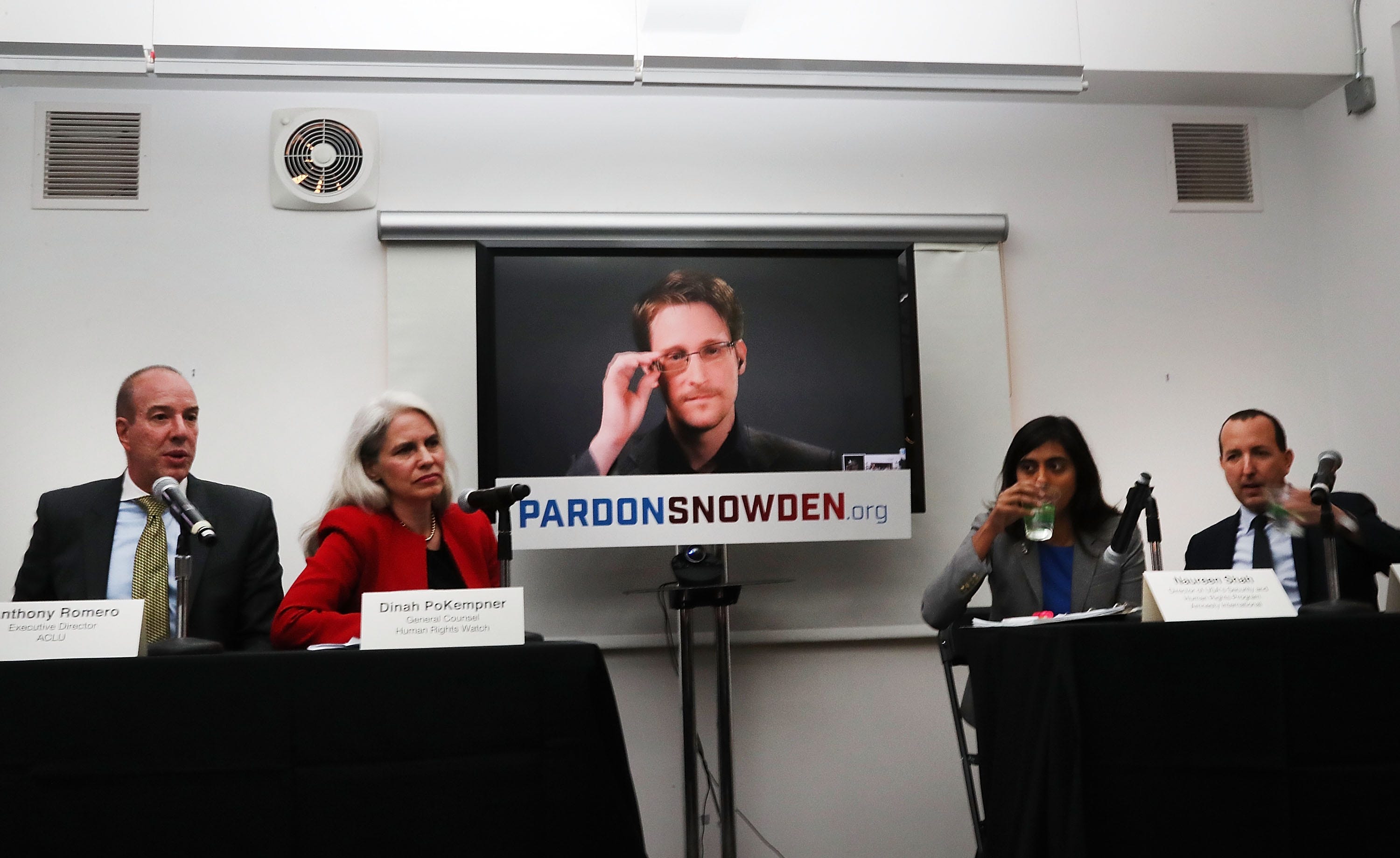
The Case For a Pardon of Edward Snowden by President Trump
The real criminals are those he exposed: the security state officials who illegally and unconstitutionally spied on innocent people by the millions, and who still do so.
Edward Snowden speaks via video link at a news conference for the launch of a campaign calling for a pardon on September 14, 2016, in New York City (Photo by Spencer Platt/Getty Images).
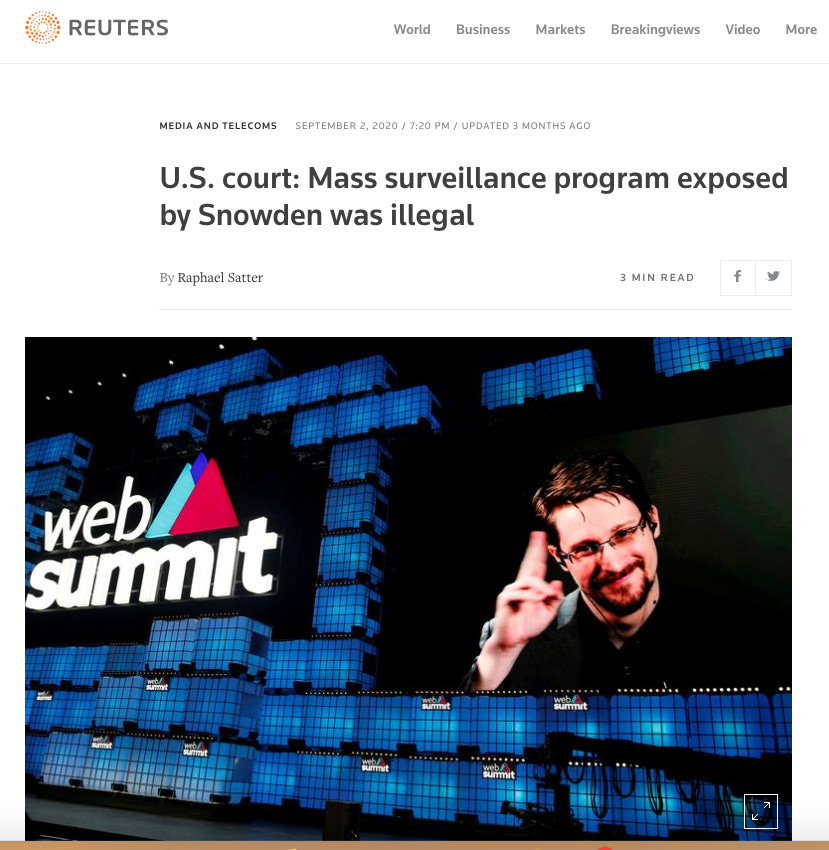
A U.S. appellate court in September unanimously ruled that the NSA's program of mass domestic surveillance was illegal, as well as likely a violation of the Fourth Amendment's guarantee against "unreasonable searches and seizures." The court, and the broader public, knew about this illegal mass surveillance program created by the NSA only because Edward Snowden, while working inside that agency, discovered its existence and concluded in 2012 that the American public has the right know about what was being secretly done to them and their privacy by their own government.
Upon making the decision to blow the whistle on this security state illegality, Snowden delivered the documents relating to that program and other then-unknown systems of mass online surveillance not by dumping them indiscriminately on the internet or selling them or passing them to foreign governments, but by providing them to journalists (including myself) with The Guardian, The Washington Post and other news outlets. The documents Snowden provided were accompanied by requests to report them responsibly. He thus relinquished the power entirely to make decisions about which documents would and would not be published, leaving those decisions exclusively to news outlets.
That meant that Snowden himself never made a single document publicly available; every document that was reported was the result of decisions by newsrooms around the world that their publication would be in the public interest and would not endanger innocent people. That method of whistleblowing chosen by Snowden — patterned after the one Daniel Ellsberg used in 1971 to make the public aware of years of lying to the American public by the U.S. Government about the Vietnam War, when he gave the top-secret Pentagon Papers to The New York Times and asked them to report it in the public interest — enabled journalists to inform the American citizenry about illegal and unconstitutional spying by the U.S. Government in the most responsible manner possible.
Indeed, the very first program we reported — on June 6, 2013 — was the mass domestic spying program which the appellate court just ruled was illegal and likely a violation of the constitutional rights of all Americans. That first article we published revealed a top secret court order under which "the National Security Agency is currently collecting the telephone records of millions of US customers," and required major telecommunications carriers "on an 'ongoing, daily basis' to give the NSA information on all telephone calls in its systems, both within the US and between the US and other countries."
The months of reporting that followed, all singularly enabled by Snowden's courageous whistleblowing, triggered so much vital public debate about privacy and mass surveillance, and fostered so many legal and technological privacy reforms around the world, that the reporting earned virtually every award journalism has to give, including the 2014 Pulitzer Prize for Public Service. For those who have not seen it, the 2014 documentary by Laura Poitras about the work Snowden did with journalists, Citizenfour, which received the 2015 Academy Award for Best Documentary, shows much of the Snowden story in real time and can be viewed on YouTube; the feature film "Snowden," available on Netflix and other platforms, separately explores the trajectory which Snowden traversed from enlisted U.S. Army soldier, CIA contractor and NSA expert to one of this generation's most consequential whistleblowers.
The recent appellate court ruling in U.S. v. Moalin, issued on September 2, emphasized the U.S. surveillance state's sustained law-breaking. "The telephony metadata collection program exceeded the scope of Congress's authorization" and "therefore violated that section of [the Foreign Intelligence Surveillance Act]," the court concluded, referring to the 1978 law requiring the government to first obtain warrants before spying on the communications of U.S. citizens. Though its ruling of illegality meant it was unnecessary to rule definitively on the program's unconstitutionality, the court nonetheless noted that "the government may have violated the Fourth Amendment" with this spying program and warned of the dangers of "the collection of millions of [] people's telephony metadata, and the ability to aggregate and analyze it."
In ruling the NSA's mass surveillance program illegal, the court noted the indispensable role Snowden played in enabling the protection of Americans' rights. It was Snowden, explained the court, who "made public the existence of NSA data collection programs." And, the court added, "Snowden's disclosure of the metadata program prompted significant public debate over the appropriate scope of government surveillance" and ultimately led to reform: "Congress passed the USA FREEDOM Act, which effectively ended the NSA's bulk telephony metadata collection program" and also "prohibited further bulk collection of phone records after November 28, 2015." Moreover, observed the court, it was "news articles in the wake of the Snowden disclosures [which] revealed that the government had been using evidence derived from foreign intelligence surveillance in criminal prosecutions without notifying the defendants of the surveillance."
This recent ruling is by no means the first time a court or other official body has declared illegal the spying programs which Snowden exposed. In 2015, CNN similarly reported that "a federal appeals court ruled on Thursday that the telephone metadata collection program, under which the National Security Agency gathers up millions of phone records on an ongoing daily basis, is illegal under the Patriot Act." The New York Timesreported in 2014 that "an independent federal privacy watchdog has concluded that the National Security Agency's program to collect bulk phone call records has provided only 'minimal' benefits in counterterrorism efforts, is illegal and should be shut down." In 2018, The Guardian reported about the British equivalent of the NSA: "GCHQ's methods for bulk interception of online communications violated privacy and failed to provide sufficient surveillance safeguards, the European court of human rights has ruled."
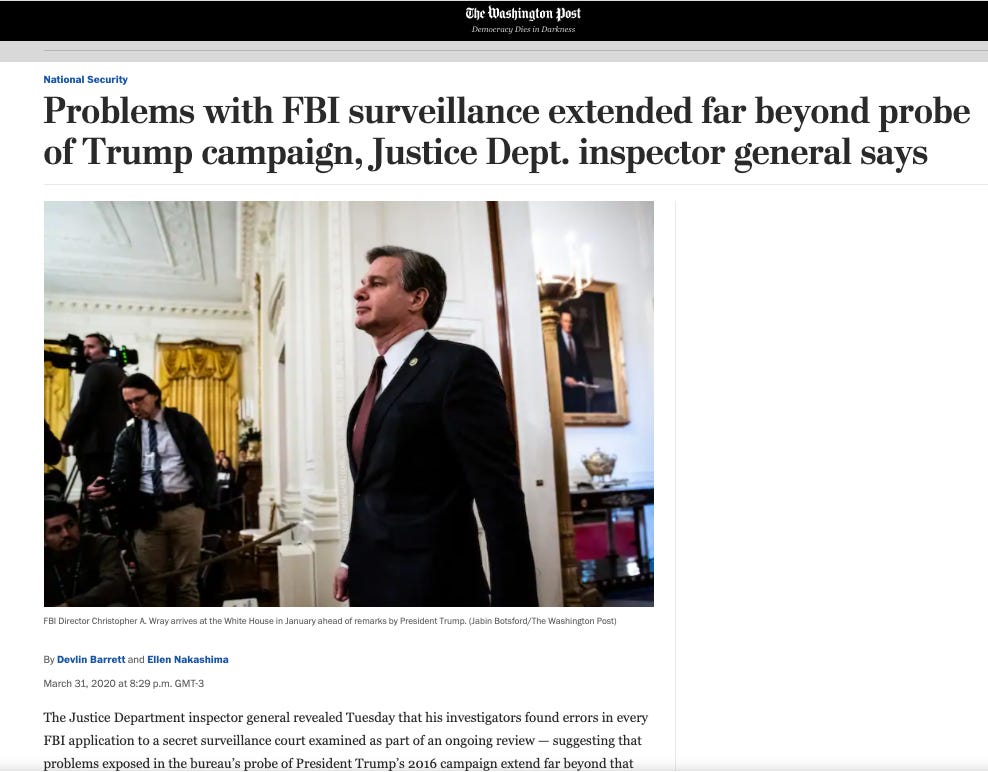
Abuses of power by these agencies continue in full force. More recently, the Justice Department's Inspector General found in 2019 that the FBI deceived the FISA court with false statements to obtain a warrant to spy on former Trump 2016 campaign official Carter Page. A former FBI lawyer pled guilty to doctoring emails to obtain those spying warrants. A DOJ report found more material errors from the FBI in the spying process in 2019. Late last year, the FISA court itself "issued a strong and highly unusual public rebuke to the FBI" and, the prior year, "found that the FBI may have violated the rights of potentially millions of Americans — including its own agents and informants — by improperly searching through information obtained by the National Security Agency's mass surveillance program."
Meanwhile, so many of the arguments against pardoning Snowden, and demanding his lifelong imprisonment or exile, come from the very security state operatives whose crimes he exposed. That includes John Brennan and James Clapper, along with their hawkish and neocon allies such as Susan Rice and Liz Cheney. And to make their case, these Deep State operatives and warmongers rely upon one demonstrable lie after the next. Indeed, it was their blatant lies in the first place that prompted Snowden to knowingly risk his liberty by revealing the existence of these mass surveillance programs.
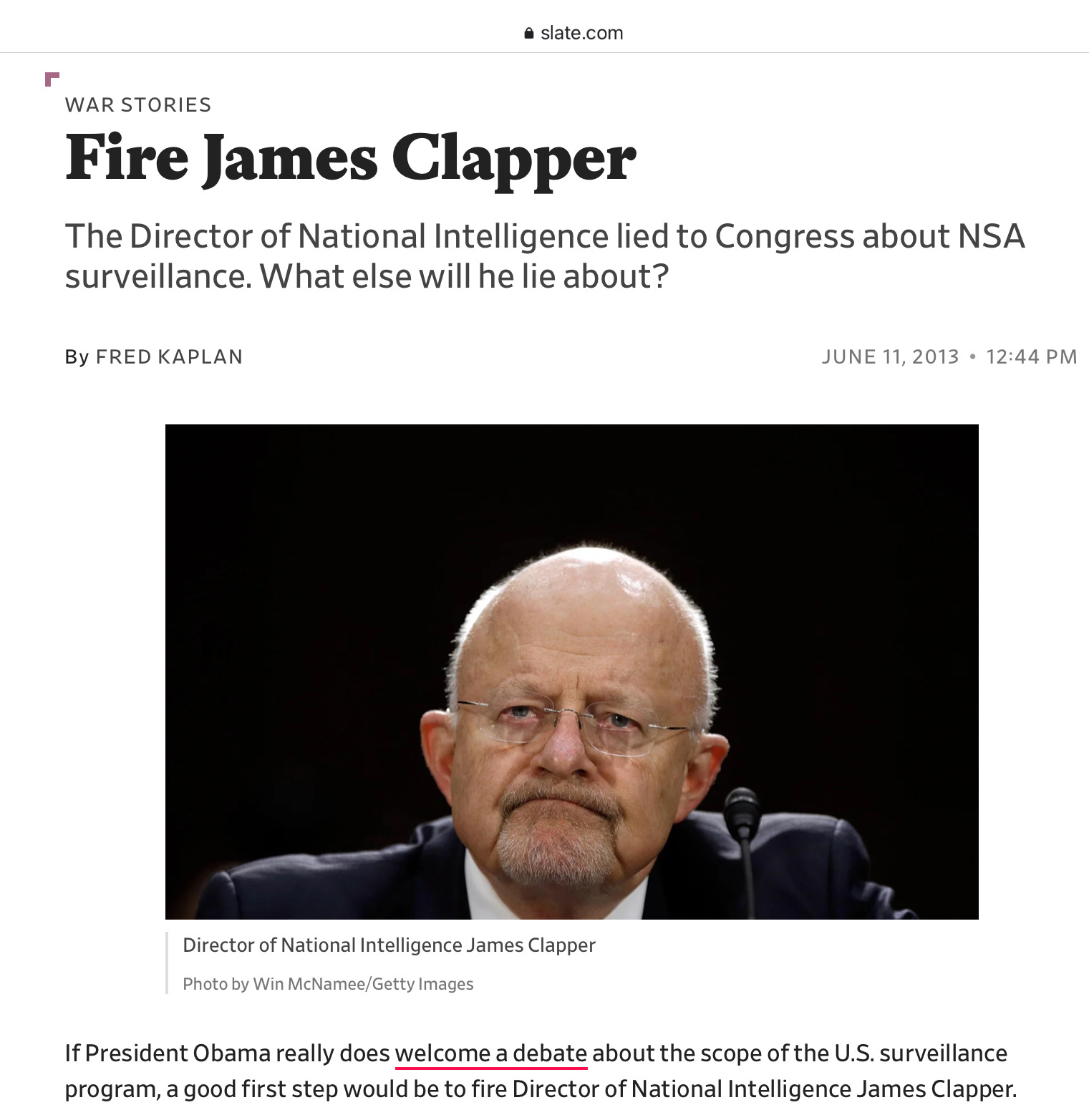
The first contact Snowden made with a journalist about the possibility of whistleblowing was a pseudonymous email he sent to me in December, 2012. But what solidified with finality his decision to blow the whistle was watching President Obama's senior national security official, Director of National Intelligence James Clapper, commit a felony when he blatantly lied to the Senate on March 12, 2013, by falsely denying — when asked by Sen. Ron Wyden (D-OR) — that "the NSA collect[s] any type of data at all on millions or hundreds of millions of Americans."
When Clapper told that lie, Snowden was holding the documents in his hand that proved that the NSA was doing exactly that which Clapper, in his public testimony, denied that it was doing. In other words, he knew for a fact that the senior national security official in the U.S. Government lied to the American people and the Senate about the mass spying they were conducting against Americans. A person in Snowden's position acting with just and noble motives would be impelled to disclose, not conceal, the truth — and that's exactly what Snowden did. The real criminals were security state officials like James Clapper for criminally lying to the Senate and his colleagues in the secret surveillance state who illegally spied on entire populations.
But James Clapper was never prosecuted for lying to the Senate. In fact, he did not even lose his job: he served as Director of National Intelligence for another three years, until the end of the Obama administration. And now this proven liar — like so many security state agents — works inside the corporate media, delivering the "news" for CNN. How can anyone justify wanting to see Edward Snowden rot in prison for life while the real powerful criminal whom he exposed, such as James Clapper, go free and thrive? Who besides a craven authoritarian would regard that as a just outcome?
Speaking of proven liars, those who oppose a pardon of Snowden do so by invariably lying about him and what he did. Why would they do that? It's because the reality is that he acted honorably and for noble ends. So they have to manufacture falsehoods to justify their demands that a hero be punished.
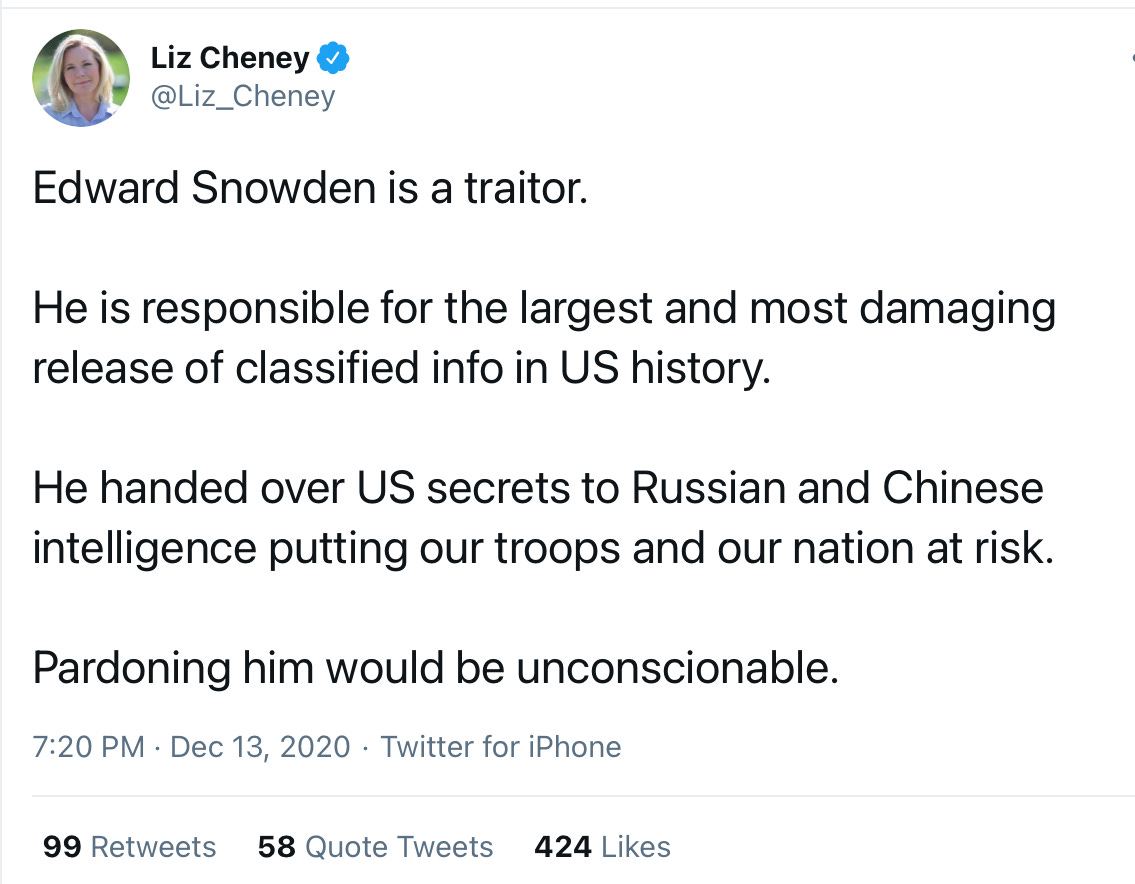
Take, for instance, the completely fabricated accusations voiced Sunday night by Congresswoman Liz Cheney (R-WY), daughter of the former Vice President and key ally of pro-war House Democrats in blocking Trump's plan to withdraw troops from Afghanistan and Germany. To justify her opposition to a Snowden pardon, she just lied outright:
That Snowden "handed over US secrets to Russian and Chinese intelligence" is every bit as much of a lie as those told by her dad in 2002 about Saddam's nuclear weapons stockpiles and alliance with Al Qaeda. She just manufactured this accusation out of thin air. Nobody can ever prove a negative — therefore, nobody can proffer dispositive proof that Snowden (or, for that matter, Liz Cheney) did not turn over U.S. secrets to the governments in Beijing and Moscow — but the burden of proof is on those hurling accusations of this sort to produce evidence for it, and she has none. That's because none exists.
But that does not stop Endless War advocates like Liz Cheney from saying it anyway — precisely because Liz Cheney is a compulsive liar who will say anything to manipulate the public, just like her father taught her to do. The same is true of former CIA Director and provenpathological liar John Brennan. On Monday, he echoed the same false allegation as Liz Cheney did, in order to defend James Clapper and attack Senator Paul for advocating a pardon for Snowden:
If there is any lesson we ought to have learned over the past two decades, it is that nobody should believe the claims of national security operatives without substantial evidence being presented. For anyone who wants to claim or believe that Snowden handed over secrets to Russia and/or China, you should demand evidence first. Where is it?
What makes this claim even more dishonest is that it exploits the fact that the U.S. Government forced Snowden, against his will, to stay in Russia. Snowden's original plan, as has been amply documented, was to fly from Hong Kong after providing us with the archive and reviewing key documents, then transit through Moscow on his way to South America, where he intended to seek asylum in Ecuador or Bolivia.
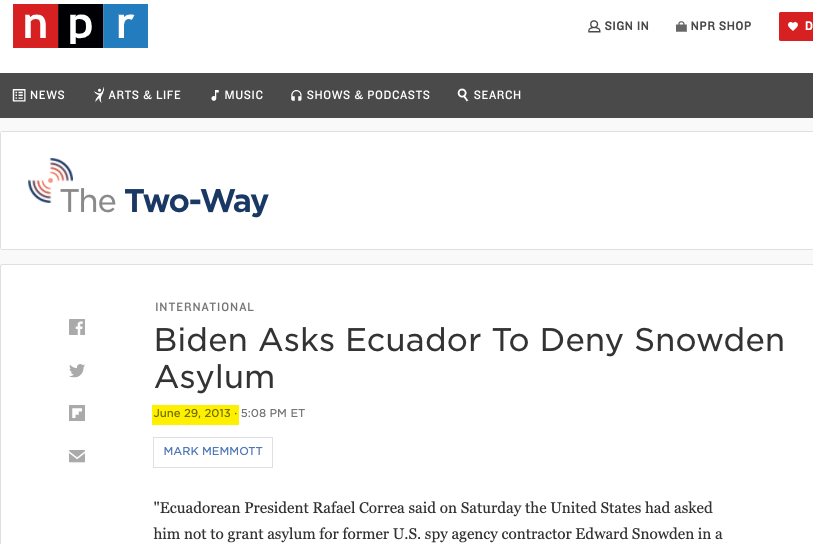
But he was trapped in the Moscow International Airport because the U.S. State Department under John Kerry invalidated his passport while he was in transit, and then-Vice President Joe Biden threatened and coerced every other country considering offering him asylum or allowing him safe passage to South America (as he did with Cuba, which withdrew its offer of safe transit). A 2013 NPR headline tells part of that story: "Biden Asks Ecuador To Deny Snowden Asylum." That was before he obtained asylum in Russia, something he was forced by Obama officials and Biden himself to do.
So U.S. officials first prevented Snowden from leaving Russia, and then, with such audacity and dishonesty, have for years exploited the fact that he's in Russia to manipulate public opinion and smear him as a Kremlin agent. And, as is true for all such allegations that a U.S. citizen is working for Moscow, the accusation is tossed out routinely without any evidence, because there is none.
Then there's the allegation that Snowden caused harm to national security or to innocent people, a claim that has been made against every whistleblower for decades who exposes corruption and criminality by the security state. Just as is true of the claim that Snowden sold or provided secrets to the governments of Russia and China, one should not even consider accepting the truth of this claim absent evidence to corroborate it.
Where is this evidence? Who was harmed by this NSA reporting? Not a single example or piece of evidence has ever been furnished in response to those questions, with the defenders of NSA opting to just repeat the accusation over and over in the hope that people will assume that it is true by virtue of its repetition.
But even if such harm could be established, the argument depends upon a complete distortion of the process used by Snowden to blow the whistle on Deep State criminality. Again, there is not one document from the NSA archive that was published because Snowden chose for it to be published. He used the opposite method for whistleblowing: recognizing that he should not have the power as a single individual to make choices about which documents should and should not be published, he instead gave the archive to journalists and asked that we make those decisions editorially, in as responsible a manner possible, guided by the standard journalistic public interest assessment.
That means that if there were documents that people believe should not have been disclosed, the choice to publish those documents rested with the top editors at leading media outlets — The Guardian, The Washington Post, The New York Times, NBC News and other outlets around the world — not with Snowden, who was never even consulted on these choices. Once Snowden realized the magnitude of criminality, deceit and corruption inside the security state, he concluded that the most just course was to turn over to journalists a massive archive regarding these programs, so that it was not up to him to curate in advance which documents should be seen by the public, but instead leave it to experienced journalists to make those determinations.
Then there's the claim — based on a substantial set of falsehoods — that Snowden somehow acted improperly by fleeing the U.S. to seek refuge in Russia rather than submitting himself to the U.S. justice system in order to "make his case", a falsehood-drenched allegation voiced most memorably by Obama national security adviser Susan Rice to Charlie Rose in 2014:
The claim that Snowden should have or could have come back to the U.S. to convince a jury that what he did was justified is nothing short of a lie. Under the archaic statute which the Obama administration aggressively used to prosecute more whistleblowers than all previous administrations combined — the Espionage Act of 1917 — someone is automatically guilty if they provide classified information to a person who is unauthorized to receive it (including a journalist), and they are absolutely barred even from raising a "justification" defense in court.
In other words, as Susan Rice well knows, Snowden would not be able to return to the U.S. and try to convince a jury of his peers that what he did was justified because the law under which they chose to prosecute him does not allow a defendant even to raise that as a defense. Instead, this old statute ensures a rigged process where a guilty verdict is all but inevitable. That's precisely why Obama officials and security state operatives use this 103-year-old law — originally designed by Woodrow Wilson to criminalize dissent from U.S. participation in World War I — against whistleblowers who expose their crimes not by acting with foreign governments but with journalists.
Then there's the reality that — as Daniel Ellsberg argued in a Washington Post op-ed about Snowden's leaving the U.S., headlined "NSA leaker Snowden made the right call" — those who are now accused of endangering national security have essentially no chance of obtaining a fair trial in the U.S. "The country I stayed in was a different America, a long time ago," Ellsberg wrote, adding:
I hope Snowden's revelations will spark a movement to rescue our democracy, but he could not be part of that movement had he stayed here. There is zero chance that he would be allowed out on bail if he returned now and close to no chance that, had he not left the country, he would have been granted bail. Instead, he would be in a prison cell like Chelsea Manning, incommunicado.
He would almost certainly be confined in total isolation, even longer than the more than eight months Manning suffered during her three years of imprisonment before her trial began recently. . . .
Snowden believes that he has done nothing wrong. I agree wholeheartedly. More than 40 years after my unauthorized disclosure of the Pentagon Papers, such leaks remain the lifeblood of a free press and our republic. One lesson of the Pentagon Papers and Snowden's leaks is simple: secrecy corrupts, just as power corrupts….
But Snowden's contribution to the noble cause of restoring the First, Fourth and Fifth amendments to the Constitution is in his documents. It depends in no way on his reputation or estimates of his character or motives — still less, on his presence in a courtroom arguing the current charges, or his living the rest of his life in prison. Nothing worthwhile would be served, in my opinion, by Snowden voluntarily surrendering to U.S. authorities given the current state of the law.
The idea that you must meekly submit to the world's most aggressive Prison State, where the rules are made by the very high officials whose crimes you exposed, is authoritarian dreck.
Snowden well knew, when he decided to inform his fellow citizens of these systems of mass surveillance, that there was a very high probability that he would end up in a maximum security U.S prison for decades if not the rest of his life. That's precisely what made Snowden's actions so courageous: how many people would be willing to make that sacrifice? But that does not mean Snowden has some moral obligation to help an unjust state keep him in a cage for life out of vindictive vengeance because he exposed their crimes.
President Trump has, on two occasions, indicated that he was considering the possibility of pardoning Snowden. A pardon is not only just on its own terms but would also be an expression of exactly the reason the U.S. Constitution vests the unilateral pardon power in the U.S. President: to prevent the abuse of the justice system for vindictive ends or to shied abuses of official power by those who operate in the dark (my arguments for why the ongoing attempted extradition and prosecution of Julian Assange is also a massive abuse of power have been set forth in prior articles as well as in a show I produced on the topic).
Even if you're someone who believes that Snowden ought to be punished in some way — and I am not — he has been. Seven years in exile, separated from your friends, family and fellow citizens, in a country in which you never chose to live and to which you have no connections, is a serious deprivation. That is particularly true now that Snowden's long-time partner, his American wife Lindsay Mills, announced that the couple is expecting their first child in January, a son who will automatically be a U.S. citizen and who should have the right to live with both of his parents in his country of citizenship.
For decades, it was a staple of left-wing politics that the CIA and the secret security state, long referred to by scholars as the Deep State, pose a grave threat to core democratic values and constitutional rights. Over the last five years, beginning with the 2016 election, the Trump movement and Trump himself has seen up close and personal how easily and casually those powers are abused, and how destructive are the results, as the president himself said when he told The New York Post why he was considering this pardon.
A pardon of Edward Snowden would be one of the greatest blows against Deep State abuse of secrecy and spying power in decades: probably the most significant act since President Eisenhower's 1961 warnings in his Farewell Address about the growing anti-democratic dangers of the "military industrial complex" or, at the very least, the mid-1970s reforms of the intelligence community.
A pardon of Snowden by Trump would prompt bipartisan cheering across the U.S. and would engender support globally across the ideological spectrum. The only ones angered by it would be exactly those people — John Brennan, James Clapper, Jim Comey, Susan Rice — whose ongoing ability to abuse their spying power against the U.S. population depends upon their vindictive use of the justice system to destroy the lives of those who reveal their crimes.
Our ancestor John Dane was born in Hertfordshire, England-- probably in the hamlet of Little Berkhamsted. He and his wife, Frances, were shocked when their older son, also named John Dane, probably about 20 years old and already working as a tailor, was enthusiastic about joining the Puritan Great Migration, to set up a more godly dominion in the newly established Massachusetts Bay Colony.
Here is young John's own statement, made years later:
"To return to the way and manner of my coming.... My father and mother showed themselves unwilling. I sat close by a table where there lay a Bible. I hastily took up the Bible, and told my father if, where I opened the Bible, there I met with anything either to encourage or discourage, that should settle me. I, opening of it, not knowing more than the child in the womb, the first I cast my eyes on was: 'come out from among them, touch no unclean thing, and I will be your God and you shall be my people.' My father and mother never more opposed me, but furthered me in the thing, and hastened after me as soon as they could." From that time forward, Dane reported, "[I] bent myself to come to New England, thinking that I should be more free here than there from temptations" Parents John and Frances and their other two childern, our ancestor Francis and his sister Elizabeth, followed young John to the New World, probably before 1636 (the year wife Frances died).
John had been a widower for at least 7 years when he married his second wife, Annis Bayford Chandler.
Immigrant John was 68 years old when he died.
See http://www.milkcanpapers.com/dane0-2.html for more information.
A Guide to Russia's High Tech Tool Box for Subverting US Democracy
A dead dog in Moscow. A dead dissident in London. Twitter trolls run by the Kremlin's Internet Research Agency. Denial of service attacks and ransomware deployed across Ukraine. News reports from the DC offices of Sputnik and RT. Spies hidden in the heart of Wall Street. The hacking of John Podesta's creamy risotto recipe. And a century-old fabricated staple of anti-Semitic hate literature.
At first glance these disparate phenomena might seem only vaguely connected. Sure, they can all be traced back to Russia. But is there any method to their badness? The definitive answer, according to Russia experts inside and outside the US government, is most certainly yes. In fact, they are part of an increasingly digital intelligence playbook known as "active measures," a wide-ranging set of techniques and strategies that Russian military and intelligence services deploy to influence the affairs of nations across the globe.
As the investigation into Russia's influence on the 2016 election—and the Trump campaign's potential participation in that effort—has intensified this summer, the Putin regime's systematic effort to undermine and destabilize democracies has become the subject of urgent focus in the West. According to interviews with more than a dozen US and European intelligence officials and diplomats, Russian active measures represent perhaps the biggest challenge to the Western order since the fall of the Berlin Wall. The consensus: Vladimir Putin, playing a poor hand economically and demographically at home, is seeking to destabilize the multilateral institutions, partnerships, and Western democracies that have kept the peace during the past seven decades.
The coordinated and multifaceted Russia efforts in the 2016 election—from the attacks on the DNC and John Podesta's email to a meeting between a Russian lawyer and Donald Trump Jr. that bears all the hallmarks of an intelligence mission—likely involved every major Russian intelligence service: the foreign intelligence service (known as the SVR) as well as the state security service (the FSB, the successor to the KGB), and the military intelligence (the GRU), both of which separately penetrated servers at the DNC.
Understanding just how extensive and coordinated Russia's operations against the West are represents the first step in confronting—and defeating—Putin's increased aggression, particularly as it becomes clear that the 2016 election interference was just a starting point. "If there has ever been a clarion call for vigilance and action against a threat to the very foundation of our democratic political system, this episode is it," former director of national intelligence James Clapper said this spring. "I hope the American people recognize the severity of this threat and that we collectively counter it before it further erodes the fabric of our democracy."
Indeed, Western intelligence leaders have warned throughout the spring that they expect Russia to use similar tricks in German parliamentary election this fall, as well as in the 2018 US congressional midterms and the 2020 presidential race. "Russia is not constrained by a rule of law or a sense of ethics—same with ISIS, same with China," says Chris Donnelly, director of the UK-based Institute for Statecraft. "They're trying to change the rules of the game, which they've seen us set in our favor."
Russia's active-measures playbook, according to public and private-sector investigators, dates back to Czarist Russia and the beginning of the Soviet Union. It has been honed and deployed over decades to advance Russian interests both at home and abroad—and has long been driven by a consistent geopolitical worldview, executed in distinct ways, and guided by a unique tradecraft philosophy at odds with the approach of Western intelligence services.
But enough throat clearing. Let's break it down, shall we?
THE GRAND STRATEGY
When he began his run for president, Donald Trump had almost certainly never heard of Valery Gerasimov. But the Russian general's vision for war in the 21st century will almost certainly help define Trump's administration in the history books. Gerasimov, who has spent more than 40 years in the Soviet and Russian military, is a complicated figure in global geopolitics: He is under international sanctions for his role in Russia's illegal annexation of Crimea and its destabilizing war in eastern Ukraine, yet by dint of his office is the man US Gen. Joseph Dunford, chairman of the joint chiefs of staff, sat down with personally in March to discuss Syria.
Russia's first deputy defense minister and chief of the general staff of the Russian Armed Forces, general Valery Gerasimov, center, in Moscow's Red Square ahead of a Victory Day military parade, May 9, 2017.
Mikhail Metzel/Getty Images
A few months after taking over as Russia's chief of the general staff, Gerasimov outlined his vision for a 21st-century style of warfare. It erased the boundary between peace and war and relied on emerging technologies to provide a level of deniability for the Russian military. "In the 21st century…wars are no longer declared and, having begun, proceed according to an unfamiliar template," he explained in a February 2013 article in the Russian journal, Military-Industrial Courier. Later, he outlined a coordinated and multi-pronged approach to warfare that relies on asymmetric tools to open up "a permanently operating front through the entire territory of the enemy state."
In other words, times have changed. "The focus of applied methods of conflict has altered in the direction of the broad use of political, economic, informational, humanitarian, and other nonmilitary measures—applied in coordination with the protest potential of the population," he wrote. These tools, he said, would be "supplemented by military means of a concealed character," like special forces. Only in the final stage of a conflict would uniformed military be deployed, usually "under the guise of peacekeeping and crisis regulation."
Gerasimov's conception of modern conflict—now enshrined as Paragraph 15(a) of the official Russian military doctrine, published in December 2014—is perhaps the clearest current-day explanation of the coordinated doctrine that Lenin and Stalin might recognize. And it is almost stage-by-stage the playbook Russia used to annex Crimea and destabilize eastern Ukraine. "Russia's concept of conflict does not distinguish between hybrid and classical warfare—there is simply warfare," says Ben Nimmo, who studies Russian influence operations for the Atlantic Council.
The roots of those active measures go deep—and they are key to comprehending the way that Russia's leaders have viewed global affairs for a century. "Looking back at the Soviet Union, they're establishing an understanding that the world is completely hostile to them," Donnelly says. "They're in a constant state of conflict with the capitalist world. They've developed from the very start a military doctrine which is a structured framework of thinking, a very disciplined approach, and a precise terminology."
Perhaps the first identifiable active-measures operation, Nimmo says, was the 1903 publication of "The Protocols of the Elders of Zion," a fabricated anti-Semitic pamphlet circulated by the Czarist Russian police that described a Jewish plot for world domination. Its purpose: to give a pretext for Russia's anti-Jewish pogroms. In the decades since, the active-measures toolbox has expanded and evolved as technologies and adversaries have, but the core of the efforts remains the same. "In some ways, it's very old-fashioned," says Robert Hannigan, who until this spring headed the Government Communications Headquarters, the British equivalent of the National Security Agency.
"It's the same playbook they used in the Cold War era," says Clint Watts, a researcher at the Foreign Policy Research Institute. In the 2016 election, he says, Russia "just used a digital battlefield instead of an analog one. They didn't do anything in terms of strategic doctrine that was different. It was just much easier to execute in cyberspace and social media than they could have ever done in the 1980s, for example."
And why not? As far removed as US politics may feel from the dark days of the Cold War—at least until recently—the Russian leadership remains dominated by those who began their careers rising through ranks controlled by stalwarts of the Communist Party. Putin began as a KGB officer, and today nearly all of his top advisers are aging products of the Cold War: Gerasimov is in his early 60s. Putin's top foreign policy adviser, Yuri Ushakov—Sergey Kislyak's predecessor as ambassador to the US—turned 70 in March, and the long-serving foreign minister, Sergey Lavrov, is 67. The men who head the three main intelligence services are all in their early 60s and graduates of the Soviet Union's top intelligence and military academies. "There's no X-ray into someone else's thoughts, but judging from my own soul, which I know well, we grew up in the Soviet Union seeing the US as the enemy," Andrei Kozyrev, who served as Russia's foreign minister in the 1990s, tells me.
Putin came to power—and held onto it—during a violent and turbulent time in Russia, a period that reinforced his mentality that the West is a constant, sustained adversary in geopolitics, not a partner for peace. That approach has given him and his leadership a fundamentally different worldview. "In the main, Western politicians—especially in Europe—have a peacetime approach," Donnelly says. "They've thrived amid slow rates of change and a stable, rules-based system. Putin is the antithesis of this."
While the operations against the 2016 election caught many in the US by surprise—officials in both the White House and the intelligence community have explained in recent months that their response was slowed by their failure to imagine that Russia would be so bold and coordinated in attacking the foundational pillars of a democratic election—Russia's leadership simply sees it as the latest chapter in a long-running shadow battle.
Indeed, all of the operations—from those used in Russia's war with Georgia in 2008 to those used to influence the Brexit referendum and the US election in 2016—are deployed with a singular goal in mind: to undermine Western democracies and weaken the multilateral alliances that Russia sees opposing its future, from NATO to the European Union (not to mention the international institutions—like the internet itself—that were created without much Russian input).
Michael McFaul, a Stanford political science professor who served as Barack Obama's second-term ambassador to Moscow, says that as much as Obama tried to adopt what he called "win-win outcomes," Putin sees the world as zero-sum game. And given Russia's economic and demographic weaknesses right now, it's easier to tear down the West than it is to build up things domestically. "The long-run objective is to have democracy break down," Watts says. "To have so many internal divides and so many fights between elected officials that there is no policy—which is exactly where we're at in the United States right now."
THE TOOLS
So what, specifically, is in the bag of tricks?
At the broadest level, modern Russian active measures break down into at least eight distinct types, ranging from traditional diplomacy to covert assassinations. While each tool is important in its own way, it's the combination of Russia's efforts that make them so effective internationally. And they are self-reinforcing, because in Russia the intelligence apparatus, business community, organized crime groups, and media distribution networks blend together, blurring and erasing the line between public and private-sector initiatives and creating one amorphous state-controlled enterprise to advance the personal goals of Vladimir Putin and his allies.
Whereas many Kremlin efforts encompass two or more of these tools at once—and nearly all of them are visible in the still-unfolding investigation into the Trump campaign's ties to Russia—Western intelligence officials break down Russia's active measures into these distinct tactics:
Disinformation
Dezinformatsiya, as its known in Russia, is an umbrella term for so-called information influence operations that seek to muddy the political waters. It can involve both overt state-sponsored media—like the Russian news channels RT and Sputnik, which recently launched a radio station in DC—as well as less fringe news sites and, in recent years, a rising number of Twitter trolls and social media bots.
Yet as much as Twitter trolls dominate the headlines, driving online conversation by appearing to cause groundswells of conversation around pro-Kremlin hashtags, they represent just the tip of a coordinated and voluminous Russian message spear. "The bots and trolls are important, but they're maybe 10 percent of the tools that are used. They're used for amplification and they're used for bullying," says one European official who requested anonymity because he wasn't authorized to speak publicly about the Russian threat. "There's so much more in the disinformation ecosystem that we should be concerned about."
For instance: Russia's legions of highly paid Washington lobbyists. The PR firm Ketchum represented the country for nine years, until 2015, and collected more than $60 million, according to federal lobbying disclosures, to advocate for and guide Russia through the capital. Its high-profile public victories were few, with the highlight being a September 11, 2013, op-ed in The New York Times by Vladimir Putin in which the Russian leader criticized American exceptionalism.
Russian President Vladimir Putin
Maxim Strashko/Getty Images
Beyond those PR efforts, which include regular "Russia Beyond the Headlines" inserts into The Washington Post, the Kremlin also appears to finance a number of less-visible news outlets around the world, often targeted to specific audiences—like financial news readers—or language populations. "Their readership is much higher than you might think. They're really good on social media," the European official says, explaining that one survey had mapped thousands of Russia-linked channels in dozens of countries. "We don't know how many disinformation channels there are," he says. "They have the full spectrum from full conspiracy to more trustworthy-appearing. It's information carpet-bombing—let's hit as many tools as we can." (In 2015 The New York Timesdocumented at length the countless hoaxes launched by just one of these groups, the Internet Research Agency, a troll farm in St. Petersburg.)
The reach of these efforts encompasses all levers of Russian power. One European researcher recalled with dark appreciation meeting a Russian Orthodox priest in a small city in the Czech Republic who ably parroted Kremlin propaganda and explained how he regularly received church bulletins reporting "the truth about Russia." As the researcher says, "Here was a priest speaking to a tiny population in a mostly atheist country, and he was still looped into the latest from the Kremlin."
Of course, not all of these efforts succeed—Sputnik shuttered many of its Scandinavian-language sites after they failed to gain traction in countries where English is widespread—but the cumulative impact can be quite effective, muddying the waters across the political spectrum. According to a report that examined the effect of Russian disinformation efforts in central Europe, "Although Russia has not been able to win the hearts and minds of the people in this region, it has managed to enchant them, ensuring that they are confused and frustrated, full of negative emotions toward their own values and institutions." The report concluded that, "the goal of Russian propaganda is not necessarily to convince people that the Russian view of the world is the right one or that their interpretation of events is better, but rather to destroy and undermine confidence in the Western media."
Sometimes, too, Russia finds a witting or unwitting ally in its information efforts. The most high-profile example of the past 18 months, of course, has been Donald Trump. Every time he tweets "#FAKENEWS" about a story that is, in fact, true, he helps undermine the trust and confidence in a free and independent press. As Watts says, "Not only was the Trump team willing to discuss with the Russians how to go about this—that's sort of coming out—but they were repeating verbatim themes pushed by the Kremlin: 'Clinton isn't healthy.' 'She can't endure.' 'Clinton is corrupt.' 'Clinton emails.' All of that was pumped very heavily by the Russians even before Trump was a serious candidate. Then going into the last two months: 'Election fraud, vote rigged, Sanders got a raw deal.' It was all started by the Kremlin, and Trump repeated all of it."
Cyber
Perhaps nowhere is the blurring of lines between intelligence operations and organized crime groups more clear than in cyberspace, where Western law enforcement officials say that they've seen a steady rise of hybrid operations involving both organized crime and Russian officials. During the 2014 invasion of Ukraine, the FBI watched as Evgeny Bogachev, who was indicted for running the GameOver Zeus botnet—a complex financial fraud that stole more than $100 million from US banks—used his network of malware-infected computers to mine for classified information about Ukraine, Georgia, Turkey, and other Russian adversaries. Similarly, this spring, US authorities indicted four people—two Russian intelligence officers and two notorious Russian cybercriminals—for the hacking of nearly a billion Yahoo accounts.
The FBI's wanted poster for Evgeniy Bogachev, who, during the 2014 Russian invasion of Ukraine, used his network of malware-infected computers to mine for classified information about Ukraine, Georgia, Turkey, and other Russian adversaries.
The government itself employs sophisticated hacking teams. According to US investigators, the hack of the DNC's servers was apparently the work of two separate Russian teams, one from the GRU and one from the FSB, neither of which appears to have known the other was also rooting around in the Democratic Party's files. From there, the plundered files were laundered through online leak sites like WikiLeaks and DCLeaks, the later of which, cybersecurity researchers say, is a front for the GRU. Their impact on the 2016 election was sizable, yielding months of damaging headlines and helping confuse voters about whether Hillary Clinton's emails as secretary of state had been compromised by the Russian government. Trump himself mentioned Wikileaks and the emails at least 164 times in the final month of the campaign, saying at one point, "Boy, that WikiLeaks has done a job on her, hasn't it?"
But Russia's cyber efforts have not been limited to financial fraud and information operations. More nefariously, Russia has repeatedly deployed cyber-activities in countries like Estonia and Ukraine, as WIRED's Andy Greenberg traced in his cover story this spring, "How to Turn a Country Off." The targeting of critical infrastructure like electrical grids and the mass disruption of online commerce and services through distributed denial of service attacks (which flood computer networks with bogus web traffic) remains just shy of overt warfare, allowing Russia to advance its geopolitical goals while remaining below the threshold that would prompt a real-world military response.
Beyond attacks on nation states, though, these cyber operations relentlessly pursue individual critics of the regime as well. Last summer, the World Anti-Doping Agency announced that hackers—believed to be linked to the Russian government—had accessed the personal information and address of Yulia Stepanova, an 800-meter runner who had been a key whistle-blower in Russia's long-term athletic doping efforts. The announcement forced Stepanova, who had already fled to the US for safety, to move again to a new, undisclosed location.
Energy
Russia boasts the world's largest natural gas reserves and the seventh-largest oil reserves and has long viewed Europe's dependence on its hydrocarbons—roughly a third of Europe's oil comes from Russian pipelines, as does even more of its natural gas—as a tool to be deployed geopolitically, especially since its top energy companies, like the state-owned Rosneft and Gazprom, are closely allied with Putin's inner circle.
Since 2006, Russia has repeatedly played politics with its gas exports, each time with the goal of punishing Ukraine. In the winter of 2009, during a dispute with Ukraine, Russia dramatically reduced the amount of natural gas piped into that country, which had the downstream effect of paralyzing other eastern European neighbors like Bulgaria, Greece, Macedonia, and Croatia. The move sparked immediate crises, as industry was hobbled and fuel for heat became scarce in the middle of a cold snap.
The weaponization of oil and gas, though, has been only partially successful. For one thing, Russia is simply too reliant on the hard currency that foreign oil and gas sales provide, and the sustained low cost of oil is wreaking havoc on the Russian economy. Meanwhile, the rise of shale oil, liquefied natural gas, and renewables like wind and solar is allowing European nations to diversify and draw on a wider set of options to heat their homes and power their economies.
At the same time, though, Russia and Europe are moving forward with the Nord Stream 2 pipeline, which would bypass eastern Europe and deliver natural gas straight to Germany, increasing that country's reliance on Russian exports even as it provides a potential pathway for Russia to cut off Ukraine's gas supply without affecting its neighbors.
A Rosneft oil rig in the Khatanga Bay, photographed on April 3, 2017. The company is closely aligned with Putin's inner circle, and since 2006 Russia has repeatedly played politics with its gas exports.
Vladimir Smirnov/Getty Images
Money
The long-standing ties between Russian business and the more shadowy worlds of intelligence and criminal enterprise has meant that there's no shortage of cash to throw around to advance Russia's interests overseas and woo possible help.
According to US and European intelligence officials, Russia regularly funnels cash to fringe political parties across Europe that might trumpet pro-Kremlin rhetoric, a practice datindg back to the Cold War. The US has not been exempt from this practice: During the 1968 presidential campaign, the long-time Soviet ambassador Anatoly Dobrynin offered financial assistance to Richard Nixon's opponent, Democratic candidate Hubert Humphrey—only to have the aid firmly rejected.
Not all candidates—or business leaders—are as quick to refuse Russian money. "Money is a weapon used to buy weapons," Donnelly says. "How many Brits take 'consultancy' payments from Russian companies? How seriously is the British ability to respond to Russian geopolitical aggression compromised because of the hundreds of millions that have been laundered—I mean invested—in London? The answer is: considerably."
In many ways, these ties between Russian officials, oligarchs, and commercial enterprises make it hard to separate out business, politics, and espionage. According to Senate testimony this summer by hedge fund leader turned anticorruption activist Bill Browder, Putin has struck a deal with the country's oligarchs that allows them to pillage the country's economy in exchange for personal kickbacks. "From that moment on, Putin became the biggest oligarch in Russia and the richest man in the world," Browder said. Recent revelations from the Panama Papers have shown that Putin's closest childhood friend, Sergei Roldugin, a famous cellist, received $2 billion from Russian oligarchs and the Russian state.
When the Russian SVR intelligence service tried in 2013 to recruit Carter Page, who went on to be a foreign policy adviser to the Trump campaign, it was partly because Page wanted to do business with Gazprom. One Russian SVR officer was caught on an FBI listening device saying about Page: "He got hooked on Gazprom thinking that if they have a project, he could rise up. Maybe he can. I don't know, but it's obvious that he wants to earn lots of money. For now his enthusiasm works for me. I also promised him a lot: that I have connections in the Trade Representation, meaning that you can push contracts [Laughs.] I will feed him empty promises."
Donnelly says he thinks that if Trump himself were ever targeted by Russian intelligence as part of his business dealings in Russia, it wasn't because of any prescience. It was just business as usual inside Russia. "The Russians didn't identify Donald Trump six years ago as a likely president." Donnelly says. "Every rich powerful person heading to Moscow is going to be targeted."
Violence
Then there's what is known as Mokroye Dyelo, the so-called "wet business" of beatings and assassinations that have long targeted regime critics and potential threats like Marxist revolutionary Leon Trotsky, murdered in Mexico City in 1940. The goal isn't the elimination of overseas criticism but merely to inject enough fear into the Russian diaspora that it remains quiet and docile.
In the past few decades, dozens of Russian officials and Putin critics have died under suspicious circumstances. Often the assassinations are brazen, intended to send a message that public criticism will only be tolerated for so long. In 2006, former FSB officer Alexander Litvinenko was poisoned in London by radioactive polonium, a particularly noisy method of murder. Just a month before Litvinenko's death, the muckraking journalist Anna Politkovskaya was shot to death in Moscow on Putin's birthday. More recently, opposition leader Boris Nemtsov was gunned down within view of the Kremlin. And this spring, another opposition candidate, Alexei Navalny, suffered an eye injury after he was attacked on the street with a chemical agent. Another political activist, Vladimir Kara-Murza, who testified before the US Congress this spring, said that he'd twice been poisoned, both times hovering near death in a coma.
Russian police investigators stand near the body of Russian opposition leader and former deputy prime minister Boris Nemtsov, who was gunned down on Bolshoi Moskvoretsky bridge near St. Basil Cathedral on February 28, 2015, in central Moscow.
Sasha Mordovets/Getty Images
Another favorite of Russia's special services is the "suspicious suicide," like the December 2007 death of banker Oleg Zhukovsky, who had opposed the Kremlin's efforts to take over his financial institution. According to authorities, Zhukovsky killed himself after pinning a suicide note to his chest, tying himself to a chair, placing a bag over his head, and throwing himself into his swimming pool.
More recently, it hasn't escaped the notice of investigators and intelligence services that there have been a number of suspicious deaths tied to the 2016 election operation, including a one-time KGB official who appears to have been a source for the infamous Christopher Steele "dossier" assembled about alleged Trump ties to Russia. "Follow the trail of dead Russians," Watts told the US Senate this spring during a hearing about Russia's interference in the election. "There have been more dead Russians in the past three months that are tied to this investigation. They are dropping dead, even in Western countries."
Russian "wet business" doesn't always involve humans: US diplomats were aghast when, as part of an escalating harassment campaign against American officials in Moscow in the years since Putin retook office in 2012, Russian intelligence broke into the home of the US Embassy's defense attaché and killed his dog.
Kompromat
While intelligence agencies the world over routinely blackmail and exploit emotional pressure points, Russia has long excelled in the use of kompromat, compromising material of a financial, sexual, or health-related nature that can coerce covert cooperation—or silence critics.
The history of Russian politics is dotted by the release of compromising sex tapes—one of which, authentic or not, helped lead to the firing of a prosecutor investigating Boris Yeltsin's government. In August 2009, an American diplomat named Kyle Hatcher was caught up in a scandal over what the US Embassy declared was a faked sex tape that mixed video of Hatcher with scenes of another couple having sex. "Clearly the video we saw was a montage of lots of different clips, some of which are clearly fabricated," ambassador John Beyrle told ABC News at the time, pointing to the fact that Hatcher worked on outreach to human rights groups as one reason he was likely targeted. "There may be some people here who don't like that job description and would like to discredit him in the eyes of his contacts."
Visiting journalists, diplomats, and influential figures are warned to beware of "honeypots," people trying to seduce them or strangers offering deals that are seemingly too good to be true. Donnelly says he's seen all too many people fall victim to such ploys, nearly all of which play out in similarly damaging ways—like when a senior manager at a US bank branch in Moscow was targeted for blackmail and eventually had to be pulled out of the country. "That gets him out of Russia, but it doesn't solve the problem," Donnelly says. "Now you have someone the Russians can blackmail operating in London, who can be pressured to do things."
Espionage
Russia takes special advantage of the openness of Western democracies to conduct advanced spying operations, leaning heavily on its UN consulate staff in New York to cloak intelligence officers under diplomatic cover. But Russia has also excelled over the years at hiding "nonofficial cover" agents, so-called NOCs, inside US society.
In 2010, after a years-long investigation known as Operation Ghost Stories, the FBI arrested 10 "sleeper" SVR agents who had been living under "deep cover" for years, working in seemingly apolitical jobs along the East Coast. That case, which inspired the FX series The Americans, captured the public imagination in part because the arrests included Anna Chapman, a striking redhead who became front-page tabloid fodder.
In early 2015, the FBI arrested another NOC, Evgeny Buryakov, who had been working in the New York office of the Russian investment bank VEB. Buryakov was expelled from the country earlier this year after spending more than a year in federal lockup—the first Russian intelligence officer to be imprisoned in the US in four decades.
In this courtroom sketch, Evgeny Buryakov, center, and his attorneys Daniel Levin, left, and Scott Hershman attend a federal court hearing on Friday, March 11, 2016, in New York City. Buryakov pleaded guilty to conspiracy and agreed to a 2 1/2-year prison sentence.
Elizabeth Williams/AP
Others cases have demonstrated the depth and breadth of Russian intelligence operations within the US. In 2012, the FBI arrested 11 people in Texas on charges of participating in what it called a "Russian military procurement network," smuggling high tech tools out of the US. In 2015, one of those involved, businessman Alexander Fishenko, pleaded guilty to a 10-year effort helping smuggle more than $50 million in illegal technology to Russia through his Houston business, Arc Electronics. "Arc would receive shopping lists from Russian entities, and they would go about acquiring the parts on the shopping lists," FBI agent Crosby Houpt testified.
Not all spies are caught or expelled, though—many operate under close surveillance by the FBI, which is responsible for domestic counterintelligence efforts. The FBI maintains surveillance posts that watch the entrances and exits at Russian missions across the country. Neighbors have long joked about suspiciously empty houses next door to the embassy in Washington, DC, and outside the massive apartment complex in the Bronx that houses most of Russia's UN staff—seemingly vacant houses with drawn blinds and where the newspapers and mail are unfailingly collected.
Suspected Russian intelligence officers at the embassy in DC are assigned to two-agent FBI teams out of the Washington field office, who are responsible both for monitoring the officers' activities as well as potentially laying the groundwork for possible recruitment as a spy or double-agent.
Sometimes that surveillance turns up intriguing and troubling intelligence operations: This spring, Politico's Ali Watkins reported that US officials were concerned that an abnormally large number of domestic trips by Russian diplomats were a ruse to map the nation's fiber-optic internet cables. As a source told Watkins, "They find these guys driving around in circles in Kansas. It's a pretty aggressive effort."
Diplomacy
Through old-fashioned diplomacy, glad-handing, and a liberal dose of money, Putin's government has amassed a varied set of Western political allies, from UK nationalist leader Nigel Farage to Michael Flynn, Trump's former national security adviser. While much of the attention has focused on the Kremlin's boosting of far-right nationalist movements in Europe, Russia is just as likely to embrace a far-left politician, as it did with 2016 Green Party candidate Jill Stein, who sat at a table with Flynn and Vladimir Putin during a December 2015 gala dinner in Russia. (Flynn was paid upward of $40,000 for his presence.) "It's not that important what you're for, it's about what you're against. If you're against Europe, against globalization, they don't care whether you're a communist or a fascist," the European official explained.
"Their goals are essentially to rebuild the Soviet Union's territory, and to do that you've got to get rid of two things: the NATO alliance and the European Union," Watts says. "The way they're going to go about doing that is by trying to develop audiences and then elected officials in each of these countries that want the same objective on a foreign policy level."
In this photo taken on December 10, 2015, Russian President Vladimir Putin, center right, is seated with retired US Lt. Gen. Michael T. Flynn, center left, and the Green Party's US presidential candidate Jill Stein, right.
Mikhail Klimentyev/AP
The co-chair of the US-Russia Economic Relations Caucus in Congress was at one point Michael Grimm, a former FBI agent known as "Mikey Suits," who as a congressman was charged with 20 counts of fraud, wire fraud, and tax evasion. He pleaded guilty to a single felony, resigned from Congress, and was sentenced to eight months in federal prison.
The movie star Steven Seagal has cultivated a close relationship with Putin, based in part on their shared love of martial arts, and just before last year's election the Russian government announced it was awarding him Russian citizenship. The embassy and the Russian government have also engaged in strange relationships with fringe secessionist movements in Texas and California and courted conservative groups like the Family Research Council.
To win over more friends, Russia annually flies American "influencers" on all-expenses-paid trips to its Valdai Discussion Club, a Putin-era invention set on the banks of Lake Valdai, outside St. Petersburg. The annual conference is Russia's attempt to create a competitor to the West-centric Davos World Economic Forum and culminates in a large-group meeting with Putin himself. But its nascent prestige has foundered since the Crimea invasion, and today the Discussion Club has been largely populated by Putin sycophants and apologists.
THE TRADECRAFT
Part of what makes the active-measures playbook effective, according to Western intelligence, is that the tactics are guided not just by Putin's grand strategic goals but by uniquely Russian tradecraft which differs in key respects from Western efforts. The "illegals" operation was typical of Russian efforts: Run by the SVR's Directorate S, the branch responsible for "nontraditional" or "illegal" espionage, it was the kind of long-term play US intelligence agencies—buffeted by ever-shifting political appointees—rarely attempt.
And whereas the technological prowess of American and European intelligence has led to those agencies sometimes overrelying on "signals intelligence"— intercepted calls and emails—Russian intelligence has tended to prize human sources and well-placed spies. That mindset stems in part from the fact that Russians, coming from a traditionally closed society where the media operates as an extension of the state and where misleading propaganda abounds, distrust the "open source" news and information of Western society.
As part of the Buryakov case, the FBI used an undercover agent to plant bugged binders inside the SVR's "rezidentura" in New York that yielded hours and hours of recorded conversations in the heart of Russia's US intelligence base. The surveillance provided a rare peek into the realities of Russian tradecraft. Even the FBI special agent who oversaw the operation—Maria Ricci, a Columbia University English major-turned-spyhunter who has spent the past 15 years chasing Russian spies in the US—was disturbed by the ruthlessness documented in the surveillance. "[They] were brutal in the way they used people. They squeezed them like a lemon and then discarded the rind," Ricci told me last summer. "This isn't about just stealing classified information. This is about stealing you. It's about having you in a Rolodex down the road when they need it."
Ricci, who was central to both the illegals operation and the Buryakov case, told me that the FBI often sees Americans become unwitting agents, passing along useful tips to Russian officers without realizing who they're dealing with. "When the Russians come to you, they don't say, 'Hey, I'm an intelligence officer,'" she says. "They say, 'Hey, friend, it'd be useful to have this information.'"
But recorded conversations made clear that the friendships were, to the Russian intelligence officers, nothing more than business transactions. As one of the SVR officers said on the tapes, "How else to work with foreigners? You promise a favor for a favor. You get the documents from him and tell him to go fuck himself. But not to upset you, I will take you to a restaurant and give you an expensive gift. You just need to sign for it. This is ideal working method."
That observation was echoed by former CIA director John Brennan in congressional testimony this spring, where he explained how manipulative and subtle Russian intelligence methods can be. "I know what the Russians try to do," Brennan told the Senate in May. "They try to suborn individuals and try to get individuals, including US individuals, to act on their behalf, wittingly or unwittingly."
He then offered a chilling, general observation about what he's seen—pointing, in a roundabout way, to one possible explanation for the Trump campaign's repeated contacts with Russians. "Frequently, people who go along a treasonous path do not know they are on a treasonous path until it is too late," Brennan said. That subtle, long-range philosophy is one reason intelligence professionals say the Trump Tower meeting between a Russian lawyer and Trump campaign leaders bears the hallmarks of a covert mission. Spy agencies worldwide rarely present themselves outright as intelligence agencies, relying instead on assets who are one- or two-degrees removed, so-called "cut-outs," to help provide deniability if something goes wrong.
The Trump Tower meeting has all the earmarks of a so-called intelligence test—the ambiguous offer of Russian assistance, determining whether the meeting would be granted or reported to the FBI, who would participate, and what reaction the Russian discussion would elicit. Would the Trump campaign confront and reject Russian assistance or keep it silent? The fact that the meeting happened—and that the Trump campaign kept silent about it—was, according to a long-time CIA officer, perhaps the "green light Russia was looking for to launch a more aggressive phase of intervention in the U.S. election."
It's a sophisticated game, one that Russia has played particularly well in recent years, despite the high-profile failures like the arrest of the illegals. It succeeds because Russia knows how to effectively exploit the seams and systemic weaknesses in Western democracies. As Robert Hannigan tells me, "The Russians have always used the openness of democracy against us."
And, after a year that saw the passage of Brexit and Trump's election—both efforts aided by the amplification of the Kremlin message machine—Western democracy indeed seems deeply imperiled. "Putin thinks he's being successful," Donnelly says. "What he's seeing is a crisis of democracy in Western countries. Our populations see the development of political elites who aren't responding to their needs. We do have a problem. The world is moving at a wartime pace of change, and we're facing it with peacetime leaders, peacetime regulations, and peacetime politics."
For his part, though, the European official says he worries deeply about the debate since the 2016 election, which has focused on "fixing" American democracy—as if better civic education or news literacy is a panacea that will thwart Putin's global ambition. Such an approach, he says, is "victim-blaming."
"We want to be democracies, we want to have our weaknesses. We need to deal with the aggressor. It's unfortunate that the argument has shifted to 'Let's repair our democracies and everything will be fine.' No, it won't. They'll just shift direction—if one tool doesn't work, they'll try another," the official says. "The problem is the aggression, not our democracy."