Saturday, February 15, 2020

How It Works - Soil Food Web

Learn about restoring the soil Everywhere!
https://www.soilfoodweb.com/how-it-works/


~A.

theday.com - New London and southeastern Connecticut News, Sports, Business, Entertainment and Video

theday.com - New London and southeastern Connecticut News, Sports, Business, Entertainment and Video

With curbside pickup, Vita Nova Compost aims to change wasteful habits

James Cruso, owner of Vita Nova Compost, stands at the company's new barn at the Barlow Nature Preserve on Thursday, January 2, 2019. The Westerly-based company offers curbside compost collection within 20 miles of Westerly. (Sarah Gordon/The Day)

Westerly — When he talks about his business, Vita Nova Compost, at local farmers markets, James Cruso often hears the question, "Why would I compost?"

His answer is that not composting is harmful — but that many people wouldn't know that, as it's not something they were taught in school.

In Rhode Island, the Central Landfill in Johnston is expected to reach capacity in 2034, according to the Rhode Island Resource Recovery Corp. Connecticut exported 367,000 tons of household and business waste to other states in 2018, necessitating more than 18,000 truck trips, The Hartford Courant recently reported.

"We're so habitual," Cruso said. "It's just the way it is that what we think is trash goes in the trash, but no one's telling people that your banana peel is actually valuable."

Cruso says he is "not really amazing at changing someone's mind," rather hoping that people change their minds on their own.

Younger generations give him hope. He sometimes finds that kids know more about composting than their parents. Another source of optimism is the positivity among people who have approached him at the Velvet Mill in Stonington on Saturdays, or at the Stonington, Westerly Land Trust and Weekapaug farmers markets in the summer.

"I didn't anticipate getting into this field, but every person who comes up to my booth, ever, is a sweetheart," he said.

Cruso, 29, started collecting waste from High Tide Juice Co. and working out of his composting bins in 2018. He officially launched Vita Nova, which means "new life," last January.

Cruso now has about 20 residential customers for curbside compost pickup within a 20-mile service area of Westerly, including ones in Stonington, Mystic, New London and Ledyard. His commercial customers include High Tide, Zest Fresh Pastry and Savoy Bookshop & CafĂ©. The highest contributor is the Pawcatuck Neighborhood Center, which he doesn't charge.

Vita Nova diverted more than 20,000 pounds of food waste in 2019, Cruso said, and he has a goal of 100,000 pounds for 2020.

Cruso said he started with 50,000 worms and now has about 100,000. (For reference, he said a pound of worms is about 800 to 1,000 worms, and he can fit 1,000 worms per square foot.)

A Westerly native, Cruso became interested in composting during the two years he lived in California, when he spent time on a farm and took a course through microbiologist Elaine Ingham's company, Soil Foodweb.

He moved back to Westerly in April 2018 and now works for his father's company, Granite Storage, but he also wanted to do something of his own.

"It made perfect sense: I like the outdoors, I like gardening, I like working with my hands and I like to do something positive," Cruso said. From the beginning, he has used solar power and collected rainwater to run his operation.

Here's how the business works: Residential customers can sign up online for weekly pickups ($32 a month) or biweekly pickups ($20), and then Cruso sends a bucket and reference guide for what to compost — such as fruit and vegetable scraps, egg shells, coffee grounds, bread and newspapers — and what not to compost.

Sometimes he'll see that customers forget to remove staples from tea bags or rubber bands from asparagus, so he'll separate those out.

He then lines pallets with burlap so nothing falls through, and adds carbon materials such as woodchips, straw and leaves. Successful composting, which gets the temperature in the pile as high as 150 degrees, involves achieving the correct ratio of carbon, nitrogen, water and air.

After the worms eat the material and Cruso puts everything through a screen, he's left with what's called vermicompost. Members get back 20 pounds of vermicompost in the spring and 20 pounds in the summer, which Cruso said is valued at more than $100.

For those who want to cut down on waste but don't have gardens in which to use their compost, Cruso will donate compost to schools or community gardens.

He started out with a shed and greenhouse at the back of Granite Storage but is in the process of moving to Barlow Nature Preserve, where he is leasing an eighth of an acre from the Westerly Land Trust.

He still has his worms at what he calls the "pilot location," but Cruso — with the help of his father and a friend — finished erecting a hoop house at Barlow Nature Preserve this fall. He plans to be fully functional there by April, and to construct three more hoop houses in the next three years.

e.moser@theday.com


~A.

Friday, February 14, 2020

US has coronavirus cases in 7 states, including California, Wisconsin - Business Insider

US has coronavirus cases in 7 states, including California, Wisconsin - Business Insider

The US has confirmed 15 coronavirus cases across 7 states. Here's what we know about all the US patients.

The 15th US coronavirus case was confirmed in Texas on Thursday.

TheLackland Air Force Base.
Lackland Air Force Base

The unidentified patient is under a mandatory 14-day federal quarantine at the Lackland Air Force Base near San Antonio, Texas, which started February 7. Evacuees at the base returned from Wuhan on a flight charted by the US state department.

The Centers for Disease Control and Prevention (CDC) did not disclose the age or gender of the patient, but said the person was isolated and receiving treatment at a nearby hospital. The patient is the first quarantined evacuee at Lackland to show symptoms and test positive for the virus, the CDC said. 

On Wednesday, CDC officials confirmed the 14th US coronavirus case — another evacuee under quarantine in San Diego.

The US Department of Health and Human Services shows evacuees from China arriving at Marine Corps Air Station in Miramar, California.
Associated Press

In a statement, the CDC said the patient had been quarantined at the Miramar Marine Corps Air Station in San Diego, California, since February 7. 

Officials did not specify where the patient is being treated, but NBC San Diego reported the person is at a San Diego County hospital. 

Another person under federal quarantine in San Diego also tested positive for the virus.

The two San Diego patients arrived on different planes and were housed in different quarantine facilities, according to the CDC. 

The agency told Business Insider on Monday that the unidentified patient had been evacuated from Wuhan to the Marine Corps Air Station in Miramar, then was taken to University of California San Diego Medical Center for treatment. 

"CDC is conducting a thorough contact investigation of the person who has tested positive to determine contacts and to assess if those contacts had high risk exposures," the agency said in a statement. 

A case in Wisconsin was confirmed on February 5.

The Wisconsin patient had "a history of travel to Beijing, China, prior to becoming ill," according to the state's health department. 

The individual is being self-quarantined at home and doing well, officials added, but they declined to provide further details. Prior to the announcement, Wisconsin had been investigating 10 cases of the virus; seven tests had come back negative.

"The risk of getting sick from 2019 novel coronavirus in Wisconsin is very low," state health officer Jeanne Ayers said in a statement. "We are responding aggressively to the situation and monitoring all developments. We are committed to keeping the public fully informed and will continue to provide updates as this situation unfolds."

Two cases were confirmed in San Benito County, California, on February 2.

The San Benito County Health and Human Services Agency announced that the coronavirus patients there are a husband and a wife, both 57 years old. The man recently traveled to Wuhan, China — the city where the outbreak began — then passed the virus to his wife after returning to California. 

On Monday, the couple was transferred by a specialty ambulance to a hospital at the University of California, San Francisco. Both patients "showed worsening symptoms" the night before, the San Benito health agency said in a statement.

But it added: "Even with news of this case, the risk to the general public remains low."

Before that, health officials announced another case in California: a woman in the San Francisco Bay Area.

The Santa Clara County Public Health Department said the woman contracted the virus while visiting Wuhan.

"She has stayed home since she arrived except for two times to seek outpatient medical care," Sara Cody, the county's health officer, told reporters. "She has been regularly monitored and was never sick enough to be hospitalized."

The woman's family has also been isolated and is not leaving the home, Cody added.

The first coronavirus case in Santa Clara County was confirmed on January 31.

Officials said the two cases in Santa Clara County were not related. The other patient is a man who also recently visited China: He returned from a trip to Wuhan and Shanghai on January 24.

Cody said the patient did not leave his home except to seek medical care, so he came into contact with "very few individuals" after his return from China. However, he did go to the Good Samaritan Hospital in San Jose, where five healthcare workers were exposed to the coronavirus. They have been told to stay home until February 11.

The man did not need to be hospitalized and is being treated at home, Cody said.

"We've been preparing for this possibility for weeks, knowing that we were likely to eventually confirm a case," Cody said last week.

On February 1, officials from the Massachusetts Department of Public Health confirmed that a man there who recently returned from Wuhan had contracted the illness.

Department officials said in a statement that the man is in his 20s and lives in Boston.

Since returning from Wuhan, he has been isolated, they added. He sought medical care shortly after arriving in the US, and authorities are monitoring his close contacts for symptoms.

"The risk to the public from the 2019 novel coronavirus remains low in Massachusetts," the statement said.

Three other US cases were confirmed on January 26: two in California, and one in Arizona.

On January 22, a Wuhan resident who was traveling through Los Angeles International Airport on his way to China told airport staff that he wasn't feeling well and was immediately taken to a local hospital.

Another case was identified in Orange County. The patient there is being kept in isolation in a hospital and was said to be doing well.

In Arizona, meanwhile, a person who lives in Maricopa County, which includes Phoenix, is in isolation. Health officials described the person as "a member of the Arizona State University community" who did not live in university housing.

All three people recently traveled to the US from Wuhan.

A woman in her 60s in Chicago was the second confirmed case in the US

The woman traveled to Wuhan in December to care for her elderly father, then returned to Chicago on January 13.

She did not exhibit any symptoms while traveling but told her doctor a few days after returning to the US that she was feeling unwell. She was sent to a local hospital, where she was isolated and given fluids. Doctors are treating her symptoms much like they would treat pneumonia.

As of January 24, the woman was in stable condition, the Centers for Disease Control and Prevention said, according to Chicago's ABC7 News. Local health officials said she did not take public transportation or attend any public gatherings.

"I want to start by stating clearly: This is a single travel-associated case, not a local emergency," said Allison Arwady, the commissioner of the Chicago Department of Public Health, according to ABC7.

Arwady added: "I can reassure you that even with this Chicago case, the health risk to the general public from novel coronavirus remains low at this time."

The spouse of the woman in Chicago also contracted the virus.

The first US case was confirmed on January 21: a man in his 30s in Snohomish County, Washington.

The CDC has required 20 US airports — including those in New York, San Francisco, Los Angeles, Atlanta, and Chicago — to screen passengers for the virus. Flights in and out of Wuhan have been canceled.

The man who contracted the virus landed at Seattle-Tacoma International Airport before those protocols were instated. He did not exhibit any symptoms while traveling. Health officials said that they were able to detect this case early and that the man had been under strict isolation.

Chris Spitters, a health officer for the Snohomish Health District, said on January 21 that the man was "hospitalized out of an abundance of precaution and for short-term monitoring, not because there was severe illness."

A spokesman at Providence Regional Medical Center Everett told The Daily Herald on January 24 that the man was in good health.

As of Thursday, at least 427 people across 41 states had been tested or were awaiting tests for the virus

At least 347 people had tested negative for the virus, the CDC said on Thursday. 

The US has barred foreign nationals who have been in China within the past 14 days from entering the country.

As of February 2, US citizens returning home who have been in China's Hubei province within the past 14 days are being quarantined for up to two weeks.

The US government has evacuated hundreds of Americans from Wuhan.

As of Thursday, more than 600 people who returned to the US on chartered flights from Wuhan remained under federal quarantine. Evacuees are being quarantined at the Travis Air Force Base in Fairfield, California; the Miramar Marine Corps Air Station in San Diego, California; the Lackland Air Force Base near San Antonio, Texas; and Camp Ashland in Omaha, Nebraska. 

Nearly 200 Americans were released from a mandatory 14-day quarantine at the March Air Reserve Base in Riverside, California, on Tuesday, marking the first successful US quarantine in nearly 60 years. None of the passengers tested positive for the virus.

In a statement on Thursday, the CDC said "there will likely be additional cases in the coming days and weeks, including among other people recently returned from Wuhan."

People who've gotten the coronavirus have reported symptoms like fevers, coughing, and difficulty breathing.

The CDC recommends that all travelers frequently wash their hands with soap and water and scrub for at least 20 seconds. They should refrain from touching their eyes, nose, or mouth with unwashed hands.

Rosie Perper and Morgan McFall-Johnsen contributed reporting for this story.


Just the beginning......
~A.

Scientists Turn Entire Human Organs Fully Transparent


https://futurism.com/neoscope/scientists-human-organs-fully-transparent


SCIENTISTS TURN ENTIRE HUMAN ORGANS FULLY TRANSPARENT

SEE-THROUGH PANCREASES, HEARTS AND KIDNEYS COULD LEAD TO FUNCTIONAL, 3D PRINTED HUMAN ORGANS.
BY JACOB BANAS / 9 HOURS AGO

Traditionally, getting a clear answer about what's going on inside our organs has required deep cuts — literally, by slicing up tissue.

In April 2019 the process saw a revolution as researchers, led by director of the Institute for Tissue Engineering and Regenerative Medicine at the Helmholtz Institute Ali ErtĂĽrk, 3D printed transparent human organsusing stem cells. Now, a team also led by ErtĂĽrk has announced in the journal Cell that they've overhauled their technique — creating stunning images of a transparent human brain, eye, and kidney.

Creating transparent organs relies on a process called "optical clearing." Essentially, all tissues contain water, lipids, and protein which refract light. By adding chemicals that alter refraction, researchers can exploit these properties to allow light through tissue. 

Adult human organs tend to build up dense, light-blocking tissues, but a new combination of chemicals can bore through those tissues allowing us to see through them. The team took images using a laser-scanning microscope, and used deep learning algorithms to analyze hundreds of millions of cells in 3D. They call the technique "Small-micelle-mediated Human orgAN Efficient clearing and Labeling," or SHANEL.


~A.

Harvey Weinstein’s Closing Argument: Women Need to Take Responsibility for ‘the Men They Flirt With’ - VICE

Harvey Weinstein's Closing Argument: Women Need to Take Responsibility for 'the Men They Flirt With' - VICE

Harvey Weinstein's Closing Argument: Women Need to Take Responsibility for 'the Men They Flirt With'

Weinstein's attorneys argued his relationships with the women accusing him of sexual assault were transactional, but ultimately consensual. By Carter Sherman Feb 13 2020, 5:53pmShareTweetSnap

As Harvey Weinstein's defense wrapped up its case Thursday, lead attorney Donna Rotunno stuck to the story her team has been trying to tell since Day One of the trial: that the disgraced Hollywood producer's relationships with the women accusing him of sexual assault were transactional, but ultimately consensual.

"In the alternative universe that prosecutors have created for you, Harvey Weinstein is a monster," Rotunno told the jury of seven men and five women, according to the Associated Press. "In their universe, women are not responsible for the parties they attend, the men they flirt with, the choices they make to further their own careers, the hotel room invitations, the plane tickets they accept, the jobs they ask for help to obtain."

"In this script, the powerful man is the villain, and he is so unattractive and large that no woman would want to sleep with him," Rotunno added, Variety reported.

Dozens of women have accused Weinstein of sexual misconduct, but Weinstein is facing five sex crime charges stemming from alleged encounters with just two: Miriam Haley, who says Weinstein forced oral sex on her in 2006, and Jessica Mann, who says Weinstein raped her in 2013. A total of six women testified against Weinstein during the trial, partially in an effort by prosecutors to detail Weinstein's alleged pattern of abuse.

Weinstein has denied all allegations of nonconsensual sex.

Throughout the trial, Weinstein's lawyers sought to portray his accusers as failing to distance themselves from him — something that all real assault victims do, the defense intimated. (A forensic psychiatrist who testified for the prosecution explained that it's common for victims to continue to talk to their abusers, particularly if the two already know each other.)

In her remarks Thursday, Rotunno tried to hammer Haley and Mann for continuing to communicate with Weinstein even after the alleged assaults. She read out emails that Mann sent to Weinstein; after reading one where Mann asked if Weinstein would be in Los Angeles around her birthday, Rotunno called the message "another thing you don't send your rapist," according to BuzzFeed News. (Women who were sexually abused may try to avoid dealing with the abuse, the psychiatrist said, in an attempt to curtail its devastation. They may believe the abuser's good qualities outweigh the bad.)

Rotunno also tried to cast doubt on Mann's behavior during the alleged rape. Mann has said that Weinstein physically blocked her from leaving the hotel room, then commanded her to undress. She felt like she had to follow his orders.

"What does she do?" Rotunno said, according to Variety. "She gets naked, and she lays on the bed. This is not a rape. This is someone who agrees to do what has been discussed."

The major witnesses

Two of the biggest moments for the defense came on Monday, when social media influencer Claudia Salinas and actress Talita Maia gave testimony that seemed to contradict two Weinstein's accusers' stories.

Lauren Young said that she was locked in a hotel bathroom with a masturbating Weinstein. Salinas, according to Young, was the one who closed her in the bathroom.

But when Salinas took the stand, she said that "never happened."

"If I had done that, I would have remembered," Salinas testified. "I have never closed the door behind anybody, ever."

When Salinas was shown photos of the hotel suite where the assault allegedly happened, Salinas said she'd never been there.

When a prosecutor cross-examined Salinas, the prosecutor said Salinas had told investigators she didn't recall exactly what happened, the New York Times reported. "It could have happened, but it doesn't mean I was there," Salinas added.

Maia, on the other hand, had previously been friends with Mann. Maia had allegedly been in the other room of a hotel suite when Weinstein allegedly forced oral sex on Mann; when the pair emerged from the other room, Maia said Mann did not seem upset.

Maia and Mann also had breakfast with Weinstein after Weinstein allegedly raped Mann. "Did she seem like herself to you?" Rotunno asked Maia, who has since fallen out with Mann.

"Yes," Maia replied.

Another witness, former Hollywood agent Paul Feldsher, was called in an apparent effort to cast doubt on actress Annabella Sciorra, who testified that Weinstein raped her in the early 1990s. While Sciorra's allegation was deemed too old to be tried separately, prosecutors hope that it could help convince jurors to convict Weinstein of "predatory sexual assault" — meaning, essentially, that he committed serious sexual assaults against at least two people.

A conviction on that charge could land Weinstein behind bars for life.

Feldsher testified that he was a close friend of Sciorra during the time of the alleged rape. At the time, he'd understood that Sciorra had "fooled around" with Weinstein but nothing suggested the encounter was nonconsensual, NPR reported.

"I remember Annabella saying to me that she [had] done this crazy thing with Harvey," Feldsher said.

"There were no components about what she was saying [that] I found shocking or alarming," he went on. "I don't recall it being stressful."

Though Weinstein briefly huddled with his lawyers on Tuesday to discuss the possibility of getting on the stand himself, the fallen producer ultimately decided against it.

Cover image: Harvey Weinstein arrives at court in his rape trial, in New York, Thursday, Feb. 13, 2020. (AP Photo/Richard Drew)

come on now...

'Men Need to Take Responsibility for 'the Women They Flirt With'....


~A.

Beloved CT Teacher Dies From Flu Complications | Woodbury, CT Patch

Beloved CT Teacher Dies From Flu Complications | Woodbury, CT Patch
This was not linked to COVID19 so far but several persistent viruses have emerged recently 
https://patch.com/connecticut/woodbury-middlebury/beloved-ct-teacher-dies-flu-complications

Beloved CT Teacher Dies From Flu Complications

A middle school teacher was one of eight people who died from the flu last week.

A middle school teacher was one of eight people who died from the flu last week. (Image via Patch)

WATERBURY, CT — A teacher at West Side Middle School in Waterbury has died as a result of flu complications, leaving the community in mourning, according to several media reports. Harley Gaafar, 28, who taught ESL, died late Tuesday afternoon.

Social workers and grief counselors have been made available for students. District officials described Gaafar as a "beloved member of the staff" and expressed its "deepest condolences to the family," according to NBC Connecticut.

Gaafar had worked in the district for seven years, The Waterbury Republican-American reported. Friends and family members remembered her as a "outgoing, loving, and such a bright person" and "an amazing teacher."

Gaafar became sick last week. Her symptoms worsened and she was admitted to St. Mary's Hospital Sunday. She was diagnosed with pneumonia Tuesday and died shortly thereafter, according to The Republican-American.

She was a graduate of Waterbury Magnet Arts School and worked two jobs while earning her master's degree.

One friend and colleague said on Facebook that she was "really sad" following Gaafar's death. "Life is too short, hug your relatives, tell them how much you love them," she wrote.

The Waterbury School District is continuing to be vigilant in cleaning and disinfecting schools to prevent the spread of the virus, according to WFSB 3 TV.

The Connecticut Department of Public Health reported that there have been 1,705 cases of influenza-associated hospitalizations during this flu season, with 339 of those coming last week. Forty people have died from the flu in the state during this season including eight in the last week. Influenza-like illness was more than 10 percent higher than the previous week.

The federal Centers for Disease Control said that flu activity is high in the U.S. this year and is expected to continue for weeks.

State health officials said residents need to get vaccinated.

"I advise all Connecticut residents to take the proactive step to protect their health during flu season by getting a flu shot," health commissioner Renee D. Coleman-Mitchell said. "Flu vaccines are safe and effective, and can either help prevent you from becoming infected by this serious virus, or help lessen your symptoms if you do get sick. Talk to your health care provider, pharmacist or local health department about the easiest way to get a flu shot."

All people can be at risk of developing serious flu complications and exposing others. Flu vaccination can help reduce those risks.

  • People at higher risk of serious flu complications include young children, pregnant women, people with certain chronic health conditions like asthma, diabetes, heart disease or lung disease, and people 65 years and older.
  • Getting vaccinated yourself may also protect people around you, including those who are more vulnerable to serious flu illness, like babies and young children, older people, and people with certain chronic health conditions.

DPH strongly encourages all Connecticut residents over the age of 6 months to get a flu shot.

If the local health department in your area does not have flu vaccine, check with your health care provider or pharmacy to see if the flu vaccine is available. To find a pharmacy near you, visit the HealthMap Vaccine Finder at https://vaccinefinder.org/


~A.

Thursday, February 13, 2020

Tapping Into Negative Mental Chatter to Yourself

Tapping Into Negative Mental Chatter to Yourself

The Importance of Self-Compassion

Negative self-talk is a common, counterproductive habit that can send you on a downward spiral physically, mentally and emotionally. Self-talk is often critical in nature and may be associated with negative events in your life, which may range from major events, like losing an important account at work, or everyday habits, like eating poorly or not exercising.

As you might suspect, correlations exist between self-critical self-talk and self-esteem,1 such that the more negative thoughts you have about yourself, the more your self-esteem suffers. In the video above, Julie Schiffman demonstrates a simple technique to gain control of negative mental chatter related to weight management or body image.

Schiffman is a practitioner of the Emotional Freedom Techniques (EFT), which is a form of psychological acupressure that involves tapping with the fingertips on specific meridians in order to clear negative emotions and thought patterns.

You can use EFT to help silence your inner critic and give yourself a figurative bear hug instead. The fact is, many of us engage in negative self-talk and are overly critical of ourselves, but you deserve better.

Self-Forgiveness Is Key to a Positive Mind

If you have trouble stopping negative self-talk, self-forgiveness may be the missing prerequisite. This is an area where EFT can prove to be invaluable as well, and one that's associated with positive emotions, high self-esteem, low neuroticism and low levels of anxiety and depression.2

What exactly does it mean to forgive yourself, whether it be from a mistake you made, a time you behaved badly or an instance when you offended or harmed someone else? Researchers explained in PLOS One:3

"Self-forgiveness has been defined as a positive attitudinal shift in the feelings, actions, and beliefs about the self, following a self-perceived transgression or wrongdoing committed by the self.

Thus, forgiving the self can be considered as an adaptive mechanism of humans that helps them to restore a positive sense of the self and safeguards their overall well-being against the toxic effects of guilt, shame and regret.

A transgression from normative rules or offences toward other people with unwanted consequences may in fact elicit psychological distress that needs to be reduced. Self-forgiveness may help to achieve such a restoration by limiting self-punishment, self-condamnation, and, instead, increasing benevolence towards the self."

Importantly, self-forgiveness is also associated with self-acceptance, an important part of psychological health that involves accepting all of your attributes, both positive and negative. "Self-acceptance enables an individual to appropriately evaluate his/her efficient and inefficient features and accept any negative aspects as parts of their personality," researchers wrote in the journal PLOS One.4

Self-acceptance includes three main attitudes, including love for your body — even if you're not completely satisfied with your weight, fitness level or any other physical attribute. It also involves the ability to protect yourself from other's negative judgments, such that you don't let it phase you if other people judge you.

Self-acceptance also involves recognizing and appreciating your own capabilities and believing in yourself. People who have high levels of self-acceptance tend to also have higher levels of self-esteem and interpersonal satisfaction. They're also less likely to suffer from , , eating disorders and .5

Advertisement


Regulatory Modes Affect Self-Forgiveness

Goal-directed behaviors, such as stopping negative mental chatter, may exist in two dimensions known as assessment and locomotion. During the assessment function, you select the best course of action to pursue the goal. During locomotion, you move on or act on the goal to effect change and reach the desired goal.

The problem with those wrapped up in assessment function is that they may focus on past experiences and consequences of past actions that keep them from moving forward. Locomotors, on the other hand, may stay more future-focused or centered on present possibilities. According to researchers in PLOS One:6

"Empirical evidence shows that assessment positively correlates with fear of invalidity, discomfort with ambiguity, neuroticism, low self-esteem, and negative mood. Locomotion, on the other hand, positively correlates with psychological vitality, self-esteem, optimism, and being decisive, and it negatively correlates with social anxiety and depression.

The above regulatory concerns can have secondary consequences: assessment may leave people confined in the current state, evaluating the past and comparing it with the present, potentially creating repercussions for self-forgiveness; whereas locomotion may help to overcome the past mistakes and effectively move forward, potentially more easily leading to self-forgiveness."

Indeed, in a study looking into this association, researchers found that those with a strong locomotion orientation were more inclined toward self-forgiveness due to their desire for change and future focus, while those with strong assessment orientation were more focused on evaluating the past and therefore more likely to refrain from self-forgiveness.7

If you know you fall into the assessment tendency, you may use EFT to tap on your tendency to focus on the past and instead be present and look toward the future.

Self-Forgiveness Boosts Physical and Mental Health

A meta-analysis published in the Journal of Counseling Psychology revealed that self-forgiveness can help to boost physical health and psychological well-being.8 It's more strongly associated with mental health outcomes, particularly for depression and positive relationship outcomes.

Such associations make sense, as positive thoughts and attitudes are able to prompt changes in your body that strengthen your immune system, boost positive emotions, decrease pain and chronic disease, and provide stress relief.

One study found, for instance, that happiness, optimism, life satisfaction and other positive psychological attributes are associated with a lower risk of heart disease.9 It's even been scientifically shown that positivity can alter your genes.

A team of researchers at UCLA showed that people with a and well-being had lower levels of inflammatory gene expression and stronger antiviral and antibody responses.10 While it's previously been suggested that self-forgiveness could have negative outcomes by enabling bad behaviors to continue, the meta-analysis found this wasn't the case.

Self-forgiveness goes hand in hand with learning to be kind and loving to yourself, i.e., having self-compassion. Kristin Neff, Ph.D., an associate professor with the University of Texas at Austin's department of educational psychology, defined self-compassion as having three primary components, as follows:11

  • Self-kindness versus self-judgment — When you're in a self-compassionate frame of mind, you soothe and comfort yourself in times of need; you do not regard yourself in a harsh, critical or judgmental way, or take a "stiff upper lip" approach when you're suffering.
  • Common humanity versus isolation — This allows you to understand that being human is to be imperfect and failing and making mistakes are common to humanity. This gives you a broader perspective when evaluating your own shortcomings.
  • Mindfulness versus overidentification — Being mindful means being present in the current moment and accepting it at face value, not giving too much weight to negative thoughts or experiences (but not ignoring them either).

Self-compassion can act as a buffer to your emotional health and recovery during stressful times like divorce. People who had higher levels of self-compassion at the beginning of one study were less negatively affected emotionally by the divorce on a daily basis.12

Even among college students, taking a short two-week self-compassion course led to gains in healthy impulse control and self-growth and decreases in self-judgment, habitual negative self-directed thinking, anxiety and depression.13

In the video below, Schiffman demonstrates how to use EFT to help you love and accept yourself — something most of us can benefit from and that can also naturally help to limit your negative mental chatter.

Get Rid of the 'Shoulds'

Negative views about your body or weight, or the tendency to criticize yourself for not making healthier eating choices or exercising is common. How many times a day do you think, "I should have gone to the gym," or "I should have stuck to my diet"?

Schiffman recommends that you take "should" out of your vocabulary altogether, because whenever you say, "I should do this or that," you're setting yourself up for a great deal of disappointment, guilt and shame.

By saying "should," you're giving false power to an imaginary authority figure that's essentially standing over you and demanding that you must do something. This is hardly a motivating mindset and the rebellious side of you is likely to push back and say, "I don't want to." Then, when you choose not to, you feel guilty and like you've failed.

"So," Schiffman says in the featured video, "either do it or don't do it. But stop 'shoulding,' as it puts you on your own personal guilt trip. Try replacing it with 'could' or 'will' … 'I could exercise' … at least it makes us feel like we have our power back."

At the same time, if you're feeling disappointed with how you look or your weight, tapping with EFT can help you change your thought process by calming your mind and the negative mental chatter.

As Schiffman says, people have, on average, 70,000 thoughts in a day, 40,000 of which are repetitive. This means you could be telling yourself over and over again that you're not good enough or not worthy. "No wonder you're feeling stuck," Schiffman says. With EFT, you can shut down the negative voice and free your mind for more positive thoughts.

A Quick Guide to EFT

If you're facing a serious mental health issue, I recommend you recruit the help of a professional EFT practitioner. However, you can use the following resource to learn the mechanics of EFT, as well to help you gain an appreciation for its wide-ranging application, including to free your mind from negative mental chatter.

There are two basic areas to learn in order to use EFT: the tapping locations and technique, and the positive affirmations. Tapping is done with your fingertips, solidly but not so hard that it hurts. Ideally, remove any glasses or watch (which could interfere electromagnetically with the process) prior to tapping, and tap each point five to seven times. The tapping points are below; it's easiest to start at the top and work your way down.

1. Top of the Head (TH) — With fingers back-to-back down the center of the skull.

2. Eyebrow (EB) — Just above and to one side of the nose, at the beginning of the eyebrow.

3. Side of the Eye (SE) — On the bone bordering the outside corner of the eye.

4. Under the Eye (UE) — On the bone under an eye about 1 inch below your pupil.

5. Under the Nose (UN) — On the small area between the bottom of your nose and the top of your upper lip.

6. Chin (Ch) — Midway between the point of your chin and the bottom of your lower lip. Even though it is not directly on the point of the chin, we call it the chin point because it is descriptive enough for people to understand easily.

7. Collar Bone (CB) — The junction where the sternum (breastbone), collarbone and the first rib meet. This is a very important point and in acupuncture is referred to as K (kidney) 27. To locate it, first place your forefinger on the U-shaped notch at the top of the breastbone (about where a man would knot his tie).

From the bottom of the U, move your forefinger down toward the navel 1 inch and then go to the left (or right) 1 inch. This point is referred to as Collar Bone even though it is not on the collarbone (or clavicle) per se.

8. Under the Arm (UA) — On the side of the body, at a point even with the nipple (for men) or in the middle of the bra strap (for women). It is about 4 inches below the armpit.

9. Wrists (WR) — The last point is the inside of both wrists.

While tapping, you'll want to hold the problem or negative emotions in your mind while saying (ideally out loud) your positive affirmations, which can take on any number of forms.

A basic phrase to use would be, "Even though I have this [you fill in the blank], I deeply and completely love and accept myself." Sometimes one round of tapping is enough to clear up an issue while others repeated rounds are necessary. The great thing about EFT is that it costs nothing and you can use it as often as necessary to support your emotional health.

You can also perform EFT on children (or teach them how to do it themselves) during stressful situations or to help stop negative self-talk and gain positive attributes like a positive mindset, self-forgiveness and self-compassion.


~A.

Wednesday, February 12, 2020

Coronavirus outbreak: This mapping tool busts the biggest myths

It wasn't working when I tried....

https://eyeondesign.aiga.org/the-empathy-economy-is-booming-but-what-happens-when-our-emotional-connections-to-others-are-designed-packaged-and-sold/


~A.

Inside the big, messy business of empathy

Inside the big, messy business of empathy https://www.fastcompany.com/90461985/inside-the-big-messy-business-of-empathy

E mpathy....
~A.

Empathy is big business

What DOES make an experience meaningful?  ....

https://eyeondesign.aiga.org/the-empathy-economy-is-booming-but-what-happens-when-our-emotional-connections-to-others-are-designed-packaged-and-sold/

On a Monday afternoon in late fall of 2018, a group of 30 or so adults in various interpretations of business-casual sat in neat rows of chairs facing a projector screen with the words "Applied Empathy" written across it. They had arrived minutes earlier, lanyards in tow, at the spacious West Village event room of Sub Rosa, a creative marketing agency whose clients include Pepsi, General Electric, and Nike, for a workshop on how to bring more empathy into their work.

At the front of the room, Sub Rosa's founder and CEO, Michael Ventura, stood before the glowing screen. Tall with long dark hair, a beard, and fashionably casual clothes, he exuded a kind of urban shaman vibe. As one of the Fast Track sessions at the Fast Company Innovation Festival, the 90-minute workshop promised to introduce attendees to Sub Rosa's Applied Empathy methodology, a corporate leadership approach designed to "drive internal cultural change, build better products, and connect [businesses] more deeply with [their] audiences." Ventura authored a book titled Applied Empathy and designed an Applied Empathy card game called Questions & Empathy that he describes as "a highbrow Cards Against Humanity—it escalates you from small talk to big talk ultra fast."

Ventura started the session with a vocabulary lesson. "I'll begin by asking a fairly obvious question that we often ask ourselves: Why empathy?" he said, as attendees dug through their bags for a pen to take notes. Empathy, he continued, is a chronically misunderstood term, particularly in the business world. "People think empathy is about being nice, being compassionate, being sympathetic—it's none of those things," he said. At Sub Rosa, he explained, empathy has a broader meaning that extends well beyond its dictionary definition of "the ability to understand and share the feelings of another."

"We say empathy is self-aware perspective-taking to gain richer, deeper understanding," he said. And all the niceties he mentioned before? Those are simply the side effects of being a more empathetic person. For companies like Sub Rosa that position themselves as design-centric problem-solvers, developing a deeper understanding of their clients—or of their clients' clients—has very real economic benefits. It can lead to more impactful campaigns and more memorable brand activations. It can produce more useful products and solve overlooked needs.

According to an organization called The Empathy Business, empathy is a quantifiable metric. In 2015 and 2016, the UK company released an Empathy Index, which ranked the top 100 companies based on an analysis of corporate culture, ethics, leadership performance, social media presence, and brand perception. Businesses can be good or bad at empathy, but the company argues that those who build an empathetic culture can see real economic benefits (Facebook ranked first in 2016, so take from the index what you will). "The top 10 companies in the Global Empathy Index 2015 increased in value more than twice as much as the bottom 10, and generated 50% more earnings," Belinda Parmar, founder of The Empathy Business, wrote in the Harvard Business Reviewin 2016. Another online report from the human resources startup Businesssolver found that in 2019, 91% of CEOs surveyed said they believe a company's financial performance is tied to empathy in the workplace, adding that empathy can motivate employees and improve productivity.

The idea that soft skills can net hard numbers was boardroom catnip for many of the attendees, who were sent to the workshop on behalf of big companies like Microsoft, Kelloggs, and L'Oréal. Unlike other corporate self-improvement initiatives that have the scent of snake oil, empathy has a hard-to-hate charm. What monster doesn't believe having more empathy in business is a good thing?

But getting to the point where teams operate in truly empathetic ways takes work, Ventura reminded the crowd: empathy is like a muscle, and if you don't exercise it, it will atrophy into self-involved mush. The workshop—and the Applied Empathy methodology in general—is a first step toward recognizing your own biases and ultimately making better products and solutions for your clients. "When you get into the shoes of someone else, you're able to really see something from their eyes and use that to inform the decision-making and the problem-solving you're doing," Ventura continued. "Does that make sense? Cool."

Turn on the news. Scroll through Twitter. Click on a stream of seemingly endless news stories with headlines like "How to Use Empathy to Get You What You Want" and "Discover Your Biggest Business Advantage—Empathy." In 2019, the drumbeat of "more empathy" is hard to escape. The term has become a cureall salve for a time of deep divisiveness. If we're to believe the news, it's the stitching that can unite opposite sides of the political aisle. It's the key to making technology less toxic and addictive. It's the secret ingredient to ensuring your design is truly "human-centered." It's also a hot commodity.

The empathy economy is booming, and understandably so. Empathy is, in theory, the perfect antidote to the anger, tension, and world-weariness that so many people currently feel. The logical thinking goes: If everyone put themselves in another person's shoes, they'd be able to see things differently. It's a sentiment that, inevitably, people have learned how to profit from—perhaps nowhere more than in the design world where the concept of "user-centered design" has become the default methodology.

Right now, you can go on Amazon and buy dozens of books that teach you how to use empathy as a leadership and marketing tool, and at least one that tells you empathy is total bullshit. You can hire a coach who will teach you how to be more empathetic or sign up for an online empathy skills training course that promises to teach you tips and tricks for imbuing your emails, body language, and verbal delivery with a sense of compassion.

But the rise of the empathy economy isn't a bulletproof path to hugs and happiness. With empathy's rapid ascent into the communal medicine cabinet, there are new questions to consider, like: What happens when empathy becomes a marketable skill? Will its meaning become diluted as its worth ascends? And is empathy something you can learn, let alone buy?

Apparently, it is. A few weeks after the Sub Rosa workshop, I found myself on the phone with Whitney Hess, an executive coach in New York City who offers coaching for individuals and businesses who are feeling stuck, adrift, unhappy, or some combination of the three. I found Hess by Googling "empathy coach," but she's just one of a whole page of results advertising motivational language and corporate problem-solving advice. In the current climate, empathy is reliably a marketable—and thus SEO-able—term.

For the better part of a decade, Hess has owned her eponymous consultancy, which boasts the tagline "Improving the human experience one say at a time." Hess's website tells me that she is a Myers-Briggs ENFJ (The Protagonist, The Teacher, The Giver) and that her conflict style is Accommodating ("you win, I lose"). Her services, which include things like "management coaching," "facilitation and mediation," and "narrative shifts," make me feel like she'll be able to guide me to a higher moral truth and help me make more money while I'm at it.

Hess told me her coaching sessions are designed to peel back the layers of hardness and rationality that prevent people from confronting the emotional roadblocks and blind spots that can make it harder to truly connect with people. Most clients pay Hess for a package of sessions, but there's also a pay-what-you-wish form on her website where people can decide on their own fee. The average payment for an hour-long session is $169.

Hess is a former user experience designer who spent her early career wire-framing apps and websites at digital agencies before she quit to make a go of it as an independent consultant. She says many UX designers and researchers are natural empaths who've found themselves in a position where their sensitive attunement to human nature is funneled toward a business goal. "I see all of user experience as being an empathy practice," she said. "There's a particular set of goals that we're trying to achieve that are ultimately for the businesses' benefit, but the vantage point of a user experience practitioner is, 'How can I find the intersection between what the business wants and what the user needs?'"

UX research is predicated on uncovering gems of insight found only by gaining access to a user's mind and emotions. To understand another person—better yet, to empathize with them—is to be able to make something they want and maybe even need. But for Hess, empathy isn't just getting to the point where you can imagine where another person is coming from; it's feeling where another person is coming from. "Empathy is actually a relatively new word in the English language," she explained in her slow, deliberate cadence. "It comes from a German word that I'm going to butcher if I try to pronounce it, but the literal definition of it is 'to feel into.' I see 'to feel into' as being very different than 'to feel for' or 'to understand.'"

That's the main problem with empathy and design, Hess conceded. Lots of designers get caught up in the idea that empathy is merely understanding another person's perspective. They approach empathy as another step in a user-centric design process or as a mental puzzle to solve rather than an emotional state to tap into. "I sometimes worry that in the field of design, when we talk about empathy, we really mean cognitive empathy," she said.

Empathy coaching is, in part, a way to strip away any notion that empathy is an item on a checklist or best practice in the design process. Hess is insistent that before people can practice empathy in their work, they must practice empathy with themselves, which tends to be a long and messy process. When I told her that empathy coaching sounds a lot like therapy, she quickly corrected my choice of words. "It's not therapy. It's not anything else—it's coaching," she said. "The work that I do with my clients is not explicitly about empathy. What I'm really doing with my clients is helping them to better understand their own feelings and needs. Because when we're not self-connected, we are much less capable of connecting with others."

"Connecting with others" has always been the lofty promise of empathy. It explains why many of Silicon Valley's biggest companies are so enamored with the word, and why some of them have turned empathy into a formal practice. In a blissfully naĂŻve interview with Freakonomics Radio in 2018, Facebook CEO Mark Zuckerberg opined on his company's power to make people more empathetic by showing them what they share.

"First, you connect over something that you have in common. So you recognize that the other person is a person," Zuckerberg told the host. "But then they go connect over other things, and they debate other things, and they find that, 'Hey, we agree on other things; we disagree on them; but now we can have productive and empathetic discussions, because we're all people, and we recognize our common humanity.'"
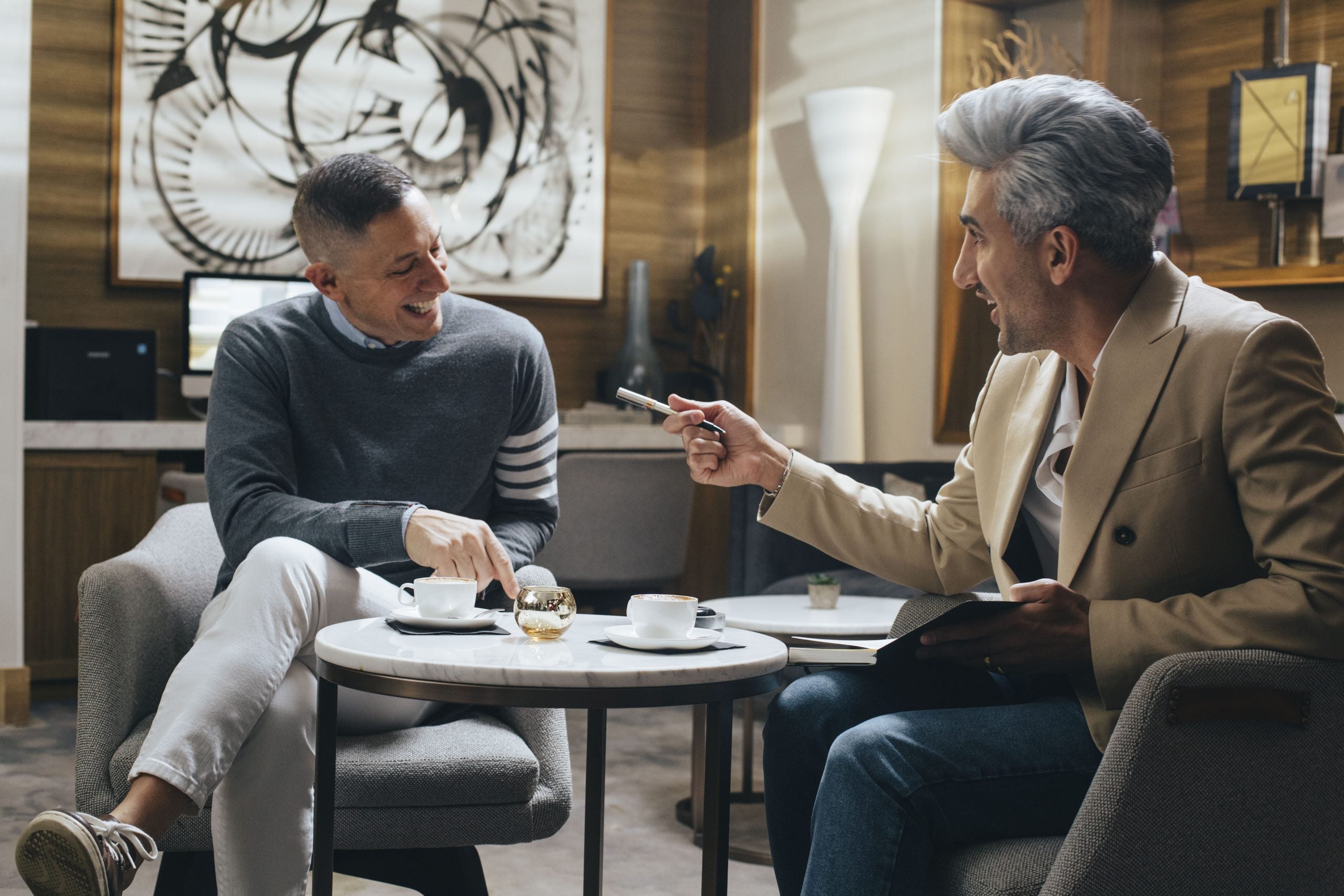
 Jonathan Adler & Tan France recharge on the road

It would be an admirable sentiment if it weren't mere sugar-coating. For companies like Facebook, empathy is often used as shorthand for "hyper-personalization." As the world becomes more complex and divided, knowing how factions of users want to experience its platform is not just good for business—it's essential to the company's survival. In 2015, Facebook launched its Empathy Lab as an effort to make its products and services more attuned to users with special needs; people with disabilities or those living in underdeveloped countries. Though it's hard to argue with Facebook's desire to make its products more useful and accessible, the effort highlights the inherent tensions in connecting empathy and business: More thoughtful products are important, as long as they attract more users.

Danielle Krettek is used to navigating the contradictions of the technology world. When she joined Google, she came to the notoriously engineering-led company with a radical idea. Having spent her earlier career working as a designer and researcher at Nike and Apple, she'd noticed how technology—despite its makers' best intentions—often ignored users' emotional well-being in return for efficiency and functionality. At Google, she wanted to bring an element of humanity to the company's products.

"I was seeing how technology ignores this whole emotional layer of our human experience," she told me over the phone from her office in Mountain View, California. "I've noticed that the intuitive interaction of multitouch and the appverse has led to very simple, very light, and deeply functionally led experiences. And the thing that's glaringly missing for me is all of the emotional experience. Now that technology is wall-to-wall and in every nook and cranny of our lives, it's just radically insufficient."

A few years ago, Krettek started Google's Empathy Lab, a multidisciplinary team that works mostly within the company's AI and Machine Learning team, but also acts as a roving research group that advocates for users' emotional well-being across various product teams. Krettek safeguards specifics around the kinds of projects the Empathy Lab works on, but right now most of her lab's resources go toward helping machine learning engineers "build humanity" into their training models and algorithms for voice assistants. "We work in a group of 600 or 700 people doing lots of different things, and what I tend to do is kind of be the human inspiration," she explained.

That companies like Google are willing to throw money at building products with an emotional conscience is, on the one hand, an admission of what's been sorely lacking in all of our habit-forming, thumb-swiping interactions with tech products for the past decade. But it's also a reaction to the way technology itself is changing. As apps become more personalized and predictive, and voice assistants more pervasive, Krettek's work is a small but important effort that will help technology slide even more seamlessly into every aspect of our lives.

Other big tech companies have begun to catch on, too. Nokia Bell Labs, the research center famous for inventing the transistor, has spent the past couple of years investing time and money into developing wearable technology that will help people communicate more empathically. Marcus Weldon, Bell Labs' president, believes that most of the world's problems are solvable by facilitating a deeper connection than what's currently possible with phones and computers.

"We've become isolated in little silos of existence," he told me for a story I previously reported for Wiredmagazine about the company. "What's lacking is state transfer between individuals, so you can actually feel how they feel." Bell Labs' solution, called The Sleeve, is like a souped-up Apple Watch that's able to measure biometric data like heart rate and perspiration, then translate that information into more emotionally rich messages communicated through haptic feedback. Eventually, this form of "sixth sense" technology could be embedded into more of our devices, layering the world with a heightened sense of emotion.

We're already seeing that happen in some form, on a much smaller scale. For Krettek's part, she's spent the past couple of years with Google Assistant's personality team, which is responsible for imbuing a sense of humanness into products like Google Home or Google Assistant. Krettek describes herself as helping engineers, product managers, writers, and scientists to better understand the nuances of human sentiment, which can make the difference between a technology product sounding creepy or comforting. The way she sees it, technology is unavoidable for most people, and it's only going to become more intimately embedded in our lives. The defining challenges of contemporary UX design is to ensure that people interact with technology in a way that feels natural (if not quite yet human), and that technology interacts with people in a way that feels respectful of their time, emotions, and privacy. "I think we're moving into a new wave for a new era, where it's actually about 'design feeling' instead of 'design thinking,'" she said.

Krettek's idealism is echoed by many of empathy's biggest advocates, who say the word's sudden preponderance is inherently good. "In my view, if empathy becomes more ubiquitous, that's probably not going to be a bad thing for anybody," Sub Rosa's Ventura said.

There's plenty of reason to believe that a more empathetic world could solve some of the problems caused by blind self-interest. But practicing personal empathy is different from selling it as a marketing tool that can be learned and honed for the betterment of the bottom line. In the past few years, empathy has garnered some vocal opponents in the design world, who argue the concept is self-serving, narrow-minded, and used as a crutch in the design process. These failures can lead to designing products that solve only a small subset of users' issues and ignore the wider implications of designing with empathy.

"We should think of ourselves as empathetic people within an empathetic practice," said design consultant Thomas Wendt, who wrote a piece for the ethnography website EPIC titled "Empathy as Faux Ethics." "But I don't know—for me, that's as far as it goes. Anything beyond that becomes sort of a commodification of empathy, which feels very counterintuitive and frankly, just kind of icky."

Even outside of the design world, the selling of empathy as a silver bullet solution runs the risk of neutering its power. Wendt takes particular issue with the contradiction of for-profit companies using empathy as a means for making more money. "It's weird right?" he said. "It's taking one of the most inherent human qualities we have and putting a price tag on it."

Ask proponents of empathy like Ventura, Krettek, and Hess, and they'll acknowledge empathy isn't foolproof. Companies can "empathy-wash" their message in the same way some "greenwash" their marketing to look more environmentally friendly. Empathy can be misused for narrow or short-sighted goals, and at its worst, can even be manipulated for malevolent purposes. Ventura brings up the point that, by his own definition, Cambridge Analytica's mining and analysis of Facebook data to influence the 2016 elections could be considered empathetic. "It was nefarious, but at its core, it was a deep understanding of these particular people. There was a lot of empathy in their behavior."

The greatest risk of empathy-washing is likely just a classic case of user fatigue. Like other well-intentioned words and phrases that are absorbed by the business leadership machine, empathy runs the risk of losing its value the more it's plastered across book covers and headlines. Marketing empathy's pristine altruism has the unintended effect of diluting its power.

Back at the workshop, Ventura instructed the crowd to split off into pairs of strangers. Each attendee was armed with two tarot-style cards printed with probing questions like "What questions make you most uncomfortable?" or "What motivates you to progress?" Ventura set a timer for 10 minutes, and the room lit up with quiet conversations that cumulatively produced an echoing boom.

The woman I was partnered with told me that her marketing team at a global consumer brand had been having trouble communicating. People were stressed and stretched too thin. There was no time for taking stock of her team's mental health. She said she wanted to be able to apply the same level of care and empathy she feels in her personal life to her work life—and that it was, frankly, really hard.

The conversation felt a little weird and forced, but it also worked. Despite knowing only her first name, I felt like I learned more about her outlook on work than I've learned about many of my friends.

"It's really beautiful to see a room shift like that," Ventura said at the end of the exercise. When it works, he continued, empathy can get people to open up—even with perfect strangers.

"Quick show of hands," he said, ready to prove his point. "How many of you have these kinds of conversations with your colleagues?"

No one raised their hand.

Liz Stinson is the managing editor of Eye on Design. This article was republished with permission from Eye on Design.

ABOUT THE AUTHOR

Liz Stinson is a writer covering where design intersects with the wider world. She's currently the managing editor of Eye On Design.

 More

~A.