How To Make a Simple Powerful AM Loop Antenna For Free
There are few truly magical things in this world that are practically free.
This DIY AM antenna is best used outdoors but you can make it work inside by somehow re-routing the wires. It amplifies all weak AM signals, so a powerful local station might be heard over your entire AM radio dial.Here is what you need:
• 100′ or more of any type of insulated wire you can easily work with
• Twist or Zip ties or tape to hold the shape of the coil
• (2) alligator clips (available online or at most electronics stores)
• (1) three or four foot ground stake (any metal stake or 1/2″ diameter or greater pipe)
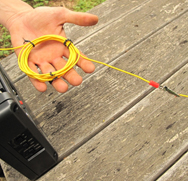
• (1) adjustable pipe clamp that fits around your metal stake1. Form a three inch coil with seven turns. Secure into a round shape with ties or tape. The attached alligator clip shown below will be connected to no less than 60′ of your antenna wire. Generally the longer the antenna wire the better so if you have a 100′ antenna wire, that's good.
2. The other end (not shown) of the coil will go to the ground stake so leave enough wire. The ground stake can be driven into a convenient and safe place nearby.
3. For maximum reception, stretch the antenna wire out perpendicular to the station you want to listen to. That means if you draw a make-believe line toward the station, you want to lay the antenna wire out 90 degrees to that imaginary line. You can mount the wire at any height, but consider eight feet for safety.
4. Bare the end of the antenna wire (I use a knife or diagonal pliers) and clip it to the coil. You really don't need the alligator clips, but it is much more reliable than twisting wire together.
5. Our antenna did not work on the pipe we used until we sanded the rust away on a small section under the clamp. What you can't see is that the dirt is damp. This is also important to make the ground work. If you have bone dry soil you may have to dump quite a bit of water on the dirt to make the soil more conductive. Clip the wire to the clamp.
6. Grand Magic Test: Tune your radio to a very weak station. You don't need a signal meter but it is fun to watch it register the gain. Move the coil near the radio until you hear the station improve. You don't actually attach this antenna to the radio. The coil intensifies the signal which is inductively picked up by the ferrite antenna inside the radio. A 1400 KHz station in our area went from "no discernible signal" to "full power". Please let us know of your successes or failures so fellow listeners can benefit from your experiences.
You can experiment with the diameter of the coil, the number of turns and the length of antenna wire you use. If you want to see some other great AM antennas try searching am loop antenna DIY. We would love it if you send a comment and/or picture that we can post.This antenna works great on the AM band because of the properties of these frequencies. Loop antennas can work on other frequencies also but need some modification because of the frequency property differences. There are probably some discoveries to be made in the future with loop antenna research.
As always, we value your opinion and encourage questions. Please feel free to contact us or leave a comment.


Opinion: Meet the Four Kinds of People Holding Us Back From Full Vaccination
Getting everyone vaccinated in the United States has become much harder now that demand for the Covid-19 vaccine is flagging. America's vaccination strategy needs to change to address this, and it starts with understanding the specific reasons people have not been vaccinated yet.
The conventional approach to understanding whether someone will get vaccinated is asking people how likely they are to get the vaccine and then building a demographic profile based on their answers: Black, white, Latinx, Republican, Democrat. But this process isn't enough: Just knowing that Republicans are less likely to get vaccinated doesn't tell us how to get them vaccinated. It's more important to understand why people are still holding out, where those people live and how to reach them.
Why are people where you live still not getting vaccinated? Select your state below.
In the United States overall...
8% are Watchful. They're waiting to see what happens next.
9% are Cost-Anxious. They want the vaccine but can't afford the time or cost.
4% are System Distrusters. They feel the health care system doesn't treat them fairly.
14% are Covid Skeptics. They don't believe the threat.
After conducting a national survey of U.S. adults, we grouped people into distinct profiles based on their shared beliefs and barriers to getting the vaccine. This approach, borrowed from the marketing world, is called psychobehavioral segmentation. It will allow health officials to target their strategies in ways that ignore demographic categories, like age and race. In the United States, we used this approach to identify five distinct personas: the Enthusiasts, the Watchful, the Cost-Anxious, the System Distrusters and the Covid Skeptics.
People in each segment share some beliefs and barriers about Covid-19 vaccination. And each persona includes at least some of every demographic: Republicans, Black people, the middle class, young people and others.
Here are the groups health officials need to reach — and how to reach them, based on their fears, concerns and barriers.
Covid Skeptics

Share of Covid Sketptics
within the state
National average: 14%
The share of Covid Skeptics
in Arkansas is 30%, exceeding
the national average
Covid Skeptics are at the far end of the spectrum as the least likely to get vaccinated. The primary barrier for people in this group are their specific, deeply held beliefs about Covid-19. Everyone in this group believes at least one conspiracy theory related to the pandemic, whether it's that microchips are implanted with the Covid vaccine; Covid-19 has been exploited by the government to control people; or that the pandemic was caused by a ring of people who secretly manipulate world events.
We found Covid Skeptics are common in Arkansas, North Dakota and Nevada. Considering that 84 percent of this group believe that the government is exploiting Covid-19 to control people, leaders of vaccination campaigns should consider tapping nonpolitical figures to mobilize this group. Doctors are trusted by 50 percent of this group, while scientists are trusted by 32 percent. They could also use religious leaders, who may resonate best with 9 percent of group members who say the vaccine goes against their religious beliefs.
The key to engaging this group will be to avoid trying to debunk what they believe; rather, experts need to listen, acknowledge how they feel and then share the facts. Our research finds that emphasizing that vaccination is their own, personal choice — one that can help them protect friends and family members — can also work.
Cost-Anxious

Share of Cost-Anxious
within the state
National average: 9%
The share of Cost-Anxious
people in Mississippi is 23%
The Cost-Anxious worry about the time and potential expense of getting vaccinated (even if it is actually free). We learned they're dominant in states like Mississippi, where they make up 23 percent of the population, which is not surprising due to the state's high poverty rates and low Medicaid coverage.
Public health experts have stressed the need to bring vaccines to the people; with no group is this truer than for the Cost-Anxious. Holding vaccination clinics in non-health-care locations that people frequent — like workplaces, religious venues, day cares, supermarkets, bars and restaurants — will be critical.
For this group, vaccination campaign leaders should stress that vaccination is totally free and encourage local businesses to provide paid time off for both doses.
System Distrusters

Share of System Distrusters
within the state
National average: 4%
The share of System Distrusters
in Georgia is 8%, double
the national avervage
The System Distrusters believe that the health care system doesn't treat them fairly. Most, but not all, members of this group are people of color, and they prevail in Washington, D.C., Maryland and Georgia.
It will be important for public health officials to hold conversations — formal or informal — with trusted members of their own communities to air concerns and be transparent about efforts to vaccinate underserved communities. People in this group have low expectations that other members of their communities will get vaccinated, so making vaccinations of people they know as visible as possible will be important. Tracking and illuminating efforts to ensure the vaccine rollout is equitable and sharing that with the community is key.
The Watchful

Share of Watchful people
within the state
National average: 8%
The share of Watchful
people in Delaware is 17%
The Watchful are holding out to see what kind of experience their friends or neighbors have with the vaccine before committing themselves. They dominate in Delaware, making up 17 percent of the state's population, as well as 12 percent in Hawaii and Rhode Island.
Behavioral science researchers know that establishing norms can lead to acceptance of products and could help persuade the Watchful. Encouraging those who are vaccinated to show their vaccination status with pride, both online and offline, can nudge their family, friends and networks to follow suit. The Watchful are already likely to wear masks, showing an intent to comply with social norms, so they may respond to similar altruistic messages about vaccination and get vaccinated to protect others.
For this group, experts should consider allowing for a "vaccinate later" option. Behavioral science suggests that people prefer moderate or "compromise" options over their extreme counterparts. Being able to opt-in to vaccines down the road may provide a comfortable alternative for this group.
With only 60 percent of U.S. adults having received their first shot, we are still far from President Biden's target of 70 percent by the Fourth of July. This national average also hides an important truth: The country is a patchwork, with states like Vermont tracking higher (with 78 percent of adults having received their first dose) and states like Mississippi tracking lower (42 percent of adults). Therefore, we can't rely on a one-size-fits-all approach.
President Biden's aggressive Fourth of July goal will be tough to meet without understanding what drives lower vaccine confidence and where various strategies to combat it will be most effective. And we can't stop at the state level; we need to go county by county and ZIP code by ZIP code, offering specific, localized solutions to convince the holdouts. It will also be important that everyone — not just the health care professionals and the politicians — do their part. It won't be easy, but it must be done to ensure that more people get vaccinated.