Friday, September 11, 2020

Inventors who regret their creations made Labradoodles, K-cups, bomb - Business Insider

Inventors who regret their creations made Labradoodles, K-cups, bomb - Business Insider

The inventor of the Labradoodle regrets what he started. These 11 other creators have lamented their contributions, too.

Conron hated that his creation helped grow a designer-dog industry.

Standard Labradoodle dog puppy shutterstock_470939075
A Labradoodle rests on the ground.
Shutterstock

"I opened a Pandora's box and released a Frankenstein monster," Conron told ABC Australia in 2019. 

Conron's attempt to create a new breed spurred many other new designer mixes, including puggles (a mix of pugs and beagles), shorkies (Shih Tzus and Yorkshire terriers), and Pomskies (Pomeranians and huskies).

"Marvelous thing? My foot," Conron told the AP. "There are a lot of unhealthy and abandoned dogs out there."

Jenna Karvunidis, inventor of the gender reveal party, has had to watch the trend she began spark wildfires and cause deaths.

The blogger from Los Angeles and her husband, Niko, had lost several pregnancies before carrying their first child to term in 2008. At a party ahead of the birth, they announced to family and friends that their baby was a girl by slicing open a cake to reveal pink. 

Twelve years after Karvunidis wrote about the cake gimmick, gender-reveal parties have become increasingly common, elaborate, and occasionally destructive. Other over-the-top gender-reveal parties have involved a giant inflatable baby, flaming car, and live alligator chomping on a jello-filled watermelon. One caused a plane crash and another accidentally killed a grandmother, according to the Washington Post.

On Saturday, pyrotechnics at a gender reveal in El Dorado Ranch Park, California, sparked a fire that has grown to more than 12,600 acres and has forced nearly 20,000 people to evacuate. The fire is still raging. 

Karvunidis now regrets ever coming up with the idea. 

"For the love of God, stop burning things down to tell everyone about your kid's penis," Karvunidis wrote Monday in a Facebook post about the fire. "No one cares but you."

Anna Jarvis, the creator of Mother's Day, hated the holiday so much that she later got arrested for protesting it.

After Jarvis's mother died on May 9, 1905, the West Virginian began campaigning to have a holiday dedicated to moms. President Woodrow Wilson officially recognized Mother's Day in 1914. 

But as time went on, the dignified holiday Jarvis had envisioned became commercialized, with a focus on flowers and gifts. Furious, she spent the rest of her life protesting the holiday, and even got arrested on charges of disturbing the peace in 1925, outside a Philadelphia confectioner's convention.

Jarvis lived out her later years in a sanatorium. Olive Ricketts, director of the Anna Jarvis museum, suggested to NPR in 2016 that people connected with the flower and card industries paid the sanatorium to keep Jarvis there — though this claim remains unproven.

The inventor of single-use Keurig K-Cups, John Sylvan, told The Atlantic: "I feel bad sometimes that I ever did it."

Most K-Cups — individual pods filled with coffee, tea, chai, or hot cocoa that Keurig machines and others like them use to brew single-serving drinks — aren't recyclable or biodegradable.

"It's like a cigarette for coffee, a single-serve delivery mechanism for an addictive substance," Sylvan told the Atlantic in 2015.

In 2014, 9 billion K-Cups were sold, used, then trashed to end up in landfills, the Atlantic reported. That's enough K-Cups to circle the Earth at least 10 1/2 times. 

Sylvan himself doesn't own a Keurig machine. 

Robert Propst, who invented the office cubicle, went to his grave hating what his creation had done to the American worker.

Propst originally designed the cubicle in 1968 as a way to give workers a space they could personalize. He saw the design as a way to allowed people to move seamlessly between individual and collaborative office tasks.

According to Nikil Saval, author of the book, "Cubed: A Secret History of the Workplace," Propst marketed the cubicle as a work station that offered privacy yet was easily accessible.

But corporations perverted that vision, putting workers into smaller spaces by repositioning cubicle walls to form a box. Three decades later, Propst denounced what his creation had become.

"The cubiclizing of people in modern corporations is monolithic insanity," Propst told The New York Times in 1997, when more than 40 million Americans were working in cubicles.

He died three years later.

Albert Einstein helped split the uranium atom in 1938. That research into nuclear fission contributed to the development of the atomic bomb.

In 1939, Einstein wrote to President Franklin Roosevelt, warning that the Germans were trying to produce an atomic bomb and urging him to support American physicists' efforts to create one.

Roosevelt complied. Six years later, on August 6 and 9, 1945 — just over 75 years ago — the US dropped two nearly 10,000-pound atomic bombs on Hiroshima and Nagasaki, Japan.

The bombs brought the Pacific front of World War II to an end; Emperor Hirohito surrendered on August 15, 1945. But the dual explosions also killed upwards of 225,000 people, according to the University of California, Los Angeles.

In the aftermath, Einstein said he regretted his letter.

"Had I known that the Germans would not succeed in developing an atomic bomb, I would have done nothing," Einstein told Newsweek in March 1947.

Robert Oppenheimer, scientific director of the Manhattan Project, also didn't like how his invention was used.

Oppenheimer later said that although he had no remorse about "the making of the bomb," the US didn't deploy it responsibility.

"As for how we used it, I understand why it happened and appreciate with what nobility those men with whom I'd worked made their decision. But I do not have the feeling that it was done right," Oppenheimer told Lansing Lamont, author of the 1965 book "Day of Trinity."

"Our government should have acted with more foresight and clarity in telling the world and Japan what the bomb meant," Oppenheimer added.

Kamran Loghman also created a weapon that he regretted: pepper spray.

Loghman helped develop the weaponized spray when he worked for the Federal Bureau of Investigations in the 1980s. He also wrote guidelines for proper police use of his technology.

But Loghman told the Huffington Post in 2016 that his creation is, in many cases, "being misused."

Pepper spray is "meant to reduce injury. It is used to prevent problems. It is not meant to be used to shut people up, for punishing people, for controlling people," he said, adding, "the culture of law enforcement needs to change."

Tim Berners-Lee, who coded the World Wide Web, came to regard his invention as "anti-human."

In 1989, the same year Conron bred the Labradoodle, Berners-Lee came up with the idea for what would later become the World Wide Web.

Berners-Lee originally made the web as a way for scientists to quickly share information across the global network known as the Internet. (Yes, they're two separate things). Because he gave away the source code for free, his invention exploded into a society-altering platform. 

But as time went on, Berners-Lee came to regret what he saw as the Web's destructive power, especially as revealed through Russian election-hacking efforts and secret psychological research run through Facebook

"I was devastated," Berners-Lee told Vanity Fair in 2018 of his realization that the platform he built had become "anti-human."

Berners-Lee even regretted the double-slash in URLs.

Even before he came to distrust his entire creation, Berners-Lee already lamented his role in creating the double-slash, or "//," after the "htttp:" in a web address. 

In a 2009 symposium, Berners-Lee said the double-slash was unnecessary — The double-slash was a programming convention at the time, but it wasn't needed to create valid URLs, he said, according to the New York Times.

Berners-Lee added that the extra space the double-slash takes up on paper likely led to the deaths of countless trees when printing out webpages, not to mention the millions of wasted hours humanity has spent typing it into browsers.

The creator of the pop-up ad, Ethan Zuckerman, apologized to internet users directly for creating "one of the most hated tools in the advertiser's toolkit."

"I wrote the code to launch the window and run an ad in it," Zuckerman wrote in a lengthy 2014 essay for The Atlantic. "I'm sorry. Our intentions were good."

He said he'd created the pop-up ad in the 1990s as a way to advertise a product on a user's website while keeping its content separate. Before the pop-up, Tripod.com, the company at which Zuckerman worked, had tried a bunch of revenue models. Advertising was the only one that made any money.

The web's reliance on ad revenue has directly caused "the fallen state of our Internet," Zuckerman wrote in the Atlantic, by encouraging companies to surveil their users for better-targeted ads.

"I have come to believe that advertising is the original sin of the web," he added. 

Vincent Connare, designer of the font Comic Sans, told the Wall Street Journal: "If you love it, you don't know much about typography."

Inspired by speech bubbles in comic books like "The Dark Knight Returns" and "Watchman," Connare developed Comic Sans in 1994 as an alternative to the sedate Times New Roman for children and new computer users.

It took the world by storm.

Then the backlash arose. A "Ban Comic Sans" campaign emerged five years later.

"Using Comic Sans is like turning up to a black-tie event in a clown costume," campaign co-founder, Holly Combs, told the Guardian in June 2010.

Connare — who also designed fonts like Trebuchet — doesn't wholly regret crafting Comic Sans, but he has said the invention overshadowed the rest of his career.

"Sometimes I wonder if people think that's all I could do, because everybody looks it up eventually," he told CBC radio host Brent Bambury in February. "So, in a way, that's the only regret, is that people think that's the only thing I've ever designed."

Scott Fahlman created one of the earliest emoticons, which have evolved into emojis. "Sometimes I feel like Dr. Frankenstein," he told The Wall Street Journal in 2013.

In the 1980s, Fahlman proposed using ":-)" to digitally indicate that someone is kidding or making a joke.

The :-) sequence became one of the earliest emotional icons (emoticons), which first morphed into emojis in 1999, according to WIRED.

"My creature started as benign but it's gone places I don't approve of," Fahlman told the Journal.

Oh, boy....I wonder about Post-it's, or micro-tangents.......

~A.

Joining the circle: Utrecht removes road to be ringed by water once more - DutchNews.nl

Joining the circle: Utrecht removes road to be ringed by water once more - DutchNews.nl

Joining the circle: Utrecht removes road to be ringed by water once more

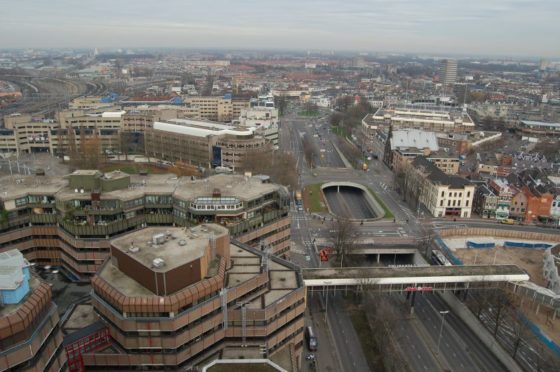
The new Singel Photo: CU2030, Gemeente Utrecht

After decades of argument, Utrecht has restored the 'singel' canal that surrounds the city in an effort to promote greener living.

In a ceremony on Saturday, the city will officially open the Catarijnesingel, which was once part of a multi-lane highway. Boats will be able to sail around the city centre again for the first time in years from 2pm.

'This is a historic moment for Utrecht,' said Eelco Eerenberg, head of the station area for the municipality. 'A lot of people from Utrecht and from outside Utrecht have always said it was a huge mistake to fill the Utrecht Singel and now after years of building work, this fault will be made good. The inner city will once again be surrounded by water and greenery.'

The city had originally intended to have a larger ceremony but due to coronavirus restrictions, DutchNews.nl understands, is celebrating the moment in a smaller way. The new stretch of canal is part of a series of measures – such as building the world's largest bike park – to redevelop the area around the train station while promoting more eco-friendly living.

The old highway Photo: CU2030, Gemeente Utrecht

Utrecht became a city in 1122, and as part of this had the right to build a wall and a protective canal around its walls. However, from the 1950s, a series of traffic management plans have replaced much of the water with roads (although one segment was listed and preserved by the Dutch government).

Following increasing pressure to reopen the Singel canal, residents voted in a 2002 referendum for a 'master plan' for the centre involving digging up the roads on the Weerdsingel and Catharijnesingel and replacing them with water again. Utrecht is also building a covered shopping centre, which boats will be able to sail underneath.

'You can see the Singel as part of the kaleidoscope of modern city development,' added Eerenberg. 'An old military hospital is now a hotel, a monastery become a teaching hospital and then homes and offices…They all had important functions for the city in their time and their place on the Singel.'

He said that now the city is developing 'green' and 'blue' corridors for people and nature to develop, with the aim of increasing wellbeing. The Singel will also be joined to the Leiden Rijn and is expected to improve migration routes for thousands of fish.

'There's not much space in the city, and cars take up a lot of room relative to pedestrians, cyclists and public transport,' said Eerenberg. 'But these also contribute to cleaner air for residents and liveability. In Utrecht, we choose water and greenery over a highway for cars.'

Thank you for donating to DutchNews.nl

The DutchNews.nl team would like to thank all the generous readers who have made a donation in recent weeks. Your financial support has helped us to expand our coverage of the coronavirus crisis into the evenings and weekends and make sure you are kept up to date with the latest developments.

DutchNews.nl has been free for 14 years, but without the financial backing of our readers, we would not be able to provide you with fair and accurate news and features about all things Dutch. Your contributions make this possible.

If you have not yet made a donation, but would like to,
you can do so via Ideal, credit card or Paypal.


~A.

Wednesday, September 09, 2020

400-Year-Old "Friendship Book" Contains the Signatures of Kings

400-Year-Old "Friendship Book" Contains the Signatures of Kings

Germany Acquires 400-Year-Old "Friendship Book" Filled With Signatures of Kings and Emperors

Flower Pages Friendship Book

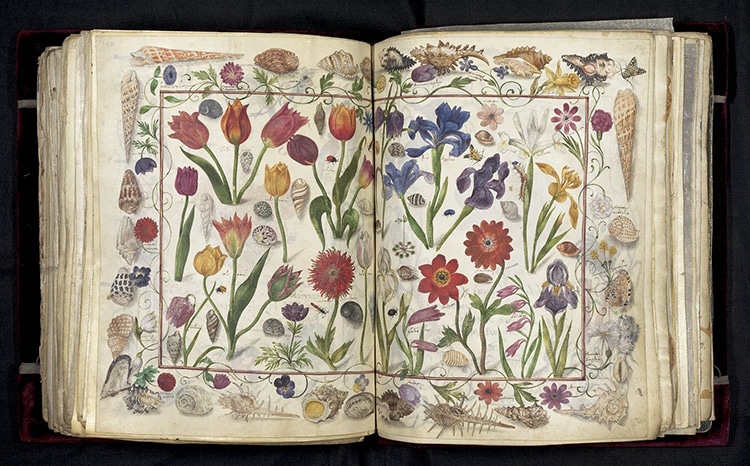
Unknown artist, double-page representation of flowers, shells and insects, within a seashell frame, around 1590/1595. From the "Große Stammbuch" of Philipp Hainhofer. (Photo: Scriptura Limited/The Herzog August Bibliothek Wolfenbüttel [HAB])

German library Herzog August Bibliothek Wolfenbüttel (HAB) recently acquired the Große Stammbuch of Philipp Hainhoferjust—a 400-year-old "friendship book" containing the signatures of emperors, kings, and princes—for about $3.3 million. Scholars thought the one-of-a-kind manuscript was lost until it reappeared in public in 2006. "Friendship books" of its kind are similar to present-day yearbooks. In fact, Große Stammbuch takes its name from the Latin Album Amicorum, which is a direct predecessor to the modern autograph book. These types of memorabilia were popular among university students in the 16th century. According to the HAB, roughly 25,000 documented Stammbücher (literally "family books") exist in collections globally.

Hainhofer, a merchant who was best known for his curiosity cabinets, began collecting content for his Große Stammbuch in his university days. Between 1596 and 1647, he filled 247 pages with illustrious signatures. While working as a diplomat and art dealer based in Augsburg, Germany, Hainhofer encountered many aristocrats and renowned artists. Hainhofer would commission artwork to illustrate the pages surrounding important signatures. According to the HAB, the Große Stammbuch became widely known, and curiosity about the book allowed Hainhofer access to elite political circles. Today, the Große Stammbuch is considered the finest example of its genre.

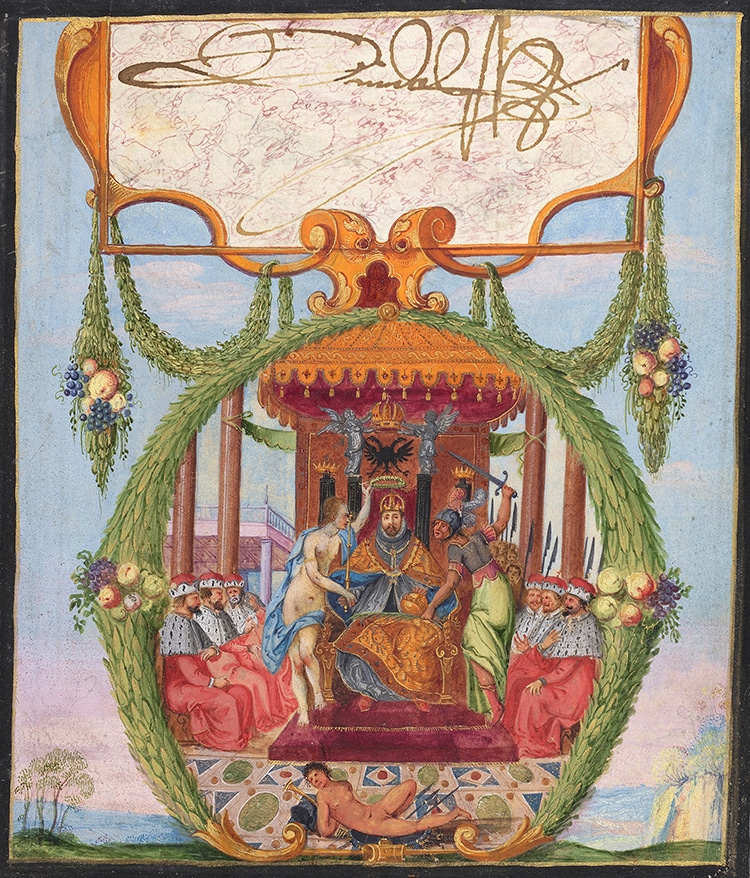
Among the signatories included are the Holy Roman Emperor Rudolph II and Christian IV, King of Denmark and Norway. Both powerful figures in early modern Central Europe, the pages bearing each ruler's signature are richly painted. Rudolph II is depicted in a portrait and coronation scene by artist Daniel Fröschl. The page of Christian IV is simpler with only a delicately painted coat of arms. Powerful women of the age are also represented. In 1618, Elizabeth Stuart, Electress of the Palatinate, signed Hainhofer's book. Her mark rests above two large putti (cherubim) holding her coat of arms.

The purchase of Hainhofer's Große Stammbuch exposes the manuscript to the public for the first time in 400 years. The HAB plans to hold several exhibits centered around the work. The library will also digitize the book to make its artwork and fascinating history available to all through their website. Björn Thümler, Lower Saxony's Minister for Science and Culture, described in a press release the joy that the book's purchase brings. He noted, "All those involved have put all their efforts into bringing the art-historical and cultural-historical masterpiece to the HAB in Wolfenbüttel. Duke August the Younger himself had already attempted to do so in 1648 after Hainhofer's death. The return of the Album Amicorum to Germany is not only in the interest of the State of Lower Saxony, but of Germany as a whole, for it ensures that this outstanding cultural treasure will be permanently accessible to the public."

After 400 years, Hainhofer's Große Stammbuch will be brought home to Germany and united with his other papers housed at the HAB.

FEATURED VIDEO

Wood-Carved Geometric Cityscapes by James McNabb

Arrow Left #1 Icon Created with Sketch.

Arrow right #1 Icon Created with Sketch.

The Herzog August Bibliothek Wolfenbüttel (HAB) in Germany recently purchased a 400-year-old autograph book known as a "friendship book." This Große Stammbuch of Philipp Hainhofer was considered lost until it reappeared in 2006.

Friendship Book the Große Stammbuch Of Philipp Hainhofer

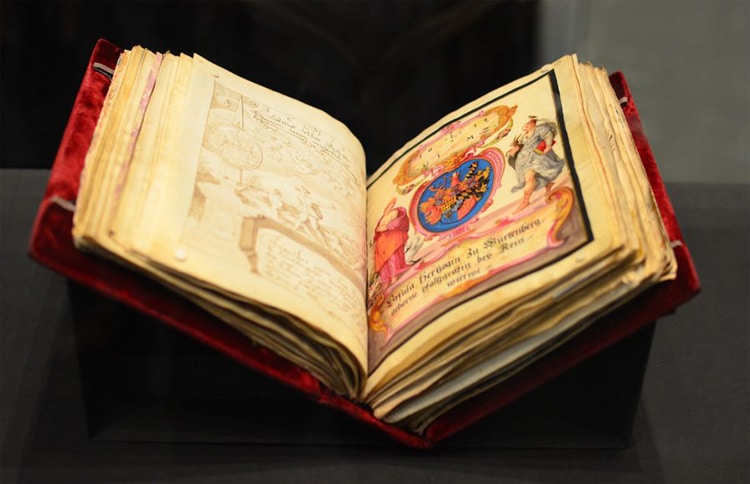
The Friendship Book, or "Große Stammbuch" of Philipp Hainhofer.

Many kings, emperors, and princes signed the book during Hainhofer's travels as a diplomat and art dealer.

Holy Roman Emperor Rudolf II Hainhofer Friendship Book

Page illustrated by Daniel Fröschl, coronation of Rudolf II, Holy Roman Emperor, surrounded by six electors, with personal signature, before 1612. (Photo: Scriptura Limited/Herzog August Bibliothek)

Hainhofer commissioned paintings and illustrations to accompany the signatures he collected.

Hainhofer Friendship Book

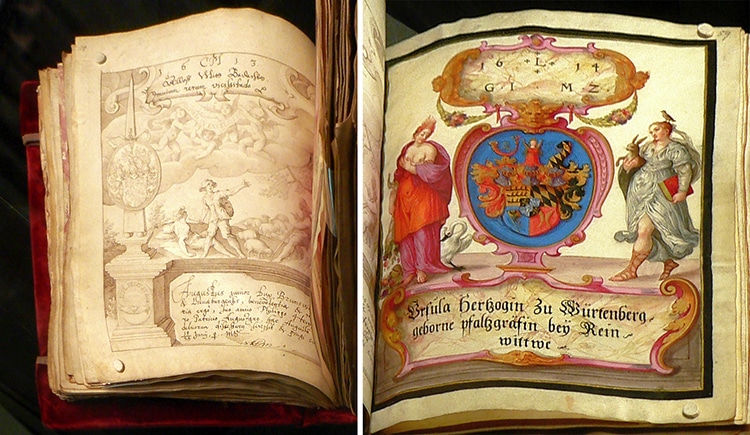
Autograph pages showing August II of Braunschweig-Lüneburg (1613, right) and Ursula Duchess of Württemberg (1614, left) from the Friendship Book, or "Große Stammbuch" of Philipp Hainhofer.

The HAB plans to display the friendship book in exhibits and online. The digitization process will make the book publicly available for the first time ever.

Hainhofer Friendship Book Latin Poem

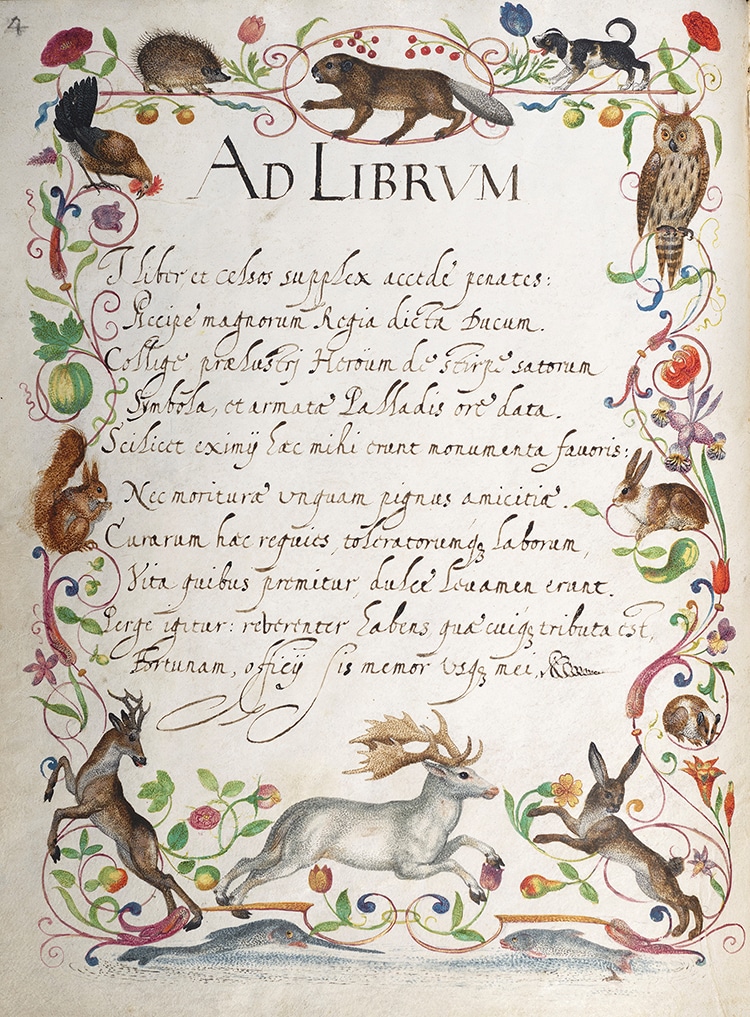
Latin poems addressed to the book and the reader, in a painted frame of dancing animals jumping over fruit and flower tendrils, birds above and fish below. (Photo: Herzog August Bibliothek)

h/t: [Colossal, The Guardian]

Related Articles:

Rare Book Collector Reveals Tibetan Book Printed Before the Gutenberg Bible

Unexpected Discovery Reveals a Rare 18th Century Coloring Book for Adults

A Look at the Earliest Printed Book—and It's Not the Gutenberg Bible

Europe's Oldest Intact Book Is Discovered Inside the Coffin of a Saint


~A.

Monday, September 07, 2020

Best and worst face masks for coronavirus protection: chart - Business Insider

Best and worst face masks for coronavirus protection: chart - Business Insider

One chart shows the best and worst face masks for coronavirus protection — and which situations they're suited for

FILE PHOTO: People wear protective face masks outside at a shopping plaza after New Jersey Governor Phil Murphy said he would sign an executive order requiring people to wear face coverings outdoors to prevent a resurgence of the coronavirus disease (COVID-19), in Edgewater, New Jersey, U.S., July 8, 2020. REUTERS/Mike Segar
People at a shopping plaza in Edgewater, New Jersey, on July 8.
Reuters
  • The ideal face mask for coronavirus protection blocks large droplets along with smaller airborne particles.
  • In general, masks should have more than one layer and be made of tightly woven fabrics.
  • Based on several studies evaluating masks' protection levels, we've ranked the most common types from best (an N95 mask) to worst (masks with a built-in valve or vent).
  • Visit Business Insider's homepage for more stories.

A simple trick can reveal whether your face mask offers sufficient protection: Try blowing out a candle while wearing it. A good mask should prevent you from extinguishing the flame.

The rule isn't foolproof, but it should help weed out masks that aren't very protective.

Ever since the Centers for Disease Control and Prevention began recommending cloth masks for the general public in April, researchers have been evaluating the best materials for filtering the coronavirus. An ideal mask blocks both large respiratory droplets from coughs or sneezes — the primary method by which people pass the virus to others — along with smaller airborne particles called aerosols, which are produced when people talk or exhale.

It should be sealed around the nose and mouth, since any gaps, holes, or vents could allow droplets to leak out and infect another person.

Assuming masks are worn properly, certain materials consistently perform better than others in studies. Based on the latest research, here's a ranking of the best and worst face coverings:

Mask rankings 03
Yuqing Liu/Business Insider

'Hybrid' masks are among the safest homemade options

As a general rule, mask fabrics should be woven as tightly as possible. That's why fabrics with higher thread counts are better at filtering particles.

It's also preferable to have more than one layer. The World Health Organization recommends that fabric masks have three layers: an inner layer that absorbs, a middle layer that filters, and an outer layer made from a nonabsorbent material like polyester.

N95 masks are the most protective because they seal tightly around the nose and mouth so that few viral particles seep in or out. They also contain tangled fibers to filter airborne pathogens — the name refers to their minimum 95% efficiency at filtering aerosols. A recent Duke study showed that less than 0.1% of droplets were transmitted through an N95 mask while the wearer was speaking.

That's why they're generally reserved for healthcare workers.

Disposable surgical masks are also made of non-woven fabric. A 2013 study found that surgical masks were about three times as effective at blocking influenza aerosols as homemade face masks (that was true, at least, when air flow was slower than a cough but faster than a human breathing during light work).

Still, there are homemade options that come close to the level of protection of an N95 or a surgical mask.

Face masks
Packaged surgical face masks.
InkheartX/Shutterstock

An April study from the University of Chicago determined that "hybrid" masks — combining two layers of 600-thread-count cotton paired with another material like silk, chiffon, or flannel — filtered at least 94% of small particles (less than 300 nanometers) and at least 96% of larger particles (bigger than 300 nanometers). Two layers of 600-thread-count cotton offer a similar level of protection against larger particles, but they weren't as effective at filtering aerosols.

That study, however, conducted measurements at low air-flow rates, so the masks might offer less protection against a cough or a sneeze. Still, multiple layers of high-thread-count cotton are preferable to face coverings made from a dishcloth or cotton T-shirt.

Fabrics like silk or cotton have more variable performances

A June study published in the Journal of Hospital Infection found that masks made from vacuum-cleaner bags were among the most effective alternatives to surgical masks, followed by masks made from tea towels, pillowcases, silk, and 100% cotton T-shirts, respectively.

sewing masks coronavirus
A woman sewing hospital masks at the Detroit Sewn facility in Pontiac, Michigan, on March 23.
Rebecca Cook/Reuters

Research from the University of Illinois, meanwhile, found that a brand-new dishcloth was slightly more effective than a used 100%-cotton T-shirt at filtering droplets when a person coughed, sneezed, or talked. That study (which is still awaiting peer review) also found that a used shirt made of 100% silk was more effective at filtering high-momentum droplets, most likely because silk has electrostatic properties that can help trap smaller viral particles.

The University of Chicago study came to a different conclusion, however: Those researchers found that a single layer of natural silk filtered just 54% of small particles and 56% of larger particles. By contrast, four layers of natural silk filtered 86% of small particles and 88% of large particles at low air-flow rates.

Bandanas and scarves don't offer great protection

bandana face mask
Kevin Houston using a bandana to cover his face on April 23 in Evanston, Illinois.
Stacey Wescott/Chicago Tribune/Tribune News Service/Getty Images

Bandanas and scarves have performed poorly in multiple studies.

The Journal of Hospital Infection study found that a scarf reduced a person's infection risk by only 44% after they shared a room with an infected person for 30 seconds. After 20 minutes of exposure, the scarf reduced infection risk by just 24%.

Similarly, the Duke researchers found that bandanas reduced the rate of droplet transmission by a factor of two, which makes them less protective than most other materials.

For the most part, though, any mask is better than no mask, with one notable exception: The CDC cautions people not to wear masks with built-in valves or vents.

Masks with one-way valves can expel infectious particles into the atmosphere, helping to fuel transmission.

Mask studies should be taken with a grain of salt

Though research is coalescing around the idea that a few types of masks offer the best protection, it's not always easy to simulate how a mask will perform in real life.

That's because only certain tests directly mimic the size of novel coronavirus particles, while others evaluate performance based on viruses like influenza. Researchers also still aren't sure about the degree to which the virus gets transmitted via aerosols, since those tiny particles are hard to trap and study without killing the virus. Some scientists even have different ideas of what constitutes an aerosol — the generally accepted cutoff is less than 5 microns (that's roughly the size of a dust particle) — and many experts think the delineation is arbitrary.

Different studies also test masks under different circumstances: Some mimic the heavy air flow produced when a person coughs, while others mimic the air flow when a person is talking or breathing normally.

And of course, masks perform differently depending on how they're worn. That's why it's better to stick with more protection over less.

Loading Something is loading.

Do you have a personal experience with the coronavirus you'd like to share? Or a tip on how your town or community is handling the pandemic? Please email covidtips@businessinsider.com and tell us your story.

Get the latest coronavirus business & economic impact analysis from Business Insider Intelligence on how COVID-19 is affecting industries.

Newsletter

Sign up now for Insider Today for regular insights and analysis from Henry Blodget & David Plotz.

NOW WATCH: Epidemiologists debunk the 14 biggest coronavirus myths


~A.

Every day Do’s.....


Most of us don't necessarily enjoy cleaning, but everyone loves the feeling of coming home to a clean house. Though Mama's standards of an orderly homemay have involved hours dedicated to deep cleaning, today's tidiest of families have found ways to incorporate little habits into their daily lives that make it less of a chore. So, what's the secret to keeping things clean? Consider adding these daily home cleaning habits into your schedule, and you'll be confidently letting friends through your front door without notice before you know it.

1. Start your day by making the bed. 

If there's one thing you can control in the day's chaos that lies ahead, it's your bed. It doesn't take but a few minutes, but this easy task sets your day up for success. Even if it's just a hurried smoothing out of the comforter, making your bed helps you start your day with a sense of productivity and order that's likely to carry through to the next thing you do.

2. Tidy up as you go. 

Did you try out two or three outfits before picking your look for the day? Use a few pans preparing breakfast? Clean it up and put it all away before you move on. If you incorporate this into everything you do throughout your day, there will be a lot less lying around taunting you later.

3. Wipe it down before you walk away. 

A quick wipe down can do wonders. If you wipe down the surface you've used after each use, you'll keep counters and glass surfaces clean and ready to be used each time. From wiping down your glass shower door to swiping your sink after washing the dishes, a quick clean can prevent grime build up and keep your surfaces spotless.

4. Tackle a load of laundry each day. 

Avoid overflowing hampers by giving your washer a work out each day. It's an unavoidable task (keeping your family clothed is kind of necessary), so if you do it on a consistent basis, it won't pile up and take over your entire Sunday.

5. Place all (things & especially)paper in their proper place. 

Mail, bills, notes from school, take out menus – paper piles up quickly. Keep your counters and office clutter-free by establishing designated places for paper in your home. Make a drawer for takeout menus and coupons. Create folders for bills, school memos, and other important printouts. Put these items in their place as soon as you get them.

6. Donate what you don't need regularly.  

Stuff is reeking havoc in homes across the South. You probably don't need 15 water bottle bottles for a family of 4, and it's likely time to get rid of that shirt your son grow out of months ago.

It's much easier to keep a home organized when there is less clutter in it. Treasure items with meaning, but don't collect unnecessary stuff. Instead of wasting time trying to keep things you don't need under control, take a moment and purge some of these things you don't need on a regular basis.

7. Clean your fridge on a weekly basis.

Seeing some scary goop under your groceries in the corner of your fridge? You're not doing it right. Give your refrigerator a weekly refresh. Not only will cleaning your fridge help you keep things spick-and-span, but it will also help you create an accurate list of what you need on your next run to the store.

8. Always clean up after cooking. 

Resist the urge to turn on the TV and melt into your couch after dinner. The longer you let your pots and pans linger, the harder they'll be to clean. We know it's been a long day, but if you quickly rinse your dishes and load the dishwasher right after you eat, the sink will be clear before you know it.

9. Straighten up before you hit the hay.

Do a quick sweep through your most lived-in rooms before you call it a night. Tuck away any toys, shoes, or blankets, and make sure backpacks and bags are ready for the next day. You'll thank yourself in the morning.

Start incorporating these clean home habits into your schedule bit by bit, and you'll build your way to having a tidy home every day.


~A.