(vx'd)Making Up Higher Proportion of COVID-19 Metrics in US
"Vx-ted" people are more likely than the unvaccinated in recent months to be a COVID-19 case, hospitalization, or death in 25 states, according to an Epoch Times investigation.
In Kentucky in June, for example, 67 percent of the deaths were among the vaccinated, according to data obtained by The Epoch Times.
That same month, the vaccinated made up 65 percent of COVID-19 cases, 64 percent of COVID-19 hospitalizations, and 66 percent of COVID-19 deaths in Wisconsin.
The numbers are a drastic change from 2021.
After the mass vaccination campaign in the United States gained momentum, virtually every state reported unvaccinated people making up the vast majority of COVID-19 cases, hospitalizations, and deaths.
The numbers began tilting while the Delta virus variant was dominant. They have tilted even more since the Omicron variant displaced Delta, according to the newly collated numbers.
The Epoch Times compiled the data from state health department websites and databases. Some were obtained through records requests and have never before been made public.
The statistics underline how vaccines have increasingly performed worse as newer virus variants emerged, according to some experts.
They are "clear evidence that the vaccines are not working to prevent disease and death," Dr. Robert Malone, who helped invent the messenger RNA utilized in the two most widely-administered vaccines, told The Epoch Times.
Others argue the raw numbers don't contribute to analyzing vaccine effectiveness because they must first be adjusted to account for factors such as age.
"Unless one is able to correct for age and health status, this number is misleading, and does not lead to the conclusion vaccines are ineffective," Dr. Roger Klein, a policy adviser to The Heartland Institute and a former adviser to the U.S. Centers for Disease Control and Prevention (CDC) and other U.S. health agencies, told The Epoch Times via email.
Some states provide age-adjusted numbers, as recommended by the CDC.
Click the dots in the upper right part of the graph to unveil the full-screen option and scroll through the graphics using the arrows at the bottom. Story continues below.
Data Reporting
Most states report at least one metric (cases, hospitalizations, deaths) by vaccination status. Some group the partially vaccinated with the unvaccinated when breaking down metrics.
As vaccines have proven increasingly unable to prevent COVID-19 infection in the Omicron era, a growing number of states have followed the CDC in separating those who have received a booster from the fully vaccinated.
Key terms as generally defined:
Unvaccinated: people who have gotten zero shots.
Partially vaccinated: people who have received one dose of the Moderna or Pfizer COVID-19 vaccines and people who have not seen 14 days elapse since their final dose of a primary series.
Fully vaccinated: people who have completed a primary series of a vaccine.
Boosted: people who have received at least one extra shot on top of the primary series.
The term fully vaccinated will be used in this article to refer to anybody who has received a primary series, regardless of whether they've received a booster. Not fully vaccinated refers to anybody who has not received a primary series. The term vaccinated, meanwhile, will refer to anyone who has received at least one dose of a vaccine.
Exceeded Expectations
In 14 states, the percentage of one or more so-called breakthrough metrics—post-vaccination cases, hospitalizations, and/or deaths—in recent months exceeded the percentage of the population that was vaccinated or fully vaccinated.
In most cases, that was a single metric. But in several, it was multiple, and in one, it was all three.
All data are from 2022. Only percentages were available for some states. Data for June were preferred, followed by data for July. Metrics are only listed if they exceed the percentage of vaccinated.
Alaska* (March): 3,995 breakthrough cases (64.5 percent of cases) Vaccinated at the time: 59.1 percent of 5 and up
Idaho+ (June 5–July 2): 89 breakthrough hospitalizations (53 percent) Fully vaccinated at the time: 52 percent
Kentucky* (June): 55 breakthrough deaths (67 percent) Vaccinated at the time: 66 percent
Louisiana– (Aug. 7): 61 percent breakthrough deaths Vaccinated at the time: 52 percent full, 6 percent partial
Some states adjust the data before releasing it, which is meant to eliminate differences that result from one population being different from another. The most common adjustment is for age.
Age adjustment is used to compare populations directly "when the age distribution of who most commonly gets the disease, or seriously sick from the disease, is skewed," according to the Wisconsin Department of Health Services. For COVID-19, older populations are more likely to experience severe illness and death, and are also more likely to be vaccinated, experts say.
While the raw numbers look bad for the vaccinated, after adjusting for age, the rates of COVID-19 hospitalizations and deaths in Wisconsin are higher for the unvaccinated throughout 2022 (cases have been higher in the vaccinated in recent months). That's similar to most of the other states that report data as rates, some of which also provide raw numbers.
Wisconsin's raw numbers were obtained through a records request.
Clinical trials and vaccine efficacy studies are the basis for determining vaccine effectiveness, Dr. Ryan Westergaard, chief medical officer for the state's Bureau of Communicable Diseases, said during a briefing, adding that the research shows that protection against severe disease and death remains high.
Studies can help control for biases such as vaccinated people being more likely to get tested at sites, which report data to the state, versus at home, which is not counted, Dr. Leisha Nolen, Utah's state epidemiologist, told The Epoch Times.
The studies show "the vaccines aren't doing as well at keeping us from getting infected, but they are still keeping people out of the hospital," Nolen told The Epoch Times.
Nolen singled out a study from researchers with the CDC and partner institutions, published in the agency's journal on July 22 (pdf).
Researchers reported data from a CDC-funded network of hospitals across 10 states from December 2021 to June 2022. The data showed that two doses of a vaccine, or a primary series, provided 57 to 68 percent protection against hospitalization through 149 days after vaccination, but dropped to as low as 24 percent 150 or more days after vaccination.
A third dose increased protection to 92 percent against BA.1, one of the subvariants, and 69 percent against BA.2, another subvariant. That protection dropped to 85 percent and 52 percent, respectively, after 120 or more days.
BA.5 is currently the dominant strain in the United States. Emerging dataindicate the vaccines do not provide as much shielding against BA.4 and BA.5 as earlier strains.
Dr. Leisha Nolen, Utah's state epidemiologist, in an undated file photo. (Courtesy of Utah Department of Health)
Majority Vaccinated
In 11 other states, the vaccinated made up a majority of at least one metric, but the proportion of vaccinated did not exceed the percentage of vaccinated.
All data are from 2022. Percentages reported near or above 50 percent. Preference was for data in June, followed by data in July. Metrics with unvaccinated comprising a majority are not listed.
Arizona+** (May): 62 percent breakthrough cases; 56.4 percent breakthrough hospitalizations Fully vaccinated as of June 1: 62 percent
Illinois+ (June 1–June 29): 205 breakthrough hospitalizations (49 percent); 195 breakthrough deaths (62 percent) Fully vaccinated at the time as of Aug. 15: 65 percent
Maryland+ (June): 67.5 percent breakthrough cases, 70.6 percent breakthrough hospitalizations Fully vaccinated as of May 31: 76 percent
Massachusetts+ (Aug. 2): 334 breakthrough hospitalized patients (60 percent); (June 25–July 1) 48 breakthrough deaths (77 percent) Fully vaccinated as of July 18: 79 percent
Research on booster effectiveness has largely shown an initial increase in protection, followed by a quick decline. Other research, meanwhile, has indicated that vaccinated people are, at a certain point, more likely than unvaccinated people to get infected, which could relate to a phenomenon called immune imprinting.
Owing to the waning effectiveness, U.S. regulators have already cleared first and second boosters—as have many other countries—and are poised to authorize updated vaccines that target Omicron, describing the current formulation as not "well-matched" to the dominant variant.
"It's really not possible to predict what this virus is going to do, and I think it makes sense to be prepared with these boosters, which contain components of a BA.4 and BA.5 as well as the so-called archival Wuhan strain," Dr. Cody Meissner, one of the U.S. Food and Drug Administration's external vaccine advisers, told The Epoch Times.
Some experts like Meissner say most people, including all adults, should still get vaccinated. Others note healthy individuals are at little risk from COVID-19, especially new variants, and say that the more recent data suggest little benefit for many.
That includes data from other parts of the world, including the United Kingdom, that have recorded the vaccinated as comprising the bulk of COVID-19 metrics.
"What we're looking at now is a sign of progress of a number of factors, primarily [that] the vaccinated can still catch and spread the COVID-19 virus," Dr. Steven Hatfill, a virologist, told The Epoch Times.
"The cost-benefit ratio now especially for the younger age groups has disappeared," he added later.
Remaining States
Of the remaining 25 states, eight reported the unvaccinated as making up more of the COVID-19 cases, hospitalizations, and deaths.
All data are from 2022. Rates are listed when raw numbers were not available. When rates are listed, they are age-adjusted. June is preferred, followed by July.
Indiana* (Jan. 1–late July): 264,779 unvaccinated cases (50.7 percent); 90 percent unvaccinated hospitalizations, 35 percent unvaccinated deaths Not fully vaccinated as of July 24: 45 percent
Maine*+ (July 16–July 23): 333 not fully vaccinated cases, 68.5 fully vaccinated; 17 not fully vaccinated hospitalizations, 1.8 fully vaccinated; 0.5 not fully vaccinated deaths, 0 vaccinated Not fully vaccinated at the time: 25.2 percent
Nebraska* (June 26–July 23): 11,048 not fully vaccinated cases (59 percent); 3,412 not fully vaccinated hospitalizations (97 percent); deaths unclear Not fully vaccinated at the time: 35 percent
New Jersey*+ (as of July 16): 565 not fully vaccinated cases, 117 fully vaccinated, 199 boosted; 16 not fully vaccinated hospitalizations, 3 fully vaccinated, 5.5 boosted; 0.35 not fully vaccinated deaths, 0.06 fully vaccinated, 0.1 boosted Not fully vaccinated as of Aug. 17: 33 percent
North Carolina* (July 31–Aug. 6): cases not available; 50.6 percent not fully vaccinated hospitalizations; death rate per 100,000 (June 30–July 30): 2.2 not fully vaccinated, 0.4 fully vaccinated, 0.2 boosted Not fully vaccinated as of Aug. 18: 37 percent
Texas*+ (June 18–June 25): 334.4 unvaccinated cases, 163.9 fully vaccinated; hospitalizations not available; 0.5 unvaccinated deaths, 0.2 fully vaccinated Not fully vaccinated as of Aug. 10: 38 percent
*counts partially vaccinated with unvaccinated +rates per 100,000 **excludes partially vaccinated
The 17 other states reported incomplete or insufficient data. To be included, states needed to report figures for at least one metric broken down by vaccination status, and a breakdown by time. States that would only provide data since the beginning of the pandemic were excluded. Some were still working on filling records requests by press time.
CDC Reporting
Earlier in the pandemic, when the unvaccinated were making up the bulk of the metrics across the country, U.S. officials and news outlets cited the state-level data as proof the vaccines worked.
The CDC still presents data on its website for COVID-19 cases and deaths by vaccination status. The data, based on statistics from 31 health departments, has repeatedly been offered by the agency as evidence of vaccine effectiveness.
The data is presented as incidence rates. Efforts to obtain the raw numbers have not yet been successful. According to the rates, the unvaccinated were 2.1 times more likely to test positive in June and five times more likely to die from COVID-19 in June than the fully vaccinated.
Separately, the CDC presents data on COVID-19 hospitalizations based on a hospital network in 14 states that it funds. But the agency has stopped listing fully vaccinated people. Instead, it lists only the unvaccinated and the boosted.
State officials are advised by the CDC not to report raw numbers by vaccination status, because "the percentage of vaccinated people among COVID-19 cases rises with either increasing vaccination coverage or decreasing vaccine effectiveness." Officials are recommended to report data as incidence rates or rate ratios, which adjust for differences between the unvaccinated and vaccinated populations such as age. The rates are described as "more stable and directly related to vaccine effectiveness."
Most states only report age-adjusted data or only present raw data in large chunks, such as from the beginning of the pandemic. The Epoch Times reviewed percentages and numbers from states that do report them, and obtained monthly or weekly breakdowns from some states. It also obtained unadjusted data from others that have never been reported before. Some states stopped reporting metrics by vaccination status after inquiries from The Epoch Times. Their reports were saved before they stopped.
Hilary Lin and Angel Yuan contributed to this report.
Lab Rat Offspring Got Rib Malformations After COVID Vaccination: Moderna Trial Documents
Documents from Moderna's COVID-19 vaccine trial on animals show that some of the offspring of rats that were injected with the company's mRNA shot developed rib malformations.
The documents total 700 pages and contain a portion of the formal biologics license application (BLA) package that Moderna had submitted to the Food and Drug Administration (FDA) for approval of its SpikeVax mRNA vaccine.
The documents, which were obtained via a Freedom of Information Act request by Judicial Watch, haven't yet been made public, but have been analyzed by former pharma executive Alexandra Latypova and reviewed by The Epoch Times.
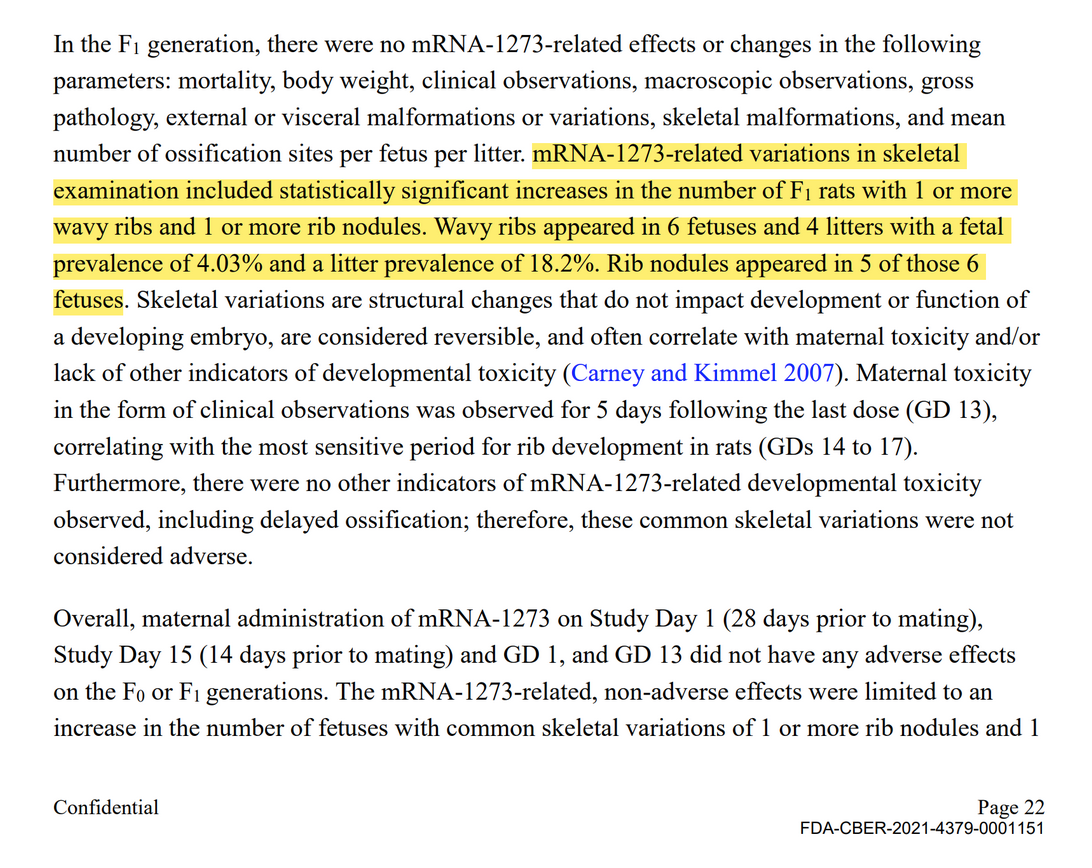
Included in the documents are test results showing that Moderna mRNA shots caused statistically significant skeletal malformations in the offspring of rats that received doses of mRNA-1273 (SpikeVax mRNA) vaccine.
"[The] mRNA-1273-related variations in skeletal examination included statistically significant increases in the number of F1 rats with 1 or more wavy ribs and 1 or more rib nodules. Wavy ribs appeared in 6 fetuses and 4 litters with a fetal prevalence of 4.03% and a litter prevalence of 18.2%. Rib nodules appeared in 5 of those 6 fetuses," the documents read.
"F1" refers to the rat offspring. "Wavy ribs" refers to ribs not properly shaped.
"Maternal toxicity in the form of clinical observations was observed for 5 days following the last dose (Gestation Day 13), correlating with the most sensitive period for rib development in rats (Gestation Days 14 to 17)," the documents state.
A document package on biodistribution studies obtained by Judicial Watch. (Courtesy of Alexandra Latypova)
Six out of about 149 baby rats had wavy ribs, and five of those also had rib nodules.
According to Latypova's analysis, only female rats were studied (male rats weren't treated with the Moderna vaccine).
The females received a human dose of 100mcg SpikeVax mRNA, 28 days and 14 days prior to mating and at gestation days 1 and 13.
"[Half of the] rats [were] euthanized before delivery to examine [their] fetuses. The rest [were] followed to 21 days after delivery," Latypova stated. "No numbers are provided for the study size."
There is no study report in the documents, but rather only Moderna's own interpretation of the outcomes.
The results were part of reproductive toxicology testing done by Moderna, which is the only reproductive toxicology testing that was conducted for the product, according to Latypova.
It isn't known how the dose translates from humans to rats.
"Neither Moderna nor Pfizer provided any dose calculations or justification information for dose selection in animal studies," Latypova told The Epoch Times.
"Doses of drugs, or especially biologics, do not necessarily have linear relationships with toxicity or efficacy. It is likely a much more complex relationship and unfortunately not known at all."
"Reproductive toxicology is the study of adverse effects of medicinal products on reproduction. The FDA requires reproductive toxicity testing for any NME [new molecular entity] to be used in women of childbearing potential," added Latypova, who has worked in more than 60 pharmaceutical companies, mainly focusing on creating and reviewing clinical trials, many of which have been submitted to the FDA.
Despite the lab results, the FDA issued a statement on Jan. 30 stating that there were no adverse effects on postnatal developments.
"No vaccine-related fetal malformations or variations and no adverse effect on postnatal development were observed in the study," the statement reads.
"In a developmental toxicity study, 0.2 mL of a vaccine formulation containing nucleoside-modified mRNA (100 mcg) and other ingredients that are included in a 0.5-mL single human dose of SPIKEVAX was administered IM to female rats on four occasions: 28 and 14 days prior to mating, and on gestation days 1 and 13."
In August 2021, Elsevier published a peer-reviewed study (pdf) titled "Lack of Effects on Female Fertility and Prenatal and Postnatal Offspring Development in Rats with BNT162b2, a mRNA-Based COVID-19 Vaccine."
BNT162b2 is the Pfizer vaccine product.
All the authors of the publication were employed by Pfizer, BioNTech, or Charles River, a Pfizer contractor.
This publication suggests that there was a "lack of effects" in postnatal offspring development, but the study shows that there was a 295 percent increase (8.3 percent, compared to 2.1 percent in the control group) in abnormal ribs in vaccinated rat offspring. A huge increase was reported in what is described as the "supernumerary lumbar."
'An Extremely Dangerous Warning Signal'
"Skeletal abnormalities in the bony rib cages are absolutely important and were statistically increased in the rat offspring of the experimental group compared with the placebo group," Dr. James Thorp, who is board-certified in obstetrics and gynecology, as well as maternal-fetal medicine, told The Epoch Times after reviewing Latypova's analysis of Moderna's BLA package.
"In clinical obstetrics and maternal-fetal medicine, we see similar findings in skeletal abnormalities prior to birth that are extremely serious and often lethal.
"This was an extremely dangerous warning signal in reproductive toxicology studies and was never brought to the light of day to protect our global citizens.
"The CDC, Pfizer, Moderna, and the flagship medical journals of the medical industrial complex lied to the American public and should be held accountable."
Thorp recently analyzed and verified the most recent Vaccine Adverse Event Reporting System data related to COVID-19 vaccines and compared them to the influenza vaccines, finding numerous abnormalities.
The CDC website recommends that pregnant women receive COVID=19 vaccines in order to "prevent severe illness and death."
The American College of Obstetricians and Gynecologists also "strongly recommends that pregnant individuals be vaccinated against COVID-19," adding that pregnant women's complete vaccination should be a "priority."
Moderna, Pfizer, the CDC, and the FDA didn't respond to requests for comment.
Seven unvaccinated Coast Guard Academy cadets facing disenrollment
By Brian Hallenbeck
New London ― Seven Coast Guard Academy cadets ordered off campus this month face "disenrollment" for failing to comply with the military's COVID-19 vaccination mandate, the academy confirmed Tuesday.
The cadets, who had applied for religious exemptions, were informed Thursday, Aug. 18 that they had until 4 p.m. the next day to leave the academy and return to their homes, according to the Summerville, S.C., attorney representing several of the cadets.
Two of the cadets had no homes to return to, the attorney, Michael Rose, said in a phone interview.
"They were escorted to the gate like they were criminals or something," Rose said of the cadets. "No one helped them with travel arrangements or gave them any money. One had to get to California, one to Alaska. One's estranged from home and living out of his truck, according to an email I received describing his situation."
The names of the cadets ― at least one of whom is a senior and at least one a sophomore ― have not been released.
Rose called the academy's orders for the cadets to leave campus "particularly mean-spirited," and said the academy, instead of acting with such little notice, could have awaited the outcome of pending litigation over the military's vaccination requirement, which the U.S. Department of Defense imposed in August 2021.
Multiple lawsuits have been filed on behalf of service members and service-academy cadets, including one in federal court in Charleston, S.C., challenging the mandate on constitutional grounds. Rose said three federal courts have issued injunctions protecting members of the Navy, the Marines and the Air Force from having actions taken against them for failure to be vaccinated.
While no injunction has applied to members of the Coast Guard or the Army, Rose said the suit filed in South Carolina sought to protect unvaccinated cadets at West Point and the Coast Guard Academy from being punished until at least Sept. 1 or until the suit is adjudicated.
A Coast Guard Academy spokesman, David Santos, provided responses via email to a series of questions The Day posed, confirming that seven cadets were found to have violated the Uniform Code of Military Justice, "willfully disobeying a superior commissioned officer," and Article 92, "Failure to obey (an) order or regulation." As a result, the cadets "were disenrolled from the Academy."
The seven were among 15 cadets who submitted requests for exemptions to the academy's vaccination policy in September 2021, according to Santos, who could not say whether all of the requests involved religious exemptions.
"Each request was evaluated on a case-by-case basis by the Coast Guard's Office of Military Personnel Policy, and adjudicated by competent authority at Coast Guard Headquarters, with the advice of counsel, as required by law and Coast Guard policy," he wrote. "None of the requests was approved. Four cadets chose to become vaccinated after their requests for exemptions were denied and four cadets chose to resign from the Academy."
Santos, in the email, said the seven cadets facing disenrollment were informed June 13, 2022 that they were in violation of a military order. They were given five days to achieve compliance by getting a first dose of COVID-19 vaccine. On June 22, the academy superintendent notified the cadets they were being disenrolled and that they could appeal to Coast Guard headquarters. The cadets were notified Aug. 15 that their final appeal was denied.
"Subsequently, the cadets were directed to proceed to an alternate worksite status beginning on Aug. 19 while administrative processes are finalized," Santos wrote.
It's unclear when the academy's disenrollment process will be concluded.
Santos wrote that 1,079 Coast Guard Academy cadets have been vaccinated against COVID-19. Since June 2020, when the academy started tracking the disease, 736 cases have been detected among the resident student population.