Saturday, February 22, 2020

The Cost of Covid-19 Quarantines: Would You Be Financially Prepared?

The Cost of Covid-19 Quarantines: Would You Be Financially Prepared?

The Cost of Covid-19 Quarantine: Would You Be Financially Prepared?

(Psst: The FTC wants me to remind you that this website contains affiliate links. That means if you make a purchase from a link you click on, I might receive a small commission. This does not increase the price you'll pay for that item nor does it decrease the awesomeness of the item. ~ Daisy)

by Daisy Luther

As the world tries frantically to contain a rapidly spreading outbreak of Covid-19, schools, public venues, tourist attractions, and workplaces are being closed in an attempt to keep even more people from contracting the illness. Quarantines and self-isolation protocols are also being instituted across the globe for those who may have been exposed.

Of course, everyone knows that millions of people in China have been in lockdown for more than a month. People are told to stay home, many businesses have ceased to operate, and Chinese New Year celebrations simply didn't happen this year. China's debts are all coming due now, at the worst possible time as the financial loss for the country has been astronomical. For example, car sales are down 92% and Lunar New Year celebrations and travel that usually earn a billion dollars were canceled.

And that tourism hit affects far more than just China. In 2017, Chinese outbound tourists spent $258 billion around the world. The airline industry is bracing for a $29 billion dollar hit. All in all, this virus could end up costing the global economy more than 1.1 trillion dollars, a number that is practically unfathomable.

While the numbers cited here are outrageously large, obviously, these losses aren't only going to affect "the economy" and "the businesses." They're going to have devastating effects on normal folks who just want to go to work, pay their bills, and keep living their lives normally.

A great deal has been written about the economic hits on a global scale as well as the shortages we could soon expect as production in China grinds to a halt, but what about simply being able to pay your rent when your workplace or business is ordered to shut its doors?

Something nobody is really talking about is the financial hit that people will be taking during such closures. This is a very real concern, and for families who already live paycheck to paycheck, the loss of income could prove devastating.

How will containment efforts affect average folks financially?

All over the world, cities are frantically attempting to contain the virus.

Yesterday came the news that 10 cities in northern Italy had closed all public venues due to a new cluster of coronavirus patients. The towns, in the Lombardy region, have shuttered restaurants, stores, and schools. Public gatherings like carnival celebrations, church masses, and sporting events have been banned for at least a week. In one town, Casalpusterlengo, an electric sign reads, "Coronavirus: the population is invited to remain indoors as a precaution." Seventeen people in the region have tested positive for Covid-19, and two have perished there from the illness.

Millions of people in South Korea have been told to stay at home. Preschools have been closed and public gatherings and demonstrations have been banned.

Thousands of people in the United States are under voluntary self-quarantine, not to mention the hundreds who have been repatriated and put into mandatory quarantine. Obviously, unless these folks have jobs to which they can telecommute, they're not working.

All of these containment measures are certainly wise and in the best interest of peoples' health. But what about their bank accounts?

Here's a scenario that's seeming less and less farfetched.

If you're the owner of a physical business like a store or restaurant, you're going to have to shut down under any of the kind of mandates mentioned above. When you're closed, of course, you're not making money. It's the same thing with factories (who will be there to produce the goods?) and offices. Your business will grind to a rapid halt.

And what about employees? Obviously, if you don't go to work, you're not going to get paid. And this isn't just a case of "evil capitalists" who are too stingy to give their employees paid leave. If the business is not running, there is no revenue coming in. That means that even if the business owners were the most generous people alive, they probably couldn't afford to maintain payrolls for very long.

So how are you going to pay your bills? It's safe to expect that the mortgage company, the credit card companies, the utility companies, and all those other businesses with their hands out each month are still going to want their money. And their businesses could potentially carry on to some degree, remotely. That stuff isn't just going to magically disappear. You're going to owe that money. Even if companies try to work with folks as they did during the most recent government shutdown, the money will still be owed and you'll still be unpaid for a week, a month, or however long you were out of work.

This doesn't include the cost of food, medication, general expenses, and medical bills – heaven help you if you do get sick.

What can you do to prepare for this financially?

Here's where the situation becomes even more difficult.

I strongly, adamantly advise getting prepared for being home for a period of time whether that quarantine is official or self-imposed. I advise also that you get prepared for other ramifications of a potential global pandemic, too. And if you aren't already pretty well-prepped, that is going to cost money.

That leaves us in a quandary.

Do you save your money for the possibility of being without work or do you spend your money to feed your family while you're without work? It's like a choice between the rock or the hard place.

If you have an emergency fund, avoid cracking into it for supplies. This will be your cushion for bills if you go for a period of time without work. If you do not have an emergency fund and you've been struggling with a paycheck to paycheck lifestyle, things will be a lot tougher.

Temporarily halt your efforts to pay off debt faster. Pay only the minimum payment for a month or two while we see how this plays out. Put that extra money into your savings account and you can build a small emergency cushion. And if things don't get bad, you can use it for debt later when things settle down. People always like to say I'm wrong when I suggest that paying off debt isn't your first priority, but in this situation, keeping your utilities on and a roof over your head is more important than paying some extra interest.

Raise some money. Now's the time to try and raise a bit of extra money. Do you have anything you can sell for a chunk of change? Is there a possibility of getting a second job temporarily? Put an ad on Craigslist for that exercise bike being used as a clothes-hanger in the basement. Sell a piece of unwanted jewelry. Get rid of the car nobody drives. Use this money for your emergency fund or for supplies. You will have a lot more difficulty selling it after a crisis because then everyone is going to be broke. If you're going to do it, do it now.

If you're flat broke, things will be more difficult. This isn't news to you if you're in this situation. Please know I'm not judging – I've been there, so broke that I literally cried over a gallon of spilled milk because it was a week until payday and I couldn't afford to get more for my children. But this isn't about emotional responses – it's about practicality. If you have only a limited amount of money, you're going to have to prioritize where you spend it. Your credit is most likely already shot if things are this tight, so don't worry about that right now. Keep a roof over your head, utilities on, food in the kitchen, and a car in your driveway if your job depends on it. Credit card debt should be the last thing you pay in a situation like this. Go read this article, How to Survive When You Can't Pay Your Bills, for more detailed information.

Prioritize your supply purchases. While people are frantically buying up N95 masks and PPE, spend your money on the things you need to have on hand during a month or more at home. Sure, I think it's great to have medical supplies for a possible pandemic, but these measures are to be used if you go out into the germy masses. And your goal should be to avoid doing that. Other reasons you'd need these supplies would be if a family member became ill – you'd want to do your best to avoid contracting the illness yourself while you care for them and you'd want to protect your other family members. The more I learn about this virus though, the less convinced I am that gloves and masks are going to be preventative enough if you're living in close quarters with an infected person. Look at the rapid rates of transmission aboard the Diamond Princess cruise ship for more information on that. While of course, it is best to have both medical supplies and food, if you can only get one type of supply or the other, focus most of your money on food and other essentials – not PPE.

Use some of the money coming in for supplies you need to buy. Think about what you would need if you couldn't leave your house for a month, two months, etc. (It's pretty difficult to put a time on something like this. China has had people in some areas locked down for a month with no real end in sight.) Here's some of the stuff I bought to top up our supplies and be prepared for lockdown. Use my list only as a general guideline – you know what your family needs and it will be different from mine. Be sure to include plenty of nutrients in your supplies – you want your immune system to remain highly functional when you could be at risk of contracting an illness.

At the same time, go for quantity over quality if money is an issue. Get some stuff that is cheap yet filling as the last resort of your pantry. Remember, you want to be able to stay home and not send someone out to be exposed while trying to acquire food. So if that means some peanut butter and crackers or mac and cheese in the back of your pantry, it's better than getting sick to go out and seek fresh veggies. (And you most likely wouldn't even be able to find them – expect the supply chain to break down pretty quickly.)

Talk to the people to whom you owe money. Contact utility companies, mortgage companies, banks, credit card companies, etc., and let them know about your situation. Everyone will be in a similar boat and these businesses may have some suggestions for you. Mortgage companies may be able to offer you a month of grace, credit card companies may make arrangements with you, etc. Do this early on and it will help you plan where your money is going to go during the crisis.

Prioritize your bills. You need a place to live (although I doubt they're going to be running around evicting people during a pandemic, you could lose your house afterward unless you can work something out.). You need to keep your utilities on. You may have some other essential spending, too – this will be very individual. Credit card debt and unsecured loans come dead-last in bill-paying during a crisis like this. Other things that are not essential? Cable, which seems like a great option for whiling away the hours when you're cooped up in the house, is not a priority. Nobody in your family will die without television although some people may act like they're going to perish from the very idea of it. Each family member having an operable cell phone? Not a priority. Extreme situations may call for measures that people find less than pleasant. Make these decisions early on. A monthly cable bill of $120 would buy you quite a bit of non-perishable food.

Be frugal. Let's assume you're able to work out a deal with the utility companies to pay your overdue bill a month after the crisis has resolved. These aren't going to be the only bills you are behind on. It would behoove you to be as frugal as possible with utility usage. Don't leave on every light in the house, don't crank your heat or air conditioner, and try to keep your bills low so that the amount you pay when things go back to normal isn't quite as daunting. Trust me, paying 2-3 electric bills at a time will still be a big chunk of money, regardless of how careful you are. Don't make it worse by acting like you're in a hotel where you don't pay for the power used.

Be ready for the long haul.

This is a crisis that could have snowballing repercussions and they could last for a very long time. Hopefully, it gets contained and blows over without affecting us too badly. Hopefully, we get lucky and in a few years, the Covid-19 outbreak warrants the same eye-roll that the 2014 Ebola scare does.

But if it doesn't – if the scenario described in this article comes to pass – you need to be prepared for a long-haul. You need to be ready for your lifestyle to change fairly dramatically. A loss of more than a trillion dollars from the global economy isn't something that we'll bounce back from with "business as usual."

  • Jobs will be cut as businesses struggle to stay afloat.
  • Businesses will fail.
  • Properties will not sell.
  • Shortages of food and other supplies will occur.
  • If people are unable to pay back debt, expect a banking crisis that makes 2008 look like a rainy Sunday afternoon.

The same measures taken to contain the virus can cause these economic effects.

…experts like Richard Schabas, Ontario's former chief medical officer, worry that draconian measures that stoke fear in the population do more harm than good.

"Recessions kill people, in fact will probably kill more people than this virus does," he told CBC News host Michael Serapio last week…

…"Our world has become so interconnected," says Jia Wang, deputy director of the University of Alberta's China Institute.

Wang suggests that the next few weeks will be critical, showing whether the epidemic, with its global economic impact, is moderating or getting worse…

…Fear and government restrictions mean people in China have been staying home, slashing the business of retailers and restaurants. Some reports say property sales are down by more than 80 per cent, affecting a business that represents about one-quarter of China's gross domestic product.

Wang says that while the country's giant companies are big enough to outlast the crisis, especially with government help, a significant and dynamic part of China's economy is based on much smaller businesses that could disappear, leading to lingering economic effects.

"If the quarantines and shutdowns of many cities around China continue for a few more months or even just one month, many of the smaller companies may not survive," she said.

Wang says there are also worries that the coronavirus and its economic effect will spread outside China. Last Friday, Singapore's president, Lee Hsien Loong. warned the disease could push that country into recession.

Putting a figure on the global impact is not easy, and estimates of the damage vary widely. Oxford Economics says global growth will fall to 2.3 percent in 2020, the lowest level in more than 10 years and below the IMF's global recession level. (source)

Currently, it's impossible to predict how far this will spread and how bad it will be. There's no way to know how long quarantine and containment measures will be put into place, or even if they'll be necessary.

But be ready for anything, economically speaking. Covid-19 is the wild card that nobody expected.

About Daisy

Daisy Luther is a coffee-swigging, globe-trotting blogger who writes about current events, preparedness, frugality, voluntaryism, and the pursuit of liberty on her website, The Organic Prepper. She is widely republished across alternative media and she curates all the most important news links on her aggregate site, PreppersDailyNews.com. Daisy is the best-selling author of 4 books and runs a small digital publishing company. You can find her on FacebookPinterest, and Twitter.


~A.

Coronavirus (COVID-19) Autopsy Report Analysis by Dr. Mike Hansen

https://youtu.be/V-7SQGPkijs


~A.

Friday, February 21, 2020

China central branch to destroy banknotes from CORVID19

China central bank branch to destroy banknotes from coronavirus-hit sectors
Paper currency collected from hospitals and buses among those targeted by the People's Bank of China's (PBOC) in a public health push
Other notes will be disinfected and stored for 14 days before going back into circulation

The Guangzhou branch of the People's Bank of China (PBOC) says it will destroy banknotes collected from virus-affected sectors such as hospitals. Photo: China Daily via Reuters
The Guangzhou branch of China's central bank says it will destroy all banknotes collected by hospitals, wet markets and buses to ensure the safety of cash transactions as the country battles a coronavirus outbreak.
Financial news outlet Caixin reported on Saturday that officials at the People's Bank of China's (PBOC) branch in the southern city ordered that all paper currency from sectors with high exposure to the coronavirus be withdrawn for destruction.
Commercial banks in the province should put banknotes from these sectors aside, disinfect them and hand them in to the PBOC.
The order comes after Fan Yifei, deputy governor of the central bank, said on Saturday that 600 billion yuan (US$85.6 billion) of new banknotes had been distributed throughout the country since January 17, including 4 billion yuan (US$572 million) in fresh notes sent to Wuhan at the centre of the outbreak before the Lunar New Year.

The central bank said that in general it would use high temperatures or ultraviolet light to disinfect cash, and store the currency for more than 14 days before putting it back in circulation.
Nearly 3 billion yuan in new banknotes was injected into the southern province of Guangdong, excluding Shenzhen, between February 3 and 13, while 7.8 billion yuan was withdrawn from circulation, the PBOC said.
The banking industry extended 270 million yuan (US$38.6 million) in cash through 1,249 transactions to government agencies, epidemic prevention and control related enterprises and other frontline units, Caixin reported. Cash withdrawals amounted to 800 million yuan through 6,186 transactions.
Central banks routinely collect and destroy old coins and banknotes in exchange for new ones. This does not affect the money supply, and is done to maintain a healthy amount of usable currency.

Caixin cited an unnamed deputy chief at a large joint stock bank in Guangzhou as saying that customers would be required to confirm the origin of the banknotes being deposited at their branches but in reality, "it would be difficult for such a measure to be completely effective".
Fan also said that China had pledged extra funds to banks, prodding them to help manufacturers and businesses pull through headwinds from the China-US trade war and the nation's worst health crisis in nearly two decades.
Economic growth, which already slowed to 6 per cent in the fourth quarter, is likely to sputter further in the three months ending in March, with an estimated 50 million workers forced to stay home since late January, disrupting production of everything from clothing to toys and crucial components.
The State Administration of Foreign Exchange said it had help fast-track 1,370 foreign exchange transactions in China between January 27 and February 12, including 70 for imports into Hubei, mainly for the purchase of masks, protective gear and production materials.


~A.

Why the controversy over chronic Lyme disease is important to everyone

Why the controversy over chronic Lyme disease is important to everyone

Why the controversy over chronic Lyme disease is important to everyone

CT VIEWPOINTS -- opinions from around Connecticut

Shown in this darkfield microscopy (400x mag) are the spirochetal bacteria known as Borrelia burgdorferi, the bacterium responsible for Lyme disease.

A response to the CT Viewpoints op-ed Treating 'chronic Lyme disease:' Is it medical fraud? By Lawrence Zemel MD and Paul G. Auwaerter MD, Dec 13, 2019.

The authors' reference to "so-called chronic Lyme disease" ignores the substantial body of evidence that suggests Lyme disease can be chronic and infection can persist following treatment with antibiotics.

The first investigation into the effectiveness of antibiotics for the treatment of Lyme disease was published by Steere in 1983. The study was conducted at a time when prevailing thought held that antibiotics would cure all infectious disease caused by bacteria. Because the findings of the 1983 study were not consistent with that belief, the data were re-categorized to generate the expected result. Critical analysis of the data reveals, however, that nearly 50% of the patients in the study who were treated with antibiotics for 10-20 days continued to experience significant symptoms.

Other studies have produced similar results, yet the Infectious Diseases Society of America (IDSA) ignores independent research and continues to claim that Lyme disease at any stage of infection is cured by a short course of antibiotics.

A 2019 subcommittee report to the Tick Borne Disease Working Group (established by Congress in 2016), stated that the results of more recent studies in animal models by different investigators, "lend support to the probability that the effects of persisting organisms are a source, if not the likely source, of ongoing symptoms in patients who have unresolved Lyme disease."

In 2019, The International Lyme and Associated Diseases Society (ILADS) Working Group published a paper in which they systematically reviewed over 250 peer reviewed papers in the international literature and concluded that Lyme disease is the result of ongoing and active infection by any of several forms of B. burgdorferi  capable of causing disease in humans.

Zemel and Auwaerter refer to an "unsubstantiated notion that 50% of patients with Lyme disease test negative by standard laboratories" but there is abundant evidence demonstrating that the two-tiered testing method recommended by the Centers for Disease Control is problematic.

There are many reasons why infected individuals may generate a negative result. Chief among them is the fact that the test relies on the ability of the infected individual to produce antibodies when Lyme bacteria have the ability to suppress the immune system preventing antibody production. Further, there are over 100 species of Borrelia in the U.S. (not all cause disease in humans) and the current two-tiered testing method misses the majority of them. Independent studies have shown these tests to correctly identify only about 56% of those with Lyme disease.

In a 2018 publication in its own journal, the IDSA admitted that "reliable direct detection methods for active B. burgdorferi have been lacking in the past but are needed and appear achievable."  Despite this, the IDSA guidelines fail to offer treatment options to patients who test negative but have the disease.

The authors' suggestion that vulnerable patients need to be protected from Lyme-literate practitioners is both intentionally misleading and unsubstantiated.

Lyme-literate practitioners have a wide variety of medical backgrounds. Many are board-certified medical doctors with expertise in a variety of specialties and have additional training in tick-borne disease, while others are board-certified osteopathic physicians, naturopathic doctors, or nurse practitioners. Many are members of ILADS. Some practitioners have a background in integrative medicine, a holistic approach to health and wellness that combines conventional medicine with complementary and alternative medicine therapies grounded in science. Others are trained in functional medicine whose aim is to determine how and why illness occurs and to restore health by addressing the root cause of illness for each individual.

Some practitioners use a multimodal approach to address factors that might be keeping a patient sick including poor digestive health, food allergies, inflammation, toxicity, and hormone imbalance. They may use prescription and herbal medicines as well as other supplements. Because treating Lyme disease is a time consuming process, it fits poorly into the current model for medical reimbursement. As a result, many practitioners do not accept insurance but will provide documentation that can be submitted to an insurance carrier.

Just as they would with any other medical professional, patients are capable of exercising due diligence when selecting a Lyme practitioner to ensure that the approach to care is consistent with their preferences and beliefs.

The authors' reference to the "careful scientific rigor" associated with the IDSA guidelines revision process does not hold up to scrutiny.

In 2006, Connecticut Attorney General Richard Blumenthal conducted a landmark anti-trust investigation into the IDSA's process for writing its 2006 Lyme disease guidelines.  Blumenthal's office "uncovered undisclosed financial interests held by several of the most powerful IDSA panelists" and found that the guidelines panel "improperly ignored or minimized alternative medical opinion and evidence regarding Lyme disease, potentially raising serious questions about whether the recommendations reflected all relevant science."

One of the most egregious and dangerous recommendations by the IDSA is the use of a single dose of doxycycline to prevent the development of Lyme disease when given within 72 hours of a tick bite. This advice is based upon a single study with illogical and flawed methodology published nearly two decades ago. It has never been replicated. Data from this study show only that the dose was sufficient to prevent formation of the rash that sometimes develops at the site of a tick bite but not that it halted development of the disease itself. This treatment may promote antibiotic resistance and lead to negative antibody testing making diagnosis even more difficult.

Why this issue is important.

The problem that can arise when evidence is scarce is the misperception that guidelines are based on evidence rather than opinion. The evidence on which both sets of guidelines are based is weak. The authors of the ILADS guidelines acknowledge this directly and the fact that there two sets of conflicting guidelines. The authors of the IDSA guidelines fail to do so.

The 2011 report by the National Academy of Medicine (NAM), Clinical Practice Guidelines We Can Trust, the 2006 IDSA Lyme Disease Guidelines were cited as an example of lack of transparency in guidelines development to illustrate the problems associated with it.

When evidence is weak, clinician discretion is especially important. The ILADS guidelines allow for this and for shared decision-making between patient and practitioner. In contrast, the IDSA guidelines severely restrict the use of clinical judgment.

Why is this important even to those that don't have Lyme disease? Clinical practice guidelines greatly influence the practice of medicine. When lack of transparency, scientific bias, and financial conflicts of interest are allowed to affect them, it places the health of all of us at risk.

Jennifer Shea lives in Longmeadow, Massachusetts.

CTViewpoints welcomes rebuttal or opposing views to this and all its commentaries. 


~A.

Wednesday, February 19, 2020

Financial and Tax Records - Dealing with Clutter


What Do I Do With... Financial and Tax Records

Privacy issues
Be careful when disposing of financial records. A credit card number or bank account number could be retrieved by a thief and used to make charges against your account. Carefully tear up or shred any financial documents that contain account numbers, Social Security numbers, or other sensitive information before tossing them.

Tax Records

You should keep a copy of income tax returns and the supporting documentation (receipts and worksheets) for several years. The Internal Revenue Service has three years to audit federal income tax returns. However, this limit does not apply in unusual cases. If you failed to report more than 25 percent of your gross income, the government has six years to collect the tax or to start legal proceedings. Also, there are no time limitations if you filed a fraudulent return or if you failed to file a return. That means keeping records for at least three years and probably six years after an expense was incurred or after the final disposition/sale/withdrawal of an asset—or for three to six years after you filed the tax return based on that action, if you filed late.

However, there are some situations where you will need to refer back to your older tax returns for much longer than that. Three examples are when you own a home, own investments, or have a Roth IRA or nontaxable amounts in your traditional IRA. Read on for more information.

You can also check IRS Publication 552, Recordkeeping for Individuals.

laundry basket

Home purchase, sale, and improvements
Keep records about how much money you have invested in your home. Before May 7, 1997, profit from the sale of one home was usually rolled into the purchase of the next home. If you sold your previous home before May 7, 1997, you will need the tax forms you filed regarding the sale of that home ( the old IRS Form 2119, Sale of Your Home), and the supporting documentation, to calculate your profit when you sell your current house. If you sold your previous home after May 6, 1997, you only need the records for the purchase of your current home. You will also want to keep receipts for any improvements or additions made to your home, since this increases your investment (basis) in the property and may reduce your profit and tax, if any, when you sell. See IRS Publication 523, Selling Your Home.

Investment or brokerage statements, including documentation of purchase of stocks, bonds, mutual funds and other investments
Keep the statements that show what you paid for each investment purchase, including any commissions or fees. If you reinvest dividends (use the dividends to automatically purchase new shares of the investment), you will also need records showing the dollar amount of those dividends. The sum of these items is your basis, or cost, in the investment. You will need these records to calculate your capital gain (profit) or loss when you sell the investment. If you sell only part of an investment (i.e., you own 300 shares of Mutual Fund ABC, and you sell 100 of those) keep records of your basis for that sale, so that you can calculate your basis and gain when you sell the remaining shares.

Retirement Accounts

Recordkeeping for retirement plans became more important with the introduction of Roth accounts and the ability to roll money from one type of account to another, including conversions of tax-deferred money into Roth (after-tax) funds.
The main recordkeeping responsibility for the individual is to track any money in IRAs that is nontaxable – that is, money on which you have already paid taxes – so that you can avoid paying tax again when the money is distributed. This includes

  • Contributions to a traditional IRA that you did not deduct from income. Contributions to a traditional IRA are nondeductible only if you or your spouse are eligible to participate in an employer retirement plan and your income is above certain limits. (See IRS Publication 590)
  • Contributions to a Roth IRA.
  • Money that was converted from a traditional IRA to a Roth IRA.
  • Roth contributions from an employer plan that were rolled over to a Roth IRA.
  • Traditional (pre-tax) contributions to an employer plan that were converted and deposited into a Roth IRA.

Report these amounts on Form 8606 and track them until you take the last distribution from your IRAs.
The IRS says you'll also need to keep your 1040 from each year that you made a non-deductible contribution, all Forms 8606 that you filed together with their supporting documents, Form 5498 annual statements showing IRA contributions or account value after distributions, plus the 1099-R forms that document your distributions. Keep these papers until you withdraw the last dollar from your last IRA.

laundry basket

In Publication 552, the IRS advises keeping Forms 5498 and 1099-R even if your IRAs contain only deductible contributions and growth on which the taxes have been deferred, which will all be taxed at distribution.

Employer plans could also hold nontaxable amounts, including contributions to designated Roth accounts and – less commonly – nondeductible contributions. The IRS appears to put the recordkeeping burden for these accounts on the plan administrator, unless distributions are rolled over to an IRA and must then be reported on Form 8606.

Bank Account Records [Back to top]

Cancelled checks, deposit slips, ATM receipts, debit card receipts
For peace of mind, keep all of these items for about a year. But once you've verified that the transactions have been correctly reported on your statement, the only items you need to keep long-term are ones you need for tax records (such as deductible expenses) or important proofs-of-payment, such as major appliances still under warranty. You may find it convenient to use an envelope to hold all these items until you have checked them against your statement.

Account Statements
Some financial experts say you only need to keep bank account statements for a couple of months. But after being audited, the editor of Kiplinger's Personal Finance Magazine recommended keeping bank statements for seven years. You may be able to obtain statements from your bank if you need them. If so, you may decide to keep only a few months of statements.

Credit Card Documents
Keep all credit card receipts until you have verified that the transactions have been correctly reported on your statement. Keep receipts you need for tax records according to the guidelines for tax records. Keep receipts that are proofs of purchase until the warranty has expired. For convenience, you may want to keep credit card receipts for about a year. If a charge shows up that you believe has already been paid, you can easily check your previous statements.

Receipts [Back to top]

While you don't need to keep most receipts long-term, sorting through them can be a hassle. Try this simple approach that gives you a loosely organized system with little effort.

  • Select a container that will hold a year's worth of receipts to serve as your receipt box. Label it Receipts and add the year, for example, Receipts 2004.
  • Put your receipts into the box when you bring your purchases home or when you empty your wallet. By default, the receipts are generally in chronological order. If you should need to locate a receipt, you can dive into the part of the stack that covers that time period.

If you REALLY want to be organized, add the following steps:

  • Give special treatment to some receipts.
    • Label a separate envelope or file for each credit card and debit card you use. File your receipts in these envelopes until your credit card or bank statement comes. Check the statement against your receipts. Then transfer them to the receipt box.
    • Receipts for items with lengthy warranty periods, such as a major appliance, should be kept longer than most receipts, perhaps stapled to the warranty.
    • File receipts that are documentation of tax-related expenses with your tax records for that year.
  • At the end of the year (Dec. 31), start a new Receipt 2005 box and move the 2004 box to your dead storage area. That might be a box under the bed or a shelf in the basement.
  • Keep one or two years' worth of receipts in dead storage. When you place the new stack in the dead storage, remove the oldest stack and toss it. You may want to shred receipts that have credit numbers or other sensitive information on them.

Bills (Unpaid and Paid) [Back to top]

Most bills do not need to be kept long term after they're paid unless they represent tax-deductible expenses. Some people only keep utility bills until the next month's bill comes and they have verified that their payment has been credited to the account.

To keep bills organized with a minimum of sorting and managing, follow this simple procedure.

  • Label two envelopes or file folders, one for Bills to Pay and one for Paid Bills that includes the year, such as Paid Bills 2004. Keep them both in your bill paying area.
  • As bills come in, put them in the Bills to Pay folder.
  • When you pay a bill, move it to the Paid Bills folder--except those that are needed for income tax records. File those with your current year tax information.
  • At the end of the year (Dec. 31), you can either toss most of the paid bills or move the file to your dead records area. That might be a box under the bed or a shelf in the basement. Dead storage doesn't need to be very convenient. Keep one or two years' worth of bills. When you add a new year's bills to the dead storage area, remove the oldest year's bills and either toss it or shred them.

Medical Bills

Medical bills may need to be kept longer than most other bills or receipts. You and one or more insurance companies pay portions of these bills, making it hard for you and for the healthcare providers to keep accurate records. Many people report receiving bills from a doctor or hospital for an expense that was several years ago, that was never submitted to insurance for payment, or that the patient already paid.

On the medical bill, make a note of when and how you paid (check number or name of credit card), and the amount. You may also want to keep proof of insurance payments. You will have to decide how long to keep these records. If you have had billing problems with a particular healthcare provider in the past, you may want to keep those records for three to five years or more.

Pay stubs

Keep pay stubs until you get your W-2 at the end of the year. Once you've checked that the amounts match, you don't need the pay stubs. If you have direct deposit and your checking account number is on the stub, shred it.


Which Tax Papers To Keep + Tips For Organizing 7 Years Of Support Documentation For Your Taxes | The Personal Finance Guide


Which Tax Papers To Keep + Tips For Organizing 7 Years Of Support Documentation For Your Taxes


In writing about our personal experiences, we sometimes mention products or services that we use or recommend. This page may contain affiliate links for which we receive a commission.


Each year around tax time, I go through all of our personal receipts, bank statements, household utilities, and medical bills/receipts in an attempt to stay organized.

By staying on top of this and doing it just once each year, it's easier to find the information we need when the time comes for filing taxes.

Now it's a breeze to find the appropriate support documentation for our tax forms — and for the accountant — each year.

I thought I'd share some of the time-saving tips I use to keep all of our personal, household, and tax info organized, including:

  • How long to keep things for taxes and which things to keep
  • How to organize all the paper that must be saved
  • How long to keep tax documents that have already been filed
  • How to find the right shredder for the items you don't need to save

What Must Be Saved

You don't need to kill lots of trees to maintain good records. The IRS allows electronic storage systems as long as they provide an accurate and accessible record of the data. Rosenberg recommends scanning your documents onto your computer then backing them up on a CD. 

Store Receipts – I keep every single store receipt in an expandable file folder in my desk drawer. At the end of the year, I go through it and decide which receipts I need to keep and which ones I can shred. The ones to keep are those that are needed for tax records (such as deductible expenses) or for proof-of-purchase (such as items still under warranty).

Some people like to have a physical receipt for every single item purchased — even if it was bought online. In that case, you'll want to take the time to print a receipt for every online purchase you make — then store it in a folder labeled "Store Receipts". On the other hand, some (like my husband) prefer to rely on credit card statements which summarize all of your purchases (including those made online) instead of keeping all of the individual receipts as documentation. According to our accountant — and the IRS — both methods are acceptable.

Utility Bills – These simply provide proof that you resided in a particular location for a specified length of time, you paid your bills on time (or not), and if you take a home-office deduction they provide support documentation for your taxes, among other things.

Bank Statements – Since these can be used as documentation for many of our large purchases, I keep them all. These days, you can also obtain copies of your bank statements directly from your bank, if needed. But I still keep all of our printed bank statements, so that I can see our purchases on the fly — if I should ever have a question.

Credit Card Statements – In addition to keeping these as a way to verify duplicate charges and items that we've returned for a refund, I keep them all since they can also be used as documentation for the majority of our daily purchases. As with bank statements, you can get copies directly from the credit card company, but I like to have everything at my fingertips should I ever need it.

Medical Bills – Since both medical institutions and insurance companies are involved (in addition to what you personally pay toward your medical expenses), it's important to keep your medical bills well organized. We write the date and check number on all medical bills that have been paid, and store them chronologically in a file folder. At year-end, all bills paid in that calendar year get filed with that particular tax year, and any unpaid bills get moved to the next calendar year.

Pay Stubs – Hold onto these throughout the year, until you receive your W2 at year end. As long as the amount on our W2 is correct, then you don't need to keep those previous pay stubs any longer.

Investments – Keep all paperwork associated with buying, selling, and trading investments — even after you sell them. However, once you receive an annual statement, you can shred any routine monthly or quarterly statements received before that.

Donations – Place all receipts for charitable contributions — including Goodwill donations, etc — in a file folder labeled "Donations" and go through them at year end.

Home Purchase/Sale/Improvements – Keep these receipts and associated paperwork in separate folders labeled "Home Purchase," "Home Sale," and "Home Improvements." They are important within the following guidelines:

If you sold your previous home after May 6, 1997, you only need the records for the purchase of your current home. You will also want to keep receipts for any improvements or additions made to your home, since this increases your investment (basis) in the property and may reduce your profit and tax, if any, when you sell. Source

How Long To Save Things

For tax purposes, I keep everything that could be used to justify what's on our tax forms for a period of 7 years. Period.

I know that some things technically only need to be kept for 3 years, and some things only 1 year, but I don't have the time or patience to create a paper storage system with varying timeframes for removal.

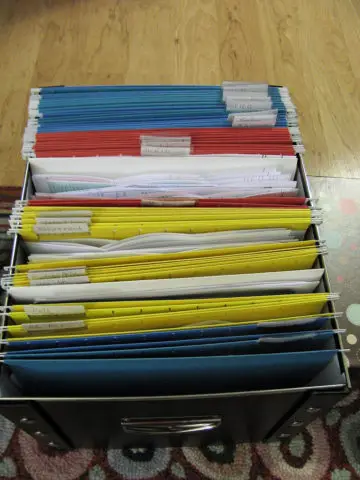
Using my method, every year I can quickly eyeball the stack of paperwork that has been saved longer than 7 years — which can now be shredded and removed from our home. It may take a tiny bit more space in the long run, but it's the simplest method in my opinion. Besides, as you can see in the above photo, it only takes one empty crate to hold the past 7 years worth of paperwork anyway!

Technically, the completed tax forms themselves can be shredded and disposed of earlier too. But as you can see in the photo, I am holding onto every single tax form that we've completed — minus all of the supporting documents — simply because it's a part of our past (individually and together) that I personally want to hold onto.

If Jim had his way, those things would have been shredded long ago, but hey — I'm a scrapbooker and a keeper of personal memorabilia for sentimental reasons. Those old tax forms have a lot of history in there — from our first jobs (and what we were paid back then!) to our personal businesses (including start and stop dates that I'll never remember myself) personal residences, and more.

Besides, you can bet if we ever did get audited, I would want to be able to go back to prior tax years and reference what we did before, or how we did things differently back then. (Perhaps that's just my overly-organized way of looking at things, but it works for me.)

There are some situations where you will need to refer back to your older tax returns for much longer than that [6 years]. Three examples are: when you own a home, have a non-deductible IRA contribution, or you have business or rental property that you are depreciating over a number of years. Source

Some experts recommend you keep copies of tax returns forever, because they provide a record of your financial history. You may need previous returns to apply for a mortgage or student loan. Source

If you're not going to save everything for the full 7 years like I do, here is the best list for how long to save things that I could find.

And, believe it or not, some stuff should be kept even longer than 7 years!

How To Organize Everything

I use basic file folders and accordion file folders for storing and organizing all papers that could be used as support documentation for our taxes.

Both types of folders hang nicely in large desk drawers using file folder drawer frames. But truthfully, you don't even need the drawer frames, since file folders of the same size (either letter size or legal size) will stack neatly together within any drawer.

For folders that will hold large, bulky forms (like credit card statements) or a lot of paper (like our "Store Receipts" file), I use accordion file folders instead of regular ones.

And then I have 2 large plastic crates (pictured above) that hold the following:

  • All of our completed tax forms (from the last 7 years… and more!)
  • Supporting documentation that goes with the last 7 years' tax forms

The completed tax forms are stored in the folders or envelopes that our accountant gives them to us in.

The support documents are stored in manila folders. (Each year has 4 envelopes: "Utilities" "Bank Statements" and "Credit Card Statements" and "Misc")

It's worth noting that, in addition to routine tax papers, we also have an accordion file folder that contains all of our vital documents.

In yours you might have things like:

  • Marriage certificate
  • Divorce papers
  • Birth certificates
  • Adoption papers
  • Bankruptcy papers
  • Estate papers from relatives
  • Citizenship papers
  • Passports
  • Military service papers
  • Government bonds
  • Social Security cards
  • Voter registration cards
  • Wills
  • Death certificates
  • Car titles
  • Patents or copyrights
  • Other government or court-recorded papers

Copies of these items should be kept in your home, while the originals should be stored off-site in a safe location — like a safe deposit box at the bank. Don't forget to include a household inventory list (or video) and a list of all of your important accounts.

And last but not least, you're going to need a paper shredder!

Here's what to look for in a paper shredder.


yer welcome...

How to create a home inventory | III


How to create a home inventory

A list of your belongings will make filing an insurance claim much easier

If you're just setting up a household, starting a home inventory is relatively simple. If you've been living in the same house for many years, however, the task of creating a list can seem daunting—but it doesn't have to be. Get started here.

  • Pick an easy spot to start – A contained area—like your small kitchen appliance cabinet, your sporting equipment closet or your handbag shelf—is a great place to get started.
  • List recent purchases – Another way to start is with recent purchases—get into the inventory habit and then go back tackle your older possessions.
  • Include the basic information – In general, describe each item you record, and note where you bought it, the make and model, what you paid and any other detail that might help in the event you need to make a claim.
  • Count clothing by general category – For example, "5 pairs of jeans, 3 pairs of sneakers…" Make note of any items that are especially valuable.
  • Record serial numbers – Usually found on the back or bottom of major appliances and electronic equipment, serial numbers are a useful reference.
  • Check coverage on big ticket items – Jewelry, art and collectibles may have increased in value and may need special coverage separate from your standard homeowners insurance policy. While you're making your home inventory list, check with your agent to make sure you have adequate insurance for these items before there is a loss.
  • Don't forget off-site items – Your belongings kept in a self-storage facility are covered by your homeowners insurance, too. Make sure you include them in your inventory.
  • Keep proof of value – Store sales receipts, purchase contracts, and appraisals with your list.
  • Don't get overwhelmed – Once you've started your inventory, keep going even if you can't get it all done immediately. It's better to have an incomplete inventory than nothing at all.


Use technology to make your home inventory easier


A simple pencil and paper will suffice, but technology can make creating a home inventory much easier.

  • Take pictures – Create a photo record of your belongings. Capture important individual items as well as entire rooms, closets or drawers. Label your photos with what's pictured, where you bought it, the make or model—whatever information might be important to replacing and/or getting reimbursed for the item. Use your smartphone or digital camera—some give you the capability to put in the description of the item when saving the photo.
  • Tape it – Walk through your house or apartment videotaping and describing the contents. For example, you might describe the contents of a kitchen cabinet: "Poppies on Blue by Lenox, service for 12 that includes a dinner plate, salad plate, bowl, cup and saucer. Purchased in 2015."
  • Use an app – There are many mobile app options that can help you create and store a room-by-room record of your belongings.

Keep your home inventory up-to-date and safely stored


Your home inventory is only useful if it's accurate and you can access it to provide information to your insurance company in case of fire, theft or other destructive disaster. Regardless of the medium you've used to create your list, keep it backed up and in a safe place.

  • Add significant new purchases to your list – Make it a habit to add the item information and receipts to your inventory while the details are fresh in your mind.
  • Store a copy of your paper inventory outside the home – Keep it—along with applicable receipts and appraisals—in a safe deposit box or at a friend's or relative's home. Make at least one backup copy of your inventory document and store it separately. An easy way to make digital backup copies of your paper list is to take pictures of it on your smartphone.
  • Backup digital files – Keep a copy on an external drive or online storage account.
  • Understand your app – Be sure the information you input is backed up by the app developer and that you know how to access information when you need it.

Next steps: After you've taken your inventory, learn how much homeowners insurance you need.