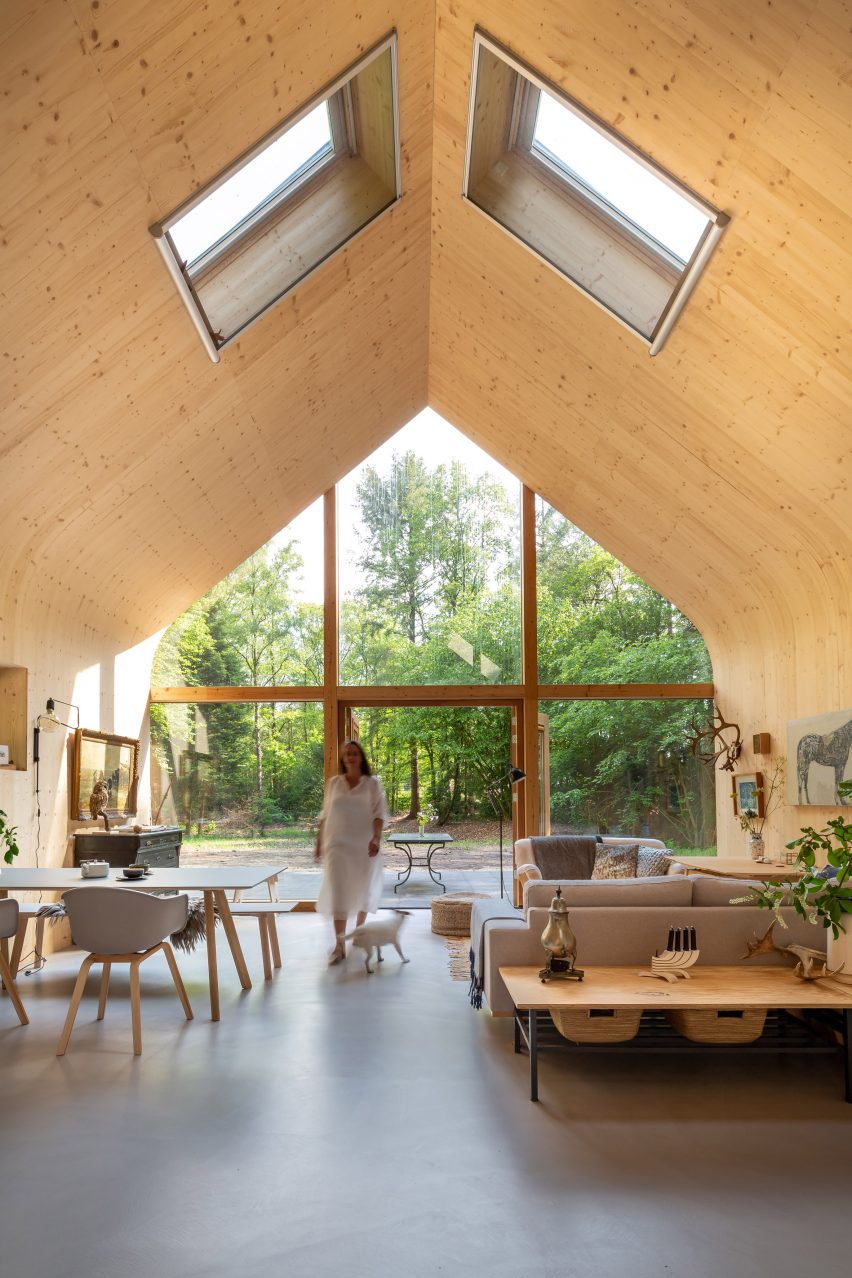
Amsterdam studio Woonpioniers has hidden a prefabricated wooden cabin with large windows and tall, curving interiors within a forest glade in the Netherlands.
The modular dwelling, named Indigo, was designed for a couple who are leasing the rural site in Barchem and wanted a low-impact home that caters to a sustainable lifestyle.
Above: Indigo is a prefabricated cabin. Top image: it is hidden in a forest glade
It is the fourth cabin of this kind to have been built by Woonpioniers after the studio developed them to offer a highly customisable and affordable housing model that can be replicated anywhere.
The dwellings, all named Indigo, are built with a prefabricated laminated-timber structure to minimise waste, transportation, construction time and, in turn, environmental impact.
It has a modular wooden structure
"At Woonpioniers we develop architectural concepts with which we burden the environment as little as possible," the studio told Dezeen.
"We also think it is important to develop individual housing concepts that are rationally structured and therefore remain affordable but do not necessarily look exactly the same every time," it continued.
"With Indigo, Woonpioniers aims to make personal architecture and a healthy way of building accessible to a wide audience."
Curved walls characterise the interior
The Indigo cabins are designed to be highly adjustable, meaning their size is tailored to the specific needs and chosen site of the client.
However, each one utilises the same prefabricated elements that are combined to form spacious interiors, characterised by tall ceilings that curve down to meet the walls.
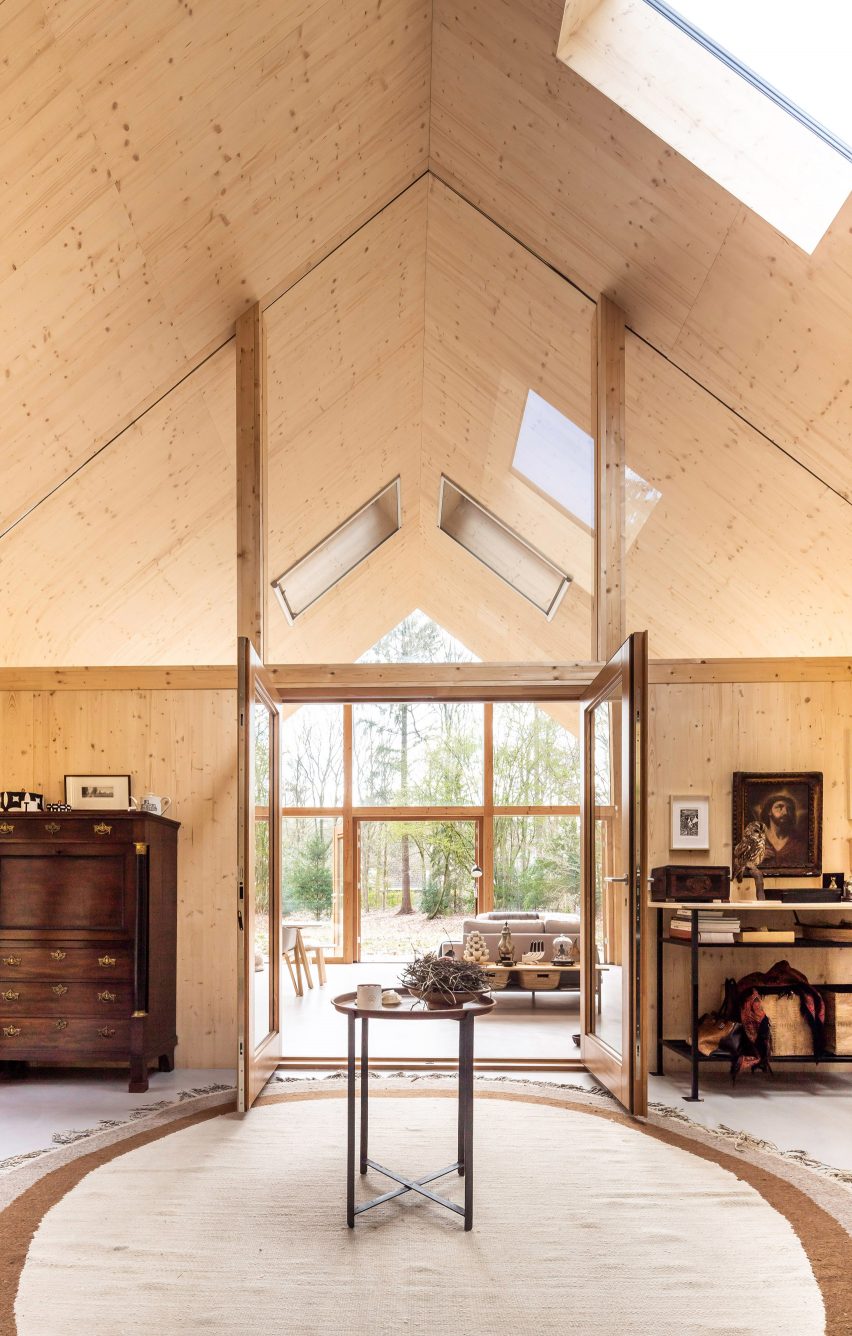
A lofty hallway divides public and private rooms
This distinctive curved interior is engineered to strengthen the corners of the cabin and negate the need for structural supports that would truncate the space – leaving an open, flexible interior.
"If you simply build two walls with a hood on top, the weight of the roof will push the walls out," the studio explained.
"If you round the corners of the house, there is the possibility of strengthening them in such a way that all forces are properly absorbed without the space losing its unity."
The hall doubles as an entertainment space
This particular Indigo cabin is sized to provide the client with ample space for a large, open living area and a two-storey "sleeping house" at the rear.
These two contrasting zones are divided by a lofty hallway, designed for the clients to host events while also helping to minimise the cabin's heating requirements.
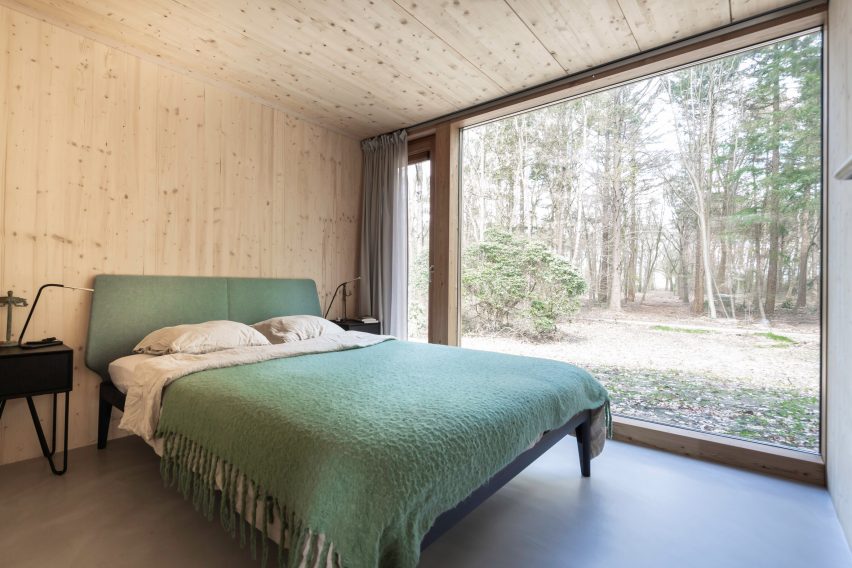
The rear of the house contains the private rooms
Externally, the cabin is finished with a prefabricated standing seam roof and stained larch wood cladding, while the interior walls are finished with spruce, complemented by a polished cement floor.
Various other material finishes are available for the cabins, but wood was chosen as the primary material for this home to create the feeling that it is "at one with the environment".
This connection to the outside is furthered through the placement of large windows and areas of glazing, such as at the gable end of the living room.
Bedrooms occupy a small upper floor
Other materials used in the construction include cellulose insulation, wedged between the prefabricated beams, and the use of screws to fasten the modular elements to ensure their recyclability.
Loose prefabricated concrete blocks topped by a cross-laminated timber slab form the cabin's foundation so that it can be easily removed at the end of the home's useful life.
Large windows connect the house to the outside
Each Indigo cabin is designed to be carbon-neutral in operation, reliant on electricity from renewable sources. This home uses solar panels on the roof of a nearby building, as the site itself is too shaded to generate enough electricity.
It also relies on an air-to-water heat pump for underfloor heating and utilises the ground's thermal mass to naturally regulate internal temperatures.
Wood lines the entire interior
Muji has also developed a prefabricated wooden home called Yō no Ie, or Plain House, which is designed to encourage indoor-outdoor living. Similarly to Indigo, the home is built without columns or fixed divisions to ensure flexibility and allow owners to reconfigure its layout to meet changing needs.
More recently, Studio Puisto launched a range of adaptable, prefabricated cabins called Space of Mind that can be built anywhere and used as anything from a garden office to a remote off-grid retreat.
We understand that some people may be concerned about getting vaccinated now that COVID-19 vaccines are available in the United States. While more COVID-19 vaccines are being developed as quickly as possible, routine processes and procedures remain in place to ensure the safety of any vaccine that is authorized or approved for use. Safety is a top priority, and there are many reasons to get vaccinated.
COVID-19 vaccination will help keep you from getting COVID-19
Based on what we know about vaccines for other diseases and early data from clinical trials, experts believe that getting a COVID-19 vaccine may also help keep you from getting seriously ill even if you do get COVID-19.
Experts continue to conduct more studies about the effect of COVID-19 vaccination on severity of illness from COVID-19, as well as its ability to keep people from spreading the virus that causes COVID-19.
COVID-19 vaccination is a safer way to help build protection
COVID-19 can have serious, life-threatening complications, and there is no way to know how COVID-19 will affect you. And if you get sick, you could spread the disease to friends, family, and others around you.
Clinical trials of all vaccines must first show they are safe and effective before any vaccine can be authorized or approved for use, including COVID-19 vaccines. The known and potential benefits of a COVID-19 vaccine must outweigh the known and potential risks of the vaccine for use under what is known as an Emergency Use Authorization (EUA). Watch a video on what an EUA is.
Getting COVID-19 may offer some natural protection, known as immunity. Current evidence suggests that reinfection with the virus that causes COVID-19 is uncommon in the 90 days after initial infection. However, experts don't know for sure how long this protection lasts, and the risk of severe illness and death from COVID-19 far outweighs any benefits of natural immunity. COVID-19 vaccination will help protect you by creating an antibody (immune system) response without having to experience sickness.
Both natural immunity and immunity produced by a vaccine are important parts of COVID-19 disease that experts are trying to learn more about, and CDC will keep the public informed as new evidence becomes available.
COVID-19 vaccination will be an important tool to help stop the pandemic
Wearing masks and social distancing help reduce your chance of being exposed to the virus or spreading it to others, but these measures are not enough. Vaccines will work with your immune system so it will be ready to fight the virus if you are exposed.
The combination of getting vaccinated and following CDC's recommendations to protect yourself and others will offer the best protection from COVID-19.
Stopping a pandemic requires using all the tools we have available. As experts learn more about how COVID-19 vaccination may help reduce spread of the disease in communities, CDC will continue to update the recommendations to protect communities using the latest science.
In this interview, Vandana Shiva, Ph.D., discusses the importance and benefits of regenerative agriculture and a future Regeneration International project that we'll be collaborating on.
We're currently facing enormously powerful technocrats who are hell-bent on ushering in the Great Reset, which will complete the ongoing transfer of wealth and resource ownership from the poor and middle classes to the ultra-rich. Perhaps the most well-known of the individuals pushing for this is Bill Gates who, like John Rockefeller a century before him, rehabilitated his sorely tarnished image by turning to philanthropy.
However, Gates' brand of philanthropy, so far, has helped few and harmed many. While his PR machine has managed to turn public opinion about him such that many now view him as a global savior who donates his wealth for the good of the planet, nothing could be further from the truth.
Gates' Stranglehold on Global Health
The magnitude of Gates' role over global health recently dawned on me. I believe the COVID-19 catastrophe would not have been possible had it not been for the World Health Organization, which Gates appears to exert shadow-control over. Remember, it was primarily the WHO that facilitated this global shutdown and adoption of freedom-robbing, economy-destroying measures by virtually every government on the planet.
When then-President Trump halted U.S. funding of the WHO in 2020, Gates became the biggest funder of the WHO. As explained in "WHO Insider Blows Whistle on Gates and GAVI," the WHO has turned global health security into a dictatorship, where the director general has assumed sole power to make decisions that member states must abide by, but according to a long-term WHO insider, Gates' vaccine alliance GAVI actually appears to be the directing power behind the WHO.
The two — Gates and the WHO — have been working hand in hand pushing for a global vaccination campaign, and Gates has a great deal of money invested in these vaccines. We've also seen extraordinary efforts to censor natural alternatives and inexpensive, readily available and clearly effective drugs, such as hydroxychloroquine and ivermectin, and it appears the reason for this is probably because they're competitors to the vaccine.
Emergency use authorization for pandemic vaccines are only given when there are no other treatments, so vilifying alternatives has been a key strategy to protect vaccine profits.
The Parallels Between Rockefeller and Gates
As noted by Shiva, the comparisons between Rockefeller and Gates are quite apt. Rockefeller created not just Big Oil but also Big Finance and Big Pharma. He had intimate connections with IG Farben.1 There was a Standard Oil IG Farben company. Without the fossil fuels of Standard Oil, IG Farben couldn't have made synthetic fertilizers or fuels.
In 1910, Rockefeller and Carnegie produced The Flexner Report,2 which was the beginning of the end for natural medicine in the conventional medical school curriculum. They eliminated it because it saw natural medicine as a hugely competitive threat to the new pharmaceuticals that were primarily derived from the oil industry.
Much of Rockefeller's history has been captured by Lily Kay,3 who sifted through Molecular Vision of Life's archives. There, she discovered that the Nazi regime, which was a eugenics regime that thought some people were inferior and needed to be exterminated to keep the superior race pure, didn't vanish when Germany lost the war.
Eugenics simply migrated to the U.S., and was taken up by Rockefeller under the term of "social psychology as biological determinants." The word gene did not exist at that time. Instead, they called it "atoms of determinism." Rockefeller paid for much of the eugenics research, which ultimately resulted in the silencing and suppression of true health.
To be healthy means to be whole, and wholeness refers to the "self-organized brilliance of your integrated body as a complex system," Shiva says. That's what Ayurveda is based on, and even this ancient system of medicine has been attacked in recent times. The notion of genetic determination ignores this foundational wholeness, seeking instead to divide the human body into mechanical components controlled by your genes.
"Coming back to the parallels, Rockefeller was behind it because he was driving the chemical industry. When the wars were over, they said, 'Oh my gosh, we have all these chemicals to sell.' And they invented the Green Revolution and pushed the Green Revolution on India.
Rockefeller, the World Bank, the USA all worked together, and if the farmers of India are protesting today, it's a result of Rockefeller's initiative, the Green Revolution in India. Most people don't realize what high cost India has borne; what high cost the state of Panjon has born.
Then you have Gates joining up with Rockefeller and creating the Alliance for the Green Revolution in Africa (AGRA) … which pretends to be his solution to climate change. I say, 'My god, what kind of stage has the world reached that absolute nonsense can pass the science?' I'll give you just three examples from his chapter on agriculture, in which he talks about how we grow things.
First of all, plants are not things. Plants are sentient beings. Our culture knows it. We have the sacred tulsi. We have the sacred neem. We have the sacred banyan. They are sentient beings. So many people are awake to animal rights. I think we need more people awake to plant rights and really tell Mr. Gates, 'No, plants are not things.'
He goes on to celebrate Norman Borlaug, who was in the DuPont defense lab, whose job it was to push these four chemicals by adapting the plants [to them]. So, he created the dwarf variety, because the tall varieties are free varieties … [Gates] says we're eating food because of Borlaug. No, people are starving because of Borlaug. The farmers are dying because of Borlaug."
Gates Offers Problems as Solutions
Gates hails synthetic fertilizer is the greatest agricultural invention. "Doesn't he realize synthetic nitrogen fertilizers are creating desertification, dead zones in the ocean, and nitric oxide, which is a greenhouse gas?" Shiva says. In short, he's offering the problem as the solution. Gates also, apparently, does not understand that nitrogen-fixing plants can fix nitrogen. He incorrectly claims that plants cannot fix nitrogen.
Gates is equally wrong about methane production from livestock. "Have you smelt methane behind nomadic tribes?" Shiva asks. "Have you ever smelt methane behind our sacred cow in India? No, they don't emit methane." The reason cows in concentrated animal feeding operations (CAFOs) emit methane that stinks to high heaven is because they're fed an unnatural diet of grains and placed in crowded quarters. It's not a natural phenomenon. It's a man-made one.
"You know what Mr. Gates wants to teach us? He says cows make methane because of their poor stomachs," Shiva says. "They call them containers. I think we should sue him for undoing basic biology 101. You've talked about how he controls the WHO. He's also trying to take control of the Food and Agricultural Organization (FAO).
[FAO] has recognized ecological agriculture is the way to go and supported [regenerative] agriculture up until last year, when Gates started to take charge. Now he's moving the food summit to New York. Five hundred organizations have said, 'This is no longer a food summit, it's a poison summit. The poison cartel and Bill Gates are running it to push more poisons, now under new names. So, we have a lot of work to do.'"
The answer to the environmental problems we face is not more of the very things that created the problems in the first place, which is what Gates proposes. The answer is regenerative agriculture and real food.
"When people are eating healthy food, there is no problem," Shiva says. "[Gates] wants to commit a crime against our gut microbiome, pushing more fake food through Impossible Food. And he wants to create conditions so that real food will disappear. That's why we all have to organize together and the scientists have to start being protected.
There's an extinction taking place. They call it the sixth mass extinction. Most people think the sixth mass extinction is about other species. They don't realize large parts of humanity are being pushed to extinction. Food is health, as Hippocrates said, [and that requires] indigenous systems of learning, ecological agriculture, small farmers.
In Bill Gates' design, all this that makes life, life, that makes society, society, that makes community, community, that makes healthy beings, he would like to push this to extinction because he's afraid of independence, freedom, health and our beingness. He wants us to be 'thingness,' but we are beings …
The worst crime against the Earth and against humanity is using gene editing technologies for gene drives, which is a collaboration of Gates with DARPA, the defense research system. Gene drives are deliberately driving [us] to extinction. Now he does it in the name of ending malaria. No. It's about driving to extinction.
Amaranth is a sacred food for us. It's a very, very important source of nutrition … There's an application in that DARPA-Gates report of driving the amaranth to extinction through gene rights. And when this was raised at the Convention on Biological Diversity, do you know what he did? He actually hired a public relations agency and bribed government representatives to not say no. Can you imagine?"
Gates' Long-Term Play
Gates clearly had a long-term vision in mind from the start. His growing control of the WHO began over a decade ago. Over this span of time, he also started transitioning into Big Pharma and the fake food industry, which would allow his influence over the WHO's global health recommendations to really pay off.
While fake foods have many potential problems, one in particular is elevated levels of the omega-6 fat linoleic acid (LA). If you eat real food, you're going to get more than enough LA. Our industrial Western diet, however, provides far more than is needed for optimal health already, and engineered meats are particularly loaded with LA, as they're made with genetically modified soy oil and canola oil.
This massive excess of LA will encourage and promote virtually all degenerative diseases, thereby accelerating the destruction of human health. In addition to that, Gates is also investing in pharmaceuticals, which of course are touted as the answer to degenerative disease. Again, his solutions to ill health are actually the problem. Shiva says:
"Gates … [is] entering every field that has to do with life. Our work in Navdanya, which means nine seeds, is basically work on biodiversity in agriculture. We started to bring together all the work that he's doing in taking over. I mentioned the Rockefeller Green Revolution, now the Gates-Rockefeller Green Revolution in Africa. The next step he wants to push is … digital agriculture.
He calls it Gates Ag One,4 and the headquarters of this is exactly where the Monsanto headquarters are, in St. Louis, Missouri. Gates Ag One is one [type of] agriculture for the whole world, organized top down. He's written about it. We have a whole section on it in our new report,5 'Gates to a Global Empire.'"
Stolen Farmer Data Is Repackaged and Sold Back to Them
What does digital agriculture entail? For starters, it entails the introduction of a digital surveillance system. So far, Shiva's organization has managed to prevent Gates from introducing a seed surveillance startup, where farmers would not be allowed to grow seeds unless approved by Gates surveillance system.
The data mining, Shiva says, is needed because they don't actually know agriculture. This is why Gates finances the policing of farmers. He needs to mine their data to learn how farming is actually done. This knowledge is then repackaged and sold back to the farmers. It's evil genius at its finest.
Through his funding, Gates now also controls the world's seed supply, and his financing of gene editing research has undercut biosafety laws across the world. As explained by Shiva, the only country that doesn't have biosafety laws is the U.S. "The rest of the world does because we have a treaty called the Cartagena Protocol on Biosafety," she says.
"While he created the appearance of philanthropy, what he's doing is giving tiny bits of money to very vital institutions. But with those bits of money, they attract government money, which was running those institutions. Now, because of his clout, he is taking control of the agenda of these institutions. In the meantime, he's pushing patenting, be it on drugs, vaccines or on seeds."
Taken together, Gates ends up wielding enormous control over global agriculture and food production, and there's virtually no evidence to suggest he has good intentions.
The Anatomy of Monopolization
The company that collects patents on gene-edited organisms, both in health and agriculture, is Editas, founded by a main financial investor for the Gates Foundation. Gates is also a big investor in Editas.
"So, here's a company called Editas to edit the world as if it is a Word program. The two scientists who got the Nobel Prize this year have both been funded in their research by Gates. My mind went back to how Rockefeller financed the research, got the Nobel Prize, and then made the money.
So, you finance the research. Then you finance the public institutions, whether they be national or international. You invest and force them down the path where they can only use what is your patented intellectual property. And, as he has said in an interview, his smartest investment was vaccines, because it is a 1-to-20 return. Put $1 in and make $20. How many billions of dollars have been put in? You can imagine how many trillions will be made.
At the end of it, where does food come from? It comes from seed. He wants to control it. It comes from land. He's controlling that. He's became the biggest farmland owner [in the U.S.]. But you need weather [control]. You need a stable climate.
So, what could be a weapon of control of agriculture? Weather modification. He calls it geoengineering. This is engineering of the climate. Again, making it look like he's going to solve global warming by creating global cooling."
As explained by Shiva, Gates is also heavily invested in climate modification technologies that not only will destabilize the earth's climate systems more, but also can be weaponized against the people by controlling rainfall and drought. In India, they've been having massive hail during harvest time, which destroys the harvest.
Is the UN Subservient to Gates?
According to Shiva, Gates is also corrupting the United Nations system, just like he's corrupted world governments and the WHO, and in so doing, he's destroying the efforts built over the last three decades to protect the global environment.
"Whether it be the climate treaty, the biodiversity treaty or the atmospheric treaties, he is absolutely behaving as if the UN is his subservient institution," Shiva says. "[He thinks] governments and regulatory bodies should not exist … and that people in democracy have no business to speak. [If they do], they're conspiracy theorists."
Taking Down Gates' Empires
As it stands right now, ordinary people are forced to fight battles that are in actuality rooted in institutional, structural and societal crimes. These crimes really need to be addressed the way Rockefeller's Standard Oil empire was addressed. In the case of Gates, his empire is actually multiple empires, and they all need to be dismantled. To that end, I will be collaborating with Shiva and Regeneration International, which she co-founded, on a project to boycott Gates' empires.
"I've noticed that no matter what the movement, they're using the word regeneration now. It could be a health movement, a democracy movement, a peace movement, a women's movement — everyone has realized that regeneration is what we have to shift to," Shiva says.
"So, what do we need to be doing in the next decade? For me, the next decade is the determining decade, because these petty minds' insatiable greed want to go so fast that if, in the next decade, we don't protect what has to be protected, build resilient alternatives and take away the sainthood from this criminal, they will leave nothing much to be saved.
The poison cartel is also big pharma. People think agriculture is here, medicine is there. No. The same criminal corporations gave us agrichemicals. They gave us bad medicine that creates more disease than it solves. So, Big Pharma, Big Ag, Big Poison — it's all one. And Bill Gates is holding it all together even more, and trying to make them bigger because he has investments in all of them …
I think [seeds] is where we have to begin … I'm hoping that we will be able, together, to launch a global movement soon to take back our seeds from the international seed banks. The strategy is we need to remind the world that these are public institutions [and] that they're accountable to the farmers whose collections these [seeds] are ...
On the food question, I think that's the big one because food and health go [together]. In Ayurveda, it says food is the best medicine, and if you don't eat good food, then no medicine can cure whatever disease you have. The best medicine is good eating. And Hippocrates said 'Let food be thy medicine.' So, I think this is the time to really grow a very big global campaign for food freedom.
Food freedom means you cannot destroy our right to grow food. Secondly, you cannot destroy our governments' obligations to us to support regenerative agriculture rather than support degenerative agriculture and subsidize it. And third, I think we should call for a worldwide boycott of lab foods …
Another part of this should be, don't let big tech enter our bodies. Let big tech not enter life sciences … These guys will make life illegal. Living will be illegal except as a little piece in their machine through their permission."
Each year, Navdanya holds a two-week campaign on food freedom starting October 2, which is nonviolence day. We now need to take that campaign to the global stage, and I will do my part to aid this effort. So, mark your calendar and prepare to join us in a global boycott of food that makes you sick — processed food, GMO foods, lab-created foods, fake meats, all of it.
More Information
You can learn more about Shiva's work and her many projects on Navdanya.org. During the first week of April every year, Navdanya gives a five-day course called Annam, Food as Health, via Zoom. In this course, you'll learn about soil and plant biodiversity and healthy eating for optimal health.
"When all the spiritual forces, all of nature's forces and most of people's forces are aligned together, what can [a few] billionaires, technocrats — who want to be richer than they are, greedier than they are, more violent than they are — do?" Shiva says. "They don't count in the long run, really. It's just that we cannot afford to not do the things that we can do."