"The most valuable skill or talent that you could ever develop is that of directing your thoughts toward what you want—to be adept at quickly evaluating all situations and then quickly coming to the conclusion of what you most want—and then giving your undivided attention to that. There is a tremendous skill in deliberately directing your own thoughts that will yield results that cannot be compared with results that mere action can provide."
New Alzheimer's treatment fully restores memory function
Of the mice that received the treatment, 75 percent got their memory function back.
Australian researchers have come up with a non-invasive ultrasound technology that clears the brain of neurotoxic amyloid plaques - structures that are responsible for memory loss and a decline in cognitive function in Alzheimer's patients.
If a person has Alzheimer's disease, it's usually the result of a build-up of two types of lesions - amyloid plaques, and neurofibrillary tangles. Amyloid plaques sit between the neurons and end up as dense clusters of beta-amyloid molecules, a sticky type of protein that clumps together and forms plaques.
Neurofibrillary tangles are found inside the neurons of the brain, and they're caused by defective tau proteins that clump up into a thick, insoluble mass. This causes tiny filaments called microtubules to get all twisted, which disrupts the transportation of essential materials such as nutrients and organelles along them, just like when you twist up the vacuum cleaner tube.
As we don't have any kind of vaccine or preventative measure for Alzheimer's - a disease that affects 343,000 people in Australia, and 50 million worldwide - it's been a race to figure out how best to treat it, starting with how to clear the build-up of defective beta-amyloid and tau proteins from a patient's brain. Now a team from the Queensland Brain Institute (QBI) at the University of Queensland have come up with a pretty promising solution for removing the former.
Publishing in Science Translational Medicine, the team describes the technique as using a particular type of ultrasound called a focused therapeutic ultrasound, which non-invasively beams sound waves into the brain tissue. By oscillating super-fast, these sound waves are able to gently open up the blood-brain barrier, which is a layer that protects the brain against bacteria, and stimulate the brain's microglial cells to activate. Microglila cells are basically waste-removal cells, so they're able to clear out the toxic beta-amyloid clumps that are responsible for the worst symptoms of Alzheimer's.
The team reports fully restoring the memory function of 75 percent of the mice they tested it on, with zero damage to the surrounding brain tissue. They found that the treated mice displayed improved performance in three memory tasks - a maze, a test to get them to recognise new objects, and one to get them to remember the places they should avoid.
"We're extremely excited by this innovation of treating Alzheimer's without using drug therapeutics," one of the team, Jürgen Götz, said in a press release. "The word 'breakthrough' is often misused, but in this case I think this really does fundamentally change our understanding of how to treat this disease, and I foresee a great future for this approach."
The team says they're planning on starting trials with higher animal models, such as sheep, and hope to get their human trials underway in 2017.
You can hear an ABC radio interview with the team here.
Fukushima report declassified: Worse than we were told
Fukushima nuclear power plant is still experiencing major contamination issues nearly five years after the earthquake, tsunami, and subsequent meltdown.
A new declassified report from the US Nuclear Regulatory Commission, written on March 18, 2011 just days after the disaster, sheds light on just how bad it was.
We now know that "100% of the total spent fuel was released to the atmosphere from unit 4."
According to nuclear expert and whistleblower Arnie Gundersen in an interview with WBAI in New York, unit four contained more cesium "than in all 800 nuclear bombs exploded above ground".
Cesium has been linked to thyroid cancer, which is on the increase in the Fukushima area since the tsunami, according to the US National Library of Medicine.
The chemical is highly soluble in water and can find its way into foodstuffs that have been prepared in contaminated areas.
Anti-nuclear activist Dr Helen Caldicott said during the crisis that if unit four collapsed, she was going to move her family from Boston to the southern hemisphere.
The declassified report from the US Nuclear Regulatory Commission said the 2011 thyroid dose estimates 'downstream' from Japan in the US were within guidelines "except for Alaska".
Engineers at Fukushima are still dealing with fallout from four years ago. Last week, the radioactivity at Reactor 1 was measured at 482,000 becquerels per liter of radioactive cesium, Tokyo Electric Power Company (TEPCO) said.
This is 4,000 times higher than last year and the company believes the contaminated water stored at a nearby building may have leaked into the duct, according to The Asahi Shimbun.
Increases in other areas have not been registered, the company said.
400 to 500 tons of radioactive seawater that washed ashore in the 2011 tsunami is pooled in the tunnels, which lie next to a temporary storage facility for radioactive water being used to cool nuclear fuel inside the damaged reactors.
TEPCO said they plan to investigate the spike in radiation.
CONFIRMED: PEOPLE WHO SPEND MONEY ON EXPERIENCES INSTEAD OF THINGS ARE MUCH HAPPIER
The pursuit and purchase of physical possessions will never fully satisfy our desire for happiness. It may result in temporary fulfillment, but the happiness found in buying a new item rarely lasts.
We all feel richer on payday than we did the day before, but that instant gratification (that comes with out-of-this-world price tags, designer shoes and trendy clothes) is satisfying enough to be called addiction, or a bad habit. That guilt or the two voices over your shoulders is a sign that you know spending most or all of your paycheck on material items might not be the wisest choice.
It is important to remember the value of investing in once-in-a-lifetime experiences and precious memories with our loved ones over indulging on the next hot item, for, as they say, money cannot buy happiness.
Living means experiencing, not material objects
According to researchers from San Francisco State University, people understand that this life we get to live is about creating memories and not the glitz and glamour of trendy clothes and technology. But again, it is easy to get wrapped up in purchases that we will ultimately regret.
If we think about it, when we are 90 and on our deathbeds, will we cherish that new iPad or gold watch or the memories and moments we created with the people who made an impact on our lives?
Focus on your happiness, not what makes you attractive
In this day and time, many people make decisions based on society's influences, making that fancy car and hip sunglasses not only more expensive than they need to be but also attractive and trendy to the world.
But who cares about what the world thinks? Are we willing to burn holes in our pockets in exchange for an Instagram post with 1,000 likes?
We are more valuable as a product of this society, than the human-made products that we desire (and never really need). I cannot say I do not like beautiful things, and it is fine to reward yourself, but our bigger investments should go toward making life unforgettable and worth living versus having that temporary satisfaction from things.
Dr. Thomas Gilovich is a psychology professor at Cornell University who has been studying the link between money and happiness. He told Fast Company:
Our experiences are a bigger part of ourselves than our material goods. You can really like your material stuff. You can even think that part of your identity is connected to those things, but nonetheless they remain separate from you. In contrast, your experiences really are part of you. We are the sum total of our experiences.
Forget the fancy things and explore the world
Well, this part can be difficult, or it can be simple. There are always excuses on how exploring the world costs a lot of money, yet you can buy those pair of Jordan shoes and Louie Vuitton bags for the same money but less real value.
Drop the need for expensive things, and pick up your luggage to gain irreplaceable experiences. Business Insider found that CEOs around the world look for their employees to achieve several familiar things in their 20s, one being traveling and broadening one's thinking.
If even the greats say so, maybe you should at least just try cutting the need for material things and instead, use that plastic card on a trip to a place you've never been. You might be surprised at how much more value you gain in your life.
US on course to ban harmful microbeads from bath and body products
The House of Representatives approved a bill to phase out the use of plastic microbeads in personal care products. The plan to ban microbeads in products such as body scrubs and toothpastes would take effect beginning 1 January, 2017. The next step is Senate approval, which is likely to occur based on some lawmakers already moving toward banning the beads in their states. The decision is huge for the safety of our waterways, as well as those who use them.
The Microbead Free Waters Act would begin phasing out the beads in about a year, which isn't a moment too soon considering 8 trillion of the pinhead-sized nuisances are released into waterways every day in the US alone. Fish mistake the beads for food and absorb toxic chemicals, which is then harmful for those who eat the fish. 90 percent of seabirds were also found to have ingested the particles.
The Great Lakes are especially affected by the release of microbeads, according to The Guardian. Both Michigan and Ohio, which borders the largest stretch of Lake Erie shoreline, are considering their own legislation against the tiny pollutants. Illinois has banned the sale of products containing microbeads and California finalized a bill to phase out the particles by 2020. "These microbeads are tiny plastic, but make for big-time pollution," said Republican co-sponsor of the bill Fred Upton. "We will fight any activity that puts our beloved Great Lakes in jeopardy."
Carson's Store: Interview with owner and chef Andrew Blacker
By Francesca Street
Walking down the picturesque streets of Noank, Connecticut is an inimitable experience. Somewhere between leaving Groton and parking opposite the village shipyard, you seem to have stepped back in time.
In Noank village, turn-of-the-twentieth century timber-frame houses line chocolate-box streets. The ever-present sound of the waves crashing and the sweeping sea views remind you that this is a working seaside community, still firmly routed in the New England fishing, lobster and shipbuilding industries.
Noank's beautifully preserved historic buildings, matchless ambiance and proximity to nearby historic Mystic have always attracted visitors, many of whom remain so charmed they decide to stay.
Recently, visitors to Noank have also been enticed by some of the best food in South Eastern Connecticut. The village's selection of small but exceptional restaurants has consolidated Noank's reputation as a good food hub.
If there's one Noank resident to whom this comes as no surprise, it's 25-year-old Andrew Blacker.
Andrew, a recent graduate of the University of Connecticut and lifelong resident of Noank, is the storekeeper, manager and chef at Noank village's most iconic business: Carson's Store.
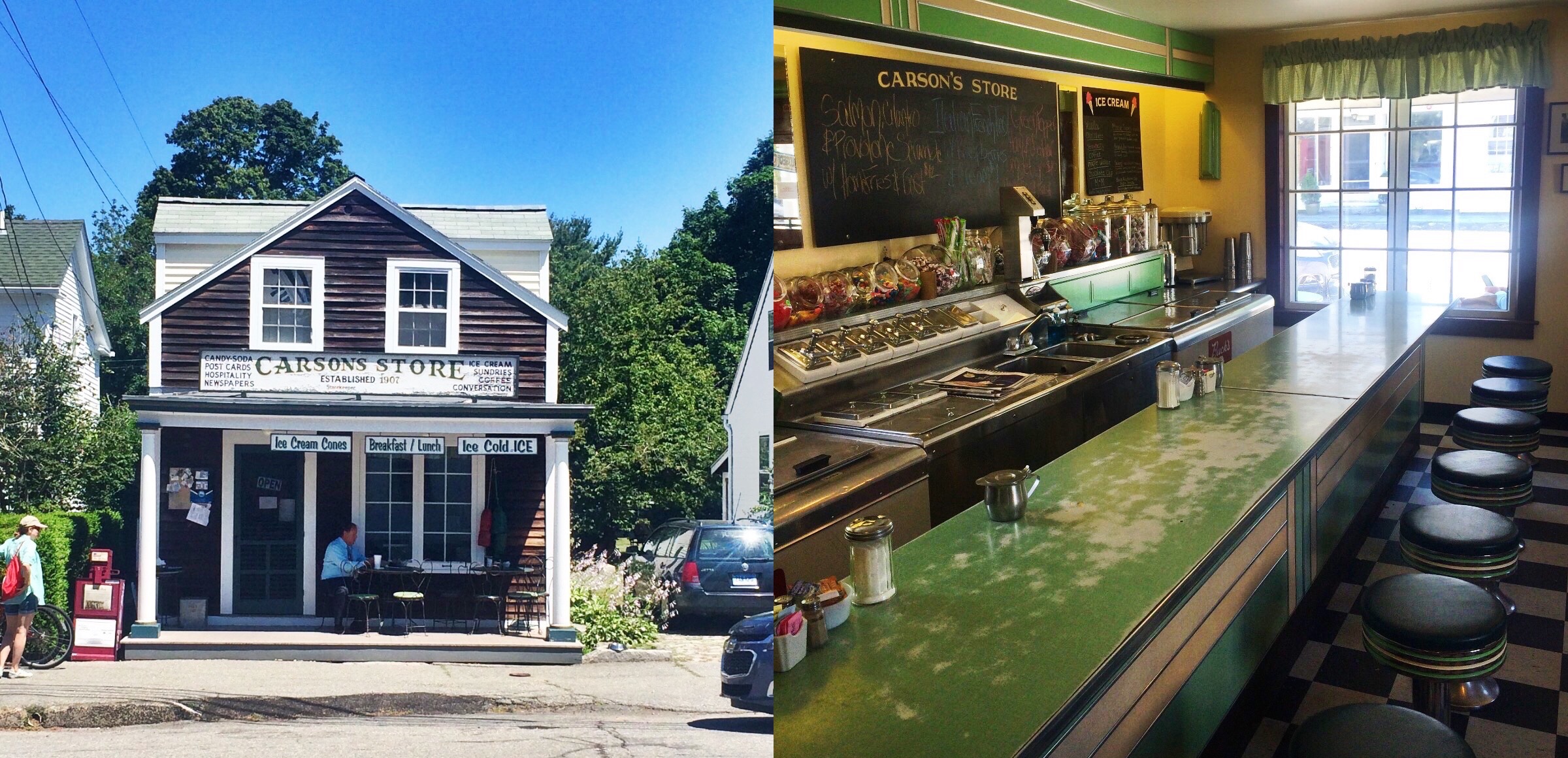
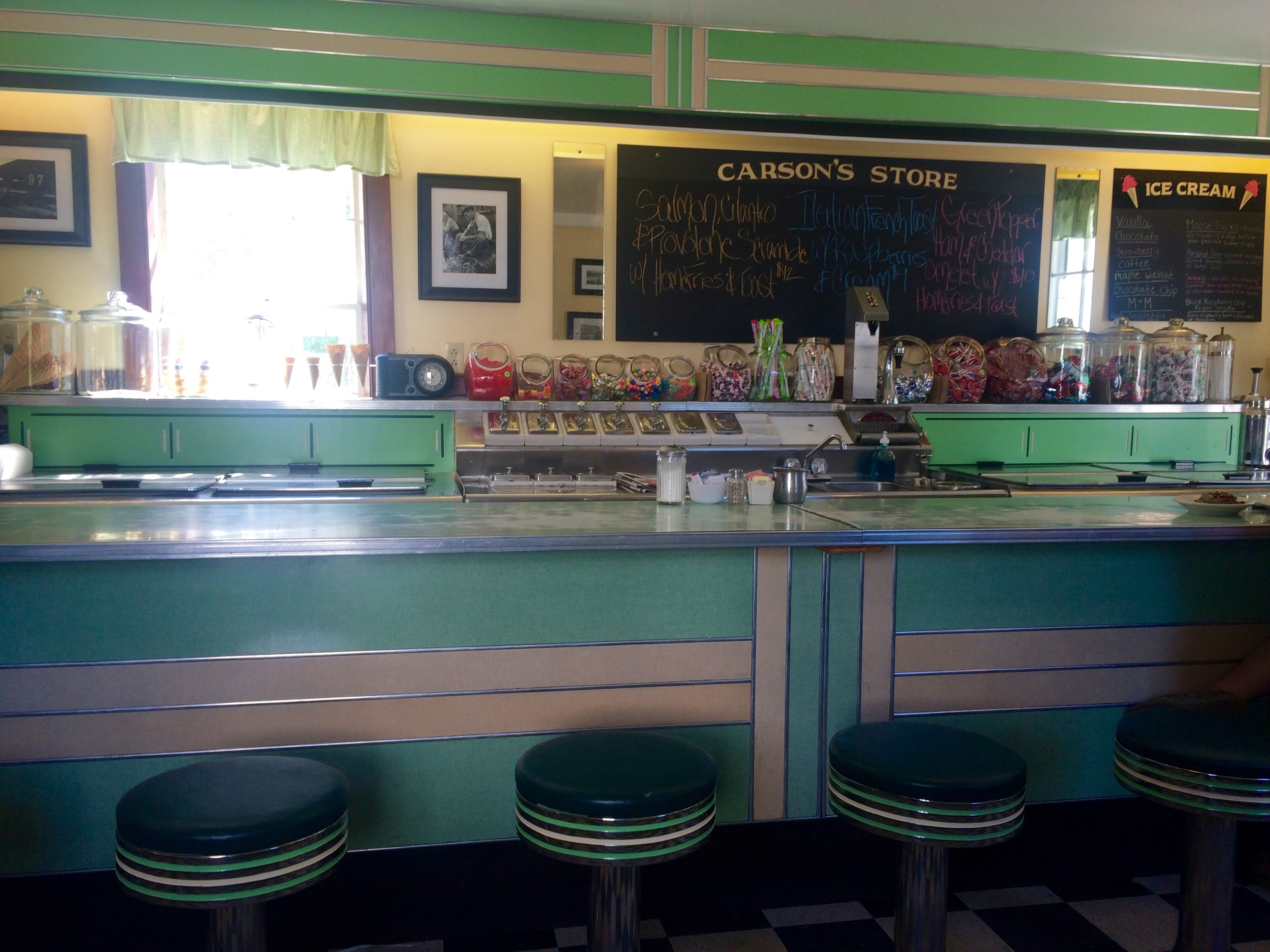
Carson's epitomises all that makes Noank unique: a café-come-meeting-place-come-historical-landmark dating from 1907, famous for delicious brunch and wondrous ice cream, a fascinating history, an iconic nineteenth century building and a bona fide all-American diner interior. For Noank residents and visitors alike, Carson's is a beloved institution.
As the store's newest manager, Andrew is the man tasked with steering the store into the twenty-first century, whilst still retaining Carson's unique charm.
To me, a Brit abroad, Carson's seems to perfectly characterise old-time Americana. Every time I enter the store I feel as though I've walked onto the set of my favourite twentieth century American movie. The store has a timelessness and friendliness that cannot be matched. Diner-style restaurants may be all the range nowadays, but Carson's is the real deal.
This summer, I was presented with the opportunity to interview Andrew and I immediately jumped at the chance. My visit to the Mystic region in Summer 2014 had been darkened by the news that Carson's had closed its doors, but after remaining close for just under a year, the store reopened last December, newly rejuvenated and with Andrew and his team at the helm.
Noank residents and visitors rejoiced at the news, although many remained uncertain of the exact behind-the-scenes goings on which had lead to the store's closure and its happy reopening.
In our August interview, Andrew is happy to set the record straight and pleased to hear of the widespread delight that reverberated around the Mystic region following the announcement that Carson's had reopened.
'My father David Blacker has owned the store for about 40 years,' explains Andrew. 'I grew up living right next to the store and I've been working there for more than half of my life. When the Carson family owned the store it was family run and it still is today. Everyone in my family helps out with the store in some way.'
In late 2013, Andrew's father David decided to retire. Andrew was keen to take over, but was in the middle of his final year studying at UCONN.
'My father told me the most important thing for me was to finish school,' Andrew tells me, 'He said that if I was still interested in running the store, it would be there when I finished.'
During his time at college, Andrew worked in restaurants, sales and marketing, establishing an impressive resume and a wealth of useful experience.
'I worked for Aeros Cultured Oyster Company as director of Sales. I shucked oysters at Captain Scotts in New London, Water Street Café in the Borough, and Swooner in the Borough before it shut down. I also worked making sandwiches at Stonington pizza. All the time while I was working these jobs I had the thought in mind that I wanted to learn as much as I could from each place and try and take away a special skill from each place.'
Andrew's efforts paid off. He worked hard in the fall semester to ensure he could complete his course in December, rather than May.
'I was able to do it and finished my bachelors in science from the college of Agriculture,' Andrew tells me proudly. Only a week after his graduation, Carson's Store was up and running once more.
Andrew's business outlook combines a genuine love of Noank and deferential respect for Carson's history with a smart, savvy outlook on the store's future. When I ask him to explain his mission for Carson's, he confidently asserts:
'I used what I learned in school and working in these different restaurants to come up with a unique idea that focused on local food and highlighted the history of the business, while trying to update and address some issues we had run into in the past.'
Whilst at UCONN, Andrew specialised in Natural Resource Economics and gained two HACCP (hazard analysis and critical control point management) certificates. These are licenses that are required by the USDA to process or resell seafood and meats.
'Having those certificates means that, if we wanted to, Carson's could process and sell both seafood and meat products, both of which we have access too. My brother farms beef in North Stonington and I worked for the oyster farm in Noank while I was in school.'
Carson's history is an undeniable part of the store's appeal, inextricably linked to and still impacting on its present day existence. Despite the importance of this history, I don't think I've ever heard the full story of Carson's origins. I am keen to hear more about this history and I ask Andrew to tell me more. He explains that Carson's actually had two other locations prior settling in its current home.
'The store was first opened in 1907 by the Carson family,' relays Andrew. 'It was located at the foot of Main Street near where the Latham Chester store sits, in a building that no longer exists. The store later moved to the opposite end of Main Street and it was located adjacent to the railroad tracks. Unfortunately, a spark from a passing steam train caught the store on fire and it burned down, forcing the Carson family to again relocate to the current location! Well almost… The old building that you mention has actually come a long way too.'
Interestingly, the structure that was to become the iconic Carson's building we know today was originally a summer kitchen for the house next door.
'The house was built in the 1840s,' Andrew explains, 'During that era, people would do their summer cooking in a summer kitchen, which was like an open air structure, to reduce some of the heat from the open fire.
Located behind the store, in close proximity to where the firehouse sits today, was a cedar swamp. Poles were cut from those cedar trees and laid down, and then the "Summer Kitchen" was hoisted up and put on beams and hitched to a team of mules. The structure was then dragged from somewhere in the yard behind the store to its current location on Main Street!'
Since this move, Carson's store has remained in the same spot for over one hundred years.
'Bernie Carson operated the Store daily as a general store until 1973,' says Andrew, 'The store changed hands to two different owners between that time and when my father purchased the business in 1979.'
Andrew's father David made some significant, important changes to Carson's.
'In 1979, the store was still just a wooden structure with no foundation,' explains Andrew, 'So the store was picked up, and a foundation was dug underneath it by hand and then the store was reset on the new foundation. After that, it was no longer resting in the soil which had previously made the structure so prone to elements.'
Carson's continued to operate as a general store until the 1990s, when it began to serve breakfast, becoming the brunch hotspot Noankers know it as today. The store underwent another renovation in 1995 and the kitchen was added and opened in 2000.
'The rich history of the store absolutely impacts the store still,' says Andrew with a smile, 'One thing my father told me is no matter what happens with the store, the front portion of the store should never change. The history makes Carson's what it is. Even the menu covers feature old post cards of Noank that are from the same decade and many from the same year the store first opened.'
Carson's enduring success is also down to its great food. The breakfast is renowned across the Mystic region. Andrew says the most popular breakfast menu item has always been the corned beef hash and gives This is Mystic the insider scoop on how Carson's perfects this dish:
'We take briskets, season them, slow cook the meat for 12 hours at just over 200 degrees until it literally falls apart. We then chop it, mix it with seasoned potatoes and grill it to a crisp.
We also added different types of eggs Benedict to the menu this summer and they have been very popular. They are served with store-made hollandaise. We have the original, eggs Florentine, a lobster Benedict and finally a combination of the corned beef and eggs benedict, the Mason Jameson Benedict.'
Since Carson's reopening in December 2014, the store has added a new wing to its bow. Taking advantage of Noank's nautical setting and its proximity to gorgeous fresh sea food, Carson's began offering a new raw bar menu in the evenings.
'The raw bar menu menu features local Noank Oysters harvested just a few hundred feet from the restaurant, as well as wild caught Rhode Island littlenecks,' Andrew tells me, 'As I mentioned earlier I worked for the Aeros Cultured Oyster Company. They are one of the members of the Noank Aquaculture Coop. When I worked there I realised that many people didn't know there was an oyster farm in Noank. When they found out they wanted to buy oysters. The problem was the Coop only sells the oysters to wholesalers.
After I stopped working for them I decided Carson's would be a nice place to showcase the oysters grown right here in the village. People can come in and try the oysters, or buy them un-shucked and take them home. We also sell oyster knives and openers. My hope one day is to be able to offer tours of the oyster farm and offer oyster tastings afterwards. I wanted to introduce the idea of oysters at Carson's and see how people responded to the idea. I also have a separate company that hosts and caters private raw bar events. I would like to one day rent Carson's out for private events from raw bars, to birthday parties, to wedding rehearsals, to filming and photo shoots. For the time being, however, the raw bar and dinners are going to be a seasonal offering. We will continue to be open at night until Labor Day at which point we will be changing the hours and scaling back the menu slightly.'
It is clear that Andrew has big plans for the store. His ideas are often new and exciting, but remain perfectly suited to the mission, integrity and culture of Carson's.
Andrew is pragmatic but hopeful about the future:
'It's hard to say what the future holds for the Store. We don't plan on going anywhere any time soon. We have a lot of ideas we look forward to trying out and only time will tell where it will take us. For right now we are just going to keep on working and trying to improve in any way that we can.'
Carson's is a Noank institution and Andrew concludes the interview by reiterating how important the Noank community is to Carson's longevity:
'The town and the community have been so supportive since we reopened and where we are located is truly one of our greatest blessings,' Andrew says gratefully, 'Mystic is also becoming such an attraction, so that proximity has definitely helped. At the same time there is nowhere in the world like the village of Noank. The small town feel is something you can't recreate.' Here's hoping Carson's will remain a part of Noank's distinctive, unique vibe for many years to come.
As a parent, you will probably go to great lengths to keep your kids healthy, but you may be overlooking one of the most powerful and effective healing products available: coconut oil.
Sometimes it seems almost impossible to keep kids healthy, especially considering the army of germs that attack them on a regular basis. If you want to add an effective and powerful tool to your natural health care arsenal, consider coconut oil.
You can easily incorporate this oil into your child's diet and routine -- and probably be pleasantly surprised by the results.
A broad spectrum tool
Coconut oil can address a wide range of health issues and is a safe and affordable product for the entire family. "It's an anti-inflammatory and is a great digestive aid," says Randi Ragan, green living and holistic lifestyle expert. "Coconut oil helps in controlling blood sugar and improved the secretion of insulin, so it can really reduce cravings for sugary foods." It's also a fantastic, gentle moisturizer and hair conditioner. While not an exhaustive list, Ragan points out the following kid-friendly uses for coconut oil:
This simple, exotic-smelling oil is truly under-appreciated. "It's high in lauric acid, which contains antiviral, antibacterial as well as anti-fungal properties," says Ragan. "It has a million benefits and no drawbacks. It's cheap, and readily available at most health food stores or online." What's not to love? Even if you don't like the taste of coconuts, you can still incorporate the oil into smoothies or baking and reap the benefits without an overpowering tropical flavor.
Look for extra virgin, organic coconut oil, which ensures that it has a level of purity safe for regular consumption.
You may have a jar of coconut oil in your pantry but never knew about the wide range of health benefits. If not, add it to your grocery list. "Extra virgin, organic coconut oil is the only way to ensure the level of purity that is important to consuming it on a regular basis," says Ragan. "Otherwise, it can be polluted with pesticides and other chemical residues." A high-quality coconut oil won't break the bank, but it will make a big contribution to your natural health care.
Horse chestnut seeds germinate reliably if properly treated.
With its spreading canopy and fragrant flower clusters, California horse chestnut (Aesculus californica), also called California buckeye, adds summertime shade and ornamental appeal to low-water landscaping. It grows best within U.S. Department of Agriculture plant hardiness zones 7 and 8, where it reaches a mature height of 10 to 20 feet with a 20- to 30-foot spread. California horse chestnut seeds germinate reliably if kept under moist conditions, providing a reliable means of at-home propagation. However, they must first be hulled and treated with bleach to prevent rot and eliminate parasites.
1
Put on rubber gloves before working with horse chestnuts since they contain toxic saponins and will irritate the skin of sensitive individuals. Wear long sleeves, as well, to further limit your contact with the seeds.
2
Remove the spiny husks from the horse chestnuts. Carefully press the blade of a paring knife onto the husk until it penetrates. Score around the husk until it is cut in half. Peel off the two halves and discard them.
3
Place the hulled horse chestnuts in a bucket of water. Soak them for 24 hours to soften the inner hull. Drain off the water the next day and lay the seeds on a flat surface to drain.
4
Place the horse chestnuts in the bucket. Pour 5-percent bleach into the bucket until the seeds are barely covered. Soak them for one minute. Remove the seeds and rinse them thoroughly. Discard the bleach.
5
Fill the bottom one-third of a sealable plastic bag with moistened perlite. Place the horse chestnuts in the bag. Add more moistened perlite until the horse chestnuts are completely covered. Seal the bag.
6
Store the horse chestnuts inside the refrigerator for six to eight weeks. Remoisten the perlite with a spray bottle whenever necessary to maintain a constant level of light moisture. Do not let the perlite dry out completely.
7
Prepare planting containers just before removing the horse chestnuts from the refrigerator. Fill 6-inch nursery containers with a moistened mixture of equal parts milled peat moss, shredded pine bark, perlite and coarse sand.
8
Sow one horse chestnut in each container. Dig a planting hole with a depth equal to the diameter of the seed, or approximately 1.5 to 2 inches. Place the seed in the hole and cover it completely.
9
Place the planting containers outdoors under partial shade. Maintain a moderate level of moisture in the top 2 inches of soil. Allow the surface to dry between waterings.
10
Watch for germination three weeks after planting. Decrease watering after germination so the top 1/2 inch of soil dries out between waterings. Avoid overwatering at this point since the seedlings will develop poorly.
11
Transplant the young horse chestnut seedlings into a permanent bed with acidic soil once they grow to 4 inches in height and have several sets of leaves.
References (3)
About the Author
Anastasia Leon began writing professionally in 2001. Her experience as a horticulturalist and nurseryman informs her work, which has appeared in publications such as Mother Earth News and Modern Farmer. Leon is a certified master gardener and holds a Bachelor of Arts from the University of California, Santa Cruz.