In the film the matrix the blue pill represents ignorance, the red pill represents truth. This is a "red pill" book. Ontological mathematics requires an open minded approach yet is grounded in solid principles such as Occam's razor and the PSR (The Principle of Sufficient Reason). Morgue outlines these philosophical foundations which are clearly defined and easy to understand. Ontological mathematics is presented in such a simple and elegant manner that everyone can benefit. Yet only requires minimum math know-how, so don't panic! Again, clear and easy to understand. Ontological mathematics is the science of the future. There is nowhere left to go, nothing else can answer the big question. Eastern and western religion have failed. Science relies on a ridged set of rules based on outdated theories. They have both had their time in the sun. Neither can solve the big questions. Ontological Mathematics does! This is where you will find ground zero! You are now standing on the edge of a choice in which there is no turning back. Do you take the red pill? Do you dare take the leap of reason? Ad Astra
Ontological mathematics is the rational core of Hyperianism. It's the science of the future that proves the shocking truth that the world is not material but a collective dream, that so-called "matter" is an illusion, and the ultimate reality is a domain of pure mind. This is not a belief but a deductive, mathematical certainty.
Ontological Mathematics was originally leaked to the public via a controversial hidden society operating under various pseudonyms. Since then, it has taken the world by storm. Ontological mathematics isn't any one person's idea. It's a new way of thinking that is championed by the greatest thinkers of the age. Nearly 100 books have been written about it by various authors and independent ontological mathematics research groups are appearing around the world. Ontological mathematics and Hyperianism is a global phenomenon.
We have made the groundbreaking knowledge of our system available to all by introducing the reader to the foundational concepts of ontological mathematics in an accessible way. This text assumes the reader has only minimal philosophical knowledge, and it is written in such a way that anyone can begin learning the mathematics of our system.
Imagine living in a time and place where the Earth is believed to be flat and humans created by a god. Now imagine you discover a book containing many astounding facts of science such as the spheroidal shape of the Earth and evolution. How exciting would that be? As you read the book, your entire perspective of reality would change. Your world would never be the same. This is such a book.
You currently exist in a time and place where existence is viewed as material. This book reveals that the world is in fact a shared dream. Ontological mathematics is the study of the mathematical wave nature of existence. This is not a reality of matter, rather, it's a reality mind, of thought. And what is thought? Thoughts are mathematical sinusoidal waves. So ontological mathematics is the study of the mathematical waveforms of mind that make up all of existence and your very being. The spacetime world isn't a material reality at all. It's the Holos, which is a mathematical Fourier projection from a frequency singularity known as the Source.
When properly understood and integrated, the information within this text will change your existence forever and elevate you to a new level of consciousness. This is the science of the future that one day soon will be taught in every school throughout the world.
You are a Mind. Existence is Thought. The World is a Dream. The Science of the Future is Here.
The design of the internet of everything, and the nature of the cloud that it floats in, is to track data. The 34 billion internet-enabled devices we expect to add to the cloud in the next five years are built to stream data. And the cloud is built to keep the data. Anything touching this cloud that is able to be tracked will be tracked.
Recently, with the help of researcher Camille Hartsell, I rounded up all the devices and systems in the U.S. that routinely track us. The key word is "routinely." I am leaving off this list the nonroutine tracking performed illegally by hackers, criminals, and cyberarmies. I also skip over the capabilities of the governmental agencies to track specific targets when and how they want to. (Governments' ability to track is proportional to their budgets.)
This list, instead, tallies the kind of tracking an average person might encounter on an ordinary day in the United States. Each example has been sourced officially or from a major publication.
Car movements — Every car since 2006 contains a chip that records your speed, braking, turns, mileage, accidents whenever you start your car.
Highway traffic — Cameras on poles and sensors buried in highway record the location of cars by license plates and fast-track badges. Seventy million plates are recorded each month.
Ride-share taxis — Uber, Lyft, and other decentralized rides record your trips.
Long-distance travel — Your travel itinerary for air flights and trains is recorded.
Drone surveillance — Along U.S. borders, Predator drones monitor and record outdoor activities.
Postal mail — The exterior of every piece of paper mail you send or receive is scanned and digitized.
Utilities — Your power and water usage patterns are kept by utilities. (Garbage is not cataloged, yet.)
Cell phone location and call logs — Where, when, and who you call (meta-data) is stored for months. Some phone carriers routinely store the contents of calls and messages for days to years.
Civic cameras — Cameras record your activities 24/7 in most city downtowns in the U.S.
Commercial and private spaces — Today 68 percent of public employers, 59 percent of private employers, 98 percent of banks, 64 percent of public schools, and 16 percent of homeowners live or work under cameras.
Smart home — Smart thermostats (like Nest) detect your presence and behavior patterns and transmit these to the cloud. Smart electrical outlets (like Belkin) monitor power consumption and usage times shared to the cloud.
Home surveillance — Installed video cameras document your activity inside and outside the home, stored on cloud servers.
Interactive devices — Your voice commands and messages from phones (Siri, Now, Cortana), consoles (Kinect), smart TVs, and ambient microphones (Amazon Echo) are recorded and processed on the cloud.
Grocery loyalty cards — Supermarkets track which items you purchase and when.
E- retailers — Retailers like Amazon track not only what you purchase, but what you look at and even think about buying.
IRS — Tracks your financial situation all your life.
Credit cards — Of course, every purchase is tracked. Also mined deeply with sophisticated AI for patterns that reveal your personality, ethnicity, idiosyncrasies, politics, and preferences.
E-wallets and e-banks — Aggregators like Mint track your entire financial situation from loans, mortgages, and investments. Wallets like Square and PayPal track all purchases.
Photo face recognition — Facebook and Google can identify (tag) you in pictures taken by others posted on the web. The location of pictures can identify your location history.
Web activities — Web advertising cookies track your movements across the web. More than 80% of the top thousand sites employ web cookies that follow you wherever you go on the web. Through agreements with ad networks, even sites you did not visit can get information about your viewing history.
Social media — Can identify family members, friends, and friends of friends. Can identify and track your former employers and your current work mates. And how you spend your free time.
Search browsers — By default Google saves every question you've ever asked forever.
Streaming services — What movies (Netflix), music (Spotify), video (YouTube) you consume and when, and what you rate them. This includes cable companies; your watching history is recorded.
Book reading — Public libraries record your borrowings for about a month. Amazon records book purchases forever. Kindle monitors your reading patterns on ebooks — where you are in the book, how long you take to read each page, where you stop.
It is shockingly easy to imagine what power would accrue to any agency that could integrate all these streams. The fear of Big Brother stems directly from how technically easy it would be to stitch these together. At the moment, however, most of these streams are independent. Their bits are not integrated and correlated.
Kevin Kelly A few strands may be coupled (credit cards and media usage, say), but by and large there is not a massive Big Brother–ish aggregate stream. Because they are slow, governments lag far behind what they could do technically. (Their own security is irresponsibly lax and decades behind the times.)
Also, the U.S.government has not unified these streams because a thin wall of hard-won privacy laws holds them back. Few laws hold corporations back from integrating as much data as they can; therefore companies have become the proxy data gatherers for governments.
Data about customers is the new gold in business, so one thing is certain: Companies (and indirectly governments) will collect more of it.
The movie Minority Report, based on a short story by Philip K. Dick, featured a not too distant future society that uses surveillance to arrest criminals before they commit a crime. Dick called that intervention "pre-crime" detection. I once thought Dick's idea of "pre-crime" to be utterly unrealistic. I don't anymore.
If you look at the above list of routine tracking today, it is not difficult to extrapolate another 50 years. All that was previously unmeasurable is becoming quantified, digitized, and trackable. We'll keep tracking ourselves, we'll keep tracking our friends, and our friends will track us.
Companies and governments will track us more. Fifty years from now ubiquitous tracking will be the norm.
From The Inevitable by Kevin Kelly, published on June 7, 2016 by Viking, an imprint of Penguin Publishing Group, a division of Penguin Random House LLC. Copyright by Kevin Kelly, 2016.
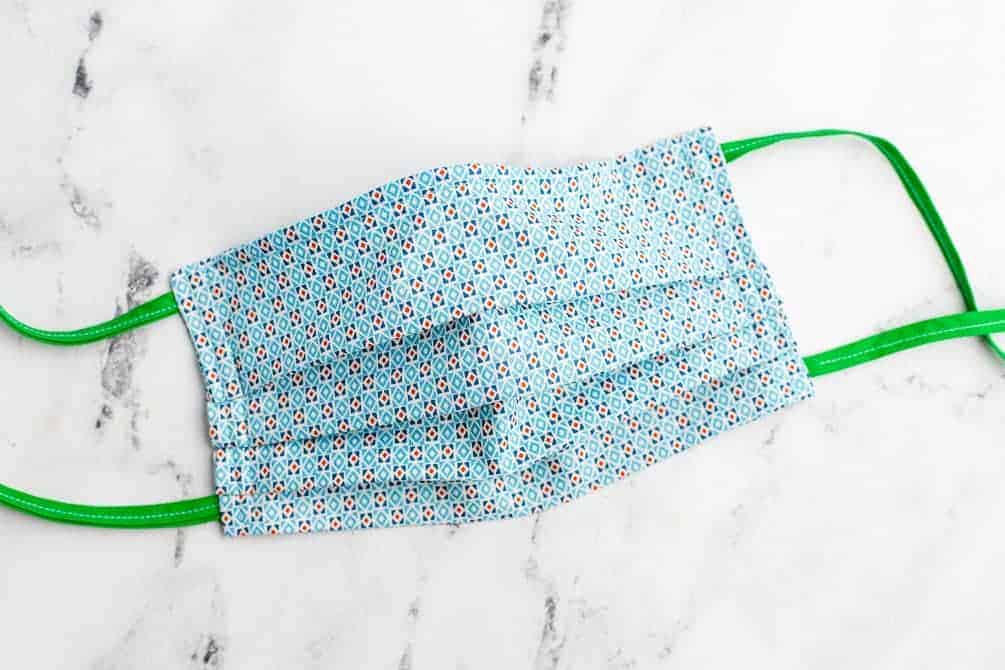
Many makers have asked for a pattern to sew homemade surgical masks for hospitals and their communities. The DIY pattern in this post will teach you to make a cloth pleated face mask with elastic ear loops or fabric ties.
The fabric face mask can be made with an interior pocket in which you can insert additional filter material.
If you can't find or don't want to use elastic ear loops, there are additional instructions for making and using fabric ties. You can make fabric ties from cotton fabric, t-shirt material, or use ready-made bias binding.
Currently, the supply of surgical masks is at a critical all-time low throughout the entire nation.
Orders for the standard disposable masks used in hospitals are back-ordered, and there is a high demand for protective equipment for health care workers.
Due to these concerns, many hospitals across the country have requested homemade surgical masks as an emergency stopgap measure.
The CDC Now Recommends the Use of Cloth Face Coverings
What's more, federal health officials now recommend people cover their mouths and noses with cloth face masks when in public.
This is a voluntary public health measure meant to help stop the spread when people must visit to public spaces such as grocery stores and public transit stations.
CDC is additionally advising the use of simple cloth face coverings to slow the spread of the virus and help people who may have the virus and do not know it from transmitting it to others.
Sewing a cloth face mask for yourself will allow medical grade surgical masks and N95 masks to be reserved health care professionals and patients.
How to Sew a Surgical Face Mask for Hospitals – Free Pattern
How to Sew a Surgical Face Mask for Hospitals – Free Pattern
An Important Distinction
Homemade face masks are not as effective as the N95 filtration mask recommended by the CDC, and are not a substitute for proper PPE.
Rather, they are meant:
To respond to the hospitals' requests for emergency backup masks.
To help community members "slow the spread" in public settings where other social distancing measures are difficult to maintain.
The Centers for Disease Control and Prevention (CDC) has explained that in times of crisis, homemade masks are acceptable as a last resort. On the CDC website, Strategies for Optimizing the Supply of Facemasks, they explain that while homemade masks are not a substitute for PPE, they can be used in settings where facemasks are not available.
HCP use of homemade masks: In settings where facemasks are not available, HCP might use homemade masks (e.g., bandana, scarf) for care of patients with COVID-19 as a last resort. However, homemade masks are not considered PPE, since their capability to protect HCP is unknown. Caution should be exercised when considering this option. Homemade masks should ideally be used in combination with a face shield that covers the entire front (that extends to the chin or below) and sides of the face.
I strongly caution you before you spend time sewing these masks:
Follow the CDC guidelines as the situation develops.
Contact your local hospital and clinic to ensure that they are accepting masks, and that any masks you make will meet their individual guidelines.
Some Hospitals are Requesting Homemade Surgical Masks
Some hospitals and clinics accepting donations of homemade face masks. Organizations like Masks for Heroes have a searchable database of facilities currently seeking donations. If you are wondering where you can donate masks, they can help you find a hospital or clinic that needs them.
Before you spend time sewing a large batch of masks to donate, please call first to ask if they are accepting them. You should ask if this pattern (2 layers of fabric with a pocket for additional disposable inserts) will meet their requirements. You should also ask about drop-off/pick-up procedures.
The Best Fabric to Use to Make A Face Mask
Researchers at Cambridge University tested the effectiveness of a wide range of household materials for use in homemade masks. They measured how well the household materials could capture and filter small particles.
Test data shows that the best choices for DIY fabric masks are cotton t-shirts, pillowcases, or other cotton materials. Using a double layer of material for your DIY mask adds a small increase in filtration effectiveness.
Other research has found that most effective masks were constructed of two layers of heavyweight "quilters cotton" with a thread count of at least 180, and had a thicker and tighter weave.
This pattern has 2 layers of fabric, and an internal pocket in which you can add additional layers of disposable filtration material if desired.
DIY Surgical Mask Pattern
The finished adult mask will be 7.75″ wide and 3.75″ tall.
1/8″ flat elastic for ear loops, or 4 fabric ties (you can use the same cotton fabric to make strips, use pre-made bias binding, or strips of cotton jersey)
fabric scissors
ruler
pins or clips
sewing machine and thread
Cut List
For an adult size mask:
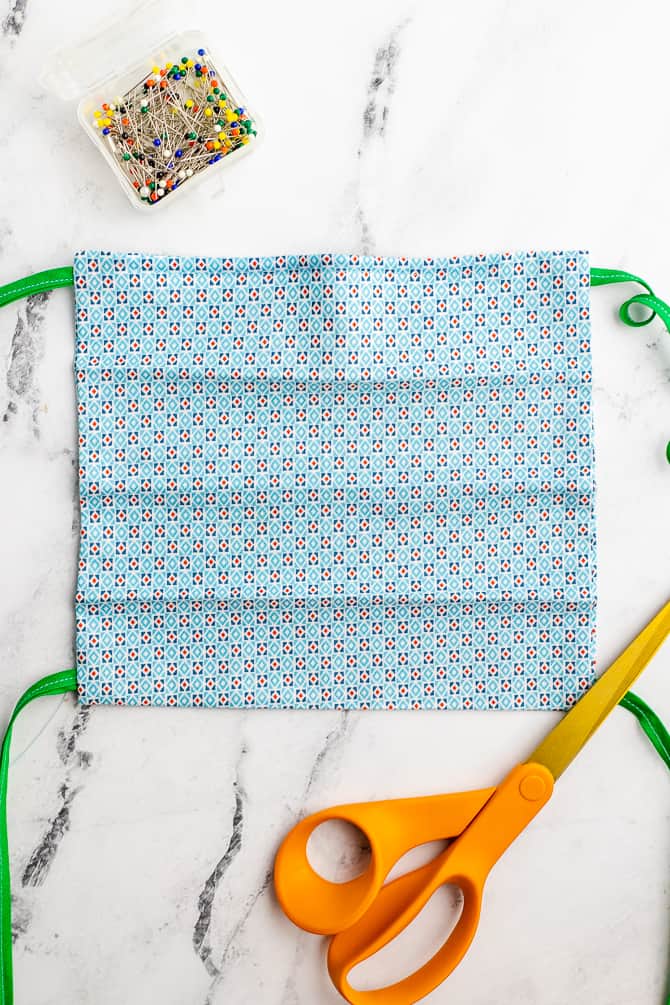
Cut 1 fabric rectangle 16″ long and 8.5″ wide
Cut 2 pieces of elastic, each 7″ long (or up to 8″ for a larger adult size)
For a child-size mask:
Cut 1 fabric rectangle 14″ long and 6.5″ wide
Cut 2 pieces of elastic, each 6″ long
For elastic ear loops:
Cut 2 7″ long pieces for an adult mask (or up to 8″ for a larger adult size)
Cut 2 6″ long pieces for a child mask
For fabric ties, if you aren't using elastic:
Cut 4 rectangles 18″ long by 1.75″ wide. Fold the long sides to meet in the middle, then fold in half again to encase the raw edges. Stitch down the length of the rectangles along the edge to create the ties.
18″ may be too long for some people, feel free to trim this down.
Step 1: Sew to the top side, with pocket
Fold the fabric rectangle in half, with the right sides facing each other.
Sew along the top 8.5″ width edge, using a large 5/8″ seam allowance. Leave a 3" opening in the center of this seam to create an opening for the filter pocket, and to allow the mask to be turned right side out after sewing. In the picture above, I've marked this opening with pins.
Update: Some people are finding it easier to insert/remove additional filter material if they make a larger opening. Instead of leaving a 3" opening you could make a 4" inch opening.
Don't want a filter pocket? If you don't want or need a pocket, that's totally fine. You will still need to leave an opening so that you can turn the mask right side out. After you've attached the elastic or ties (in the next step) and turned the mask right side out, you can stitch the opening closed. Then you can continue with the rest of the directions.
Next, turn the fabric so that the seam with the pocket opening is centered in the middle of one side. Using an iron, press the seam open.
Fold the excess seam allowance under, encasing the raw edge of the fabric. Topstitch or zig-zag stitch along each side of this seam to finish the edge. This will help keep the fabric from fraying when you insert and remove any filters.
See the next photo or the video for clarification.
Step 2: Pin Elastic or Fabric Ties
If Using Elastic:
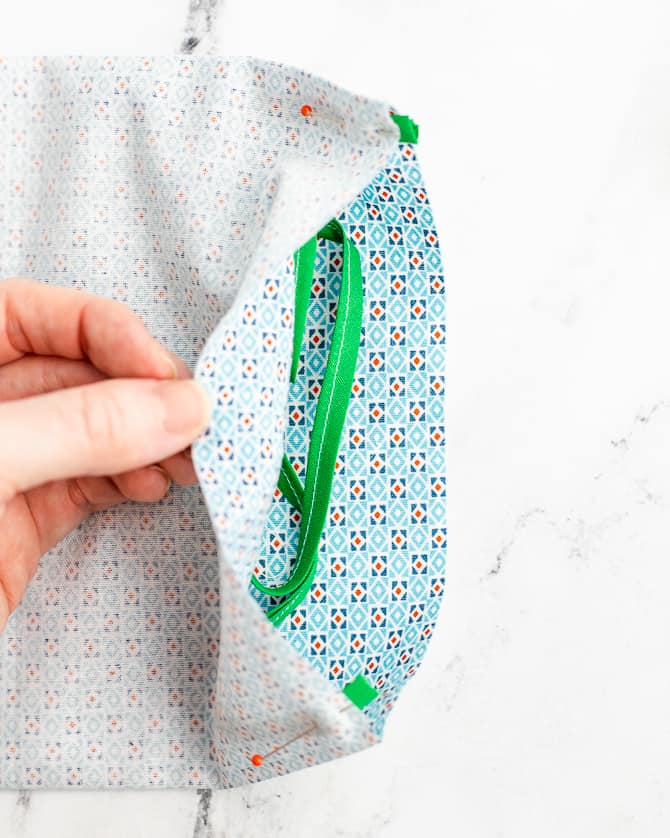
Pin one piece of elastic to each side of the mask, one end to the top corner and one end to the bottom corner of the fabric rectangle. This will create the ear loop once the mask is turned right side out and pleated. Place the ends of the elastic about 1/4″ to 1/2" from the top and bottom corners of the fabric.
The piece of elastic itself will be sandwiched between the two layers of fabric. Once you turn the mask right side out, the elastic will be on the outside.
Repeat this process on each side to make two ear loops.
Alternative – Use fabric ties:
If you can't find elastic, or prefer to use fabric ties, you can use 4 fabric ties, one in each corner. Each tie will be 18″ long. Sew one tie in each corner, being careful not to catch the ties in the side seams.
You can also use twill tape, bias tape, or strips from cotton jersey (t-shirt fabric).
The finished mask will then be worn by tying the fabric strips behind the head. See notes at the bottom of the post.
Step 3: Sew the Sides, Securing the Ties
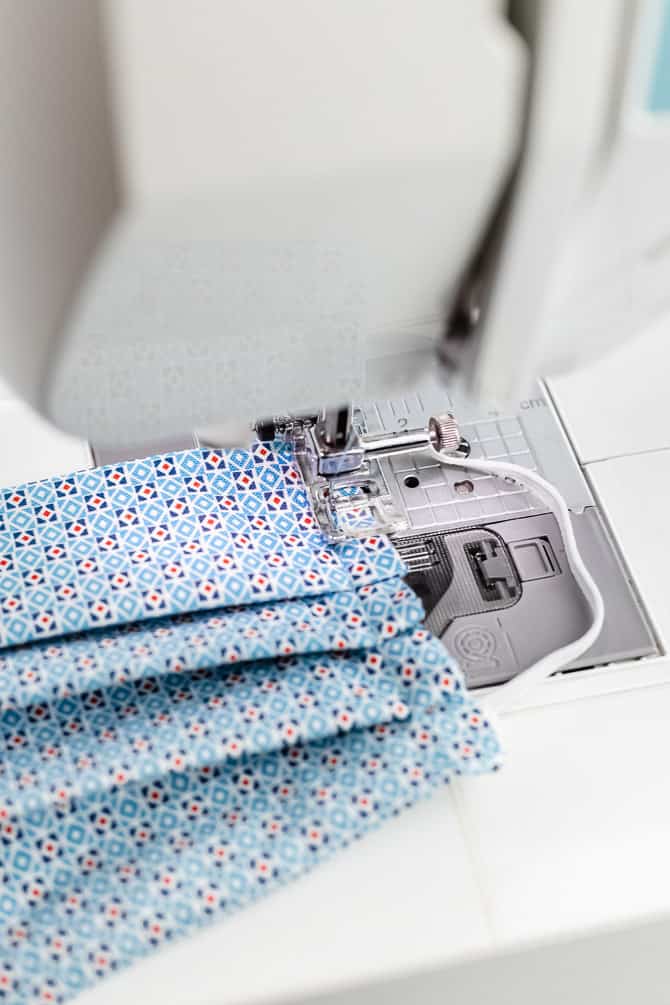
With a 3/8″ seam allowance, sew each side of the facemask. Backstitch over the elastic or fabric ties to secure them. Trim the corners with scissors so that it will be easier to turn the mask right side out. Becare not to accidentally clip the stitches.
Turn the mask right side out and press with an iron. You can use a pencil to push out the corners.
Optional: Insert a Flexible Nose Piece
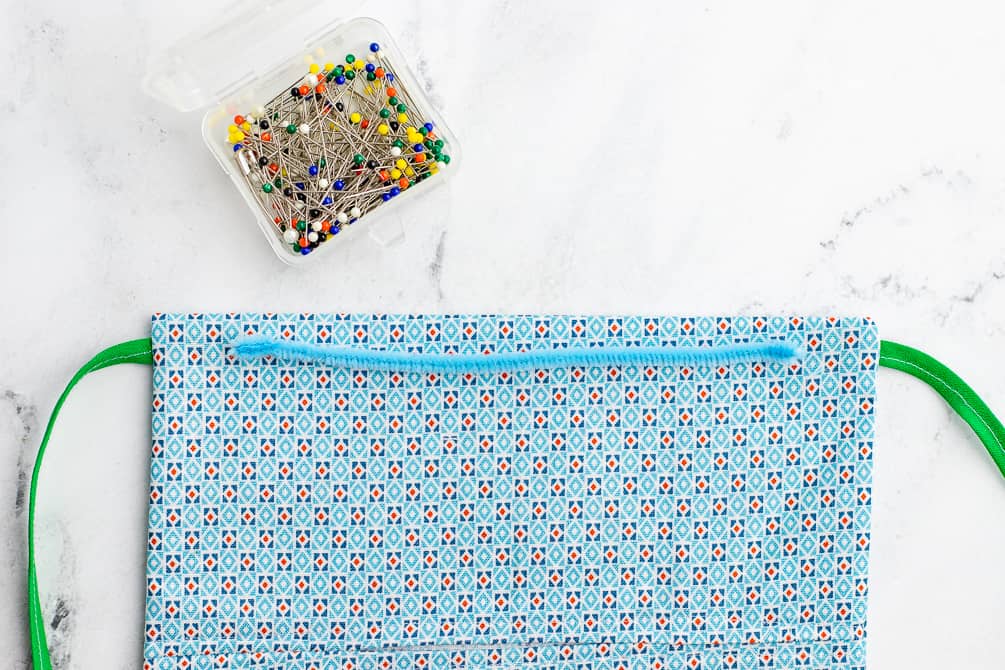
Cut a 6-inch piece of pipe cleaner, floral wire, or other flexible wire to create a nose piece. I folded the ends of wire back into to keep them from poking through the fabric. Place the wire through the pocket hole and slide it up to the very top of the mask. Stitch around it on all 3 sides to keep it in place.
Step 4: Make the Pleats
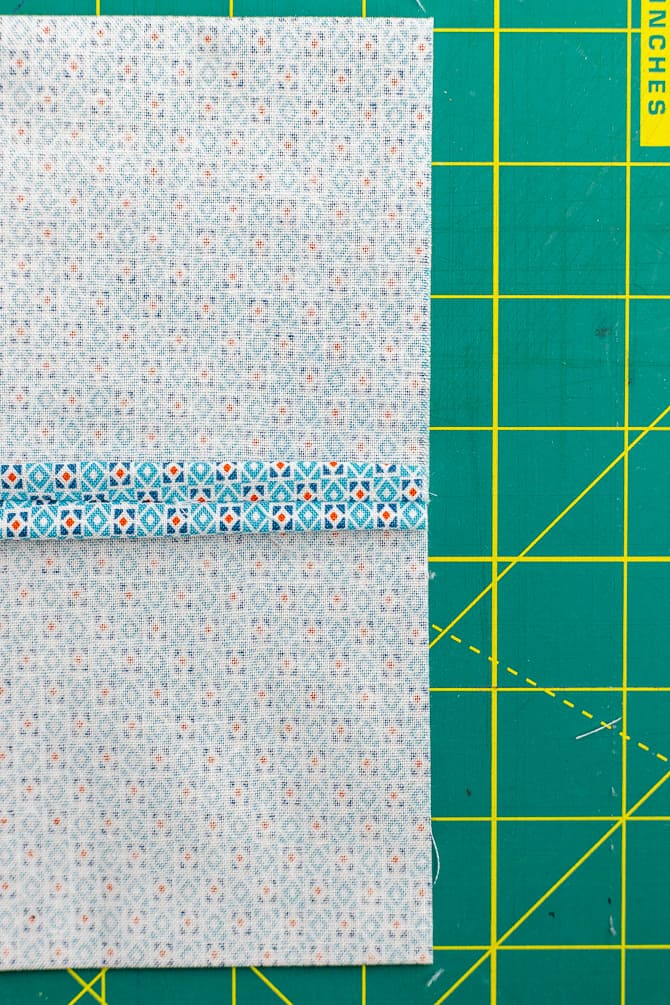
Make the mask with three evenly spaced lines. To do this, you can measure and mark with a water-soluble fabric pen. Or, you can do what I did, and fold the mask in quarters – fold the sides to meet in the middle, and then fold again in half. Use an iron to make a crease.
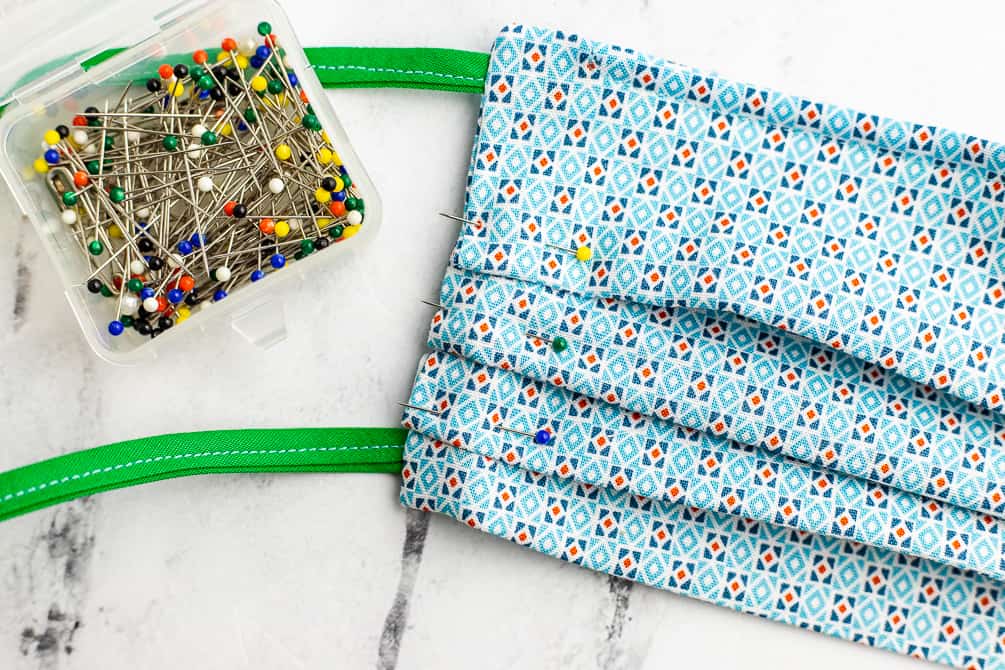
Use your markings to create three evenly spaced 1/2" pleats. Pin the folds down, make sure all pleats are facing the same direction. Sew along the sides to secure the pleats. I like to sew down the sides twice, just to make sure.
When the mask is worn, the pleats should open downwards to prevent any particles from collecting in the fold pockets.
Troubleshooting the Pattern
What if you can't find elastic?
I've heard from many people that are having a hard time finding elastic. If you can't find elastic to make the ear loops, you can make a mask with fabric ties instead. You can use ready-made 1/4″ twill tape, double-fold bias tape, or cut long strips of the same tightly woven cotton fabric you are using for the rest of the mask.
To make bias binding fabric ties: Cut 18″ long strips of fabric, 1.75″ wide. Fold the long sides together (lengthwise or hot-dog style) so that they meet in the middle. Then fold the strips in half again (lengthwise) to encase the raw edges. Stitch down the strips along the edge to create the ties.
If you wanted these straps to have a bit of stretch, you could also cut long strips from cotton jersey or knit T-shirt material. The great thing about using jersey fabric is that it will form itself into a tube when you stretch it. And, it's comfortable to wear since it keeps a bit of stretch.
Whichever option you choose, you'll want to cut 4 pieces about 18″ long, and attach one strip to each of the corners. The mask will fasten by tying the straps behind the head.
What about metal to help the mask fit better?
To help the mask fit better around your nose, you can insert a length of flexible metal to the top inside of the mask, through the pocket insert opening before forming the pleats. Then, you can topstitch down around the metal insert so that it stays in place. I've seen people use pipe cleaners, floral wire, or twist ties.
What can you use as a filter?
It is so important that everyone understands that while wearing a cloth face mask can offer some level of protection, it can't protect against viruses the same way that an N95 mask can.
Many different types of filters have been suggested, like coffee filters, felt, and vacuum filter bags. Not all of these filters are effective, and not all of them are safe.
Without further research into the safety and efficacy of face mask filter materials, we won't know what the best filter is.
Face Mask Filter Materials: Pros and Cons
HEPA filters. In testing, a layer of HEPA vacuum cleaner bag seemed to perform the best. However, it is difficult to breathe through. In addition, many people have raised concerns over the safety of materials (like fiberglass) used to produce these filters. At this time I can't recommend them.
Coffee filters. One of the mask designs that the CDC has published includes a layer of a coffee filter. They are readily available and disposable.
Blue shop towels.Others have tested the efficacy of blue shop towels, like these. They look promising, but the data hasn't been released publically or verified.
Dryer sheet or baby wipes. Because these items are coated in fragrances and other chemicals, I don't recommend using these as a filter.
Non-woven interfacing. This has been suggested many times in the comments. I can't find research suggesting it will help. If you choose to use interfacing, avoid the fusible/iron-on types.
Flannel or felt. These materials are not as closely woven as the cotton fabric on the outside of the mask, so it is doubtful they would improve filtration effectiveness. In addition, they may trap moisture.
One more layer of cotton fabric.The research we do have suggests that the safest and simplest option for a filter is cotton t-shirt material or tightly woven cotton fabric.
If you are sewing for hospitals, they may have their own medical grade filters. Always call before you sew to check their requirements.
Disclaimer: This pattern has not been industry-tested and is intended for educational purposes only. The decision to use this device is solely your own.
Where can you donate masks?
Not all hospitals are requesting masks, but many are. Search your local hospital to see if they have requested donations.
Also, an organization called Masks for Heroes has a website with a searchable database of facilities currently seeking donations. If you are wondering where you can donate masks, they can help you find a hospital or clinic that needs them.
How do you wear a cloth mask?
It's important to use proper procedures when putting on, and taking off, your mask. Be careful not to touch your eyes, nose, and mouth when removing the mask and wash your hands immediately afterward.
Here is a clear, step-by-step guide to the best way to properly wear a face mask.
Important to Note: Per the CDC, masks "should not be placed on young children younger than 2 years of age, anyone who has trouble breathing, or is unconscious, incapacitated or otherwise unable to remove the cover without assistance."
How do you clean and sanitize a cloth mask?
Wear only dry masks. When masks get moist, even if it's just from your breath, they need to be cleaned.
Wash masks regularly, with regular detergent and in a hot washing machine cycles. Dry completely.
Homemade fabric surgical face mask to be worn as a last resort in a crisis situation.
Prep Time5 minutes
Active Time15 minutes
Total Time20 minutes
DifficultyEasy
Instructions
Cut the fabric. For an adult size mask, cut 1 fabric rectangle 16″ long and 8.5″ wide. Cut 2 pieces of elastic, each 7″ long. Or, cut 4 fabric ties 18" long. For a child-size mask, cut 1 fabric rectangle 14″ long and 6.5″ wide. Then, cut 2 pieces of elastic, each 6″ long.
Sew the top side, with pocket opening. Fold the fabric in half, with the right sides facing. Sew along the 8.5″ width edge, using a 5/8″ seam allowance. Leave a 3" opening in the center of this seam to create an opening for the filter pocket, and to allow the mask to be turned right side out after sewing. Press the seam open. Topstitch/zig-zag stitch along both sides of the seam for a neater edge.
Pin Elastic or Fabric Ties. Pin one piece of elastic to each side of the mask, one end to the top corner and one end to the bottom corner. If using fabric ties, pin one tie to each corner, with the rest of the tie sandwiched inside the two layers of fabric.
Sew the Sides. Sew the sides of the facemask. Backstitch over the elastic or fabric ties to secure them. Clip the corners, turn the mask right side out, and press with an iron.
Sew the Pleats Create three evenly spaced 1/2" pleats. Pin the folds in place, making sure all pleats are facing the same direction. Sew down each side to secure the pleats. Note: When the mask is worn, the pleats should open downwards to prevent any particles from collecting in the fold pockets.
Notes
Remember, before you start sewing a huge batch of masks, please call the hospital or clinic and make sure that they both want and can accept homemade masks.
(Psst: The FTC wants me to remind you that this website contains affiliate links. That means if you make a purchase from a link you click on, I might receive a small commission. This does not increase the price you'll pay for that item nor does it decrease the awesomeness of the item. ~ Daisy)
by Daisy Luther
Landing AI has created a new tool to help keep people "safe" by spying on them with a camera that measures whether or not they're properly participating in social distancing. Because who needs privacy when there's a deadly virus around, right?
Landing AI's blog says:
To complement our customers' efforts and to help ensure social distancing protocol in their workplace, Landing AI has developed an AI-enabled social distancing detection tool that can detect if people are keeping a safe distance from each other by analyzing real time video streams from the camera.
For example, at a factory that produces protective equipment, technicians could integrate this software into their security camera systems to monitor the working environment with easy calibration steps. As the demo shows below, the detector could highlight people whose distance is below the minimum acceptable distance in red, and draw a line between to emphasize this. The system will also be able to issue an alert to remind people to keep a safe distance if the protocol is violated.
As part of an ongoing effort to keep our customers and others safe, and understanding that the only way through this is with global collaboration, we wanted to share the technical methodology we used to develop this software. (source)
Watch the quick video below.
Watching life go on through the eyes of an artificial intelligence device has a certain sense of dystopia. The technology highlights "people whose distance is below the minimum acceptable distance in red, and draw a line between to emphasize this."
What will they do to enforce it? Make people wear shock collars that will give them a little zap when they get to close to a fellow human being? Deploy a drone to give them a verbal warning? Dispatch a human being to get within six feet and threaten them with arrest, resulting in even more contact?
Landing AI doesn't mention that. Instead, they conclude cheerfully:
As medical experts point out, until a vaccine becomes available, social distancing is our best tool to help mitigate the coronavirus pandemic and as we open up the economy. Our goal with creating this tool and sharing it at such an early stage, is to help our customers and to encourage others to explore new ideas to keep us safe. (source)
AI in the workplace
Landing AI is a company out of California that will work "closely with you to empower your company to become an AI-driven organization" and they hope to "influence the emerging AI generation."
Some workplaces may be launching AI technology in the age of social distancing.
One potential use touted for the technology is that it would enable workplaces to monitor their employees to make sure they are operating within the advised distance of each other. It's even able to issue alerts to remind them to re-establish that distance if they break the rules.
The system works by using an artificial 'neural network' that detects individuals and draws a box around them. If two boxes come too close to each other, they are highlighted in red.
Perhaps unsurprisingly, Amazon has already introduced similar technology in its warehouses, and has warned workers they could be fired if they violate social distancing guidelines. (source)
So, just in case your workplace isn't already looking over your shoulder to a sufficient degree, your every move could soon be digitally downloaded.
Your privacy is "safe" with Landing AI.
Oh, and there's no need for privacy concerns. Landing IA says that those deploying their system should only use it on people who have given their "informed consent."
The rise of computer vision has opened up important questions about privacy and individual rights; our current system does not recognize individuals, and we urge anyone using such a system to do so with transparency and only with informed consent. (source)
Because we know that'll happen when they pop this bad boy into the already-existing surveillance cameras in cities across America. They'll be sure to let us know they're now also measuring how close e get to our fellow humans too and of course they'd never use other tech to identify "offenders."
Don't worry. It's just to keep us "safe."
At this point, the word "safe" should now be looked upon with suspicion any time it's used in a sentence uttered by the government or anyone who contracts with the government. Just like the way people can be kept "safe" by not being allowed to purchase non-essentials (to be determined by the government) from open stores. Or how Baltimore has deployed surveillance drones 24 hours a day to keep people "safe."
We've now crossed the Rubicon between intelligent measures to reduce the spread of illness and authoritarian control. The protests are growing daily.
At some point in the not-so-distant future, people are going to completely rebel and we'll all be dealing with the fallout. Or potentially worse, nobody will rebel and this will become our everyday lives. We'll be so "safe" that we'll never experience true freedom again.
Will the overreach be here to stay?
In the words of Rahm Emmanuel, former mayor of Chicago, President Obama's Chief of Staff, and senior advisor to President Clinton, "You never want a serious crisis to go to waste. And what I mean by that is it's an opportunity to do things that you think you could not before."
Our government, along with governments around the world, are taking those words to heart. Please do not think that surveillance deployed now will just go away if or when the virus is eradicated. Don't believe it for a minute when you are told the measures are only temporary.
All you have to do is remember the Patriot Act and take a look at your "travel papers" if you've got them, to realize the infringements on our freedom happening now are very likely here to stay with only some minor modifications to make us feel like we're "free" again.
This is dividing our country.
All of this may sound like I support infected people being out there willy-nilly and mingling with everybody else. That's not the case. You can be concerned about a deadly virus, the economy, and freedom all at the same time. These things are not mutually exclusive.
But we're being made to feel that you have to choose only one thing to worry about and to hell with the rest. We're being pitted against one another and that never ends well. And the longer the population is locked up and kept from making a living, the higher tensions are going to rise. Civil unrest is already happening and it's inevitable that it will get worse.
What do you think of yet another surveillance device being used on us? Are you more concerned with the virus, the economy, or the attacks on personal liberty? Or are you concerned with all of the above? Share your thoughts in the comments below.
In our society, there is a mysterious phenomenon occurring known as "Soul Loss" arising in all people of all ages, genders, races, and backgrounds.
Indigenous people have known about the occurrence of Soul Loss for millennia, and understand it as the result of an inner fragmentation caused by a traumatic experience or an intense shock to the mind and body.
While for many of us Soul Loss sounds uncomfortably familiar, this experience is usually temporary, and with the proper inner work, these lost elements of ourselves can be reintegrated into our lives.
What is Soul Loss?
When we experience Soul Loss, a part of our Soul – or living essence – 'hides' or shuts away, hindering us from expressing and experiencing our true potential and wholeness as human beings. Often times entire aspects of our psyches are completely blocked out or repressed.
During my exploration of shamanism and its methods of soul retrieval, Soul Loss was defined as the experience of the Soul traveling to other realms, or alternate realities, and often being possessed by spirits. In the shamanic perspective, when these parts of our Souls are not recovered, we can't seem to find inner completion or wholeness.
Before psychology, this explanation was the only way primal cultures could explain (what we refer to in modern times as) trauma in order to find ways to treat it – and it was immensely effective at the time. However, Soul Loss can now be approached from many different angles. We'll explore these varying perspectives next.
How Does Soul Loss Happen?
Sadly, in our modern world, Soul Loss is the rule rather than the exception.
But there's a reason why we identify with the ego and disconnect with the soul in the first place: it's a survival mechanism. We must develop a sense of self, a separate sense of "me" in the world in order to function. But simultaneously, developing an ego (which is basically one big defense mechanism to ensure that we're loved, accepted, taken care of, avoid pain, etc.) means that we lose touch with the authentic essence of who we truly are: the Soul.
As a result of Soul Loss, we begin experiencing symptoms of weakness, fatigue, depression, anxiety, and emptiness. We just know that something is missing from our lives – but many of us struggle to discover what exactly is missing. To understand Soul Loss as a loss, or disconnection, from the most vital parts of who we are, is known in psychology as dissociation: the root of many mental illnesses.
The Psychology Behind Soul Loss
So how does the actual process of losing touch with our Soul happen, from a psychological standpoint?
When we become disconnected from the root of who we are, an imbalance is created within the psyche. This disconnection grows through time and can be intensified by traumatic circumstances that have a tendency to fragment the psyche.
What happens when our psyches fragment? The answer is that individual parts of our personality (e.g., the shadow self, anima, animus, etc.) are made independent and thus escape the control of the conscious mind. Lingering in the unconscious mind, these parts of us long to be integrated and to be made conscious, and can resort to extreme measures to get our attention (such as suicidal depressions, self-destructive behavior, sudden rages).
What happens when one of our psychological 'complexes' emancipates itself and becomes a tyrannical usurper of consciousness? The result is an increasing feeling of being alienated from ourselves, life, and the Divine. We may live with fear, guilt, and shame as a constant backdrop to our lives. And usually, we feel numb, empty inside, and a sense of hopelessness that we try to smother with work, family life, friendships, gossip, and various addictions.
Soul Loss is Also Known as Dissociation
Soul Loss, in a sense, is another way of saying dissociation.
If you're familiar with basic psychology, you'll know that dissociating means disconnecting from something, in this case, ourselves. This disconnection happens as a result of a traumatic situation or environment that we're subjected to. It's a defense mechanism that prevents us from totally shutting down and being incapable of functioning.
Here's a (tragically very common) scenario of how dissociation works:
Imagine that a young child is molested or abused. In order to cope with the horrendous experience, the child escapes by dissociating, or detaching themselves, from the situation. In the process of protecting themselves, the child creates various alter egos, or entirely different personalities within themselves, as a defense mechanism. In psychology, this is treated as "multiple personality disorder" (now known as Dissociative Identity Disorder).
It is easy to understand how tribal cultures would have perceived this as a loss of the Soul. But essentially, psychological dissociation is nature's way of protecting ourselves against intense trauma and loss by blocking these wounding situations out.
But Soul Loss, or dissociation, is not limited to these extreme cases and can be found in different degrees in most people. Addictions, eating disorders, identity disorders, post-traumatic stress, depression, codependency, narcissism, low self-esteem, and adjustment disorders are all common causes for (and symptoms of) Soul Loss in our superficial, fast-paced, materialistic modern societies that are mostly devoid of all sense of sacredness.
A young woman who dreams of being an artist but has to live up to her parent's expectations of being a doctor will lose a little bit of her Soul, ignoring an essential part of her being. Or suppose the young woman does go ahead and follows her dream of being an artist, but deep down she still depends on her parent's approval. She then either blames them to avoid taking responsibility for pursuing her passion, or she develops depression because she is not accepted by them. This story might sound familiar to you.
Fortunately, there are many ways of finding wholeness again. Most of the material Luna and I write for lonerwolf is a form of Soul Retrieval, where we help you to become aware of aspects within yourself that may be buried or lost. We do this by encouraging the development of authenticity, self-exploration, self-love, and self-transformation. I'll explore some common Soul Retrieval practices a little later.
But first, are you experiencing Soul Loss?
21 Signs You Might Be Experiencing Soul Loss
There are a variety of physical, psychological, and spiritual symptoms of Soul Loss.
When we experience Soul Loss – that is, parts of our Soul 'hiding away' or dissociating from us – the result is a loss in Soulful energy or the very vitality of our lives. This loss of energy prevents us from living a healthy, fulfilling, and creative existence. Sometimes Soul Loss can last for a whole lifetime, resulting in the development of a self-destructive person who we often refer to as a "Lost Soul" in our language.
To recover these lost parts of ourselves, and to become balanced, whole, and centered once again, we must first identify the symptoms of Soul Loss within us. Below you will find some of the most common symptoms:
Memories and parts of your life have been blocked out.
You sometimes feel that you're not in control of yourself.
You constantly feel mentally or physically fatigued for no medical reason.
You thirst for authenticity and complete acceptance of yourself.
How many can you relate to? You're welcome to share in the comments below.
How to Reconnect With Your Soul
For what shall it profit a man, if he gain the whole world, and suffer the loss of his soul? – Jesus of Nazareth
Inner work or Soul Retrieval practices are the best way to reconnect with your soul. This is because they take you on an internal adventure and channel your energy toward your deepest buried feelings, thoughts, and dreams: all of which carry vital parts of you.
There are a multitude of inner work practices out there. Some of those particularly suited to Soul Retrieval may include:
Choose a few areas you're interested in and stick with them for a period of a year or more. (However, ultimately use your own judgment – and if you feel overwhelmed by any, stop immediately.) This work takes dedication and sincerity. So go at a slow and steady pace. One day you will look back on the moment you read this article and realize how far you've come!
Soul Loss Q&A
Here are the answers to some commonly asked questions:
Q: Is Soul Loss about losing your soul – can I lose my soul?
A: Soul Loss is about losing touch with your Soul. You cannot totally lose your Soul, it is always there in the background of your life, albeit, often times inaccessible due to the trauma you may have experienced. Many people misunderstand the term Soul Loss as literally meaning losing your Soul. But instead, it's about losing access to the vital core of you.
Q: How do you know if your soul is gone?
A: Again, the Soul never 'goes' away, it just becomes hard to reach, hard to reconnect with. Common signs that you've experienced Soul Loss include anxiety, depression, emotional numbness, loneliness, emptiness, chronic fatigue, feelings of hopelessness, boredom, and profound dissatisfaction with life.
Q: Can soul retrieval only be done with a shaman?
A: Although 'Soul Retrieval' is a shamanic term, it doesn't need to be performed exclusively by a shaman. Psychotherapists, bodyworkers, and spiritual healers can also provide Soul Retrieval help. Try to find someone reputable when it comes to Soul Retrieval: trust your instincts. This is a sacred journey and requires guidance from a person who genuinely respects you and the process.
***
To be healthy, to feel whole, and to live a harmonious life, you must recover the vital lost parts of yourself by learning to live a life of balance, authenticity, and self-love.
Finding the fragments of yourself that are lost and restoring them is to return to your innate wholeness, to restore the essential vitality that is your Soul, is often part of the journey of spiritual awakening. To learn to slowly reintegrate the lost elements of your Soul through the practice of inner work (or Soul Retrieval) is to fulfill your potential as a divine being having a human experience.