Friday, January 20, 2023

Thursday, January 19, 2023

What to Do with a Steep Backyard to Make it Pretty 2023: Own The Yard


What to Do with a Steep Backyard to Reclaim Your Yard

You might not have noticed the effects at first. Slowly, it becomes apparent. Your yard is going down the drain—literally! You may have lost plants that didn't have enough time to get established. You know you need to take action. Here is your guide about what to do with a steep backyard to turn the tide back in your favor and save your yard.
Water is a powerful force. Think glaciers and floods. On a smaller scale, it can wreak havoc in your yard. It certainly doesn't help the fact that the consequences can spread to your neighbors' backyards, nearby waterways, and even your local water supply. That's because a steep backyard means that the earth is mobile.

It doesn't stay put and therein lies the problem.

The Negative Impacts of Soil Erosion

The greatest problem with a steep backyard is that it's vulnerable to soil erosion. The US Environmental Protection Agency (EPA) classifies sources of runoff without a specific origin as nonpoint source pollution (NSP). If it was a matter of just soil, that'd be one thing. But that's not to say that we should dismiss it, as we'll discuss later.

What is rolling off your steep backyard has a lot of other things in it too, such as:

  • Fertilizers
  • Pesticides
  • Runoff from the impervious surfaces like your driveway
  • Salt from the streets

That's where the trouble starts.

If the soil remains undisturbed, whatever is deposited on it eventually is contained and sequestered. That's the value of wetlands, which do the same thing. These materials can't harm plants or pollute waterways, anymore.

When stormwater washes over your steep yard, it stirs up all these materials that can pollute your garden and lawn as well as that of your neighbor. It can also send the output into streams, lakes, and other waterways. Because of the topography, the water gains speed. It'll move more stuff and dig deeper trenches in your yard.

That can become a more serious issue if the water runs under and structures because it could make them unstable. That's a problem that needs immediate attention.

The First Step

The first step is to assess the water flow in your yard. You must know where the water comes from and where it goes once it crosses your property line to see if you can divert it somehow. We'd also suggest noting the patterns of the occurrence, for example, whether it's a seasonal thing or something that happens every time it rains.

That can mean the difference between a temporary or permanent fix.

It'll also give you the knowledge about whether you need to find a solution that goes beyond your yard. Your home doesn't exist in isolation. Other areas around your property contribute to the water flow over your backyard. In a larger context, scientists refer to it as the watershed of a waterway. That is the acreage that drains into a stream or lake.

We mention this fact because you may be able to get local, state, or federal assistance to help you correct this issue. For example, if a new road is sending water your way, you might convince the city planners to add sewers or a curb to redirect the runoff from your property. That will at least lessen the negative impacts of having a steep backyard.

You may qualify for assistance from the federal government through the Conservation Reserve Program (CRP). We'd also suggest reaching out to your state's Department of Natural Resources. If you live on a lake or stream, find out if there is a local watershed district that can help.

Landscaping Solutions

If these other outlets couldn't provide assistance, don't fret. All is not lost. Fortunately, you have several options about what to do with a steep backyard. You might even be surprised to learn that some people may envy your situation. That's because it opens up so many possibilities versus a flat yard. Let's review what you can do and help you make an informed decision about what comes next.

Grade It

Grading your yard to remove the slope is a quick fix if you don't want to deal with it anymore. However, it isn't a solution for all situations simply because of the expense. Topsoil isn't cheap. You might be able to score some inexpensive fill if there's new construction going on in your area. There's still the cost of getting it to your property.

You're also going to have to landscape your yard to anchor the soil in place. The quickest way to handle that task is with sod, which is also spendy. On the positive side, you'll increase your backyard's usable space to add other features like a patio, garden, or even a pickleball court.

Last update on 2022-12-21 / Affiliate links / Images from Amazon Product Advertising API


Add Stairs

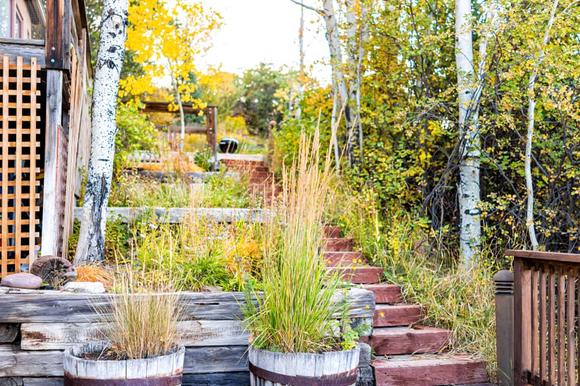
Another option is to add a stairway so that it's easier to walk across your yard. You can put in switchbacks with benches along the way if it's really steep. That gives you some more places for creative touches, such as planters or small conversation nooks. If you use the bottom of the slope, you can even install an inclined elevator or lift to make moving stuff down the hill easier.

You can opt for a stairway made of decking material like treated lumber. You can also go the natural route and make a stone staircase that meanders up the slope. Either way, the individual stairs will slow water flow and help prevent soil erosion.

Make a Terrace

A more creative method is to build terraces. They'll fix the problem of a steep backyard no unlike a stairway. You can create individual gardens at each level for visual interest. The one thing to remember is to add a slight angle to each layer to keep the water moving and prevent it from pooling. This option works best if you have well-draining soil.

Build a Retaining Wall

If you're in danger of losing a hillside because it's so steep, you may need to take more direct action with building a retaining wall. The other advantage this fix offers is that you can cut into the slope to add more usable space to your yard. That will also provide more landscaping opportunities with plantings in and along with it as well as your choice of stone.

Last update on 2022-12-21 / Affiliate links / Images from Amazon Product Advertising API


Just Add Water

Sometimes, it's better to join them instead of fighting them. You can do that with your steep backyard by building a waterfall. After all, you're well on your way with the steepness of the angle. It's an excellent way to turn an eyesore into a landscaping feature. Adding shelves and a pond at the end can control the water flow too.

Put Up a Deck

You can take this lemon of a problem and make lemonade by building a deck to take advantage of the view. The great thing about this option is that you have a ready solution for privacy if your land sits higher above your neighbors. You can make this new space cozy by adding a fire pit and some comfy garden furniture. What better way to start your day with a cup of coffee!

Make a Rain Garden

An eco-friendly fix is to plant a rain garden at the end of the slope. It will help keep the soil intact while providing habitat for birds and other wildlife. It's best to use perennials for a long-term solution for erosion. You may also need to add a drainage system if your soil is poor-draining. The benefit of going this route is that it gives you more choices for flowers and other plants to add to your yard.

Put in Some Raised Garden Beds

Adding some raised garden beds can give you more space to grow fruits and vegetables. You can add a mixture of decorative plants to create a cottage garden look to your yard. We like this solution because it makes something positive out of a thing you may see as negative. The good thing about this option is that you have a structure in place to stabilize the slope during the off-season.

Last update on 2022-12-21 / Affiliate links / Images from Amazon Product Advertising API


Call in the Big Guns

Planting some trees offers a permanent solution to a steep slope. Opt for deep-rooted varieties such as hickory, sycamore, or oaks. Adding some grass around the plantings will create a savanna-type of habitat that can attract songbirds. We couldn't think of a better way to make peace with a challenging landscaping issue!

Plant Native Plants

One of the easiest actions you can take for what to do with a steep backyard is to plant some native plants, preferably ones with deep root networks such as little blue-stem. There are several advantages to choosing these species. First, they're adapted to the climate of your area. That means less maintenance for you. Also, the roots will anchor the soil in place and eliminate an erosion problem.

Finally, you can select plants with different blooming times to have a colorful backdrop for the entire season and even into the fall with varieties like Liatris or blazing star. Instead of being the bane of your yard, the hillside is now a showcase for some gorgeous plants that are functional too.

Last update on 2022-12-21 / Affiliate links / Images from Amazon Product Advertising API


Final Thoughts

We understand how vexing it can be when deciding what to do with a steep backyard. Depending on the slope, it can cut into your usable space, which can make it even more aggravating. However, don't despair. There are so many things you can do to make it a part of your landscaping and maybe even its star attraction. Instead of viewing it as a challenge, see it as an opportunity.


Adrienne L den Tex


Tuesday, January 17, 2023

How to Tell If Someone Is Gaslighting You

How to Tell If Someone Is Gaslighting You

Reading Time: 7 minutes

With more young people talking openly about mental health, gaslighting has become an increasingly common topic among this age group over the last few years. Gaslighting and other forms of emotional abuse have also shown up in popular media recently—for example, in the Netflix series Maid, the novel and movie The Girl on the Train, and the reality TV show The Bachelorette.

Overall, that's a good thing, because greater awareness around this form of emotional abuse can help people avoid threatening and unhealthy relationships. But before you accuse someone of this behavior, it's important to understand what gaslighting really means and how to look for the signs of gaslighting in a relationship.

Let's take a closer look at the definition and origin of the word gaslighting, the mental health impact of this behavior, and how to tell if someone is gaslighting you.

What Is Gaslighting Abuse?

Gaslighting is a form of psychological manipulation in which the abuser attempts to sow self-doubt and confusion in their victim's mind. Typically, gaslighters are seeking to gain power and control over the other person, by distorting reality and forcing them to question their own judgment and intuition.

The term "gaslighting" comes from the 1938 play Angel Street, which Alfred Hitchock later adapted into the film Gaslight, in which a man tries to convince his wife that she is going insane so he can steal from her. When he turns on the lights in the attic to search for her jewelry collection, and the gas lights dim downstairs, he tells her it's all in her imagination. Gradually she begins to question her own memories and perceptions.

Gaslighting typically takes place in abusive relationships like this, and is closely associated with other types of emotional and physical abuse. While gaslighting is most common in romantic relationships, it can also occur within family or workplace relationships.

10 Signs of Gaslighting in a Relationship

If you're wondering how to tell if someone is gaslighting you, consider whether someone has exhibited any of the following behaviors within your romantic, family, or work relationships:

  1. Lying about or denying something and refusing to admit the lie even when you show them proof
  2. Insisting that an event or behavior you witnessed never happened and that you're remembering it wrong
  3. Spreading rumors and gossip about you, or telling you that other people are gossiping about you
  4. Changing the subject or refusing to listen when confronted about a lie or other gaslighting behavior
  5. Telling you that you're overreacting when you call them out
  6. Blame shifting in relationships—saying that if you acted differently, they wouldn't treat you like this, so it's really your fault
  7. Trying to smooth things over with loving words that don't match their actions
  8. Twisting a story to minimize their abusive behavior
  9. Minimizing their hurtful behaviors or words by saying something like, "It was just a joke" or "You're way too sensitive"
  10. Separating you from friends and family who might recognize your gaslighting abuse symptoms.

Any of these signs of gaslighting in a relationship are cause for concern and indicate that the connection is unhealthy and may be causing severe mental health repercussions for the person being gaslit.

Know the Facts

74% of female victims of domestic violence also experienced gaslighting from their partner or ex-partner, according to the National Domestic Violence Hotline.

What Is Gaslighting Abuse at Work and in Society?

It's also important to recognize gaslighting abuse symptoms in the workplaceand other contexts outside romantic relationships. Blame shifting in relationships and other gaslighting behaviors can take place between colleagues or between a supervisor and employee. Typically the perpetrator acts in a way that causes the other person to question their take on the situation, undermining their confidence and belief in themselves. Someone might use gaslighting as a tactic to avoid owning up to a mistake at work, or to unfairly take credit for a task well done.

Another type of workplace gaslighting is known as "whistle-blower gaslighting." This describes a situation in which an employee who reports misconduct at work, such as a toxic environment or sexual harassment, is made to feel that they are overreacting, remembering wrong, or misinterpreting.

Gaslighting can also be perpetrated against marginalized or disempowered groups in the workplace. A gaslighter might try to dismiss or deny their colleagues' experiences or identities. One study involving women of color in the field of academic science found that all participants had had negative workplace experiences, including gaslighting. Women in general are often subject to gaslighting, particularly when reporting gender-based violence, according to a study published in the American Sociological Review. "Gaslighting could not exist without inequities in the distribution of social, political, and economic power," writes Harvard researcher Paige L. Sweet.

The Impact of Gaslighting Abuse on Mental Health

Being consistently told that you are wrong, confused, or even "crazy" can have devastating effects on mental health. Along with questioning their own reality and beliefs, gaslighting victims often feel isolated and powerless. Gaslighting abuse symptoms also include low self-esteem, disorientation, self-doubt, and difficulty functioning in school, at work, or in social situations.

As a result, people who experience gaslighting are at a high risk for anxietydepression, and suicidal thoughts. Young adults who suffered from these conditions prior to the abuse may be more vulnerable to gaslighting, which in turn makes their mental health issues worse.

Moreover, even after leaving an abusive relationship, people who have been gaslit often struggle with PTSD and have difficulty both trusting others and trusting themselves. Hence, they may engage in codependent relationships and have trouble building authentic connections. Because gaslighters usually don't apologize or admit wrongdoing, it's harder for their victims to move on from the experience.

Gaslighting may not be the only factor leading to mental illness, but the same factors that leave a person vulnerable to gaslighting may result in lower self-esteem, uncertainty about their own reality, anxiety, and ultimately depression. Over time, you begin to believe that there is something wrong with you because one of the most important people in your life is telling you this.

Robin Stern
PhD, author of The Gaslight Effect: How to Spot and Survive the Hidden Manipulation Others Use to Control Your Life

How to Tell If Someone Is Gaslighting You and Eroding Your Mental Health

The most damaging gaslighting abuse symptoms are the ones that take root in a victim's mind and begin to wear away at their self-worth and trust in themselves. Here are some of the mental health consequences of being gaslit.

  • Having trouble making even simple decisions
  • Making excuses for your partner's behavior to family or friends
  • Constantly second-guessing yourself
  • Blaming yourself for the way the other person treats you
  • Trying to convince yourself that their behavior isn't really that bad
  • Walking on eggshells around the other person
  • Believing that you are too sensitive
  • Questioning your own feelings, judgments, and observations
  • Feeling lonely and trapped
  • Doubting your own memory and sanity
  • Staying silent rather than speaking up about what you think or believe
  • Being on edge and feeling threatened all the time
  • Starting to believe what the gaslighter tells you about yourself, that you are "crazy" or "stupid"
  • Thinking you can't do anything right and feeling disappointed in who you have become
  • Spending a lot of time apologizing for your actions.

In addition, perpetrators of gaslighting typically suffer from mental health issues as well. They may have developed these controlling behaviors as a response to childhood trauma, or as the result of Narcissistic Personality Disorder or another psychological condition.

Know the Facts

study of 250 young adults found that abusers who gaslit their partners also exhibited high levels of emotional detachment, impulsivity, and risk-taking and anti-social behaviors.

5 Ways to Counteract Gaslighting Abuse Symptoms

Once you've figured out how to tell if someone is gaslighting you, the next step is removing yourself from the relationship, if at all possible, and avoiding other potential gaslighting situations. Here are some ways to take action and protect yourself if you are being gaslit in a relationship or at work.

Talk to others about what's happening. Don't let the gaslighter separate you from friends, family, or colleagues who care about you and respect your viewpoint. Share what's going on with as many people as possible so they can validate your experience.

Focus on actions, not words. A gaslighter may sometimes tell you what you want to hear in order to keep you in the relationship. But their words are meaningless if their behaviors don't change as well.

Remind yourself that you are not the reason for a gaslighter's abuse. There is nothing you could or should have done differently to avoid being gaslit. The abusive behavior was not your fault—it was about the gaslighter's attempts to control and manipulate you.

Don't try to argue with a gaslighter. Gaslighting is not a rational behavior and gaslighters will not respond to logic or admit their true motivation. If a partner, friend, or colleague turns a conversation into an opportunity to insult you or question your sanity or ability, step away from the discussion—and the relationship if possible.

Practice trusting yourself again. Once you have ended a relationship with a gaslighter, it may take some time and practice to start trusting your instincts and your perceptions again. Remember that the pictured the gaslighter painted of you is not the truth of who you are.

Support for Overcoming the Mental Health Consequences of Gaslighting

After being in a relationship, friendship, or work environment with someone who was gaslighting you, additional support is often necessary to address gaslighting abuse symptoms. Support groups with others who have gone through similar relationships can be very helpful in helping victims overcome feelings of isolation and self-blame. Therapy can help people who have been gaslit to heal the self-doubt, self-esteem issues, lack of trust, depression, and/or PTSD resulting from this painful experience.

Treatment with compassionate mental health professionals, alongside a caring community of peers, can allow young adults to get back on track with their relationships and their sense of self-worth. At Newport Institute, our model of care focuses on supporting young people to build trusting connections with others while reestablishing their connection with their own inner guidance and wisdom.


weird news??? not meeeeeeeeee!?

Hunter Biden asked a judge to prevent his 4-year-old daughter, born out of wedlock, from taking his surname.

Hunter Biden made the request on Jan. 6 when his lawyer filed a motion (pdf) with Arkansas Circuit Court Judge Holly Meyer in response to a name change request from Lunden Roberts, the mother of Navy Joan Roberts.

Roberts, in a motion (pdf) filed by her attorney with Judge Meyer on Dec. 27, said her daughter would "benefit from carrying the Biden family name" since the surname is "now synonymous with being well educated, successful, financially acute, and politically powerful."

As examples, the filing named President Joe Biden, his wife Jill Biden, and Beau Biden, who is Hunter Biden's late brother.

Additionally, it says the Biden family, including the president, remains "estranged from the child."

"To the extent this is misconduct or neglect, it can be rectified by changing her last name to Biden so that she may undeniably be known to the world as the child of the defendant and member of the prestigious Biden family," Roberts's lawyers said.

They added: "The child will not experience any difficulty, harassment, or embarrassment by carrying the last name of Biden. Instead, it will open opportunities for her just like it has for other members of the Biden family."

However, Hunter Biden disagreed with the value and benefits of his surname, arguing that the name would "no doubt rob this child of peaceful existence," according to the Jan. 6 filing.

He added that his daughter should decide for herself if she wants to take up his surname, once "the disparagement of the Biden name is not at its height."

As proof that his surname is tainted, Hunter Biden pointed to other court filings from Roberts that mentioned the federal investigation into his tax issues and his dealings with Ukrainian energy giant Burisma.

U.S. Attorney for Delaware David Weiss, a prosecutor appointed by former President Donald Trump, is currently investigating Hunter for alleged tax fraud, lobbying crimes, and money laundering.

Hunter Biden accused the Roberts of being motivated by a "political warfare" against the Biden family.

Roberts's "disparaging comments in various other motions and responses in this case are evident of scorn in the community for the Biden name."

The fight over the child's last name is part of a paternity case against Hunter Biden. The case was settled in March 2020 but reopened in September last year, when he is trying to lower his child support payment due to "substantial material change" in his "financial circumstances, including but not limited to his income. "

The child, initially called "Baby Doe" in the case, was born in August 2018 and Roberts filed the paternity suit in May 2019.

In January 2020, Judge Meyer ruled that Hunter Biden is Baby Doe's father, following a DNA test.

"The results of the DNA tests indicate with near scientific certainty that the defendant is the biological father of the child in this case," Meyer wrote.

In his book "Beautiful Things," Hunter Biden wrote he challenged Roberts's paternity case because he had "no recollection" of their encounter.

"The other women I'd been with during rampages since my divorce were hardly the dating type. We would satisfy our immediate needs and little else," Hunter Biden wrote. "I'm not proud of it.


(..guess not…)

Chief Daddy?

Medical Daddy, that is. Uhhhh, what else qualifies him???