EMF and RF Measurement and Mitigation Specialists: Canada + USA
WELCOME TO SAFE LIVING TECHNOLOGIES INC!
People worldwide are affected by exposure to electromagnetic radiation. At Safe Living Technologies, we want our customers to make informed decisions for their living and working environments in regards to electromagnetic field and radio frequency exposure mitigation. Whether it is through buying EMF meters or understanding what electromagnetic fields are, we provide the knowledge through our own resources as well as the resources of other leading professionals in the industry. Through our products and services we provide the technology for proper electromagnetic radiation mitigation as well.
RF meters, EMF meters, and body voltage kits are just a few of the items we offer for electromagnetic radiation mitigation. With an RF meter you can measure the amount of radio frequency or microwave radiation in your work or living space. You will be surprised to find out how much radiation is running through your current environment. With more electronics producing higher levels of electromagnetic radiation, it is important to not only be knowledgeable about what's in your environment, but it's also important to have the right technology to combat against these high levels of electromagnetic radiation.
Safe Living Technologies provides the knowledge and technology to create a safer living and working space. If you are unsure of what you may need to create a healthier environment in your home or workspace, our professionals at SLT.co will be happy to help you with information on the right RF meter, EMF meter, or other mitigation technology for you. We proudly provide testing and mitigation services to Canada and the United States.
PG&E Committed to Providing Safe and Reliable Energy, Aiding Restoration and Rebuilding Efforts, and Working Together with Customers, Regulators and Community Leaders to Address Wildfire Threat
Seeks Court Approval to Access $5.5 Billion in Debtor-in-Possession Financing to Support Operations and Ongoing Safety Initiatives
SAN FRANCISCO--(BUSINESS WIRE)-- PG&E Corporation (NYSE: PCG) and its primary operating subsidiary, Pacific Gas and Electric Company (the "Utility"), today filed voluntary petitions under Chapter 11 of the U.S. Bankruptcy Code in the United States Bankruptcy Court for the Northern District of California.
Throughout the forthcoming process, PG&E remains committed to:
Delivering safe and reliable electric and natural gas service to customers;
Continuing to make critical investments in system safety and maintenance;
Supporting the orderly, fair and expeditious resolution of its liabilities resulting from the 2017 and 2018 wildfires;
Working with customers, civic leaders, regulators, policymakers, the financial community and other key stakeholders to consider alternatives to provide for the safe delivery of natural gas and electricity and new safety solutions in an environment challenged by climate change; and
Assisting our customers and communities impacted by wildfires in Northern California. PG&E's restoration and rebuilding efforts will continue.
"Our most important responsibility is and must be safety, and that remains our focus. Throughout this process, we are fully committed to enhancing our wildfire safety efforts, as well as helping restoration and rebuilding efforts across the communities impacted by the devastating Northern California wildfires. We also intend to work together with our customers, employees and other stakeholders to create a more sustainable foundation for the delivery of safe, reliable and affordable service in the years ahead. To be clear, we have heard the calls for change and we are determined to take action throughout this process to build the energy system our customers want and deserve," said John R. Simon, PG&E Corporation Interim CEO.
In conjunction with the filings, PG&E also filed a motion seeking interim and final approval of the Court to enter into an agreement for $5.5 billion in debtor-in-possession (DIP) financing with J.P. Morgan, Bank of America, Barclays, Citi, BNP Paribas, Credit Suisse, Goldman Sachs, MUFG Union Bank and Wells Fargo acting as joint lead arrangers. PG&E expects the Court to act on an interim basis on the DIP motion in the coming days. The DIP financing, when approved, will provide PG&E with necessary capital to ensure essential maintenance and continued investments in safety and reliability for the expected duration of the Chapter 11 cases.
"Through this process, we will prioritize what matters most to our customers and the communities we serve – safety and reliability. We believe that this process will make sure that we have sufficient liquidity to serve our customers and support our operations and obligations," Mr. Simon said.
"I know that our 24,000 dedicated employees remain steadfastly focused on delivering safe and reliable natural gas and electric service for the 16 million people across our service area," said Mr. Simon. "Each day I see the hard work and resilience of our team, and I thank them for their continued dedication to working safely and delivering for our customers."
As part of the filings, PG&E also filed various motions with the Court in support of its reorganization, including requesting authorization to continue paying employee wages and providing healthcare and other benefits. In the filings, PG&E also asked for authority to continue existing customer programs, including low income support, energy efficiency and other programs supporting customer adoption of clean energy. PG&E expects the Court to act on these requests in the coming days. PG&E also intends to pay suppliers in full under normal terms for goods and services provided on or after the filing date of January 29, 2019.
In order to help support the Company through the reorganization process, PG&E has appointed James A. Mesterharm, a Managing Director at AlixPartners, LLP ("AlixPartners") and an authorized representative of AP Services, LLC ("APS"), to serve as Chief Restructuring Officer. In addition, PG&E appointed John Boken, also a Managing Director at AlixPartners and an authorized representative of APS, to serve as Deputy Chief Restructuring Officer. Mr. Mesterharm, Mr. Boken and their colleagues at AlixPartners will continue to assist PG&E with the reorganization process and related activities.
Tubbs Fire
On January 24, 2019, CAL FIRE released the results of its investigation of the 2017 Tubbs Fire, which concluded that PG&E equipment did not cause the fire. The comprehensive analysis underlying PG&E's decision to pursue reorganization under Chapter 11, conducted with the assistance of independent legal and financial advisors, took into account PG&E's longstanding belief based on available evidence that its equipment did not cause the Tubbs Fire. As such, PG&E continues to believe that the Chapter 11 process will facilitate the orderly, fair and expeditious resolution of the liabilities that have arisen and will continue to arise in connection with the 2017 and 2018 Northern California wildfires.
Additional Resources
Additional resources for customers and other stakeholders, and other information on PG&E's filings, can be accessed by visiting PG&E's restructuring website at www.pge.com/reorganization. Court filings and other documents related to the Chapter 11 process in the U.S. are available on a separate website administered by PG&E's claims agent, Prime Clerk, at https://restructuring.primeclerk.com/pge. Information is also available by calling 844-339-4217 (toll-free in the U.S.) or 1-929-333-8977 (for parties outside the U.S.), as well as by emailing pgeinfo@primeclerk.com.
Advisors
Weil, Gotshal & Manges LLP and Cravath, Swaine & Moore LLP are serving as PG&E's legal counsel, Lazard is serving as its investment banker and AlixPartners, LLP is serving as the restructuring advisor to PG&E.
About PG&E Corporation
PG&E Corporation (NYSE: PCG) is a holding company headquartered in San Francisco. It is the parent company of Pacific Gas and Electric Company, an energy company that serves 16 million Californians across a 70,000-square-mile service area in Northern and Central California. Each of PG&E Corporation and the Utility is a separate entity, with distinct creditors and claimants, and is subject to separate laws, rules and regulations. For more information, visit http://www.pgecorp.com. In this press release, they are together referred to as "PG&E" or the "Company."
This press release includes forward-looking statements that are not historical facts, including statements about the beliefs, expectations, estimates, future plans and strategies of PG&E Corporation and the Utility. These statements are based on current expectations and assumptions, which management believes are reasonable, and on information currently available to management, but are necessarily subject to various risks and uncertainties. In addition to the risk that these assumptions prove to be inaccurate, factors that could cause actual results to differ materially from those contemplated by the forward-looking statements include factors disclosed in PG&E Corporation and the Utility's annual report on Form 10-K for the year ended December 31, 2017, their quarterly reports on Form 10-Q for the quarters ended March 31, 2018, June 30, 2018, and September 30, 2018, and their subsequent reports filed with the SEC. Additional factors include, but are not limited to, those associated with the Chapter 11 cases, PG&E Corporation and the Utility's filing for relief under Chapter 11, and the timing and outcome of the investigation into the cause of the 2018 Camp fire. PG&E Corporation and the Utility undertake no obligation to publicly update or revise any forward-looking statements, whether due to new information, future events or otherwise, except to the extent required by law.
If you live in the Midwest, you surely already know that dangerously cold weather is heading your way. Some parts of the region are experiencing heavy snowfall and powerful winds, and the worst is yet to come.
Here's what has already happened.
Officials have already canceled nearly 1,600 flights so far, most at Chicago's airports. Hundreds of schools have been closed. In Michigan, non-essential government offices, including the Capitol, are closed.
Winter Storm Jayden has already pummeled parts of the Plains and Midwest with snow and wind and is now heading for parts of the South and the East.
In Wisconsin and Minnesota, snowplow drivers are having trouble keeping up. Those states are expecting up to 14 inches of snow in some areas.
Snowfall rates of 1 inch per hour were measured early this morning in Chicago, Milwaukee, Grand Rapids and Traverse City, Michigan, according to The Weather Channel.
In the Northeast, winter storm watches have been issued from Monday night into Wednesday morning for parts of western, central and upstate New York, northeast Pennsylvania, and western and northern New England.
Even folks in the South aren't escaping this winter storm. Warnings have been issued for parts of Mississippi, Alabama, northern Georgia, south-central Tennessee, and western North Carolina. Winter weather advisories stretch from northern Louisiana to western Virginia and West Virginia.
But even more extremely cold "arctic" weather is yet to come.
The most dangerous weather is yet to come: "frigidly low temperatures that the region hasn't seen in a quarter century," reports the Associated Press:
Wednesday is expected to be the worst. Wind chills in northern Illinois could fall to negative 55 degrees (negative 48 degrees Celsius), which the National Weather Service called "possibly life threatening." Minnesota temperatures could hit minus 30 degrees (negative 34 degrees Celsius) with a wind chill of negative 60 (negative 51 degrees Celsius). (source)
Brian Hurley, a meteorologist with the Weather Prediction Center, told the AP that temperatures will plummet over the next three days:
"That's quite dangerous. You're talking about frostbite and hypothermia issues very quickly, like in a matter of minutes, maybe seconds." (source)
Weather.us meteorologist Ryan Maue said a "blend of models" shows that 55 million people in 24 percent of the continental U.S. land could be at zero degrees or lower Wednesday morning. In Chicago, wind chills as low as 55 below zero are "likely" midweek, the weather service said. Some areas in the northern Plains could see wind chills of 64 degrees below zero. (source)
Are you ready to get stuck inside for a few days? Do you have enough water and food for your family? Do you have a way to stay warm if the power goes out? Now is the time to get prepared. Below, you'll find a list of articles with everything you need to know. The best advice is to stay off the roads and stay inside if at all possible.
What should you get if the supplies at the store are already picked bare? Here's what to buy if you waited until the last minute to stock up. I wrote this during the days leading up to a hurricane but the advice is good for any type of disaster that clears the shelves.
PRESERVING OUR SEAFARING TRADITIONS – THE NAUTICAL ARTS WORKSHOP
Photos and profile by Caryn B. Davis
Peter McKenna is preserving our maritime traditions, one project at a time. He has combined his love for teaching, woodworking, and seafaring to create the Nautical Arts Workshop in Deep River, Connecticut, now in its first season.
McKenna grew up in Setauket, New York and spent a lot of time boating on the waterways of Long Island Sound and building things with his father, a woodworking enthusiast. They had a blacksmith shop and wood shop in their basement where there was always an old boat about, requiring refurbishing. In between projects, McKenna's father built the house where they resided.
McKenna parlayed his love for carpentry into a profession. He earned a B.S. in Industrial Arts Education and an M.A. in Liberal Studies and currently teaches wood shop at the Greenwich Country Day School in Greenwich, Connecticut. He has taught there for the past 23 years, although he has been an educator at public and private institutions for over thirty years. This includes teaching boat building workshops to families at the Connecticut River Museum in Essex and woodworking activities to the Boy Scouts.
Following in his father's footsteps, he also built himself a 3,000 square foot colonial reproduction gambrel roof Cape Cod-style home over the course of eight years. During this period he and his wife Pamela occupied a small homestead on the property that had been constructed circa 1800 by Hosmer Buckingham. McKenna purchased it in 1995 and restored it.
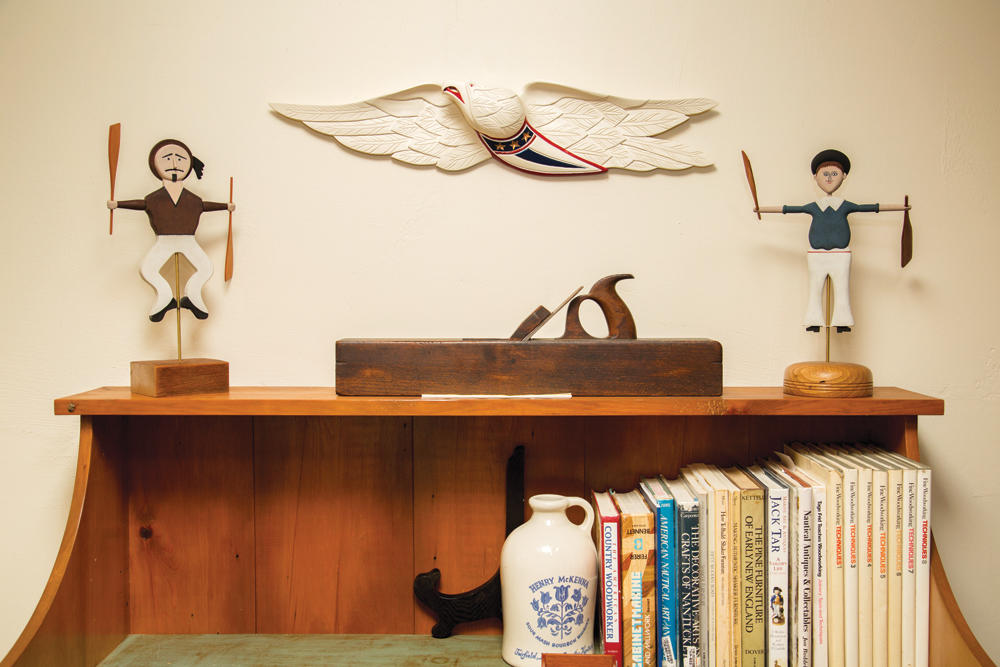
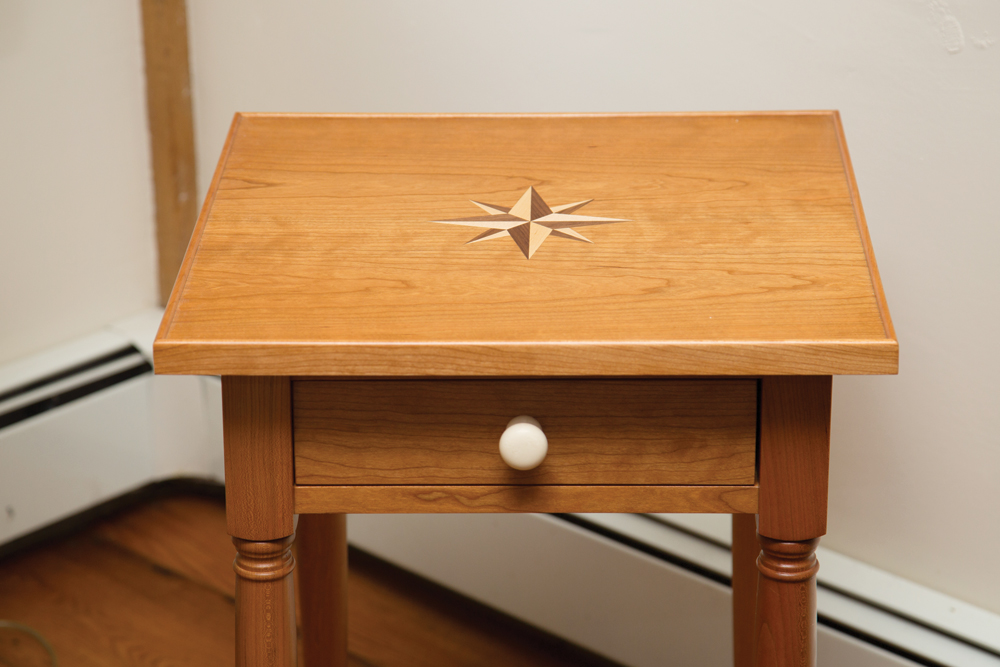
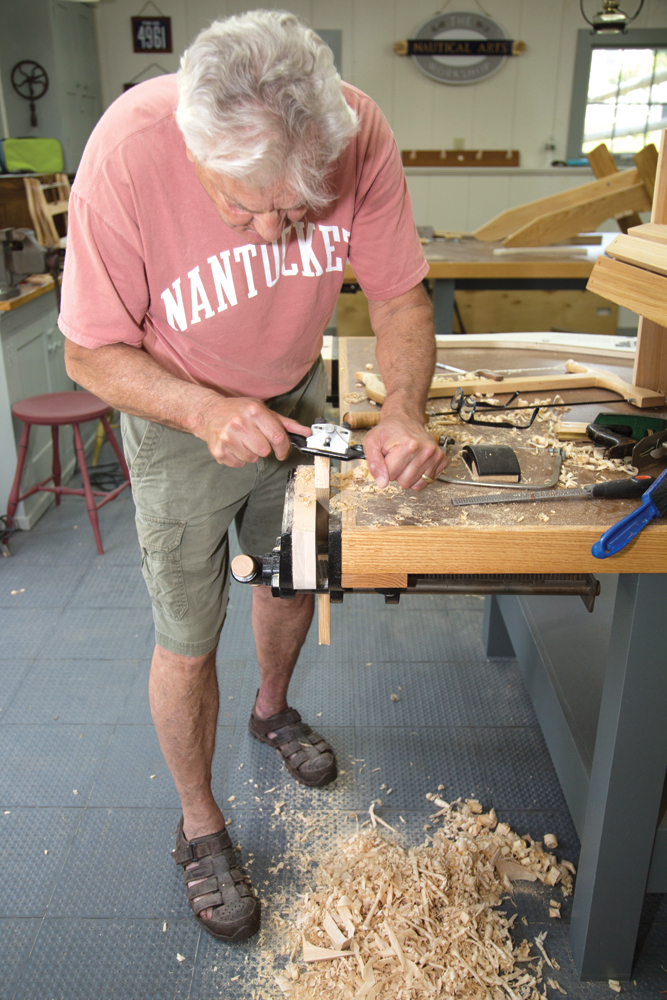
Keeping in mind the idea of one day having a nautical arts school, he designed and built a two-story barn and turned it into a studio with enough workstations for ten students and a variety of power and hand tools, many that were once owned by his father. He also transformed the living room of the Buckingham House into a showroom to display the projects the students can make, such as large and small sea chests, ditty boxes, half-hull models, name boards, "scrimshaw" hat and coat racks, a Sheraton style side table, Nantucket baskets, an Adirondack Chair, whirligigs, and others. The kitchen of the house is now used for communal meals, and there is an outdoor patio for relaxing and conversing in between classes.
Every project McKenna offers is steeped in maritime history with origins that date back to whaling, shipping, and sailing heritage. He has spent much time visiting places like The Mystic Seaport and The New Bedford Whaling Museum, researching and reading books on nautical antiques to understand how these arts evolved and the stories and skills behind them.
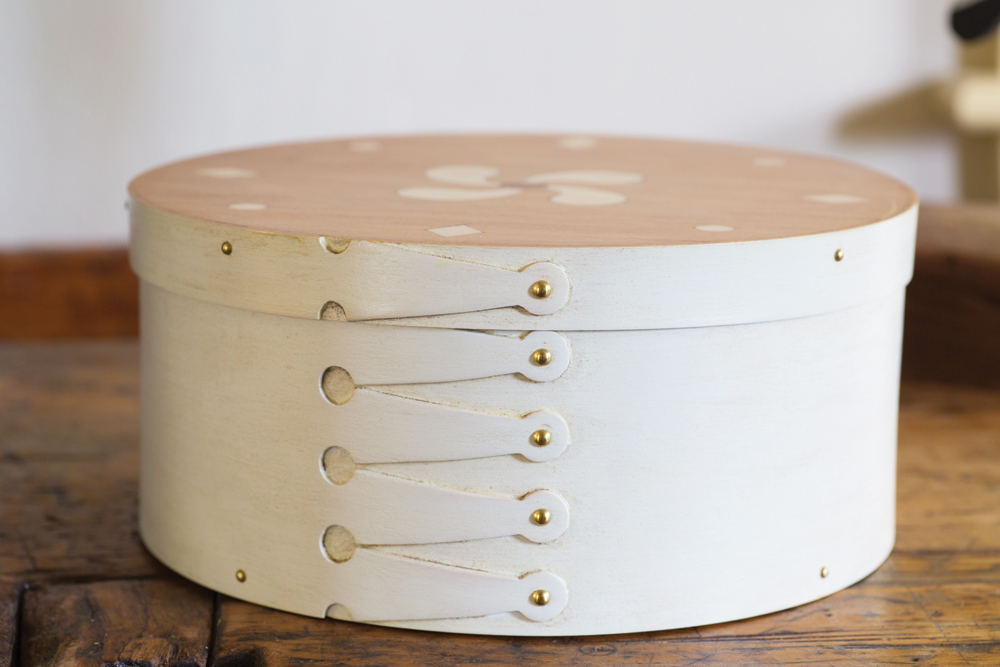
For example, there are several different designs of bentwood ditty boxes students can make using thin hardwood strips that are steamed and bent around an oval or round mold and then inlaid with abalone, mother of pearl, or "applied" ivory derived from acrylic. These containers, similar to Shaker boxes, were "inspired by the sailor-made ditty boxes of the early nineteenth century" and originally used whalebone for the decorative touches.
"A ditty box is a small box every sailor made to accommodate their personal belongings. They were used to hold cherished possessions and practical items such as needles, thread, and soap. Ditty boxes are as varied as the men who made them. They can be round or square and often employed symbols such as diamond shapes, stars, initials, or names," explains McKenna.
Other boxes are a 19th century reproduction of a rectangular shaped ditty box and a Christening Box, both made from mahogany, with dovetail joints and a solid brass lock. "Historically, the Christening Box, or as it is more commonly known, the Presentation Box, was used to house the bottle of wine or champagne that was used in the ship christening-launching ceremony. After the ship slid down the ways, a box such as this would be presented to the sponsor of the craft. It would contain the broken bottle of spirits, ribbons, and other keepsakes. Tradition also has it that boxes with wine or champagne intact would be presented to other members who were integral in the ships launching," McKenna says.
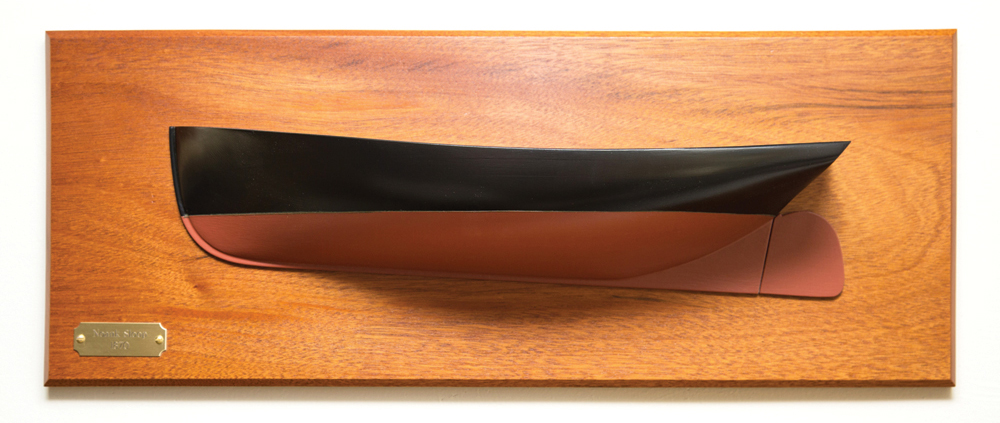
The half-hull model classes McKenna offers include a Noank Sloop, once used for dredging oysters, lobstering, and line fishing; a Connecticut River Shad Boat, popular for catching shad on the river and shoreline; and a New Haven Sharpie, utilized in the oyster industry. McKenna intentionally selected vessels native to this area to replicate.
"From the time of the American Revolution until about 1850, the sailing ships of the United States were first designed entirely with half-hull models constructed by shipwrights as a means of planning the ship's design and sheer. This model was an exact scale replica of the ship's hull. From this model, the shipwright was able to enlarge the lines and build a full size symmetrical hull. Gradually it became the practice to draw ship plans first on paper, superseding the use of half-models except as a building aid. Today many boat owners will have a half-hull model carved after their boat has been built," McKenna explains.
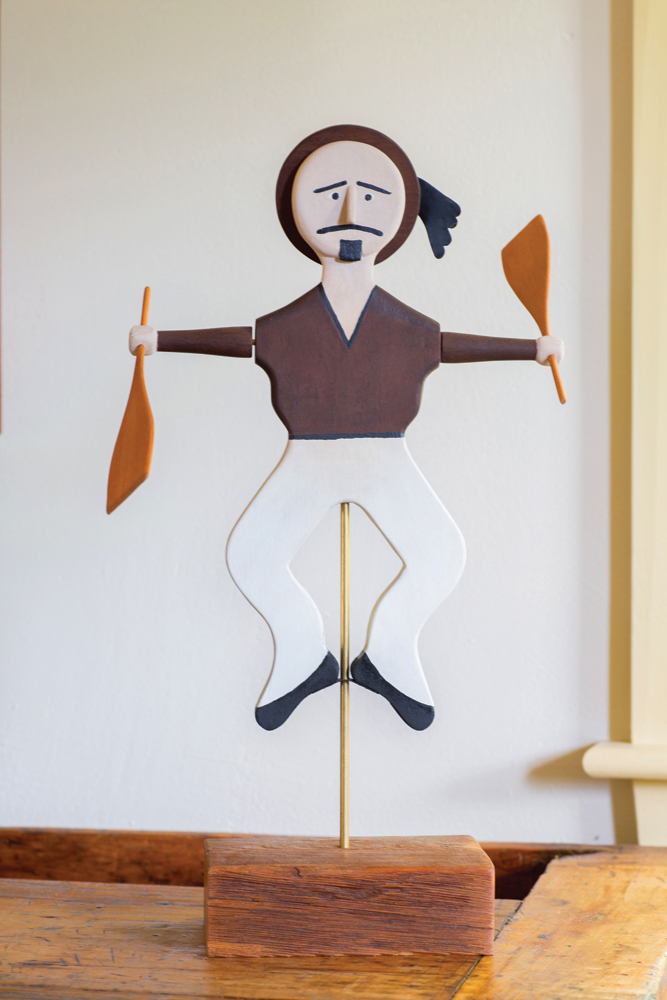
A variety of whimsical, folk art weathervanes and baskets originating from Nantucket are just some of the other objects interested students can craft. While whirligigs serve a practical purpose of betraying the wind's direction and are a common figure aloft many Nantucket edifices, these carved figures were also beloved as sculpture; the kind McKenna makes are representations of Charles F. Ray and William H. Chase designs.
McKenna is committed to teaching his students to produce everything from scratch. So instead of buying a pre-made handle for the Nantucket baskets, they learn the art of steam bending to fabricate one.
"We make our own base, the staves, the rim, and handle. My goal is to teach the whole process," he says.
The Nantucket Basket, also known as a "Lightship Basket," finds its roots in seventeenth and eighteenth centuries when Native American and white settlers fashioned them from wood for storage and carrying goods. When whaling ships returned home from the Pacific with a cargo of rattan, the islanders incorporated it into their weaving techniques.
"As maritime traffic increased, the demand for safer navigation became louder. The government commissioned lightships to mark coastlines and noted dangers. The first Nantucket lightship was built in 1853. To occupy their free time and to make extra money, sailors took basket-making materials on board. For the next fifty years lightships anchored off Nantucket. The year 1905 saw the end of service. It is from this era that the basket received the "Lightship Basket" moniker," McKenna notes.
McKenna offers weekend and weeklong classes from spring to early winter. The classes are open to people ages 18 and older, and all levels are welcome. In addition to the tangible objects students create using traditional hand tools, they also learn carving, furniture making, and steam bending – skills that can be applied to other pursuits such as building a toy chest for your children.
"I don't think anyone around is doing what I am doing at a center like this. I am trying to fill a niche. Part of my mission is to preserve these arts because they are fading away. I want a place people can come to learn these crafts to help keep them alive and to learn about our maritime history," says McKenna.