Tuesday, May 03, 2016

Historical society hopes 3rd time’s the charm for lighthouse plan The Westerly Sun

Historical society hopes 3rd time's the charm for lighthouse plan The Westerly Sun

Historical society hopes 3rd time's the charm for lighthouse plan

image
The Stonington Historical Society has proposed a new plan to bring the Old Lighthouse Museum into compliance with the Americans with Disabilities Act. Sun file photo

STONINGTON — The Stonington Historical Society has proposed an expansion of the Old Lighthouse Museum that would bring it into compliance with the Americans with Disabilities Act and allow handicapped access to the museum and program space.

The existing museum, is a nonconformity and is not permitted to expand under the current zoning regulations in the borough. According to the society's attorney, Mark Branse, the board of directors believe their inability to expand to accommodate those with disabilities is an unintentional effect of the zoning rules. They have applied to amend the regulations to allow a legal nonconforming use to expand for handicapped access by special use permit in the residential-1 zone.

The proposed 495-square-foot addition would include a handicapped-accessible bathroom, gift shop and ticketing area. Also included in the proposal is a rehabilitation segment to replace portions of the building that are damaged or showing signs of rot and water infiltration. The final portion of the project includes an upgrade to improve the climate control system.

"This will allow us to take better care of not only our artifacts and collections and ensure the long term preservation of this iconic structure, but also address the safety and well being of staff and visitors," Stonington Historical Society Executive Director Elizabeth Wood said. "In the planning process we also identified universal access as a worthy and estimable goal and one that would be made possible by adding a small addition to also allow access to the museum to those with limited mobility."

The original expansion proposal in 2013 was nearly double the size of the current proposal and included an addition off the back of the museum with two handicapped-accessible bathrooms. A second design was proposed in 2015, and although the addition was only 550 square feet with one handicapped-accessible bathroom, it still took a great deal of flak from residents. Both proposals, which were fairly modern and involved a glass pavilion, were shut down by locals who said it didn't fit the historical character of the village.

The current plan was specifically designed to maintain the appearance of the building as it was when it was built in 1840, Wood said.

Both Wood and project architect Conrad Ello of Oudens Ello Architecture, Boston, said they hope the new design will mitigate the concerns of members of the community who expressed worry when previous plans were proposed.

Wood said the primary goal is to preserve the lighthouse, which is showing signs of age after 176 years, and to allow access to more people. As an iconic structure, Wood said she knows the lighthouse is something local residents care a lot about and is hopeful the new project will be widely accepted as the best way to move forward and further preserve the property.

"When the project is fully realized, the Lighthouse will remain an iconic and treasured local landmark, but one accessible to those with disabilities as well," she said. "Our mission is to preserve, interpret, and celebrate the history of Stonington and what better way than commit significant resources to a preservation project that preserves and restores the infrastructure of a local landmark and provides physical and intellectual access to those with disabilities."

A public hearing is scheduled for Tuesday, May 10 at 7:30 p.m. at Borough Hall.

bwhite@thewesterlysun.com


~A den Tex

‘Voting Is Rigged & Used To Pacify The Public’ Says Three-Time US Presidential Candidate Ron Paul | Collective-Evolution

'Voting Is Rigged & Used To Pacify The Public' Says Three-Time US Presidential Candidate Ron Paul | Collective-Evolution

'Voting Is Rigged & Used To Pacify The Public' Says Three-Time US Presidential Candidate Ron Paul

"This is the way the system works, it's a rotten system, and I see elections as so much of a charade. So much deceit goes on. . . . whether it's a Republican or a Democrat president, the people who want to keep the status quo seems to have their finger in the pot and can control things. They just get so nervous so, if they have an independent thinker out there, whether it's Sanders, or Trump, or Ron Paul, they're going to be very desperate to try to change things. . . . More people are discovering that the system is all rigged, and that voting is just pacification for the voters and it really doesn't count."  

Above are the words of Dr. Ron Paul, three-time presidential candidate and a former member of the U.S. House of Representatives. Similar to Bernie Sanders, Dr. Paul attracted significant attention while he was in the running, appealing to the intellect of the masses and helping to   wake people up to the realities of the U.S. electoral system.

U.S. presidential elections are rigged. This is the truth that he, and Sanders, and so many others, hope to make clear. Voting only provides the illusion of democracy, it does not actually serve democracy. In the video below, Dr. Paul goes on to describe how the electoral process has become a giant charade, meant to entertain rather facilitate democracy. He also argues that who exactly is chosen for president is irrelevant, because corporate interests will always prevent them from effecting real change. In a  recent debate with Hilary Clinton, Bernie Sanders made the same arguments, saying that "no matter who is elected to be president, that person . . . will not be able to succeed because the power of corporate America, the power of Wall Street, (and) the power of campaign donors is so great that no president alone can stand up to them." (source)

It is an uncomfortable truth, as Bernie himself admits, but it is a reality we must face. And hearing this for the first time can be jarring, to be sure. We've been told that the world operates in a specific way, that we decide who our political leaders will be, but as with anything in life, it's important that we discover the truth for ourselves rather than trusting blindly the words of others. We have been programmed to believe everything we are told, and corporate media is not telling us the truth.

Dr. Paul and Bernie Sanders are not the only major political figures to speak out about this issue. Various presidents and politicians have been saying this for decades. For example, Theodore Roosevelt, the 26 President of the United States,  told the world that "behind the ostensible government sits enthroned an invisible government owing no allegiance and acknowledging no responsibility to the people." He also stated that "presidents are selected, not elected." Even the very first British MP, Benjamin Disraeli, warned us that "the world is governed by very different personages to what is imagined by those who are not behind the scenes."

Here is a very memorable quote from former New York City (1918-1925) Mayor John F. Hylan:

The real menace of our Republic is the invisible government, which like a giant octopus sprawls its slimy legs over our cities, states and nation . . .  The little coterie of powerful international bankers virtually run the United States government for their own selfish purposes. They practically control both parties . . . [and] control the majority of the newspapers and magazines in this country. They use the columns of these papers to club into submission or drive out of office public officials who refuse to do the bidding of the powerful corrupt cliques which compose the invisible government. It operates under cover of a self-created screen [and] seizes our executive officers, legislative bodies, schools, courts, newspapers and every agency created for the public protection. (source)(source)

Here is another great one from the 28th president of the United States, Woodrow Wilson, taken from his book The New Freedom:

Since I entered politics, I have chiefly had men's views confided to me privately. Some of the biggest men in the United State, in the field of commerce and manufacture, are afraid of somebody, are afraid of something. They know that there is a power somewhere so organized, so subtle, so watchful, so interlocked, so complete, so pervasive, that they had better not speak above their breath when they speak in condemnation of it. (source)

As you can see, the idea that the system is corrupt and ruled by outside influence is not a new one, but it is only recently that the general population has begun to see it for themselves.


"Democracy is popular because of the illusion of choice and participation it provides, but when you live in a society in which most people's knowledge of the world extends as far as sports, sitcoms, reality shows, and celebrity gossip, democracy because a very dangerous idea. Until people are properly educated and informed, instead of indoctrinated to be ignorant mindless consumers, democracy is nothing more than a clever tool used by the ruling class to subjugate the rest of of us."

– Gavin Nascimento.

Presidents now seem to be little more than figureheads, meant to capture the hearts and attention of the people while leaving corporations (controlled by the big banks) free to do as they will, polluting and destroying our planet in their endless quest for profit. Barack Obama was a big time celebrity, and there is no doubt in my mind that Hillary Clinton will be the same by taking on the role of "first female president." While this is obviously a commendable and much-needed step forward for gender quality, I think we need to take a step back and consider the bigger picture. We can't look to our political leaders for change, we have to look to ourselves, because our desires are not being represented or addressed in the political sphere. The ongoing GMO debate is just one example of this, but there are many.

If we want to change the things which matter the most — the degradation of the environment, the military industrial complex, poverty, among others — we can't keep looking to political 'leaders' like Obama or international organizations like the UN, all of whom give empty speeches, year after year, like they've always done, without taking real action. And nothing ever seems to get done.

Don't let them fool you any longer. Change will not come from them; it never has and it never will. Change can only come from you and from me, and the first step is awareness. See the circus for what it is and choose not to participate. If we keep looking to 'them' to provide the solutions we need to take care of our planet, we will continue down this road to destruction. It's how we got here in the first place.

I will leave you with these words from the late Carl Sagan, which neatly explain how it is we continue to be blinded by those in control: "One of the saddest lessons of history is this: If we've been bamboozled long enough, we tend to reject any evidence of the bamboozle. The bamboozle has captured us. Once you give a charlatan power over you, you almost never get it back."


And then there's....

'Wim Hof Method' Free Video Class

At Last, The health & physical performance secrets of multiple guinness world record holder Wim Hof AKA "The Iceman" are revealed for the first time"

In this course you will learn to do more pushups with a breathing technique, boost your immune system and increase your physical performance.

This will truly unlock your full physical potential.

Click Here


~A.

A little more JAR for the ears | the jewelry loupe

A little more JAR for the ears | the jewelry loupe

A little more JAR for the ears

JAR earclips of garnet, tourmaline, amethyst and diamond, 1995

When I spotted the thumbnails of these earclips on Christie's site, the maker wasn't visible in the title but I stopped scrolling and clicked to find out. Something spelled J.A.R. Maybe it was the subtle pear shape and unlikely combination of red and purple? Maybe it was the diamond accents jutting out like a six-point star.

Or maybe I'd just seen them before.

JAR earclips of garnet, tourmaline, amethyst and diamond, 1995Sure enough. Looks like Lily Safra's jewels have begun to circle back to the same auction block at Christie's Geneva where they were sold four years ago. Made for Safra in 1995, these went for $223,371 in 2012 – along with 17 other JAR jewels in her collection. Two weeks from now, they're estimated to fetch as much as $300,000.

And they don't even match! Though you have to look close to notice. One has a pear-shaped 24.53ct garnet, the other a 28.95ct tourmaline. Mismatching earrings is something JAR had begun to do routinely by the time he made these – but a quarter mil plus for a pair of mismatched earclips, made primarily of garnet, tourmaline and amethyst? Only JAR jewels.

Of course, that's partly because "semi-precious" and "non-precious" are meaningless labels with stones of the quality for which the self-taught, Bronx-born Joel Arthur Rosenthal is known.

As fortunes ebb and flow, and buyer's remorse sets in, expect to see more of the 18 JAR jewels Safra unloaded for charity. We saw this after the famous sale of actress Ellen Barkin's JAR jewels, the one that inspired the auction scene in the first Sex & the City movie – in particular, that classic pair of JAR earrings with oval-cut topaz and ruby accents.

Topaz in diamond surround with ruby accents by JAR (Christie's Images)

Topaz in diamond surround with ruby accents by JAR (Christie's Images)

Those got a good price the second time around – $650,500 – but not quite as good as they did at the much-hyped Barkin sale three years earlier.

Christie's ran that show, but Sotheby's had the JAR mother lode last year, including many amazing ear clips. Another pair designed around topaz, this time in the form of stylized feathers, sold in December at Sotheby's New York for $358,000.

JAR topaz and diamond earclips, 1987 (Sotheby's)

JAR earclips, 1987, with pear-shape topazes (20.99 carats) and diamonds in blackened silver/gold sold for $358,000 at Sotheby's NY in December 2015 (courtesy Sotheby's)

A month before, three more pairs of Rosenthal's ear clips sold at Sotheby's Geneva, all with classic JAR design signatures: "tweed" pavé, diamond accents, and bombé or spiral shapes.

JAR spinel and diamond earclips

JAR earclips of beryl, tourmaline and diamond (Sotheby's)

JAR sapphire diamond earclips

Three pairs of JAR earclips sold at Sotheby's Geneva on November 11, 2015 (photos courtesy Sotheby's)

Bombé-shaped sapphire and diamond clips got the best price at $584,000. Spirals of green beryls, green tourmalines, and diamonds sold for $274,000, and the pair with octagonal spinels and brownish diamonds went for $292,000.

On the crazier bagel end of the JAR spectrum, his "Sea Urchin" clock from 1999 sold for $75,000 (10x estimate) in the same sale. The clock was created from an actual sea urchin shell with a dial applied with sand and set with one single-cut diamond, the "interior weighted with cemented sand for placing the clock upright."

Screen Shot 2016-04-28 at 4.51.25 PM

Yes, timepieces are part of the JAR oeuvre. If you recall from the Met exhibit in 2013, JAR designed a series of watches in the eighties, and used them as prototypes for a lower-end line of $600 watches he designed for sale at the museum shop, in conjunction with the show.

Watches by JAR: Sienna watch of marble and gold, 1987; watch, of boxwood and platinum, 1980; Pebble watch of platinum, 1998 (private collections/photo by Cathleen McCarthy)

Watches by JAR: Sienna watch of marble and gold, 1987; watch of boxwood and platinum, 1980; Pebble watch of platinum, 1998 (private collections)

Also in Sotheby's December sale was a long necklace with links resembling a bicycle chain, designed to come apart to form two 16-inch and a 20-inch necklaces – unusually practical for Rosenthal – set with multi-colored sapphires and pearls. This necklace doesn't have the famous JAR pavé or blackened metal. In fact, it looks a bit Paloma Picasso to me, although the color combination and protruding accents were somewhat JAR-like.

Screen Shot 2016-04-28 at 5.08.45 PM
The necklace was estimated modestly, perhaps because it doesn't scream JAR, yet it sold for $193,750, more than double the high estimate.

Those earclips up for sale at Christie's this month do scream JAR. Expect a good price.

Photos courtesy Christie's and Sotheby's

Ahhhhhhhhhh........, such it is.    


~A.

As Americans bicker about gender-neutral toilets, three nuclear disasters are unfolding -- Society's Child -- Sott.net

As Americans bicker about gender-neutral toilets, three nuclear disasters are unfolding -- Society's Child -- Sott.net

As Americans bicker about gender-neutral toilets, three nuclear disasters are unfolding

As the debate over which bathroom an individual should use based on their sexual identity heats up, we are witnessing the ignorant and brash nature of state enforcement of these edicts come to a head.

It is not only a distraction and a means for the state to get involved in your bowel movements, but it paints the trans and gay community in a negative light by asserting there is some sexual stigma involved in relieving one's bladder.

The end result of such obstinate legalese clouding the minds of the public is going to be state violence initiated against individuals who have caused zero harm.

As individuals argue over how much government should be in the bathroom, nuclear environmental disasters are unfolding before our eyes. However, many Americans are too blinded by the blue glow of the television to notice.

According to a Missouri emergency plan recently distributed by St. Louis County officials, in recent months, a fire at the Bridgeton Landfill is closing in on a nuclear waste dump. The landfill fire has been burning for over five years, and they have been unable to contain it thus far.

There are clouds of smoke that have been billowing from the site, making the air in parts of St. Louis heavily polluted. In 2013, Missouri Attorney General Chris Koster sued Republic Services, the company responsible for the landfill, charging the company with neglecting the site and harming the local environment.

Last year, city officials became concerned that the fire may reach the nearby West Lake Landfill, which is littered with decades worth of nuclear waste from government projects and weapons manufacturing. Remnants from the Manhattan Project and the cold war have been stuffed there for generations. The site has been under the control of the Environmental Protection Agency (EPA) since 1990, but they have not made any significant effort to clean up the waste.


In December of last year, the EPA announced that it would install a physical barrier in an effort to isolate the nuclear waste. But the timeline given by the EPA said it could take up to a year to complete. Residents aren't comforted by that timetable, and think the government, despite years of warning, has done too little to stave off a possible environmental disaster. They are right.

To add to the legitimacy of the residents' worries were about the government's timeline, the ground has yet to be broken, the fire is still smoldering, and the EPA just finalized, on Thursday, an Administrative Settlement Agreement and Order on Consent (Settlement) requiring Bridgeton Landfill, LLC to start work on the isolation barrier system at the West Lake Landfill Superfund Site.

Aside from the threat of the U.S. Military's decades-old nuclear waste erupting into flames in the near future, there are also two nuclear reactors inside the United States, which have been leaking for months.

In Florida, a recent study commissioned by Miami-Dade County concluded that the area's four-decades-old nuclear power plants at Turkey Point are leaking polluted water into Biscayne Bay.

This has raised alarm among county officials and environmentalists that the plant, which sits on the coastline, is polluting the bay's surface waters and its fragile ecosystem, reports the NY Times. In the past two years, bay waters near the plant have had a large saltwater plume that is slowly moving toward wells several miles away that supply drinking water to millions of residents in Miami and the Florida Keys.

Samples taken during the study show everything from the deadly radioactive isotope, tritium, to elevated levels of salt, ammonia, and phosphorous. So far, according to the scientists conducting the study, the levels of tritium are too low to harm people. However, in December, and January, the levels were far higher than they should be in nearby ocean water which is a telling sign of a much larger underlying problem.

"We now know exactly where the pollution is coming from, and we have a tracer that shows it's in the national park," said Laura Reynolds, an environmental consultant who is working with the Tropical Audubon Society and the Southern Alliance for Clean Energy, which intend to file the lawsuit, according to the Times. "We are worried about the marine life there and the future of Biscayne Bay."

Fifteen hundred miles north of the leaking reactors in Florida is the Indian Point nuclear power plant in New York. Since the beginning of this year, there's been an uncontrollable radioactive flow from the Indian Point nuclear power plant continues leaking into groundwater, which leads to the Hudson River, raising the specter of a Fukushima-like disaster only 25 miles from New York City.

The Indian Point nuclear plant is located on the Hudson River and serves the electrical needs of an estimated 2 million people. In January, while preparing a reactor for refueling, workers accidentally spilled some contaminated water, containing the radioactive hydrogen isotope tritium, causing a massive radiation spike in groundwater monitoring wells, with one well's radioactivity increasing by as much as 65,000 percent.

The tritium leak is the ninth in just the past year, four of which were severe enough to shut down the reactors. But the most recent leak, however, according to an assessment by the New York Department of State as part of its Coastal Zone Management Assessment, contains a variety of radioactive elements such as strontium-90, cesium-137, cobalt-60, and nickel-63, and isn't limited to tritium contamination.

As the utility companies and government agencies continue to downplay the severity of these situations, the residents who live the closest to these spots are already feeling the effects.

According to a report by RT, Radiation and Public Health Project researchers compared the state and national cancer data from 1988-92 with three other five-year periods (1993-97, 1998-02, and 2003-07). The results, published in 2009, show the cancer rates going from 11 percent below the national average to 7 percent above in that timespan. Unexpected increases were detected in 19 out of 20 major types of cancer. Thyroid cancer registered the biggest increase, going from 13 percent below the national average to 51 percent above.

Sadly, it seems, government officials care more about locking people in cages for possessing arbitrary substances than they do about the potential for nuclear environmental disasters. As multiple Fukushima-like scenarios continue to unfold across the country, the media, who is largely beholden to the special interests behind these disasters, remain mum.

Instead of showing Americans the things that actually affect them, strawmen, red herrings, puppet politicians, and two-party talking points are shoved down our collective throats — and the majority of people are pacified. Until Americans change their preference for being lied to and stolen from, we can only expect more of the same.

Now, back to the toilet debacle.....
~A.

Monday, May 02, 2016

Beyond the drill - Reversing tooth decay | April 2016 (Vol. 27 Issue 1) | Magazine | What Doctors Don't Tell You

Beyond the drill - Reversing tooth decay | April 2016 (Vol. 27 Issue 1) | Magazine | What Doctors Don't Tell You

Beyond the drill - Reversing tooth decay

In a little known study in the 1920s, researchers at the Department of Pediatrics and Dentistry at the State University of Iowa treating children for diabetes discovered something untoward. Twenty-eight of the children, who'd had a number of dental cavities, saw their extensive active tooth decay come to a halt after they were put on a diabetic diet and treated with insulin. Low in sugar, the diet also included two pints of milk each day, cream, butter, eggs, cod liver oil, vegetables and fruit.1

Intrigued by these findings, the same researchers tried the diet on children in the hospital's orthopaedic ward. The group were fed the same low-sugar, high-dairy plus cod liver oil diabetic diet, but not insulin. Again, all of their dental caries were halted, as evidenced by the "stony hardness" of the dentine ('dentin' in the US) compared with its initially decaying state. The researchers noted "no advance in the destructive process".

Next, the researchers instructed the mothers of a group of preschool children with cavities to make sure the children got a teaspoon of cod liver oil, a quart of whole milk, an ounce of butter, a glass of orange or tomato juice and two or more servings of vegetables and fruit every day. Otherwise, they could eat whatever they wanted.Some children ate sweets, some were on high-carbohydrate diets and some on low-carbohydrate, high-fat diets. In some cases, they didn't even use a toothbrush. Yet all of the children's tooth decay arrested within 10 weeks.2

This study and the idea behind it—that dental cavities can be reversed—has been largely forgotten by the dental profession, whose approach to dental decay is to brandish a drill. In the UK, dentists drill and fit about 12 million metal amalgam fillings each year, to say nothing of the white fillings offered to small children and those willing to pay extra to avoid mercury. According to a British Dental Health Foundation survey, dental decay is the most common disease of UK children. More than four-fifths of the entire UK population has at least one filling; the average adult has seven.

But recently, the possibility of reversing tooth decay was resurrected after a team of Australian dental researchers published the results of their explosive seven-year study and follow-up: up to half of all tooth decay was reversible with the appropriate care, they concluded.

The researchers had split 902 patients from 22 private dental clinics into two groups: those having conventional "restorative" treatment (drilling and filling); and those following a routine of preventative oral care, including high-fluoride varnishes, attention to brushing, and restriction of snacks and sugary drinks. At the end of the study, those patients following the conservative route were between 30 and nearly 50 per cent less likely to need drilling and filling.3

Unnecessary treatment

As Associate Professor Wendell Evans of the University of Sydney, the study's lead author, concluded, fillings are "unnecessary" and "not required in many cases of dental decay". In his view, his team's research signals nothing less than "the need for a major shift in the way tooth decay is managed by dentists".

In the current paradigm, when a semi-annual checkup at the dentist reveals early tooth decay, it is generally a fait accompli that drilling around the affected spot and filling the hole will follow. Even if patients don't feel pain now, they are told that if they don't deal with the decay immediately, it will progress rapidly, damaging the tooth enamel first, then invading the dentine (the layer just under the enamel) to finally make its way to the innervated pulp, where it will cause lots of pain and the need for a root canal procedure or even eventually extraction of the tooth.

A little pain now or a lot of pain later is the deal—and to not treat at all may well be considered negligent. The idea of healing or reversing cavities is rarely discussed—it's as if teeth are inert rocks in our mouths rather than living tissues. What's done can't be undone.

But the University of Sydney study notes that, as far back as the 1960s, dental decay was described as a "dynamic" disease with various states of "arrest, progression and remineralization."4 Teeth are in a constant state of demineralization and remineralization, like skin being continually sloughed off and replaced—all without our needing to do a thing.

Watch and wait

The average tooth decay takes four to eight years to progress from the outer enamel layer to the inner layer, according to the Australian dentists. "That is plenty of time for the decay to be detected and treated before it becomes a cavity and requires a filling."

What's more, according to Evans, "50 years of research studies have shown that decay is not always progressive and develops more slowly than was previously believed". One recent study, for example, of 8,084 tooth surfaces from 543 "caries-active adults with substantial fluoride exposure" discovered that half the early lesions found were reversed within 33 months, with only 8 per cent progressing to cavities.5

The study concluded that drilling and filling is often unnecessary and "brings into question the ethics of continuing this practice".

This is a radical accusation coming from within mainstream dentistry. While 'overtreatment' is a well-known topic inside the profession, it is considered to apply only to "gross" situations, Evans told WDDTY. "Many dentists would claim that our approach is unprofessional and bordering on malpractice."

But Evans is not alone. David Albert, an associate professor of dentistry at Columbia University, told the website Colgate Professional in 2014 that early fillings of caries is not always a good thing, as it usually leads to a domino effect of drilling and filling.

"For some individuals at high risk for dental decay, it's good to find decay early and treat it early. But if you're in a low-risk group for dental decay, the treatment of choice is to apply fluorides in the dental office and at home to repair the tooth. In other words, don't drill.

"If I saw 100 patients [who had early decay and no cavities] and decided to wait six months before treating them, it would be the right decision for 95 of them," he added. "I think we do more harm by overtreating because there will always be complications of treatment."

Fillings can crack, break or fall out, for example, and the space between the filling and the tooth is a hot spot for further decay that could lead to root canal treatment or tooth loss.

Drilling weakens the tooth and may also threaten neighbouring teeth. A 2015 study from the University of Oslo found that, of 750 tooth surfaces in contact with new dental composite fillings, 61 per cent developed tooth decay within five years. The type of filling used made no difference to the increased risk of tooth decay.6

Not to mention that the material used for the fillings themselves may be hazardous. Amalgam fillings are at least 50 per cent mercury—a metal for which there are more than 10,000 published reports of toxicity. Mercury is a well-established neurotoxin, associated with diseases ranging from Alzheimer's to cancer and multiple sclerosis. Ccountries like Sweden, Norway and Denmark have even banned amalgam fillings altogether.

But the white composite resin fillings that are replacing them may contain hormone disruptors like bisphenol A (BPA). This component of plastics has been linked to infertility, altered brain development, cancer and cardiovascular disease.

Particularly in the case of children's painless cavities, the 'wait-and-see' approach seems to be gaining favour. In 2009, more than 50 practising dentists met at the University of Manchester to discuss the treatment of painless cavities in baby teeth and agreed that it seemed to only expose children to needless pain and suffering for teeth that would be lost by age 11 in any case. The NHS Health Technology Assessment Programme is currently running a trial throughout the UK to compare treatment options in such cases.7

For some critics outside of the dental profession, the suggestion that dental practices are not supported by evidence is hardly a revelation. Drilling and filling is driven not by research evidence, but by dentistry's third pillar—billing—according to Ramiel Nagel, author of the book Cure Tooth Decay (Golden Child Publishing, 2009). In the UK, dentistry is a £7 billion industry—a fraction of the £90.4 billion of the US dental industry, but still enormous.

"There isn't much incentive in the system for curing and preventing cavities," says Nagel.

Nagel started to look at tooth decay several years ago, when his young daughter's teeth began crumbling, and he himself had four cavities. Preferring natural remedies to fluoride, and loath to subject a toddler to the dentist's drill, he began to investigate other options.

He came across the works of dentist Weston Price who, in 1915, was the first research director of the National Dental Association (now the American Dental Association). In the 1930s, Price set out to study indigenous peoples across the globe to learn why their teeth and general health were now deteriorating rapidly.

His 1939 book, Nutrition and Physical Degeneration, is still popular today. It contains many remarkable photographs of the robust health and teeth of people on traditional diets, and those of people with rotten mouths and lots of degenerative diseases with the rapidly spreading modern diet of sugar and processed flour.

Modern dentistry acknowledges that increased sugar consumption is a key ingredient in dental caries because it promotes the growth of the Streptococcus variety of bacteria which produce acid that gradually eats away at teeth. Genetic factors are also increasingly implicated in the process as well.8

But even dental textbooks continue to acknowledge that the mechanism for reducing caries is still not "fully explained" by either the use of fluoride or restricting sugar intakes.9

Price recognized the perils of sugar, but he also noted that the various cavity-free indigenous peoples around the world, though they had widely different diets, all had one thing in common: a high level of fat-soluble vitamins (especially A, D, E and K).

"Dr Price found that modern people suffer from tooth decay because modern diets are severely lacking in fat-soluble vitamins," says Nagel. "To cure cavities, they simply need to add these vitamins back into their diets."

In his Cleveland, Ohio, clinic, Price successfully reversed many cavities, both in the enamel and the deeper layers of dentine, without using fluoride, but
just his nutrient-dense protocol.

Pre-World War II studies

Price's nutritional approach to preventing or reversing dental caries is also supported by other early research besides the Iowa study of diabetic children. Lady May Mellanby, a British dentist who studied thousands of children in pre-World War II London, was also convinced that diet is essential. In an early experiment in children, she observed that a high-cereal diet (and especially oatmeal) was associated with the greatest tooth decay.10

This result prompted her to investigate a cereal-free diet rich in vitamin D and calcium. This diet was given to 22 children who had a number of cavities for an average of 26 weeks. The results showed that the diet worked better than any other in preventing further decay and healing those teeth with cavities.10

Miraculous turnarounds

Ramiel Nagel put these and other findings to the test, and healed his daughter's and his own cavities. He claims to have been contacted by many people who've also reversed their caries or their children's too.

Mielle Chenier-Cowan Rose is one of them. Before her daughter Clara Rose was two years old, her teeth were in trouble. One of them was brown and mushy to the touch, and her other teeth were obviously decaying too. Her dentist recommended immediate surgery.

Mielle found Nagel's book on the internet and implemented every recommendation immediately. "Literally, in five days that one tooth had a miraculous turnaround," she says. "It was hard and had lightened. It had been brown. I just couldn't believe it."

That was five years ago and today, Clara Rose, now seven, has lost a few of her baby teeth naturally, but all of her dental checkups have been positive. Mielle says they've reintroduced some of Nagel's prohibited foods, such as high-phytic-acid beans and nuts and a few grains occasionally, but she is no longer 'casually vegetarian', a factor she believes contributed to her daughter's tooth decay.

Judene Benoit is a practising Canadian dentist and author of How to Stop Cavities: A Natural Approach to Prevention and Remineralization (self-published, 2015). "Absolutely remineralizing your teeth and cavities requires much more work and effort than having a filling," she says. "And remineralizing your teeth and cavities naturally [that is, without fluoride] requires even more work and effort."

Benoit says that choosing not to have fillings can be risky and should always be overseen by a dentist to ensure that the tooth is healing and the cavity is not progressing. But be aware: some cavities must be treated. Benoit has developed a chart to help determine how likely it is to be able to reverse dental caries in a given case (see box, right).

Nevertheless, everyone can benefit from remineralizing their teeth, whether they have cavities or not, she insists. Benoit hears stories of other unintended benefits in children with her approach: it cleared up allergies and acne, improved energy, normalized weight, improved school performance, led to better sleep and made rashes disappear.

All this is more evidence of what Weston Price intuitively understood:
the mouth is a unique window into the state of your health.

Price's protocol

Dr Weston Price was the first research director of the National Dental Association (now the American Dental Association)

¼ tsp fermented cod liver oil + ¼ tsp high-vitamin butter oil (from the milk of grass-fed cattle)

Suggested daily dose: 1–1½ tsp/day (taken in two to three doses)

Foods to avoid:

White-flour products

Skimmed-milk products

Sugar and other sweeteners

Foods to include:

2 cups or more of raw grass-fed milk daily

Bone and vegetable broths

Bone marrow

Beef and fish stews

Seafood

Organ meats

Fine cuts of red meat

Tomato or orange juice (rich in vitamin C and antioxidants)

Lots of green vegetables

Cooked fruit

Some whole grains (although Nagel advises against grains like oatmeal, which are high in phytic acid, which can deplete critical minerals)

Benoit's Remineralizing Likeliness Chart

Remineralizing teeth, while possible, is still a challenge that requires significant changes to diet that may impact lifestyle. Dentist Judene Benoit has seen patients cry for joy when they've hardened a cavity and staved off the drill, but also some who've worked hard, yet decay has progressed. She devised the following chart to assess the odds of a tooth remineralizing before it needs drilling and filling, but she urges people not to self-assess themselves, as it's a skill that requires extensive training and isn't always obvious: sinister-looking cavities can be harmless, and harmless-looking ones can be a potential disaster. A dentist can help assess the risks of waiting to treat while attempting to remineralize based on the location and extent of the decay, and how fast it is progressing.

The chart assesses your tooth by adding up the points: easiest to remineralize = 2 points; challenging = 3–6 points; highly unlikely = 7+ points. Minus 2 means subtract two points from the total score, and a zero point is neutral. But Benoit maintains that whatever the odds of remineralizing an existing cavity, changing the conditions in the mouth to prevent future cavities is always a good idea.
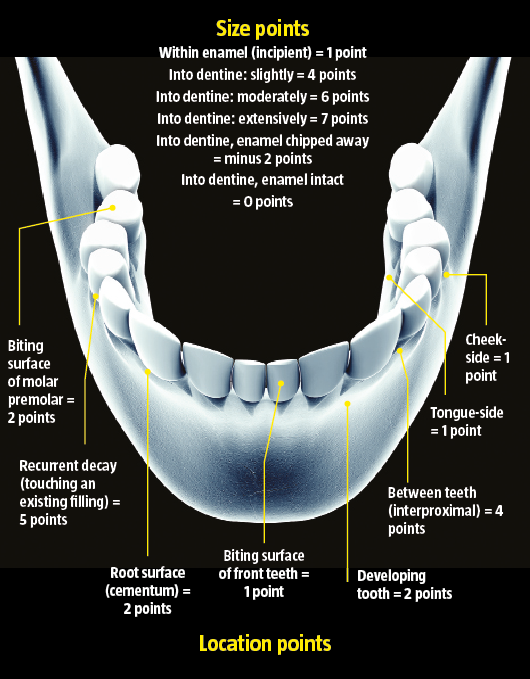
Healing your cavities naturally

Besides increasing nutrient-dense foods and cutting out grains, especially oatmeal, from your diet, here are a few other cavity-healing remedies to try.

Coconut oil 'pulling'

Many people recommend taking a tablespoon or so of coconut oil and swishing it around the mouth, pushing and pulling it between the teeth. It's an ancient Ayurvedic technique that is claimed to have a detoxifying effect, but some think it may remove plaque associated with dental caries too. A recommended oil-pull should last 15 to 20 minutes, and the swishing-about seems to also have a tooth-whitening effect.

In 2015, a group of 60 teenagers with plaque-induced gingivitis were asked to swish coconut oil each morning for 30 days in addition to brushing their teeth. After seven days, plaque and gingivitis markers began to noticeably decrease significantly and continued to drop throughout the rest of the trial.1

Grape seed extract (instead of fluoride varnish)

Many dentists like to treat cavities with a fluoride varnish, but this has been linked to neurotoxicity in adults and, at low levels, impaired brain development in children.2

Alternatively, grape seed extract, inexpensively available in liquid or powder form, has been demonstrated to be even more effective at remineralizing human teeth in the lab than fluoride,3 or two other remineralizing agents commonly used in toothpaste.4

Cinnamon and clove oil

Applying clove oil to a sore tooth is an old traditional remedy that, in a 2011 study, significantly inhibited the growth of Streptococcus mutans, the bacteria associated with cavity formation.5 In another study, cinnamon oil beat clove oil at combatting cavity-causing mouth bacteria.6

Try adding a few drops of cinnamon or clove oil to a homemade baking soda (bicarbonate of soda) mouthwash:

1 cup (250 mL) tap water

¼ tsp (1 mL) baking soda

Stir the baking soda in the water until it dissolves, then pour the mouthwash into a bottle and close the lid. This mouthwash can only be used for 24 hours; after that, throw it away and make a fresh batch.

Altering your oral pH

The acidity of our mouths is changing all the time—when we're sleeping, after we eat or drink, when we mouth-breathe, if we're dehydrated, when we're stressed, even when we're hungry. Tooth cavity formation requires acidic conditions, as acid dissolves enamel and dentine.

Dentist Judene Benoit recommends that patients start testing their pH throughout the day—several times at first, to get an idea of what conditions are contributing to oral acidity. pH strips are not expensive and come with a colour-coded chart to show where your mouth saliva is on the scale between acid and alkaline (this runs from 0 to 14). You simply spit into a cup or let saliva pool in your mouth, dip the test strip into the saliva and immediately compare it against the colour chart to get a reading. (Don't wait or you'll get a false reading.)

A pH of 7 is neutral, neither acid nor alkaline—and where you want to be. A number higher than 7 is alkaline, and a number lower than 7 is acidic. A saliva pH of 5.5 is the 'critical pH' for cavity formation, Benoit says. "If you or your child see a pH score of 5.5, you should treat it like a mini-emergency and take action to raise mouth pH immediately."

But higher acidic numbers like 6.5 aren't ideal either. Your mouth should be neutral or very slightly alkaline. If you find your mouth is acidic after drinking numerous cups of coffee all day, stop sipping it all day! If it's mildly acidic after eating, take the following steps to alkalinize it:

1) Consume green drinks, smoothies and vegetables containing Chlorella algae, eat a salad, or add a few drops of liquid Chlorella to water.

2) Swish Milk of Magnesia like a mouthwash and spit it out.

3) Mix 1 tsp of sea salt and 1 tsp of baking soda in a cup of water, swish it like a mouthwash, then spit it out.


~A.