Saturday, March 11, 2023

US tax credits for low carbon aviation fuel need longer life, companies say

Aviation biofuel would need half of UK agricultural land, report says | The Independent

Aviation biofuel would need half of UK agricultural land, report says | The Independent

Aviation biofuel would need half of UK agricultural land, report says

The Royal Society said a portfolio of alternative fuels will be required to meet current passenger demand and achieve net zero.

The authors of the report said there is no single, clear alternative to kerosene (John Walton/PA)

The authors of the report said there is no single, clear alternative to kerosene (John Walton/PA)

(PA Archive)

Sign up to the Independent Climate email for the latest advice on saving the planet

Replacing jet fuel with biomass would require the UK to give up 50% of its agricultural land to sustain current passenger levels, according to a new report from the Royal Society.

In examining how the aviation industry can reach net zero, the authors said there is no single, clear alternative to kerosene, with biomass requiring huge tracts of land and other options, such as hydrogen, ammonia and synthetic fuels requiring a massive increase in renewable energy production.

The Government is relying on the development of alternative fuels to continue growth in aviation and to allow passengers to enjoy "guilt-free travel".

In its Jet Zero Strategy published last year it said it wants five "sustainable aviation fuel" plants under construction by 2025.

The elephant in the room here is, of course, the need to fly less

Cait Hewitt, Aviation Environment Federation

Figures taken pre-pandemic show UK aviation consumes 12.3 million tonnes of jet fuel and produces 8% of the UK's greenhouse gas emissions, with the lack of alternative options making it one of the hardest industries to decarbonise.

Producing enough green hydrogen – which is created by splitting water molecules into oxygen and hydrogen with renewably-generated electricity – would require more than doubling or tripling the UK's renewable capacity.

It would also mean the development of new aircraft and airport infrastructure to store and transport fuel as well as new training and safety regimes.

Professor Graham Hutchings, chair of the report's working group, said: "The requirements for an alternative to jet fuel, to kerosene, is energy density, has to be sufficient to sustain short and long haul flights, it must be produced globally at scale, it must be cost-competitive and it must be implementable by 2050."

Using ammonia, which is made using hydrogen, would also require around a tripling of renewable energy capacity and a substantial retrofit of aircraft to accommodate it.

Other forms of fuel which use captured carbon to produce synthetic or electrofuels could be used in existing aircraft engines but would need five to eight times the renewable capacity.

Professor Marcelle McManus of the University of Bath said: "With all of these fuels we need to have new supply chains, new resources and at the scale we need, this is not going to come without difficulties.

"How and where they're produced will have significant impacts on their impact and their cost."

She also said that many biofuel sources would not meet the EU's target for sustainable energy sources – called RED II – because of their production emissions.

The Royal Society authors identified rapeseed, fast-growing poplar trees and miscanthus as energy-providing crops, but because of the amount of land needed, they said, there has been a growing interest in using biowaste such as used cooking oil.

They said the UK is "highly reliant" on importing raw material for biofuel, known as feedstocks, with 423 million litres of used cooking oil imported from China alone in 2021.

Converting waste from the 250 million litres of vegetable oil produced in the UK would produce only 0.3 to 0.6% of the UK's annual jet fuel needs.

A spokesperson from the Department for Transport said: "The UK's Sustainable Aviation Fuels programme is one of the most comprehensive in the world.

"Our Jet Zero Strategy sets out how we can achieve net zero emissions from UK aviation by 2050, without directly limiting demand for aviation. Sustainable aviation fuels and hydrogen are key elements of this, and we will ensure that there is no impact on food crops."

A spokesperson for Airlines UK, the industry's trade body, added: "There is no magic bullet, but by modernising airspace to make flying more efficient, by introducing new zero-emission technology like hydrogen aircraft and by upscaling the use of sustainable aviation fuels this decade, it can be achieved.

"Critically, the UK does have sufficient feedstocks for sustainable fuels, which would be drawn initially from household, commercial, agricultural and forestry waste and waste industrial gases – and do not compete with food crops."

The report also said that replacing kerosene may not completely stop planes from warming the Earth's climate.

Contrails, which are caused by water vapour freezing on soot particles from a plane's engine, can sometimes spread into cirrus clouds and then warm the atmosphere by trapping infrared radiation.

It is thought that up to two-thirds of the climate-warming effect from aviation comes from non-CO2 sources like contrails, though there is a wide degree of uncertainty about this.

Cait Hewitt, policy director at Aviation Environment Federation, which campaigns on aviation's environmental impacts, said: "The elephant in the room here is of, course, the need to fly less.

"One area that would really benefit now from some Government-funded research is how to deliver better standards of living, continued connectivity for businesses, and sustainable employment for the aviation workforce without the continued growth of flying.

"Tax cuts for domestic tourism and leisure and promotion of alternatives to in-person business flights would be good places to start."

The Climate Change Committee, which advises the Government on how to reach net zero, said in its sixth carbon budget that passenger demand should not rise more than 25% by 2050 from its pre-pandemic levels.

At its current rate, demand is expected to grow by 65% without any further airport expansions, though Bristol Airport was recently granted permission in the High Court to expand and five others have similar plans.


~A.

To fly or …….?

Please Read!……— Beautiful Trouble. ;-\…….

The NGO-ization of resistance — Beautiful Trouble

The NGO-ization of resistance

When frontline organizers spend more time writing grant reports than changing the system, something is wrong. People most impacted by injustice, not those working for big non-profits, should drive the movement.

A hazard facing mass movements is the NGO-ization of resistance. It will be easy to twist what I'm about to say into an indictment of all NGOs. That would be a falsehood. In the murky waters of fake NGOs set up to siphon off grant money or as tax dodges (in states like Bihar, they are given as dowry), of course there are NGOs doing valuable work. But it's important to turn our attention away from the positive work being done by some individual NGOs, and consider the NGO phenomenon in a broader political context.

In India, for instance, the funded NGO boom began in the late 1980s and 1990s. It coincided with the opening of India's markets to neoliberalism (see: THEORY: Neoliberalism). At the time, the Indian state, in keeping with the requirements of structural adjustment, was withdrawing funding from rural development, agriculture, energy, transport, and public health. As the state abdicated its traditional role, NGOs moved in to work in these very areas. The difference, of course, is that the funds available to them are a minuscule fraction of the actual cut in public spending. Most large well-funded NGOs are financed and patronized by aid and development agencies, which are in turn funded by Western governments, the World Bank, the UN, and some multinational corporations. Though they may not be the very same agencies, they are certainly part of the same loose, political formation that oversees the neoliberal project and demands the slash in government spending in the first place.

The greater the devastation caused by neoliberalism, the greater the outbreak of NGOs.

Why should these agencies fund NGOs? Could it be just old-fashioned missionary zeal? Guilt? It's a little more than that.

NGOs give the impression that they are filling the vacuum created by a retreating state. And they are, but in a materially inconsequential way. Their real contribution is that they defuse political anger and dole out as aid or benevolence what people ought to have by right. They alter the public psyche. They turn people into dependent victims and blunt the edges of political resistance. NGOs form a sort of buffer between the sarkar and public. Between Empire and its subjects. They have become the arbitrators, the interpreters, the facilitators of the discourse. They play out the role of the "reasonable man" in an unfair, unreasonable war.

In the long run, NGOs are accountable to their funders, not to the people they work among. They're what botanists would call an indicator species. It's almost as though the greater the devastation caused by neoliberalism, the greater the outbreak of NGOs. Nothing illustrates this more poignantly than the phenomenon of the US preparing to invade a country and simultaneously readying NGOs to go in and clean up the devastation.

In order to make sure their funding is not jeopardized and that the governments of the countries they work in will allow them to function, NGOs have to present their work — whether it's in a country devastated by war, poverty, or an epidemic of disease — within a shallow framework more or less shorn of a political or historical context. At any rate, an inconvenient historical or political context. It's not for nothing that the "NGO perspective" is becoming increasingly respected.

Apolitical (and therefore, actually, extremely political) distress reports from poor countries and war zones eventually make the (dark) people of those (dark) countries seem like pathological victims. Another malnourished Indian, another starving Ethiopian, another Afghan refugee camp, another maimed Sudanese . . . in need of the white man's help (see: THEORY: Poverty). They unwittingly reinforce racist stereotypes and reaffirm the achievements, the comforts, and the compassion (the tough love) of Western civilization, minus the guilt of the history of genocide, colonialism, and slavery. They're the secular missionaries of the modern world.

Eventually — on a smaller scale, but more insidiously — the capital available to NGOs plays the same role in alternative politics as the speculative capital that flows in and out of the economies of poor countries. It begins to dictate the agenda.

It turns confrontation into negotiation. It de-politicizes resistance. It interferes with local peoples' movements that have traditionally been self-reliant. NGOs have funds that can employ local people who might otherwise be activists in resistance movements, but now can feel they are doing some immediate, creative good (and earning a living while they're at it). Charity offers instant gratification to the giver, as well as the receiver, but its side effects can be dangerous. Real political resistance offers no such short cuts.

The NGO-ization of politics threatens to turn resistance into a well-mannered, reasonable, salaried, 9-to-5 job. With a few perks thrown in.

Real resistance has real consequences. And no salary.

Excerpted from Arundhati Roy, The End of Imagination (Chicago: Haymarket Books, 2016), by permission of Haymarket Books.


~A.

Colorado Seeking Annual Mental Health Check for Children in School

Colorado Seeking Annual Mental Health Check for Children in School
Danger, Will Robinson…., Danger!

Colorado Seeking Annual Mental Health Check for Children in School

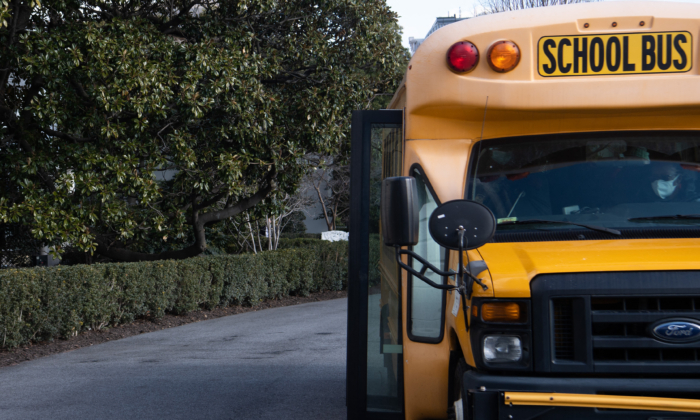
A school bus in a file photo. A bill introduced in Colorado would pave the way for schools to conduct annual mental health check for students. (SAUL LOEB/AFP via Getty Images)

A new bill passing through the Colorado legislature would create an annual mental health assessment program for sixth through twelfth-graders. Proponents hope it will help identify and address student mental health concerns early.

"By promoting early intervention among youth in schools who need behavioral health services and supports, our state can continue to make progress in achieving better behavioral health outcomes for young people," Wivine Ngongo, president of the Colorado Public Health Association, testified at a recent hearing on the bill.

The bill allows parents to opt their child out of the assessments; however, children aged 12 and older can override their parents and opt back in, without the parents' knowledge. Critics say it contravenes existing Colorado law and undermines parental rights.

"Nurses at schools aren't allowed to give children ibuprofen for headaches, yet we should allow mental health assessments to take place on school grounds, and even without parental consent?" testified Samantha Wild, vice-chair of Moms for Liberty El Paso County.

The bill, House Bill 23-1003, was introduced to Colorado's General Assembly on Jan. 9 by state Rep. Dafna Michaelson Jenet and Sen. Lisa Cutter, both democrats. It has passed through one committee and is now under consideration by the Appropriations Committee.

Addressing Mental Health

Nearly 40 percent of Colorado high school students said they felt "sad or hopeless," and 7 percent of youth have attempted suicide, according to a Healthy Kids Colorado report released in Sep. 2022 by Colorado Behavior Health Administration (BHA).

"The COVID-19 pandemic triggered a surge in behavioral health concerns nationwide resulting from social isolation, essential worker burnout, mass loss of life, disruption to standard mental health services, loss of traditional support services and systems such as those available through schools, restricted access to in-person assistance, and more," the report stated.

Epoch Times Photo
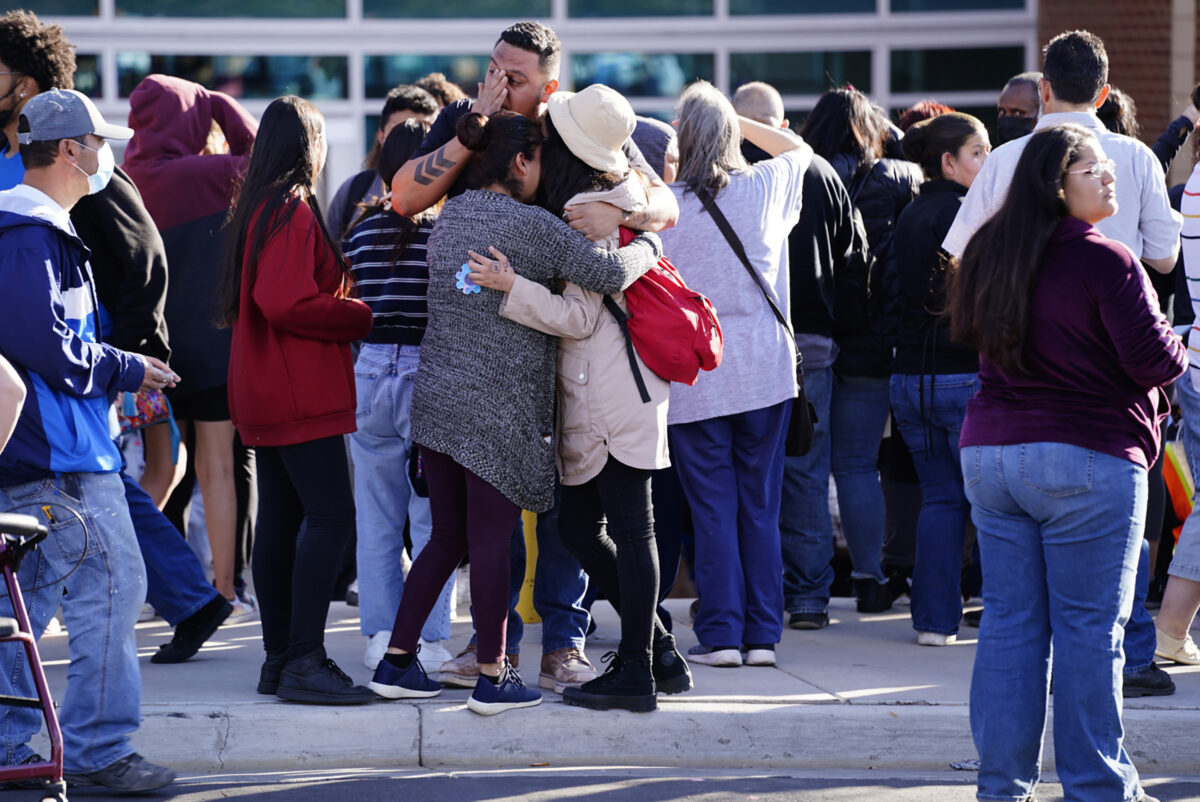
Edgar James, front center, battles with tears as he hugs his daughter, Mia, front right, and his wife, Olga Aguirre, front left, as they are reunited outside Hinkley High School in Aurora, Colo., on Nov. 19, 2021. (Philip B. Poston/Sentinel Colorado via AP)

Colorado had the 7th highest "suicide-associated death rate" in the nation in 2020, the report said.

"The BHA recognizes that access and availability to mental health providers is a barrier to young people getting the care they need," BHA stated in an email to The Epoch Times.

It added that through a 2021 bill, Colorado had invested $9 million of federal stimulus funding for programs and training to help address the rising mental health crisis in Colorado.

In the same year, other bills established a mental health rapid response program for youth called IMATTER, a program managed by BHA that allows Colorado youth up to six free therapy sessions with a participating licensed therapist.

But, the ability to identify youth who are struggling with a possible mental health crisis remained a concern, which is addressed by HB23-1003, some lawmakers say.

School Mental Health Assessment

If passed, HB 23-1003 will allow schools to decide if they want grades six through 12 to participate in the yearly mental health screening, defined as a "brief, structured, questionnaire completed by a participating student."

The questionnaire would be administered by a "screener," a term the bill defines as "the entity selected by the department pursuant to this part to conduct the mental health assessment," referring to the Department of Public Health and Environment.

Upon review, if the screener thinks the student "may be suffering from a mental or emotional health concern … the screener shall notify the student's parent within forty-eight hours … and provide the student's parents with information on resources and services provided through IMATTER."

But, a provision in the bill allows for a student to be referred to IMATTER directly, without the parents' knowledge or consent, if the parent has already opted their child out of the screening, but the child opted back in.

Support For and Against

Ngongo, who provided testimony in support of the bill in front of the House Committee on Public and Behavioral Health and Human Services on Feb. 7, said , HB23-1003 has "the potential to increase the proportion of children with mental health challenges who get access to treatment."

She added that it aligns with federal public health priorities through Healthy People 2030.

Wild, who testified against the bill, said, "Passing this bill takes away parental rights. Parental rights are fundamental rights and are not limited to education, medical care, and moral upbringing.

"Children aged 12-18 do not have fully developed brains to consent to what is going on with their own medical care, and mental health assessments is a form of medical care. Education and Medical Care should never mix."

Angela Kimball, the senior vice president of advocacy and public policy for Inseparable.Us, said half of all mental health conditions begin by age 14, and 75 percent begin by age 24.

"Like many other health conditions, when signs and symptoms are identified early and addressed appropriately, it's possible to get young lives back on track," Kimball said.

"An assessment is not a diagnosis but an opportunity to spot students who may be at risk."

Los Angeles school buses
School buses line up in Los Angeles on Aug. 30, 2021. (Mike Blake/Reuters)

An LGBTQ+ advocacy network, Envision: You, added its support for the bill. "LGBTQ+ youth in Colorado are at greater risk of mental health concerns than their heterosexual and cisgender counterparts and often experience disparities in accessing mental services as well," the group stated.

"House Bill 23-1003 would allow initial access to mental health assessment services for LGBTQ+ youth that they may not otherwise receive."

Colorado educator and parent, Diana Bara, hit back against the bill, "It not only undermines the relationship between parents and teachers, it also violates a parent's right to be consulted about the welfare of a minor child, per Colorado law. This bill puts that right into the hands of strangers and the government who do not know what is best for our children."

Bara said HB23-1003 contravenes existing Colorado laws, 2-4-401(6)) and (19-4- 103, and the government or school administrators don't have the right to "obstruct" parental obligation.

"The first defines a minor as a person who has not attained the age of 21. It states that parents are liable for their child's action until they reach the age of majority. This includes decisions about his or her body and mental health," she said.

"The second law defines a 'parent and child relationship' as a legal relationship existing between a child and his/her natural or adoptive parents. Within this relationship, there are rights, privileges, duties, and obligations specified by law. Parents have the legal right to be consulted about their child's mental health."

Carolyn Martin, director of government relations for Christian Home Educators of Colorado told The Epoch Times that she opposes HB23-1003 because, "The fundamental right of parents to direct the upbringing, education, and care of their children is the cornerstone of home education freedom.

"Every time this fundamental right is infringed, it threatens a parent's right to educate their children outside the government school system. HB23-1003 builds upon the state of Colorado's intrusion into the family by giving children the ability to circumvent a decision made by their parents who know them best."

The House Committee on Public and Behavioral Health and Human Services passed the motion on Feb. 7, in a 7–4 vote.

Representatives Amabile, English, Gonzales-Gutierez, Jodeh, Story, Young, and Michelson Jenet—all Democrats—voted for the bill, while Republican Representatives Bradfield, Bradley, and Holtof, were joined by Democratic Rep. Hamrick in opposition.

The bill has moved to the Appropriations Committee.


~A.

Friday, March 10, 2023

News from The Day

This SUCKS


whadda crappy newspaper, soooooooooo Biased. 
BLUE
BLUE
BLUE
BLUEBLUEBLUEBLUE
BLUE
BLUE
BLUE
BLUEBLUEBLUE
BLUE
BLUE
BLUE
BLUE
BLUE………….


Begin forwarded message:

From: "The Day" <marketing@theday.com>
Subject: Events and Entertainment News from The Day
Date: March 9, 2023 at 2:38:32 PM EST
To: "ADRIENE DENTEX" <adtmarin@aol.com>

March 9, 2023

It's arguable that the most entertaining stuff in recent editions of The Day isn't in our hallowed Daybreak or Night & Day arts and features sections – even though we continue (he writes modestly) to turn out fine stuff. No, if you want to be entertained, read the online comments from those readers who, despite the grotesque revelations about seven-plus years of blatant lies from the Fox "news" weasels, continue to lap up the offal relentlessly regurgitated by those folks.

In terms of literal arts coverage, though, well, we've done it again. Another fun week! In case you missed anything:


Wednesday, March 08, 2023