Friday, April 09, 2021

Masks Are a Ticking Time Bomb

Masks Are a Ticking Time Bomb

Why Disposable Masks May Be Even Worse Than Plastic Bottles

The planet may be facing a new plastic crisis, similar to the one brought on by bottled water, but this time involving discarded face masks. "Mass masking" continues to be recommended by most public health groups during the COVID-19 pandemic, despite research showing masks do not significantly reduce the incidence of infection.1

As a result, it's estimated that 129 billion face masks are used worldwide each month, which works out to about 3 million masks a minute. Most of these are the disposable variety, made from plastic microfibers.2

Ranging in size from five millimeters (mm) to microscopic lengths, microplastics, which include microfibers, are being ingested by fish, plankton and other marine life, as well as the creatures on land that consume them (including humans3).

More than 300 million tons of plastic are produced globally annually — and that was before mask-wearing became a daily habit. Most of it ends up as waste in the environment, leading researchers from the University of Southern Denmark and Princeton University to warn that masks could quickly become "the next plastic problem."4

The bottled water crisis is now well-known as a leading source of environmental plastic pollution, but it's slated to be outpaced by a new mask crisis. While about 25% of plastic bottles are recycled, "there is no official guidance on mask recycle, making it more likely to be disposed of as solid waste," the researchers stated. "With increasing reports on inappropriate disposal of masks, it is urgent to recognize this potential environmental threat."5

Not only are masks not being recycled, but their materials make them likely to persist and accumulate in the environment. Most disposable face masks contain three layers — a polyester outer layer, a polypropylene or polystyrene middle layer and an inner layer made of absorbent material such as cotton.

Polypropylene is already one of the most problematic plastics, as it's widely produced and responsible for large waste accumulation in the environment, as well as being a known asthma trigger.6 Further, the researchers noted:7

"Once in the environment, the mask is subjected to solar radiation and heat, but the degradation of polypropylene is retarded due to its high hydrophobicity, high molecular weight, lacking an active functional group, and continuous chain of repetitive methylene units. These recalcitrant properties lead to the persistence and accumulation in the environment."

They also stated that when the masks become weathered in the environment, they can generate a large number of microsized polypropylene particles in a matter of weeks, then break down further into nanoplastics that are less than 1 mm in size.

Because masks may be directly made from microsized plastic fibers with a thickness of 1 mm to 10 mm, they may release microsized particles into the environment more readily — and faster — than larger plastic items, like plastic bags.

Further, "Such impacts can be worsened by a new-generation mask, nanomasks, which directly use nanosized plastic fibers (e.g., diameter <1 mm) and add a new source of nanoplastic pollution."8 A report by OceansAsia further estimated that 1.56 billion face masks may have entered the world's oceans in 2020, based on a global production estimate of 52 billion masks manufactured that year, and a loss rate of 3%, which is conservative.

Based on this data, and an average weight of 3 to 4 grams for a single-use polypropylene surgical mask, the masks would add 4,680 to 6,240 additional metric tons of plastic pollution to the marine environment, which, they note, "will take as long as 450 years to break down, slowly turning into microplastics while negatively impacting marine wildlife and ecosystems."9

Click here to learn more

Masks Entering Marine Environments Pose Additional Risks

Plastic particles are known to travel great distances, posing immense risks to virtually every part of the globe. Small, weathered pieces of plastic — suggesting they'd been on a long journey — have been found at the top of the Pyrénées mountains in southern France10 and "in the northernmost and easternmost areas of the Greenland and Barents seas."11

Calling the Greenland and Barents seas area a "dead end" for the plastic debris, researchers hypothesized that the seafloor below would be a catch-all for accumulating plastic debris.12 In separate research, it was also revealed that plastic pollution has reached the Southern Ocean surrounding Antarctica — an area believed to be mostly free of contamination.13 According to the featured study:14

"When not properly collected and managed, masks can be transported from land into freshwater and marine environments by surface run-off, river flows, oceanic currents, wind, and animals (via entanglement or ingestion). The occurrence of waste masks has been increasingly reported in different environments and social media have shared of wildlife tangled in elastic straps of masks."

Such plastics also contain contaminants, such as polycyclic hydrocarbons (PAHs), which may be genotoxic (i.e., causing DNA damage that could lead to cancer), along with dyes, plasticizers and other additives linked to additional toxic effects, including reproductive toxicity, carcinogenicity and mutagenicity.15

Aside from the chemical toxicity, ingestion of microplastics from degraded masks and other plastic waste is also toxic due to the particles themselves as well as the potential that they could carry pathogenic microorganisms.

Another issue that's rarely talked about is the fact that when you wear a mask, tiny microfibers are released, which can cause health problems when inhaled. The risk is increased when masks are reused. This hazard was highlighted in a performance study to be published in the June 2021 issue of Journal of Hazardous Materials.16

Researchers from Xi'an Jiaotong University also said scientists, manufacturers and regulators need to assess the inhalation of microplastic and nanoplastic debris shed from masks — both disposable and cloth — noting:17

"… [C]omplaints of throat irritation or discomfort in the respiratory tract by children, the elderly, or other sensitive individuals after wearing these may be alerting signs of excessive amounts of respirable debris inhaled from self-made masks and respirators."

In the featured study researchers also called on the environmental research community to "move fast to understand and mitigate these risks," suggesting that reusable cloth masks be promoted in lieu of disposable options and that mask-only trash cans be set up to assist in proper disposal.18 However, another option would be to loosen or eliminate mask mandates, which may turn out to cause more harm than good.

Mask Use May Pose a Risk for Advanced Stage Lung Cancer

While it's well-known that gut microbiota affect your immune system and risk of chronic diseases, it was long thought that lungs were sterile. Now it's known that microbes from your mouth, known as oral commensals, frequently enter your lungs.19 Not only that, but researchers from New York University (NYU) Grossman School of Medicine revealed that when these oral commensals are "enriched" in the lungs, it's associated with cancer.20

Specifically, in a study of 83 adults with lung cancer, those with advanced-stage cancer had more oral commensals in their lungs than those with early-stage cancer. Those with an enrichment of oral commensals in their lungs also had decreased survival and worsened tumor progression.

While the study didn't look into how mask usage could affect oral commensals in your lungs, they did note, "The lower airway microbiota, whether in health or disease state, are mostly affected by aspiration of oral secretions, and the lower airway microbial products are in constant interaction with the host immune system."21

It seems highly likely that wearing a mask would accelerate the accumulation of oral microbes in your lungs, thereby raising the question of whether mask usage could be linked to advanced stage lung cancer. The National Institutes of Health even conducted a study22 that confirmed when you wear a mask most of the water vapor you would normally exhale remains in the mask, becomes condensed and is re-inhaled.23

They went so far as to suggest that wearing a moist mask and inhaling the humid air of your own breath was a good thing, because it would hydrate your respiratory tract. But given the finding that inhaling the microbes from your mouth may increase advanced cancer risk, this hardly sounds like a benefit.

Not to mention, the humidity inside the mask will allow pathogenic bacteria to rapidly grow and multiply and, since the mask makes it more difficult to breathe, you're likely to breathe heavier, thereby risking inhaling the microbes even deeper inside your lungs.

Masks Are Harming Children and Adults

The "new normal" of widespread masking is affecting not only the environment but also the mental and physical health of humans, including children. It's largely assumed that face masks are "safe" for children to wear for long periods, such as during school, but no risk assessment has been carried out.24 Further, as evidenced by Germany's first registry recording the experience children are having wearing masks.25

Using data on 25,930 children, 24 health issues were reported that were associated with wearing masks that fell into the categories of physical, psychological and behavioral issues.26 They recorded symptoms that:27

"… included irritability (60%), headache (53%), difficulty concentrating (50%), less happiness (49%), reluctance to go to school/kindergarten (44%), malaise (42%), impaired learning (38%) and drowsiness or fatigue (37%)."

They also found 29.7% reported feeling short of breath, 26.4% being dizzy and 17.9% were unwilling to move or play.28 Hundreds more experienced "accelerated respiration, tightness in chest, weakness and short-term impairment of consciousness."

It's also known that microplastics exist in human placentas,29 and animal studies show that inhaled plastic particles pass through the placenta and into the heart and brains of fetuses.30 The fetuses exposed to the microplastics also gained less weight in the later part of the pregnancy.31

"We found the plastic nanoparticles everywhere we looked — in the maternal tissues, in the placenta and in the fetal tissues. We found them in the fetal heart, brain, lungs, liver and kidney," lead research Phoebe Stapleton of Rutgers University told The Guardian.32

Dr. Jim Meehan, an ophthalmologist and preventive medicine specialist who has performed more than 10,000 surgical procedures and is also a former editor of the medical journal Ocular Immunology and Inflammation, also conducted an evidence-based scientific analysis on masks, which shows that not only should healthy people not be wearing masks but they could be harmed as a result.33

Meehan suggests that the notion of mask-wearing defies common sense and reason, considering that most of the population is at very low or almost no risk of becoming severely ill from COVID-19. He also compiled 17 ways that masks can cause harm:34

Medical masks adversely affect respiratory physiology and function

Medical masks lower oxygen levels in the blood

Medical masks raise carbon dioxide levels in the blood

SAR-CoV-2 has a "furin cleavage" site that makes it more pathogenic, and the virus enters cells more easily when arterial oxygen levels decline, which means wearing a mask could increase COVID-19 severity

Medical masks trap exhaled virus in the mouth/mask, increasing viral/infectious load and increasing disease severity

SARS-CoV-2 becomes more dangerous when blood oxygen levels decline

The furin cleavage site of SARS-CoV-2 increases cellular invasion, especially during low blood oxygen levels

Cloth masks may increase the risk of contracting COVID-19 and other respiratory infections

Wearing a face mask may give a false sense of security

Masks compromise communications and reduce social distancing

Untrained and inappropriate management of face masks is common

Masks worn imperfectly are dangerous

Masks collect and colonize viruses, bacteria and mold

Wearing a face mask makes the exhaled air go into the eyes

Contact tracing studies show that asymptomatic carrier transmission is very rare

Face masks and stay at home orders prevent the development of herd immunity

Face masks are dangerous and contraindicated for a large number of people with pre-existing medical conditions and disabilities

Adding insult to injury, the first randomized controlled trial of more than 6,000 individuals to assess the effectiveness of surgical face masks against SARS-CoV-2 infection found masks did not statistically significantly reduce the incidence of infection.35

Considering the lack of evidence for their use, and the potential harms to human health and the environment, it's no wonder that calls for peaceful civil disobedience against mandatory masking are growing. The U.S. nonprofit Stand for Health Freedom has a widget you can use to contact your government representatives to let them know wearing a mask must be a personal choice.




~A.

More uh oh.....

Lockdown Protests Flare Up Around the World

Lockdown Protests Flare Up Around the World

At the end of 2020, there were large public demonstrations opposing severe restrictions on civil liberties, including in Germany1,2 and Great Britain.3 In Denmark, there was a public protest against proposed legislation that would mandate COVID-19 vaccination.4

There is increasing civil unrest in many countries after a year of experiencing the crippling side effects of government public health policies that have restricted autonomy and freedom of assembly5,6 and caused mass unemployment and destruction of small businesses,7,8,9 steep increases in substance abuse, depression and suicide,10,11,12,13 and inadequate treatment for other diseases like cancer.14,15

Since the beginning of 2021,16 demonstrations calling for an end to COVID lockdowns and voluntary vaccination have spanned the globe from Canada17 to the Netherlands18 and Lebanon.19 February and March 2021 saw anti-lockdown protests in Denmark, Sweden, Switzerland, Canada, France, Germany, Netherlands, Austria, Bulgaria, Serbia, Poland20 and other countries.

The Netherlands: 'Love, Freedom, Stop Dictatorship'

In January 2021, the government of The Netherlands instituted strict lockdown rules that banned gatherings of more than two people, shut bars and restaurants and imposed a 9 p.m. to 4:30 a.m. curfew, the first since the Nazi's issued orders to Dutch citizens to "stay at home" during World War II.

People who break the curfew face a 95 Euro ($115) fine. Schools and "nonessential" shops have been closed since December 2020.21 On January 24, 2021, the police used water cannons and dogs to disperse hundreds of protesters opposed to curfews.

Tear gas was fired on a crowd of several hundred protesters in Eindhoven, where there were reports of looting and at least 30 arrests and a COVID testing center was burned in the city of Urk.22 In early March, a test center in another city near Amsterdam was the scene of a pipe bomb explosion.23

On March 14, 2021, Dutch riot police broke up a crowd of several thousand anti-lockdown protesters gathered at The Hague. Water cannons, batons and dogs were used by police after protesters violated social distancing rules and disregarded warnings to disperse. Holding yellow umbrellas and chanting, "love, freedom, stop dictatorship," about 20 people reportedly were detained by police and two demonstrators were injured.24

Ireland: 'Let Ireland Live'

On February 17, 2021, hundreds of people gathered in Dublin carrying signs like "End the Lockdown" and "Let Ireland Live" and clashed with police, resulting in 23 arrests.

The demonstration was held after the government extended the country's third lockdown until April, which meant that all nonessential businesses, restaurants, pubs and gyms would remain shut, with the government recommending people stay at home and placing a 3-mile travel limit on movements.25

On St. Patrick's Day and on March 20, 2021, the Irish police (Gardai) arrested a number of demonstrators for violating pandemic public health restrictions on public gatherings.26 The majority were not wearing face masks and some carried banners opposing mandatory COVID vaccinations.

Click here to learn more

Denmark: 1,200 Rally Against Lockdown Restrictions

On February 28, 2021, eight demonstrators were arrested in Copenhagen, Denmark, in front of the Town Hall during a mostly peaceful anti-lockdown rally attended by a crowd of about 1,200 people.

Organized by "Men in Black," it was the first protest since the government announced the extension of many COVID health restrictions to April 4, which includes the closure of bars, restaurants and most secondary schools and universities. Danish police said the eight demonstrators were arrested for rowdy behavior and using fireworks during the protest.27

Sweden: First Protest Opposing New Public Health Rules

Unlike most other European countries, Sweden did not lockdown at the beginning of the COVID pandemic and there were few social distancing restrictions through most of 2020.28 However, when COVID cases began to rise in later in the year, the government instituted stricter rules.

On March 6, 2021, Swedish police broke up a rally of hundreds of people who had assembled in Stockholm to demonstrate against COVID public health restrictions.29 The rally, which was the first to protest the country's new public health laws restricting movement, was organized by Freedom Sweden, a citizen group that maintains the new laws violate human freedom.

Switzerland: Protest Against 'Dictatorial Powers'

On March 6, 2021, 4,000 Swiss citizens walked peacefully in the town of Chur, Switzerland, carrying banners in a protest against use of "dictatorial powers" by the government to implement restrictive COVID public health policies that include the continued closure of bars and restaurants.

In Zurich, police reportedly dispersed several public gatherings that violated the 15-person gathering limit outside (five people limit inside buildings).30

Greece: Lockdown Fatigue Fuels Protests

During the month of March, dozens of demonstrations took place in Athens and other cities in Greece against strict COVID lockdown measures that have included nightly curfews and police patrols on university campuses. There also have been riots protesting police brutality related to enforcement of social distancing rules.

One politician in Greece alleged the government is "taking advantage of the pandemic as a pretext to impose harsh measures, restrict democratic rights and freedoms, and advance an agenda that is damaging the public interest."31

Australia: This All Ends When We Say NO!

On February 13, 2021, health officials in Victoria, Australia put into effect a hard "circuit breaker" five-day lockdown and told citizens "you cannot leave your home unless you are doing it for one of four reasons: shopping for necessary goods and services; care and caregiving; exercise; and essential work."32

Protests across Melbourne against the new restrictions resulted in several arrests. The protesters urged Australians to "make your voices heard" because, they said, the people cannot endure another lockdown. One demonstrator held a sign that said, "This All Ends When We Say NO!"33

Canada: March of the Rebellious and Walk for Freedom

On March 13, 2021, in Quebec, Canada, thousands of people chanting "liberte" held a "March of the Rebellious" in opposition to Canada's COVID strict curfews and other lockdown measures.34 The demonstrators asked the Quebec government to support the need for all its COVID-19 health regulations with published scientific reports and "allow people to make informed decisions about vaccines."

Several people were arrested and tickets issued for failure to wear masks or to social distance. Hundreds of Canadians in the province of Alberta participated in a "Walk for Freedom" demonstration in Calgary on March 20, 2021. Like the protest in Quebec, their goal was to communicate opposition to ongoing pandemic public health restrictions.35 No tickets were issued or arrests made.

Several hundred residents of North Bay in Ontario, Canada, gathered at the North Bay waterfront holding banners that said "No More Lockdowns" and "No Vaccines" and called for an end to pandemic lockdowns and restoration of people's freedoms.36

Germany: 'We Are the People'

On March 20, 2021, more than 20,000 German citizens rallied in protest against pandemic lockdown restrictions in the city of Kassel, clashing with police in riot gear. Many of the protesters were chanting "Wir sind das Volk" — "We are the people" — a slogan that was used by protesters calling for and to the Berlin Wall and communist East Germany.37

According to Deutsche Welle(DW), some protesters tried to break through a police barrier, and police used mace and batons in scuffles with protesters and then used water cannons to disperse some demonstrators outside the area authorized for the rally. Police had warned that the demonstration would be broken up if protesters did not wear masks or social distance.38

Britain: 'Stop Destroying Our Kids' Lives'

On March 20, 2021, 10,000 British citizens holding banners with slogans like "Stop Destroying our Kids Lives" and "Fake Pandemic" marched in London against COVID pandemic rules that prohibit groups to gather together and engage in public protests for any reason.39 A number of demonstrators were arrested for violating pandemic restrictions on public protests.

According to AP/AFP, the march took place after "more than 60 lawmakers signed a letter demanding that the government change the law and allow protests to take place even when pandemic restrictions bar other types of gatherings." The letter was coordinated by Liberty and Big Brother Watch, two civil rights groups.40 There also were demonstrations in Newcastle and Manchester.

According to Britain's Daily Mail, hundreds of protesters in Manchester marched to police headquarters, characterizing the COVID lockdown as a "crime against humanity," while one of the groups marching through the center of London, Jam For Freedom, emphasized the need to avoid violence, reportedly instructing its members to: 'Stay tight, stay aware, stay peaceful and polite.'41

France: Thousands Ignore New Lockdown Rules

On the weekend of March 20, 2021, thousands of protesters gathered in Marseille and Paris to oppose new COVID lockdown orders announced by the government. Many Parisians ignored the order and gathered outdoors in parks and promenades to enjoy the warm spring weekend, while more than 6,500 gathered in Marseille to attend a rule-breaking street carnival.42

Under the new restrictions in France, people are not required to spend most of the day confined at home, but "non-essential" shops are closed and people's movements are confined to a six-mile radius from their home residence.

Finland: 'Let the People Speak!'

On March 20, about 400 people without masks marched through city streets to the parliament building in Helsinki, Finland carrying signs like "Let the people speak!" and "Facts and numbers don't add up." Police said the marchers protesting the government's COVID restrictions violated social distancing requirements and crowd limits on public gatherings but was peaceful.43

Romania: Parents, Protect Your Children!

Romania's capital of Bucharest saw more than a thousand protesters opposing mandatory COVID-19 vaccinations. According to an AP/AFP report, "the largely maskless crowd honked horns, waved national flags and chanted messages such as 'Block vaccination' and 'Freedom.' One placard read: "Parents, protect your children! Stop the fear!"44


~A.

Uh ohh, wooo.

World Health Organization Enters Damage Control Mode

Media Struggle to Prop Up Unproven Zoonotic Theory

While the mainstream media has, by and large, dismissed the theory that SARS-CoV-2 was created and leaked from a high-security biocontainment lab in Wuhan, China, a number of high-ranking U.S. officials are sticking to it, and there's probably good reason for this.

On the whole, if the virus was actually a natural occurrence, a series of improbable coincidences would have had to transpire. Meanwhile, a series of highly probable "coincidences" point to the Wuhan Institute of Virology (WIV) being the most likely source, and to dismiss them as a whole simply doesn't make sense.

I first mentioned that the outbreak had the hallmarks of a laboratory escape in an article we posted well over a year ago, February 4, 2020. On the upside, some members of the media are now finally starting to inch toward more honest reporting on this — probably because U.S. officials keep leaning that way.

That doesn't mean some aren't still trying to defend the official narrative. Take The New York Times, for example. The original headline of its March 26, 2021, article about Dr. Robert Redfield, former director of the Centers for Disease Control and Prevention, read: "Ex-CDC Director Favors Debunked Covid-19 Origin Theory."1

Three days later, that headline was toned down to: "The CDC's Ex-Director Offers No Evidence in Favoring Speculation That the Coronavirus Originated in a Lab,"2 with a correction notice noting that the earlier headline "referred incorrectly to a theory on the origins of the coronavirus. The theory is unproven, not debunked."

Well, the truth is, all other theories are equally unproven — and are riddled with far more holes. The theory that the virus arose through natural mutation, for example, looks like Swiss cheese in comparison to the lab-leak theory.

In a February 16, 2021, article3 in Independent Science News, molecular biologist and virologist Jonathan Latham, Ph.D., and Allison Wilson, Ph.D., a molecular biologist, reviewed the evidence for a laboratory origin and the reasons why a zoonotic origin "will never be found." I also summarized their review in "How We Know SARS-CoV-2 Leaked From a Chinese Lab."

The half-baked idea brought forth by the World Health Organization's investigative team, that the virus somehow naturally evolved in some unknown part of the world and then piggy-backed into Wuhan on top of frozen food, is held together by even fewer facts.

Among the more compelling "coincidences" that hint at lab-origin are the facts that the WIV has admitted storing and working with bat coronaviruses collected significant distances away from the lab, and that it's the only biosafety lab in China that studies human coronaviruses. These viruses include RaTG13,4 the closest known ancestor to SARS-CoV-2, obtained from miners who fell ill with severe respiratory illness after working in a Mojiang mine in 2012.

WHO COVID Report 'Totally Flawed'

In a March 30, 2021, opinion piece in The Washington Post,5 Josh Rogin accurately points out that the WHO's report6 on the origin of SARS-CoV-2 is so flawed, "a real investigation has yet to take place." We simply cannot count that report as the result of a true investigative effort.

"Determining the origin of the SARS-CoV-2 virus should have nothing to do with politics," he writes.7 "It is a forensic question, one that requires thorough investigation of all possible theories, and one that should encompass both the scenario that the virus jumped from animals to humans in nature as well as one related to human error in a Wuhan lab.

But a fatally flawed investigation by the World Health Organization and Chinese officials and experts only muddies the waters, and it places the WHO further at odds with the U.S. government and the Biden administration."

As noted by Rogin and many others, the investigation was far from independent and transparent, as China was allowed to select its members, who then relied on their Chinese counterparts when it came to data collection. It's no surprise then that this team decided the natural origin theory is the most credible, while the lab-accident theory is summarily dismissed as unworthy of further consideration and study.

In a March 25, 2021, CNN interview,8 Secretary of State Antony Blinken stated, "We've got real concerns about the methodology and the process that went into that report, including the fact that the government in Beijing apparently helped to write it." Rogin adds:9

"Specifically, declassified U.S. intelligence, confirmed by Blinken's own State Department,10 alleges that the WIV was conducting undisclosed research on bat coronaviruses, had secret research projects with the Chinese military, and failed to disclose that several lab workers got sick with COVID-like symptoms in autumn 2019."

Click here to learn more

Someone's Not Telling the Truth

According to the WHO report, the labs "were well-managed, with a staff health monitoring program with no reporting of COVID-19 compatible respiratory illness during the weeks/months prior to December 2019." "In other words, the WHO is saying the U.S. intelligence is wrong," Rogin writes.11

Not a word is mentioned in the report about U.S. government claims that the WIV engaged in the very research required to create a novel coronavirus with the specific affinity to infect human cells.

Recently, Shi Zhengli, who heads bat coronavirus research at the WIV spoke at a Rutgers University seminar, calling the WIV's research "open" and "transparent." Former deputy national security adviser Matthew Pottinger disagrees. In an interview with Lesley Stahl on 60 Minutes, he said:12

"There was a direct order from Beijing to destroy all viral samples — and they didn't volunteer to share the genetic sequences. There is a body of research that's been taking place, conducted by the Chinese military in collaboration with the WIV, which has not been acknowledged by the Chinese government.

We've seen the data. I've personally seen the data. We don't know [why the military were in that lab]. It is a major lead that needs to be pursued by the press, certainly by the WHO."

As noted by Pottinger, Shi published studies showing how bat coronaviruses were manipulated to render them more infectious to humans, and the U.S. government has in the past received reports of safety concerns due to lax standards at the WIV.

"They were doing research specifically on coronaviruses that attach to the ACE2 receptors in human lungs just like the COVID-19 virus," Pottinger told Stahl.13 "It's circumstantial evidence. But it's a pretty potent bullet point when you consider that the place where this pandemic emerged was a few kilometers away from the WIV."

US State Department Suspects Lab Leak

In a March 21, 2021, interview with Sky News Australia,14 David Asher, former lead investigator for the U.S. State Department's task force that looked into the origins of COVID-19, also stated that the data they collected "made us feel the Wuhan Institute was highly probably the source of the COVID pandemic."

According to Asher, three workers at the WIV who worked with the RatG13 coronavirus — the closest relative to SARS-CoV-2 identified to date — appear to have actually been the first cluster of cases of COVID-19. They fell ill with symptoms consistent with COVID-19 as early as October 2019. At least one of the workers required hospitalization.

He also pointed out there is evidence in the genetic sequence of SARS-CoV-2 suggesting it's been synthetically altered. It has the backbone of a bat coronavirus, combined with a pangolin receptor and "some sort of humanized mice transceptor." "These things don't naturally make sense," Asher said, adding that experts around the world agree that the odds of this configuration occurring naturally is "very low."

Another troubling indicator that something was amiss at the WIV was the Chinese government's taking down of a WIV database in September 2019. According to the Chinese, this was done because of "thousands of hacking attempts."

However, Asher pointed out many other databases were taken offline around the same time as well.15 The Chinese even tried to remove data posted in a European database containing viral sequencing from patients exhibiting COVID-19-related symptoms. Interestingly, those sequences included adenovirus, which is a vaccine vector. This, Asher said, could indicate that SARS-CoV-2 is part of a vaccine developed in response to a biological weapon.

In an earlier article16 by The Sun, Asher is quoted saying the WIV "was operating a secret, classified program," and that "In my view … it was a biological weapons program." He stops short of accusing China of intentional release, however, which also would not make sense from a bioweapon point of view. Instead, he said he believes it was a weapon vector that, during development, "somehow leaked."17

A March 27, 2020, assessment report by the U.S. Defense Intelligence Agency also concluded SARS-CoV-2 was likely an accidental release from an infectious diseases laboratory, but stops short of calling it a biological weapon.18 Asher also told Sky News19 he's never seen a more systematic cover-up, and The Sun20 quotes him as saying that "Motive, cover-up, conspiracy, all the hallmarks of guilt are associated with this."

Former FDA Commissioner Weighs in on Lab Origin

March 28, 2021, former FDA commissioner Dr. Scott Gottlieb, now a board member of Pfizer (producer of one of the COVID vaccines), weighed in on the origin of the pandemic in a Face the Nation interview, saying:21

"It looks like the WHO report was an attempt to try to support the Chinese narrative … You know, the lab leak theory doesn't seem like a plausible theory unless you aggregate the biggest collection of coronaviruses and put them in a lab, a minimum-security lab in the middle of a densely-populated center and experiment on animals, which is exactly what the Wuhan Institute of Virology did.

They were using these viruses in a BSL-2 lab and, we now know, infecting animals. So that creates the opportunity for a lab leak. It might not be the most likely scenario on how this virus got out, but it has to remain a scenario. And I think at the end of the day, we're never going to fully discharge that possibility. What we're going to have here is a battle of competing narratives."

WHO Enters Damage Control Mode

In response to growing critique, WHO director general, Tedros Adhanom Ghebreyesus and 13 other world leaders have joined the U.S. government in expressing "frustration with the level of access China granted an international mission to Wuhan." As reported by The Washington Post, March 30, 2021:22

"Ghebreyesus said in a briefing to member states … that he expected 'future collaborative studies to include more timely and comprehensive data sharing' — the most pointed comments to date from an agency that has been solicitous toward China through most of the pandemic.

He said there is a particular need for a 'full analysis' of the role of animal markets in Wuhan and that the report did not conduct an 'extensive enough' assessment of the possibility the virus was introduced to humans through a laboratory incident …

The United States, Britain, South Korea, Israel, Japan and others issued a joint statement23 … expressing concern. 'Together, we support a transparent and independent analysis and evaluation, free from interference and undue influence,' it reads …

Tedros said24 … that mission team members raised concerns to him about access to raw data needed for the report … 'The team reports that the first detected case had symptom onset on the 8th of December 2019. But to understand the earliest cases, scientists would benefit from full access to data, including biological samples from at least September 2019,' he said."

WHO Investigation Team Accused of Spreading Disinformation

In a March 2020 interview with Independent Science News,25 molecular biologist Richard Ebright, Ph.D., laboratory director at the Waksman Institute of Microbiology and member of the Institutional Biosafety Committee of Rutgers University and the Working Group on Pathogen Security of the state of New Jersey, called out the members of the WHO-instigated investigative team as "participants in disinformation."

Ebright was one of 26 scientists who signed an open letter26 demanding a full and unrestricted forensic investigation into the origins of the pandemic, published in the Wall Street Journal and French Le Monde, March 4, 2021. When asked to describe the shortcomings of the WHO-China team's investigation, he responded:

"A credible investigation would have had Terms of Reference that: 1) Acknowledged the possibility of laboratory origin, 2) Ensured access of investigators to records, samples, personnel, and facilities at the Wuhan laboratories that handle bat SARS-related coronaviruses,

3) Enabled collection of evidence, not mere meet-and-greet photo-ops, 4) Authorized an investigation of months, not mere days, and 5) A credible investigation also would have had conflict-of-interest-free investigators, not persons who were subjects of the research and/or closely associated with subjects of the investigation …

It is crucial that any team reviewing the issues include not only research scientists, but also biosafety, biosecurity, and science policy specialists."

Ebright, who has repeatedly called the WHO mission "a charade," stated that "its members were willing — and, in at least one case, enthusiastic — participants in disinformation." Importantly, the terms of reference for the investigation were prenegotiated, and did not include even the possibility of a laboratory origin. He's also highly critical of the inclusion of Peter Daszak, whose conflicts of interest alone are enough to invalidate the investigation.

"Daszak was the contractor who funded the laboratory at WIV that potentially was the source of the virus (with subcontracts from $200 million from the US Department of State and $7 million from the US National Institutes of Health), and he was a collaborator and co-author on research projects at the laboratory," Ebright noted.

What Do We Know?

While another signer of the open letter, Dr. Steven Quay, claims to have calculated27 the lab-origin hypothesis as having a 99.8% probability of being correct, Ebright is unwilling to assign relative probabilities to either theory. Rather, he insists a truly thorough forensic investigation and analysis is what is required, as there is biological evidence going in both directions. He explains:

"The genome sequence of the outbreak virus indicates that its progenitor was either the horseshoe-bat coronavirus RaTG13, or a closely related bat coronavirus.

RaTG13 was collected by Wuhan Institute of Virology in 2013 from a horseshoe-bat colony in a mine in Yunnan province, where miners had died from a SARS-like pneumonia in 2012, was partly sequenced by WIV in 2013-2016, was fully sequenced by WIV in 2018-2019, and was published by WIV in 2020.

Bat coronaviruses are present in nature in multiple parts of China. Therefore, the first human infection could have occurred as a natural accident, with a virus passing from a bat to a human, possibly through another animal. There is clear precedent for this. The first entry of the SARS virus into the human population occurred as a natural accident in a rural part of Guangdong province in 2002.

But bat coronaviruses are also collected and studied by laboratories in multiple parts of China, including the Wuhan Institute of Virology. Therefore, the first human infection also could have occurred as a laboratory accident, with a virus accidentally infecting a field collection staffer, a field survey staffer, or a laboratory staffer, followed by transmission from the staffer to the public.

There also is clear precedent for this. The second, third, fourth and fifth entries of the SARS virus into human populations occurred as a laboratory accident in Singapore in 2003, a laboratory accident in Taipei in 2003, and two separate laboratory accidents in Beijing in 2004.

At this point in time, there is no secure basis to assign relative probabilities to the natural-accident hypothesis and the laboratory-accident hypothesis. Nevertheless, there are three lines of circumstantial evidence that are worth noting.

1. First, the outbreak occurred in Wuhan, a city of 11 million persons that does not contain horseshoe-bat colonies; that is tens of kilometers from, and that is outside the flight range of, the nearest known horseshoe-bat colonies. Furthermore, the outbreak occurred at a time of year when horseshoe bats are in hibernation and do not leave colonies.

2. Second, the outbreak occurred in Wuhan, on the doorstep of the laboratory that conducts the world's largest research project on horseshoe bat viruses, that has the world's largest collection of horseshoe-bat viruses, and that possessed and worked with the world's closest sequenced relative of the outbreak virus …

3. Third, the bat-SARS-related-coronavirus projects at the Wuhan Institute of Virology used personal protective equipment (usually just gloves; sometimes not even gloves) and biosafety standards (usually just biosafety level 2) that would pose very high risk of infection of field-collection, field-survey, or laboratory staff upon contact with a virus having the transmission properties of SARS-CoV-2."

Who's Qualified to Opine on Viral Origin?

When asked "What would you say to the scientists who declined to comment on the open letter because it does not come from virologists?" Ebright responded:28

"The claim is unsound. There were virologists among the signers of the Open Letter. There even were coronavirologists among the signers of the Open Letter. More important, COVID-19 affects every person on the planet. Not just virologists …

Microbiologists and molecular biologists are as qualified as virologists to assess the relevant science and science policies. Virology is a subset, not a superset, of microbiology and molecular biology. The sequencing, sequence analysis, cell culture, animal-infection studies and other laboratory procedures used by virologists are not materially different from the procedures used by other microbiologists and molecular biologists."

Is Gain-of-Function Research Ever Justifiable?

Clearly, getting to the bottom of the origin of SARS-CoV-2 is crucial if we are to prevent a similar pandemic from erupting in the future. If gain-of-function research was in fact involved, we need to know, so that steps can either be taken to prevent another leak (which is not likely possible) or to dismantle and ban such research altogether for the common good.

As long as we are creating the risk, the benefit will be secondary. Any scientific or medical gains made from this kind of research pales in comparison to the incredible risks involved if weaponized pathogens are released, and it doesn't matter if it's by accident or on purpose. This sentiment has been echoed by others in a variety of scientific publications.29,30,31,32

Considering the potential for a massively lethal pandemic, I believe it's safe to say that BSL 3 and 4 laboratories pose a very real and serious existential threat to humanity.

Historical facts tell us accidental exposures and releases have already happened, and we only have our lucky stars to thank that none have turned into pandemics taking the lives of tens of millions, as was predicted at the beginning of the COVID-19 pandemic.

Seeing how scientists have already figured out a way to mutate SARS-CoV-2 such that it evades human antibodies, as detailed in "Lab Just Made a More Dangerous COVID Virus," having a frank, open discussion about the scientific merits of this kind of work is more pertinent than ever before.

If SARS-CoV-2 really was the result of zoonotic spillover, the easiest and most effective way to quash "conspiracy theories" about a lab origin would be to present compelling evidence for a plausible theory. So far, that hasn't happened, and as noted by Latham and Wilson, the most likely reason for that is because the virus does not have a natural zoonotic origin, and you cannot find that which does not exist.

Summary

Ideally, we need to reevaluate the usefulness of the WHO. Strong evidence indicates it is heavily influenced, if not outright controlled by Bill Gates. On the whole, it seems it would be far wiser to decentralize pandemic planning from the global and federal levels to the state and local levels. Both medicine and government work best when individualized and locally applied.

Sadly, even though this is clearly the best strategy for successfully addressing any truly serious infectious threat, the likelihood of this happening is very close to zero.

This is largely due to decades of careful planning by the technocrats that have carefully placed their surrogates in virtually every arena of global government, finances and media, which allows them to easily dictate their propaganda campaigns and censor or deplatform virtually anyone who disagrees and seeks to provide a balanced counter-narrative.


~A.

Thursday, April 08, 2021

Sea History Today: The travels (and travails) of a container ship

Faasckinatin'……...

Sea History Today: The travels (and travails) of a container ship

SeaHistory_Today_Shamrock_V_John_Mecray2
Back in February I noticed a lot of discussion on a crafting group I follow on social media; they were talking about a ship! It turns out that the excitement was all about a new electric spinning wheel, pre-ordered from the company Dreaming Robots months before. The wheels had been boxed and loaded into a container on the Evergreen ship Ever Laden, and now the ship was underway from China to Boston. The group's news feed was suddenly filled with people sharing updates on the ship's location, comments on its every move, and a new obsession with vessel-tracking websites. "She's heading into port!" "I wonder if she will be taking on new cargo!" "Still heading north at 13.6 knots (15 mph) chug chug chug." They cheered as she neared the Panama Canal, and cheered again as she left it in her wake. The fact that one special box, one of thousands on that great big ship, held their long-anticipated wheels, opened up the usually invisible world of commercial shipping to their imaginations and taught them about the travels of a container ship.

 
Ever Laden captured traversing the Panama Canal March 2021 via webcam
The Ever Laden, captured traversing the Panama Canal March 2021, via webcam.
 
As it happens, over in another famous canal, another ship had become the focus of world attention—in not such a good way. Ever Given, an Evergreen sister ship of Ever Laden, became wedged into the Suez Canal, and the world watched for six days as crews struggled to free her, while halted shipping traffic stacked up, and some ships altered course and chose longer alternate routes. Although there were plenty of internet memes and jokes from late-night tv hosts, news writers were also taking a closer look at the global marine shipping industry and how so few of us notice it when everything is going smoothly.


Suez_Canal_traffic_jam_seen_from_space
Egypt's Suez Canal on 21 March (left) and 25 March, two days after the grounding
of Ever Given obstructed the canal and brought container shipping to a standstill.
Image: European Space Agency
  
At the heart of the story was the container ship. While the idea of shipping cargo in containers that could be shifted from truck to railcar, and even railcars that could be transported intact via ship, had been employed in the past to improve the transportation of goods, American Malcom* McLean is credited with being the father of intermodalism—transporting goods in a uniform container that can be transferred and carried with ease by land, sea, or rail. The story goes that McLean grew frustrated watching goods being unloaded off his truck at a pier, and decided that the process would have been vastly improved if his entire trailer could just be loaded onto a ship. Years later, in 1955, McLean sold his trucking company and purchased the Pan-American Steamship Company, renaming it Sea-Land. He had three tankers adapted to carry containers, and in 1956 the first of the three, Ideal X, departed from Port Newark, NJ, pioneering the new system. You can read more about the emergence of containerization in Sea History 114, pages 9–11. Today, around 90% of the world's non-bulk cargo (bulk cargo is shipped loosely and not in packaging—products like grain, oil, or coal) travels in standardized shipping containers.

 
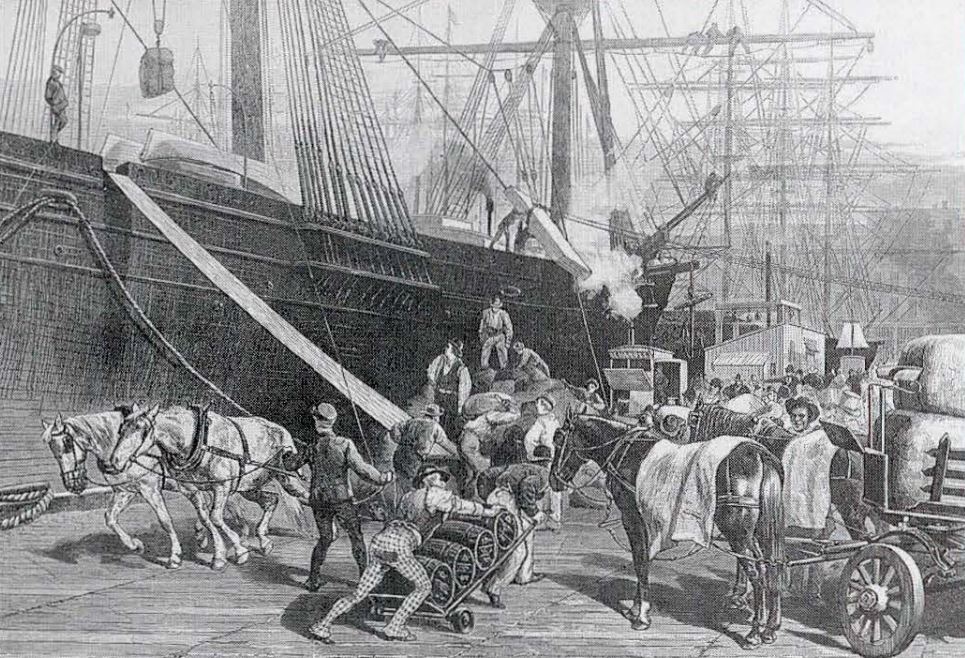
Harper's WEekly
This drawing by I.P. Pranishnikoff in Harper's Weekly (v. 21, no. 1072, 1877)
depicts the hard physical labor it took to load and unload ships in the 19th century. 
Image: Library of Congress
 

The global pandemic, however, has highlighted vulnerabilities in this complex system. The availability of dock workers and truck drivers has been reduced, slowing down progress along the delivery chain. Another problem is the need for the containers to keep circulating, regardless of the supply or demands for the goods inside. As more Americans stuck at home purchased consumer goods manufactured abroad, falling American export of some things like grains and produce reduced the number of loaded containers being sent back. Gizmodo reports that nearly 670,000 empty shipping containers were shipped to foreign ports in 2020—twelve times the number shipped in 2019. The Ever Given incident pointed out to the world just how much impact a single bottleneck in the system could have.
 
In the coming weeks the world's gaze will be drawn to some new shiny trend or event; the late-night comedians will be talking about something else and internet memes will share a new joke. We hope that the public will remember, however, that container ships will continue chugging across the seas, bringing us appliances and exercise equipment, medical equipment and PPE, and the many things that line our stores' shelves. A small incident in this complex system can have worldwide impact, and it is a system to which we ought to pay attention.
 
 *McLean was born Malcolm McLean, but he adopted the spelling Malcom as an adult.
 Sea History Today is written by Shelley Reid, NMHS senior staff writer.  Past issues can be read online by clicking 

Wednesday, April 07, 2021

Daily Quote – April 7, 2021

Masks Are a Ticking Time Bomb

Masks Are a Ticking Time Bomb
Tick, tick, tick,......I find them floating across my yard, headed toward the Ocean....🩸

Why Disposable Masks May Be Even Worse Than Plastic Bottles

The planet may be facing a new plastic crisis, similar to the one brought on by bottled water, but this time involving discarded face masks. "Mass masking" continues to be recommended by most public health groups during the COVID-19 pandemic, despite research showing masks do not significantly reduce the incidence of infection.1

As a result, it's estimated that 129 billion face masks are used worldwide each month, which works out to about 3 million masks a minute. Most of these are the disposable variety, made from plastic microfibers.2

Ranging in size from five millimeters (mm) to microscopic lengths, microplastics, which include microfibers, are being ingested by fish, plankton and other marine life, as well as the creatures on land that consume them (including humans3).

More than 300 million tons of plastic are produced globally annually — and that was before mask-wearing became a daily habit. Most of it ends up as waste in the environment, leading researchers from the University of Southern Denmark and Princeton University to warn that masks could quickly become "the next plastic problem."4

The bottled water crisis is now well-known as a leading source of environmental plastic pollution, but it's slated to be outpaced by a new mask crisis. While about 25% of plastic bottles are recycled, "there is no official guidance on mask recycle, making it more likely to be disposed of as solid waste," the researchers stated. "With increasing reports on inappropriate disposal of masks, it is urgent to recognize this potential environmental threat."5

Not only are masks not being recycled, but their materials make them likely to persist and accumulate in the environment. Most disposable face masks contain three layers — a polyester outer layer, a polypropylene or polystyrene middle layer and an inner layer made of absorbent material such as cotton.

Polypropylene is already one of the most problematic plastics, as it's widely produced and responsible for large waste accumulation in the environment, as well as being a known asthma trigger.6 Further, the researchers noted:7

"Once in the environment, the mask is subjected to solar radiation and heat, but the degradation of polypropylene is retarded due to its high hydrophobicity, high molecular weight, lacking an active functional group, and continuous chain of repetitive methylene units. These recalcitrant properties lead to the persistence and accumulation in the environment."

They also stated that when the masks become weathered in the environment, they can generate a large number of microsized polypropylene particles in a matter of weeks, then break down further into nanoplastics that are less than 1 mm in size.

Because masks may be directly made from microsized plastic fibers with a thickness of 1 mm to 10 mm, they may release microsized particles into the environment more readily — and faster — than larger plastic items, like plastic bags.

Further, "Such impacts can be worsened by a new-generation mask, nanomasks, which directly use nanosized plastic fibers (e.g., diameter <1 mm) and add a new source of nanoplastic pollution."8 A report by OceansAsia further estimated that 1.56 billion face masks may have entered the world's oceans in 2020, based on a global production estimate of 52 billion masks manufactured that year, and a loss rate of 3%, which is conservative.

Based on this data, and an average weight of 3 to 4 grams for a single-use polypropylene surgical mask, the masks would add 4,680 to 6,240 additional metric tons of plastic pollution to the marine environment, which, they note, "will take as long as 450 years to break down, slowly turning into microplastics while negatively impacting marine wildlife and ecosystems."9

Click here to learn more

Masks Entering Marine Environments Pose Additional Risks

Plastic particles are known to travel great distances, posing immense risks to virtually every part of the globe. Small, weathered pieces of plastic — suggesting they'd been on a long journey — have been found at the top of the Pyrénées mountains in southern France10 and "in the northernmost and easternmost areas of the Greenland and Barents seas."11

Calling the Greenland and Barents seas area a "dead end" for the plastic debris, researchers hypothesized that the seafloor below would be a catch-all for accumulating plastic debris.12 In separate research, it was also revealed that plastic pollution has reached the Southern Ocean surrounding Antarctica — an area believed to be mostly free of contamination.13 According to the featured study:14

"When not properly collected and managed, masks can be transported from land into freshwater and marine environments by surface run-off, river flows, oceanic currents, wind, and animals (via entanglement or ingestion). The occurrence of waste masks has been increasingly reported in different environments and social media have shared of wildlife tangled in elastic straps of masks."

Such plastics also contain contaminants, such as polycyclic hydrocarbons (PAHs), which may be genotoxic (i.e., causing DNA damage that could lead to cancer), along with dyes, plasticizers and other additives linked to additional toxic effects, including reproductive toxicity, carcinogenicity and mutagenicity.15

Aside from the chemical toxicity, ingestion of microplastics from degraded masks and other plastic waste is also toxic due to the particles themselves as well as the potential that they could carry pathogenic microorganisms.

Another issue that's rarely talked about is the fact that when you wear a mask, tiny microfibers are released, which can cause health problems when inhaled. The risk is increased when masks are reused. This hazard was highlighted in a performance study to be published in the June 2021 issue of Journal of Hazardous Materials.16

Researchers from Xi'an Jiaotong University also said scientists, manufacturers and regulators need to assess the inhalation of microplastic and nanoplastic debris shed from masks — both disposable and cloth — noting:17

"… [C]omplaints of throat irritation or discomfort in the respiratory tract by children, the elderly, or other sensitive individuals after wearing these may be alerting signs of excessive amounts of respirable debris inhaled from self-made masks and respirators."

In the featured study researchers also called on the environmental research community to "move fast to understand and mitigate these risks," suggesting that reusable cloth masks be promoted in lieu of disposable options and that mask-only trash cans be set up to assist in proper disposal.18 However, another option would be to loosen or eliminate mask mandates, which may turn out to cause more harm than good.

Mask Use May Pose a Risk for Advanced Stage Lung Cancer

While it's well-known that gut microbiota affect your immune system and risk of chronic diseases, it was long thought that lungs were sterile. Now it's known that microbes from your mouth, known as oral commensals, frequently enter your lungs.19 Not only that, but researchers from New York University (NYU) Grossman School of Medicine revealed that when these oral commensals are "enriched" in the lungs, it's associated with cancer.20

Specifically, in a study of 83 adults with lung cancer, those with advanced-stage cancer had more oral commensals in their lungs than those with early-stage cancer. Those with an enrichment of oral commensals in their lungs also had decreased survival and worsened tumor progression.

While the study didn't look into how mask usage could affect oral commensals in your lungs, they did note, "The lower airway microbiota, whether in health or disease state, are mostly affected by aspiration of oral secretions, and the lower airway microbial products are in constant interaction with the host immune system."21

It seems highly likely that wearing a mask would accelerate the accumulation of oral microbes in your lungs, thereby raising the question of whether mask usage could be linked to advanced stage lung cancer. The National Institutes of Health even conducted a study22 that confirmed when you wear a mask most of the water vapor you would normally exhale remains in the mask, becomes condensed and is re-inhaled.23

They went so far as to suggest that wearing a moist mask and inhaling the humid air of your own breath was a good thing, because it would hydrate your respiratory tract. But given the finding that inhaling the microbes from your mouth may increase advanced cancer risk, this hardly sounds like a benefit.

Not to mention, the humidity inside the mask will allow pathogenic bacteria to rapidly grow and multiply and, since the mask makes it more difficult to breathe, you're likely to breathe heavier, thereby risking inhaling the microbes even deeper inside your lungs.

Masks Are Harming Children and Adults

The "new normal" of widespread masking is affecting not only the environment but also the mental and physical health of humans, including children. It's largely assumed that face masks are "safe" for children to wear for long periods, such as during school, but no risk assessment has been carried out.24 Further, as evidenced by Germany's first registry recording the experience children are having wearing masks.25

Using data on 25,930 children, 24 health issues were reported that were associated with wearing masks that fell into the categories of physical, psychological and behavioral issues.26 They recorded symptoms that:27

"… included irritability (60%), headache (53%), difficulty concentrating (50%), less happiness (49%), reluctance to go to school/kindergarten (44%), malaise (42%), impaired learning (38%) and drowsiness or fatigue (37%)."

They also found 29.7% reported feeling short of breath, 26.4% being dizzy and 17.9% were unwilling to move or play.28 Hundreds more experienced "accelerated respiration, tightness in chest, weakness and short-term impairment of consciousness."

It's also known that microplastics exist in human placentas,29 and animal studies show that inhaled plastic particles pass through the placenta and into the heart and brains of fetuses.30 The fetuses exposed to the microplastics also gained less weight in the later part of the pregnancy.31

"We found the plastic nanoparticles everywhere we looked — in the maternal tissues, in the placenta and in the fetal tissues. We found them in the fetal heart, brain, lungs, liver and kidney," lead research Phoebe Stapleton of Rutgers University told The Guardian.32

Dr. Jim Meehan, an ophthalmologist and preventive medicine specialist who has performed more than 10,000 surgical procedures and is also a former editor of the medical journal Ocular Immunology and Inflammation, also conducted an evidence-based scientific analysis on masks, which shows that not only should healthy people not be wearing masks but they could be harmed as a result.33

Meehan suggests that the notion of mask-wearing defies common sense and reason, considering that most of the population is at very low or almost no risk of becoming severely ill from COVID-19. He also compiled 17 ways that masks can cause harm:34

Medical masks adversely affect respiratory physiology and function

Medical masks lower oxygen levels in the blood

Medical masks raise carbon dioxide levels in the blood

SAR-CoV-2 has a "furin cleavage" site that makes it more pathogenic, and the virus enters cells more easily when arterial oxygen levels decline, which means wearing a mask could increase COVID-19 severity

Medical masks trap exhaled virus in the mouth/mask, increasing viral/infectious load and increasing disease severity

SARS-CoV-2 becomes more dangerous when blood oxygen levels decline

The furin cleavage site of SARS-CoV-2 increases cellular invasion, especially during low blood oxygen levels

Cloth masks may increase the risk of contracting COVID-19 and other respiratory infections

Wearing a face mask may give a false sense of security

Masks compromise communications and reduce social distancing

Untrained and inappropriate management of face masks is common

Masks worn imperfectly are dangerous

Masks collect and colonize viruses, bacteria and mold

Wearing a face mask makes the exhaled air go into the eyes

Contact tracing studies show that asymptomatic carrier transmission is very rare

Face masks and stay at home orders prevent the development of herd immunity

Face masks are dangerous and contraindicated for a large number of people with pre-existing medical conditions and disabilities

Adding insult to injury, the first randomized controlled trial of more than 6,000 individuals to assess the effectiveness of surgical face masks against SARS-CoV-2 infection found masks did not statistically significantly reduce the incidence of infection.35

Considering the lack of evidence for their use, and the potential harms to human health and the environment, it's no wonder that calls for peaceful civil disobedience against mandatory masking are growing. The U.S. nonprofit Stand for Health Freedom has a widget you can use to contact your government representatives to let them know wearing a mask must be a personal choice.



~A.