Before Three Mile Island, before Chernobyl, Wood River Junction in Charlestown, R.I., had the first civilian nuclear accident resulting in the death of an employee in 1964.
United Nuclear Corporation recovered usable uranium from previously used uranium, such as control rods from nuclear reactors. The process involved purifying the scrap through a series of chemical treatments to extract the usable uranium.
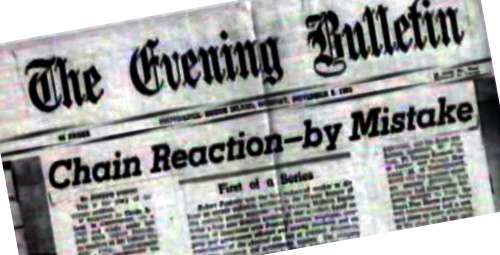
Peabody, as usual, worked the second shift at the Wood River Junction nuclear facility. That enabled him to work his day job as a mechanic. On that evening he was to add a chemical to a vat, which he did. However, he used the wrong chemical, which instantly started a uranium chain reaction and an explosion. The blast threw him to the floor and splashed radioactive liquid off the 12-foot ceiling and all over him.
The accident set off all of the emergency sirens. They screamed throughout the building, "Radiation leak, a bad one." Peabody got himself up and started running to the company emergency shack 450 feet away. He tore all of his clothing off along the way, but he didn't make it. He collapsed to the ground vomiting, with blood running out of his nose and ears.
The accident exposed Peabody to more radiation than anyone had since Hiroshima and Nagasaki. Two days later he passed away from radiation poisoning.
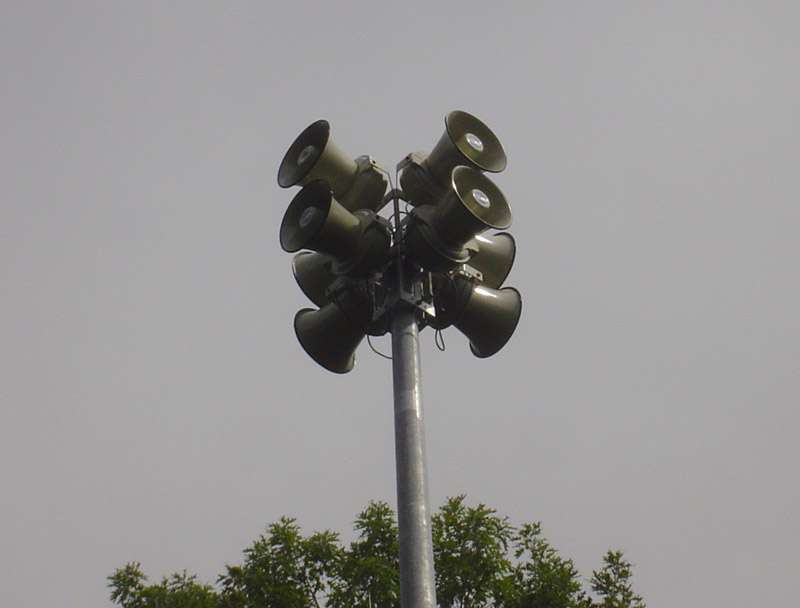
Warning sirens at the Indian Point nuclear facility
First Responders
The local Hope Valley Ambulance squad rushed to the scene to transport the doomed Peabody to the nearest hospital, in Westerly. Upon arrival, accident room doctors immediately recognized his condition was far beyond their capability. They sent him to Rhode Island Hospital in Providence, almost 45 miles away. To compound this unfolding tragedy, Robert Peabody's wife caught up with him, perhaps at Westerly. She briefly held his hand. He was so radioactive, the mother of nine children contracted lymphoma.
At Rhode Island Hospital, doctors could do little for Robert Peabody. They placed him in an isolation room, where he expired 49 hours later.
Because his body was so radioactive, it wasn't safe to bury it. So the bishop of the Diocese of Providence was petitioned for permission to cremate him. The bishop granted permission. Subsequently, Anna Peabody received an urn with his ashes. However, she reportedly suspected the ashes were not really his. Her suspicion was probably well founded.
According to a chronicled case, the ashes of a man treated with radioactive isotopes had detectable radiation. So why wouldn't Robert Peabody's ashes have been radioactive? He had received thousands of times more radiation than the medical patient. So perhaps his body lies in a lead-lined coffin somewhere or deep at sea.
Aftermath
United Nuclear made a small cash settlement of $22,000 to his family, which left them destitute.
The Atomic Energy Commission cited United Nuclear with 14 violations. The Environmental Protection Agency named the site of the contaminated Wood River Junction plant a Superfund cleanup site.
Image courtesy Google Maps.
The only bright note in this tragedy is that the site was eventually cleaned. It became and remains today Rhode Island's second largest nature conservancy at a little over 1,100 acres.
Leo Caisse, the author of this story, recently published the book, The Civilian Conservation Corps: A Guide to Their Works in Rhode Island. He has also published a number of historical articles, including Ears On the World in America in World War II Magazine, October, 2017. He has a B.A. and M.A. in American History from Providence College and he lives in East Providence, R.I.
Image: Warning sirens, By Div60 (talk) – I created this work entirely by myself., CC BY-SA 3.0, https://en.wikipedia.org/w/index.php?curid=23518269
What to the Slave Is the Fourth of July? is the popular name of a speech delivered by Frederick Douglass on the Fifth of July 1852 in Rochester, N.Y.
The most famous speech of the orator's career, it marked a departure from his mentor, Boston abolitionist William Lloyd Garrison. In it, Douglass expressed his desire to participate in the political life of the nation, while the more radical Garrison rejected it outright.
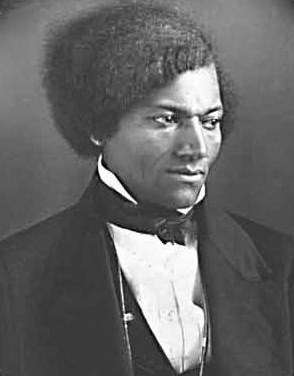
Frederick Douglass in 1848.
Garrison thought the U.S. Constitution supported slavery, that the country was built on slavery and that free states should secede from the Union.
Douglass' Fifth of July speech argued people could interpret the Constitution as opposed to slavery. And it expressed his hope and desire to share in the freedom and justice sought by the Founding Fathers.
In other words, Garrison wanted out of the government created by the Constitution, while Douglass wanted in.
The Fifth of July speech, at 10,000 words, probably took Douglass over an hour to deliver. His sponsors, the ladies of the "Rochester Anti Slavery Sewing Society," had 100 copies printed of his 'most able and eloquent oration' in pamphlet form.
Fifth of July Speech
Douglass starts the Fifth of July speech by telling the white audience that the Fourth of July is the birthday of their independence and freedom. And he tells them their celebration, their 'jubilee shouts,' make the chains of the enslaved 'more heavy and intolerable.'
He acknowledged the achievements of the country's founders, and his audience's right to celebrate them:
They succeeded; and today you reap the fruits of their success. The freedom gained is yours; and you, therefore, may properly celebrate this anniversary.
But then he asks the rhetorical questions, What am I doing here? Should I celebrate this day?
…why am I called upon to speak here today? What have I, or those I represent, to do with your national independence? Are the great principles of political freedom and of natural justice, embodied in that Declaration of Independence, extended to us?
No, he answers just as rhetorically:
The rich inheritance of justice, liberty, prosperity and independence, bequeathed by your fathers, is shared by you, not by me. The sunlight that brought life and healing to you, has brought stripes and death to me. This Fourth July is yours, not mine. You may rejoice, I must mourn.
"What to the slave…"
The 46th paragraph of the speech was perhaps Douglass' most famous passage.
What, to the American slave, is your 4th of July? I answer; a day that reveals to him, more than all other days in the year, the gross injustice and cruelty to which lie is the constant victim. To him, your celebration is a sham; your boasted liberty, an unholy license; your national greatness, swelling vanity…
Engraving from the Anti-Slavery Almanac
He grows more and more furious, more and more vituperative:
…your sounds of rejoicing are empty and heartless; your denunciations of tyrants, brass fronted impudence.
Shout of liberty and equality, he stormed, are "hollow mockery."
…your prayers and hymns, your sermons and thanksgivings, with all your religious parade, and solemnity, are, to him, mere bombast, fraud, deception, impiety, and hypocrisy-a thin veil to cover up crimes which would disgrace a nation of savages. There is not a nation on the earth guilty of practices, more shocking and bloody, than are the people of these United States, at this very hour.
The Constitution
He then excoriates religions for their silence on the subject of slavery. But, unlike, Garrison, he defends the U.S. Constitution as a document that rejects slavery.
"Now, take the constitution according to its plain reading, and I defy the presentation of a single pro . slavery clause in it. On the other hand it will be found to contain principles and purposes, entirely hostile to the existence of slavery.
Douglass ends the Fifth of July speech on a note of hope. He predicts the Civil War – and the end of slavery.
The Road to the Fifth of July Speech
Born into slavery in Maryland, Douglass rode the Underground Railroad to freedom in 1838 at the age of 20. He settled in New Bedford, Mass., a good choice of residence. The whaling city's maritime industries were open to African-Americans, and many who escaped from slavery put down roots there. New Bedford by 1853 would have the highest population of African-Americans in the Northeast.
Douglass had taught himself to read while enslaved, and eventually he began to speak out against slavery at abolitionist meetings in New England. He gave his first speech on Nantucket, describing the cruelties of slavery.
William Lloyd Garrison
William Lloyd Garrison, leader of the American Anti-Slavery Society, heard him speak and decided to put him on the broader abolitionist circuit. Garrison, 13 years older than Douglass, mentored him as he rose to stardom as an abolitionist lecturer.
Douglass moved to Lynn, Mass., in 1841, then to Rochester, N.Y., in 1852.
Burning the Constitution
Two years later, on a hot July 4, 1854, at the Harmony Grove picnic area in Framingham, Mass., Garrison publicly burned a copy of the U.S. Constitution. He began with a speech questioning Fourth of July celebrations, much as Douglass had:
"To-day, we are called to celebrate the seventy-eighth anniversary of American Independence. In what spirit?" he asked, "with what purpose? to what end?"
He then burned a copy of the hated Fugitive Slave Act as the abolitionist crowd cried "Amen."
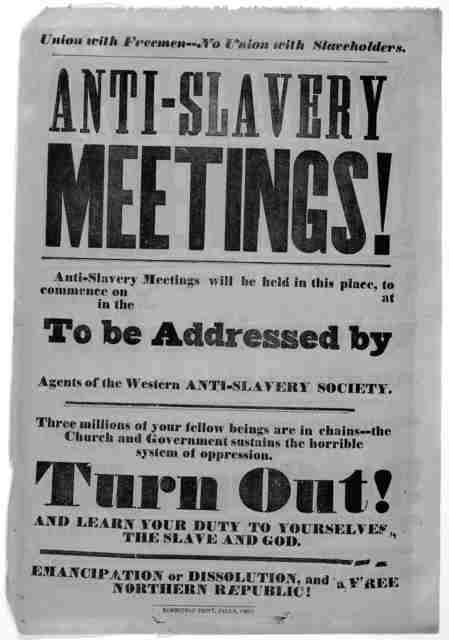
Anti-slavery poster. Image courtesy Library of Congress.
Then he burned a copy of the U.S. Constitution, "the source and parent of all the other atrocities–'a covenant with death, and an agreement with hell'.'" As it burned, he cried out: "So perish all compromises with tyranny!"
Douglass and Garrison broke over their different views of the Constitution. Douglass later explained:
When I escaped from slavery, and was introduced to the Garrisonians, I adopted very many of their opinions, and defended them just as long as I deemed them true. I was young, had read but little, and naturally took some things on trust. Subsequent experience and reading have led me to examine for myself. This has brought me to other conclusions.
Eventually the two men reconciled after the abolition of slavery.
Such actors as Morgan Freeman, James Earl Jones and Danny Glover have delivered the Fifth of July speech. Watch James Earl Jones read excerpts here. Or watch Douglass' descendants read excerpts here.
Our sensemaking used to rely heavily on consensus opinions handed down by trusted institutions. And in many ways this is the world that alternative narratives clash against; there can only be one 'epistemic commons' - or the mass of things considered legitimate knowledge. There can only be one 'science', and one 'expert consensus'.
If that consensus was wrong on the lab leak, then everything else is called into question. Maybe we should question the sacred cows, it seems: vaccines, for instance, which have been undeniably over-prioritised compared to intermediate treatments like ivermectin, which was rubbished (again) as 'debunked', but does help improve mortality odds and recovery times in clinical trials.
It might be useful to zoom out even further. In our last newsletter, we questioned the consensus around physicalism and materialism, which has aspersed questions about the role of the mind in constituting reality. If the consensus can be visibly imbalanced, if not actively wrong, on questions about the nature of reality itself - not just the particulars involved in it - then it's a powerful sign something has gone awry.
Here's the challenge. If conspiracy thinking and alternative sensemaking are on the cards, how far do you take them? How do you avoid falling into another rabbit hole that leads you further into confusion? Robert Anton Wilson's notion of 'Chapel Perilous' - covered in a Rebel Wisdom film with Wilson scholar and counterculture thinker Erik Davis - is a useful frame.
In Wilson's original formulation, 'Chapel Perilous' is a state of mind one enters when something really unexpected (especially something seeming 'supernatural') collides with your everyday reality. Mundane, taken-for-granted certainty is blown to bits, and a strange sense of loss and disorientation sets in. There are only two ways out the Chapel door, Erik says: emerging a "stone cold paranoid" or a "radical agnostic".
Often, people enter the Chapel after disillusionment with the mainstream narrative, after which they seek certainty in alternative sources and conspiracy theories. Yet certainty on each side is elusive, and both ought to be appraised as sceptically as the other. Peter Limberg of The Stoa has said that becoming a 'conspiracy theorist' is part the journey we have to go on, almost comparable to Campbell's Hero's Journey, and not the destination. It's a process perhaps comparable also to Stage 4 of Robert Kegan's Developmental Model, where we break away from socialised patterns before entering our most developed self at Stage 5.
The key is grounding yourself in embodied exchange and maintaining a rich source of perspectives: an equal balance pick-and-mix of left, right, middle, mainstream and something else. Thought another way by Venkatesh Rao, one should take the 'grey pill', not the 'red pill'. We need persistent unknowing, not dramatic moments of 'red pill' insight.
65 Retirement Tips for a healthy, Wealthy and Happy Retirement
65 Retirement Tips for a Healthy, Wealthy and Happy Retirement!
If you want to have a good retirement, you need to figure out what that means to you. Do some life planning for retirement, set goals and use these retirement tips to create a plan that allows you to achieve exactly what you want. What do most of us want? It is usually pretty simple, we want a: Happy retirement. Healthy retirement. And, a wealthy retirement (or at least one that is affordable).
The Big Takeaways…
The way you create your lifestyle in retirement impacts your health, wealth and overall happiness.
Health, happiness and wealth are interrelated. Don't let finances take priority over your well-being.
You can create your own retirement plan in 5 minutes with the NewRetirement Planner.
A happy retirement is no longer really about sitting with your feet up and watching the rest of the world whiz by. Many people now think that retirement is a time for embarking on one of life's greatest adventures. This is the time to do what you want with the experience-laden good sense to appreciate it.
How to be happy in retirement? Here are 65 retirement tips that can help you have a really good retirement. Make this the best time of your life!
1. Have a Sense of Purpose and Meaning
Make every day meaningful. Oxford University suggests that a meaningful life lessens the effects of aging. And, research from Patrick Hill and Nicholas Turiano found that people who have a sense or purpose or direction in life outlive their peers.
In fact, people with a sense of purpose had a 15 percent lower risk of death, compared with those who said they were more or less aimless. And it didn't seem to matter when people found their direction. It could be in their 20s, 50s or 70s — even when controlled for other factors that affect longevity like age, gender and emotional well-being.
Most people have lived their lives day to day, month to month, year to year.
However, retirement is the time to have the best plan possible. You want to spend this time of your life doing what you want to do and you want to make sure you have the finances and wherewithal to achieve what is important.
Perhaps the best way to plan for retirement is to visualize your future — really think about the details of who you will be, where and why. Being able to imagine now who you will be in the future and what your needs and desires will be at that time is perhaps the most important aspect of planning.
More than 80% of today's retirees say health is the most important ingredient for a happy retirement, meaning that the majority value good health even over financial security. According to a Merrill Lynch study, "Americans age 50+ cite health care costs in retirement as their greatest financial concern, regardless of their wealth level. Yet the vast majority of people have not factored health care costs into their retirement planning."
So, the best retirement plan involves not just your finances but also ways to stay mentally and physically healthy. Gardening, walking, joining a gym, eating healthy are all proven ways to stay physically healthy. Staying vital, having a purpose and challenging yourself mentally are great ways to maintain your mental health.
5. Trade Time for Money
If you can live on a little less than you have been planning, then retirement can be a lot closer than you might have thought possible. Cut expenses dramatically and the time to retire might be tomorrow.
If you are looking for meaning in retirement, volunteering might be something to try.
According to an Encore.org study, 55% of Americans believe that putting skills and expertise to use in some fashion to help others is an important part of how they view retirement. And 28% put post-midlife work with real social impact at the center of their planning.
Try making exercise something you look forward to instead of something you have to do. Instead of walking (trudging) on a treadmill, take walks through the park or go for mini hikes. Still does not appeal to you? Why not listen to music or — better yet — bring a friend along and talk and laugh as you get the heart rate going.
Best of all, there is a bonus to the fun! Research from Cornell Food and Brand Lab found that those who think they are having fun while exercising end up eating less than those who are doing it for exercise.
8. And, If Walking Is Your Exercise, Walk Fast
Many research studies have found that how fast you walk after age 60 is a good gauge of longevity. Apparently, your walking speed can predict dementia, shorter life spans and depression.
In one study, published in Neurology, researcher, Dr. Joe Verghese, says: "As a young researcher, I examined hundreds of patients and noticed that if an older person was walking slowly, there was a good chance that his cognitive tests were also abnormal."
9. Think Income Not Investments
Esteemed economists like Nobel Prize winner Robert Merton believe that it is more important to estimate and plan for your retirement income needs than worry about investments and how much you need for retirement. He recommends dividing your income needs into three categories:
Minimum guaranteed retirement income — This category is for how much income you need to maintain your life at the bare minimum. Your retirement assets should be allocated to guarantee this income for as long as you live. Social Security and lifetime annuities are two common guaranteed income sources.
Flexible income — This category is for how much income you would like to live at your desired lifestyle. Income for this category should come from conservatively invested assets.
Nice to haves — You can take some risks with investments in this category.
10. Leave Behind More Wealth than You Had When You First Retired
Retirement is not always about scrimping and saving. Many people are lucky enough to be able to increase their wealth throughout retirement. Bud Hebeler was one such guy.
11. Create and Maintain a Comprehensive Investment Strategy
Perhaps too much emphasis has been put on retirement investments, but it is not something you want to get wrong.
Creating an investment policy statement could be the secret weapon your retirement needs. An investment policy statement defines your investment goals, strategies for achieving those objectives, a framework for making changes to your plans and options for what to do if things don't go as expected. This type of document can help you make more rational decisions about your money.\
12. Don't Overlook Taxes
When it comes to your retirement planning, saving, investing and plotting how to spend your free time are at the top of the list. How much you will have to pay in taxes after retirement may be the last thing on your mind, but taxes can be a bigger swing in your wealth than investment returns.
13. Keep a Schedule and Structure and Follow 7 Other Overlooked Retirement Skills
It can be difficult figuring out just what to do with your time once the 9 to 5 is over and done. Retirement is a major life change, and not all of it is fun. But with a schedule, you can help avoid the boredom and restlessness that comes with switching from a busy life to one where busyness only happens because you want it to.
Studies have shown that a structured life is one of the keys to happiness. Work usually imposes a schedule and structure on your life. When you retire, you are faced with days and evenings at your leisure. While you may find this novel and a bit exciting, you may want to define some specific routines to maintain order and structure.
14. Research the Best Places to Retire and Go There
New lists about the best places to retire are common. While it is possible that you already live in the best place for you, it is also possible that there is a better place for your retirement. Best of all, relocating may give you more money for retirement expenses if you manage to downsize or move to a more economical location.
Retirement doesn't have to mean that you'll stay in the same house where you've always lived. Downsizing can free up your time. And moving to a 50+ community can surround you with like-minded people with similar interests. There's less home maintenance, too.
According to surveys of NewRetirement users, knowing how to have a good retirement typically involves figuring out how to travel. Travel is clearly the most popular and desired pursuit for this phase of life. From day trips by car to round the world journeys, retirees have wanderlust!
Anything is possible with the right prioritization. If travel is what you have always dreamed of, here are "20 Great Retirement Travel Ideas."
Achieving what you want out of retirement can be a matter of setting a goal and then prioritizing that goal above everything else. Using a good Retirement Calculator can help you visualize what you need to do to achieve whatever is important to you.
16. Think Positively About Aging
"There is a fountain of youth: it is your mind, your talents, the creativity you bring to your life and the lives of people you love. When you learn to tap this source, you will truly have defeated age." ― Sophia Loren
Levy has found that when older adults think of getting old as a positive experience — being about wisdom, self-realization and satisfaction — then they:
Function at a higher level
Live 7.5 years longer
Are more likely to eat well, exercise and avoid vice
17. Some Researchers Think Aging is… Optional…?
David Sinclair is a Harvard professor who made Time Magazine's list of of the 100 most influential people in 2014. He argues that aging is… optional.
He believes that growing old is not a natural part of life but rather a disease that needs a cure. The bad news is that, yes, everyone does need to die at some point, but he says that we can double our life expectancy AND live healthy active lives right up until the end.
18. Avoid Retirement Depression (It is More Common Than You Might Think)
A study published in the Journal of Population Ageing found that those who were retired were about twice as likely to report feeling symptoms of depression than those who were still working. And, research from the London-based Institute of Economic Affairs found that the likelihood that someone will suffer from clinical depression actually goes up by about 40% after retiring.
Research from the Institute on Aging at Boston College found that grandparents who were able to both give and receive support from grandchildren are less likely to be depressed. In fact, "the greater emotional support grandparents and adult grandchildren received from one another, the better their psychological health," said Sara M. Moorman, an assistant professor at Boston College.
If you have grandkids, spending active play time with them can help you stay healthier. Active play doesn't have to mean that you'll climb a tree, but you can play other games and go on outings together. The National Institute on Aging's (NIA) says spending time with the little ones you love is also great for bonding.
20. Have You Found Your Ikigai?
The residents of the Japanese island of Okinawa have discovered three proven concepts for happy longevity: ikigai, moai and hara hachi bu.
21. Make Sure Your Retirement Planning Includes Your Spouse and Loved Ones
It may seem obvious, but it is actually important to remember to include loved ones — especially spouses — in your retirement planning. A survey by Fidelity Investments found that finances and retirement planning are extremely difficult subjects for married couples.
Whether by circumstances or choice, the U.S. Census Bureau estimates that there were 19.5 million unmarried U.S. residents age 65 and older in 2016. Experts estimate that around 23 percent of the older population nationwide will age alone and that percentage can be much higher — as high as 50% — in many cities. These aging adults are often referred to as elder orphans or solo seniors.
Women especially are living alone in greater numbers. The Administration on Aging found that 37% of women in the U.S. over 65 live by themselves, are happy about it and wouldn't want to live any other way.
23. If You Have a Health Setback, Adopt a Positive Outlook
Much new research indicates that you are who you think you are. The power of positive thinking is turning out to be very true.
The Journal of the American Medical Association reports that seniors with a positive bias toward themselves and life are 44 percent more likely to fully recover from a bout of disability than someone with a negative outlook.
24. Find a Motto for Your Retirement Plan — Put it On Your Refrigerator
Keeping your retirement goals front and center is important. Some people write down their goals, keep a budget or plan.
Seniors are an all too common target of fraud. According to the National Council on Aging, "approximately 1 in 10 Americans aged 60+ have experienced some form of elder abuse. Some estimates range as high as 5 million elders who are abused each year. One study estimated that only 1 in 14 cases of abuse are reported to authorities." Here are 7 ways to protect yourself from investment fraud and tips for avoiding reverse mortgage scams.
26. Stay Married — Especially If You Are a Man
Marriage is good for you, and so are long-term relationships. This Psychophysiology study points out that while stressful marriages are detrimental as we age, strong relationships with a partner help in nearly every aspect of life.
Additional research from Harvard Medical School found that men who have marital partners live longer than men without spouses.
Even though you might spend every day together once you retire, date night is something different and special.
27. Devote Time to Retirement Planning — Even After You Retire
Research shows that most people spend more time buying a TV, making a restaurant reservation and planning a vacation than they do planning their retirement.
Planning, assessing and updating your retirement plans should be on your monthly checklist — even after you retire. It is important to check in with your budget and investments and adjust as necessary. Online tools like retirement calculators can help.
You want to have a clear plan in place for making your savings last, but experts are finding that many of today's retirees simply aren't spending enough.
There are so many questions. Good news: the Stanford Center on Longevity in collaboration with the Society of Actuaries (SOA) has some answers. They analyzed 292 retirement income strategies and are recommending the "spend safely in retirement strategy" as the best way to spend in retirement.
30. Adjust to Turning Your Perspective Upside Down
Retirement is a big deal. Both your lifestyle and your finances do an almost 180. Your time is spent in leisure not work and you go from earning money to spending. It is challenging to go from a focus on accumulation (saving, saving, saving) to spending (efficient use and drawdown of your assets).
You may be retired, but working on creating and maintaining friendships is one of your most important "jobs" as a retired person.
Research abounds on the benefits of being social as we age. The links between healthy social relationships and better health are well established. One study from the Pennsylvania State University found that when the social activities are linked to physical exercise, even more benefits are achieved.
And, it turns out that the opposite is also true. Researchers at the University of Chicago found that loneliness in older people may increase the chance of death by 14 percent. Psychologist John Cacioppo says that loneliness may have twice the impact on early death as obesity and is as damaging as disadvantaged socioeconomic status.
Whether you are an introvert or an extrovert, maintaining friendships is actually critical to your health and well-being.
You need people you can rely on emotionally and for real life help. And, believe it or not, science says that you are way better off when you have people who rely on you!
32. Be Social with People Outside Your Age Group
It turns out that there are some powerful benefits to have younger (and older) pals — a sense of vitality, energy, different perspectives and more. Get inspired by some beautiful stories of friendships across generations.
33. Choose the Right Time to Start Social Security
The later you start Social Security, the more monthly income you will receive. You might be eligible to begin benefits at 62, but delaying the start of benefits can reap big rewards — especially if you are a woman. Calculate your most optimal start date and explore spousal benefit options before committing.
34. Come Out of Retirement for a Career Switch
Seventy-five percent of Americans expect to work for as long as they can, and 39% say it's because they like to work, according to a Bankrate Financial Literacy poll.
Many seniors make some kind of career change and work because they love what they are doing. The additional income is good, but it is often the satisfaction of a job well done that keeps them working. There are so many benefits to working past the traditional retirement age.
35. Hire a Financial Advisor
You'll need as much good advice after retirement as before. With a financial advisor, you'll spend and save more wisely. Research found that that Boomers who are working with a financial advisor are twice as confident about having sufficient savings for retirement than their peers who are planning retirement on their own.
36. Are You a Family Caregiver? Be Careful to Keep Your Own Retirement on Track
The costs of being a caregiver can be overwhelming. There is the extreme emotional turmoil but there are also serious financial concerns — from money spent out of pocket and from time spent caregiving instead of earning income.
While you may only be able to think about how to help the person you are caring for, there are steps you can take to protect your own retirement. You deserve the time it takes to care for your own self, too. Explore 5 tips for taking care of yourself.
37. Get a Dog
The research on the benefits of owning a dog is pretty overwhelming. Beyond emotional benefits like their unconditional love of us, one study found that dog owners need fewer doctor visits. Another study from Australia found that pet owners had lower cholesterol, lower blood pressure and a lower heart attack risk than people without pets.
Other research has suggested that caring for a dog, in particular, is healthful in that it keeps us vital and generally insures that we get a walk every day. Here are six ways pets can improve your health.
38. Don't Stop Budgeting
If you've saved well, you'll want to be sure that your retirement funds last as long as you need them to. And if your finances are less-than-stellar, it's even more important to budget, since you won't have next week's paycheck to supplement financial mistakes.
Willingness to be flexible with spending is "absolutely key" both before and during retirement, says Jon R. King, certified financial planner with Austin, Texas-based Pegasus Financial Solutions, LLC. "Spending before retirement is important because the less you spend, the more you save," he says. "Cutting spending after retirement makes [your money] last longer."
A recent survey suggests that financial literacy is lower than even most people might expect. Fidelity asked more than 2000 people — half who were between the ages of 55 and 65 and not retired — questions in eight different retirement categories. The average that people got right was a mere 30 percent. Absolutely nobody got all the questions correct and the highest overall grade was 79 percent. Can you do better?
One way to improve your financial literacy is to create a detailed retirement plan and run many different scenarios. While few retirement calculators are comprehensive enough to really help you learn, the NewRetirement retirement planning calculator is. This easy to use system is completely comprehensive. Here are more than 15 different things to try with your plans.
40. Be Sure to Plan Your Next Big Financial Goal: Your Estate!
A big part of retirement planning is figuring out how much you can and want to leave behind to heirs.
Do you know what your estate is likely to be? And, have you created all the recommended documents and kept your paperwork up to date? Find out by using the Retirement Planner! This is critically important.
42. Be Realistic About What Retirement Will Mean to Your Lifestyle
While many things are fairly universal for retirees, such as having lots of time to do what you want, some things might surprise you. Boredom can be a big problem, especially for someone who is used to a busy pre-retirement life. Time isn't necessarily fun when it's spent in front of the TV wishing you had something to do.
If you want to know how to be happy after retirement? Explore the definitive ranking of the top 25 ways to spend your golden years. Sure, there is no bad way to spend your days, but here are 25 things that will contribute to your mental and physical well-being.
43. Continually Optimize Your Health Insurance
It is important to re-evaluate your supplemental Medicare coverage every year. Insurance companies change policies and your health changes too.
44. Don't Forget to Plan for a Long Term Care Need
You also want to look at ways to fund long-term care costs. Long-term care is not covered by Medicare or Medicare supplemental insurance. And, research suggests that at least 52% of people turning 65 today will need long term care at some point.
You need to plan for it!
The NewRetirement Planner allows you to try out different strategies for planning for long term care as part of your overall plan.
47. Will a Retirement Survival Pack Help You Have a Happier Retirement?
From calendars to help you maintain a schedule to replacements for what you will miss from work plus books, apps and tools for staying physically and mentally healthy, discover a retirement survival pack.
48. Watch a Movie
Movies – like all art forms – can be a great way to explore important themes in your life. Movies with themes of retirement and aging run the gamut from great animated choices to watch with your grandkids to adult comedy and drama.
49. Optimize Your Resources to Maximize Your Income and Protection from Risks
One of the key reasons that the very rich hire financial planners is that they can help optimize resources – make small tradeoffs – to dramatically improve the client's overall wealth and security.
Through education, innovation, and access to retirement products and strategies, NewRetirement hopes to provide that same level of holistic planning to the average retiree.
Examples of small tradeoffs that make a big difference include:
Delaying the start of their Social Security can mean an additional 30 percent in monthly income.
Buying a lifetime annuity or long term care insurance may mean less total savings are required for retirement
Working longer can be the difference between making ends meet and not
50. Reverse Your Retirement
According to a Federal Reserve Board study, a full 1/3 of those who retire eventually reverse retirement and return to work on either a full or part time basis.
The most common reasons that people go back to work are somewhat dependent on income levels. People with less income usually go back to work to boost their cash flow. Retirees of the highest income levels go back to work because they want to take advantage of their skills and make more money.
51. Get Out and Do Something Amazing — It Is Not Too Late
Walking away from the 9-to-5 opens up a world of opportunity for you. You can do anything and become anything that you want. If you've always wondered what would have happened if your life had taken a different turn, this is your golden opportunity to make that turn and see what happens.
Regular older people are doing amazing things. They hike the Pacific Coast Trail, take up skydiving and go back to school.
It will be exciting to see what today's retirees accomplish. Older Americans today are more vibrant than those of the past. Even so, there have been many notable accomplishments and amazing feats by people well into their 60s, 70s and 80s — at age 65, Colonel Sanders started Kentucky Fried Chicken and at 90, Pablo Picasso was still actively producing art.
Retirement does not need to be about retiring from the world.
52. Cut Housing Costs
Housing is the most expensive budget item for most households. Your home is probably also your most valuable asset. As such, optimizing your housing to best achieve your retirement plan is critical to your retirement success.
A few ideas for cutting housing costs in retirement include:
Homesharing — think Golden Girls and reduce costs by living with friends.
Downsizing — downsizing can be the most efficient way to tap your home equity.
If you've ever wanted to learn how to play piano or build a cabinet, there's no better time than after you retire. Forbes says you could even take on several new skills every year.
While some people prepare for the financial aspects of retirement, it is not clear how many people develop clear plans for the non-financial aspects. Both are important. A financial advisor or an online retirement planner can help you with your finances. A retirement coach can help you be mentally and emotionally prepared for what happens when your career ends.
55. Follow the Lessons of Healthy 90 Year Olds
UC Irvine is heading a celebrated research project that is documenting what factors determine who will live past age 90. Here are some of their findings:
Smokers die earlier than nonsmokers
People who exercise live longer than those who do not. As little as 15 minutes a day makes a difference. Forty five minutes a day is best.
Nonphysical activities are also important. Think book clubs, meeting friends for coffee, crossword puzzles.
Vitamins do not seem to make a difference.
Moderate alcohol consumption is associated with living longer. Up to two drinks a day leads to a 10-15 percent reduced risk of death.
Coffee is good too — 1-3 cups a day.
Gain a little weight — people who are average or slightly overweight seem to live longer than those who are underweight.
If you want to know more about this retirement research, "60 Minutes" did an excellent report on "Living to 90 and Beyond."
56. Think About College in a Whole New Way
Most people go to college to meet a goal, not for personal enrichment. Taking a college class, or a few classes, after you retire is a whole different experience. There's less pressure to get each class under your belt and move ahead. You might actually enjoy criminal justice or cultural anthropology now that it's not something you must take in order to earn a degree.
57. Start a Retirement Planning Club
We all need help with our retirement plans but very few of us turn to friends for that support. A retirement club — kind of like a book club where you discuss retirement topics instead of novels — can provide an ideal and friendly forum for helping you have a more secure future. Learn how to get started. Or, try a retirement book club.
58. Forget Retirement — Take a Long Vacation Instead
The road to retirement is changing dramatically, with older Americans taking a long vacation, or a work sabbatical, for a period of time and then rejoining the workforce –often by switching careers — to delay full retirement. Explore the pros and cons of sabbaticals before full retirement.
59. Keep Making 5-Year Plans
Goal-setting isn't just for twenty-somethings. The more you plan for the future, the more you'll get out of your retirement. Brainstorming over your next move in life can be a great way to spend Sunday morning coffee time.
Just make sure your plans and goals keep in synch with your retirement finances. Keep using retirement calculators or your financial advisor to stay on track.
60. Not Yet Retired? Do Some Catch Up Savings
Catch up contributions are the IRS's way of making it easier for savers age 50 and up to tuck away enough retirement savings. You probably already know that there's a limit to how much you're allowed to save in tax-advantaged retirement account such as IRAs and 401(k)s. Well, once you reach age 50, you're allowed to make additional "catch up" contributions over and above those annual contribution limits.
RMD stands for required minimum distribution. When you reach a certain age, you are required to withdraw a minimum amount from your IRAs and 401ks or get a huge tax penalty.
Until recently, RMDs were required by everyone at age 70 ½. However, in late 2019 Congress passed the Secure Act that increases the age
The Secure Act increases the age after which you must begin taking RMDs from 70 1/2 to 72 — at least for anyone who turns 70 1/2 after 2019.
How old would you be if you didn't know how old you was? Satchel Paige
Satchel Paige may have had it right. In studies conducted over four decades, Harvard psychology professor Ellen Langer showed that mental attitude can reverse the effects of aging and improve physical health. Langer proved time and time again that age is truly a mindset and not a number. If you think of yourself as young, you can be young.
The right mental attitude can reverse the effects of aging and improve physical health.
63. Stay Inquisitive About the World Around You
It's easy to become isolated and fall into a rut after you retire. Keeping a curious mind will allow you to really enjoy learning how the world works.
64. Plan for a Longer and Healthier Life in Retirement
In the 1950s, people retiring at age 65 lived until 78. Today's retirees can expect an average lifespan of 83 or 84 years – which means that half of you will live even much longer than that.
Your expanded lifespan means many things:
That your retirement savings will need to last longer
Your overall health-related costs will be higher now than ever before
You will need to plan for different phases of retirement – each with its own financial requirements
Instead of a time for slowing down, retirement could very well be the doorway you walk through to a whole new experience. Strive for an active, inspiring, fulfilling life where you'll learn new things, listen to new music, dance new steps, and embrace the things that you already love.
If you find that you've got a million excuses about why you can't do this or that, maybe it's time for a change of perspective. So, you aren't physically able to hike? Chances are you can take a walk on the beach. You get the idea.
With a strong mind, healthy body and a well-laid plan, you can look forward to a happy retirement instead of allowing it to surprise you in some good, and not-so-good, ways. By taking control of how you approach it, you'll have a much better chance of creating your retirement instead of just allowing life to happen to you.
65. Think About the Big Picture
It is easy to worry about getting older. Health faltering and all… Did your golf game not go as planned this afternoon? Has your knee faltered for a second (or third) time? No doubt. It's a bummer. Aging is a ….
However, instead of focusing on your own shortcomings, be sure that you are doing and experiencing things that make an impact. Bring joy to other people. Be inspiring. Do something memorable.
Sure, retirement is your time. Just keep the big picture in mind and be sure to leave behind a little inspiration.
Speaking of inspiration…. Share this article with your friends! And, let us know what you think makes for a happy retirement in the comments below!