Saturday, October 20, 2018

Say Amen to This Historic Convent-to-Hotel Conversion | Good Sh*t | OZY


Say Amen to This Historic Convent-to-Hotel Conversion

As you walk from the bustling streets into the cool, minimalist lobby of the Jaffa hotel, you are confronted with a Damien Hirst painting, some chic Shiro Kuramata sofas and the remnants of an ancient curved stone wall. In a project that has taken nearly a quarter of a century, this luxurious hotel has been carved out from an old convent and hospital that stood on the site since the 1880s, but the wall — built by 13th-century Crusaders — is a striking reminder that this is ground steeped in far older history.

For two millennia, Jaffa's port was the gate to Palestine, changing hands between Saladin, the Crusaders led by Richard the Lionheart, the Mamelukes, the Ottomans, the British and, finally, Israel, which gained control of the once Arab-majority town in the 1948 Arab-Israeli War. The resulting riot of architectural and commercial exuberance has created a port like no other on the Mediterranean, home to Tel Aviv's hippest young residents. A decade of gentrification has led to art studios, boutique bakeries, and a pedestrian promenade lined with yachts and apartments with stellar views.

The Jaffa, in contrast, has a more tranquil feel. Originally home to the nuns of the Sisterhood of St. Joseph (a French order) and a hospital for ill pilgrims, the building's facade gives little clue to what lies within — a sprawling courtyard shaded by mulberry trees, a swimming pool, and an obscenely beautiful nightclub and events space housed in the desanctified chapel. The hotel itself has 120 rooms — 40 in the renovated old wing and 80 in a newly built wing, some with sea views.

A careful excavation revealed one of the only ancient circular walls in the Middle East.

The project's architect, Ramy Gill, who grew up in Jaffa, explains how he worked to preserve the original architectural elements. While excavating thousands upon thousands of truckloads of earth, he tried to "echo the geometry of the alleyways around us," while exposing the foundations of the building to create more space. A careful excavation revealed one of the only ancient circular walls in the Middle East and fourth-century architectural artifacts. New floors were dug out, with the courtyard for a restaurant and the swimming pool sunk below the surrounding street level on the spot where the nuns once grew Jaffa oranges.

While Gill was digging, owner Aby Rosen, a Manhattan-based developer to whom the Sisterhood granted a 110-year lease of the land, was luring celebrated British architectural designer John Pawson to join the project. Pawson quickly realized that while he would have free rein to exert his signature minimalist style in the new wing, he would have to be more flexible elsewhere. Israeli hotels often have a rather flashy, conspicuous side to them, and Pawson admitted to having to put his foot down to make sure the design remained restrained. "Some people think a wall is something to hang pictures on," he says, when pushed for an example. Perforated metal screens that recall Arab wood-carved moucharabies are all that adorn many of the walls.

Earlier in the day, Gill showed me the most spectacular part of the renovation, the chapel, with its striking powder-blue vaulted ceiling and stunning stained-glass windows. All the Christian icons have been removed (and replaced with posters of famous film stars as priests). Its marbled floors show off three-legged Botolo chairs, and a giant bar stands where the altar once did. Waitresses wear outfits resembling a nun's habit except that theirs end above the knee.

Later I found long queues for the club (note to guests staying in a $1,600-per-night junior suite: That's not enough to get you on the guest list) and took a walk around Jaffa. It was late, but the streets were still full, with people spilling out of restaurants and into bars. Around the corner from the hotel, in a tiny bar filled with off-duty waiters, salsa blasted from the speakers and couples danced on a floor smaller than my suite's bedroom. The bartender handed me a free shot.

It was a reminder that in the heart of the old port, colorful and riotous, the Jaffa is a rarefied addition, an oasis from the city outside, while still being deeply entwined with its history: an expensive but delightful escape.

Mehul Srivastava was a guest of the Jaffa, which has double rooms from $550. Access to the chapel is free for guests, but they must email to reserve in advance.

By Mehul Srivastava

OZY partners with the U.K.'s Financial Times to bring you premium analysis and features. © The Financial Times Limited 2018.


Friday, October 19, 2018

Showcase — Information is Beautiful Awards

Showcase — Information is Beautiful Awards

Showcase — Information is Beautiful Awards

This is not a graphic experiment to represent Beethoven's work, but a precise research that attempts to narrate the musical and stage performance by the Quartetto Sincronie. So we decided to tell...

Medium

This project visualizes city street network orientation, configuration, and entropy using OpenStreetMap data and the Python-based OSMnx package. Each of these cities is represented by a polar...

View project


~A.

Thursday, October 18, 2018

Craft Weed | The MIT Press

Craft Weed | The MIT Press

Craft Weed

Family Farming and the Future of the Marijuana Industry

How the future of post-legalization marijuana farming can be sustainable, local, and artisanal.

What will the marijuana industry look like as legalization spreads? Will corporations sweep in and create Big Marijuana, flooding the market with mass-produced weed? Or will marijuana agriculture stay true to its roots in family farming, and reflect a sustainable, local, and artisanal ethic? In Craft Weed, Ryan Stoa argues that the future of the marijuana industry should be powered by small farms—that its model should be more craft beer than Anheuser-Busch.

To make his case for craft weed, Stoa interviews veteran and novice marijuana growers, politicians, activists, and investors. He provides a history of marijuana farming and its post-hippie resurgence in the United States. He reports on the amazing adaptability of the cannabis plant and its genetic gifts, the legalization movement, regulatory efforts, the tradeoffs of indoor versus outdoor farms, and the environmental impacts of marijuana agriculture. To protect and promote small farmers and their communities, Stoa proposes a Marijuana Appellation system, modeled after the wine industry, which would provide a certified designation of origin to local crops. A sustainable, local, and artisanal farming model is not an inevitable future for the marijuana industry, but Craft Weed makes clear that marijuana legalization has the potential to revitalize rural communities and the American family farm.

As the era of marijuana prohibition comes to an end, now is the time to think about what kind of marijuana industry and marijuana agriculture we want. Craft Weed will help us plan for a future that is almost here.


~A.

Tuesday, October 16, 2018

Rembrandt masterpiece The Night Watch to be restored under world's gaze | Art and design | The Guardian

Rembrandt masterpiece The Night Watch to be restored under world's gaze | Art and design | The Guardian

The Night Watch: Rembrandt painting to be restored under world's gaze

Exclusive: Art lovers will be able to watch conservators restoring work in Amsterdam's Rijksmuseum and via web livestream

The Night Watch by Rembrandt, one of the world's most spectacular paintings, is to be restored under the world's gaze at the Rijksmuseum in Amsterdam, its general director has told the Guardian.

The public will be invited to watch the intimate conservation process, both up close in the gallery itself and via an internet livestream, in what is believed to be the biggest ever undertaking of its kind.

Taco Dibbits said it was expected to be a slow and intricate project, which would take several years and cost millions of euros.

"It will be carried out under the eyes of the world, and people will be able to follow the conservation wherever they are, whenever they want," the art historian, who has been head of the Rijksmuseum since 2016, said in an exclusive interview.

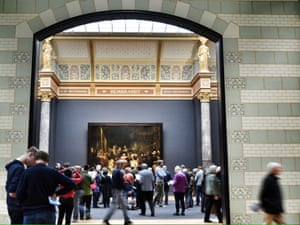
Visitors looks at Rembrandt's the Night Watch in the Rijksmuseum in Amsterdam.
Visitors looks at the Night Watch in the Rijksmuseum in Amsterdam. Photograph: Robin van Lonkhuijsen/AFP/Getty Images

Completed by Rembrandt van Rijn in 1642 at the height of the Dutch Golden Age, The Night Watch, more formally known as Militia Company of District II under the Command of Captain Francis Banninck Cocq, was commissioned by the major and leader of the civic guard of Amsterdam. He wanted Rembrandt to create a group portrait of his shooting company. The artist depicted them moving out, rather than a static group as convention dictated. Its focal figures – almost life sized – are the captain and lieutenant at the centre and the girl in the background left of centre, who is bathed in light and clutching a chicken.

The painting has pride of place in the Rijksmuseum's Gallery of Honour, which was built especially for the painting and where it sits on what Dibbits calls a "high altar", visited by more than 2 million people a year.

In recent years, Dibbits and his colleagues had noticed deterioration in the work, which was last restored in 1975, following a knife attack by a Dutch teacher. "We continuously monitor the painting and noticed that the restoration of the 1970s had stared to discolour," said Dibbits. "There's a whiteish haze which appears on it, so you can't quite appreciate it in its full glory."

One tell-tale patch, he said, is the blanched figure of a dog on the lower right of the painting.

The figure of the dog in the lower right portion of the painting.
The figure of the dog in the lower right portion of the painting. Photograph: Rijksmuseum, Amsterdam

"Because it's such an amazingly important painting and so many people want to see it, we feel we have to keep showing it to the public even as we're restoring it," he said.

An ultra white (very clear glass) chamber, 7-metres square, designed by the French architect Jean-Michel Wilmotte, is being built to encase The Night Watch and its conservators.

Firstly the experts will research the painting, mapping it millimetre by millimetre using a scanner, in a process which will take around 70 days. Using the scan, and additional imaging techniques, high-resolution photography and computer analysis, a detailed picture of the painting, from the varnish to the canvas, will be mapped. Only then will the team make a plan, determining precisely how to proceed with the restoration.

"This is a once in lifetime opportunity for the public," Dibbits said, "not least because the materials we have now for preservation are so much better and more advanced than in the past, that it's unlikely to happen again for the next few generations."

Dibbits, 50, recalled what he described as the magic of seeing The Night Watch as a seven-year-old in between workers' breaks, when it was being restored last time round.

"It was hugely exciting to see. Like every conservation, on the one hand it's very scientific, on the other it's very mysterious. It inspired my curiosity in the creative process, in how a work of art is born. But when the conservators were working it was hidden behind a curtain.

"This time round we decided to be transparent because the process is so pleasing to see – it's like being able to get a view into the kitchen to see what the cook actually does."

The Night Watch.
The Night Watch. Photograph: Carolyn Eaton/Moment Editorial/Getty Images

Hundreds of experts, including from the Rijksmuseum and the Delft University of Technology and elsewhere around the world, will be involved.

The project is not comparable in scale to the vast restoration project to restore the Sistine Chapel, which took place between 1980 and 1994. Neither is it the first public restoration project. One of the highest profile of recent years was the Musée D'Orsay's crowd-funded restoration of Gustave Courbet's The Artist's Studio, between 2014-15. But it is believed to be the largest and most elaborate public restoration project ever undertaken.

Dibbits said conservators and restorers were clamouring to work on the project and insisted that they would not shy away from public scrutiny if criticisms or comments over the progress of the restoration work were forthcoming.

"We'd rather raise discussion than shy away from it," he said. "At the same time we have to have our own plan, otherwise we'd waver."

Conservators will be on hand to answer visitors' questions, and regular updates on the work, such as discoveries over pigments used or changes made by Rembrandt, will be made public.

Fears that restoration work will remove the painting's dramatic use of light and shadow were unfounded, Dibbits added. "There will be parts that will be lighter once we've restored it but it will be a painting that retains that dramatic contrast, as Rembrandt chose it should," he said.

The Night Watch, its common name, is considered to be Rembrandt's most ambitious painting and took three years to complete. It is striking for its size – over 3.5 metres in height by almost 4.5 metres in length – and its affecting use of light and shadow. But for Dibbits what makes the oil painting even more arresting is Rembrandt's defiant breaking of the rules of portrait painting.

"What he did with this was a first in art history: he received a commission to paint a group portrait, but he painted a history scene instead, telling a story. It's alive and moving rather than being stiff and formulaic. He's asked to portray people, but he doesn't make them beautiful, he just paints them as they are. He doesn't follow the rules of art and by so doing, he advances art in an incredible way."

Barack Obama visting the Night Watch in 2014
Barack Obama viewing The Night Watch in 2014. Photograph: Erik Smits Fotografie/Erik Smits Fotografie

The restoration process – by far the most elaborate of the 25 treatments the painting has received in its lifetime – is due to begin in July 2019. In the five preceding months, from 15 February 2019, it will be the centrepiece in the Rijksmuseum's showcase of its entire collection of over 400 works by Rembrandt as it commemorates the 350th anniversary of his death.

Dibbits said if he needed a reminder of the contemporary resonance of the painting it was brought home to him by Barack Obama who visited the newly restored Rijksmuseum in 2014, famously delivering a statement with the masterpiece as his backdrop.

"He described it as the most beautiful backdrop he'd ever had," Dibbits said. "He was very moved by it, calling it a tribute to humanity, because it shows us human beings as we are, with our faults and shortcomings, our joy and sadness – it's us, and Rembrandt's skill was to paint people just as they are.

"It stands for a deep belief in society, that we make the world together and everyone has their responsibility in that," he added.

Since you're here…

… we have a small favour to ask. More people are reading the Guardian than ever, but advertising revenues across the media are falling fast. And unlike many news organisations, we haven't put up a paywall – we want to keep our journalism as open as we can. So you can see why we need to ask for your help.

The Guardian is editorially independent. So we set our own agenda. Our journalism is free from commercial bias. It isn't influenced by billionaire owners, politicians or shareholders. No one edits our editor. No one steers our opinion. This means we can give a voice to the voiceless. It lets us challenge the powerful - and hold them to account. And at a time when factual, honest reporting is critical, it's what sets us apart from so many others.

The Guardian's long term sustainability relies on the support that we receive directly from our readers. And we would like to thank the hundreds of thousands who are helping to secure our future. But we cannot stop here. As more of you offer your ongoing support, we can keep investing in quality investigative journalism and analysis. We can remain a strong, progressive force that is open to all.

If everyone who reads our reporting, who likes it, helps to support it, our future would be much more secure. For as little as $1, you can support the Guardian – and it only takes a minute. Thank you.


~A.

Monday, October 15, 2018

How Many Households Qualify As Middle Class? | Zero Hedge


How Many Households Qualify As Middle Class?

Authored by Charles Hugh Smith via OfTwoMinds blog,

By the standards of previous generations, the middle class has been stripmined of income, assets and purchasing power.

What does it take to be middle class nowadays? Defining the middle class is a parlor game, with most of the punditry referring to income brackets as the defining factor.

People tend to self-report that they belong to the middle class based on income, but income is not the key metric: 12 other factors are more telling measures of middle class membership than income.

In Why the Middle Class Is Doomed (April 17, 2012) I listed five minimum threshold characteristics of membership in the middle class:

1. Meaningful healthcare insurance (i.e. not phantom insurance with $5,000 deductibles, etc.) and life insurance.

2. Significant equity (25%-50%) in a home or equivalent real estate

3. Income/expenses that enable the household to save at least 6% of its income

4. Significant retirement funds: 401Ks, IRAs, etc.

5. The ability to service all debt and expenses over the medium-term if one of the primary household wage-earners lose their job

I then added a taken-for-granted sixth:

6. Reliable vehicles for each wage-earner

Author Chris Sullins suggested adding these additional thresholds:

7. If a household requires government assistance to maintain the family lifestyle, their Middle Class status is in doubt.

8. A percentage of non-paper, non-family home hard assets such as family heirlooms, precious metals, tools, etc. that can be transferred to the next generation, i.e. generational wealth.

9. Ability to invest in offspring (education, extracurricular clubs/training, etc.).

10. Leisure time devoted to the maintenance of physical/spiritual/mental fitness.

Correspondent Mark G. recently suggested two more:

11. Continual accumulation of human and social capital (new skills, networks of collaborators, markets for one's services, etc.)

And the money shot:

12. Family ownership of income-producing assets such as rental properties, bonds, etc.

The key point of these thresholds is that propping up a precarious illusion of consumption and status signifiers does not qualify as middle class. To qualify as middle class (that is, what was considered middle class a generation or two ago), the household must actually own/control wealth that won't vanish if the investment bubble du jour pops, and won't be wiped out by a medical emergency.

In Chris's phrase, "They should be focusing resources on the next generation and passing on Generational Wealth" as opposed to "keeping up appearances" via aspirational consumption financed with debt.

What does it take in the real world to qualify as middle class?

Here are my calculations based on our own expenses and those of our friends in urban America. We can quibble about details endlessly, so these are mid-range estimates. These reflect urban costs; rural towns/cities will naturally have significantly lower cost structures. Please make adjustments as suits your area or experience, but please recall that tens of millions of people live in high-cost left and right-coast cities, and millions more have high heating/cooling/commuting costs.

The wages of those employed by Corporate America or the government do not reflect the total cost of benefits such as healthcare insurance. Self-employed people like myself pay the full costs of benefits, so we have to realize there is no ideal average of household expenses. Some households pay very little of their actual healthcare expenses, other pay for part of these costs and still others pay most or all of their healthcare insurance and co-pays.

1. Healthcare. Let's budget $15,000 annually for healthcare insurance. Yes, if you're 23 years old and single, you will pay less, so this is an average. If you're older (I'm 64), $15,000 a year only buys you and your spouse stripped down coverage: no eyewear, medication or dental coverage--and that's if your existing plan is grandfathered in. (If you want non-phantom ObamaCare coverage, the cost zooms up to $2,000/month or $24,000 annually.)

Add in co-pays and out-of-pocket expenses, and the realistic annual total is between $15,000 and $20,000 annually: Your family's health care costs: $19,393 (this was before ACA).

Let's say $15,000 annually is about as low as you can reasonably expect to maintain middle class healthcare.

2. Home equity. Building home equity requires paying meaningful principal. Let's say a household has a 15-year mortgage so the principal payments are actually meaningfully adding to equity, unlike a 30-year mortgage. Let's say $5-$10,000 of $25,000 in annual mortgage payments is interest (deductible) and $15-$20,000 goes to principal reduction.

3. Savings. Anything less than $5,000 in annual savings is not very meaningful if college costs, co-pays for medical emergencies, etc. are being anticipated, and $10,000 is a more realistic number given the need to stockpile cash in the event of job loss or reduced hours/pay. So let's go with a minimum of $5,000 in cash savings annually.

4. Retirement. Let's assume $6,000 per wage earner per year, or $12,000 per household. That won't buy much of a retirement unless you start at age 25, and even then the return at current rates is so abysmal the nestegg won't grow faster than inflation unless you take horrendous risks (and win).

5. Vehicles. The AAA pegs the cost of each compact car at $7,000 annually, so $14K per year assumes two compacts each driven 15,000 miles. The cost declines for two paid-for, well-maintained clunkers and increases for sedans and trucks. Let's assume a scrimp-and-save household who manages to operate and insure two vehicles for $10,000 annually.

6. Social Security and Medicare Taxes. Self-employed people pay full freight Social Security and Medicare taxes: 15.3% of all net income, starting with dollar one and going up to $127,200 for SSA. But let's take a household of two employed wage-earners and put in $8,000.

Property taxes: These are low in many parts of the country, but let's assume a level between New Jersey/New York/California level of property tax and very low property tax rates: $10,000 annually.

Income tax: There are too many complexities, so let's assume $2,000 in state and local taxes and $5,000 in federal taxes for a total of $7,000.

7. Living expenses: Some people spend hundreds of dollars on food each week, others considerably less. Let's assume a two-adult household will need at least $12,000 annually for food, utilities, phone service, Internet, home maintenance, clothing, furnishings, books, films, etc., while those who like to dine out often, take week-ends away for skiing or equivalent will need more like $20,000.

8. Donations, church tithes, community organizations, adult education, hobbies, etc.: Let's say $2,000 annually at a minimum.

Note that this does not include the cost of maintaining boats, RVs, pools, etc., or the cost of an annual vacation.

Here's the annual summary:

Healthcare: $15,000
Mortgage: $25,000
Savings: $5,000
Retirement: $12,000
Vehicles: $10,000
Property taxes: $10,000
Income and Social Security/Medicare taxes: $15,000
Living expenses: $12,000
Other: $2,000

Minimum Total: $106,000

Vacations, travel, unexpected expenses, etc: $5,000.

Realistic Total: $111,000

That's almost double the median household income of $59,000. Note that this $111,000 household income has no budget for lavish vacations, luxury vehicles, large pickup trucks, boats, second homes, college expenses, etc. There is no budget for private schooling. Most of the family income goes to the mortgage, taxes and healthcare. Savings are modest, along with living expenses and retirement contributions. This is a barebones budget.

$111,000 household income is right about the cut-off point for the top 20% of household income. How close are you to the top 1%?

Toss in a jumbo mortgage, college tuition paid in cash, an aging parent to care for or any of a dozen other major expenses and the minimum quickly rises to $155,000, which puts the household in the top 10% of household income.

How can we even talk about a "middle class" when the minimum thresholds put the household in the top 20%? And we haven't even considered the ultimate  minimum threshold of middle class membership: family ownership of income-producing assets such as businesses, rental properties, bonds, etc.

The key takeaway of this chart is the concentration of the household wealth of the bottom 90% in the family home. The wealthy and upper-middle class own income-producing assets, while the bottom 90% own some life insurance, cash and pensions, but their largest asset by far is the family home. (They also "own" a tremendous amount of debt.)

The problem is life insurance, cash and pensions don't generate much income, and neither does the family home. Households counting on the equity in bubble-priced housing are not factoring in the unwelcome reality that all bubbles pop, even housing bubbles that can't possibly pop.

To have the equivalent security and generational wealth enjoyed by the middle class two generations ago, households have to check off all 12 minimum thresholds. I'm not sure there is a "middle class" any more; if we use these 12 minimum thresholds, the U.S. now has a super-wealthy class (top .01%), a very wealthy class (top .5%), an upper class (top 9.5% below the wealthy) and the rest (bottom 90%), with varying levels of security and assets but at levels far below what median-income households enjoyed in bygone eras.

By the standards of previous generations, the middle class has been strip-mined of income, assets and purchasing power.

*  *  *

My new mystery The Adventures of the Consulting Philosopher: The Disappearance of Drake is $1.29 (Kindle) or $8.95 (print); read the first chapters for free (PDF). My book Money and Work Unchained is now $6.95 for the Kindle ebook and $15 for the print edition. Read the first section for free in PDF format. If you found value in this content, please join me in seeking solutions by becoming a $1/month patron of my work via patreon.com.


Lambda Legal, ...Is In Crisis | HuffPost

Lambda Legal, Which Won Key Court Victories For Marriage Equality, Is In Crisis | HuffPost

Lambda Legal, Which Won Key Court Victories For Marriage Equality, Is In Crisis

The LGBTQ group's internal chaos comes at a terrible time as queer America battles the Trump administration's hostility.

Illustration: Damon Dahlen/HuffPost; Photos: Getty

Lambda Legal, the impact litigation group that has played a key role in nearly every Supreme Court case advancing LGBTQ rights, is mired in chaos.

The 45-year-old organization has lost about half its staff since 2016, when a new CEO, Rachel Tiven, initiated an acrimonious shakeup, deep cuts to employee benefits and a messy fight over Lambda's tactics, priorities and limitations. The group's caseload was roughly 150 lawsuits in mid-2016; today, it's about half that. Lambda enlisted a law firm known for its work on "union avoidance" to negotiate with a newly formed employee union. It has not resolved long-standing issues of racial equity, and its health insurance plan does not adequately cover transition-related health care — a potential violation of the law over which Lambda frequently sues other companies.

On Aug. 3, after more than 60 employees, former employees, funders and former board members took the extraordinary step of signing a letter of no confidence, Tiven announced her resignation.

Lambda's board named an interim CEO last week, but the conflicts Tiven presided over are still raging, with some groups of staffers barely speaking to each other. They remain split by arguments that Lambda is an inadequate ally of marginalized LGBTQ people, or catastrophically resistant to necessary change, or cavalier about the needs of its long-suffering staff.

Whoever's at the table, they're the ones making decisions for the whole movement. Which cases are being brought, who's living, and who's dying. One person on why it matters who runs Lambda Legal

There could hardly be a worse time for the premier legal advocate for LGBTQ rights to find itself in chaos. The election of Donald Trump has imperiled years of progress and tilted the federal judiciary to the right. Even before Trump, the LGBTQ movement had a long way to go to achieve full equality, and there were divisive debates over how to move forward after the 2015 landmark victory on marriage equality.

But at the heart of Lambda's internal battles are the same questions facing the entire left: Does an unprecedented moment like this one call for big swings or extreme caution? Are the most obvious battles also the most strategic? Where do your most vulnerable constituents figure in? And what should employees of progressive organizations be expected to sacrifice to advance the cause?

Few believe the past two years of infighting at Lambda produced a clear winner or established the path forward. Fierce all-staff goodbye letters have become routine. "It is anguishing to witness, day after day, so many of my colleagues weary and wary from having to simultaneously fight both the enemy outside these walls and what feels too often like a hostile environment even within these walls," one recent farewell note read.

This story is based on interviews with nearly two dozen current and recent Lambda employees and numerous internal memos, emails and other documents. On Sept. 28, in response to questions for this article, Lambda sent HuffPost a four-page statement defending its record, which you can read in full below.

The stakes of what multiple sources described as a war "for Lambda's soul" couldn't be higher. "Whoever's at the table, they're the ones making decisions for the whole movement," one person said. "Which cases are being brought, who's living, and who's dying."

'Hired To Make Big Changes'

Tiven's term as CEO began in the summer of 2016 amid a lot of optimism. The Supreme Court's ruling for marriage equality, Obergefell v. Hodges, was only a year old, and Lambda, like nearly every other LGBTQ organization, was searching for a new purpose. Tiven's predecessor, Kevin Cathcart, had led Lambda for 24 years. In that time, Lambda had won the 2003 Supreme Court case, Lawrence v. Texas, that struck down criminal sodomy laws and chalked up multiple other victories expanding LGBTQ rights and advancing the march toward same-sex marriage.

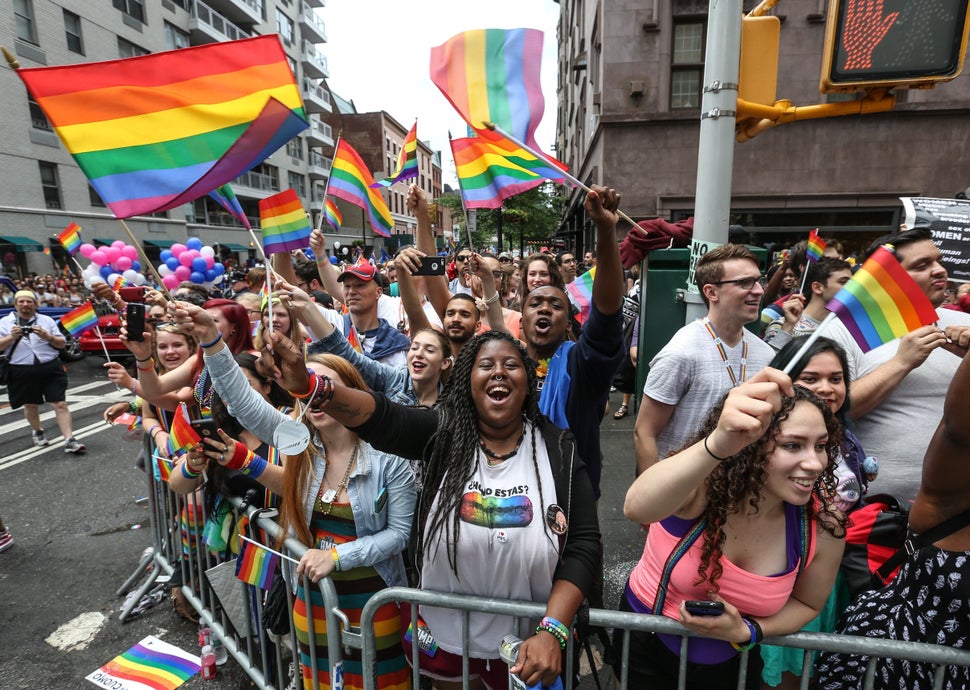
People celebrate at New York's Pride Parade in 2015, just days after the Supreme Court handed down its landmark decision on m

Anadolu Agency via Getty Images

People celebrate at New York's Pride Parade in 2015, just days after the Supreme Court handed down its landmark decision on marriage equality.

But even Cathcart's many admirers were ready for a change. Lambda's leadership was still predominantly white, male and cisgender. Two department heads could hardly stand to work together. Staff argued about whether Lambda's docket was adequately addressing the needs of the poor, people of color, and transgender and non-binary individuals. The New York headquarters didn't have Wi-Fi.

Few people, in other words, were surprised to see Tiven clean house and install new leadership. But they were stricken by many of her other moves — and the unilateral, uncompromising way they claim she made them. Lambda paid soaring consultant fees toward an ambitious restructuring plan around the same time that Tiven hiked the staff's health care contributions — only some people received salary bumps that offset the pain — and slashed pension benefits. Some of her personnel decisions seemed to make longtime racial and gender inequities worse. And she made a raft of changes that juiced Lambda's name recognition, some employees argued, at the expense of its actual impact.

The weightiest moves involved the legal team. Tiven swept in with a plan to dedicate more resources to a narrower set of causes. She envisioned Lambda winning more marquee cases and ceasing to take on issues, such as immigration and parenting rights, that she thought were too niche. Her plan was born out of her belief, and the board's, that Lambda's work had become too diffuse — nearly every attorney on staff had a different specialty — and too obscure. They were hungry to take another case to the Supreme Court.

"We were not as strategic and we were not as aggressive as we once were," said Karen Dixon, a former member of the board who served on the executive search committee that chose Tiven. She and her wife Nan Schaffer are Lambda's top living donors. Before Tiven, she said, a whole new generation of LGBTQ people had never heard of Lambda, and Lambda's legal strategy boiled down to "anybody can chase whatever type of case they want and find interesting."  

The board "felt the organization was coasting, stale," Tiven wrote in an email to donors shortly before her ouster. "I was hired to make big changes."

Early in her tenure, Tiven announced a list of four priorities: suing the Trump administration, fighting Trump's judicial nominees, expanding employment protections and building on the marriage equality victory. The legal team agreed these were worthy priorities. But they recoiled at the idea of discontinuing work on other causes, such as immigration and the rights of the incarcerated.

Rachel Tiven was hired in 2016 to move Lambda into the post-Obergefell future.

Randy Shropshire via Getty Images

Rachel Tiven was hired in 2016 to move Lambda into the post-Obergefell future.

More broadly, her critics felt Tiven lacked the management skills to execute her grand new vision. She failed to appreciate the slow, complicated nature of impact litigation, which often requires leveraging one small courtroom victory into another into another, over the course of many years, to pave the road for a landmark decision. She was prone to altering her priorities and shifting personnel assignments in the middle of cases, making long-term planning impossible, and she made choices, unilaterally, that undercut her own goals. She directed the legal team, for example, to stop taking parental rights cases, to the detriment of Lambda's strategy of protecting the marriage equality decision by advancing marriage equality and parental rights in tandem. In the face of ordinary pushback, emails show, she could be belittling and impatient. 

What Tiven seemed to want were splashy, straightforward victories — even if that meant taking reckless actions. 

Last year, Lambda became involved in Zarda v. Altitude Express, a potential Supreme Court case over whether the Civil Rights Act of 1964 bars employment discrimination against LGBTQ people. Although a Lambda attorney argued the latest phase of the case, it was originally filed by a lawyer in private practice.

Tiven wanted Lambda to take the lead. In New York, as in most states, there are professional rules against lawyers poaching one another's clients. But Tiven, according to an ethics complaint later filed by the original attorney, approached one of the plaintiffs anyway. That attorney slapped Tiven with the ethics complaint, which alleged that Tiven had asked the plaintiff about dropping their private practice attorney in favor of Lambda. ("I can neither confirm nor deny having done so, because a disciplinary complaint is confidential unless the disciplinary committee decides to assess public discipline," the lawyer, Gregory Antollino, told HuffPost.) Tiven called the complaint "utterly baseless," and the committee ultimately found Tiven hadn't violated any rules and declined to take punitive action. But the complaint alone could have had a lasting impact on Lambda's ability to collaborate on future cases.

I don't think seeds are being planted for the future. A Lambda employee who recently left

Then there were the causes that didn't appear on Tiven's list of priorities. Lambda lawyers who worked with marginalized clients — particularly trans people, incarcerated people and people of color — have accused Lambda's management for many years, long before Tiven took over, of failing to provide them with adequate mentorship and resources. But during her tenure, they claimed, their situation became even more challenging.

"Over the last couple of years, legal staff members have been told on several occasions that we must focus our work on certain issues at the expense of others," wrote one lawyer in a parting letter to the board. "The 'others' typically includes work on behalf of some of the most vulnerable communities," such as immigrants or her own specialty, LGBTQ people caught in the criminal justice system. Several people said Lambda was particularly slow to promote the case of Passion Star — a black transgender woman who, for years, was beaten up and sexually assaulted in men's prisons in Texas — seemingly because it wasn't an obvious candidate for press or social media attention.

One Lambda lawyer after another has quit in the past two years, taking valuable institutional knowledge with them. "You lose the ability to recall, 'Oh yeah, we made this argument 10 years ago, the court gave us a sideways win on this, and we can leverage it on that,'" one person said.

Lambda did not respond directly to questions about staff turnover. But internal tallies found that half the staff left in the last two years (its website now lists a staff of roughly 75), and 43 people departed between June 2017 and April 2018. That includes at least eight attorneys who had worked at Lambda for a combined 60 years. A current employee described the remaining legal team, of about 20 attorneys and their support staff, as a "skeleton crew." They are so busy covering their own and their ex-colleagues' caseloads that they rarely have time to research new cases. Nearly every member of the legal team signed the August letter of no confidence. "I don't think seeds are being planted for the future," said one employee who recently left.

'Nothing Salacious Or Juicy'

Not everyone considers the wave of departures a crisis.

"I don't see it as so much turnover," said Dixon, the ex-board member. "You have to have new ideas, new blood, new energy. That's how you change, grow and evolve. The histrionics about 'Oh my gosh, some lawyers left'? Check out any law firm."

Indeed, Lambda's legal work is not at a standstill. Out of all the civil rights groups challenging the Pentagon's ban on transgender service members, Lambda has the most advanced case, the one blocking the policy in court. Within the past few months, it has won access to transition-related health care for a transgender woman in a Missouri men's prison and sued Alaska because of exclusions, also related to transition-related health care, in its state employee health plan. Lambda just sued to stop discrimination against service members with HIV and recently forced the State Department to issue a passport to a non-binary person that accurately reflects their gender identity.

Legal director Sharon McGowan said Lambda has made up for some of its legal personnel losses with new hires, including Diana Flynn, who brings decades of legal experience and is also the first woman of trans experience to join Lambda's leadership.

One of the biggest core issues right now at Lambda is the treatment of the staff. A current Lambda employee

Tiven declined to discuss her critics' arguments in detail. She spoke to HuffPost once by phone but canceled a second phone call and followed up with written statements.

"There's no story here," she wrote in one email. "There's nothing salacious or juicy, the union has been recognized, there's a new interim director, the work continues. If it's a story about people disliking the boss, I've already left."

Tiven also defended her record: "I was hired as a change agent to revitalize Lambda Legal and bring it into the 21st century. I expanded the organization's visibility among existing and new audiences, and opened Lambda Legal's first new office in 15 years to fight the Trump threat up close. I modernized infrastructures and broke down silos, enabling meaningful internal collaboration. Under my leadership, Lambda attracted 9,000 new donors post-Trump: its first new infusion of living donors in a decade."

Cuts to the staff's benefits and changes to their health care coverage were painful, she acknowledged, but necessary to bring Lambda's spending under control and in line with comparable organizations. Dixon agreed that financial realities forced Tiven's hand; that the task fell to a new boss was a stroke of extremely bad luck.

"Rachel Tiven took on the tremendous responsibility of leading Lambda Legal as its CEO through a difficult period of transition following the prior leadership of more than two decades," Lambda said in a statement of its own. "We wish her well in her future endeavors."

'Utterly Inhospitable' To People Of Color

Lambda's current problems are not all of Tiven's making. And plenty of divisions remain after her departure.

Negotiations between management and the new union have grown increasingly difficult. Lambda frustrated the staff by hiring a law firm known for its tough stance on labor — Seyfarth Shaw's website boasts it has "gone up against" the largest unions and learned their "tactics" — yet seemingly unversed in the needs of LGBTQ workers. Take a recent clash over Lambda's bereavement leave policy, which provides time off for the death of an immediate family member. Noting that LGBTQ people are sometimes rejected by their nuclear families, the union wanted the policy to cover the deaths of close friends and other relatives as well. A Seyfarth attorney proposed adding two friends or extended family members to the list — so long as the employee identified those two loved ones in advance of their deaths.

Lambda declined to comment about ongoing negotiations, but said it "respects and supported" its workers' decision to organize.

According to a current employee, "One of the biggest core issues right now at Lambda is the treatment of the staff."

After cuts to employee benefits, even some of its lawyers struggled to make ends meet. One senior attorney delivered food for Caviar, the restaurant app, and graded practice essays. Nobody joined Lambda expecting to be paid handsomely, several people said. But coupled with a feeling that Lambda's leadership sees the staff as interchangeable, the financial burden has become too much to bear for some.

LL has championed itself publicly as a leader in transgender rights while harming the transgender people who work here. A Lambda lawyer in a letter to the board

That goes double for many employees who are not white or cisgender. Long before Tiven became involved, Lambda had a deserved reputation as a difficult place to work for people of color and transgender or non-binary people. Around the same time she became CEO, a black employee circulated a memo saying that employees of color had for years found Lambda to be "'exclusive' and 'alienating' at best and 'utterly inhospitable' and 'oppressive' at worst."

Although Lambda routinely sues others over employee health care plans that deny coverage to trans, non-binary or gender nonconforming individuals for transition-related care, Lambda's own health care plan, a Cigna policy, denies coverage for several transition-related therapies and procedures. The plan has prevented some employees from receiving timely care.

"These are the same types of policies that I and others at LL have filed (and won) lawsuits against," one Lambda lawyer wrote to the board in August. "LL has championed itself publicly as a leader in transgender rights while harming the transgender people who work here." That same month, the Queer Caucus of the progressive National Lawyers Guild warned Lambda that sticking with its discriminatory policy is a potential violation of federal and state laws.

In September, after HuffPost contacted the organization about its health plan, Lambda announced it would establish a health care reimbursement account to compensate employees for any transition-related care that Cigna declined to cover. It is also negotiating with Cigna to end the discrimination, Lambda told HuffPost, but its small size means it doesn't have a lot of leverage.

Tiven promised to improve diversity at Lambda. "I made race equity a top priority in everything we did: what cases to take, what cases to showcase, who had power in the organization, and how people were hired," she told HuffPost. She promoted several employees of color and installed what was probably the most diverse leadership team, including the first woman of trans experience, in Lambda's history.

But staff are divided over whether diversity truly improved under Tiven. One of her handpicked senior managers and several members of a human resources consultancy group hired on her watch repeatedly insulted Lambda's transgender, non-binary and gender nonconforming staff with offensive questions and comments.

The HR team in particular had a penchant for misgendering people — that is, referring to someone by the wrong pronouns. "This has created an extremely toxic environment where many of us feel an absolute lack of respect," several employees wrote in a memo to Tiven in February. "To misgender someone is to attack a person's very sense of self."

Doing so also runs contrary to both Lambda's staff policy and its public policy positions. In May, the organization supported a proposed change to Arizona's rules of professional conduct that would make it a punishable offense for lawyers to misgender people in the courtroom. Yet Lambda's board received two more complaints about in-house misgendering in August. 

You may not feel you have a train wreck on your hands but I can tell you that the community thinks you do. Chuck Loring, a former Lambda board member

As Lambda de-emphasized legal work that fell outside Tiven's big-picture priorities, it also allowed its community education team, which focused on local LGBTQ communities, to disappear through attrition. The team had always drawn internal criticism from those who saw it as an awkward fit for a legal organization. But even those critics said that at its best, the team's work was a clear extension of Lambda's legal advocacy for overlooked communities.

One former team member said he worked with Harris and Dallas counties, two of Texas' largest, to create policies on housing trans inmates. He also conducted practical and sensitivity training for dozens of social workers in the Texas and Louisiana foster care systems on dealing with LGBTQ children. As far as he knows, no one at Lambda has taken up his work.

Without the community education team, Lambda's strongest remaining link to ordinary LGBTQ people is probably a project known as the Help Desk. Conceived of as a way to find test cases, the Help Desk encourages people to report anti-LGBTQ bias by offering them information about their rights under the law. Staffing the desk is a difficult job. Many callers are desperate — some have even threatened suicide, which Help Desk employees aren't trained to handle — and don't realize Lambda is almost certainly not going to offer them legal representation.

Despite these flaws, the Help Desk was part of Lambda's attempts last year to find a new audience among young people. In early 2017 — just after the Trump administration rescinded federal guidelines for protecting trans students — Lambda launched an online campaign to encourage children and parents to report transphobia in schools. "Take action to protect your rights," the website read. "We have your back."

That generated a sudden wave of requests for which the Help Desk was not prepared. "It is impossible and unethical for us to respond to the current call volume with quality," four Help Desk employees wrote in a February 2018 memo to management.

One trans student underwent a mental health crisis and was hospitalized while their parent waited months for the Help Desk to call back, according to the memo.  

What's Next?

Lambda's employees are still feuding. Most of the fights that began or intensified under Tiven remain unresolved, including debates over gender and racial equality, how to retain employees, how expansive and intersectional Lambda's legal portfolio ought to be, and whether efforts to build its name recognition have compromised its strategic integrity. 

Lambda's board, however, is eager to move on. It has formed a committee to boost morale and retention. Lambda has put out an open call for new attorneys. On Oct. 4, the board announced that Richard Burns, a New York LGBTQ rights activist and nonprofit consultant, would become Lambda's interim CEO. The announcement suggested the organization was turning over a new leaf.

During the reporting of this story, five separate sources forwarded to HuffPost a letter that Chuck Loring, a former member of Lambda's board and a longtime donor, sent to the board in September, saying it summed up their feelings on the crisis.

"You may not feel you have a train wreck on your hands but I can tell you that the community thinks you do," Loring wrote. "At this time in the nation's history a strong and vibrant Lambda Legal is needed more than ever. But that is not what you have given us."

Clarification: Language has been updated to explain more clearly the conclusion of the ethics complaint against Tiven regarding Zarda v. Altitude Express.

Do you have information you want to share with HuffPost? Here's how.


~A.