Wood River Junction Was the First
Before Three Mile Island, before Chernobyl, Wood River Junction in Charlestown, R.I., had the first civilian nuclear accident resulting in the death of an employee in 1964.
The accident happened on July 24th of that year at the semi-secret United Nuclear Corporation. The victim was 37-year-old Robert Peabody, a production technician working a second job to help support his wife, Anna, and nine children.

Wood River Junction
United Nuclear Corporation recovered usable uranium from previously used uranium, such as control rods from nuclear reactors. The process involved purifying the scrap through a series of chemical treatments to extract the usable uranium.
Peabody, as usual, worked the second shift at the Wood River Junction nuclear facility. That enabled him to work his day job as a mechanic. On that evening he was to add a chemical to a vat, which he did. However, he used the wrong chemical, which instantly started a uranium chain reaction and an explosion. The blast threw him to the floor and splashed radioactive liquid off the 12-foot ceiling and all over him.
The accident set off all of the emergency sirens. They screamed throughout the building, "Radiation leak, a bad one." Peabody got himself up and started running to the company emergency shack 450 feet away. He tore all of his clothing off along the way, but he didn't make it. He collapsed to the ground vomiting, with blood running out of his nose and ears.
The accident exposed Peabody to more radiation than anyone had since Hiroshima and Nagasaki. Two days later he passed away from radiation poisoning.

Warning sirens at the Indian Point nuclear facility
First Responders
The local Hope Valley Ambulance squad rushed to the scene to transport the doomed Peabody to the nearest hospital, in Westerly. Upon arrival, accident room doctors immediately recognized his condition was far beyond their capability. They sent him to Rhode Island Hospital in Providence, almost 45 miles away. To compound this unfolding tragedy, Robert Peabody's wife caught up with him, perhaps at Westerly. She briefly held his hand. He was so radioactive, the mother of nine children contracted lymphoma.
At Rhode Island Hospital, doctors could do little for Robert Peabody. They placed him in an isolation room, where he expired 49 hours later.
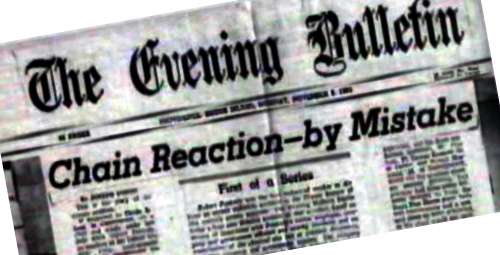
Because his body was so radioactive, it wasn't safe to bury it. So the bishop of the Diocese of Providence was petitioned for permission to cremate him. The bishop granted permission. Subsequently, Anna Peabody received an urn with his ashes. However, she reportedly suspected the ashes were not really his. Her suspicion was probably well founded.
According to a chronicled case, the ashes of a man treated with radioactive isotopes had detectable radiation. So why wouldn't Robert Peabody's ashes have been radioactive? He had received thousands of times more radiation than the medical patient. So perhaps his body lies in a lead-lined coffin somewhere or deep at sea.
Aftermath
United Nuclear made a small cash settlement of $22,000 to his family, which left them destitute.
The Atomic Energy Commission cited United Nuclear with 14 violations. The Environmental Protection Agency named the site of the contaminated Wood River Junction plant a Superfund cleanup site.

Image courtesy Google Maps.
The only bright note in this tragedy is that the site was eventually cleaned. It became and remains today Rhode Island's second largest nature conservancy at a little over 1,100 acres.
Leo Caisse, the author of this story, recently published the book, The Civilian Conservation Corps: A Guide to Their Works in Rhode Island. He has also published a number of historical articles, including Ears On the World in America in World War II Magazine, October, 2017. He has a B.A. and M.A. in American History from Providence College and he lives in East Providence, R.I.
Image: Warning sirens, By Div60 (talk) – I created this work entirely by myself., CC BY-SA 3.0, https://en.wikipedia.org/w/index.php?curid=23518269
What to the Slave Is the Fourth of July? is the popular name of a speech delivered by Frederick Douglass on the Fifth of July 1852 in Rochester, N.Y.
The most famous speech of the orator's career, it marked a departure from his mentor, Boston abolitionist William Lloyd Garrison. In it, Douglass expressed his desire to participate in the political life of the nation, while the more radical Garrison rejected it outright.
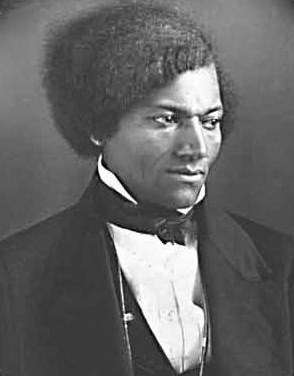
Frederick Douglass in 1848.
Garrison thought the U.S. Constitution supported slavery, that the country was built on slavery and that free states should secede from the Union.
Douglass' Fifth of July speech argued people could interpret the Constitution as opposed to slavery. And it expressed his hope and desire to share in the freedom and justice sought by the Founding Fathers.
In other words, Garrison wanted out of the government created by the Constitution, while Douglass wanted in.
The Fifth of July speech, at 10,000 words, probably took Douglass over an hour to deliver. His sponsors, the ladies of the "Rochester Anti Slavery Sewing Society," had 100 copies printed of his 'most able and eloquent oration' in pamphlet form.
Fifth of July Speech
Douglass starts the Fifth of July speech by telling the white audience that the Fourth of July is the birthday of their independence and freedom. And he tells them their celebration, their 'jubilee shouts,' make the chains of the enslaved 'more heavy and intolerable.'
He acknowledged the achievements of the country's founders, and his audience's right to celebrate them:
They succeeded; and today you reap the fruits of their success. The freedom gained is yours; and you, therefore, may properly celebrate this anniversary.
But then he asks the rhetorical questions, What am I doing here? Should I celebrate this day?
…why am I called upon to speak here today? What have I, or those I represent, to do with your national independence? Are the great principles of political freedom and of natural justice, embodied in that Declaration of Independence, extended to us?
No, he answers just as rhetorically:
The rich inheritance of justice, liberty, prosperity and independence, bequeathed by your fathers, is shared by you, not by me. The sunlight that brought life and healing to you, has brought stripes and death to me. This Fourth July is yours, not mine. You may rejoice, I must mourn.
"What to the slave…"
The 46th paragraph of the speech was perhaps Douglass' most famous passage.
What, to the American slave, is your 4th of July? I answer; a day that reveals to him, more than all other days in the year, the gross injustice and cruelty to which lie is the constant victim. To him, your celebration is a sham; your boasted liberty, an unholy license; your national greatness, swelling vanity…
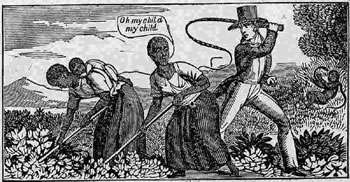
Engraving from the Anti-Slavery Almanac
He grows more and more furious, more and more vituperative:
…your sounds of rejoicing are empty and heartless; your denunciations of tyrants, brass fronted impudence.
Shout of liberty and equality, he stormed, are "hollow mockery."
…your prayers and hymns, your sermons and thanksgivings, with all your religious parade, and solemnity, are, to him, mere bombast, fraud, deception, impiety, and hypocrisy-a thin veil to cover up crimes which would disgrace a nation of savages. There is not a nation on the earth guilty of practices, more shocking and bloody, than are the people of these United States, at this very hour.
The Constitution
He then excoriates religions for their silence on the subject of slavery. But, unlike, Garrison, he defends the U.S. Constitution as a document that rejects slavery.
"Now, take the constitution according to its plain reading, and I defy the presentation of a single pro . slavery clause in it. On the other hand it will be found to contain principles and purposes, entirely hostile to the existence of slavery.
Douglass ends the Fifth of July speech on a note of hope. He predicts the Civil War – and the end of slavery.
The Road to the Fifth of July Speech
Born into slavery in Maryland, Douglass rode the Underground Railroad to freedom in 1838 at the age of 20. He settled in New Bedford, Mass., a good choice of residence. The whaling city's maritime industries were open to African-Americans, and many who escaped from slavery put down roots there. New Bedford by 1853 would have the highest population of African-Americans in the Northeast.
Douglass had taught himself to read while enslaved, and eventually he began to speak out against slavery at abolitionist meetings in New England. He gave his first speech on Nantucket, describing the cruelties of slavery.

William Lloyd Garrison
William Lloyd Garrison, leader of the American Anti-Slavery Society, heard him speak and decided to put him on the broader abolitionist circuit. Garrison, 13 years older than Douglass, mentored him as he rose to stardom as an abolitionist lecturer.
Douglass moved to Lynn, Mass., in 1841, then to Rochester, N.Y., in 1852.
Burning the Constitution
Two years later, on a hot July 4, 1854, at the Harmony Grove picnic area in Framingham, Mass., Garrison publicly burned a copy of the U.S. Constitution. He began with a speech questioning Fourth of July celebrations, much as Douglass had:
"To-day, we are called to celebrate the seventy-eighth anniversary of American Independence. In what spirit?" he asked, "with what purpose? to what end?"
He then burned a copy of the hated Fugitive Slave Act as the abolitionist crowd cried "Amen."
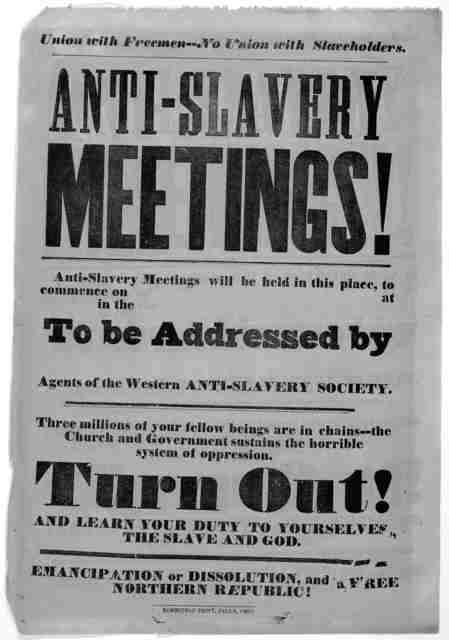
Anti-slavery poster. Image courtesy Library of Congress.
Then he burned a copy of the U.S. Constitution, "the source and parent of all the other atrocities–'a covenant with death, and an agreement with hell'.'" As it burned, he cried out: "So perish all compromises with tyranny!"
Douglass and Garrison broke over their different views of the Constitution. Douglass later explained:
When I escaped from slavery, and was introduced to the Garrisonians, I adopted very many of their opinions, and defended them just as long as I deemed them true. I was young, had read but little, and naturally took some things on trust. Subsequent experience and reading have led me to examine for myself. This has brought me to other conclusions.
Eventually the two men reconciled after the abolition of slavery.
Such actors as Morgan Freeman, James Earl Jones and Danny Glover have delivered the Fifth of July speech. Watch James Earl Jones read excerpts here. Or watch Douglass' descendants read excerpts here.
Read the whole speech here.


No comments:
Post a Comment