Monday, January 20, 2014

How Race Colors the Path to Homeownership | Zillow Real Estate Research

A House Divided – How Race Colors the Path to Homeownership


For millions of Americans, owning one's own home is a fundamental part of the American Dream. It's a goal shared equally among all people, regardless of race or ethnic origin. But while the goal is equally shared, the path to reaching that goal, and even experiences once homeownership is achieved, can be radically different among those races.

In this report, Zillow and the National Urban League examined recent trends in minority access to housing, outlining the different experiences among races when seeking a mortgage and buying and owning a home. We discovered a number of areas in which outcomes for minority groups, particularly blacks and Hispanics, differ greatly from those of white Americans. To perform our analysis we relied on Home Mortgage Disclosure Act (HMDA) data, Zillow Home Value Index data and unique information obtained from a survey performed by Ipsos for the purposes of this study.

To download the full report click here.

To download this executive summary click here.

Background

At a fundamental level, it is important to understand the characteristics and resources with which each group approaches the lending and homeownership process. Different education levels among races, higher or lower incomes and varying credit scores all inevitably shape the home buying and homeownership experiences. There is not sufficient information in the HMDA data nor in the survey data to determine if any of the findings in this report reflect illegal discrimination. Rather, it is these critical differences in qualifications and resources among whites, blacks, Asians and Hispanics that undoubtedly help explain a majority of the findings related to the differences in outcomes by race.

In both the HMDA data and the survey data, blacks and Hispanics had a lower average income, as seen in Figure 1. Blacks and Hispanics who apply for a mortgage are also much more likely to have a lower credit score compared to whites and Asians. In addition, we found that of the surveyed Americans, Asians are much more likely to have achieved a higher level of education, which also contributes to their higher incomes.

Figure1

These unequal incomes naturally lead to stark differences in the amount of down payment that different races are able to afford. Blacks are much more likely to put down 5 percent or less as a down payment, while a majority of Hispanics contribute 6 percent or more towards a down payment. Asians are more likely to have down payments of 20 percent or higher. Figure 2 shows the distribution of down payment amount by race.

Figure2

Experience

Regarding diversity in the home mortgage application experience, we found that blacks and Hispanics are less likely to apply for a mortgage to make a home purchase in the first place, and much less likely to be approved for one than whites and Asians. While blacks make up 12.1 percent of the U.S. population, they filed only 6 percent of all mortgage purchase applications in 2012. Hispanics make up 17.3 percent of the population and filed 9.4 percent of the applications. In contrast, whites make up 63 percent of the U.S. population and filed 64.8 percent of purchase applications. The differences are primarily seen within the conventional mortgage market. The racial and ethnic composition of FHA loan applications is much more similar to the racial and ethnic composition of the nation as a whole. Blacks and Hispanics are much more likely to apply for an FHA mortgage than a conventional loan when purchasing a home as more than half of black applicants (57.4 percent) and 60.3 percent of Hispanic applicants applied for an FHA loan. In contrast, less than one-third (30.1 percent) of white applicants apply for an FHA loan. See Figure 3 for an overview.

Figure3

Figure4

According to HMDA records, we also found that blacks and Hispanics are much more likely than whites to have their mortgage application denied. When applying for a conventional loan, black applicants are 2.4 times and Hispanic applicants are 1.98 times more likely than white applicants to be denied. When applying for an FHA loan, black applicants are 1.75 times more likely and Hispanic applicants are 1.47 times more likely than white applicants to be denied. These trends are shown in Figure 5.

Figure5

Overall, a majority of survey respondents from each race surveyed had a positive experience when applying for a mortgage (as indicated by a rating of more than 8 on a 1-10 scale). A minority within each race surveyed felt that their race had at least some influence on their experience of trying to obtain a mortgage, though it remains unknown if respondents felt their race had a positive or negative influence on their experience. Specifically, 37 percent of Hispanics, 33 percent of blacks, 25 percent of Asians and 14 percent of whites said they thought race was a contributing factor in their experience.

Respondents who said they felt race was a factor in their experience obtaining a mortgage were significantly more likely to have shopped around for multiple mortgage quotes. In general, Asians and Hispanics are more likely to have considered multiple loans from multiple lenders, while blacks are more likely to have considered multiple loans from the same lender. Hispanics and Asians are more likely to go with a lender who was recommended to them, while blacks and Hispanics are more likely to recommend their lender to a friend or family member. In addition, Asians and especially Hispanics are more likely to have two or more mortgage applications. Blacks and Hispanics are more likely to have their mortgage process take longer.

Differential impacts of the housing recession and recovery

Over the last 13 years, the nation underwent a steep run-up in home values, followed by a grueling collapse of that housing bubble. Now, more than two years after home values bottomed, a robust housing recovery is currently underway. However, not everyone experienced the housing boom and bust in the same way.

Figure6

Hispanic communities (where Hispanic individuals make up a larger share of the population than any other group) were hit hardest by the housing boom and bust, with home values falling 46.2 percent from the height of the bubble to the bottom. Black communities, where black individuals make up a larger share of the population than any other group, were also hit hard, with home values dropping 32.3 percent over the same period. Drops of 23.6 percent and 19.9 percent were observed within white and Asian communities, respectively (see Figure 7).

For Hispanic communities, there has been something of a silver lining. Even though home values in Hispanic communities were hardest hit, they've been relatively faster to recover. Home values in Hispanic communities have increased 25.3 percent from the bottom over the past two years. Comparatively, home values in black communities have only increased 13.2 percent.

Figure7

Figure 7 shows the difference in current home values relative to their post-recession bottom (i.e., the low point in home values subsequent to the boom-era peak), and clearly demonstrates how much faster Asian communities have rebounded. Asian communities are in full recovery, with current home values only 0.6 percent below their peak levels. Hispanic communities are forecasted to do the best over the next year in terms of home value growth. According to the Zillow Home Value Forecast, Hispanic communities will appreciate by 16.8 percent, Asian communities by 15.6 percent, white communities by 8.3 percent; and black communities by 8.5 percent.

Much of the drop and subsequent rise in home values can be attributed to the location of these communities. As Map 1 shows, many Asian communities are located on the West Coast, which has had an incredibly strong recovery. While Hispanic communities were hit incredibly hard, with many of them located in the "sand states" of California, Arizona and Nevada, they are rebounding well (see Map 2). As Map 3 shows, blacks are located in many cities nationwide that have had less robust housing recoveries, putting a damper on their forecasted growth.

Unfortunately, during the housing bust, homeowners not only lost an enormous amount of value in their homes, but were frequently foreclosed upon, losing their homes altogether. We examined changes in homeownership rates over the last decade. In 2011, 46.5 percent of blacks and 50.9 percent of Hispanics owned their home. The homeownership rate for whites was 73.9 percent. Ownership rates for white and Hispanics have hardly changed over the course of the last decade (-0.1 and 0.1 percentage points respectively). However, among blacks the ownership rate dropped 2.4 percentage points, while the homeownership rate of Asians increased by 2.4 percentage points (see Figure 4).

To view the full report, or download this executive summary please visit our reports page.

Maps 1 and 2

Map 3


~A.

Sunday, January 19, 2014

7 Of The Weirdest, Most Promising New Jobs In 2014 | Fast Company | Business + Innovation

7 OF THE WEIRDEST, MOST PROMISING NEW JOBS IN 2014

For the first time in years, job growth projections aren't entirely dismal, and plenty of people are itching for a new gig. According to one survey, 20% of Americans are looking to change jobs in the next year. Economists are saying that there could be more full-time, high-quality opportunities out there, too. And while you could look for a job in sales or finance or engineering, there are more exciting options--weird new gigs that hardly existed six months ago but that, by this time next year, you won't stop hearing about. Here are seven of the most peculiarly promising new lines of work out there.

Cannabis capitalist

A year ago, the ArcView Group, a network of angel investors focused on the cannabis industry, had 25 members. Now, says Troy Dayton, the group's CEO, they've got about 120 high net worth people, who're looking to build what Dayton, a long-time advocate for legalization, likes to call "the next great American industry."

"Everything changed when Washington and Colorado passed legalization in 2012," says Dayton, "but it didn't really, really change until last week."

As of January 1, responsible adults (irresponsible ones, too, most likely) can walk into stores in Colorado and Washington and legally buy pot for recreational use. And there are plenty of entrepreneurs ready to take advantage of these new markets--not just growers and dispensary owners, but purveyors of vending machines, specially composed soil, power pipe cleaners, inventory software, topical creams, and slick accessories. They just need capital.

And there are an increasing number of VC and private equity firms eager to provide it. A few, like ArcView and Privateer Holdings, which is run by Yale School of Management alums, have gotten a jump on the market, but new firms are popping open, too. There's plenty of opportunity to go around: Analyses from both ArcView and Medical Marijuana Business Daily predict that, in the next year, the industry's revenue will at least double.

Insta-driver

These days, simply driving a car around can mean being on the entrepreneurial cutting edge, as companies like Uber, Sidecar, and Lyft are making it easy for anyone with a set of wheels to make money playing cabbie. With a new-enough car and some basic preliminary info about the company of choice and the city streets, almost anyone can sign up to start providing rides-on-demand to people who'd rather push a button on an app than call or hail a cab.

Whether this is actually a job is up for debate: Sidecar and Lyft both call the people behind the wheel "community drivers," and Lyft calls the payment for the ride a "donation." But it's possible to drive for UberX--Uber's more casual, and cheaper, service--and make as much (or more) money in a year as a yellow cab driver might. While there's been some disagreement between drivers and Uber whether fare cuts have been good or bad for business, recruits to the UberX ranks reportedly range from a startup founder waiting out a non-compete clause to a transportation engineer with a master's degree, who drives full-time.

The ultimate 2014 driving job, however, could be one that does not involve driving at all--car companies might be eager to show off their newly driver-less cars, but, according to law in test-ground states like Nevada and Michigan, there still needs to be an actual human in the driver's seat.

Google Glass model

Dressing up models in dorky tech gear isn't exactly a new gambit. Google Glass first did the rounds at New York Fashion week in 2012, and last year appeared in Vogue's inimitable September issue. But none of it's worked to convince the masses that Glass is cool, exactly, and with a new version coming in 2014, there should be a whole new round of chances for attractive people to give the device a spin. And until someone (okay, Apple) designs a smartwatch that an average person would want to put on, models are the wearables industry's best bet for making their products look good.

Cryptocurrency trader

Every day, it's looking more certain that the Bitcoin boom is here to stay. Recently a U.K. startup announced it was opening a Bitcoin vault insured by Lloyd's of London, and the inventor of the world's first Bitcoin ATM started negotiating a rental agreement to install it in a New York City bubble tea shop.

With hundreds of cryptocurrencies out there, and a burgeoning number of exchanges, speculation in digital coin has become rampant. At the January 1 opening of the Bitcoin Center of New York--just a few doors down from the New York Stock Exchange--spontaneous trading broke out on the floor. Some early adopters have transitioned to trading full time. One key to cleaning up, says Nick Spanos, a founding member of the new center, is to watch for currencies to jump from less highly esteemed exchanges to a major hub like BTC-e.

If all this sounds appealing, the Bitcoin Center is offering classes in trading digital currency. "Stockbrokers, lawyers, regular people with no job, everyone's coming," says Spanos.

Foxconn factory worker... in Pennsylvania

Global economics are, slowly, shifting the logic of outsourcing and bringing factory jobs back to the United States. But this process can be a little complicated. Because of demand from existing customers for made-in-the-USA products, Foxconn, the iPhone-manufacturing company that's become emblematic of grueling factory conditions in China, that it would expand its operations to Harrisburg, Pennsylvania.

The Harrisburg factory will be Foxconn's largest in the U.S.--but not its first. The company already has outposts in Texas and Indiana. In China, a Foxconn factory might have its own hospital, a series of company-backed stores, and hundreds of thousands of workers, many of whom live in dorms and work more than 60-hour weeks. The Pennsylvania factory will have 500 employees and U.S. labor laws to contend with. And workers will be doing "high-precision" manufacturing--working a different sort of assembly line than their Chinese counterparts.

It's not just Foxconn that's seeing some advantage in American-made goods, either. Other sectors are looking at "onshoring" jobs, and for the first time in a long, long time, the manufacturing picture is looking rosier.

Quantitative Editor

As part of FiveThirtyEight's expansion beyond sports and politics, to include economics, culture, and science, data master Nate Silver hired Andrew Flowers, an analyst for the Atlanta Fed, to be his new site's Quantitative Editor--a job Silver describes as "a cross between an economist, a quant, an editor, and a writer."

There are increasing numbers of journalists who fit this description--numbers people who can write, and whose data-geekdom is championed, rather than siloed. Now the job has a catchy name, and every news organization is going to want one.

Drone safety expert

The drone industry is optimistic about its economic potential: One industry study predicted that the business of flying unmanned aircraft could create 100,000 jobs in the next decade, and 70,000 just in the first three years in which drone-flying is legal. A pilot could earn as much as $115,000 annually.

First, though, the Federal Aviation Administration needs to be convinced that these things are safe. The agency , from Alaska to Texas to Virginia, where researchers will evaluate risks and develop protocols like standard categories, operator codes, and certification requirements. Making up those rules might sound dull, but it means asking simple, yet mind-boggling questions: How do we organize these small, flying objects? Who gets to fly one? How are we going to keep them from crashing into planes?

The test sites have approval through 2017 to try to find the answers, and, as a bonus, create many, many jobs in places as diverse as upstate New York and North Dakota.


A.

Friday, January 17, 2014

Growing Smart Legislative Guidebook

thought you'd like this...

Growing Smart Legislative Guidebook

States and their local governments have practical tools to help combat urban sprawl, protect farmland, promote affordable housing, and encourage redevelopment. They appear in the American Planning Association's Growing Smart Legislative Guidebook: Model Statutes for Planning and the Management of Change, 2002 Edition.

Printer Friendly Version

dextopia...

dextopia - Google Search:

On Such a Full Sea by Chang-rae Lee (Hardcover): Booksamillion.com: Books

On Such a Full Sea by Chang-rae Lee (Hardcover): Booksamillion.com: Books: "  (0)   On Such a Full Sea by Chang-rae Lee Overview - This limited, numbered edition of Chang-rae Lee's "On Such a Full Sea" has a specially designed cover and a first-of-its-kind 3D printed slip case made on a MakerBot(R) Replicator(R) 2 Desktop 3D Printer, made with MakerBot PLA filament, a bioplastic made of corn, fabricated by MakerBot in Brooklyn, New York.  Read more...   Hardcover $150.00
Add to Wishlist", please.

'via Blog this'

87 Solar Myths eBook - Thank You For Your Interest - Real Goods Solar

http://realgoodssolar.com/thank-you-87-solar-myths-ebook/

Will do....
~A.

Water Purification in Mystic, CTStrategic Water Resources

INDUSTRY SEGMENTS AND APPLICATIONS

SWR is uniquely positioned to capitalize on global water industry growth potential, insuring positive economic, as well as environmentally sustainable results for our clients.

Resort and Hospitality Operations:

SWR is engaged in strategic relationships to provide sustainable, long-term, clean water solutions to the Resort and Hospitality industry. Forward osmosis desalination plants integrated with our NeptuneCF purification technology are scalable to fulfill onsite water requirements for this industry segment.

The choice of a desalination process is determined by the chemistry and physical condition of the feed water, output water quality requirements, and the energy source available to power the plant. The benefit of Strategic Water Resources desalination plants is in their ability to provide independence from municipal water sources, giving the client control of onsite water requirements and costs.  Our systems fulfill the water usage demands of these resort and hospitality locations at an industry standard of 200,000 gallons per day potable water.

Waste-to-Energy Operations:

Currently there are approximately 800 facilities worldwide that utilize combustion of municipal solid waste, with energy recovery. Waste-to-Energy plants require immense quantities of water.  SWR systems optimize the recycling of water from various fluid streams by these facilities to reduce environmental impact and operational costs.

Contaminated Marine Ballast Water:

Stagnant water stored inside ballast trim tanks requires purging of biological agents prior to discharge into the environment. Demand for ballast water treatment systems (BWTS) followed adoption of the International Convention for the Control and Management of Ship's Ballast Water and Sediments in 2004. This Convention aims to address the issue of marine species discharged into a new environment that may endanger native ecologies, threaten local economic activities such as fisheries, or foster diseases to the human population.

SWR supplies a cost effective, on-board, compact, retrofittable solution for individual vessels to meet the new international regulations. The system processes ballast water by removing all biological elements while the vessel is underway. System integration into the vessel is designed to minimize impact on vessel timescales with no dry dock requirement.

Hydraulic Fracturing – Oil and Gas:

SWR pre-processes well injection fluids to eliminate the need to add chemicals (biocides) to kill bacteria and algae growth. The flowback fluid can then be post-processed to re-cycle the water for another injection, or for reintroduction to the open environment while meeting client and/or regulatory requirements. This process also reduces demand on the Earth's water table.

Agriculture – Hydroponics, Aquaponics:

Agriculture accounts for approximately 70% of global water demand and carries significant long-term challenges in the form of water scarcity and rising food demands. As a consequence of extreme weather, particularly drought, there is a pressing need to implement and develop more effective water management practices to produce crops with greater water-use efficiency.

SWR is positioned to provide hydroponic or aquaponic farms oxygen- enriched water supplies that will shorten growth cycle time while enhancing plant nutrient content. SWR also provides waste water purification solutions for crop irrigation.

Mining:

The mining industry is particularly dependent on water as a key input to the processing system.  Ore is crushed into finely ground tailings and mixed with various chemicals. As the number of mines operating in water scarce regions increases, there is a corresponding need to ensure secure access to water.  Water pollution from waste rock and tailings has prompted national regulators to focus on water quality surrounding mining areas. One stressor stems from mechanization of the industry enabling mining companies to handle more rock and process minerals from lower grade ore while generating large volumes of waste.

SWR's NeptuneCF purification technology is tailored to maximize water re-use and reclamation in the mining industry.

Transportation Maintenance Logistics:

SWR reprocesses and filters water used in high volume cleaning operations such as car washes or transport fleet maintenance for repeated water re-use. Similar applications are easily customized for aviation cleaning facilities, road freight maintenance operations, and marinas.


And thats probably not all....
~A.

Water Purification in Mystic, CTStrategic Water Resources

SWR's NeptuneCF TECHNOLOGY


Our NeptuneCF Ozonation technology is a Patent Pending process combining several proprietary hardware components that improve upon the state-of-the art by dramatically lowering input power requirements for ozone production, as well as improving the volumetric efficiency of the crucial gas-fluid interface.  NeptuneCF is a Chemical-Free process, so it is environmentally sound.

NeptuneCF utilizes singlet oxygen (O1)  along with ozone (O3) and related by-product radicals to neutralize biological pathogen agents and prepare complex inorganic molecules for downstream depolymerization by breaking carbon-nitrogen bonds, all without injecting any chemicals.

A high concentration of reactive O1 gas is produced by our proprietary electrical discharge ozonator and is then injected into the fluid stream via our patented manifold and contact chamber piping circuit. This circuit includes passive mechanical devices to increase fluid cavitation, further enhancing the chemical reactions involved. The injected O1 reacts in solution with the fluid as it flows down this circuit, reducing in part to form ozone (O3) and radicals such as hydrogen peroxy (HO2) and hydroxyl (OH) . These are all strong virucides and oxidants which will disinfect via several mechanisms, including cell wall disintegration (cell lysis).

Our base Water Purification System, the SWR50 Module, processes 50,000 gallons of water per day (4.65 cfm) on a duty cycle basis.  Multiple units can be configured to accomodate increased flow rates, operational redundancy and scalability based on processing requirements. The SWR50′s portability assures that it can be quickly deployed and integrated into a system as needed. Larger flow rate units are in the design stages.

Remote networking is implemented via PLC sensors to monitor and diagnose the systems operations globally. Our PLC System monitors Performance and Water Quality in real time via imagery from an on-stream microscopic camera; this imagery is translated into output data via sophisticated algorithms.

The entire customized solution can be provided world-wide with on-site installation assistance where needed, as well as training, and regular maintenance. Where the client has multiple installations, we can train the client's staff  to handle installation and maintenance. Our alternative energy expertise allows us to design, specify and build solar/wind energy systems to provide clean power in remote areas, or supplement existing grid power.


Can i help?
~A.

Valuing Mitigation Strategies...in Mystic & Groton...

http://www.esri.com/news/arcuser/1010/files/coast.pdf

Water Purification Systems in Mystic, ConnecticutStrategic Water Resources

WATER PURIFICATION SYSTEMS IN MYSTIC, CONNECTICUT

Strategic Water ReSources (SWR) is a registered Connecticut Corporation founded in 2013 specializing in the design, procurement and implementation of water processing devices and systems. SWR was created by a focused team of scientist, engineers and entrepreneurs that possess decades of unique experience and skill sets especially suited for the highly competitive water purification market. One of our primary ancillary goals is to bring economic development and green technology to Southeastern Connecticut. This will be accomplished by hiring local veterans and industry experts within our community. The primordial challenge facing our entire industry is the anticipated global demand for clean water. Presently this is an underserved market. Our main focus is to provide ecologically sound water purification strategies and technologies that are cost-effective and environmentally sustainable. We are committed to bring economic development and green technology to the global community.

SWR's office is located at 32 Williams Ave, Mystic, Connecticut. Our Mystic facility includes administrative, research & development, production operations and field support. With worldwide experience in networked energy management systems and solar energy systems, the team includes engineers with software and hardware development, installation, manufacturing, and client service backgrounds. These team members have made a professional, monetary and personal commitment to the success of SWR.

Our goal at SWR is to design customized solutions to meet our client's specific water processing requirements.  While we provide our flagship NeptuneCF technology as the central system component to mitigate
biological and inorganic elements, we can specify, support and provide other system elements, such as:

  • Forward Osmosis Desalination
  • Multi-Media and Membrane Filtration
  • Electrical Coagulation
  • Oil/Water Separation

Our alternative energy expertise allows us to design, specify and build solar/wind energy systems to provide clean power in remote areas, or supplement existing grid power.

These customized solutions can be provided world-wide with on-site installation assistance where needed, as well as training, and regular maintenance. Where the client has multiple installations, we can train the client's staff  to handle installation and maintenance.

Our management team welcomes the opportunity to discuss these possibilities in greater detail. Please contact us if you have any questions.


Nice trailer.....
~A.

Thursday, January 16, 2014

From Saved to Stolen: Thief Absconds with Extinct-in-the-Wild Water Lily | Extinction Countdown, Scientific American Blog Network

From Saved to Stolen: Thief Absconds with Extinct-in-the-Wild Water Lily

Nymphaea thermarumThis is why we can't have nice species: Last week one of the world's rarest plants was stolen from public display in London at the Royal Botanic Gardens, Kew. An unknown thief or thieves walked in, pulled or dug up the plant and disappeared with it.

The tiny thermal water lily (Nymphaea thermarum) is the smallest water lily in the world, with a flower barely the size of a human fingernail. Native to a single hot spring in Rwanda, the plant went extinct in the wild a few years ago after the spring was drained for local agricultural use. As I wrote back in 2010, the water lily was saved from extinction by botanist Eberhard Fischer, who discovered the species back in 1985 but never figured out how to propagate it in captivity. That changed in 2009 when Kew horticulturist Carlos Magdalena figured out that the lily thrived not in water, like all other water lilies, but in damp mud at very specific temperatures and atmospheric conditions.

Since then Kew has managed to grow about 50 of the plants, and has transferred a handful to other facilities. Nevertheless it remains critically endangered. Kew considers the stolen lily to be "priceless" and vital to the conservation of the species. Police are currently investigating the crime of the lifted lily.

Guy Barter, chief adviser to the Royal Horticultural Society (which runs Kew Gardens), told the Telegraph that theft from a public garden is unfortunately common as well as dangerous to the plants. In this case he blamed something more sinister than the general public: "plants stolen to order and sold for profit" for collectors who will "sink to any depth to have something they really want."

Look, I get the collector's mentality. I'm the kind of guy who has spent hundreds of hours in dingy used bookstores or comic book shops to track down that one last early Joe R. Lansdale paperback or obscure Matt Howarth comic that I must have for my collection. But stealing rare plants and animals from captivity and the wild or checking off the list of species that you have hunted and killed, that's a drive I don't understand. This is why smuggled, endangered tortoises sell for tens of thousands of dollars, why rare orchids are black-market treasures and why a permit to hunt an endangered black rhino can sell for $350,000. And for what? For a head to hang on your wall, a tortoise to wander the grounds of your estate or a plant you'll have to struggle to keep alive under incredibly precise conditions?

It might not be easy to find whomever stole this water lily. Kew, unfortunately, didn't have a security camera pointed at right spot. The tiny plant was no doubt easy to hide as the thief slipped out of the garden. Even with police investigating, it may be gone forever. Unfortunately, with precious few plants and seeds available to keep the population of this species growing, the footprint of this one plant's loss may be felt for a long time to come.

Photo: Nymphaea thermarum, courtesy of Kew Gardens


~A.

"First 3D-printed book cover" created with a MakerBot

"First 3D-printed book cover" created with a MakerBot

3D-printed book cover of On Such a Full Sea by Chang-rae Lee created with a MakerBot

News: US publisher Riverhead has collaborated with 3D-printing firm MakerBot to create the first printed book sleeve.

A desktop MakerBot Replicator 2 was used to print the slipcase for Korean-American writer Chang-rae Lee's futuristic novel On Such a Full Sea, released on 7 January.

"We think the 3D-printed slipcase for On Such a Full Sea is a work of art, and one we are very proud to have helped create," said MakerBot CEO Bre Pettis.

3D-printed book cover of On Such a Full Sea by Chang-rae Lee created with a MakerBot

The case was designed by Riverhead art director Helen Yentus and members of MakerBot's in-house design team.

The title lettering is extruded and stretched across the white printed sleeve, as a continuation of the flat writing on the yellow hardback tucked underneath.

"What I like about this project is that it re-introduces the idea of the book as an art object," said Lee. "Content is what's most important, but this [3D edition] is a book with a physical presence too."

3D-printed book cover of On Such a Full Sea by Chang-rae Lee created with a MakerBot

The technology was used as an experimental proposal for the future of books covers, which the designer says are becoming less significant as digital books are more widely read.

"We've talked a lot about what's going to happen to books and cover designers if covers aren't necessarily going to be the focus anymore," said Yentis in a film about the book. "We're looking for new ways to present our books."

Only 200 copies have been produced with the printed covers, each signed by the author. These limited editions are on sale for $150 (£91) and the book is also available with an alternative hardback cover, as well as an electronic version.

When Dezeen spoke to Pettis in 2012, he told us that cheap 3D printers mean manufacturing can again take place at home - read the full interview here.

More information from the publishers follows:


3D-printed slipcase for hardcover of Lee's latest novel On Such a Full Sea

In an unprecedented and innovative format, award-winning and Pulitzer Prize–nominated author Chang-rae Lee debuts his new novel, On Such a Full Sea, with a first-of-its-kind 3D printed slipcase, printed on a MakerBot Replicator 2 Desktop 3D Printer.

This highly anticipated new novel, set in a dystopian future America, comes as a signed limited edition hardcover with a custom 3D printed slipcase, designed by Helen Yentus and MakerBot. Only 200 of the 3D printed slipcases will be sold.

"What I like about this project is that it re-introduces the idea of the book as an art object," said Lee. "Content is what's most important, but this [3D edition] is a book with a physical presence, too. Of course I hope what's inside is kinetic, but the physical thing isn't normally meant to be. This edition feels as if it's kinetic, that it has some real movement to it. It's quite elegant as well."

In talking about the 3D printed slipcase that was made on a MakerBot, Lee noted, "It's all about changing the familiar. That's ultimately what all art is about. That's what we all do as writers."

Though it won't be released until January, On Such a Full Sea has been lauded and highlighted in all of its early reviews: "An astonishing feat of encapsulated genius from the inimitable Lee... Brilliant... A heart-thumping adventure," said Library Journal. Booklist said On Such a Full Sea is "Always entrancing and delving…. Takes a truly radical leap in this wrenching yet poetic, philosophical, even mystical speculative odyssey…. Electrifying." And Kirkus described the novel as "a harrowing and fully imagined version of dystopian America... Welcome and surprising proof that there's plenty of life in end-of-the-world storytelling."

Chang-rae Lee using a MakerBot Replicator 2 to create his 3D-printed book cover
Chang-rae Lee using a MakerBot Replicator 2

Chang-rae Lee is a deeply influential writer who tells stories about race, class and immigrant life in America. He has built a dazzling reputation as "a spellbinder" (Hartford Courant), "a master craftsman" (Washington Post), and "an original: (Los Angeles Times), and has been honoured with top prizes, including a PEN/Hemingway Award, Dayton Literary Peace Prize, and Asian American Literary Award; been a finalist for the Pulitzer Prize; nominated for the Neustadt International Prize for Literature; and selected for the New Yorker's "20 Writers for the 21st Century" list.

"We are honoured to work with Chang-rae Lee and Riverhead Books," noted Bre Pettis, CEO of MakerBot. "We think the 3D printed slipcase for On Such a Full Sea is a work of art, and one we are very proud to have helped create."

On Such a Full Sea is a bold and thrilling departure from Lee's previous novels. In On Such a Full Sea, Lee has turned his acute eye toward the future of America. The story takes place in a chilling dystopia, a century or so beyond the present, where abandoned post-industrial cities like Baltimore have been converted into forced labor colonies and populated with immigrant workers. China is a distant, mythical memory. Environmental catastrophes have laid waste to much of the world, a cancer-like disease has infected the entire population, and stratification by class and race is more pronounced and horrific than ever. The fate of the world may lay in the hands of one tiny, nervy girl named Fan, an enigmatic and beautiful fish-tank diver who jolts the labor colony by running away.

Epic in scope, masterful in execution, and page-turning right to the shocking end, On Such a Full Sea fires on many levels: it is simultaneously a heart-stopping survival adventure across the wasteland of a wrecked continent; a deeply moving story of a girl's first love; and a searing, frightening commentary on where America may be headed if we don't strive to do better. The Boston Globe writes that Lee "asks the crucial and abiding question: How do we live a kind and decent life in this woeful world?" On Such a Full Sea imagines a future in which that question is more urgent than ever, and challenges us to ask what we need to change today.

Chang-rae Lee is the author of Native Speaker, winner of the Hemingway Foundation/PEN Award for first fiction; A Gesture Life; Aloft; and The Surrendered, winner of the Dayton Peace Prize and a finalist for the Pulitzer Prize. Selected by The New Yorker as one of the "20 Writers for the 21st Century," Lee is professor in the Lewis Center for the Arts at Princeton University and a Shinhan Distinguished Visiting Professor at Yonsei University.


~A.

Swimming pools for the River Thames in central London by Studio Octopi

?, my thoughts exactly...

Swimming pools for London's River Thames by Studio Octopi

London architecture firm Studio Octopi has designed a concept for swimming pools that would enable Londoners to enjoy views of the city centre while bathing in the tidal waters of the River Thames.

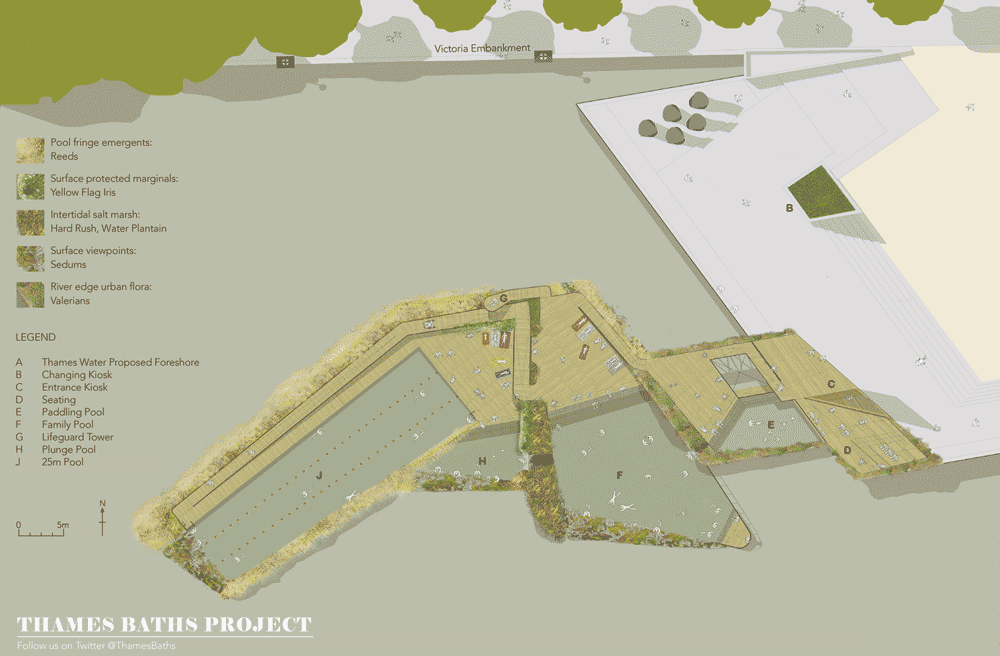
Thames Bath Project by Studio Octopi

Studio Octopi developed the proposal in response to plans from the city's water supplier Thames Water to upgrade London's 150-year-old sewage system, which would result in a huge improvement in water purity.

"A lot of people screw their noses up at the thought of swimming in the Thames but it already occurs within very controlled conditions, such as at Hampton Court and the Docklands," Studio Octopi director Chris Romer-Lee told Dezeen.

Thames Bath Project by Studio Octopi

Thames Water plans to construct a new tunnel, dubbed the Super Sewer, which will remove 96 percent of the sewage currently entering the river and is scheduled for completion in 2023, if planning permission is granted.

Thames Bath Project by Studio Octopi
Exploded view of structure

Studio Octopi proposes building pools at two of the Super Sewer construction sites; Shadwell in the east of the city and Blackfriars Bridge in central London.

"Imagine the views from the waterline, downstream to the London Eye, upstream to the City," said Romer-Lee of the Blackfriars location. "Whether it's for sport or leisure, bringing these alternative uses to the heart of cities unites diverse communities, encourages physical activity and invigorates the flora and fauna of our much overlooked river."

Thames Bath Project by Studio Octopi
Plan - click for annotated larger image

Romer-Lee pointed out that the concept doesn't rely on the Super Sewer, but does require the UK government to take steps to improve the current sewage system and water quality in The Thames, which currently falls below European standards.

The architects worked with structural engineering specialist Civic Engineers to develop the design, which includes a pair of pools supported by a concrete slab and raised to the height of the high water mark on a series of steel columns. The pools would be replenished with fresh river water at high tides.

A further pool made from concrete waffle slabs anchored to fixed posts would float on the surface of the river, rising and falling with the tide while protecting swimmers from the tidal currents.

Thames Bath Project by Studio Octopi
Sketch showing view from the water

Concrete decks with cast-in air pockets would surround the pools, providing places for swimmers to rest and counterbalancing heavy gabion cages filled with rocks and plants.

Jonathan Cook Landscape Architects contributed ideas for planting to enhance the natural look of the pools, including reeds to fringe the floating pool and perennials and ferns along the wharf edge. Over time, algae, ferns and saline plants would cover the supporting structure as it gradually weathers, while native plants would colonise the planted areas.

Thames Bath Project by Studio Octopi
Concept sketch

Studio Octopi's design was one of five proposals created by teams chosen to submit ideas for a project called London As It Could Be Now, developed by The Architecture Foundation with architecture firm Rogers Stirk Harbour + Partners.

The concepts for new ways to make the most of the River Thames were presented last autumn as part of the exhibition Richard Rogers RA: Inside Out, at London's Royal Academy.

Images are by Picture Plane.

The architects sent us the following details:


London-based architects Studio Octopi propose reintroducing swimming in the tidal River Thames

As a result of the collaborative London As It Could Be Now project, developed by The Architecture Foundation with Rogers Stirk Harbour + Partners and the Royal Academy of Arts, Studio Octopi were selected as one of five teams to work up new visions for the Thames. The teams were encouraged to explore ideas that increased interaction with the waterway and raised awareness of this important artery running through the Capital. Thames Baths Project is collaboration between architects Studio Octopi, Civic Engineers and Jonathan Cook Landscape Architects.

In 1865, Sir Joseph Bazalgette's London sewage system was opened. 150 years later the sewers are at the limits of their capacity. In 2012, 57 combined sewer overflows discharged 39 million tonnes of sewage into the River Thames.

Thames Water is planning the Thames Tideway Tunnel, or 'Super Sewer', for completion in 2023. This tunnel will remove 96% of the sewage currently entering the river. Instead of a weekly discharge into the river, the Super Sewer will overflow a maximum of 4 times a year.

When Sir Joseph Baselgette's sewer system was finally completed in 1875 swimming in the River became a common occurence. In the same year a floating swimming baths opened on the foreshore at Charing Cross. Heated river water was pumped around an iron and glass structure. Then in 1878 Agnes Beckwith 'the greatest lady swimmer in the world' safely swam 20 miles from Richmond to Westminster and back again. The improvements in water quality open the possibility for once again swimming in the tidal Thames. The Thames Baths Project looks to re-establish an intimate and playful link between Londoners and the historic lifeblood of the city, the River Thames. Here is an opportunity for Londoner's to reclaim ownership of their largest outdoor public space.

Studio Octopi's proposals are focused on two of the Super Sewer construction sites: Blackfriars Bridge Foreshore and King Edward Memorial Park Foreshore. These sites were chosen for their contrasting London contexts. As well as creating a community resource and tourist attraction, its proposed that these floating and fixed aquatic landscapes should also continue to improve the ecology of the River Thames. Growing from planted rock cages (gabions) an array of native planting forms enclosure and frames views to the surrounding city. The fixed pools, lifted high on timber and steel piles, are replenished at high tide like coastal rockpools. The floating pools rise and fall with the tide offering a unique experience with the river. The sunken structure protects the swimmers from currents, whilst the planting offers tantalising views to the city beyond.

Intertidal Flora by Jonathan Cook Landscape Architects

Imagine swimming in the tidal river, surrounded by reeds that frame tantalising views of the city around you. The pools are not just for swimmers, but provide refuge and habitat for fish, birds and a wide range of flora.

Here in the heart of London is the upstream limit of saline plants on the Thames, and a series of layered habitats. From the algal slime at the base of the structure to the gabion-protected surface planting, the stages mimic salt marshes to freshwater wetlands.

As the supporting timbers weather they will be colonised by algae, ferns and saline plants such as sea beet and sea aster. The extensive planting of reeds around the pools will frame viewpoints edged with low sedums, and surface beds of yellow flag iris. The flooded pool will feature salt marsh species such as rushes and water plantains, while the wharf edge planting will be a relaxed mix of colourful perennials (red valerian) and ferns. All planted areas will soon be accompanied by naturally colonising plants, some native, others typical of London's introduced alien flora.

Structural Principles by Civic Engineers

The fixed structure consists of a randomly ordered grillage of small sectioned steel channels founded in the river bed and extending to a height just below the high water mark. Embedded within the frame will be non-structural timber members to encourage the colonisation by flora. The fixed pools are split across two levels and sit on a concrete slab suspended on the steel frame.

The second adjoining floating structure is free to rise and fall with the tide. This is restrained with a series of substantial fixed posts which allow the open concrete waffle slab to rise and fall. Surrounding the pools, a concrete deck with cast-in air pockets counterbalances the weight of the planted rock gabion cages. The concrete deck can be precast off site and floated up the river into position.


~A.

NASAs Stereo Sun Viewer and Heliophysics

Space Weather


Space weather happens when a solar storm from the Sun travels through space and impacts the Earth's magnetosphere.  Studying space weather is important to our national economy because solar storms can affect the advanced technology we have become so dependent upon in our everyday lives. Energy and radiation from solar flares and coronal mass ejections can:

  • Harm astronauts in space
  • Damage sensitive electronics on orbiting spacecraft…
  • Cause colorful auroras, often seen in the higher latitudes…
  • Create blackouts on Earth when they cause surges in power grids.

Understanding the changing Sun and its effects on the solar system, life, and society is a main goal of NASA's Heliophysics research program. Many NASA missions focus on the Sun and its interactions with Earth. Current missions include STEREO, SDO, SOHO, ACE, SORCE, and the Van Allen Probes.

Check the Current Space Weather.


Solar Cycle

The changing Sun produces sunspots and solar storms over an 11-year cycle of activity, which is driven by the reversal of its magnetic poles over this time period. Solar storms (coronal mass ejections and flares) occur most often and more powerfully during its period of solar maximum. The current solar maximum is expected to peak in 2012 or 2013.


Solar Storms

There are two kinds of solar storms, often related to each other: coronal mass ejections (CMEs) and solar flares. A flare occurs when magnetic energy builds to a peak near the Sun's surface and explodes. This intense, fast-paced event results in an intense burst of light, including X-rays, in the Sun's lower atmosphere. A much larger storm, a CME erupts when magnetic field lines snap, sending billions of tons of material into space at millions of miles per hour. The cloud expands to over 30 million miles by the time it reaches Earth. Both flares and CMEs can result in additional high speed particles being shot out into the solar system at close to the speed of light.


Impact From Space

One beautiful sign of the space weather at the Earth is the aurora. When the CMEs from the sun interact with the Earth's own protective magnetic shield, its magnetosphere, the magnetosphere becomes disturbed. This ultimately causes charged particles to flow down along magnetic field lines into the polar regions where they hit the atmosphere and create the bright aurora. If viewed from high above Earth, these regions appear as ovals. Images taken by astronauts in the space shuttles show the depth of aurora. Other impacts from space weather include short-circuiting power grids that cause blackouts, disrupting communications, damaging satellites, and endangering astronauts with radiation.


Aurora

Aurora appear from Earth as shimmering, dancing lights in the night sky. Only 100 years ago did scientists discover that the Sun was ultimately the cause of these mysterious lights. Although green is the most common color, red and yellow hues are also observed. The most powerful displays occur when large clouds of particles from CMEs slam into our magnetosphere, but the constant outpouring of solar particles (called the solar wind) can cause them as well.


Video Clips and Animations


Overview animation of solar storm and its impact on Earth
    
Extreme close-up of a sunspot in action, Swedish Solar Telescope large (QT, 3.9M), small (QT, 403k)
    
A particle blast close-up, EIT 304. large (QT, 2.2M), small (QT, 717k)

Flares and solar activity from late 2003 storms, EIT 195. large (QT, 10.4M), small (QT, 2.6M)
    
Close-up of a CME blasting off, EIT 195. large (QT, 1.9M), small (QT, 246k)
    
A busy week of solar activity, LASCO C2 large (QT, 7.2M), small (QT, 2.7M)

Weeks of solar activity from late 2003 storms, LASCO C3 large (QT, 7.7M), small (QT, 3.8M)
    
A light-bulb shaped CME, LASCO C3. large (QT, 1.6M), small (QT, 640k)
    
Solar streaming and CMEs from the Solarmax IMAX film. large (QT, 4.7M), small (QT, 821k)

Cascades of loops following a flare from TRACE. large (QT, 3.6M), small (QT, 530k)
    
Cascades of loops following a flare from TRACE. large (QT, 2.6M), small (QT, 359k)
    
Auroral oval observed from space by IMAGE. large (QT, 2.0M), small (QT, 148k)

Auroral ovals over the North Pole region from Polar. large (QT, 4.1M), small (QT, 1.7M)
    
Aurora in UV over both polar regions from Polar. (QT, 2.4M)
    
NASA animation of Earth's magnetosphere shaped by solar wind (QT, 3.4M)

Clip of aurora from the Solarmax IMAX film. large (QT, 1.2M), small (QT, 448k)

Space Weather Poster


Links

Now try to stay caught up, gonna be a ride!

~A.

Tuesday, January 14, 2014

M6.4 - 57km N of Hatillo, Puerto Rico 2014-01-13 04:01:04 UTC

Tectonic Summary

The January 13, 2014 M 6.4 earthquake north of Puerto Rico occurred as a result of oblique-thrust faulting. Preliminary faulting mechanisms for the event indicate it ruptured either a structure dipping shallowly to the south and striking approximately east-west, or a near-vertical structure striking northwest-southeast. At the location of this earthquake, the North America plate moves west-southwest with respect to the Caribbean plate at a velocity of approximately 20 mm/yr, and subducts beneath the Caribbean plate at the Puerto Rico Trench.  The location, depth and mechanism of the earthquake are consistent with the event occurring on this subduction zone interface.


While the Puerto Rico Trench is known to be a significant seismic hazard, and is capable of hosting M8+ earthquakes, moderate-to-large events on the subduction zone are rare. Over the past century, three such events have occurred nearby to the January 13, 2014 earthquake – a M 6.6 event in 1915, just to the east of the 2014 event; a M 7.0 earthquake 70 km to the west in 1917; and a M 7.6 earthquake in 1943 just northwest of the 2014 earthquake. Two earthquakes occurred in the Mona Passage approximately 100 km to the southwest of the 2014 earthquake in 1916 (M 7.0) and 1918 (M 7.3), while the 1946 M 7.9-8.0 Hispaniola earthquake struck 230 km to the west, also on the North America slab interface. The July 1943 North Mona Passage earthquake did not cause significant damage in Puerto Rico, though it did spawn a small tsunami, and was the first in a series of large events in the broader northern Caribbean region between central Hispaniola and Puerto Rico over the following decade, including the larger 1946 earthquake. The 1946 event is known to have caused significant damage in both Hispaniola and Puerto Rico, including destruction from a subsequent tsunami.

Seismotectonics of the Caribbean Region and Vicinity

Extensive diversity and complexity of tectonic regimes characterizes the perimeter of the Caribbean plate, involving no fewer than four major plates (North America, South America, Nazca, and Cocos). Inclined zones of deep earthquakes (Wadati-Benioff zones), ocean trenches, and arcs of volcanoes clearly indicate subduction of oceanic lithosphere along the Central American and Atlantic Ocean margins of the Caribbean plate, while crustal seismicity in Guatemala, northern Venezuela, and the Cayman Ridge and Cayman Trench indicate transform fault and pull-apart basin tectonics.

Along the northern margin of the Caribbean plate, the North America plate moves westwards with respect to the Caribbean plate at a velocity of approximately 20 mm/yr. Motion is accommodated along several major transform faults that extend eastward from Isla de Roatan to Haiti, including the Swan Island Fault and the Oriente Fault. These faults represent the southern and northern boundaries of the Cayman Trench. Further east, from the Dominican Republic to the Island of Barbuda, relative motion between the North America plate and the Caribbean plate becomes increasingly complex and is partially accommodated by nearly arc-parallel subduction of the North America plate beneath the Caribbean plate. This results in the formation of the deep Puerto Rico Trench and a zone of intermediate focus earthquakes (70-300 km depth) within the subducted slab. Although the Puerto Rico subduction zone is thought to be capable of generating a megathrust earthquake, there have been no such events in the past century. The last probable interplate (thrust fault) event here occurred on May 2, 1787 and was widely felt throughout the island with documented destruction across the entire northern coast, including Arecibo and San Juan. Since 1900, the two largest earthquakes to occur in this region were the August 4, 1946 M8.0 Samana earthquake in northeastern Hispaniola and the July 29, 1943 M7.6 Mona Passage earthquake, both of which were shallow thrust fault earthquakes. A significant portion of the motion between the North America plate and the Caribbean plate in this region is accommodated by a series of left-lateral strike-slip faults that bisect the island of Hispaniola, notably the Septentrional Fault in the north and the Enriquillo-Plantain Garden Fault in the south. Activity adjacent to the Enriquillo-Plantain Garden Fault system is best documented by the devastating January 12, 2010 M7.0 Haiti strike-slip earthquake, its associated aftershocks and a comparable earthquake in 1770.

Moving east and south, the plate boundary curves around Puerto Rico and the northern Lesser Antilles where the plate motion vector of the Caribbean plate relative to the North and South America plates is less oblique, resulting in active island-arc tectonics. Here, the North and South America plates subduct towards the west beneath the Caribbean plate along the Lesser Antilles Trench at rates of approximately 20 mm/yr. As a result of this subduction, there exists both intermediate focus earthquakes within the subducted plates and a chain of active volcanoes along the island arc. Although the Lesser Antilles is considered one of the most seismically active regions in the Caribbean, few of these events have been greater than M7.0 over the past century. The island of Guadeloupe was the site of one of the largest megathrust earthquakes to occur in this region on February 8, 1843, with a suggested magnitude greater than 8.0. The largest recent intermediate-depth earthquake to occur along the Lesser Antilles arc was the November 29, 2007 M7.4 Martinique earthquake northwest of Fort-De-France.

The southern Caribbean plate boundary with the South America plate strikes east-west across Trinidad and western Venezuela at a relative rate of approximately 20 mm/yr. This boundary is characterized by major transform faults, including the Central Range Fault and the Boconó-San Sebastian-El Pilar Faults, and shallow seismicity. Since 1900, the largest earthquakes to occur in this region were the October 29, 1900 M7.7 Caracas earthquake, and the July 29, 1967 M6.5 earthquake near this same region. Further to the west, a broad zone of compressive deformation trends southwestward across western Venezuela and central Columbia. The plate boundary is not well defined across northwestern South America, but deformation transitions from being dominated by Caribbean/South America convergence in the east to Nazca/South America convergence in the west. The transition zone between subduction on the eastern and western margins of the Caribbean plate is characterized by diffuse seismicity involving low- to intermediate-magnitude (M<6.0) earthquakes of shallow to intermediate depth.

The plate boundary offshore of Colombia is also characterized by convergence, where the Nazca plate subducts beneath South America towards the east at a rate of approximately 65 mm/yr. The January 31, 1906 M8.5 earthquake occurred on the shallowly dipping megathrust interface of this plate boundary segment. Along the western coast of Central America, the Cocos plate subducts towards the east beneath the Caribbean plate at the Middle America Trench. Convergence rates vary between 72-81 mm/yr, decreasing towards the north. This subduction results in relatively high rates of seismicity and a chain of numerous active volcanoes; intermediate-focus earthquakes occur within the subducted Cocos plate to depths of nearly 300 km. Since 1900, there have been many moderately sized intermediate-depth earthquakes in this region, including the September 7, 1915 M7.4 El Salvador and the October 5, 1950 M7.8 Costa Rica events.

The boundary between the Cocos and Nazca plates is characterized by a series of north-south trending transform faults and east-west trending spreading centers. The largest and most seismically active of these transform boundaries is the Panama Fracture Zone. The Panama Fracture Zone terminates in the south at the Galapagos rift zone and in the north at the Middle America trench, where it forms part of the Cocos-Nazca-Caribbean triple junction. Earthquakes along the Panama Fracture Zone are generally shallow, low- to intermediate in magnitude (M<7.2) and are characteristically right-lateral strike-slip faulting earthquakes. Since 1900, the largest earthquake to occur along the Panama Fracture Zone was the July 26, 1962 M7.2 earthquake.

References for the Panama Fracture Zone:
Molnar, P., and Sykes, L. R., 1969, Tectonics of the Caribbean and Middle America Regions from Focal Mechanisms and Seismicity: Geological Society of America Bulletin, v. 80, p. 1639-1684.

More information on regional seismicity and tectonics


~A.

1/13/2014 -- Large Earthquake Strikes near Puerto Rico -- 6.4M event sign of greater pressure - YouTube


1/13/2014 -- Large Earthquake Strikes near Puerto Rico -- 6.4M event sign of greater pressure.    dutchsinse

Uploaded on Jan 13, 2014
A sizable earthquake has struck off the NW coast of Puerto Rico... a 6.4 magnitude accompanied by several aftershocks in the 4.0 range.

This is a sign of greater pressure , which has built over the past several days, showing up via multiple earthquakes along the edge of the North American Craton, such as mid 2.0M events along the New Madrid Seismic Zone (NMSZ), also seeing a 3.4M event reaching northwest to Yellowstone Super Volcano . 

Add in the earthquake swarm in north central California (along the deformed western edge of the craton/plate). 

We've also seen MULTIPLE man made (fracking) earthquakes, in Oklahoma, Texas, and Colorado. (again along the edge of the craton/plate).

Put it all together with the cluster point activity in the West Pacific, causing the initial excessive plate boundary unrest, and we can expect further movement , larger movement at the cluster points in the near term (week or so). 
Add this channel to your youtube news feed by clicking here: http://www.youtube.com/subscription_center?add_user=dutchsinse
__
here are the USGS earthquake statistics for this event:
http://earthquake.usgs.gov/earthquakes/eventpage/usc000m1w9#summary

Event Time
2014-01-13 04:01:04 UTC
2014-01-13 00:01:04 UTC-04:00 at epicenter
2014-01-12 22:01:04 UTC-06:00 system time
Location
19.001°N 66.848°W depth=28.0km (17.4mi)
Nearby Cities
57km (35mi) N of Hatillo, Puerto Rico
58km (36mi) NNE of Isabela, Puerto Rico
60km (37mi) NNW of Arecibo, Puerto Rico
69km (43mi) NNW of Barceloneta, Puerto Rico

Attention~A.

Monday, January 13, 2014

Tidal Power Generators Company- Blue Energy

I ran across these guys while tracing its founder from an article he wrote. Great ideas, put to good use…  leading me to wonder how adaptable, human-scalable it could be, including 3D printing, for example, and material choices. Set the scale/location/ of the homestead location to the variable parameters of the generator design and take advantage of each spot… I especially like this one that goes in the water with its own boat…and driver?


5kW Tor 5

In the spring of 1987 the TOR 5 (5kW) run-of-river unit was constructed and tested at the entrance to Porters Lake in Nova Scotia.  This unit was mounted on a retractable drum on a standard 18 foot fiberglass boat hull which provided floatation, a self-mooring capability, space for auxiliary equipment and maintenance personnel, trailering capability, and self-launching and propulsion to the selected site.

http://www.bluenergy.com/technology_development_history.html