Monday, November 07, 2016

Earthquake Risk | San Onofre Safety

Earthquake Risk | San Onofre Safety

Earthquake Risk

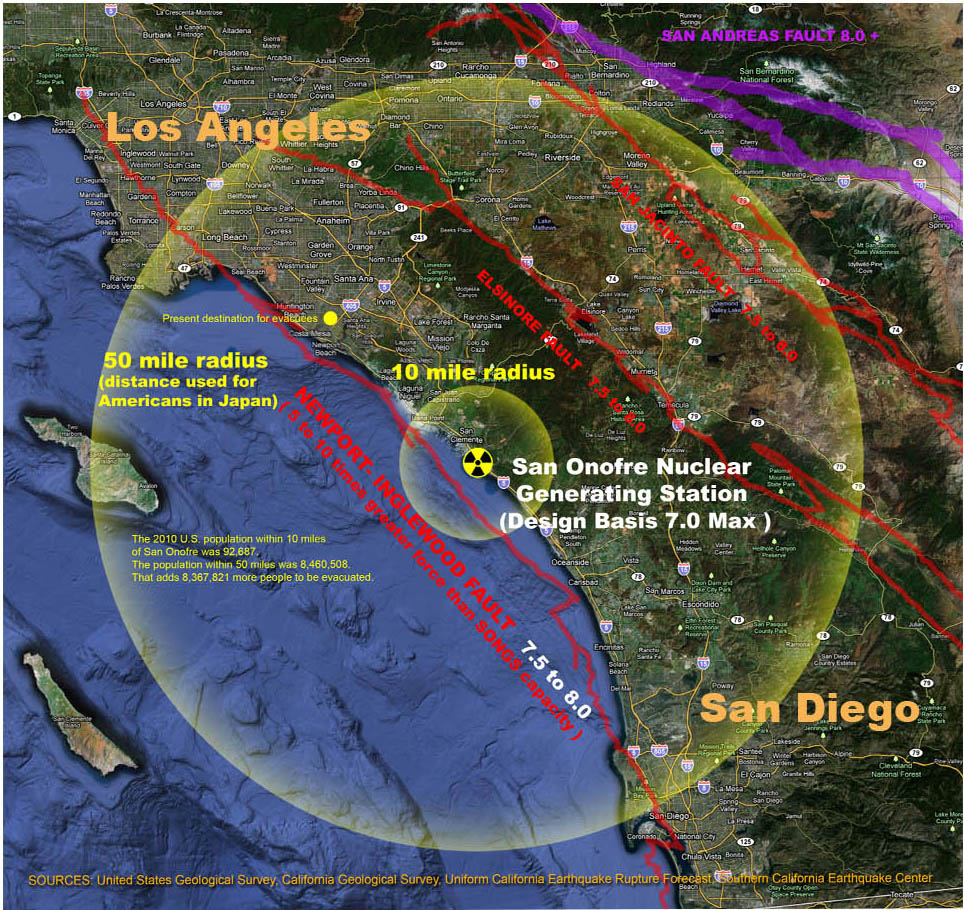
Earthquake Map within 10/50 miles of San Onofre San Onofre was redesigned for a 7.0 earthquake, but sits near faults capable of 8.0+ earthquakes — 10 times larger, 32 times stronger, and long overdue. See USGS earthquake calculator.

USGS predicts probability of at 7.5+ earthquake in Southern California as 36% in 30-years and a probability of a 7.0+ earthquake as 75%. Northern California a 7.0+ as 37% in 30-years.

There is no seismic rating for the nuclear waste thin storage canisters that may already be cracking at San Onofre and other nuclear plants, especially in the corrosive coastal environment. Each of the canisters contains more radiation (Cesium-137) than that released from Chernobyl.

Nelson Mar, PhD (former Senior Engineer for the original design of San Onofre Units 2 & 3), said San Onofre is not designed for current earthquake or tsunami risks. See 3/27/12 Irvine City Council meeting video.

Over the next 30 years the probability of a major earthquake occurring in Southern California is 60% and 67% in the San Francisco Bay area.

USGS: "...no scientists have EVER predicted a major earthquake."

USGS M5+ earthquakes

5.5+ magnitude. Source: USGS Centennial Catalog 1900 – 2002 and USGS/NEIC (PDE) Catalog 1973 – Feb 2014

They do not know how and they do not expect to know how any time in the foreseeable future.   Major earthquakes can occur on what are predicted to be minor faults. Based on scientific data, only probabilities can be calculated for potential future earthquakes. U.S. Geological Survey (USGS)

Many seismic countries, however, have research programs based on identifying possible precursors to major earthquakes. This includes the study of dilatancy, how rocks crack and expand under the increased stress associated with the earthquake. Some major earthquakes, but not all, are heralded by the occurrence of foreshocks. which can be detected by dense local monitoring networks. Other instruments can measure changes in the levels of radon gas, electrical and magnetic properties, velocity changes of seismic waves and changes in topography. Long term monitoring and examination by these sensors is required as some or all of these factors may change due to the opening of cracks PRIOR to the earthquake. All attempts to predict earthquakes have, however, been generally considered as failures and it is unlikely that accurate prediction will occur in the near future.  Efforts will, instead, be channelled into hazard mitigation. Earthquakes are difficult or impossible to predict because of their inherent random element and their near-chaotic behaviour.  British Geology Survey FAQS

    • "The Earth's natural systems are not static… This is why I personally feel we need to regularly update the scientific data we use to inform our regulatory approach so that our nuclear facilities are adequately protected against unanticipated events", said NRC Chairman Macfarlane at the November 6, 2012 INPO CEO conference, in reference to the Fukushima nuclear disaster.

Building design limitations due to ground motion unpredictibility

Professor Thomas Heaton of Caltech's Earthquake Engineering Research Lab, reveals limitations in designing structures to protect against large earthquakes. Every earthquake has different dynamics and affects different types of construction differently.  "All tall buildings are designed to be flexible, but here's the rub," Heaton said. "People talk about a building designed for an 8 [magnitude], as if anybody has a good idea of what the actual ground motion would be in an 8. There's tremendous variation from one place to another." If you "put a really large quake under downtown L.A., 7-plus, it could be a true nightmare." L.A. Times, Earthquakes on the brain, April 1, 2014.

Disconnected faults can jump nine feet, according to new 2015 USGS data

Southern California 8+ earthquake 30-year probability increased from 3% to 7% due to new understanding about how disconnected faults can jump up to nine feet.

Estimates of the chance of a magnitude 8.0 or greater earthquake hitting California in the next three decades have been raised from about 4.7% to 7%, the U.S. Geological Survey said Tuesday [March 9, 2015].  Scientists said the reason for the increased estimate was because of the growing understanding that earthquakes aren't limited to separate faults, but can start on one fault and jump to others. The result could be multiple faults rupturing in a simultaneous mega-quake… LA Times, March 9, 2015

New Forecast for California's Earthquake Fault System,  USGS, March 2015

USGS CA Earthquake Risk 2015

Fracking on the Newport-Inglewood Fault

Los Angeles Basin Injection Wells Earthquakes Figure4-4-9Several wells in the Wilmington field are located within 4 km (2.5 mi) of the Holocene Palos Verdes fault (slip rate 3 mm/yr). Only scattered seismicity has occurred near any these fields except Inglewood and Cheviot Hills at the northwestern end of the Newport-Inglewood trend. As in the Ventura Basin, clusters of seismicity are located close to some disposal wells but also elsewhere. The cluster at the top-center of the figure are aftershocks of the 2014 La Habra earthquake.

An Independent Scientific Assessment of Well Stimulation in California, An Examination of Hydraulic Fracturing and Acid Stimulations in the Oil and Gas Industry, Jane C. S. Long, PhD, California Council on Science and Technology, Steering Committee Chairman; Science Lead Jens T. Birkholzer, PhD, Lawrence Berkeley National Laboratory Principal Investigator; Laura C. Feinstein, PhD, California Council on Science and Technology, Project Manager

Fracking can trigger earthquakes

Correlation between earthquake frequency and volume of contaminated waste injected. Rocky Mountain Arsenal Well, Colorado 1962-1965

Correlation between earthquake frequency & volume of contaminated waste injected. Rocky Mountain Arsenal Well, Colorado 1962-65

Earthquakes can be triggered by any significant perturbation of the hydrologic regime.  In areas where potentially active faults are already close to failure, the increased pore pressure resulting from fluid injection, or, alternatively, the massive extraction of fluid or gas, can induce sufficient stress and/or strain changes that, with time, can lead to sudden catastrophic failure in a major earthquake.

Source: Triggered Earthquakes and Deep Well Activities, Craig Nicholson and Robert L. Wesson, 1992.

.

  Lessons learned from the March 11, 2011 9.0 Tohoku, Japan earthquake.

    • Seismologists across the globe were surprised by the magnitude of shaking that occurred in the segment of fault responsible for the Tohoku quake. Japanese scientists had not believed a quake of such intensity could occur in that area, which in turn impacted tsunami strength estimates.
    • Insights gained from the Tohoku earthquake are leading scientists to re-evaluate the way they've assumed many other major faults are segmented. This may end up altering some hazard analyses for the West Coast, and will contribute to improved scenario modeling, building code development, and public warnings about tsunami threats.
    • An unparalleled amount of strong ground motion data were recorded.
    • Many cases of liquefaction were witnessed and filmed for the first time. Liquefaction occurs when soil loses strength and stiffness due to an applied stress like an earthquake and behaves like a liquid, often causing damage to structures and infrastructure.
    • Even though the Japanese had planned and were well-prepared for a 200- or 300-year tsunami, they were not prepared for the 1000-year tsunami (an event that's likely to occur just once every 1,000 years) that came instead. Consequently, Japan is currently updating its tsunami disaster plans for all of its coastal areas and requiring that all plans take evidence from paleo-tsunami deposits into consideration.
    • Paleo-tsunami deposits are the sand and mud that tsunamis leave behind. By studying deposits from recent events like the March 11 tsunamis, scientists are able to develop criteria for what those deposits look like and use them to examine coastal areas for records of tsunamis that struck centuries back. They can tell when tsunamis occurred and how far inland they reached by looking at the evidence left behind.  USGS coastal and marine geologists Bruce Jaffe, Bruce Richmond, and Rick Wilson have worked with Japanese scientists over the past year to study these deposits in Japan. Said Jaffe, "Japan has learned from this tsunami that it's necessary to look at the geologic evidence for tsunamis in conjunction with the current understanding of earthquake potential to accurately assess the future tsunami hazard." He explained that "Each tsunami brings its own sand and mud. Japan recognizes the value of using the very rich record of past tsunamis to help us understand the hazard for future tsunamis."
    • The United States is also conducting its own paleo-tsunami deposit studies in California, Alaska, the Caribbean, Puerto Rico, and the Virgin Islands to better understand the tsunami risk in those areas.

Ratepayers must pay $64 million in new seismic studies.

Lessons learned about strike-slip faults from 8.6 East Indian Ocean earthquake.

    • On April 11, 2012, an 8.6 earthquake struck the East Indian Ocean along a strike-slip fault – the largest earthquake ever recorded on a strike slip and 10 times larger than any previously recorded strike-slip quake.
    • A large earthquake in one part of the globe can trigger earthquakes elsewhere. In the 6 days after the quake, the number of earthquakes across the globe that were 5.5 or larger increased nearly five fold. "if you asked any of us if this event is possible a year ago, we would have laughed at you", said Thomas Heaton, seismologist at California Institute of Technology. BayCitizen.org 9/28/2012, USGS 9/26/2012, Nature 2012

San Onofre and Diablo Canyon nuclear plants are located within the "Ring of Fire".Ring of Fire

The "Ring of Fire", also called the Circum-Pacific belt, is the zone of earthquakes surrounding the Pacific Ocean. About 90% of the world's earthquakes occur there.

See animation of 2011 global 6.0+ earthquakes (using USGS data) and more maps below.

Mexico's recent 7.4 earthquake (03/20/2012) was 2.5 times larger and 4 times stronger than what San Onofre is designed for. Japan's Fukushima Daiiachi nuclear meltdown began after a 9.0 earthquake.

Lessons learned about length of a fault.

Known length of a fault is not always a predictor of magnitude as in the 1952 Kern County 7.5 earthquake.

Kern County 7.5 Earthquake 1952

Vertical fracture on the northeast side of Bear Mountain, along the White Wolf Fault. At this location, a vertical displacement of 60 cm (2 ft) and a horizontal (left-lateral) displacement of 45 cm (1.5 ft) were measured along the break. Photo: University of California, Seismographic Station

Seismic evaluations are not required before license renewal. 

San Onofre was originally licensed to shut down in 2013, but was extended to 2022. The plant was designed in 1973 for a 40 year lifespan. In 2013 Southern California Edison plans to ask for an extension to 2042. A comprehensive seismic analysis has not been conducted on San Onofre since 1995, according to an April 2012 Government Accountability Office report.
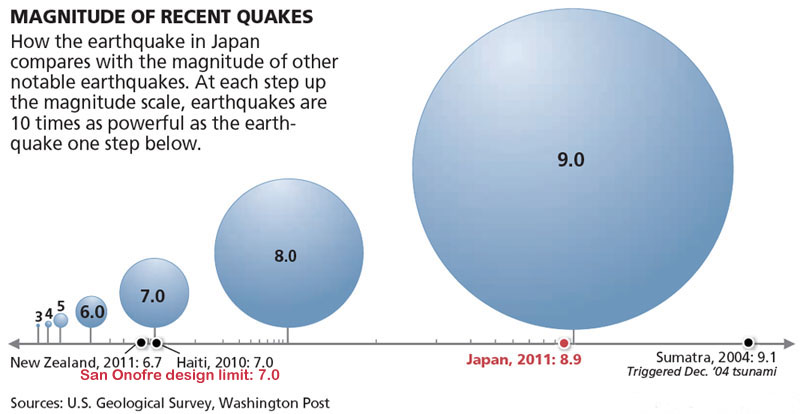
Magnitude Comparison
 

Handouts

.

Resources

Forecasting California's earthquakes – What can we expect in the next 30 years (USGS)
The Uniform California Earthquake Rupture Forecast, Version 2 (UCERF 2)
California Institute of Technology (Caltech)
Southern California Earthquake Center (SCEC)
Nuclear Regulatory Commission
LA Times "50 New California Faults" 04/28/2010
Earthquake Country Information
Kern County Earthquake 7.5 (SCEC)
Significant Earthquakes & Faults in Southern CA (SCEC)
Earthquake Facts and Statistics (USGS)
British Geological Survey FAQS
.

Maps


Map Southern California Earthquake Faults
 

Southern California 8+ earthquake 30-year probability increased from 3% to 7% due to new understanding about how disconnected faults can jump up to nine feet.  Estimates of the chance of a magnitude 8.0 or greater earthquake hitting California in the next three decades have been raised from about 4.7% to 7%, the U.S. Geological Survey said Tuesday [March 9, 2015].  Scientists said the reason for the increased estimate was because of the growing understanding that earthquakes aren't limited to separate faults, but can start on one fault and jump to others. The result could be multiple faults rupturing in a simultaneous mega-quake… LA Times, March 9, 2015

USGS A New Earthquake Forecast for California's Complex Fault System, March 2015

USGS CA Earthquake Risk 2015

USGS California Earthquake Risks, revised March 2015

California Earthquake Probabilities Map - SCEC.org

    Note: Probabilities are outdated on this map. Use 2015 data from above for probabilities


  USGS US %G Force Hazard Map

Global Earthquakes (1900-1999)

Global Earthquakes 1900-1999

Source USGS   

2011 Global 6.0+ earthquakes plotted and animated with sound

.. SONGs and Scripps Seismic Submarine
San Onofre disaster

Our worst nightmare every time the earth shakes in Southern California


~A.

Wednesday, November 02, 2016

Daylight Saving Time Can Trigger Sundowning - AgingCare.com

Daylight Saving Time Can Trigger Sundowning - AgingCare.com

Daylight Saving Time Can Trigger Sundowning Behaviors

It's almost that time again. On Sunday, November 6, Daylight Saving Time ends and we turn our clocks back. This can have a dramatic effect on those who are living with dementia and their loved ones.

I already suffer from sundowning and Daylight Saving Time always makes it worse. Everyone has an internal clock, and light plays a huge role in our sleep/wake cycles. Changes in natural light are part of why sundowning occurs in the first place, but messing with the timing and amounts of daylight we receive only complicates things further.

I have long ago lost the concept of time, but when it's only 5:00 PM and it's already getting dark, I'm aware that this isn't "normal." Change itself is one of the biggest things that affects me and other dementia patients. Even subtle changes can be stressful for us.

According to the Mayo Clinic, sundown syndrome is described as "…a state of confusion at the end of the day and [that can last] into the night. Sundowning can cause a variety of behaviors, such as confusion, anxiety, aggression or ignoring directions. It can also lead to pacing or wandering. Sundowning isn't a disease, but a group of symptoms that occur at a specific time of the day that may affect people with dementia, such as Alzheimer's disease. The exact cause of this behavior is unknown."

They had this mostly right, but the very first sentence is wrong in my opinion. Sundowning can actually affect people living with dementia during anytime of the day. It does not always have to be at dusk or in the evening.

Just dealing with the fact that the days are shorter can be a struggle for dementia patients. I have said many times that your loved one has a routine. Every patient has one. Try setting the table differently or changing the linens on their bed. You'll see that even the smallest adjustments can be very disorienting for them.

Now, because of the time change, most of us will be eating supper when the sun has gone down or is at least in the process. You will hear many experts recommend turning the lights up before the sun begins to set. They will say, "Change the time you begin dinner, that way you can be through with it before sunset and nightfall." But again, you are dealing with people who have a set routine.

None of these suggestions have ever worked for me, but I am just one patient. Each one is entirely unique. For me, it can happen mid-morning on an average Tuesday. It certainly doesn't have to be at sunset, and it doesn't happen solely around Daylight Saving Time. I just have to deal with this.

Unless a patient is in the very early or late stages, you can bet they will have increased confusion and agitation starting on Sunday. For the patient, it feels like everything changes, not just the time. They will know by their internal clocks that something isn't quite right. As with all things dementia-related, you are dealing with something there simply isn't a "fix" for. However, it is still important to do what you can to help with this.

Some will say, "Just explain to your loved one what is happening; that it is time to turn the clocks back." Anyone who thinks this will help has missed the boat. Remember, the first thing to go with dementia is one's short term memory. People around me often forget this. My short term memory is all but gone and has been for some time. So, telling me the clocks were turned back and why is waste of time. Pardon the pun, but it's true. Your loved one may still have the ability to understand the concept of the time change, but the problem is, as always, that they won't remember this from one minute, one hour, or one day to the next.

Instead, make a point of keeping your home well-lit and the atmosphere upbeat. Natural light is important, but dusk and twilight can cause distorting shadows and colors that are overwhelming to a patient. In the late afternoon or early evening, make a point of drawing the curtains, closing the blinds and switching on plenty of warm, artificial lights. Playing their favorite music can also help keep them calm and content.

Since people naturally tire as the day wears on, keep in mind that this applies to dementia patients tenfold. Plan evening activities that are low key and not too complex to avoid increased disorientation and frustration. These emotions can escalate into troublesome behaviors that are more difficult to handle, like delusions, hallucinations and paranoia.

You may be one of the lucky ones who can rearrange the timing of their routine without much of an issue, but it isn't likely. The time change is coming. The one and only way to avoid it is to move to a state that doesn't recognize it, like Arizona or Hawaii. For most people, this isn't a practical option and will cause more problems with the routine your loved one has. Just be prepared and try to make this time and the transition as calm and uneventful as you can.

Light!

~A den Tex

Monday, October 24, 2016

Donald Trump lays out historic plan for first 100 days in office: End corruption, stop the crooks in Washington and unleash economic abundance for America - NaturalNews.com

Donald Trump lays out historic plan for first 100 days in office: End corruption, stop the crooks in Washington and unleash economic abundance for America - NaturalNews.com

Donald Trump lays out historic plan for first 100 days in office: End corruption, stop the crooks in Washington and unleash economic abundance for America

(NaturalNews) Donald J. Trump just delivered an historic speech that lays out his plan for the first 100 days in office.

Highlights are listed here. Actual quotes from Donald Trump shown in italics.

The system is totally rigged and broken.

The dishonest mainstream media is a major part of this corruption. They lie and fabricate stories to make a candidate that is not their preferred choice look as bad and as dangerous as possible... They're trying desperately to suppress my vote and the voice of the American people... They're trying to poison the mind of the American voter.

If they can fight somebody like me, who has unlimited resources, just imagine what they can do to YOU...

The rigging of the system is designed for one reason: to keep the corrupt establishment and the special interests in power at your expense.

We will never solve our problems by relying on the same politicians who created these problems in the first place. Hillary Clinton is running against all the American people...

[This 100-day plan is] a contract between Donald J. Trump and the American voter... to bring honestly, accountability change to Washington D.C.

We will drain the swamp in Washington D.C. and replace it with a new government of, by and for the People.

This is my pledge to you. If we follow these steps, we will once more have a government of, by and for the people. We will make America great again.


Six groundbreaking political reforms that will end corruption in Washington

1) A constitutional amendment to impose term limits on all members of Congress.

2) A hiring freeze on all federal employees, exempting military, public safety and public health.

3) A requirement that for every new federal regulations, two existing regulations must be eliminated. "Regulations are killing our country and our jobs..."

4) A five year ban on White House and congressional officials becoming lobbyists after they leave government. service.

5) A lifetime ban on White House officials lobbying on behalf of a foreign government.

6) A complete ban on foreign lobbyists raising money for American elections.

Seven actions to protection American workers

1) Totally renegotiate NAFTA, "one of the first deals out country has ever made."

2) Announce withdrawal from the TPP, "a potential disaster for our country."

3) Direct the Secretary of the Treasury to label China a currency manipulator. "What they have done to us by playing [with] currency is very sad... I blame our politicians for letting this take place."

4) Direct the Secretary of Commerce to identity all foreign trading abuses that unfairly impact American workers, and to use "every tool" under American law to end those abuses.

5) Lift restrictions on production of $50 trillion worth of job-producing American energy reserves, including shale, oil, natural gas and clean coal. "And we will put our miners back to work."

6) Lift Obama / Clinton roadblocks that allow this vital energy infrastructure projects to go forward. "We're going to allow the Keystone pipeline ... to move forward."

7) Will cancel billions in payments to UN climate change programs and use the money to fix America's water and environmental infrastructure.

Five actions to restore security and constitutional rule of law in America

1) Cancel every unconstitutional executive order and action issued by Obama.

2) Begin the process of selecting a replacement for Justice Scalia.

3) Cancel all federal funding for sanctuary cities.

4) Remove two million criminal illegal immigrants from the country, and cancel visas to foreign countries that won't take them back.

5) Suspend immigration from terror prone regions where vetting cannot safetly occur.

Substantial tax policy changes that will create jobs, simplify tax forms and reduce taxes on the middle class by up to 35%

1) Reduce taxes for the middle class. "The largest tax reductions are for the middle class... they have been forgotten. The middle class family with two children will get ... a 35% tax cut."

2) The number of tax brackets will be reduced from 7 to 3. Tax forms will be greatly simplified.

3) The business rate will be lowered from 35% to 15% and the trillions of dollars in corporate money overseas will be brought back at a 10% rate. (This will allow businesses to invest in American operations that will create millions of new jobs.)

4) End the offshoring act, establish tariffs to discourage companies from laying off their workers and relocating to foreign countries.

Side comment: We are going to work on fixing the VA hospital problem. "We have illegal immigrants that are treated far better than our veterans."

Donald Trump's propose Acts for serious reform

1) Infrastructure Reinvestment Act would restore investment in our domestic infrastructure (bridges, roads, water systems).

2) School Choice and Education Opportunity Act will give parents the right to send their child to the schools of their choice. "We're going to end Common Core and bring education supervision to local communities... Our current system is not working." We will expand vocational and technical education, and make 2- and 4-year colleges more affordable.

3) Repeal and Replace Obamacare Act: Fully repeal Obamacare and replace it with health savings accounts. The ability to purchase health insurance across state lines (to create competition), and let states manage Medicaid funds. Reforms will include cutting the red tape at the FDA. We want to speed the approval of lifesaving medications.

4) Affordable Childcare and Elder Care Act would allow caregivers to deduct care costs from their taxes. Creates tax free dependent care savings accounts.

5) End Illegal Immigration Act: Fully funds the construction of a wall on our southern border, with the understanding that the country of Mexico will be reimbursing the United States for the full cost. Establishes 2-4 year mandatory prison sentences for those illegally re-entering the USA if they have multiple prior deportations or felony convictions.

6) Restoring Community Safety Act: Creates a task force on violent crime, increases funding for programs to train and assist local police. "Put violent offenders behind bars or out of our country..."

7) Restoring National Security Act: Rebuilds our military by eliminating the defense sequester and expanding military investment. "Peace through strength... we need a strong military." It also provides our veterans with the ability to receive public VA treatment or visit a private doctor of their choice.

Additional comment: "We are going to protect our vital infrastructure from cyber attack."

8) Clean up Corruption in Washington Act: Enact new ethics reforms to reduce corrupting influence of special interests and donors.

Stay informed at Trump.news and Newstarget.com

Watch the full speech at this YouTube link.

So there!
~A.


~A.

Sunday, October 09, 2016

Dozens of Scientists Have Been Dying Mysteriously - Daisy Luther

Dozens of Scientists Have Been Dying Mysteriously - Daisy Luther

Dozens of Scientists Have Been Dying Mysteriously

You may remember a while back there was a spate of news articles about high-level bankers and bank employees committing suicide. Conspiracy theories were coming left and right and then as suddenly as the reports started they stopped – just like that. Here is a list of more than 50 of these bankers, in date order, with a brief overview on each of them.

You probably also remember that last year, a dozen holistic doctors either died or went missing over a course of only 90 days. How oddly coincidental.

But the deaths of these bankers and doctors are just the tip of the iceberg.

Did you hear about all of the dead scientists? Probably not.

What if I told you that dozens and dozens and dozens of scientists have been killed died in mysterious circumstances and few reports have filtered out via the mainstream media?

What if I told you that they were involved in researching or working with bio-level 4 pathogens, nuclear research and the like? And that many had government links…by grants issued, research on behalf of or directly by working in government facilities.

The current spate of deaths began not long after 9/11, on November 12, 2001, to be precise. On Nov. 12, Benito Que, 52, was found comatose in the street near the laboratory where he worked at the University of Miami Medical School. He died on Dec. 6.

On November 16, 2001, professor don Wiley apparently killed himself – yet there was, and never has been any evidence of that.

On November 15th, Harvard Professor Don Wiley left a gathering of friends and colleagues some time after 10:30 PM. The next morning, Memphis police found his rental car stopped on a bridge, with a full tank of gas and keys still in the ignition. There was no financial or family trouble. Indeed Wiley was supposed to meet his family at the Memphis airport to continue on to an Icelandic vacation. Neither was there any history of depression or mental illness.

In the report printed in the New York Times on November 27th, the FBI's Memphis office distanced itself from the case saying that the available facts did not add up to a suspicion of foul play. I guess at the FBI it's a perfectly everyday occurrence for a Harvard Professor to stop his rental car on a bridge in the middle of the night before he is supposed to leave for Iceland and just walk away into the Tennessee dark.

Move along citizen, nothing to see.

The professor's colleagues expressed doubts about the official "suicide" explanation for his disappearance. (source)

His body was found on Dec. 20.

Next came Vladimir Pasechnik who died on November 23, 2001. No cause of death was ever given. A Russian he defected to Britain in 1989 aged 64.

He described a network of secret laboratories, disguised as a commercial organisation called Biopreparat, which employed several thousand scientists and technicians to develop potential biological weapons that could spread diseases like anthrax, ebola, Marburg virus, plague, Q fever, and smallpox. (source)

On December 10, 2001, Robert Schwartz, 57, was found murdered in his rural home in Loudoun County, Va. His daughter was ultimately convicted of his murder.

On December 11, 2001, Set Van Nguyen, 44, was found dead in the airlock entrance to a walk-in refrigerator in the laboratory where he worked in Victoria State, Australia. According to reports, he was a "conscientious, diligent and careful employee."

On February 8,  2002, Vladimir Korshunov, 56, was found dead on a Moscow street. outside his home. He died from blunt force trauma to his head and there is no record of his killer being caught – or even being sought!

On February 11, 2002, Ian Langford, 40, was found dead in his home in Norwich, England. He was half naked and wedged under a chair. His specialty was environmental risk. Police and post-mortem results declared the wounds found on his body were self-inflicted or sustained accidentally.

The list goes on and on:

  • Alexi Brushlinski
  • Robert Leslie Burghoff
  • Dr. Tanya Holzmayer
  • Eugene Mallove
  • John Mullen
  • Dr. Jeong Im
  • Source for the following list:
  • Alberto Behar
  • Martin John Rogers
  • Glenn Thomas
  • Mark Ferri
  • Professor Carol Ambruster
  • Anne Szarewski
  • Shane Todd
  • Dr. Richard Holmes
  • Melissa Ketunuti
  • Professor Dr. Richard Crowe
  • James S. Miller
  • Zachary Greene Warfield
  • Jonathan Widom
  • Fanjun Meng and Chunyang Zhang
  • Andrei Tropinov, Sergei Rizhov, Gennadi Benyok, Nicolai Tronov and Valery Lyalin, in a Russian plane crash.
  • Rodger Lynn Dickey
  • Gregory Stone
  • Bradley C. Livezey
  • Dr. Massoud Ali Mohammadi
  • John (Jack) P. Wheeler II
  • Mark A. Smith
  • Chitra Chauhan
  • Franco Cerrina
  • Maria Ragland Davis
  • Gopi K. Podila
  • Adriel D. Johnson Sr.
  • Amy Bishop, 45
  • Keith Fagnou
  • Stephen Lagakos
  • Malcolm Casadaban
  • Wallace L. Pannier
  • August "Gus" Watanabe.
  • Caroline Coffe
  • Nasser Talebzadeh Ordoubadi
  • Bruce Edwards Ivins
  • Laurent Bonomo and Gabriel Ferez. Died  after being bound, gagged, stabbed and set alight
  • Yongsheng Li
  • Dr. Mario Alberto Vargas Olvera
  • Yoram Kaufmanich

This is an incomplete list.  There are many, many more. Quite a number of these scientists were young and in the prime of their lives. Most of the deaths were attributed to accidents and homicides, with a few suicides thrown in for good measure.

Are their deaths linked? Who knows.

Are governments silencing scientists? Who knows.

What I can say for sure is that a huge amount of scientific genius has been wiped out with the deaths of these people…and possibly many more we don't know about.

What I would really like to know is why.


<ditto....>~A.

Friday, September 30, 2016

Fasting shown to regenerate stem cells, reverse immunosuppression after three days - NaturalNews.com

I soo agree. There have been times when I simply took myself off of everything but water for days at a time and felt so much better for it. 
Think of it as Freedom, not Depravity
.~AdT.

Fasting shown to regenerate stem cells, reverse immunosuppression after three days

(NaturalNews) What if the key to maintaining a vibrant immune system was simply not eating for a few days at a time twice a year? Researchers from the University of Southern California in Los Angeles say that periodic, prolonged fasting -- that is, not eating for between two and four subsequent days at a time -- not only protects against immune system damage, but it also promotes immune system regeneration, particularly in patients who are already immuno-compromised.

Valter Longo, an Edna M. Jones Professor of Gerontology and the Biological Sciences at the USC Davis School of Gerontology and director of the USC Longevity Institute, looked at the effects of fasting in both mice and humans, observing that when these mammals fasted, their white blood cell counts decreased. The result was that their bodies "recycled" old immune cells, thereby triggering the production of new immune cells to replace them.

Over time, immune cells can become worn out and stop functioning at optimal levels. It was previously believed that there wasn't much that could be done to overcome this apart from stem cell treatments. However, this latest research shows that periodic fasting cycles actually flip some kind of regenerative switch inside the body, altering the signaling pathways for hematopoietic stem cells, which generate both blood and immunity.

"We could not predict that prolonged fasting would have such a remarkable effect in promoting stem cell-based regeneration of the hematopoietic system," stated Longo, who holds a joint appointment at the USC Dornsife College of Letters, Arts and Sciences.

"When you starve, the system tries to save energy, and one of the things it can do to save energy is to recycle a lot of the immune cells that are not needed, especially those that may be damaged. What we started noticing in both our human work and animal work is that the white blood cell count goes down with prolonged fasting. Then when you re-feed, the blood cells come back. So we started thinking, well, where does it come from?"

Periodic fasting might help correct autoimmune disorders, including those brought about by vaccines

While the study focused primarily on chemotherapy patients whose immune systems are ravaged by this deadly poison treatment, the implications of the study also extend to other conditions like autoimmune disorders. By triggering the production of new, undamaged immune cells, fasting might help people who suffer from what the system has long claimed are incurable medical conditions.

As it turns out, prolonged fasting forces the body to use stores of glucose, fat and ketones as well as a significant portion of existing white blood cells. In essence, fasting acts as a type of detoxification, clearing out the old so it can be replaced by the new. The researchers say that the result is essentially the formation of a whole new immune system.

Specifically, prolonged fasting helps reduce levels of an enzyme known as PKA, or protein kinase A, which earlier research has found bolsters the regulation of stem cell self-renewal and pluripotency in addition to extending longevity. Prolonged fasting also helps decrease levels of IGF-1, a growth-factor hormone that's been linked to aging, tumor progression and cancer risk.

"PKA is the key gene that needs to shut down in order for these stem cells to switch into regenerative mode," says Longo.

"It gives the OK for stem cells to go ahead and begin proliferating and rebuild the entire system. And the good news is that the body got rid of the parts of the system that might be damaged or old, the inefficient parts, during the fasting. Now, if you start with a system heavily damaged by chemotherapy or aging, fasting cycles can generate, literally, a new immune system."

Sources:

http://www.sciencedirect.com

http://news.usc.edu

LED blue light wavelengths linked to cancer, cardiovascular disease and impaired vision - NaturalNews.com


LED blue light wavelengths linked to cancer, cardiovascular disease and impaired vision

(NaturalNews) Could LED lights be hazardous to your health? Well, it certainly seems like they might be. The American Medical Association (AMA) has just issued a warning that high-intensity LED streetlights emit blue light – which cannot be seen. Blue light is known for disrupting sleeping patterns, and can possibly increase the risks of a number of serious health conditions, including cancer and cardiovascular disease.

These concerns about the potential health risks of LED lights are not unfamiliar; similar questions have been raised over the last few years. But, the AMA's report provides much needed support to these claims. Their findings may even inspire cities and states to reevaluate the intensity of the light-emitting diodes they install, especially following the AMA's discovery that bright LED lights can actually impair nighttime vision for some drivers.

A report prepared by the Department of Energy last year revealed that almost 13 percent of streetlights and other roadway lighting relied on LEDs. However, many communities that have not changed over to LED lights plan on doing so, thanks to their superb energy efficiency. Light-emitting diodes are up to 50 percent more energy efficient than the standard high-pressure sodium lights they so often replace. LEDs also boast a substantially longer lifespan, lasting 15 to 20 years on average. Their predecessors, with their iconic yellow-orange glow, typically only last for a maximum of five years. Sodium lights are also not capable of dispersing light as evenly or efficiently as their new competitor.

Unsurprisingly, many cities are insistent that the health concerns associated with high-intensity LEDs are not strong enough to overshadow the benefits of these lights. There is money to be saved, so why worry about the consequences, right?

Among the cities that have put the first-generation bright LED lights to use in the last three to eight years is New York. While they too agree that the benefits far outweigh any currently perceived health risks, officials have responded to resident complaints by providing a lower-intensity replacement for the high-intensity LED bulbs.

In Washington state, Scott Thomsen, a spokesman for Seattle City Lights has dismissed the concerns over the risks of these "high-intensity" bulbs entirely. Thomsen claims that the LEDs emit a smaller amount of the problematic blue light than most televisions and computers. Of course, a key flaw with that argument is that those devices can actually be turned off, whereas people cannot simply turn off a streetlight that is keeping them awake at night.

Regardless, the advent of outdoor LEDs has led to a surge in their popularity. The federal government itself urged states to implement them as an energy efficient solution. Critics believe that the federal government provided their endorsement far too quickly and should have waited for more testing to be done. Certainly, if past actions are any indication, it would seem that our nation's government agencies do tend to act too quickly when it comes to harmful products, and not quickly enough on things that may actually be good for us.

Michael Siminovitch, director of the California Lighting Technology Center at the University of California at Davis, told The Blade that the Department of Energy and the Environmental Protection Agency put concerted effort into getting states interested in LEDs. He also commented that the light from these high-intensity diodes "really negatively impacts people's physiological well-being. "Mr. Siminovitch went on to say that, "As a species, we weren't designed to see light at night."

Because of this, the blue light from high-intensity LEDs may interfere with melatonin production. Melatonin is key to the balance of our sleep-wake cycles. The AMA made note of this in their warning, citing numerous studies that have linked bright light to reduced sleep, poor sleep quality and impaired function during waking hours. The warning also noted several studies which indicated that cancer, diabetes, cardiovascular disease and obesity risks could be increased by exposure to high-intensity light at night.

The AMA is urging cities to use a maximum light temperature (frequency) of 3,000K, instead of the 4,000K and 5,000K LED lights that were initially made available.

Sources:

ToledoBlade.com

CNN.com

Check out this interesting article

LED blue light wavelengths linked to cancer, cardiovascular disease and impaired vision - NaturalNews.com

http://www.naturalnews.com/055482_LED_lights_cancer_health_effects.html

LED blue light wavelengths linked to cancer, cardiovascular disease and impaired vision

Learn more:  http://www.naturalnews.com/055482_LED_lights_cancer_health_effects.html#ixzz4Lm2GAfyd

The H(i)ptotic Moves of a PoleDancer....

Saturday, September 24, 2016

About Neil’s Mission – Neil Keenan – Group K, Ltd.

About Neil's Mission – Neil Keenan – Group K, Ltd.

About Neil's Mission

A BRIEF HISTORY OF THE GLOBAL COLLATERAL ACCOUNTS AND KEENAN'S EFFORTS TO FREE THEM

by Michael Henry Dunn
June 8, 2013

The history behind the Global Collateral Accounts is vast and complex, and reaches back some 250 years. For the purposes of this brief overview, we will focus on two key elements which are now headlining stories around the world: debt, and gold.

The Western banking oligarchy's current global control can be traced back to the Rothschild family's dominance of international banking in the early years of the 19th century. The long-term strategy of the elite banking and royal bloodline families was simple: gain control of the global gold supply in order to maintain power through the control of global currency and its underlying collateral.  Gold and Debt – that is the essence of this story.

Where Did the Gold Come from and to Whom Does It Belong?

For two thousand years, the gold of the world flowed east toward China, along the Silk Road, from the Roman Empire, on through to the Byzantine and the Spanish, in exchange for the silks, spices, and treasures of the East.  When the bankers of Europe decided to seek control of the world financial system, control of this gold became essential.

Who created the Global Collateral Accounts and why?

Operation Golden Lily is the well-documented story of the Japanese gold-collecting teams, which infiltrated key gold-holding nations well in advance of the military invasions of China and other nations, with the express intent of seizing the hundreds of thousands of metric tons of gold that had accumulated in Asia (primarily in China).  The Nazi gold-collecting system is well-known, but the Japanese accumulated a far greater hoard, with the knowledge and cooperation of certain European banking interests.

Where is the gold and how did it get there?

The "official" total for the entire amount of gold said to be above ground since humanity first began mining the precious metal is approximately 160,000 metric tons. Evidence now indicates that a more accurate figure is well in excess of two million metric tons. During World War Two, the Japanese dug tunnels and bunkers throughout Southeast Asia to store the gold – primarily in Indonesia, Thailand, and The Phillipines.  After the war, the gold was discovered by the Allies, and was incorporated into a system set up by the European central bankers before the war for this very purpose.  The exact total of the wealth in the off-ledger accounts is not known, but is said to be in the thousands of trillions of dollars in gold, platinum, and gems, in addition to an undetermined amount in Federal Reserve notes and other currencies.

How did the nations come to agree that the Accounts were to be used for humanitarian programs?

At the Bretton Woods Conference in 1944, when the soon-to-be-victorious Allies met to create a new global financial system, the International Monetary Fund was created.  In the late 1940's, President Sukarno of Indonesia was appointed monetary controller of behalf of the depositors to monitor and implement the Global Accounts for redevelopment purposes.

How did the banking elite abuse the Accounts?

The central banking families had already put in place essential structures to seize and control this wealth: the Bank of International Settlements, the International Monetary Fund, the Council on Foreign Relations, and the United Nations, all of which were funded by elite banking figures, including the Rockefellers and Warburgs. The agreements to use the funds for development were neglected, and the banking elite proceeded to use them for their own ends, blocking the depositors from access. President Sukarno of Indonesia had been appointed "M1" or Monetary Controller of the Accounts (as much of the assets are stored in hidden bunkers in Indonesia), but he was removed from power after making a deal with John F. Kennedy to use the funds to back new U.S. Treasury dollars, in a direct move against the central bankers' power. Kennedy's assassination prevented this move from succeeding.

The central bankers put in place a system that allows the Federal Reserve to block anyone but banking elite insiders from using the Accounts, thus blocking the actual owners – the depositors – from utilizing the assets for humanitarian programs, as originally intended.

Who is Neil Keenan and what is his relationship to the Global Accounts?

The emergence of Neil Keenan at the cutting edge of these events can be traced to the theft in 2009 by Vatican financial insider Daniele dal Bosco of $144.5 billion in Federal Reserve notes which were entrusted to Mr. Keenan by the Dragon Family, the group of ancient wealthy clans in Asia who are the legitimate owners of vast amounts of gold in the off-ledger Global Accounts. The Dragon Family has been attempting for decades to utilize the Accounts for their originally intended purpose, and sought out Keenan's help because of his reputation as a well-connected, tough-minded international businessman.  The story of this theft, and of Mr. Keenan's filing of a trillion-dollar lawsuit against elite figures and institutions (including the United Nations, the World Economic Forum, The World Bank, the Italian government, the Italian Financial Police, Silvio Berlusconi, and others) was first revealed by Benjamin Fulford, former Forbes Magazine financial editor for Asia, who traveled to Italy to conduct initial investigations, where an attempt was made on his life. The story was then taken up by best-selling author David Wilcock (who then also received death threats), confirming the story in an investigative article on his influential blog.  The 110-page lawsuit, first filed in New York federal court, can be viewed at this link.

In addition to his lawsuit (which he subsequently withdrew in order to re-file in a more effective jurisdiction), Keenan also filed a Cease and Desist order on behalf of the Dragon Family against a Who's Who of the cabal power structure, putting them on notice that they were defrauding the Global Accounts, and would be prosecuted for any further fraud.  This Cease and Desist names George Herbert Walker Bush, George W Bush, Queen Elizabeth II, the United Nations, Ban Ki Moon, David Rockefeller, Hillary Clinton, and a host of other world figures and organizations who are in the inner circle of the cabal.

The bonds which were stolen from Mr. Keenan were Federal Reserve notes given to the Dragon Family in payment for the gold deposited in the Accounts – notes which the Federal Reserve continually blocked from utilization. Mr. Keenan's lawsuit represents the first formidable attempt to defeat this theft.

As may be expected, his life is in danger.  He has survived four assassination attempts to date, and now has protection in place from numerous allies around the world.  Mr. Keenan is currently in Indonesia, finalizing agreements with the Indonesian elders, and Chinese officials holding lineal claim to the majority of the assets in the Accounts.

Mr. Keenan is in possession of key documents, such as the original of the Green Hilton Memorial Agreement between Kennedy and Sukarno, and the "Black Book," secret records of the Accounts.  Numerous other pieces of evidence can be provided. In addition to Mr. Keenan's participation, other key players may be brought to the table as part of the interview process, including Indonesians involved in the guardianship of the Assets, powerful Asian financial officials, and others. We propose immediate discussions to explore this possibility.

Michael Henry Dunn


Here are a couple of photos of the Blue Book, which establishes the bloodline lineages of these cabal families, how they evolved, and where they are today. This is who we're fighting: the people from the Blue Book who illegally control the assets of the off-ledger accounts. They are the elitists who control all the industry of the Western world, to whom all the dots connect. These are the people who received OUR bailouts, OUR money!  

SAM_5188 SAM_5192 - Version 2

Here are couple of photos of The Black Book, whose entries are all hand-written. The history of the Global Off-ledger Accounts on the black screen is in this book. This is the Book that exposes the cabal. Now you can understand why this book is priceless.

Screen Shot 2013-09-17 at 9.33.06 AM

Screen Shot 2013-09-17 at 9.53.20 AM

Copyright © 2013 Group K, Ltd.


~A.

Sunday, September 18, 2016

The Greatest Shipwrecks Still Out There - The Daily Beast


The Greatest Shipwrecks Still Out There

It's estimated that, beneath Earth's waters, 3 million undiscovered shipwrecks exist. And right now, all across the planet, the locations of a select few of these lost ships are actively being sought.

Some of these expeditions are publicly sanctioned by governments and others are privately funded by organizations, foundations, or like Bill Paxton's character in the Titanic, greedy bastards. However, the public curiosity surrounding theses expeditions's searches and/or findings are greater than one might think. Not only is the internet overloaded with sites and blogs dedicated to covering news and updates regarding the hunts for shipwrecks, but books, YouTube fare, and podcasts about the subject are also rather easy to find. Moreover, once a upon a time, both National Geographic Channel and Discovery Channel aired reality programming which followed the adventures of teams of people who get their adrenaline kicks searching the open seas for sunken vessels and their lost treasures of shiny shit. Obviously, for many of us, there's just something about shipwrecks—maybe the history or the treasure or the mystery—that we find fascinating.

Last week was a good week for shipwreck aficionados. According to a small group of smart, overachieving explorers from the Arctic Research Foundation, a 19th century shipwreck has been found. According to The Guardian, on Sept 3, the ARF found Sir John Franklin's long-lost, second ship, the HMS Terror, at the bottom of an Arctic bay.

Now, this news might not seem like a big deal to those of us who do most of our exploration on Netflix or Amazon or those of us who, right now, are thinking, who the hell is Sir John Franklin? However, for the 10 people who discovered HMS Terror and spent more than a week capturing video and photographs of the Terror's "perfect" condition, finding this underwater historical treasure was, at least for them, the discovery of a lifetime.

Unfortunately, their under-the-sea adventure didn't include the discovery of riches; their treasure will be found in the solving of the 168-year-old mystery surrounding Franklin's doomed quest to navigate the unchartered sections of the Northwest Passage—a shipping route through the Arctic Ocean connecting the Atlantic and Pacific Oceans. The demise of Franklin's pursuit has confounded historians, archeologists, and seafaring adventurers for decades. Often considered the most disastrous event in exploration history, amid Franklin's fourth—and final—Arctic voyage, 129 crew members (including Franklin) lost their lives when the Terror, along with the mission's flagship, the HMS Erebus—became icebound in the frozen waters of Canada's Terror Bay.

What's perhaps most fascinating about the Terror's discovery and what might inspire adventurers of all kinds to take up shipwreck hunting as a hobby was how researchers ended up locating the ship. As NPR tells it, one of the explorers overheard an Intuit man—an Arctic local—talking about that time six years prior when he'd seen what appeared to be a wooden masthead sticking out of the ice near Terror Bay. Though the man had snapped a picture, he never told anybody about his finding because he'd lost his camera and considered that to be bad luck. Still, even without photo proof, the researcher believed the man's story and the team ended up finding the Terror almost exactly where the man claimed to have seen it.

Now, of course, the chances of finding a lost shipwreck, especially one with gold and silver or, at the very least, one that the general public finds interesting, are pretty slim. But that's not for the lack of lost vessels. If the estimate is correct, there are at least 2,999,999 shipwrecks still sitting on the ocean floor waiting to be found. Moreover, among these sunken boats, historians believe there's billions of dollars in gold, silver, and other treasure to be found (though in most cases the finders don't get to be the keepers).

But just in case this Arctic tale of Terror has inspired your inner pirate to take up searching the deep blue sea for lost ships (and maybe some loot to boot), here's a list of just a few of the world's most famous shipwrecks yet to be found.

Treasure hunters have been searching for years for the Merchant Royal, also known as the "Eldorado of the Sea." This British sailing ship that went down near the Isles of Scilly during a violent storm in 1641 is believed to be loaded down with unimaginable riches. As one of the more well known shipwrecks, under-the-sea hunters have invested years into seeking out the location of this near 400-year-old wreckage. According to historians, the Merchant Royal's treasure includes "gold, silver, and bullion estimated to be worth hundreds of millions in today's prices." Some believe its worth could surpass $1 billion.

Lovers of ghost stories might find this lost ship to be especially of interest. Constructed in Sweden in 1914 and owned by a German shipping company until the start of World War I, the SS Baychimo was a 1,322 ton vessel powered by steam. After being purchased by The Hudson's Bay Company, the boat made voyages across the North Atlantic from Scotland as well as frequent trips to Alaska and British Columbia. In 1931, while en route to Vancouver, the frigid untamed waters of the North Pacific proved too strong for Baychimo, leaving its crew no choice but to evacuate. However, according to legend, the Swedish-built ship didn't exactly sink. Over the course of the next 38 years, there were a countless number of Baychimo sightings from captains, Inuits, and fisherman. Some of these reports suggested the ship was moving along quite well, seemingly unmanned. Other stories include threads of failed attempts by sailors to board the ship. After more than 20 years without a sighting, leading most to believe it had finally sunk, an Intuit crew claim to have seen Baychimo drifting along the Beaufort Sea coastline. The last sighting happened in 1969. As of 2006, the officials in Alaska renewed their interest in finding the so-called ghost ship. So far, it's location is still unknown.

If the name Santa Maria sounds vaguely familiar, it should, since its one of the triad of boats—the Nina, Pinta, and the Santa Maria—that Christopher Columbus used in 1492 when he "discovered" the New World. Over the course of his career, Columbus lost nearly a dozen ships to the sea's violent side; but by far, the Santa Maria was his most famous loss. Though the Nina and Pinta both made voyages home to Spain, the infamous explorer's flagship, on Christmas Eve, 1492, ran aground into a coral reef off the coast of modern Haiti. It sank the following day. Though several oceanic salvagers have claimed to have found Columbus's ill-fated boat, their findings have all been proven false. The Santa Maria is still believed to be on the floor of the Caribbean Sea, somewhere off the coast of Haiti.

In 1679, the Griffin became the first ship to sail the Great Lakes. It was built by Rene-Robert Cavelier, Sieur de La Salle, a French explorer who used the ship to survey the Niagara River, Lake Erie, Lake Huron, and Lake Michigan. However, in September of 1679, while on its maiden journey, the ship vanished. Countless theories exist as to what happened to the Griffin—from native attacks to violent storms—but no proof for any of the theories exist. Considered by many to be the "holy grail of Great Lakes shipwrecks," all attempts at locating La Salle's craft have either failed or their findings have been proven false. While a handful of theories suggest that La Salle's boat might be in Lake Erie or Lake Huron, a majority of under water archeologists believe the Griffin is located on the seafloor of Lake Michigan. So, you should probably start there.

Built in 1502, the Flor del la Mar (Flower of the Sea) was a 400 ton Portuguese carrack. Not only was the Flower of the Sea quite instrumental in helping Portugal during the Battle of Diu and its capture of Malacca, the Flower is best known for its dramatic sinking. During the fall of 1511, while navigating the Strait of Malacca, a violent storm not only shipwrecked the Flower off the coast of Sumatra, it split the boat in to two pieces. At the time of its sinking, the Flower was loaded down with what historians consider the largest, most elaborate treasure ever lost at sea, including gold goblets, silver plate, and gold bullion galore.