"However, I'm now convinced that we've reached what I call "peak multitool", and there's no getting better or moving forward from here."-Sarang Sheth, Yanko Design
"Some multitools focus on doing a few things right, while others aim to be more a Jack of all trades. The modular Toler Union is the latter on steroids…"-Nick Lavars, New Atlas
"Talking with Michael from Toler Tools he really pointed out a lot of features that would be super useful…what's a mechanical engineer left to do but invest a few years of time, lots of savings and build it right!"-Jay Amstutz, COPTOOL
"The OMNILOCK wrench can grab ¼- to ¾-inch bolts, and the UNION's bit extender lets users fold the multitool out and lay down power."-Gear Junkie
"The Toler Union may not be the most compact of multitools, but it gives you several full-size tools and better leverage while still remaining pocketable."-The Awesomer
"Equipped with a self-adjusting wrench, the thing can grip tightly onto different sizes of nuts and bolts automatically, allowing it to simplify your loosening and tightening tasks...it also happens to be a full-fledged multi-tool that you can use for a whole host of other tasks, making it a potential replacement for your everyday multi-tool."-Coolthings.com
"…that wrench design is super cool."-Reddit user
"…what really caught my eye is the inventiveness of it."-Reddit user
Our story:
My wife was running her food truck, The Coop, while I was finishing my degree in mechanical engineering. I had to go and fix things for her regularly, so I began to carry more tools on me, trying to make quick fixes and get back to studying. One day, under the counter working on a leak, frustrated with the nut and bolt prowess of the multi-tool I always carried, the idea for the Omnilock™ began to take shape in my head. I decided to try and design my dream multi-tool, one that could take advantage of the new wrench design to the fullest. I'm very happy with the results, and I've not carried another tool since the first UNION™ prototypes were built.
Help us unleash the world's most capable multi-tool.
We've been working behind the scenes. Making deals and promoting the brand. We are so close to production, but need a little help. That's where you come in. Pledge to be one of the first in the world to carry more capability in the pocket than ever before. We'll fire up the line and deliver this unprecedented tool to your door.
Where are we?
We're aiming to set the new world standard in multi-tools, so we're leaving nothing to chance. Third iteration samples are in hand and they are very close to production ready.
Where have we been?
From the first acrylic wrench prototypes laser cut at the Columbus Idea Foundry to the fully functioning units we have now, we have been cruising towards a new era of multi-tools.
Where are we going?
The UNION™ is a family of tools. More modules and accessories are in the works to extend your carry options. You'll pair two halves for the day you expect. Headed to the woods, the workplace, a weekend motorcycle getaway, or a night on the town? Carry the tools you need and none you don't.
When are we shipping?
December, 2019
I will give "go" on the first run shortly after the end of the 60 day campaign. I want to make sure I'm making enough to serve all campaign pre-orders in the first phase of deliveries. At that point tooling will be made, a small trial batch produced to verify tooling, then full production. This is to insure the first run of tools is not plagued with any first batch gremlins. December is playing it safe, but I don't want to speculate about how much I might be able to expedite the process. Rest assured, you'll be one of the first in the world to carry the awesome capability the UNION has to offer.
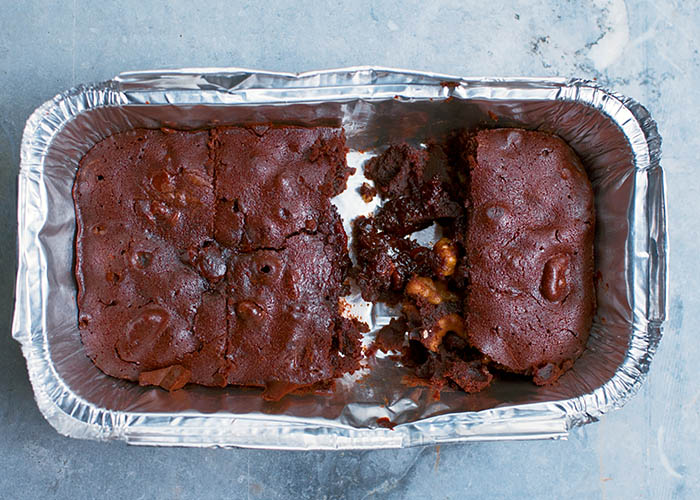
This is for those times you urgently need a brownie, but don't want to make – or, rather, can't justify making – a whole batch. This recipe makes two (four if needs be) fudgy brownies to be snaffled straight from the pan. And they can be turned into glorious sundaes: squodge into glasses with ice cream, pour a little maple syrup over, and sprinkle with chopped walnuts.
It is worth keeping takeout aluminum foil pans in the house just to make these. Take my word for it, it will be a frequent occurrence.
Preheat the oven to 325°F. Put the butter, sugar, and maple or light corn syrup into a small heavy-based saucepan and gently warm, stirring once or twice, until the butter's melted and the sugar has dissolved. Remove the pan from the heat.
Fork together the flour, cocoa, and salt to mix, then beat into the butter and sugar pan with a wooden spoon or spatula until smoothly combined.
Whisk the egg with the vanilla – just casually, by hand – then stir into the pan, giving a final little whisk, if needed, to make sure everything's mixed together thoroughly, before folding in the nuts and chocolate chips. Pour and scrape this nubbly brownie batter into an aluminum foil pan measuring approx. 7 x 4 x 2 inches. Bake in the oven for 15–20 minutes until it is beginning to come away at the sides and the top has dried a little just around the edges.
Transfer to a wire rack and let cool – but not completely. I leave them for 20–30 minutes (and that's difficult enough) so that my first bite gets them when still warm, but just set enough to cut into 2 squidgy squares. If your need is not so great, or you want them to go further, cut each square in half again.
Last week, NPR's "All Things Considered" covered an unusual topic: Scientific conference posters. For the first time in decades, scientists are rethinking the traditional design of the posters they make to share their research at meetings. This sudden spotlight on what was always a mundane part of scientific discourse has launched a conversation about the need for basic art and design skills for scientists.
A classic poster session at the 2014 conference of the American Geophysical Union (AGU).
NASA Ames
Scientific conferences are a lot like any other professional conference: A series of talks in hotel event centers, a marketplace of company booths, networking events. But there's another aspect to scientific conferences. With more researchers hoping to share their research than there are presentation slots in the conference program, many scientists instead summarize their work on a poster.
At a large conference, there can be hundreds of these posters, often showing the work of early career researchers just starting out in their field. It's impossible to see them all, so visitors make a snap decision about which posters to read. Unfortunately, many of the posters are so crammed full of text and graphs that there is nothing eye-catching on them to draw people in.
NPR interviewed PhD student Mike Morrison about his initiative to encourage researchers to make better conference posters. His downloadable templates have given scientists an opportunity to create a different style of conference poster. By using negative space, and a prompt to summarize the poster in a single sentence, Morrison has convinced scientists that less is more.
It's an impressive feat, because most communication between scientists involves tedious levels of detail, to ensure that their colleagues have enough information to replicate the work. A conference presentation doesn't have that same purpose. It should just be an introduction to the topic, but many scientists - used to being asked for all the details - still try to put far too much information on a poster.
Morrison's new and recognizable style of poster making is starting to appear at conferences after researchers found and shared his video highlighting the problems with traditional poster design.
After the NPR piece aired, Morrison's method got even more attention. Scientists took to Twitter to share their own experiences with the new design, but also to discuss how it could further improve.
Amy Cheu is a is a PhD student studying vertebrate biology at Clark University. She's also an illustrator, and her background in art gives her a good eye for conference poster design. Cheu is wary of the new "better poster" trend, because it doesn't seem to solve one of the core problems of scientific posters. "Every example or use I have seen so far has continued the trend of text-heavy, graphic-poor posters. Only now, the text is smaller and smashed into the corners of the poster."
Instead of focusing on text, Cheu would like to see more focus on images. "Effective conference posters are focused on graphics, whether it be in the form of illustrations, figures, graphs, or photographs. The text should only be there to supplement the graphic content." As an example, she highlights the conference posters made by Nicholas Wu, a biologist at the University of Queensland, in Australia.
One of the conference posters designed by Nicholas Wu, making use of eye-catching images, a consistent color scheme, and minimal text.
Nicholas Wu
Morrison's better poster design is still a far cry from work like Wu's, but it could be a step in the right direction, as experts on scientific poster design are finally finding their audience.
Echo Rivera has made a business out of teaching scientists proper design skills when it comes to making presentation slides. She likens the better poster trend to the popularity of Prezi presentation software a few years ago. "It has the potential to get people interested in using design and creativity in their research communication."
Rivera's main expertise is slide presentations, but a lot of the skills she teaches scientists also translate to poster making. For example, she advises people to start by storyboarding their idea and to make use of basic graphic design techniques. Ultimately, she says, "A good conference poster catches people's attention and makes them excited to hear about your research before they even read about it or talk to you."
There is generally very little training for scientists on how to make a conference poster. Usually, once a PhD student has their first poster presentation, they ask someone else in their lab for help. They'll borrow their old posters, edit the lab's default poster powerpoint template, and create something that looks exactly like every poster made by everyone else - full of text, and with very little thought to design.
What Morrison has done is giving researchers a second option. They don't have to edit the lab poster template - they can edit the templates he provides. It's that familiar process that made this method catch on.
But Morrison's template asks scientists to put more thought in the process than they're used to. "Other templates didn't necessarily ask you to think about what you were putting on them because they allowed it all," says Derek Crowe, a PhD student in biomedical genetics with a former career in visual communication and design, "In order to use Mike's layout though, my hand is forced."
With the new template, scientists need to think about their core message, but some people have a difficult time figuring out how to do that, or how to use visuals to present their message. Without proper science communication training, even a better poster template doesn't work.
Crowe has taken matters into his own hands. Not only does he teach a course on visual communication for scientists at the University of Rochester, but he also shared his poster design tips online. In a nod to Morrison's "better poster", Crowe's is a "butter poster". He provides step by step instructions on how to organize the poster, and how to think about the content in a visual way.
Derek Crowe's advice for conference poster design draws on basic graphic design tips.
Derek Crowe
Research is an extremely competitive field. Even though it's ultimately about doing good science, an eye-catching conference poster can make a difference in a field where hundreds of others are also doing good science.
The new better poster trend may not be the final answer to boring conference posters, but it's getting scientists to understand the power of design.
"Like the graphic novel did for literature, visual languages have the power to add more dimensions to scientific storytelling," says Crowe. "I'm excited to see what happens as the greater science community begins to take advantage of well-established visual storytelling tools."
With a little help from artists and visual communication experts, scientific conferences are about to look very different.
Our progress in understanding human genes has been an incredible one at that. While we don't have that many genes (about 25,000 in each cell, compared to tiny water fleas who have over 30,000!), scientists have recently discovered ways to control the very small amount we do have. Scientists call it epigenetics – how changes in gene activity can occur without changing our actual DNA.
One way we can influence our genes without changing their basic structure is through the foods we eat. Nobel Prize winner Elizabeth Blackburn found that a vegan diet caused more than 500 genes to change in only three months! The vegan diet was found to turn ON genes that prevent disease and turn OFF genes that cause breast cancer, heart disease, prostate cancer, and other illnesses.
But, before I get into that, I want to talk about tiny caps at the end of each strand of DNA that protect our chromosomes – telomeres!
What Are Telomeres?
Telomeres are the caps of non-coding DNA at the ends of our chromosomes that protect our genetic material and make it possible for our cells to divide. You can think of them like the plastic tips at the end of shoelaces (1).
Telomeres are where the DNA replication machinery attaches during the cell division process, so that the entire DNA strand can be copied. Each time the cell divides, the telomeres get shorter. For the next cell division to happen, there must be enough room left on the telomere for the replication enzymes. If the telomere becomes too short, the DNA can't be copied properly, and the cell cannot divide.
To prevent excessive shortening, the enzyme telomerase rebuilds telomeres.
Telomere length is closely correlated to cellular aging: as we age, the telomeres in our cells grow shorter. Shorter telomere length is not only associated with biological aging, but lifestyle-related diseases like heart disease, diabetes, osteoporosis, cancer and premature death.
What Influences Telomere Length?
While telomere length is largely genetic, is can also be influenced by environmental factors like diet and lifestyle choices. Eating whole plant-based foods and living a healthy lifestyle are associated with greater telomere length. On the other hand, oxidative stress and chronic inflammation are linked to telomere shortening. Studies have reported factors that promote these conditions in the body, like high body mass index (2), obesity (3), a sedentary lifestyle (4), smoking (5), chronic stress (6), and a low socioeconomic status (7).
Telomeres and The Vegan Diet
Dr. Dean Ornish, M.D., the developer of the Ornish Diet, showed that heart disease is reversible (8) by making comprehensive lifestyle changes, including a healthy diet, stress management techniques, moderate exercise and social support.
Ornish explained to HuffPost, "in more than 35 years of scientific research we found this diet and lifestyle program could reverse the progression of even severe coronary heart disease." Because of this, Medicare is now covering "Dr. Ornish's Program for Reversing Heart Disease," the first time that Medicare has covered an integrative medicine program.
By affecting gene expression, the Ornish program turns on genes that prevent disease and turns off genes that promote breast cancer, prostate cancer, colon cancer and heart disease.
Another study showed that the Ornish diet and lifestyle program also may slow, stop, or even reverse the progression of early-stage prostate cancer (9). Dr. Ornish fed 31 men with low-grade prostate cancer a plant-based diet with fewer than 10% of calories from fat. The men were encouraged to walk, meditate, and meet in group sessions. In just three months, changes to more than 500 genes were made. While 48 genes crucial to cancer growth were found to be more active, 453 genes (ones that controlled for tumour growth and protein production)were less active in producing proteins. Overall, blood tests for prostate cancer activity improved and tumours shrunk. Clearly, the epigenetic changes from eating a vegan diet, getting a little exercise and reducing stress were doing great things for these men.
From the same group studied above, Dr. Ornish measured the activity of an enzyme produced by genes (telomerase), which is believed to be involved in slowing the aging process. After five years in the Ornish program, the age-related decrease in telomerase activity was much less in the plant-based low-fat group than a control group, and their telomeres were longer, suggesting a slowing of the aging process (10).
Another research group out of Pennsylvania studied 63 individuals with heart disease who followed the Ornish program (11), and compared them to a group of 63 people who were not following any particular program. The results? No improvement in health for the control group, but the Ornish group lost weight and blood pressure fell by about 10%.
After 12 weeks, researchers found that 26 genes were exhibiting different activity in the Ornish group. After one year, 143 genes were doing the same. There were significant reductions in activity of the genes that promoted inflammation and blood vessel injury. The control group showed no improvements as their standard diet was maintained throughout the year.
Ornish, the founder and president of the non-profit Preventive Medicine Research Institute, and clinical professor of medicine at the Universe of California, San Francisco, explained that vegan foods, like vegetables, fruits, whole grains, legumes and soy products are the most health-promoting foods. Those that are least-healthful include red meat, deep-fried foods and trans-fats (12).
Vegan Diet Most Effective At Affecting Telomere Length
While participants in these studies underwent a complete lifestyle shift, it makes me ask the question – was it the vegan diet, stress reduction, exercise regime, or all three that affected telomere length? Or, was it the mere fact that participants lost weight that affected telomere length?
Fortunately, one study took a look at exactly that.
The study took 400 women and randomized them into four groups: (1) dietary weight loss; (2) aerobic exercise; (3) diet and exercise; (4) control. The diet was a group-based program with a 10% weight loss goal, and the exercise intervention was 45 minutes a day, 5 days a week of moderate-to-vigorous aerobic activity (13). The study took place over the course of a year.
What were the results? No change in telomere length in the control group (-0.3%), or the exercise group (-0.2%). The dietary weight loss group (-1.6%) and the diet and exercise group (+0.1%) also had no changes in telomere length (or at least, the changes were not statistically significant).
So as long as we are eating the same lousy diet, it doesn't matter how small our portions are, how much weight we lose, or how hard we exercise – after a year, they saw no benefit. Compare this to the 3-month study that Ornish and colleagues performed. The Ornish group on the plant-based diet lost the same amount of weight after just three months, exercising less than half as hard, and saw significant telomere protection. So it wasn't the exercise, or the weight loss, it was the food.
What about a plant-based diet is so protective? Higher consumption of vegetables (14), less butter and more fruit (15), and foods higher in fibre and vitamins (16). In other words, markers of slower biological aging with lower cholesterol.
But the key may be avoiding saturated animal fat. Swapping just 1% of saturated fat calories in the diet for anything else, can add nearly a whole year of agings worth of length onto our telomeres (17). As the authors of this study describe, it's no wonder that lifelong low cholesterol levels have been related to longer telomeres, and a smaller proportion of short telomeres.
The good news is that Even if we have been beating up on our telomeres, despite past accumulated injury leading to shorter telomere length, current healthy behaviours may help to decrease our risk of some of the consequences like heart disease (18).
This is empowering news, given that most people are fed the idea that they are a victim of their genes. We aren't helpless at all, however, and that power is largely in our hands – we just need to do a little work to help prevent disease and keep it at bay.
Nigella Lawson's Spicy Mint Lamb Chops with a Preserved Lemon and Mint Sauce
Although not an instant dinner, this is nonetheless simple and speedy to make. You do need to marinate the lamb for 30 minutes or so, but you can pour yourself a glass of wine, sit back and enjoy it, then whizz up the mint sauce in the meantime.
Speaking of which, this is a simple, spontaneous reworking of the old-fashioned vinegary mint sauce my mother used to make, using ingredients from my kitchen now. Namely, I saw two preserved lemons left bobbing hopefully about in their jar, and thought this would be an excellent opportunity to use them up. It was: the preserved lemons' intense and scented sourness counters and enhances the mint perfectly.— Nigella Lawson
Put the lamb rib chops into a resealable plastic bag and add the olive oil, finely grated zest and juice of the lemon, dried mint, red pepper flakes, salt, and minced garlic. Seal the bag and give a good squidge before marinating for 30–40 minutes, long enough for them to come to room temperature.
To make the sauce, put the mint, garlic, preserved lemons and juice, and half the oil into a bowl and patiently blitz with an immersion blender. When most of the leaves have been incorporated, pour in the remaining oil and blitz again, until you have a deep emerald, emulsified sauce. Taste to see if you want to add salt, though I find the preserved lemons give all the salinity you need, and I am an enthusiastic salter.
Heat a grill pan (my preference) or heavy-based frying pan, then lift the cutlets out of the marinade and cook them over a high heat – if you want them a little pink – for 2 minutes each side. But check and cook longer as needed.
Arrange the lamb cutlets on a plate, lined with the greenery of your choice. Serve with the fragrant, sharp mint sauce, drizzling some on the cutlets too, if you so wish.
A gigantic freshwater aquifer is hiding under the salty Atlantic Ocean, just off the northeastern coast of the United States, a new study finds.
While the aquifer's exact size is still a mystery, it may be the largest of its kind, taking up a region stretching from at least Massachusetts to southern New Jersey, or nearly 220 miles (350 kilometers). The area includes the coastlines of New York, Connecticut and Rhode Island. This aquifer may contain about 670 cubic miles (2,800 cubic kilometers) of slightly salty water (we'll explain its slight saltiness later).
Scientists got the first hints that an aquifer was hanging out under the ocean in the 1970s, when companies drilling off the coast for oil sometimes hit freshwater instead. But it wasn't clear whether these freshwater water deposits were isolated pockets or whether they covered a larger expanse.
About 20 years ago, study co-researcher Kerry Key, now a geophysicist at the Lamont-Doherty Earth Observatory at Columbia University in New York, began helping oil companies pinpoint oil hotspots by using electromagnetic imaging on the subseafloor. Much like an X-ray can image a person's bones, electromagnetic imaging uses electromagnetic waves (from static to microwaves and other high frequencies) to detect objects hidden from view.
More recently, in an effort to find freshwater deposits, Key decided to see if tweaking this technology could help him find aquifers, which are underground pools of fresh water. So, in 2015 he and study co-researcher Rob Evans, a senior scientist of geology and geophysics at the Woods Hole Oceanographic Institution in Massachusetts, spent 10 days at sea, taking measurements off the coast of southern New Jersey and Martha's Vineyard in Massachusetts. The researchers chose these spots because oil companies had reported finding fresh water there.
"We knew there was fresh water down there in isolated places, but we did not know the extent or geometry," lead author Chloe Gustafson, a doctoral candidate of marine geology and geophysics at Lamont-Doherty Earth Observatory, said in a statement.
To investigate these areas, the researchers dropped instruments to the seafloor to measure the electromagnetic fields below. In addition, a tool towed behind the ship emitted artificial electromagnetic pulses and measured the reactions from the subseafloor. The two methods rely on a similar science: Salt water conducts electromagnetic waves better than fresh water does, so any pools of fresh water would stand out as bands of low conductance, the researchers said.
An analysis found that the fresh water wasn't scattered here and there, but was instead continuous, starting at the shoreline and extending out on the continental shelf. In some places, the aquifer stretched as far as 75 miles (120 km) offshore.
The feature also ran deep, starting at about 600 feet (182 meters) below the ocean's floor and ending at about 1,200 feet (365 m) below the seafloor. If later research shows that the aquifer is larger, it could rival the Ogallala Aquifer, a huge freshwater pool that supplies groundwater to eight Great Plains states, from South Dakota to Texas. [Dry and Dying: Images of Drought]
How did the water get under the ocean?
The aquifer likely came into being at the end of the last ice age, the researchers said. About 20,000 to 15,000 years ago, much of the world's water was locked up in glaciers, making sea levels lower than they are now. As temperatures rose and the ice covering the U.S. Northeast melted, water washed away huge quantities of sediments, which formed river deltas on the still-exposed continental shelf. Large pockets of fresh water from the melted glaciers then got stuck in these sediment traps. Later, sea levels rose, trapping the sediment and fresh water under the ocean.
These days, it appears that the aquifer isn't stagnant. Rather, it's likely fed by subterranean runoff from the land, the researchers said. This water is then likely pumped seaward by the rising and falling pressure of the tides, Key said.
This conceptual model shows how offshore groundwater feeds the aquifer.
He added that the aquifer is freshest close to shore and gets saltier farther out, indicating that it slowly mixes with seawater over time. The freshwater near land is about 1-part-per-thousand salt, much like other terrestrial fresh water, he said. In contrast, by the aquifer's outer edges, it's about 15 parts per thousand, which is still lower than typical seawater's level of 35 parts per thousand.
In other words, this water would have to be desalinated before people could use it, but it would still be cheaper to process than regular salt water, Key said.
"We probably don't need to do that in this region, but if we can show there are large aquifers in other regions, that might potentially represent a resource" in dry places such as Southern California, Australia, the Mideast or Saharan Africa, he said in the statement.
The study was published online June 18 in the journal Scientific Reports.
This is a breaking story. Please refresh for updates.
Correction 6/24 8:26 p.m.: A previous version of this story stated that the Sawgrass Fire was burning through Everglades National Park. This fire is in the Everglades but not in the Everglades National Park, which is southwest of the fire.
A massive wildfire has consumed more than 17,000 acres of the Everglades in less than 24 hours, the Florida Forest Service told VICE News.
Officials believe lightning started the blaze Sunday evening in west-central Broward County. Since then, the flames spread quickly: As of 4 p.m. on Monday afternoon, an area of 17,000 acres was burning — and had been 0% contained.
The fire isn't currently threatening any structures, according to the forest service. The main concern is for drivers along I-75, which is still open but expected to be engulfed in smoke.
The wind is forecasted to start coming out of the southwest, which will begin to push the fire east toward another highway.
"This is totally different from a regular wildfire; it's all sawgrass," said Scott Peterich, a local wildfire mitigation specialist with Florida Forest Service.
Sawgrass is a long, narrow plant that grows well in wet environments. It's covering an area of some 165,000 acres around where it's currently burning in the Everglades.
"I do not believe that this area has burned in a couple of years," Peterich added. "It was designed to burn, but it hasn't burned in a while."
Brush fires happen regularly in the Everglades — one blaze, just a few months ago in December, burned over at least 2,300 acres. But the Sawgrass fire is already particularly large. Another huge fire in the Everglades National Park in 2008 burned over 40,000 acres.
Cover image: Courtesy of the Florida Forest Service
Make this fish on your backyard grill or, as I do, right on the beach. I love to make swordfish, snapper, shrimp, or halibut by placing the fish in a large piece of aluminum foil I can close. On top of the fish I toss in a half stick of butter, a splash of white wine, a few marinated artichokes from a jar, a lemon quartered, feta cheese, and scallions. You can add anything you like. Then I crimp the foil all the way around and place the package on the grill. The fish steams and all the flavors meld together. In 10 or 15 minutes you have a delicious meal. It's a simple and dreamy thing to do on the beach with a ten dollar hardware store grill. I always keep one in the trunk of the car.