Wednesday, August 21, 2019

Is Amazon Surveillance Secretly Infiltrating Police Departments?

Is Amazon Surveillance Secretly Infiltrating Police Departments?

Is the Amazon Surveillance Machine Secretly Infiltrating Police Departments?

If you're new here, you may want to subscribe to my RSS feed. Thanks for visiting!

By Eta Onrish

Big Tech has come under fire quite consistently for privacy concerns and has even faced big fines for violations (which they can afford). It seems that public attention on this matter has forced them to start going underground, with secret back-end deals with the government at local levels to expand their surveillance capabilities.

If you haven't heard, there is a very useful doorbell camera called Ring. Ring started out as a product called, Doorbot, on the Shark Tank TV show but was rejected. The owners got immediate exposure and millions of dollars from investors after the show, changing the name from Doorbot to Ring. Fast forward five years, and Amazon decides to compete with Google's friendly surveillance system called Nest, and buys Ring for A Billion Freaking Dollars.

Using Ring to expand a surveillance network

Ok, so what? It's a very useful thing to be able to see who's at the door and have a record of someone breaking into your home. The systems, in themselves, aren't an issue. It's when governments start to get involved and big money starts being made that conflicts of interest can lead to misuse and violations of privacy.

It's these very expansions outside of the homeowner's benefit that need scrutiny.

In addition to the actual doorbell surveillance camera itself, Ring/Amazon added a handy online app called, Neighbors, to use these systems to help reduce crime. According to Jamie Siminoff, Chief Inventor and Founder of Ring,

"At Ring, we come to work every day with the mission of reducing crime in neighborhoods. Over the past few years we have learned that, when neighbors, the Ring team and law enforcement all work together, we can create safer communities. Neighbors is meant to facilitate real-time communication between these groups, while maintaining neighbor privacy first and foremost. By bringing security to every neighbor with the free Neighbors app, communities can stay on top of crime and safety alerts as they happen."

That sounds very good, doesn't it? This may not seem all that much of an issue on the surface (if we ignore the obvious conflict of interest), but let's dig deeper…

In addition to a system that allows people to monitor their homes, and then has expanded to help them monitor their neighborhoods, they've also developed a government-only backend portal to this system that they provide for free.

According to this article,

"Ring, Amazon's home security company most known for its doorbell camera, has been quietly creating a massive private surveillance network. The company has formed partnerships with at least 225 law enforcement agencies, enticed cities to finance discounts on its cameras with taxpayer money, and worked with police to organize package theft sting operations in several U.S. cities."

This portal not only gives the government backdoor access to the Neighbors app to directly contact users, they also have a map of all cameras in the area that they can access.

But it gets worse.

Using police departments to help expand the network

Ring is starting to leverage these backdoor agreements to require these agencies to help them expand their network. According to another article from someone who received private communications between Ring and government agencies, "Police are contractually required to …

"Engage the Lakeland community with outreach efforts on the platform to encourage adoption of the platform/app."

To assist in that endeavor, Ring is coaching agencies, by way of an assigned Ring Partner Success Associate, on how to leverage social media and community outreach programs to expand their reach by,

"… provid[ing] templates and educational materials for police departments."

Here is an example of one, obtained by an investigator/staff writer at motherboard:Emails from the Bloomfield, NJ police department obtained by Motherboard.

and from obtained correspondence to that same police department,

"You are doing a great job interacting with them and that will be critical in increasing the opt-in rate."

"The more users you have, the more useful the information you can collect," the representative added.

But they also stipulate,

Ring requests to look at press releases and any messaging prior to distribution to ensure our company and our products and services are accurately represented."

The agreement also requires Ring and the Lakeland Police to coordinate on all public communications regarding their partnership.

"The parties shall agree to a joint press release to be mutually agreed upon by the parties,"

Motherboard/Vice also found this is isn't limited to Lakeland, stating it found similar requirements in Fort Lauderdale, Florida, and Frisco, Texas.

Ring also is telling the local agencies to create roles in their departments to facilitate the communication with itself and control the information to the public, presumably to help expand the network, with five created roles:

  1. Partnership Point of Contact
    • With Ring
  2. Press/Media Coordinator
    • to coordinate PR with Ring
  3. Social Media Coordinator
    • to coordinate the department's social media with Ring
  4. Investigative Coordinator
    • the point of contact that they can work with to "ensure maximum participation and sharing of video."
  5. Community Relations Coordinator
    • A person to oversee the team at community events

Now that may be understandable, but they're also putting pressure on police departments to control the information the public receives about the program:

For nearly three weeks in June, the Boca Raton Police Department was engaged in a partnership with Ring that went publicly unreported. The delay in announcing the city's deal with Ring occurred at the company's request. Emails show that Ring was interested in keeping the public's attention focused on a separate subsidy deal it struck with the city designed, according to the city's press release, to "incentivize the purchase of Ring Video Doorbells and Ring security devices."

According to another Vice article,

A signed memorandum of understanding between Ring and the police department of Lakeland, Florida, and emails obtained via a public records request, show that Ring is using local police as a de facto advertising firm. Police are contractually required to "Engage the Lakeland community with outreach efforts on the platform to encourage adoption of the platform/app."

Not all agencies, however, are laying down as easily. According to Gizmodo:

In Boca Raton, however, city attorneys Thomas Collery and Joni Hamilton refused to accept the terms and managed to get them amended, noting, for example, that Ring's conditions would run afoul of Florida's public records laws. The phrase "Unless otherwise required by law, including, but not limited to, public records laws" was added to the agreement Boca Raton ultimately signed. It was also altered to remove the requirement for a "joint press release," with the city opting instead to give each party the right to approve the other's individual statements.

At least THEY are requiring their expansion of the surveillance machine be legal. Of course, adopting systems such as this, and then manipulating public perceptions, starts this slippery slope. According to Chris Gilliard, a professor of English at Macomb Community College who studies digital redlining and discriminatory practices enabled by data mining,

When really powerful companies, or police for that matter, are incentivized to find crime, they're going to find it no matter what. It'll ultimately shift the definition of what is a crime and lead to over-policing in some ways. Frankly, [it's] the broken windows style that tends to harm marginalized communities more."

Bypassing your rights

Keep in mind that this video footage that you're recording for your own use can be taken by law enforcement via a warrant, but Ring/Amazon is also coaching the agencies on how to influence people to give up the information willingly. According to Vice,

emails from the police department of Bloomfield, NJ, which were also posted by Wired—show that Ring coaches police on how to obtain footage. The company provides cops with templates for requesting footage, which they do not need a court warrant to do.

Andrew Ferguson, a professor at the University of the District of Columbia School of Law,

"What people fundamentally misunderstand is that self-surveillance is potentially a form of government surveillance, because the information that you are collecting—you think to augment and improve your life—is one step away from being obtained by law enforcement to completely upend your life."

According to an article on The Intercept, regarding a police-only video,

The video ends on an eerie note, adding that "in future versions we will also be enabling Ring's smart search functionality that will allow for suspicious activity detection and person recognition." What constitutes "suspicious activity" is anyone's guess, as is how Ring will "detect" it.

Also according to the article, Matt Cagle, an attorney at the American Civil Liberties Union of Northern California believes it. According to the article he says, it…

gives law enforcement "coercive power over customers" by virtue of its design. "Many people are not going to feel like they have a choice when law enforcement asks for access to their footage."

Cagle goes on to say:

"Consent here is a smokescreen. Folks online consent to policies all the time without being meaningfully explained what is happening with our data, and the stakes are much higher here: Under guise of consent, this could invite needless surveillance of private lives."

If you agree, there is something you can do about it. Fight for the Future is running a campaign specifically to stop this collusion. According to the petition:

Amazon is building a privately run, for-profit surveillance state—and they're getting local police to market it for them in exchange for VIP access to Amazon's on-demand surveillance system.

What do you think?

Does the alliance of the surveillance state and Big Tech concern you? Or, are you no longer shocked by these revelations? Do you think there is much we can do about it? Please share your thoughts in the comments.

About Eta

As the former Director of Alliteration for the Association of Redundancy Association, Eta has developed a tautological approach to obfuscation through recursion and periodicity.



~A.

Full memo from (George Soros) David Brock on fighting Trump

https://www.scribd.com/document/337535680/Full-David-Brock-Confidential-Memo-On-Fighting-Trump
Full David Brock Confidenti... by Joe Schoffstall on Scribd

25 Herbs, Vegetables & Plants You Can Grow In Water

25 Herbs, Vegetables & Plants You Can Grow In Water

25 Herbs, Vegetables & Plants You Can Grow In Water

25 Herbs, Vegetables & Plants You Can Grow In Water

Do you have a few favorite "go-to" herbs? Why not grow them in water and keep them close at hand on the kitchen window sill or right on the counter? Water-grown herbs are just as flavorsome as those you grow in the garden. You don't have to mess with soil or worry about regular watering or changing seasons.

Most herbs will be happy growing in water, but those propagated from cuttings are easier to start in water. Seed-grown annuals like cilantro, mustard, and dill are a bit tricky because you need to sow the seeds in soil or some other medium and then transfer the seedlings to water. Soil to water transition is not impossible, but it may not always work out because soil-grown roots are a bit different from water roots.

What You Need to Grow Herbs in Water

Water

For a simple herb stand in the kitchen, you can root herb cuttings in plain water in glass bottles. Avoid using chlorinated water directly as the bleaching chemical is not exactly friendly to plant tissues. Tap water that has been left to air overnight is fine, so is stored rainwater. Spring water or well water is the best because it has some amount of dissolved minerals that may be of use to plants.

Containers

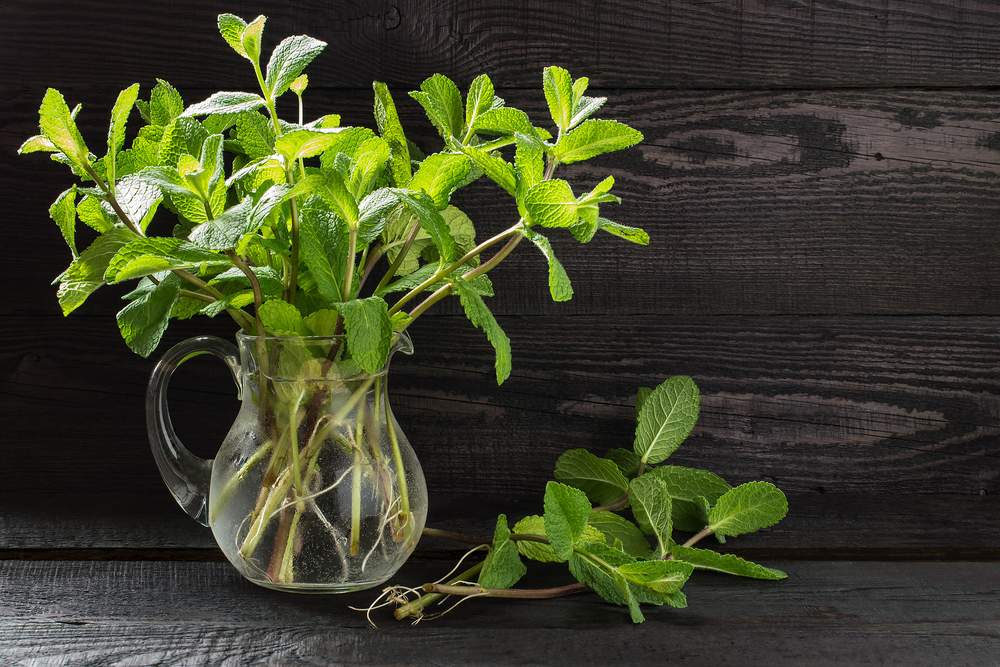
As for the container, mason jars or any other glass bottles will do, even plastic bottles. Roots generally like to grow away from light, so colored bottles, especially amber colored ones (such as these) are best. You can just wrap a piece of paper around the bottle to keep the root zone in the dark. This will even prevent algal growth on the container walls and on the root surface. Algae do not adversely affect plant growth, but they make the bottles look untidy.   

Narrow-mouthed containers have an advantage: they can support the cuttings and keep them nearly upright. However, the mouth of the container shouldn't be too narrow or tight-fitting around the cutting. The roots have to breathe, and the mouth of the container should allow free movement of air.

If you're using a wide-mouthed container, you have the option of covering the top with nylon or wire netting. Insert the cuttings through the holes, and that will offer some support to the cuttings. Another advantage, especially in warmer areas, is that the netting prevents mosquitoes from laying eggs in the water and multiplying.

Plant cuttings   

Soft cuttings are pretty quick to root in water. You don't need to use any rooting hormones. If you have some herbs growing in the garden, snip off 6-inch sections from growing tips and put them in the water-filled containers. The best part of growing herbs from cuttings is that you can use the ones you get from the supermarket. Just wash them in plain water and cut off the lower portion.

Remove lower leaves from cuttings and trim the lower tips close to the nodes from where the roots arise. When they are inserted into the bottles, there shouldn't be any leaves touching the water. They can rot easily and spoil the water, as they do in flower vases.  

Woody cuttings like rosemary may take longer to root, so be patient. Change the water once a week without disturbing the cuttings. Once the roots start growing, usually between 2-6 weeks, water changes may not be necessary.

If you have willow trees in the garden, you can steep some branches in warm water overnight to make a natural rooting hormone mix. Place the cuttings in the infusion to encourage rooting. Alternately, rooting hormone powder can be used.  

10 Best Herbs You Can Grow In Water

10 Delicious Herbs You Can Grow Indoors In WATER All Year Long

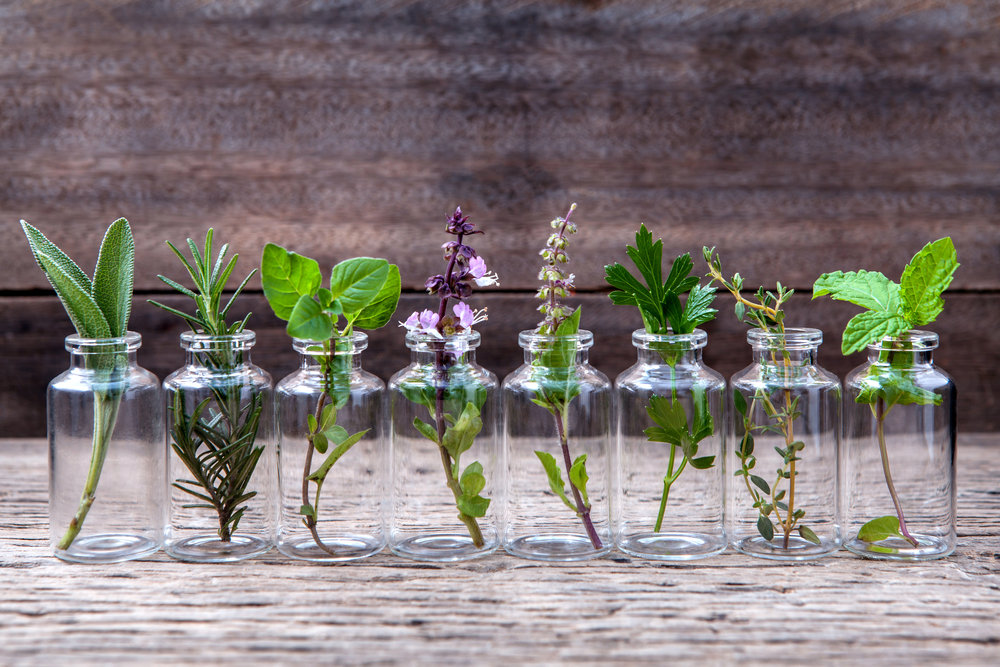
1. Peppermint – This is the most popular mint for medicinal uses because it contains high amounts of the volatile substance menthol. It gives a unique cooling sensation on the skin or tongue, but without actually causing any temperature variation. Growing peppermint in water is easy; just put fresh cuttings in water to grow new plants.

2. Spearmint – This is another mint variety closely related to peppermint. In fact, peppermint is a natural hybrid of spearmint and an aquatic mint that is commonly known as water mint.

3. Oregano – This pungent herb is worth growing indoors because you can use the leaves to flavor almost any vegetable. Take cuttings of fresh growth and pot them up in water. Start pinching the growing tips as soon as the plant starts to grow well.

4. Basil – Basil would love the warmth of your kitchen and grow happily in a water-filled container as long as you provide it good light. Take cuttings any time before it starts flowering. If you have several varieties of basil, growing cuttings in water is the best way to preserve your collection during winter.

5. Sage – Take soft cuttings in the spring and root them in water. You may need only one or two sage plants because only very tiny amounts are needed to impart flavor. Keep the plants in bright light and in a well-aerated place because this herb is prone to mildew.

6. Stevia – This sweet plant is good to have in the house to add to freshly brewed teas and beverages. Take cuttings of actively growing soft branches and place them in water. Provide a warm place and as much light as possible to keep this tropical plant happy and full of sweetness.

7. Lemon balm – The lemony scent of this mint-family herb is a welcome treat in any home, especially in the winter. The leaves are great for making tea. Take cuttings in spring or fall. Keep the containers in a warm place that receives plenty of bright indirect light. They may take up to 3-4 weeks to develop roots. Keep the water clean with regular changes. Some people find it easier to root the cuttings outside the house when the weather's still warm. It may help avoid white mildew that lemon balm is prone to. You can bring them indoors when the new plants are well established.

8. Tarragon – Take cuttings in the spring after new growth appears. Fall cuttings are fine too, but they may take longer to grow roots. Keep cuttings in a warm place that gets bright light. French tarragon is best as a culinary herb. Russian tarragon is milder, or even bland, so use it as a green in salads.

9. Thyme – You need to take cuttings of new growth that is green in color. The old growth that has become stiff and brown may not sprout roots easily. The best time to take the cuttings is mid-spring to early summer, before the plant starts flowering. The thin stems of thyme can dry out very fast, so put them in water as soon as you cut them. Spray the portion above the water, if necessary. Once it starts growing, cut the stems to promote branching.

10. Rosemary – The semi-woody cuttings of rosemary take longer to root, but spring cuttings of new shoots may be faster. Either way, it is worth the effort because rosemary makes an excellent indoor plant for a sunny spot.

9 Best Houseplants To Grow In Water

25 Herbs, Vegetables & Plants You Can Grow In Water

Not just herbs, but other houseplants do equally well in water. Just perfect for you if you regularly kill houseplants by over watering them or forgetting to water altogether. You don't need to make any special arrangements when you go off for a few days.

Pothos – This plant is commonly grown in water. Take tip cuttings of any length and put the cut end into some water making sure that 2-3 nodes are submerged in water.

Arrowhead –  This plant is similar to pothos. Tip cuttings can be potted up with a few nodes below the water level.

Philodendrons – Dainty heart-leaved philodendrons, as well as the large, split-leaved types do equally well in water. Take 6-8 inch cuttings of growing tips and put in a container that can support its weight. You may need to place a piece of rock in the container to prevent accidental tipping.  

Peace lily – You can pot up divisions or use an entire plant growing in a pot. Just wash off all the soil from the roots and put it in a bowl of water.

Aluminum plant – Cuttings of this beautiful plant with silver markings do very well in water.

Dracena – The plant commonly grown in water as Chinese lucky bamboo incidentally is no bamboo, but a variety of dracaena (Dracaena braunii). Others like corn plant (D. fragrans), Song of India (D. reflexa) are good choices. Sections of the cane can be rooted and grown in water, but support is essential for these top heavy plants.

Dieffenbachia (Dumb cane) – Cut top growth and pot up in water after the cut end becomes dry. Care must be taken while handling this plant; its sap is so caustic, it can burn your skin.

Chinese evergreen (Aglaonema) – Take cuttings or clean whole plants growing in pots and put them in large containers of water.

Chlorophytum (Spider plant, Airplane plant) – Put large plantlets or entire plants cleaned of all soil particles in goldfish bowls full of water. Water culture is best for hanging plants because you don't need to water them often.

6 Best Vegetables To Grow In Water

Watercress, water chestnut, wasabi, and lotus are some of the food plants that naturally grow in water. But many terrestrial vegetables can adapt to growing in water. Some, like leafy greens like lettuce and spinach, do extremely well. They seem to be happier than their counterparts growing in the ground because they get a continuous supply of water and are not bothered by soil pathogens.

Lettuce – This is the most favorite vegetable of hydroponic farmers. The easiest way to grow them hydroponically is to start the seeds in netted cups. When they are bigger, insert them into the beds containing growing medium.

Spinach – This leafy vegetable is grown the same way as lettuce.

Tomatoes – Tomato seeds started in individual cups are inserted into the growing medium. High yields are typical of hydroponically cultivated tomatoes.

Peppers – Their cultural requirements are similar to tomatoes.

Cucumbers – Bush type cucumbers are preferred for hydroponics; the climbing type would need extra support.

Celery – Being able to grow celery without soil is a bonus; it means no dirt deposited in the leaf bases. It makes cleaning the vegetable very easy.  

How To Feed Water-Grown Plants

Plants growing in plain water will soon exhaust what little mineral nutrients the water may contain. Since they don't have access to the nutrients naturally occurring in soil, they need supplemental nutrition to do well. Regular fertilizers diluted in water or proprietary formulations designed for hydroponics can be used at regular intervals.

When you use fertilizers to feed water grown plants, they leave some residues that may accumulate in the water and on the roots, causing root burn. Change the water at regular intervals and flush the plants and the containers occasionally.

Hydroponics – Growing Plants in Water and Inert Media

Soil has some functions other than providing minerals required for plant growth,. It supports the plants and provides a medium for anchoring the roots. When plants are grown without soil, the lack of proper support can be a limiting factor. Soil acts as a reservoir of water and fertilizers added to it, and then releases both in a controlled manner.  

Inert natural media like sand, gravel, perlite, vermiculite coconut fiber, and coconut chips are sometimes added to water containers to serve as support. Some products like lightweight expanded clay and rock wool are specially manufactured for this purpose.

Plants grown in a hydroponic medium seem to appreciate the physical support they get. Special nutrient formulations are mixed with water to provide continuous nourishment to the plants. That's why hydroponic systems typically give very high yield.  

Types of Hydroponic Systems

Wick system – The plants grow in tubs filled with an absorbent medium like coco-peat that can wick up nutrient-rich water from a bottom reservoir. It is somewhat like growing plants in soil, except that the nutrients come from the water, not the medium.

Deep Water Culture – It is almost same as the simple system described for growing plants directly in containers of water. The roots remain suspended in water, but the plants are actually growing in another container partially immersed in the main water container. Sometimes Styrofoam sheets with holes are used for suspending the plants.

The water in the main container is agitated or aerated with an aquarium pump. This extra aeration to the root zone helps reduce disease and keeps the roots healthy and strong. The main drawback is that power is required to run the system.  

Instead of allowing the roots to remain submerged in water all the time, different types of arrangements for intermittent exposure have been developed. This allows more air-circulation around the roots, helping reduce root zone diseases.  

Falling water – Nutrient solution is supplied to the beds from overhead sprinklers. It percolates down by gravity and gets recirculated. The root zone gets good air circulation, but the system involves pumping water for recirculation.

Flood and drain – The plants growing in the bed of inert medium are watered by intermittent flooding of the beds with the nutrient solution. The bed is them allowed to drain, exposing the roots to air.

Aeroponics

This is an improvement on hydroponics where growing medium is done away with. Plants are grown in holes cut into large pipes so that their roots remain inside the pipe. Nutrient solution is sprayed on to this root zone.   

Aquaponics

This is a combination of hydroponics and aquaculture in which fish and other aquatic life are grown. It does away with the proprietary nutrient solutions used in hydroponics, replacing it with the nutrient-rich water discarded from aquaculture tanks.

The system uses an inert medium that gets colonized by microorganisms capable of breaking down aquaculture waste products. The water thus cleaned and filtered by the hydroponic bed gets recirculated into the aquaculture tanks.

A simple replication of aquaponics would be growing herbs, watercress or microgreens on Styrofoam sheets floating in an aquarium tank with their roots absorbing the nutrients generated from fish waste.

It is truly amazing the number of plants that can be grown without soil.  If you are ready for a change from conventional gardening why not try your green thumb at water gardening?

Read Next: 20 Cut & Come Again Edibles For An Endless Supply Of Nutrient Dense Food


~A.

Tuesday, August 20, 2019

What Britain’s release of an Iranian tanker says about its post-Brexit foreign policy - Tanker geopolitics


What Britain's release of an Iranian tanker says about its post-Brexit foreign policy

Britain is caught awkwardly between America and Europe

Britain is caught awkwardly between America and Europe

A SUPERTANKER LOADED with oil headed east from the Strait of Gibraltar into the Mediterranean, bound for Greece, just before midnight on August 18th. Nothing unusual in that—some 120,000 vessels pass through the strait each year, carrying a third of the world's oil and gas. But the Iranian-flagged Adrian Darya 1 was no ordinary tanker.

Just days earlier she had been renamed and reflagged, with fresh paint covering her old identity, Grace 1. Those actions accompanied the vessel's release from over a month of detention in Gibraltar, an overseas territory of Britain. The episode not only marks the latest chapter in the increasingly bitter struggle between Iran and America—which made a final effort to seize the ship hours before she set sail—but also highlights Britain's increasingly strained effort to balance its Iran policy between American belligerence and European emollience.

Get our daily newsletter

Upgrade your inbox and get our Daily Dispatch and Editor's Picks.

The backdrop to the crisis is President Donald Trump's withdrawal last year from the multinational nuclear agreement that his predecessor, Barack Obama, had reached with Iran in 2015. This agreement had limited Iran's nuclear programme in exchange for a partial lifting of sanctions.

American sanctions on Iran were tightened sharply in April under Mr Trump's policy of "maximum pressure". Moreover, any foreign firms that do business with Iran also face the threat of punishment. That prompted Iran to walk away from elements of the pact and to hit back in other ways. In May America and several of its allies blamed Iran for mine attacks on ships in the Gulf of Oman. Matters almost came to a head when Iran shot down an American spy drone on June 20th, causing Mr Trump to order—and then cancel—air strikes on Iran.

That was the febrile atmosphere on July 4th, when British marines abseiled onto the deck of the Adrian Darya 1 in Gibraltarian waters. They did so on the basis of American intelligence suggesting that the tanker's oil was bound for Syria, whose main refinery is under EU sanctions. On July 19th, after weeks of naval shadow-boxing, Iran procured a bargaining chip of its own by grabbing a British tanker, the Stena Impero, in the Strait of Hormuz on spurious charges of safety violations.

That may have strengthened Iran's hand. But it was not until Iran promised that the tanker would not be sent to Syria, or any other destination covered by EU sanctions—promises extracted after weeks of intense diplomacy involving British and Iranian diplomats—that Gibraltar relented. "In light of the assurances we have received," said the territory's chief minister on August 15th, "there are no longer any reasonable grounds for the continued legal detention of the Grace 1 in order to ensure compliance with the EU Sanctions Regulation." The ship was accordingly freed.

That was a relief to Britain. The threat of further ship-grabs, which had led the Royal Navy to send extra warships to the Gulf, would diminish, and Iran would probably release Britain's tanker in turn. But the drama was not over yet. The Adrian Darya's new paint barely dry, when America made a last-ditch effort to keep the heat on Iran. The next day, on August 16th, a federal court in Washington, DC, issued a warrant for its re-seizure, on the basis that the ship was secretly controlled by a network of companies run by Iran's Islamic Revolutionary Guard Corps (IRGC), a powerful branch of Iran's armed forces.

America's legal case reflected both the long reach of its sanctions and their unique severity against Iran. In April the Trump administration had designated the IRGC as a foreign terrorist organisation, against the advice of American military and intelligence officials. The ship's "deceptive voyages" were part of large-scale money-laundering operation, complained America's Department of Justice. That cut no ice with Gibraltar. It pointed out that the EU's sanctions laws differ from America's, and that Europeans—like the rest of the world—treat the IRGC as unsavoury actors rather than outright terrorists.

The Adrian Darya 1 may yet struggle to sell its wares; America has threatened to impose sanctions on anyone doing business with her. But she has probably escaped America's clutches. Even the Trump administration is likely to rule out nabbing the ship in international waters, which would cause an outcry. And courts in Greece—where she is due to arrive on August 25th—will prove no more pliant than those in Gibraltar.

Nevertheless, the diplomatic tussle has put Britain in a difficult position. In May Hassan Rouhani, Iran's president, warned that unless the deal's other signatories—including Europe, China and Russia—helped Iran withstand the tightening vice of American sanctions, it would begin steadily violating elements of the deal, inching closer to the ability to build nuclear weapons. It has started to act on that threat. Iran is also said to have warned, privately, that unless it can export 1.5m barrels of oil per day, far more than it does now, it will walk away (oil makes up about a third of Iran's government budget).

Like its European allies, Britain wants to encourage Iran to remain in compliance. It has made sincere efforts to that end. In January it spearheaded, with France and Germany, the creation of Instex, a barter mechanism that would facilitate certain types of Europe-Iran transactions, particularly for humanitarian supplies. British diplomats say they remain eager to soothe Iran with continued trade. But the seizure of the Adrian Darya 1—with its 2.1m barrels of oil—threw a spanner in the works, not least because Britain was prodded into action by American intelligence.

Further complicating matters, Britain's government changed hands midway through the crisis; on July 24th, Boris Johnson succeeded Theresa May as prime minister, and appointed new foreign and defence ministers. Mr Johnson has adopted a confrontational attitude to European partners over the terms of Britain's departure from the European Union, saying Britain would leave the EU as scheduled on October 31st, with or without a deal. He has also courted the Trump administration, which is keen to encourage Brexit and is holding out the prospect of a speedy free-trade deal between Britain and America to help cushion the British economy.

That leaves Britain's Iran policy in a parlous position. Should Mr Johnson continue to side with the Europeans, he may anger America, placing at risk the promise of a post-Brexit economic deal. But if he sides with Mr Trump and heaps more pressure on Iran, he would risk a complete collapse in the teetering nuclear deal and a spat with Europe. "You can't maintain that post-Brexit you'll be a loyal ally of European nations in matters of security and ditch 20 years of Iran policy by moving over to the American side," says Richard Dalton, who served as Britain's ambassador to Iran between 2003 and 2006. "If Britain is to have any influence in the world, it's got to keep intact the relationships with France and Germany in order to continue to be a bridge between America and Europe."

Thus far, Mr Johnson has continued to seek a balance. Whereas Mrs May's government had tried to corral a group of European states in a maritime-security mission for the Persian Gulf—in marked preference to one involving America—Mr Johnson's government quickly signed up to the American-led scheme. John Bolton, Mr Trump's national security adviser, visiting Britain on August 12th, noted with pleasure that the choice "reflects a change from the prior government". But the release of the Adrian Darya 1 shows that even Mr Johnson is unwilling to break with European partners and join Mr Trump in trying to throttle Iran. At least not yet.


Environmentally Hypocritical Lifestyles of the Rich & Famous


Environmentally Hypocritical Lifestyles of the Rich & Famous

by Daisy Luther

There's little I find more annoying than a bunch of rich people lecturing the peons about how something we're doing is "bad" but then they turn around and do the exact same thing times ten because it's different when they do it.

I'm talking about environmental hypocrisy.

I like the environment as much as anyone else. I take my reusable bags to the store. I re-use just about everything until it can't be used any more (a practice I began when I was flat broke and couldn't afford to add a box of ziplock bags to my grocery cart for school lunches every week.) We try to reduce the amount of trash we create. My family makes all sorts of choices that are good for the environment because we want to be good stewards of the earth.

But it's pretty annoying to see a bunch of rich people take 114 private jets to an Italian island so they can talk about how crappy the rest of us are to the planet.

And then to hear them say that their private jet flight is "carbon neutral" because they made a financial donation is positively idiotic.

Apparently only people who can afford to make a donation are allowed to be environmentally frivolous and I can pay by credit card or debit to make my sins against the earth disappear.

Here are two ridiculous examples of the financial "elite" wishing to tell the rest of us what to do while they do the diametric opposite but it's okay because they paid extra.

Environmental activists arrived at "Google Camp" in private jets

Google founders Sergey Brin and Larry Page throw a shindig every summer so that rich people can come and decide how to save the world from the rest of us.  Nicknamed "Google Camp," it's a star-studded, rich-person get-together.

This year, the "activists" arrived in Sicily via private jets, mega-yachts, and helicopters.

Scores of A-list celebrities arrived in Sicily, Italy this week for the annual "Google Camp" to discuss the threat of climate change while communing with some of the wealthiest tech entrepreneurs in the world to a posh, seaside resort.

The event is hosted by Google co-founders Sergey Brin and Larry Page, who reportedly intend for the camp to be a "meeting of the minds" between technology giants, powerful business owners, and others who are known to be global thought leaders…

…More than 114 private jets were reported to have been expected at nearby Palermo airport, where camp guests would be transported to the resort by van. Mega yachts docked at a nearby beach were reported to belong to designer Diane Von Furstenberg, German pharmaceutical giant Udo J. Vetter, Google's Eric Schmidt, New Zealand tycoon Graeme Hart, and American billionaire David Geffen…

…Some estimates suggest that up to 100,000 kilograms of CO2 could be expelled into the air during the journeys of that many private jets. Mega yachts, like Graeme Hart's $275 million "Ulysses," can use up to 2,000 liters of fuel per hour when in motion. (source)

Thankfully, after attending Google Camp, "thought leaders" like movie stars, Prince Harry and Meghan Markle, and pop singers should be able to explain to the rest of us how to live carbon neutral lives.

What should you do if you are carboning up the environment?

If you are flying around on private jets and dining on steak and using plastic bags, never fear. You don't need to change your habits. You can buy your way out of this and the environment will be just fine.  I found this site where individuals can "offset" their carbon footprints by giving the organization money.

You can pay a fee for your own carbon use, choose what vehicle you have and offset that, choose how many flights you'll be taking, how many gifts you will be giving, how many parties you'll have, and how big your house is. And don't worry – if you have a surprise flight you can just bop on over to the site and give them some more money.

I quickly calculated how much it would cost to make my family of 2 people carbon-neutral and it was "just" $955.72 a year. If I want a discount, I can pay $16,320 for each of us for our lifetime personal carbon output, however, I'd still need to donate to cover my sins of travel, gift-giving, driving, and living in a house. You can even "offset" your wedding right here.

Here's how it works:

Carbonfund.org is leading the fight against global warming, making it easy and affordable for any individual, business or organization to reduce & offset their climate impact and hasten the transition to a clean energy future. Carbonfund.org achieves its goals through:

  • Climate change education
  • Carbon offsets and reductions
  • Public outreach

We encourage everyone to continually strive to reduce their carbon footprint through sensible energy reductions combined with cost-effective carbon offsets to eliminate their overall carbon footprint.

Carbonfund.org supports third-party validated renewable energy, energy efficiency and reforestation projects globally that reduce carbon dioxide emissions and the threat of climate change. (source)

And don't worry. Your environmentally friendly donations are all tax-deductible. And as you can see, if you just pay some extra money after doing something environmentally unfriendly, it'll be just fine. I figure all the people at Google Camp gave an organization like this some money to cover the use of their jets and yachts.

Unpopular opinion: If you firmly believe you're doing stuff that is damaging to the environment, donating money doesn't fix the harm you've done. How about, if you feel so strong, you just stop harming the environment?

Then there's the new meat tax Germany wants to try.

Germany, most recently, has an idea to help convince people to eat less meat. They want to add on a hefty tax so that basically, poor people can't afford it. Then, much like Google Camp, the wealthy can indulge however they want and it'll be okay because they can pay the meat tax and it won't count against the environment.

The German debate coincided with a UN report from a panel of scientists calling for a determined switch away from livestock farming. They argue that the West's high consumption of meat and dairy produce is fuelling global warming.

Besides the harm caused by methane emissions from livestock, there is the widespread destruction of forests to make way for pasture, a process that releases CO2 stored in soil and reduces the absorption of CO2 by trees.

The UN Food and Agriculture Organization (FAO) says the livestock sector produces 14.5% of greenhouse gas emissions, or 7.1 gigatonnes of CO2 equivalent – more than all the direct emissions from cars, aviation, ships and other transport. (source)

Some MPs are calling for a meat tax as high as 19%. Currently, the tax is 7% on food.

SPD agriculture spokesman Rainer Spiering said "there are discount stores in Germany selling 500 grams of mince for €2.50 (£2.30), and if the VAT rate goes up by 12 percentage points they will charge €2.80 – I think that is acceptable". (source)

But there are problems with this "solution."

With the added tax, meat just costs more but there's no real way to separate that extra meat tax from the general VAT (which stands for value-added tax ROFL). So that money just goes into the government coffers to the detriment of poor people. Which is really no surprise – as I've written before, when you are poor in the modern world, you get fined and fee-ed into a financial hole from which it's nearly impossible to extricate yourself. Why not add some new taxes on top of that. Don't be selfish. It's for the EARTH.

Igor Ogorodnev's beautifully scathing essay on RT points out some flaws in this logic.

Being a wealthy lawmaker you will eat as much or as little meat as before, as food makes a small proportion of your monthly budget. Your constituents – that is a different matter. Perhaps some will get the message, and eat more vegetables instead. Or perhaps, instead of buying organic, cruelty-free, carbon-neutral meat, they will now buy more factory-farmed meat. Or perhaps they will spend the money on a decent steak but will not be able to afford to repair their car, or take that holiday to the Balearics. Though I guess that could be a result in itself – after all, as a rule, the poorer someone is in the West, the less CO2 they emit. Some might be so deprived, however, that they will eat no meat at all. Their remaining money will now go to other, cheaper high-calorie processed foods, like cakes or oven-fried chips. While your farmers will simply find it more profitable to export the food abroad, over longer distances, increasing their emissions. Is this what you wanted?

…What's the right ethical trade-off between seven-course feasts of imported ostrich and elk and government-mandated buckwheat three times a day?

…You will say that at least it is better to be doing something.

And indeed you are right – it is the "something" that matters, not the specific results. After all if there is one thing that Greta Thunberg and Nigel Lawson can agree on is that creating a meat tax in Germany, Sweden and Denmark, the three countries that have shown the greatest appetite for this policy, will make almost no difference to global emissions. For example, even if every resident of the United States, the country with the highest consumption of meat per capita, stopped eating meat tomorrow, that would only slice 2.6 percent off its emissions. Meanwhile, a Chinese person now eats five times as much meat as they did in the 1980s, and still only half as much as Americans – so he wants more. And the world population will likely double by the end of the century. Germans eating two fewer sausages a week is not going to cut it, and everyone knows it. (source)

Environmentally hypocrisy will end up costing us a lot of money.

The problem is, for some bizarre reason, people listen to the idealistic verbiage of the rich and famous. We're not talking about high IQ environmental scientists. We're talking about people like Leonardo DiCaprio, Harry Styles, Prince Harry and Meghan Markle, Mark Zuckerberg, and Diane Von Furstenberg (source) attending an event that cost Google an estimated 20 million bucks.

As for the brainstorming sessions, you need not worry that they'll be too arduous on the guests. Morning discussions are reportedly followed by afternoons and evenings of relaxation, food, and drink. (source)

It's pretty "Marie Antoinette" to jet off to a sunbaked European holiday and talk about what the rest of us little people should be doing to save the earth.

Think about the clothes they'll only wear once, the hats and the shoes.

Think about the multiple trips per year they take on private transportation.

Think about the mansions with 6 or more bedrooms they have to heat and cool.

Think about the lavish parties and events they host and attend.

The list of frivolities could go on and on, and actually if they can afford to be frivolous, more power to 'em. It's not my job to police their finances and activities.

If only they felt the same way about policing ours.

Monday, August 19, 2019

20 Best CBD Oil Drops for 2019 [With Lab Results] - CBD Hacker


20 Best CBD Oil Drops for 2019 [With Lab Results] - CBD Hacker

Consumers have few reliable sources for information about CBD products and companies. That's where we come in.

CBD oil drops that are made to be taken sublingually, or under the tongue, are among the most popular formats for cannabidiol. But the industry's lack of transparency makes it difficult to find the best CBD oil drops for you, especially if it's your first time shopping for CBD.

We're here to remove the guesswork and trial and error from purchasing CBD oil. Our updated and expanded ranking of the top CBD oils includes the latest information and new, up-and-coming CBD brands.

We evaluated each company's business practices and customer service, sent samples out to a third-party lab for testing, and compared the potency and price for each product.

We also used a blind tasting process to eliminate bias and get our authentic reactions to each product.

Ready to learn more? Read on to find the CBD oil drops that are right for you.


Editor's Choice Awards - August 2019

Every month, we highlight a few brands that we found to be overachievers in specific categories.

This August, we're focusing on cannabinoid potency. Whether you're looking for a product that is free of tetrahydrocannabinol, or seeking the full benefits of CBD's entourage effect, we've got you covered.

But first, we'll take a look at who earned the highest scores overall.

Skip to the full ranking to get the full reviews.


Best All Around


Best THC-Free CBD Oil


Best Full-Spectrum (TIE)

When it comes to whole-plant potency, two brands stood out from the rest. We selected the winners in this category by analyzing our third-party lab results and comparing the ratio of other cannabinoids to CBD.

If you're looking for a full-spectrum CBD product that packs a hefty cannabinoid punch, you can't go wrong with NuLeaf Naturals or 4 Corners Cannabis.

Table of Contents

Choosing the best CBD oil drops for 2019 was no easy task. Not only did we have to taste every single sample, but we also called each company's customer service reps and sent samples to a third-party lab for analysis.

Let's just say there was a lot of math involved.

So, we have a lot of ground to cover! Here's what you can expect to find ahead:

  • Methodology: How we ranked the top CBD oil drops
  • Value: CBD oil price comparison
  • Potency: Cannabinoid profile comparison
  • The 20 Best CBD Oil Drops of 2019

Click on any of the list items above to skip to the relevant section, or just keep reading!

Our Methodology

So, what sets this ranking apart from all of the other CBD oil reviews out there?
Well, our rigorous testing process is designed to make our rankings as fair and unbiased as possible. Here's how it works:
We selected a mix of established brands and rising stars to evaluate for this ranking. To do that, we looked at the products CBD users are recommending in online communities, and which brands are generating buzz in the industry. We also included companies that had previously reached out to us, asking to be evaluated.
In the end, we whittled down a starting list of 60 companies, and ended up fully evaluating about 35 different samples. Then, we scored each one in these five main categories:
  • Product quality and value
  • User experience
  • Customer service
  • Reputation
  • Transparency and accuracy

We want to make sure that our CBD oil reviews are as relevant as possible, for as many different people as possible. That's why we incorporated feedback from our readers into our scoring metrics this year.

Product Quality and Value

As always, the product category carried the greatest weight in our final scores. That's because it included some of the most important questions for consumers:

  • Quality: What are the ingredients in this oil? What extraction methods did they use?
  • Sourcing: Where does the hemp come from? Was it grown organically to ensure that it is free of pesticides and heavy metals?
  • Value: What is the price per milligram of CBD?
  • Flavor: Can I stand to take this regularly?

It was important to us to eliminate bias as much as possible, so we used a blind testing process to evaluate the products for taste, aroma, texture, and appearance. Every sample was decanted into an identical container labeled only by number.

We've also updated the way we award points for flavor in this ranking, to account for the increased bitterness that is typical of higher-potency full spectrum products.

User Experience

A company could be offering the best product out there. But if the webstore crashes every time you try to make a purchase, then it doesn't do you any good. That's why we closely evaluated each company's website for performance, design, and accessibility.

We also checked to see how easy it is to find important information, from shipping and return policies to the ingredient lists for each product.

Customer Service

We only want to recommend companies that stand by their customers. If you have a question or a problem with your CBD product, you should be able to count on quick, friendly, and knowledgeable customer care.

In addition to using secret-shopper-style research to see how each company's customer service measured up, we also checked to see how consumer-friendly their policies are. For example, we looked at:

  • Shipping policies
  • Return policies and satisfaction guarantees
  • Assistance programs
  • Loyalty or rewards programs

Among the top brands, the quality of their customer service was often the deciding factor that determined a higher score.

Reputation

For the reputation category, we looked at each company's track record. We scoured the web for reviews to see what customers have been saying over time, and to look for any red flags.

We also looked at how each company interacts with customers. Do they respond professionally to critical reviews?

Transparency and accuracy

Finally, in an industry that essentially regulates itself, transparency is massively important to building trust for consumers. For this category, we looked at the types of information that each company was willing to share. We also evaluated how easy it was to access that information.

Most importantly, we sent samples of each product to a third-party lab for CBD and THC potency tests. While some variation is to be expected, no products that tested more than 10 percent below the advertised amount of CBD are included in this ranking.

We compared our lab's analysis to the CBD quantity listed on each product's label. And where companies made their own lab testing public, we looked at how extensive, up-to-date, and easy-to-find their lab results were.

Value: CBD Oil Price Comparison

Looking for the best CBD oil deals? Here's our price comparison of each brand we evaluated.

CBD Oil Potency: Cannabinoid Profile Comparison

If getting the full entourage effect is important to you, or if you're trying to avoid THC, cannabinoid potency should be a big part of your decision-making process. These are the results of our third-party lab's analysis of each sample.

The Top CBD Oil Drops


John Lovin Life (backyard conversation...)

Saved from my phone…