Wednesday, November 04, 2020

The Way Between.....


BOOK ONE OF THE AWARD-WINNING ARI ARA SERIES!


"...as magical as Tolkien and as authentic as Twain... this novel should be read aloud to everyone, by everyone, from childhood onward." – Dr. Tom Hastings, Director of Peace Voice

Ari Ara was a half-wild shepherdess running the black slopes of the High Mountains when the great warrior Shulen chose her as his apprentice in the mysterious Way Between. With courage and determination, she enters a world of warriors and secrets, swords and magic, prophecy and danger. As the search for the Lost Heir propels two nations to the brink of war, Ari Ara must master this path between fight and flight before violence destroys everything she loves.


In an exciting blend of action, adventure, and fantasy, author Rivera Sun boldly takes the genre in a new direction. The Way Between combines everything we love about epic myths – courage, daring, adventure – with the skills of conflict resolution, anti-bullying, and ending violence. This novel will claim a spot on your bookshelf and a place in your heart. It's a book for both adults and children to enjoy! 


Recommended for teachers, students, anti-bullying groups, peace advocates, and youth activist groups and dedicated to old soldiers that wish for the better way… Get your copy now! 


Comments From Reviewers


Rivera Sun has, once again, used her passion for nonviolence, and her talent for putting thoughts into powerful words on a page, to recreate life, to show us the possibilities that can be, if we dedicate ourselves to The Way Between. ~ Robin Wildman, Fifth Grade Teacher, Nonviolent Schools Movement, and Nonviolence Trainer


A wonderful book! It is so rare to find exciting fiction for young people and adults that shows creative solutions to conflict and challenges violence with active nonviolence and peace. Ari Ara is a delightful character and this story is a gem. ~ Heart Phoenix, River Phoenix Center for Peacebuilding


A beautiful story that expands the imagination into the possibilities of peace and active nonviolence . . . this book will prepare our children and ourselves for the real-life world we so desperately need. ~ David Hartsough, Founder Nonviolent Peaceforce, author of Waging Peace


I love the book! It's a great adventure tale, with all the elements of a classic legend, and an even more important message. ~ Michael Colvin, Fellowship of Reconciliation, National Council Member


The Way Between is a compelling and wise articulation of the human sojourn . . . a dispatch from a mythic dimension of archaic longing and potential that calls us to our truest selves.~ Ken Butigan, Pace e Bene/Campaign Nonviolence


Nonviolence is a treasure hidden right under our noses that can help solve--not just some-- all of the challenges the world is facing. Imagine the sheer wonder of making this great discovery. Rivera Sun skillfully shows us The Way. ~ Stephanie N. Van Hook, Director of the Metta Center for Nonviolence; author of Gandhi Searches for Truth: A Practical Biography for Children


The Way Between is a story that reached deep inside and literally grabbed my heart because it speaks to our common humanity. ~ Margaret Flowers, Popular Resistance


Generations of young adults will be helped to find this way in the adventures of Ari Ara; and we will all be so greatly in Rivera's debt. ~ Michael Nagler, author of Search for a Nonviolent Future
 The Way Between is a story that reached deep inside and literally grabbed my heartbecause it speaks to our common humanity and validates the belief thatthere is a another way than the course we are on. Ari Ara had thecourage to insist upon making something that everybody wanted a realitywhen they thought it couldn't be done. And that's what we need now inthese times of crisis, to know that if this and that aren't working, it is within our power to choose another way. ~ Margaret Flowers, M.D., Co-Founder/Editor Popular Ressistance
 
Generations of young adults will be helped to find this way in the adventures ofAri Ara; and we will all be so greatly in debt to Rivera. ~ Michael Nagler, author of Search for a Nonviolent Future; founder of Metta Center for Nonviolence
 
A thought-provoking book with the pluckiest red-haired heroine this side of Little Orphan Annie. The Way Between turns the fantasy genre on its ear by not giving us what we ve come toexpect (set piece battles, ogres and dragons) but what we need to learn. ~ Burt Kempner, Children's Book Author
 
The Way Between is an inspired fantasy masterpiece ... woven within the story ofnonviolence is a beautiful coming of age tale that is heart-warming andinspiring. ~ Angela Parker, mother and Board Member of the Social Justice Center of Marin
 
The story is set in a far off mystical land but it is indeed a story ofmodern day struggles and the human condition. A most excellent book. ~ Larsen Prip, Veteran for Peace
 
Thank you so much for giving me, my family, and the world this wonderful story! ~ Adam Vogal. Fellowship of Reconciliation, National Council Member
 
A perfect book to inspire our future generations in understanding there is a way beyond war and conflict. ~ Robin Farrin
 
I just finished the delightful reading of The Way Between! I don't yet have the right words to express my admiration . . . thank you! Can't wait for the sequel! ~ Nancy Audette
 
I loved the book. I am an Aikido practitioner and I found it inspired me in my practice and other areas of my life. ~ John Mazzola
 
Stellar storytelling! Inspiration for young people and grownups alike. ~ Maja Bengtson, Nonviolence Coach
 
Rivera Sun is an amazing storyteller and The Way Between is an incredible elucidation of the possibilities when we look beyond the ways of war & conflict! ~ Pamela Twining
 
She writes like a young Ursula LeGuin! Many thanks for your work and your words! ~ Ken Kailing
 
We live in a time of fascinating contradictions. We need stories to helpus discover, create, and be new ways. Rivera Sun's great new book offers just that for the young, the young at heart, the caring and thecurious. The Way Between is a GREAT read and another important book for our times. ~ Cindy Reinhardt
 
I sat on the edge of my seat, laughed, cried and learned. This book is something special! ~ Beverly Campbell
--Rising Sun Media Works 

Comments From Reviewers
 
This novel shouldbe read aloud to everyone, by everyone, from childhood onward... RiveraSun writes in a style as magical as Tolkien and as authentic as Twain. ~ Tom Hastings, Director of PeaceVoice, Professor of Conflict Studies at Portland State University
 
Rivera Sun has, once again, used her passion for nonviolence, and her talentfor putting thoughts into powerful words on a page, to recreate life, to show us the possibilities that can be, if we dedicate ourselves to The Way Between. ~ Robin Wildman, Fifth Grade Teacher, Nonviolent Schools Movement, and Nonviolence Trainer
 
A wonderful book! It is so rare to find exciting fiction for young people and adults that shows creative solutions to conflict and challengesviolence with active nonviolence and peace. Ari Ara is a delightfulcharacter and this story is a gem. ~ Heart Phoenix, River Phoenix Center for Peacebuilding
 
A beautiful story that expands the imagination into the possibilities ofpeace and active nonviolence . . . this book will prepare our childrenand ourselves for the real-life world we so desperately need. ~ David Hartsough, Founder Nonviolent Peaceforce, author of Waging Peace
 
I love the book! It's a great adventure tale, with all the elements of a classic legend, and an even more important message. ~ Michael Colvin, Fellowship of Reconciliation, National Council Member
 
The Way Between is a compelling and wise articulation of the human sojourn . . . adispatch from a mythic dimension of archaic longing and potential thatcalls us to our truest selves. ~ Ken Butigan, Pace e Bene/Campaign Nonviolence
 
Nonviolence is a treasure hidden right under our noses that can help solve--notjust some-- all of the challenges the world is facing. Imagine the sheer wonder of making this great discovery. Rivera Sun skillfully shows us The Way. ~ Stephanie N. Van Hook, Director of the Metta Center for Nonviolence;author of Gandhi Searches for Truth: A Practical Biography for Children
 

Please enjoy your adventure with Ari Ara and The Way Between
 

You will love this book! --Rising Sun Media Works

New Stories for a New Era, a Review of The Way Between
 
By: Tom H. Hastings, Ed.D., Director, PeaceVoice Program, Oregon Peace Institute
 
This novel should be read aloud to everyone, by everyone, fromchildhood onward. It is an auspicious beginning to a new mythology ofpeace, of justice, of inclusion, of conversion and transformation.Rivera Sun s care for the unobtrusive embedding of the theories ofchange, of the principles of conflict transformation, and the way of the human heart all conspire to allow for a tale that will inspire. It isancient and magical and legendary. It flips the glory of big men wagingwar into the valorization of powerless tween girls waging peace, thesacralization of bloody combat into the lionization of nonviolent heartand mind power. It does so credibly, which is the stumbling block tomost fiction writers trying to achieve what Rivera Sun actually doesmanage to do here.
 
If the reader were told at the outset that an 11-year-old girl would defeat the mightiest warrior of the nationwithout inflicting any pain or harm this is in a medieval time of swords and teapots, warriors and monasteries you would not continue reading.But by the time it happens, you have been prepared by Sun s artfulstorytelling to accept even expect and demand just that outcome. Likeany good plotmaster, Sun describes many setbacks, much potential, lotsof inner conflicting emotions, but it s all undergirded by theunflinching idealism of youth. The girl is mixed ethnicity and raised by a third people, thus bearing the strengths and some of the challengesof all three peoples, all of whom have been either in conflict oravoiding one another.
 
What is so poignant is that the girl is not accepted too much by any group the forest people raise her but sheis not one of them and cannot follow them to their wintering place, thevillage boys torment her, the monastery warriors-in-training taunt herand even beat her in her early training phases but her idealism and herpotential push her toward her own special destiny. The girl is theunderdog at every turn but we learn to expect her to rise to meet allchallenges. Her flash of serendipitous and even accidental brillianceconvinces a great warrior to take her as apprentice and he teaches herthe ancient, all-but-forgotten, Way Between neither the violence of thewarrior nor the avoidance of the coward. No, there is no didacticartifice to teach us the particulars of principled negotiation, CLARAde-escalation, peer mediation, Sharpian or Kingian strategic civilresistance or any other of the researched competencies in the field ofPeace and Conflict Studies, even though Sun is in her professional lifeprofoundly knowledgeable of all this. Rather, Rivera Sun writes in astyle as magical as Tolkien and as authentic as Twain. The reader is not once bludgeoned with the zealot s pontificating but rather is drawn tolove the characters and the conclusions.
 
This book, along with her instant classic The Dandelion Insurrection will be on the reading list next time I teach Peace Novels, my favorite summer class. Sun s appendices carry all the theoretical,competency-based, and practical teachings that she wove invisibly intoher tale. She helps the reader achieve the education necessary to reifyher yarn and it makes it an invitational, educational, volume. Requiredreading for those wishing to be the countervailing message and meaningas we head into the Age of the Avenging Autocrat. Read it soon. We needyou to pass it along.
 
Tom Hastings, Director, PeaceVoice News Syndicate, Jan 19, 2017 --Tom Hastings, Director, PeaceVoice News Syndicate

From the Author

Many social, economic and environmental justice and literature classes and independent reading and political action study groups use my novels, articles and study guide to strategic nonviolent action. 

I am thrilled to speak with your groups by video-conference or on-site in workshops or speaking events. Please contact me through my website... riverasun.com.  

About the Author

Author/Activist Rivera Sun lives in an earthship house in Taos, New Mexico, where she grows tomatoes and bakes sourdough bread in an adobe oven. She has red hair, a twin sister, and a fondness for esoteric mystics. Everything else about her - except her writing - is perfectly ordinary. 

Rivera sings the anthem of our times and rallies us to meet adversity with gusto. She is the author of five social protest novels, nine theatrical plays, three books of poetry, and a study guide to nonviolent action.

Rivera co-hosts Love and Revolution Radio, and has co-founded two nationwide nonviolent study and action groups. She was the program director for Pace e Bene/Campaign Nonviolence and holds webinars, workshops and speaks nationally on the history and power of active nonviolence. Her essays on social justice are syndicated by Peace Voice and have appeared in hundreds of newspapers and magazines. 

Rivera studied strategic nonviolent civil action at the James Lawson Institute. She went to Bennington College to study writing as a Harcourt Scholar and graduated with a degree in dance. After six years working as a professional playwright, choreographer, and director in the San Francisco Bay Area, she founded the nationally touring Rising Sun Dance & Theater company. In 2010, Rivera Sun wrote and performed a trilogy of solo theater shows entitled The Freedom Stories of Lala that received coast-to-coast standing ovations. 

She believes in being an embodiment of love-in-action in all that she does. A passionate participant in creating a just, sustainable, and peaceful world, she takes the responsibility of life seriously,,,and with a good dose of humor. 

Her novels focus on the social issues of our times, positing creative solutions as well as muckraking through the causes of suffering. Connect with Rivera on Facebook and Twitter, or through the RiveraSun.com website. She encourages her readers to reach out, write reviews, and share their favorite quotes with others, riverasun.com


Biography
Award-winning author Rivera Sun lives in an earthship in the high desert of New Mexico. She gets up before dawn (and the lizards) and starts her day by drinking pu'erh tea and baking bread in her outdoor adobe clay oven. She has red hair, a twin sister, and a fondness for esoteric mystics. Everything else about her - except her writing - is perfectly ordinary.

Rivera writes the stories of our times and rallies us to meet adversity with gusto. She is the author of six social protest novels, as well as nine theatrical plays, three books of poetry, and a study guide to nonviolent action. Rivera co-hosts Love and Revolution Radio, and has co-founded two nationwide nonviolent study and action groups. She has been the program director for Pace e Bene/Campaign Nonviolence and holds webinars, workshops and speaks nationally on the history and power of active nonviolence. Her essays on social justice are syndicated by Peace Voice and have appeared in hundreds of newspapers and magazines.

She studied strategic nonviolent civil action at the James Lawson Institute and went to Bennington College to study writing as a Harcourt Scholar but graduated with a degree in dance. After six years working as a professional playwright, choreographer, and director in the San Francisco Bay Area, she founded the nationally touring Rising Sun Dance & Theater company that received coast-to-coast standing ovations.

Being an embodiment of love-in-action in all that she does, Rivera is a passionate participant in creating a just, sustainable, and peaceful world. She takes the responsibility of life seriously . . . and with a good dose of humor. Her novels focus on the social issues of our times, positing creative solutions as well as muckraking through the causes of suffering.

"Life is the ultimate adventure!" Rivera says.

Rivera is easy to connect with on Facebook and Twitter, or through the RiveraSun.com website. She encourages her readers to reach out, write reviews, and share their favorite quotes with others.


A Poetic Writer's Statement by Rivera Sun

I collect tangible heroes
imperfect and lovable
from all times and all nations, races and creeds
with their adventure-plot-metaphors
that we, ourselves, live
to inspire all people
to lead boldly authentic, everyday lives
deeply connected to themselves
each other
and this earth.

I pair complexity to simplicity
fold panoramas into packages
challenge one voice to speak many.

I leave room for music,
dance,
and physicality.
embodying the teller
in mind, heart, and soul.

The kitchen becomes a stage
the classroom a theater
every human a storyteller.

The tales become common
discussed over tea,
simmered with dinner
written in letters
rippling. . .
into our lives.
So nice to have 'met' you.... thank you for your visions and energetic Sharing. 
Keep it up! We need you⚓️
~A.

The Gospel of James Baldwin: Musician Meshell Ndegeocello Rekindles the Fire of Truth for This Time – Brain Pickings

The Gospel of James Baldwin: Musician Meshell Ndegeocello Rekindles the Fire of Truth for This Time – Brain Pickings
omg.....so potent. 
... You know I send these out to Share.  
Talk about lonely.
But I know you're out there.

The Gospel of James Baldwin: Musician Meshell Ndegeocello Rekindles the Fire of Truth for This Time

"You think your pain and your heartbreak are unprecedented in the history of the world, but then you read."

The Gospel of James Baldwin: Musician Meshell Ndegeocello Rekindles the Fire of Truth for This Time

The history of the world is the history of telling others who and what we are — from tribal markings to national flags to family crests to pronoun-specifying email signatures. Every war that has ever been fought, political or personal, has been staked on these battlegrounds of identity and belonging. Every work of art that has ever been made has turned the battleground into a garden, where these same seeds of selfhood have come abloom in the artist's being to touch with the pollen of some grander beauty and some larger truth other beings, clarifying and fortifying their own identity, their own presence, their own belonging in history. "An artist," James Baldwin told the interviewer in his historic 1963 LIFE profile, "is a sort of emotional or spiritual historian. His role is to make you realize the doom and glory of knowing who you are and what you are."

Who and what we are is, of course, a complex mosaic with myriad tesserae, drawn from our genetic and cultural inheritance, shaped by the biological ancestors chance has dealt us and shaped equally by the spiritual ancestors we have chosen for ourselves, all of our ancestors themselves shaped by myriad confluences of chance and choice. The mosaic rests atop the most elemental stratum of our nature, for as Rachel Carson observed, "our origins are of the earth… so there is in us a deeply seated response to the natural universe, which is part of our humanity."

Musician and conceptual poet Meshell Ndegeocello reanimates Baldwin's words from that altogether vivifying 1963 interview to weave around them a lush lyric meditation on the roots and realities of personhood in an enchanting prose-poem, part of her multimedia experience Chapter and Verse — a project she envisioned as "a twenty-first-century ritual toolkit for justice, a call for revolution, a gift during turbulent times," inspired by Baldwin's prophetic 1963 book The Fire Next Time, which occasioned the LIFE tribute.

You think your pain and your heartbreak are unprecedented in the history of the world, but then you read. It was books that taught me that the things that tormented me most were the very things that connected me with all the people who were alive, who had ever been alive.

Complement this small fragment of Ndegeocello's majestic Chapter and Verse with Anne Lamott's lovely letter to children about books as an antidote to isolation and Baldwin's great friend, champion, and fellow genius Gwendolyn Brooks's forgotten 1969 poem about the power of books, then revisit Baldwin's own account of how he read his way from Harlem to the literary pantheon and some of his most poignant, least known words of wisdom set to music by Ndegeocello's friends and frequent collaborators Morley and Chris Bruce.


~A.

The Root of Our Trouble (Né à Nouveau) from Meshell Ndegeocello on Vimeo.

“A child cannot, thank Heaven, know how vast and how merciless is the nature of power, with what unbelievable cruelty people treat each other. He reacts to the fear in his parents’ voices because his parents hold up the world for him and he has no protection without them.’ — James Baldwin, ‘Letter from a Region in My Mind’ (1962)   

My parents were both born and raised in the south; my father enlisted in the Army enabling him to travel. I believe this contributed to his bitterness once returning to the US. European travel accompanied by the daily struggle of military service and taking care of a family because much like Rufus in Baldwins, Another Country, he pined for a career as a Jazz musician. My mother had a 4th-grade education and suffered from mental illness; she had a challenging, painful life, mostly working as a domestic or home health aide to the elderly. I know very little about my mother; I do know she was old enough to remember sharecropping on tobacco farms. My mother also suffered from the patriarchy; my father would not allow her to have her own bank account.   The world they raised me in was troubled, harsh, filled with anguish, judgment, physical and sexual abuse, along with disturbing ideas about race. Music, books, people, art and theatre, I believe with all my heart, saved me from madness and my harrowing adventures in Christianity, other religions, drugs, and alcohol, and, as Baldwin put it, “my sexual career.”Baldwin writes in THE FIRE NEXT TIME, “I did not intend to allow the white people of this country to tell me who I was and limit me that way, and polish me off that way” I did not allow my upbringing and experiences to “finish” me off that way either. I’m grateful to those before me, beside me, and in front of me for safe passage in this realm. 

I try with all my heart to create work that allows others the freedom to think and create for themselves. THE GOSPEL OF JAMES BALDWIN EMPLOYS GIFTED AND TALENTED HUMANS; IT ALLOWS FOR A FAIR WAGE, COMMUNION WITH OTHERS, AND THINGS UNSEEN.    

 Baldwin writes …”there seems to be no way whatsoever to remove this cloud that stood between them and the sun, between them and love and life and power, between them and whatever it was that they wanted. Baldwin gave me language for my brokenness, allowing healing and understanding to not only the personal but an account of how the systems at work made it hard for my parents even to begin to raise a resilient human ready to engage with life. “

– Meshell Ndegeocello


Antoine de Saint-Exupéry’s Original Watercolors for “The Little Prince” – Brain Pickings

Antoine de Saint-Exupéry's Original Watercolors for "The Little Prince" – Brain Pickings

Antoine de Saint-Exupéry's Original Watercolors for "The Little Prince"

"The Little Prince will shine upon children with a sidewise gleam. It will strike them in some place that is not the mind and glow there until the time comes for them to comprehend it."

Although Antoine de Saint-Exupéry (June 29, 1900–July 31, 1944) only wrote one children's book in his lifetime, it is among the most beloved of all time, one of those rare gems with most timeless philosophy for grown-ups. But what few realize is that Saint-Exupéry, a commercial pilot who never mastered English and penned his masterwork in French, wrote The Little Prince (public library) not in Paris but in New York City and Long Island, where he arrived in 1940 after the Nazi invasion of France.

In April of 1943, shortly after the book came out, 43-year-old Saint-Exupéry shoved his Little Prince manuscripts and drawings in a brown paper bag, handing it to his friend Silvia Hamilton — "I'd like to give you something splendid," he told her, "but this is all I have." — and departed for Algiers as a military pilot with the Free French Air Force. He was eight years over the age limit for pilots in such squadrons, so he petitioned relentlessly for exemption until it was finally granted by General Dwight Eisenhower. On July 31, 1944, he left on a reconnaissance mission, never to return. He was 44 years old when he perished — a biographical detail that lends eerie poignancy to the fact that, perched atop his little planet, the Little Prince watched the sun set exactly 44 times.

Parts of his plane were found years later. A fisherman near Marseilles caught Saint-Exupéry's silver bracelet in his net. Along with the author's name, that of his wife, and his American publisher's address, the inscription read "NYC USA."

The Little Prince wasn't published in the author's native France until two years after his death. Even in America, it was only a moderate success initially — it only stayed on The New York Times bestseller list for two weeks, compared to twenty for Saint-Exupéry's aviation memoir, Wind, Sand and Stars, perhaps because it occupied that odd, uncategorizable neverland between a children's story and philosophical fable for adults. And yet precisely therein lies the book's timeless magic. Today, it has been translated into more than 260 languages and dialects, and it lands in millions of hands, little and big, each year.

In 1968, The Morgan Library in New York — home to such treasures as the life of Rumi in rare Islamic paintings and the illustrated to-do lists of famous artists — acquired the original manuscripts. Now, a new Morgan exhibition explores Saint-Exupéry's creative process through the writings that he excluded from the final version — the Morgan manuscript contains 30,000 words, nearly double those in the published book — and his little-known original watercolors, among other biographical ephemera. Indeed, what made Saint-Exupéry such a singular artist of the imagination was that he ranked among those rare writers who also illustrated their own works — celebrated creators like Maurice Sendak, J.R.R. Tolkien, and Maira Kalman — with text and image informing and enriching one another.

What makes these drawings most extraordinary is that they at once embody and counter Saint-Exupéry's most memorable line — "What is essential is invisible to the eye." — by seeking to make visible, even seen, the creative craftsmanship of a man who long after his death continues to move generations with his tender tale about the meaning of life.

Saint-Exupéry was among the many famous writers with odd habits and questionable sleep regimens: He wrote well into the night and had no scruples about calling up a friend at 2 A.M. to read a passage aloud; he carried a cup of coffee or tea with him at all times and almost always had a cigarette hanging out of his mouth. Unsurprisingly, those habits are imprinted — quote literally — on his work, as in the coffee stain on this early Little Prince manuscript page:

One of the drawings even has a cigarette burn:

Also included in the exhibition, envisioned by Morgan Library curator Christine Nelson, are the last photographs taken of Saint-Exupéry, captured by LIFE photojournalist John Phillips, whose account of a conversation with Saint-Exupéry is our only record of the inspiration for the book:

When I asked Saint-Ex how the Little Prince had entered his life, he told me that one day he looked down on what he thought was a blank sheet and saw a small childlike figure. "I asked him who he was, " Saint-Ex said. "I'm the Little Prince," was the reply.

Indeed, Saint-Exupéry's beloved character evolved largely in the margins of his letters and notebooks. In a 1940 missive to a friend, he doodled a character with thinning hair, much like his own, wearing a bow-tie. He gave a similar drawing to Elizabeth Reynal, a French-speaking friend in New York, who eventually convinced him to weave his character into a children's story.

One of the loveliest meta-materials in the exhibit is a 1943 review of The Little Prince by P.L. Travers for the New York Herald Tribune, echoing Tolkien's conviction that there is no such thing as writing "for children" and articulating the profound, timeless appeal of the book with exquisite sensitivity:

Children quite naturally see with the heart, the essential is clearly visible to them. The little fox will move them simply by being a fox. They will not need his secret until they have forgotten it and have to find it again. I think, therefore, that The Little Prince will shine upon children with a sidewise gleam. It will strike them in some place that is not the mind and glow there until the time comes for them to comprehend it. Yet even in saying this I am conscious of drawing a line between grown-ups and children. . . . And I do not believe that line exists.

Saint-Exupéry's original full-color drawings are included in the 70th anniversary boxed set edition of The Little Prince. The Morgan Library's The Little Prince: A New York Story is on view through April 27, 2014.

All images courtesy of The Morgan Library & Museum © Estate of Antoine de Saint-Exupéry


~A.

Singularity: Marie Howe’s Ode to Stephen Hawking, Our Cosmic Belonging, and the Meaning of Home, in a Stunning Animated Short Film – Brain Pickings

Singularity: Marie Howe's Ode to Stephen Hawking, Our Cosmic Belonging, and the Meaning of Home, in a Stunning Animated Short Film – Brain Pickings
Please let this wrap around and sink into your holey soul....🐚(and find the movie that is online and won't upload here)
https://www.brainpickings.org/2020/04/23/singularity-marie-howe-animated/?fbclid=IwAR0VrZVekP_767AywgTQUCxfzn3iCyZxC06AF_SAyvvfbV7QMqA_2aIzcMI

Singularity: Marie Howe's Ode to Stephen Hawking, Our Cosmic Belonging, and the Meaning of Home, in a Stunning Animated Short Film

"For every atom belonging to me as good belongs to you. Remember?"

"We, this people, on a small and lonely planet," Maya Angelou begins "A Brave and Startling Truth" — her cosmic wakeup call to humanity, which flew into space aboard NASA's Orion spacecraft and which opened the 2018 Universe in Verse, dedicated to our ecological awakening on the wings of Rachel Carson's courageous work.

That year, Marie Howe — one of our great living poets, who awakens the creaturely conscience of the next generation in her ecopoetry class at Sarah Lawrence College — premiered a kindred poem that stilled the crowd constellating at Pioneer Works before erupting into a thousand-bodied standing ovation. While inspired by Stephen Hawking (who had just returned his stardust to the universe several weeks earlier) and titled after his trailblazing work on black holes and singularities — work that shines a sidewise gleam on the origin of everything — the poem is at bottom a stunning meditation on the interconnectedness of belonging across space and time, across selves and species, across the myriad artificial unbelongings we have manufactured as we have drifted further and further from our elemental nature. Its closing line is an invocation, an incantation, ending with a timeless word of staggering resonance today: home.

As we now stand on a profound precipice two years later — facing our deeply interconnected ecology of being on this shared cosmic home as we look back on fifty years of Earth Day built on Carson's legacy, facing the most intimate meaning of home in our isolated shelters scattered across this "small and lonely planet" — the poem pulsates with a whole new meaning, as all great poems do in the veins of time.

And so, as a special treat for the 2020 Universe in Verse, streaming on April 25 into millions of homes around this sole shared home, I teamed up with SALT Project — a kindred clan of visual storytellers, who have won some hearts and won some Emmys with their soulful shorts ranging from book trailers to bird migration documentaries — to bring Howe's "Singularity" to life in a transcendent short film, illustrated by paper collage artist Elena Skoreyko Wagner and featuring original music by the heroic cellist Zoë Keating, who was present in atoms at the 2018 show when "Singularity" premiered and who also composed the score for "Antidotes to Fear of Death" — the headlining miracle of a poem for the 2020 show.

It is with exuberant joy and gratitude that I share, as a special taste of the 2020 Universe in Verse, this symphony of beauty and perspective, over which so many talented women have labored with so much heart and generosity of spirit .

SINGULARITY
by Marie Howe

          (after Stephen Hawking)

Do you sometimes want to wake up to the singularity
we once were?

so compact nobody
needed a bed, or food or money —

nobody hiding in the school bathroom
or home alone

pulling open the drawer
where the pills are kept.

For every atom belonging to me as good
Belongs to you.
   Remember?

There was no   Nature.    No
 them.   No tests

to determine if the elephant
grieves her calf    or if

the coral reef feels pain.    Trashed
oceans don't speak English or Farsi or French;

would that we could wake up   to what we were
— when we were ocean    and before that

to when sky was earth, and animal was energy, and rock was
liquid and stars were space and space was not

at all — nothing

before we came to believe humans were so important
before this awful loneliness.

Can molecules recall it?
what once was?    before anything happened?

No I, no We, no one. No was
No verb      no noun
only a tiny tiny dot brimming with

is is is is is

All   everything   home

Complement with an ink-and-watercolor animation of Mojave American poet Natalie Diaz's gorgeous poem of brokenness and belonging and an animated adaptation of Neil Gaiman's feminist revision of the history of science, then be sure to tune into the 2020 Universe in Verse at 4:30PM EST on April 25 for more poetic gifts of cosmic perspective, read by astrophysicists, artists, astronauts, and a portable galaxy of other radiant humans, including Patti Smith, Amanda Palmer, Elizabeth Gilbert, Debbie Millman, Brian Greene, Rosanne Cash, and Neil Gaiman.


~A.

Tuesday, November 03, 2020

Climate is driven by the sun, not CO2 – Vogt’s Diehold

Climate is driven by the sun, not CO2 – Cowichan Valley Citizen

Climate is driven by the sun, not CO2

Douglas Vogt has discovered a solar cycle that he believes will end with a cataclysm in 2046

Climate is driven by the sun, not CO2

Our sun has an 11-year cycle in which solar activity alternates between high levels of sunspots and flares to almost none at all. Then its magnetic field reverses and a new cycle begins.

Every 88 years (eight solar cycles) there is an extreme solar maximum known as the Gleissberg cycle. The last time this occurred in 1958, astronomers were shocked to observe more than 300 sunspots daily for over a week. Intense red auroras frightened people in Europe and caused a radio blackout in North America. Governments around the globe were alarmed and just a few months later the North American Space Agency was created.

Douglas Vogt, a scientist at the Diehold Foundation has discovered an even longer solar cycle that he believes will end with a civilization-shattering cataclysm in 2046. He claims that every 12,000 years (136 Gleissberg cycles) the sun goes "nova" triggering a geo-magnetic pole reversal on Earth, followed by an ice age that lasts several thousand years.

According to Vogt, the powers that be are aware of this event but have chosen to suppress the information. He says that global temperatures and sea levels have been slowly but steadily rising since 1958, but this is directly related to solar output and nothing to do with CO2. He claims that our current model of the sun is flawed and anthropogenic global warming was fabricated to conceal the truth.

So, was NASA's real purpose to search for evidence of this re-occurring cataclysm elsewhere in the solar system? Is this why governments have been boring tunnels and constructing underground bases for the past 60 years? Are they secretly preparing to go underground while the unsuspecting populations obsess over their carbon footprints and blame each other for the erratic weather?

The global elite's goal to "Maintain humanity under 500 million" is literally written in stone on a monument in Georgia, but how will they accomplish that without committing genocide? Well, as a U.S. chief of staff once said, "Never let a serious crisis go to waste." Anyone on the surface who survives the initial solar blast, mega-earthquakes, volcanic eruptions and mile high tsunamis will likely face starvation as temperatures drop well below zero.

Just another crazy conspiracy theory? Perhaps, but it does resonate with the mythologies, histories and religious texts of many ancient cultures that tell of cyclical cosmic disasters heralding the end of one age and the beginning of another. And, if the globalists really cared, would they be flying their private jets to fancy climate conferences and fracking, drilling, mining, logging and spraying chemicals as if there was no tomorrow? Maybe they know something we don't?

David Work

Lake Cowichan

Get local stories you won't find anywhere else right to your inbox.
Sign up here


~A.

Toroid note:

The toroids are used to step down or step up a voltage. Circuits, such as power supplies, amplifiers, and inverters, use toroids. Additionally, electrical equipment, such as computers, televisions, audio systems, and radios, use toroid coils.

Torah = Jewish bible
Written in Hebrew alphabet, 26 letters configured as toroidal glyphs with unique significances relating to higher values.


~A.

New Display Packs 10,000 PPI, and Could Paint Stunning VR Worlds

New Display Packs 10,000 PPI, and Could Paint Stunning VR Worlds

New Display Packs 10,000 PPI, and Could Paint Stunning VR Worlds

You can plausibly say, today's virtual reality is a descendent of smartphones. The affordable sensors, chips, and high-resolution displays critical to rendering a decent VR experience were engineered for iPhones and Galaxys not Rifts and Vives. Early on, VR pioneer Oculus built prototypes with 1080p AMOLED displays from Samsung Galaxy S4 smartphones.

But after Facebook's $2 billion acquisition, the team had the wherewithal to begin dreaming up and ordering custom components. And of course, displays were first on their list.

Early Oculus Rift developer kits were like looking through a coarsely patterned screen door. But the ideal experience is one in which the eye discerns nary a pixel on the screen, a heavenly state referred to as retina resolution.

The best VR displays are somewhere between super-screen-door and retina resolution. High-end, tethered headsets offer higher resolution than early versions of the Rift. Yet, the image still isn't so crisp that the eye detects no pixelation at all. Not bad, not ideal.

Retina resolution depends on a number of factors, one of which is how close the display is to your eyes. The closer it is, the more pixels you need. That means for VR to hit retina resolution, we'll need displays with way more, way smaller pixels.

Luckily, science is on it, and with retina resolution laptops and phones yawn-worthy at this point, VR and AR are now key technologies driving cutting-edge research in high-res displays.

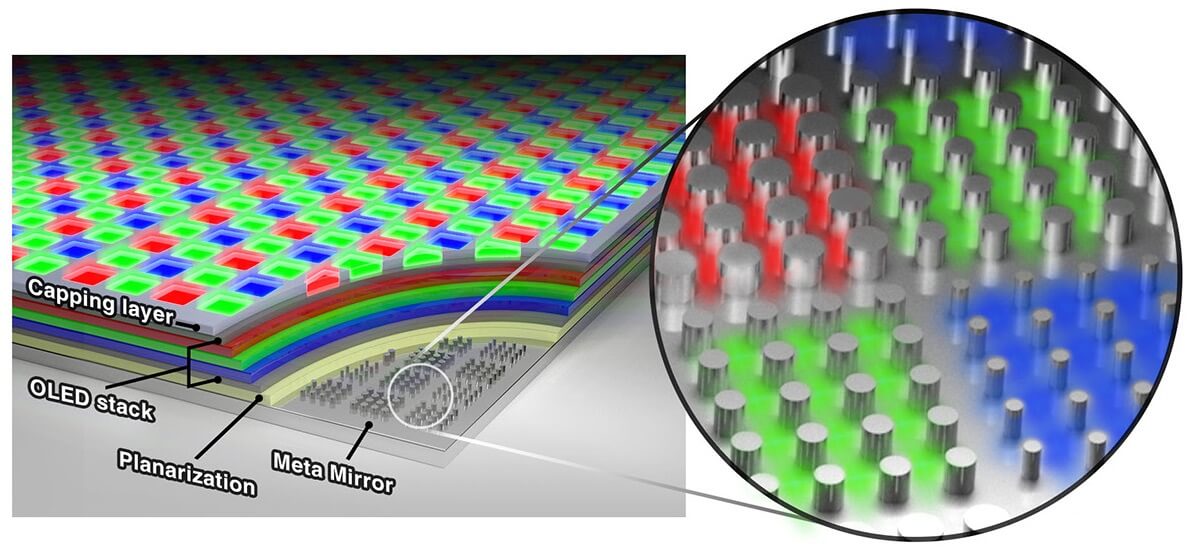
In a recent example, a team of scientists led by Samsung's Won-Jae Joo and Stanford's Mark Brongersma published a paper in Science describing a new meta-OLED display that can pack in 10,000 pixels per inch with room to scale. In comparison, today's smartphone and VR displays are less than 1,000 pixels per inch.

The team says current displays, sufficient for TVs or smartphones, can't meet the pixel density needs of near-eye VR and AR applications. They're looking beyond headsets too, writing, "An ultrahigh density of 10,000 pixels per inch readily meets the requirements for the next-generation microdisplays that can be fabricated on glasses or contact lenses."

Of course, they aren't alone in their quest for ultra-high-def, and the display is still firmly in the research phase, but it hints at what the future holds for stunning AR/VR experiences.

Very Meta: From Solar Panels to Virtual Reality

The new display was born from a breakthrough in solar cells, where Brongersma's lab used optical metasurfaces—these are surfaces with built-in nanoscale structures to control a material's properties—to manipulate light. Joo, who was visiting Stanford at the time, learned of Brongersma's approach in a presentation by graduate student Majid Esfandyarpour.

He realized the same approach could be useful in organic light-emitting diode (OLED) displays too.

Some of the top displays in the world—like the ones in high-end televisions and iPhones—use OLEDs because they're very thin and flexible and known for their deep, pure colors.

Currently, there are two ways to make OLED displays. For small screens like smartphones, the pixels are split into subpixels that emit red, green, or blue light. These are laid down by spraying dots of each material through a fine mesh. But the method has limitations both in how small the subpixels (and therefore pixels) can be and how large the display can go. If the mesh is too big, it has a tendency to sag.

So, for larger displays like televisions, manufacturers opt for white OLEDs with red, blue, and green filters sitting on top of them. The thing is, the filters absorb 70% of the light, thus requiring more power to keep them bright. Filtered OLEDs are also limited in how small you can make them.

A Nanoscale Skyline to Filter Light Into Pixels

The new Stanford and Samsung solves both problems at the same time.

Instead of filters or color-specific OLED materials, the new display makes use of a surface bristling with tiny silver nanopillars 80 nanometers high.

When bathed in white light, the spacing between the pillars determines which wavelengths are transmitted. Each subpixel contains pillars of different widths. The widest pillars with the least spacing give off red light, the next widest, green, and least wide, blue. Larger squares—containing red, blue, and green subpixels—make up the display's pixels. Each is 2.4 microns wide or roughly 1/10,000th of an inch.

Illustration of meta-OLED display highlighting the metaphotonic layer, in which grids of nanopillars manipulate light to produce the desired color (red, green, or blue). Image credit: Samsung Advanced Institute of Technology

As the pixels are no longer shaded by filters—and due to a curious property of the metasurface that allows light to build up and resonate, a bit like sound in a musical instrument—the display's color is very pure and achieves greater brightness with less power.

The team estimates the approach could yield pixel density up to 20,000 pixels per inch. But as the pixels go below a micron, you begin to sacrifice brightness. The next step is to make a full-size display, something Samsung is currently working to make happen.

Of course, other research is going after ultrahigh resolution displays too.

MicroLED tech, a leading candidate, has achieved 30,000 pixels per inch. However, displays over 1,000 pixels per inch are monochromatic, and full-color displays remain challenging.

Whichever approach wins, computing power will have to scale too. More pixels equals more processing. One potential solution for AR/VR is called foveated rendering, where devices track our eyes and only serve up the highest resolution image where the gaze is directed. This makes use of the fact our peripheral vision is blurry, regardless of medium, thus saving precious processing power.

More Immersion = Better?

Of course, visuals are only part of the equation. Truly immersive, sci-fi-like VR will supply a sense of touch, muscular resistance, and maybe even direct manipulation of virtual worlds. And if we're to avoid only enjoying VR in huge warehouses, we'll need to figure out how to move in place.

Practical solutions to these problems have been slowly emerging. Early, weird, and/or expensive peripherals include at-home VR treadmills, robotic boots, and even robotic exoskeletons.

One might wonder (quite rationally) if we really need to be more immersed in our devices. Many people have been spending a whole lot more time on screens, and it can be pretty draining. It's amazing what an afternoon spent sitting by a good old fashioned stream rendered by the laws of physics unfiltered can do for your sanity.

Still, quality virtual and augmented reality interfaces may solve a few of the less palatable side effects of 2D displays because it's better tailored to how our brains operate in the world. We very consciously have to teach ourselves to type and use a trackpad, but we learn to navigate the physical world almost by accident (just watch a baby move into toddlerhood).

Perhaps, as we spend more time in the digital world, making it immersive will also help make it a better experience (in some ways, at least). And regardless, the next round of interfaces is coming. So, wouldn't it be nice if they looked especially pretty?

Image credit: Luca Huter / Unsplash


~A.

SELECTED DEATHS VS COVID-19 WORLD

REALLY cool....

https://www.worldlifeexpectancy.com/selected-deaths-vs-covid-19-world


~A.

Friday, October 30, 2020

Make Peace

We encourage you to make peace with everyone who opposes you and with everyone whom you oppose, not only because you cannot insist on their yielding to your perspective but because their opposing perspective is of tremendous benefit to you.

You see, because of your exposure to what you perceive as their wrong or bad or unwanted behavior or perspective—you have given birth to an improved situation. And just as they helped the problem side of the equation to come into focus, they helped the solution side of the equation to come into focus, also; and that solution waits for you in your Vortex of Creation.

Through our daily meditation process, you will come into alignment with those solutions and creations that are in your Vortex, and from inside your Vortex, you will feel appreciation for everyone who contributed to its becoming.

When you make peace with those who differ in desire and belief and behavior from your ideas of what is appropriate, you do not perpetuate what you consider to be wrong. Instead, you align with the solution side of the equation that has been waiting for you in your Vortex of Creation.

Excerpted from Getting into the Vortex Guided Meditation CD and User Guide on 11/1/10

Our Love
Esther (Abraham and Jerry)