Wednesday, December 23, 2020

Top 100 Free Education Sites
Top 100 Free Education Sites

Top 100 Free Education Sites

Top 100 Free Education Sites

Since 2013, Help Teaching has brought you our Top 100 Free Education Sites. We're continually updating our list to provide you with the best resources. Not only can you find the top free sites for teaching math, science, English, and social studies, but we've also added some of our favorite computer science and coding sites, language sites, and homeschooling sites.

No time to go through the whole list? Just use "Quick Links" section to jump straight to the section that interests you and bookmark this article for a reference later.

QUICK LINKS:

10 Awesome Sites Lesson Planning Reading Science Arts
Classroom Management Social Studies Writing Math Music
Educating Yourself Health and Safety Educational Games Coding Homeschool
Early Education Education News Homework Help and Study Skills Language Life Skills

10 Awesome Education Sites

Whatever the grade-level or subject area, these websites have something to offer. From high-quality lesson plans to entertaining games and educational videos, they represent some of the best educational websites in existence.

Code.org has gained recognition with its Hour of Code initiative. The website offers free, easy lessons to help kids learn some of the basics of coding. The lessons also help teach critical thinking and problem-solving skills.

Google is something most teachers know about, but many haven't taken the time to explore all of their awesome free resources for education. There are some fun activities too, such as Google Experiments where kids can create all kinds of unique simulations and games online.

FunBrain helps students learn through fun games related to math and reading. They'll also find books and other entertaining resources.

Scholastic has developed a reputation for its high-quality educational books and materials and its website does not disappoint, offering lesson plans, interactive activities, and articles designed to help teachers and parents.

Gooru helps students take control of their own learning by providing them with information about how they learn best.

Edutopia focuses on helping educators grow. From articles and blogs from those working in the field to informational videos and classroom guides, educators in all areas of education will stay on top of the latest trends and find tips to help them improve.

DIY.org encourages kids to learn new skills. Teachers and parents can challenge them to set goals and complete tasks on the site.

Science Bob gets kids interested in science by providing experiments, research, Q&A, and other info all focused on science.

Teachers Pay Teachers isn't technically a free site since teachers sell materials. However, there are plenty of free downloads on the site. You may find the perfect free worksheet, lesson lan, or classroom time-filler.

Ted-Ed goes beyond traditional Ted Talks by offering lessons to accompany many of those videos. In addition, you'll find animated videos and resources for elementary,middle, and high school students too.

Coding

Every day, in classrooms around the world, kids are learning how to code. Coding is a valuable skill that helps teach kids to think logically and develop the critical thinking and reasoning skills they need for our increasingly technological world. These resources offer free coding activities for kids.

Our Top Pick

Code.org is home to the Hour of Code. In just an hour, kids can complete a fun coding game. There are many games to choose from, including those that feature popular characters kids love.

Tynker offers its own free Hour of Code activities and games for kids to enjoy.

CodeCombat is an online, multiplayer game that requires kids to write code to play.

Kodu Game Lab is a visual programming tool that kids can download to create games of their own.

CS Unplugged teaches the principles of coding, but not in the traditional way. The site offers a large selection of offline activities designed to help kids develop these critical thinking skills.

Reading

Find games and activities for early readers, as well as texts for advanced readers, in this collection of high-quality reading websites. In addition to these sites, Help Teaching offers a large collection of public domain and original reading passages organized by grade-level, word count, and Lexile level.

CommonLit contains a wealth of free fiction and non-fiction texts for use in the classroom. Texts are organized by grade-level and theme.

Our Top Pick

Media Literacy Clearinghouse introduces students to a new type of literacy – media literacy. With all of the new technology and messages appearing every day, it's important for kids to be media literate.

Awesome Stories uses non-traditional reading materials, such as biographies and primary source texts, to get students learning through reading. Students can use the site to help with research and teachers can use the texts as part of lesson plans. Creating an account allows users to access audio versions of many of the titles as well, making it an ideal site for auditory learners and those with learning disabilities.

ReadWriteThink gets students to participate in critical thinking and reading activities through its lesson plans and interactive student resources.

Book Adventure is a free online reading program that provides students with incentives for reading.

Bookopolis is essentially a GoodReads for kids. The site allows students to read reviews written by their peers and helps them find the perfect book.

Writing

Whether students need an outlet for their creative writing or want to brush up on their grammar skills, one of these resources will get the job done.

Our Top Pick

Make Beliefs Comix gives kids a place to create their own cartoons and store them online. It features tons of clipart and other artistic effects to make the comics visually appealing.

Voki features animated characters that students can customize and manipulate to speak their words. It's a great tool to help with creative thinking, writing, and storytelling.

Grammar Bytes tests students' knowledge of grammar through simple multiple-choice activities and rewards them with cheesy virtual prizes.

Purdue OWL is an online writing lab from Purdue University that provides students, particularly those in high school and college, with everything they need to know about writing a paper, including grammar advice and paper formatting guides.

Social Studies

Teachers can find primary source documents and high-quality lesson plans, as well as discover ways to connect students to history, geography, government, and other areas of social studies online.

Our Top Pick

GeoGuessr tests kids' geography skills. Using images from Google's Street View, it plops players down in the middle of the street and asks them to figure out where they are.

National Archives: DocsTeach allows teachers to incorporate primary source documents and other historical texts into a variety of critical thinking and thought-mapping activities. Pre-made activities are also provided. Students can complete the activities online or through the DocsTeach app available for the iPad.

iCivics offers high-quality and engaging games for students to play while they learn about civics. Lesson plans help teachers incorporate the games in the classroom.

Sutori gives students the chance to create free interactive timelines and engage in collaborative learning.

What Was There? allows students to type in any city, state, or country to view an archive of historical photographs and other documents. It's a unique way to help them learn about history.

Math

Not all websites focus on elementary math skills. While many of these games do work well for elementary-age students, they also offer games and lesson plans for students tackling subjects such as algebra, geometry, and calculus.

Our Top Pick

Math is Fun is full of math resources for kids and teachers. It also includes an illustrated dictionary of math terms to help students understand difficult concepts.

Numberphile features short videos about numbers. They help kids explore complex math topics and make math more fun.

Math Games offers a large collection of math games and questions organized by grade-level and skill. It also includes a progress-tracking feature so teachers and parents can see what kids know.

AAA Math features online interactive math lessons for students in kindergarten through 8th grade.

Yummy Math connects math with the real world through timely news stories and other reading passages.

Math Forum offers online professional development opportunities and other resources to help math teachers improve their skills.

Science

Help students understand science with this collection of videos, games, experiments, and creative science activities.

Our Top Pick

PhET features many engaging simulations to help kids learn difficult concepts in science and math.

Wonderopolis shows kids a wonder of the day, and then gives them a chance to test their knowledge or join in on a discussion related to that wonder. Kids will be surprised by all of the cool facts that they learn and they may spark some interesting discussions in the classroom.

Molecular Workbench contains hundreds of simulations, curriculum models, and assessments designed to improve the teaching of science.

Science Made Simple gives kids science experiment ideas and other science project topics. It also offers help when preparing for a science fair.

The Science Spot offers lesson plans, activities, and student examples from one teacher's science classroom, as well as daily science trivia challenges and daily science starters.

BioDigital is a human visualization platform that allows students to explore the human body in really cool ways.

For even more science-specific resources, check out the Ultimate Guide to Teaching Science.

Art

Art museums around the world have made it their mission to teach students about art. These websites introduce students to art theory, let them explore classic works of art, and even give them the chance to create art of their own.

Our Top Pick

Artsonia bills itself as the world's largest kids art museum. All of the artwork has been created by kids and, while the site is free, parents can also purchase products featuring their kids' artwork.

Artsology helps kids learn to appreciate the arts by providing them with the opportunity to play games, conduct investigations, and explore different forms of art.

NGAKids Art Zone allows kids to explore popular art movements, themes, and artists and offers guides to help teachers as well.

Tate Kids gives kids a chance to explore famous works of art, play art-related games, and even create their own works of art to add to their online gallery.

Music

Encourage kids to think beyond One Direction and their other favorite artists and experience new types of music. Kids can learn about the symphony and classical music or even build their own musical skills by learning through ear training or playing instruments online.

Our Top Pick

Andrew & Polly is an indie children's music duo that has created a podcast called Ear Snacks designed to help kids learn through music, sound, and unique experiences.

Classics for Kids regularly highlights famous composers and provides teachers with activities to use in the classroom.

KIDiddles has lyrics and audio files for over 2,000 kids songs for music teachers, or any teachers, to use in their classrooms.

Good Ear may not look like an awesome site, but it contains a lot in its simple design. This website provides virtual ear training to help serious student musicians learn to recognize the differences between notes.

Virtual Musical Instruments lets kids play instruments online. Instruments include the guitar, piano, pan flute, drums, and bongos.

Health and Safety

Health and safety are important to kids. Whether kids want to know more about keeping their bodies healthy or staying safe online, these websites have them covered.

Our Top Pick

KidsHealth is the top website for kids to learn about their bodies and their health. It features easy-to-read articles and kid-friendly graphics to help kids learn about a whole host of topics related to health and safety.

CDC BAM! focuses on teaching kids about their bodies. BAM stands for body and mind and all of the resources on the site help kids learn more about their bodies and keeping their minds sharp.

NetSmartzKidz and its sister site, Netsmartz, promotes online safety. Kids and adults can learn all about staying safe online and avoiding dangers such as cyber bullying.

StopBullying.gov helps prevent bullying in all forms by providing teachers, parents, and students with resources to educate them about bullying and let them know what to do when bullying occurs.

PE Central is a physical education teacher's ultimate resource. It includes lesson plans, assessment ideas, and other resources.

Early Education

Don't forget about your younger learners too. Many websites, including our own Early Education collection, offer games and activities designed to help toddlers and preschoolers build their basic skills.

Our Top Pick

Preschool Express is full of crafts, activities, bulletin board designs, and finger plays for early education teachers and parents to use with kids.

Starfall promotes beginning reading and number skills with fun stories and activities.

Funbrain Jr. brings the fun and quality of Funbrain to a younger audience with its early learning games.

Songs for Teaching offers a large selection of fun songs to help teach preschool students.

Super Simple Learning's resource section includes free flashcards, coloring pages, worksheets, and other resources for children, teachers, and parents.

Educational Games

Kids love to play games online. Why not encourage the practice by introducing them to some fun educational games websites? They'll have fun and you'll know they're learning.

Our Top Pick
Arcademic Skill Builders offers a series of racing games for kids focused on math and ELA skills. Best of all, many of the games are multiplayer so kids can create rooms and play against their friends.

Quizalize lets teachers turn content into fun quiz games for students. It's free to create quizzes, but teachers can also buy inexpensive quizzes from other teachers in the marketplace.

Cool Math Games is the ultimate site for kids who want to play math-oriented games. These arcade-style games are a lot of fun and many accompany the lessons found on the site.

Primary Games has a lot of educational games for kids to play mixed in with some "just for fun" games too. All of the games are kid-friendly.

Games for Change gets kids thinking about problem-solving and social issues by providing them with unique games to play. Many of the games help kids solve world problems or introduce them to social issues.

Educational News

It's important to keep up with the news. These websites cover the latest education news and also provide kid-friendly news sites to use with students.

Our Top Pick
Education World's main page highlights the latest news in the world of education, including interesting research and controversy.

Education Week publishes a weekly newspaper all about education. Its website highlights many of those stories so you can access them for free.

Smithsonian TweenTribune features unique news stories for kids. Stories are organized by Lexile level and cover topics related to kids' interests.

Time for Kids gives students and teachers access to many of the articles from Time for Kids magazine, even if they don't subscribe. Stories focuses on world news stories and pop culture.

DOGO News promotes "fodder for young minds" by sharing unique news stories, including stories of people doing good around the world.

Educating Yourself

With the introduction of open courseware and TED talks, educating yourself online has never been easier. Find access to actual college courses and learn what you want to know from the experts in the field. At HelpTeaching, we have launched our own line of online K-12 lessons that students can use for self-directed learning.

Our Top Pick
TED features videos and other resources from some of the world's greatest leaders, innovators, and thinkers. If you want to learn more about a particular field, chances are there's an expert talking about it.

Khan Academy offers free online courses in a wide variety of subjects. It offers the most content in math, but also has courses in science, economics, test prep, and more.

Open Education Consortium allows you to search for open courses around the world. It also provides news on the open courseware movement.

MIT OpenCourseWare gives you access to courses from one of the nation's most prestigious colleges.

Coursera helps you find and sign up to take free online courses from some of the world's top universities and other experts.

Youtube has been around for a long time, but that only supports its awesomeness. You'll find a lot of video tutorials on everything from fixing a car to learning how to beat a difficult level on Angry Birds. Don't forget to check out Help Teaching's YouTube channel with online lessons too.

For more resources, don't forget to check out the Ultimate Guide to Self-Learning for Kids and the Ultimate Guide to Self-Learning for Teens and Adults.

Homework Help and Study Skills

For general homework questions and help studying for that big test, students should check out this collection of websites. Teachers will also find study skills lessons to go over with students in class.

Our Top Pick

HomeworkSpot provides students with links, resources, games, and reference materials to help them build their skills and complete their homework.

Fact Monster Homework Center connects kids with reference materials and tools to help them successfully complete their homework.

Shmoop offers homework help, literature guides, and a ton of other resources for students. The site's writers incorporate a lot of humor in their writing too, making the site incredibly entertaining.

Howtostudy.org features articles on different study skills and test-taking strategies. There's even a subject-based "How to Write" section to help students learn how to write all kinds of informational texts.

Don't forget Help Teaching's Study Skills and Strategies worksheets either!

Lesson Planning

Lesson planning can be time consuming, but with high-quality pre-created lesson plans, lesson plan templates, and a place to store their lesson plans, teachers can simplify the process.

Our Top Pick

The Differentiator provides teachers with lesson plan ideas to help them incorporate higher-order thinking skills, change up the products students create, and add to the resources they use. This helps ensure teachers aren't presenting the same lessons all the time and that they reach students in many different ways.

ShareMyLesson offers lesson plans and other resources shared by teachers, educators, and educational companies around the world.

Classroom Management

If teachers want students to learn, they must have good classroom management. These resources help keep students in control and encourage behavior that promotes learning.

Our Top Pick

ClassDojo is a classroom management system that allows teachers to set goals for students, track their progress, and reward them for that progress. Parents can also access reports to see how their children are doing.

Remind gives teachers a free, easy, and safe way to share important information with parents and students via text message. All phone numbers are kept private and parents must opt-in to receive messages.

BouncyBalls is an online game where the noise level makes the balls bounce. The more balls bouncing, the noisier the classroom is, reminding students to quiet down and focus on their work.

NEA Classroom Management offers a classroom management survival guide, as well as articles and resources to help with specific areas of classroom management.

Super Teachers Tools contains free resources such as seating chart makers and countdown timers that can help teachers implement solid classroom management strategies.

Language

Whether students are looking to learn a foreign language or improve their English language skills, these sites are designed to help.

Our Top Pick

Internet Polyglot offers free videos, games, and other resources to help language learners memorize words in a new language. It also offers over 4,000 vocabulary lessons.

Busy Teacher features thousands of articles, worksheets, slideshow presentations, and other resources designed to help English language learners and teachers. All resources are available to view and download for free.

Google Translate is a free translation service provided by Google. You can translate a few words at a time or a whole document. While not 100% accurate, it can be a good place for language learners to start.

Open Culture contains a collection of the best free language learning courses and resources online.

Homeschool

Homeschool curriculum can be expensive. Thankfully, there are plenty of free resources out there to help offset the cost. You'll also find lots of tips, tricks, and other resources to help make your hoeschooling journey successful.

Our Top Pick

Homeschool.com bills itself as the #1 resource for homeschooling and with good reason. The website is full or articles about homeschooling, local homeschooler groups and even free curriculum and homeschool mom planner.

Beestar offers online elementary math and reading exercises. With a free account, kids can access a set number of free worksheets a day. There are also competitions kids can enter for a small fee.

Brainly gives students a place to ask questions and get answers. Think of it as a moderated Reddit or Yahoo! Answers for kids and teens. Most of the content on the site is free, although some verified answers require a subscription.

CK-12 is a platform that offers free online textbooks and resources for students and teachers. Why pay for curriculum when you can get free, customized resources online?

Hillsdale College provides free online courses to help people learn more about the principles of American democracy and study some of the authors and artists who were part of America's foundation.

Life Skills

There are some skills that aren't taught in high school, but they're extremely important for students to learn. These sites help students gain these essential skills.

Our Top Pick
Practical Money Skills bills itself as a site that offers financial education for everyone. The site includes free articles and learning modules for students, lesson plans for teachers, and a host of fun games, including many related to athletics.

Gen i Revolution offers free personal finance and economics education for students through the form of a game. Students go through real-life scenarios and use the selection of characters and skills available to them to set things right in the financial world of the game.

Everyday Life from GCF Learn Free features multiple interactive tutorials designed to take students through everyday life activities, including work shills and getting around town.

Overcoming Obstacles is a free life skills curriculum for students in grades K-12. Their resources include strategies for teaching social and emotional skills. Teachers and parents must register for a free account to access the curriculum.

For more resources, check out Help Teaching's selection of free life and money skills worksheets.

Did you favorite sites make the list? If not, share them in the comments. Maybe they'll make 2019's list of the 100 Best Free Education Sites. Remember to check out Help Teaching for all of your worksheet and printable needs too.


~A.

Covid Pandemic: Microbiomes Could Be Key to Stopping Spread of Future Viruses - Bloomberg

Covid Pandemic: Microbiomes Could Be Key to Stopping Spread of Future Viruses - Bloomberg

To Make a Building Healthier, Stop Sanitizing Everything

Improve the ventilation, even spread some good germs. If you want people to be healthy and productive, tend the microbiome.

Four years ago a doctoral student in architecture asked Luke Leung to help him come up with a thesis topic. Leung, an engineer whose projects include the world's tallest building, the Burj Khalifa in Dubai, proposed the question: What is heaven?

"The student did a lot of research and found that no matter the faith—Islam, Judaism, Christianity—heaven is always a place with a garden and running water," recalls Leung, director of the sustainable engineering studio of Skidmore Owings & Merrill, the architectural behemoth better known as SOM. "So then we started questioning, 'If that is heaven, what exactly is the place we are living in?' "

In the Western world, humans spend 90% of their time indoors. The average American spends even more than that—93%—inside buildings or cars. For years scientists have sounded the alarm that our disconnect from the outdoors is linked to a host of chronic health problems, including allergies, asthma, depression, irritable bowel syndrome, and obesity. More recently, experts in various fields have begun studying why buildings, even those designed to be as germ-free as possible, are vectors for disease, not the least Covid-19.

"There was a study of more than 7,300 cases in China, and guess how many people caught the disease outdoors?" Leung asks. "Just two." Early testing following Black Lives Matter protests in Minnesota also suggested that transmission of SARS-CoV-2 outside is rare, even when thousands of people gather, talking, yelling, and chanting—at least when most of those people wear masks. Out of more than 13,000 protesters tested, only 1.8% were positive. Other states showed similar results.

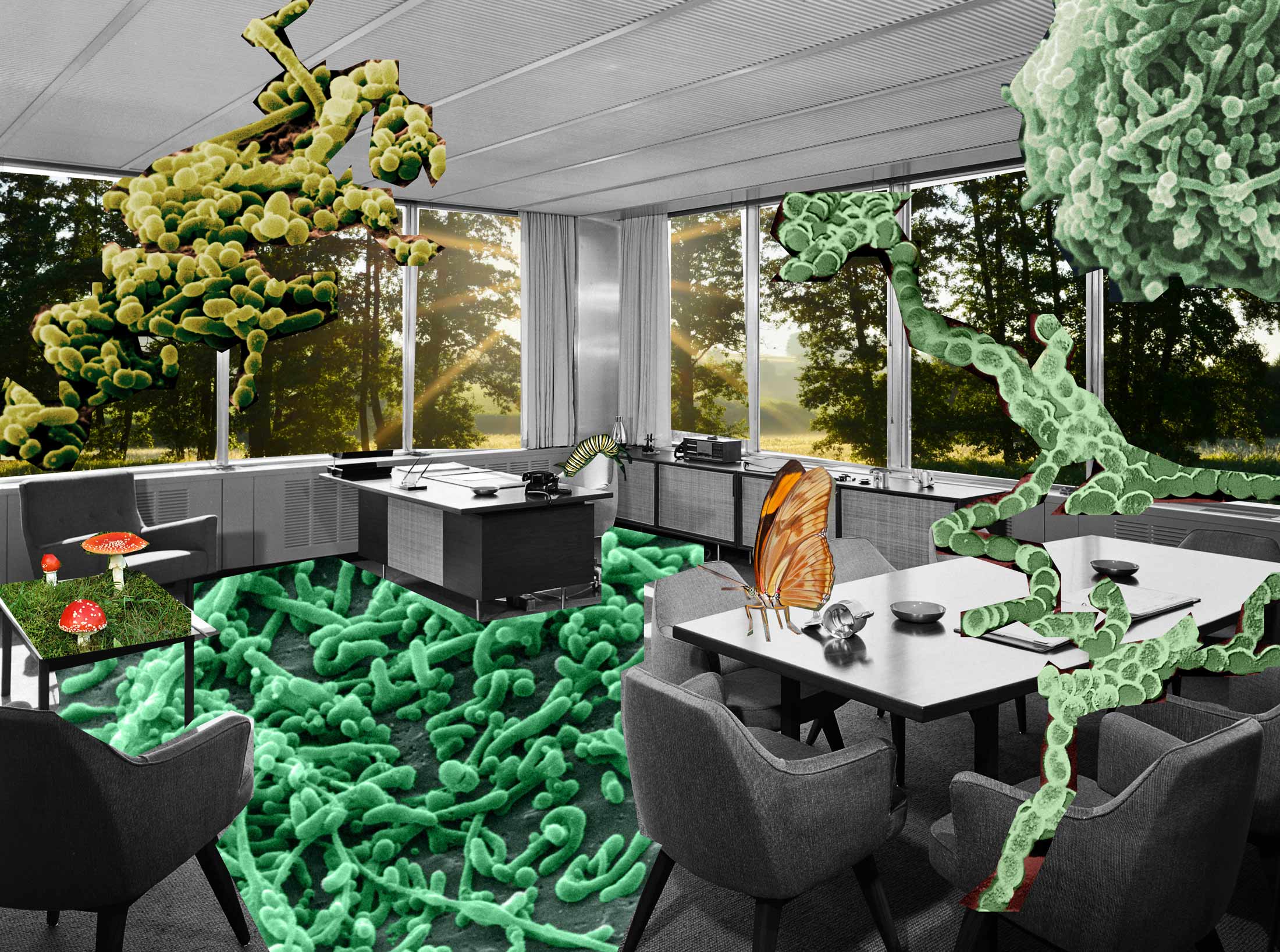
Leung says a "misalignment with nature" in building design is partly to blame for our scourge of chronic diseases and the current pandemic. The relative lack of air flow and sunlight is an obvious issue; temperature, humidity, and indoor air pollution also play a role. But there's another, less discussed factor: the microbiome of the built environment, which encompasses trillions of microbes including bacteria, fungi, and viruses.

Until about 15 years ago, very few scientists—and even fewer architects, designers, and engineers—paid attention to indoor microbes, with the exception of problematic outcroppings such as black mold and legionella, the bacteria that causes Legionnaires' disease. That changed after the 2001 anthrax attacks, when letters laced with deadly bacteria were mailed to politicians and the offices of news outlets, killing 5 people and infecting 17 more. Experts at the nonprofit Alfred P. Sloan Foundation began contemplating what role buildings might play in mitigating bioterrorism threats. Realizing we knew almost nothing about which microbes exist indoors, the foundation poured tens of millions of dollars into research. Soon scientists uncovered rich ecologies of fast-evolving indoor microbe populations. Crucially, most had little overlap with outdoor populations, including salutary species that humans co-evolved with over millions of years.

Now, with a global pandemic raging, these researchers are suddenly in demand. "Our calendar is fairly full," says Kevin van den Wymelenberg, director of the Biology and the Built Environment Center at the University of Oregon. He used to receive two or three inquiries per week, asking for advice on how to improve the health of a building. Now he gets 20 a day. "It's everyone from hospitals, to large commercial real estate portfolios, to nursing homes and school districts, to personal friends who run a barber shop and are trying to decide whether or not they should blow out the hair of their patrons."

Of course, the most urgent microbe-related question is where to find SARS-CoV-2 and how to kill it. Beyond that, there are also long-term questions. How can we promote indoor microbe populations that don't make us chronically ill or harbor deadly pathogens? Can we actually cultivate beneficial microbes in our buildings the way a farmer cultivates a field? Experts including Van den Wymelenberg are confident all this is possible. "I really believe our building operators of the future and our designers will be thinking about how to shape the microbiome," he says. 

relates to To Make a Building Healthier, Stop Sanitizing Everything

Photo Illustration: 731; Photos: Agefoto; Alamy; Science Source; USDA

The term "microbiome" is most often used to refer to the population of microbes that inhabit our body, many of which help produce vitamins, hormones, and other chemicals vital to our immune system, metabolism, mood, and much more. In the typical person, microbial cells are as numerous as those containing human DNA and cumulatively weigh about 2 pounds. In recent decades our personal microbiomes have been altered by factors such as poor dietary habits, a rise in cesarean-section births, overprescription of antibiotics, overuse of disinfectants and other germ fighters, and dwindling contact with beneficial microbes on animals and in nature. According a 2015 study, Americans' microbiomes are about half as diverse as those of the Yanomami, a remote Amazonian tribe.

Like our bodies, the buildings we inhabit are also teeming with microbes. "Inhale deeply," writes Rob Dunn, a professor of applied ecology at North Carolina State University, in his 2018 book Never Home Alone. "With each breath you bring oxygen deep into the alveoli of your lungs, along with hundreds or thousands of species. Sit down. Each place you sit you are surrounded by a floating, leaping, crawling circus of thousands of species." Dunn says more species of bacteria have been found in homes than there are species of birds and mammals on Earth. In 2015, researchers found that indoor air contains nearly equal concentrations of bacteria and viruses. (Almost all viruses are harmless, and some may be beneficial.) Over time these many microbes have adapted to survive, and even thrive, everywhere from our pillowcases and toothbrushes to the more extreme climates of our dishwashers, showerheads, ovens, and freezers.

Many are derived from humans, or likely feed off human debris. Like Pigpen from the comic strip Peanuts, each of us has a plume of microbes spewing off our body at a rate of about 37 million bacteria and 8 million fungal particles per hour; the difference is that our plumes are invisible to the naked eye. Indoors, the impact is measurable. One study notes that it takes less than 24 hours for a hotel guest to colonize a room with their personal microbes, erasing all traces of previous guests and making the space microbially identical to their home.

Considering our perpetual emanations, it's easy to envision how the coronavirus might spread within a room. A single sneeze discharges roughly 30,000 microbe-filled droplets traveling at up to 200 mph. A cough releases about 3,000 droplets, which reach speeds of 50 mph. A simple exhale produces 50 to 5,000 droplets. We know that a person infected with influenza releases as many as 33 viral particles per minute just breathing and about 200 million per sneeze. Meanwhile, exposure to just a few hundred SARS-CoV-2 particles may be enough to cause infection.

Outdoors our invisible plumes almost always disperse quickly, which is a very good thing in the case of Covid carriers. "Any virus that is released into the air is rapidly diluted, moved by wind currents, and spread out across a seemingly infinite space," says Linsey Marr, an expert in infectious disease transmission and professor of civil and environmental engineering at Virginia Tech. "It's almost like putting a drop of dye into the ocean vs. putting it into a glass of water." Sunlight also inactivates viruses in as little as five minutes—eight minutes in the case of SARS-CoV-2. A study from the Department of Homeland Security found that the coronavirus can hang around indoors in the dark for hours.

Facing an invisible and potentially deadly virus, the understandable impulse has been to whip out some Clorox and go to battle. But indiscriminate bleach-bombing could backfire. For one thing, misdirected efforts may be a colossal waste of time and money. New York City, for example, announced in the spring that for the first time, it was closing the subway system during early-morning hours to deep-clean every train. "It's all theater!" says Jack Gilbert, a professor and microbiome researcher at the University of California at San Diego. "You bleach the subway, the bleach dries up and becomes inactive. If just one person who has Covid-19 interacts with that surface, the four hours of cleaning have no effect." And because we now know SARS-CoV-2 is most often transmitted through the air, cleaning efforts seem even more futile.

A more serious risk is that attempts to sterilize our surroundings can kill off bacteria critical for human health—or, even worse, inadvertently promote the survival and evolution of more dangerous bugs, including antibiotic-resistant superbugs. "We should be worried," says Rob Knight, founding director of the Center for Microbiome Innovation and a professor of pediatrics at UCSD. "If we're overzealously stripping off all the bacteria that would naturally be there, then we may be creating homes for bacteria and maybe even viruses that are harder to remove."

No amount of chemicals will get rid of everything, and what's left behind is often undesirable. Microbiologists have swabbed the International Space Station to find out what happens inside an enclosed, supposedly sterile chamber in which every bit of food and equipment has been disinfected within a specially designed NASA facility. As it turned out, microbes were everywhere, almost all of them human derived. Among the most common were bacteria associated with feces, stinky feet, and armpits, which is perhaps why the ISS has been described as smelling like a mix of plastics, garbage, and body odor.

Here on Earth, proper hygiene is effective in minimizing exposure to pathogens such as those that cause food poisoning and strep throat, but we tend to go nuclear, using harsh chemicals when soap and water could do the job. For years antimicrobials have been added to everything—wall paint, kitchen sponges, underwear, lip gloss. Now we've become more extreme.

In hopes of zapping SARS-CoV-2 straight out of the air, some building managers are installing so-called bipolar ionization units, even though they may not work against Covid and sometimes generate harmful gases such as the lung irritant ozone. As for the antimicrobial cleaning agents and surface coatings being liberally applied throughout offices and other public spaces, we may be introducing large quantities of poorly understood, potentially poisonous chemicals into our everyday life—as well as speeding the evolution of disastrous superbugs.

"The more we use the same antimicrobials in different contexts, the more opportunity these microbes have to develop resistance," says Erica Hartmann, an engineering professor at Northwestern University who focuses on indoor microbiology and chemistry. "If they're developing resistance to the antimicrobial itself, that's not great, because then we've lost an important product in our cleaning arsenal. But if they also develop resistance to clinically relevant antibiotics, of which we have precious few, that's an even bigger concern—and there's evidence that both of those things happen."

Wiping out good bacteria along with the bad has also been linked to chronic health problems. One often-cited series of studies, begun in 1998, examined the relationship between cleanliness and disease in the Finnish-Russian border region of Karelia, where people share similar genetics. On the wealthier, cleaner Finnish side, people were as many as 13 times more likely to suffer from inflammatory disorders as on the Russian side, where the majority live in rural homes, keep animals, and cultivate their own gardens.

Our pandemic-era anti-germ crusade may not have a big impact on the already formed microbiomes of adults. But infants and young children, who need exposure to a wide variety of microbes to train their developing immune systems, could be more adversely affected. "It's just speculation, but we could see a blip where this generation of kids has more immune-related conditions," Knight says, "especially in places where people have had to stay quarantined indoors, where kids didn't get to go outside as much." 

Leung of SOM began thinking about the microbiology of buildings years before the pandemic. It's not something he tends to mention to prospective clients. "If you tell a client, 'Let's talk about microbes,' they'll say, 'Get out of here—next!' " he says. "We have to address it carefully."

Beyond using organic materials and maximizing access to natural light and outdoor spaces, Leung says lots can be done to make buildings healthier at the microbial level. For safer air he extols the use of filters designed to eliminate SARS-CoV-2 and other pathogens and contaminants, but he cautions against bipolar ionization technology and says air shouldn't be sterilized over long durations. Whenever possible, Leung suggests deploying ventilation systems that pump offices full of microbially diverse outdoor air. Among his current projects is the 31-story WeBank tower in Shenzhen, which upon completion in 2022 will draw air through trees planted on balconies before it's funneled inside. "Sometimes we also open up buildings at night," Leung says, noting that the outdoor air is first measured for pollutants. "During the day people want air conditioning, but when they're gone you can recharge the building with microbes from outside."

Proper ventilation is particularly important in energy-efficient buildings, which, like spaceships, are designed to be sealed off from the outside world. In addition to delivering fresh oxygen and eliminating the brain-numbing buildup of carbon dioxide, good airflow and filtration reduce exposure to a long list of mostly unregulated and unmonitored chemicals found indoors. These include known carcinogens and endocrine disrupters, which reside in carpets, computers, free-floating dust, office chairs, paint, and more. Outdoor pollution also seeps inside buildings and gets trapped, especially during hours when ventilation systems are turned off. All this means indoor air is often far worse than outdoor air, with levels of some contaminants rising to 10 times higher or more.

For businesses, better air quality alone translates to an estimated $6,500 to $7,500 of added annual productivity per employee, mainly a result of improved wakefulness and acuity, say Joseph Allen and John Macomber, Harvard professors who in April published the book Healthy Buildings. By contrast, they note, a study of more than 3,000 workers in 40 buildings found that 57% of all sick leave was attributable to bad air. Disturbingly, Allen and Macomber also write that up to 90% of American schools don't meet the minimum ventilation requirements—and that those standards are already far below optimal.

In London, Los Angeles, Mumbai, and other polluted cities, outdoor air needs to be heavily filtered before being pumped indoors, and most beneficial outdoor microbes likely don't survive. But in cleaner and greener areas, simply opening windows has proved effective. "After taking antibiotics, you're supposed to eat yogurt to replenish with probiotics," says Mark Fretz, a colleague of Van den Wymelenberg at the University of Oregon, where he's a research assistant professor at the Institute for Health in the Built Environment. "For your buildings, the yogurt is essentially opening your window."

In 2012 researchers compared the microbiomes of a hospital room in Portland, Ore., with operable windows with one in which windows were permanently sealed. "It was very difficult to find a hospital that even had an operable window," Fretz says. Opening the window, it turned out, resulted in far more microbial diversity throughout the room, including species found on plants and leaves. Notably, there was also a significantly lower chance of encountering pathogens. (Side note: Potted plants also seed indoor spaces with valuable natural microbes—and they measurably improve human happiness, physical and mental health, and even original thinking—but they barely improve air quality.)

Another means of achieving healthier air is humidification, currently an extreme rarity in North America, as any office worker who's struggled through a dry and overheated winter season knows. "Most of our commercial buildings in the U.S. are not humidified," Leung says. "And that's why the pandemic could get even worse this winter." Not only does sufficient moisture in the air allow the human immune system to function at its best, it also causes viral particles to drop to the floor and die more quickly. According to some calculations, viruses in dry air can survive six times as long as those in buildings with a relative humidity of about 40%.

Of course, building interventions alone can't eliminate the risk of SARS-CoV-2 contagion, so it's best to keep social distancing and wearing masks. In the meantime, scientists at universities and startups are racing to develop microbial sensors for air filters, building surfaces, wastewater, and even indoor air. "We have tools to help us see the unseen," Van den Wymelenberg says. For now those detection tools are in their infancy, relying on the arduous process of repeatedly collecting samples and transporting them to labs for testing. 

Gilbert has ambitious plans for microbial interventions in buildings. Trained as a microbial ecologist, and with experience working on soils, plants, and marine systems, he was initially skeptical when he learned the Sloan Foundation was promoting something called the Microbiology of the Built Environment. "I thought it was a joke," Gilbert says. "I'll admit it, I thought there can't be much microbiology in the built environment, so why would anyone be interested?"

Then, in the winter of 2012, he got a visit from Paula Olsiewski, a program director for the Sloan Foundation. At that point he was a professor at the University of Chicago, and when the meeting was over, a blizzard had descended on the city. "I offered to drive her back to her hotel because I had a car that could handle the snow," Gilbert recalls. "But it was snowing so heavily that the drive took two and a half hours, and in that time she convinced me."

Now at the forefront of microbiome research, human and environmental, Gilbert was even permitted to sample President Obama's microbiome in 2016. (He's not allowed to disclose the results.) When the pandemic hit, Gilbert quickly redirected much of his research funding toward studying SARS-CoV-2. He has one project together with Knight's lab to see how the virus travels through hospitals, where it most often takes up residence, and whether it piggybacks on nefarious bacteria, as the influenza virus often does.

He also has a second, more counterintuitive study under way: In an undisclosed California hospital, Gilbert is investigating whether adding harmless bacillus bacteria into medical facilities reduces the prevalence of pathogens, including multidrug-resistant bacteria and viruses. "If you don't have anything on a freshly disinfected surface, and you cough your virus-laden bacteria onto the table, it will survive there," Gilbert says. "But if there's a high enough abundance of bacillus, then the bacillus will outcompete and exclude other pathogens that land on the surface." Similar studies have been done in the past, with encouraging findings, but Gilbert's is more rigorous.

The idea of putting bacteria to work cleaning isn't as far-fetched as it might sound. In the 1940s a Danish company called Novozymes started selling environmental microbes for decontaminating wastewater. In the 1980s and '90s it also contracted with the U.S. government on a large-scale bioremediation project to help clean up the Exxon Valdez oil tanker spill. About the same time, Novozymes sent researchers looking for bugs that might help clean home septic tanks, restaurant grease traps, pet stains, and much more. Among their best finds were grease- and odor-cutting bacteria discovered in the outdoor grill sites of Virginia parks and the kitchen of a Florida restaurant.

Today, Novozymes is worth about $16 billion, and its microbes are key ingredients in dozens of home-care brands. These include the likes of Aunt Fannie's Microcosmic Probiotic-Powered Multi-Surface Cleanser and Counter Culture Probiotic Cleaning Tonic. "We clean the way nature has been cleaning for 4 billion years … with probiotics," reads Counter Culture's website. The idea is to deploy an army of microbes that eat away at dirt, debris, and organic matter, also degrading the stuff left in cracks and crevices. Last year even Reckitt Benckiser LLC introduced a probiotic cleaner called Veo, which the company says will "help contribute to the balancing of the home microbiome."

Going a step further, scientists are studying whether salubrious environmental microbes can be introduced into urban homes to reduce the prevalence of inflammatory diseases. In Finland, one group seeded the doormats of city dwellers with about 30 grams (1 ounce) of forest soil so residents could drag outdoor microbes inside. The six-month experiment showed the rugs did shift the indoor air to include more outdoor microbes. Next the researchers want to run a large-scale study to see whether forest-soil-impacted rugs can improve the immune systems of infants and young children. (Another Finnish group is bypassing the rugs and simply smearing infants with a soil preparation to find out if there are health benefits.)

So far no one knows exactly which outdoor microbes are beneficial or how much exposure is best. Still, a number of startups are marketing bacteria sprays for homes and businesses. Belgium-based TakeAir advertises an "air enricher" that disperses soil- and ocean-derived microbes through existing ventilation systems to create "a 100% natural and protective biosphere for your building users." Clients include a Belgian chain of gyms and a housing project in Antwerp. Another front-runner, Betterair in Israel, sells "the world's first organic air and surface probiotic," a freestanding microbe mister that retails for $400. (Refill cartridges are $99.)

It's only a matter of time before these technologies become better understood and more widespread. "There's absolutely fascinating research to be done," Gilbert says. "I want to maybe engineer bacillus so it has properties that can stimulate the immune systems of people in a room." Van den Wymelenberg is also hopeful: "There's no reason this stuff can't work," he says. "We're already heavily manipulating the microbes in our buildings, just not deliberately." 

On a Tuesday afternoon in June, Leung takes my call while teaching his 18-year-old son to drive. Asked about the probiotic air enhancers, he laughs. "It actually says a lot about human beings," he says. "We've created buildings so sterile that now we have to buy nature and spray it back in. That's how silly we are."

Perhaps the pandemic will serve as a wake-up call. "This is our chance to right our wrongs of the past 200 years," he says, speaking of restoring our relationship with soils, plants, and animals. It won't be easy. Over the next 40 years, the total amount of indoor square footage will roughly double worldwide, reports science journalist Emily Anthes in her book The Great Indoors. Given the horrors of Covid, many businesses and building managers will also work their hardest to sanitize indoor environments like never before, perhaps causing unintended consequences.

In the meantime, the climate crisis is compounding potential health risks as flooding, wildfires, and man-made disasters destroy the natural world, exposing us to dangerous new diseases while annihilating the microbes we likely need to prevent widespread chronic illness (not to mention those we may need as medicines). Already, Leung says, urban air is often depleted of healthful natural bacteria. "In the wintertime, when the leaves are gone from trees, do you know what the main thing is you find in urban air?" he asks. "Microbes from animal feces."

Still, the pandemic may be changing our perspective on indoor life—and even physically altering our microbiomes. Although some people are cleaning too much, eating more junk food, and drinking more alcohol, prescriptions for antibiotics are markedly down from last year, according to the Centers for Disease Control and Prevention. One explanation is a decrease in non-Covid illnesses as a result of social distancing.

And though people aren't mingling as much or sharing microbes—which can be beneficial when pathogens aren't involved—those lucky enough to live where they aren't required to hole up indoors are spending more time in nature. "I mean, I see neighbors outside I didn't even know existed, and they're working in dirt that they're pretending is a garden," one microbiome expert says. As businesses allow employees to work from home, many are also abandoning urban life for greener settings.

But winter is upon us, and the pandemic is surging once again as more people move indoors. If we don't adjust our lifestyle and start making our buildings healthier from a microbial standpoint now, Leung says, we'll get hit even harder. "If you think this pandemic is bad, wait another 50 years when we have a much older population and much higher health-care costs."

In the not-so-distant future, he warns, three interrelated factors will increasingly affect our well-being: climate change, chronic health problems, and more pandemics. "We're going to have to design for that," Leung says. "And it's going to be important to bring humans and nature together again—like in heaven."
 
Read next: America Just Can't Get Enough Lysol

(Clarifies how virus particles react to humidity in indoor air, in the 28th paragraph.

Corrects number of fungal particles emanating hourly from a human, in the 11th paragraph.
)


~A.