this is copied from my recent dialog with Chat GPT on the topic of Autism Spectrum Disorder
Question:
do my rights as an individual with ASD include the right to object to vaccinations
In general, individuals with autism spectrum disorder (ASD) have the same rights as anyone else, including the right to refuse medical treatment. However, it's important to understand that there may be consequences to refusing vaccinations, and the specific circumstances of each case can impact an individual's rights.
In some cases, the refusal of vaccinations may be deemed to be against an individual's best interests, and the state may have the authority to override an individual's refusal of vaccination in order to protect the individual's health and the health of the community. This can depend on the specific laws and regulations of the jurisdiction in which the individual lives.
It's important for individuals with ASD or their loved ones to be aware of the potential risks and benefits of vaccination and to discuss any concerns or questions with a qualified healthcare professional. A healthcare professional can provide information about the risks and benefits of vaccination and help individuals make an informed decision about their health care.
where are there laws mandating (Covid) vaccines
Laws mandating the use of vaccines, including COVID-19 vaccines, vary by jurisdiction. Some countries, states, or localities may have laws or regulations that require certain vaccines for certain populations, such as healthcare workers or students. Other jurisdictions may have laws or regulations that allow for exemptions from vaccine requirements for medical, philosophical, or religious reasons.
It's important to note that vaccine laws and regulations are constantly evolving in response to changing public health needs. It's a good idea to check with your local government or health department for the most up-to-date information about vaccine requirements in your area. You can also speak with a qualified healthcare professional for more information about the risks and benefits of vaccination.
too vague, are there Laws mandating the use of vaccines, including COVID-19 vaccines in the US
In the United States, laws mandating the use of vaccines, including COVID-19 vaccines, vary by state. Some states have laws that require certain vaccines for certain populations, such as healthcare workers or students. Other states may have laws that allow for exemptions from vaccine requirements for medical, philosophical, or religious reasons.
It's important to note that vaccine laws and regulations are constantly evolving in response to changing public health needs. It's a good idea to check with your state government or health department for the most up-to-date information about vaccine requirements in your area. You can also speak with a qualified healthcare professional for more information about the risks and benefits of vaccination.
It's worth noting that while some states may have laws that mandate the use of certain vaccines, the federal government does not have the authority to mandate vaccines for the general population. However, the federal government may recommend certain vaccines and provide funding and other support to states and localities to encourage vaccination.
This looks like the wobbly rights around guns, abortion, religion, and death penalties. Is our government the best system of managment for these concerns
The United States has a system of federalism, in which power is divided between the federal government and the states. This system allows for a degree of flexibility and diversity in policy-making, but it can also lead to inconsistencies and conflicts between different levels of government and between different states.
This can be particularly apparent when it comes to issues that are sensitive and controversial, such as gun rights, abortion, religion, and the death penalty. Different states may have laws and policies that differ significantly on these issues, and there may be ongoing debates and controversies at the federal level as well.
It's not for me to say whether the U.S. government is the best system of management for these concerns, as this is a matter of opinion and there are valid arguments on both sides. However, it's important for individuals to be informed about their rights and to participate in the democratic process by expressing their views and advocating for policies that align with their values.
What is the best system to gain consensus in the general population about how to manage these issues
Reaching consensus on sensitive and controversial issues, such as gun rights, abortion, religion, and the death penalty, can be challenging in any society. Here are a few strategies that may help to promote dialogue and facilitate consensus-building on these issues:
Encourage respectful and open communication: Creating a safe and respectful environment for dialogue can help to foster understanding and facilitate the exchange of ideas.
Foster a sense of empathy: Encouraging individuals to try to understand the perspectives and experiences of others can help to build common ground and facilitate the development of mutually acceptable solutions.
Promote evidence-based decision-making: Encouraging the use of reliable, evidence-based information can help to inform decision-making and reduce the influence of misinformation or bias.
Encourage participation in the democratic process: Encouraging individuals to get involved in the democratic process by voting, participating in public hearings and town halls, and advocating for their views can help to ensure that diverse perspectives are represented in policy-making.
Foster collaboration and cooperation: Encouraging individuals and groups to work together and seek common ground can help to promote consensus-building and the development of mutually acceptable solutions.
It's important to remember that consensus-building is a process and may require patience, flexibility, and a willingness to compromise. It's also important to recognize that it may not always be possible to achieve complete consensus on every issue, but working towards common understanding and cooperation can help to create a more cohesive and functional society.
is there a social media outlet committed to these principles
There are many social media outlets that strive to promote respectful and open communication, empathy, evidence-based decision-making, participation in the democratic process, and collaboration and cooperation. It's important to note that different social media platforms may have different policies and practices, and it's a good idea to familiarize yourself with a platform's terms of service and community guidelines before using it.
Here are a few examples of social media platforms that may be committed to these principles:
Reddit: Reddit is a social media platform that encourages users to participate in online communities centered around specific interests or topics. Reddit has a strong emphasis on free speech and encourages open and respectful dialogue.
Wikipedia: Wikipedia is a collaborative online encyclopedia that is open to contributions from anyone. Wikipedia has a strong commitment to accuracy, neutrality, and the use of reliable sources, and encourages users to work together to build a comprehensive and accurate resource.
Quora: Quora is a social media platform that allows users to ask and answer questions on a wide range of topics. Quora encourages respectful and constructive dialogue and has policies in place to promote the use of reliable sources and the avoidance of misinformation.
It's worth noting that no social media platform is perfect, and it's important to use caution and critical thinking when consuming information from any source. It's also important to remember that social media can be a powerful tool for bringing people together and fostering dialogue, but it can also be a source of conflict and polarization. It's up to each individual to use social media responsibly and to contribute to a positive and respectful online community.
"Stay out of my head, stay away from my own thinking, do not interfere with my mind, remove your observation schemes, allow Free Investivation of REALITY…. Even if it's not all TRUE,
It is MY CHOICE, NOT yours - YouTube- to view, comment and evaluate the world and it's information on my own terms."
I can't say how many times my posts have been censored due to "unpopular" references.
I don't get it.
PRIVATE blog, unavailable to anyone but the key.
FUCKERS
In my work researching materials from the Witherill Collection, a collection of documents and objects relating to the grand ocean liners of the 20th century, it has often been frustrating trying to learn more about women's stories. The passenger lists we have are full of interesting and accomplished men and, no doubt women, but even … Continue reading
In my work researching materials from the Witherill Collection, a collection of documents and objects relating to the grand ocean liners of the 20th century, it has often been frustrating trying to learn more about women's stories. The passenger lists we have are full of interesting and accomplished men and, no doubt women, but even the women who seem to be traveling without a husband are often identified only by their husbands' name or initials. Sometimes, though, a woman passenger does stand out for her title or her name.
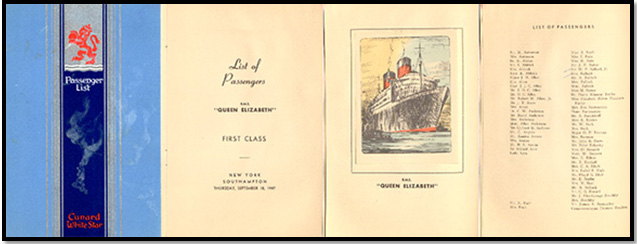
A wonderful example is this passenger list for the QUEEN ELIZABETH's voyage departing New York on September 18, 1947 for Southampton, England. It is full of interesting men: Allen W. Dulles, the future director of the CIA; H.S.M. Burns, the president of the Shell Oil Company; Dr. Hajo Holborn, Yale professor of history; Dr. Otto Stern, a Nobel Prize winning physicist at the Carnegie Institute of Technology in Pittsburgh; Harvard philosopher Dr. Ralph Barton Perry. There are also a number of Congressmen listed, including John Davis Lodge, who later became the governor of Connecticut. Clearly, it was a post-war moment when Americans were eagerly embracing European travel again.
But there, at the bottom of the first page of names, is "Congresswoman Frances Boulton." On further investigation, it turns out that this 1947 voyage represented both a turning point in U.S. history and a milestone for women in politics.
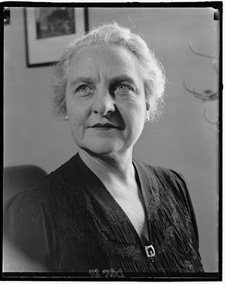
Frances Payne Bolton (the passenger list misspells it) was Ohio's first Congresswoman and one of just a handful of women in the House of Representatives. Born in Cleveland, Ohio, she was an heiress to the Standard Oil fortune, making her one of the richest women in America. Her husband, Chester Castle Bolton, was the Congressman for Ohio's 22nd District, and when he passed away, Frances Payne Bolton ran in the special election for his seat. This was often how women managed to get a foothold in politics in this time period. The men who encouraged her to run for her husband's office thought she would serve out his term and then retire from politics. Instead, she continued to serve and win elections for 28 years.
Congresswoman Frances Bolton. Wikimedia Commons.
In the fall of 1947, Congress sent many of its members on fact-finding missions abroad. It was a crucial moment: the US had emerged from World War II as a new superpower, with parts of western Europe in ruins, while the USSR seemed to be engaged in a power grab. The world's hunger for Middle Eastern oil was clear, and the United Nations was attempting to resolve a fiery situation in British Palestine.
By this time, Frances Bolton was a seasoned member of Congress and served on the House Committee on Foreign Affairs. In the fall of 1947, as chair of a subcommittee studying the situation in the Near East, she made history, becoming the first woman ever to lead a Congressional delegation. On October 4, she and her colleague Congressman Chester E. Merrow of New Hampshire arrived in Jerusalem to meet with all parties. This September 18 passenger list is from their trip over to England, before continuing on to Jerusalem.
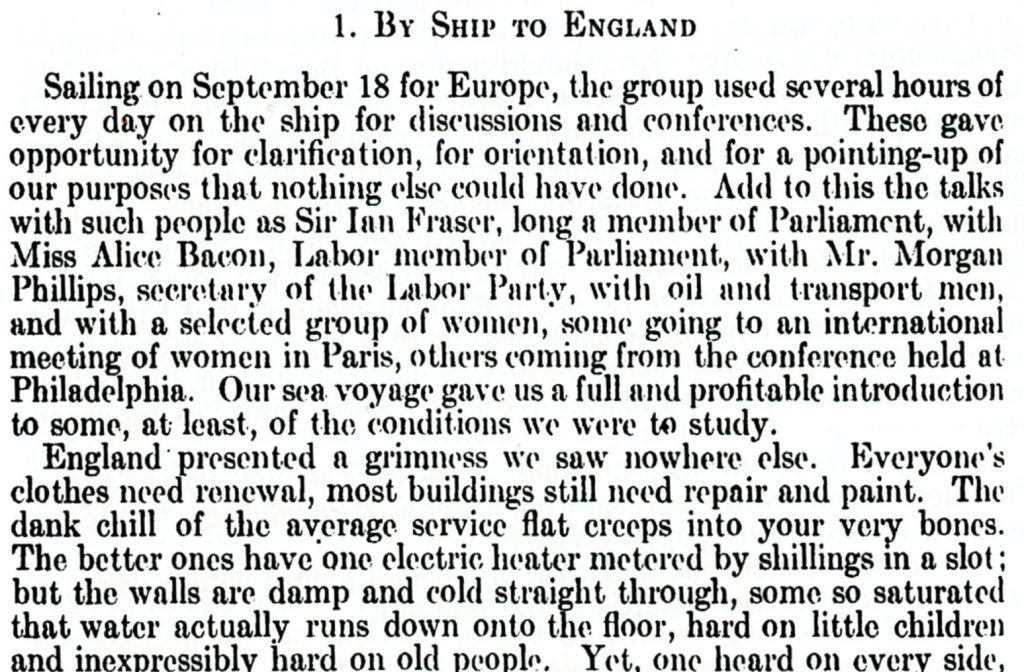
Bolton and Merrow issued a report in early 1948 about what they had seen and heard. Their report back to the Committee on Foreign Affairs includes a paragraph about their voyage on the QUEEN ELIZABETH and how it helped shape their experience.
Already 55 years old when she was first elected, Frances Bolton threw herself into her public service and into the minute details of foreign policy. At a time when many women's lives are barely visible in the historical record, she went on fact-gathering voyages, wrote reports and gave speeches that were instrumental in forming American understandings of the post-war world, of the Communist threat, and of policy towards the Middle East and Africa.
Committee on Foreign Affairs. House. National and International Movements. Report of Hon. Frances P. Bolton, Ohio and Hon. Chester E. Merrow, N.H. Relative to the Near East (and other Points Visited). Jan. 1, 1948. 80th Congress. https://li.proquest.com/elhpdf/histcontext/CMP-1948-FOA-0033.pdf
Bolton, Frances P. The Strategy and Tactics of World Communism: Report [of] Subcommittee No. 5, National and International Movements, with Supplement I, One Hundred Years of Communism, 1848-1948, and Supplement II, Official Protests of the United States Government Against Communist Policies or Actions, and Related Correspondence. [July 1945-Dec. 1947]. United States: U.S. Government Print., Office, 1948. https://www.google.com/books/edition/The_Strategy_and_Tactics_of_World_Commun/_Kk3AAAAIAAJ?hl=en
Two small collections of papers in the G.W. Blunt White Library illuminate how United States merchantmen trading with Europe faced many obstacles during the early 19th century as continual warfare convulsed the continent. France's emperor, Napoleon Bonaparte, issued the so-called Berlin Decree in 1806 that tried to blockade any trade, including that of neutral nations, … Continue reading
Two small collections of papers in the G.W. Blunt White Library illuminate how United States merchantmen trading with Europe faced many obstacles during the early 19th century as continual warfare convulsed the continent. France's emperor, Napoleon Bonaparte, issued the so-called Berlin Decree in 1806 that tried to blockade any trade, including that of neutral nations, with Britain. The British responded with a policy that allowed neutral ships to trade with the Continent only if they first touched at British ports, discharged their cargoes and paid a tax for an export license. In response, Napoleon then issued the Milan Decrees in 1807 that ordered that any ships that had touched British ports before sailing into French, or its allies' territorial waters, be seized and condemned.
Neutral shipping, most importantly that of the United States, faced the dilemma of being seized by the Royal Navy if they failed to touch on a British port and pay the tax before proceeding to the Continent, or seized by the French or its allies if they did. This was the difficult situation faced by the United States ship Commerce in 1806 and 1807, and the merchant vessel North America and 26 other vessels in 1809-1810.
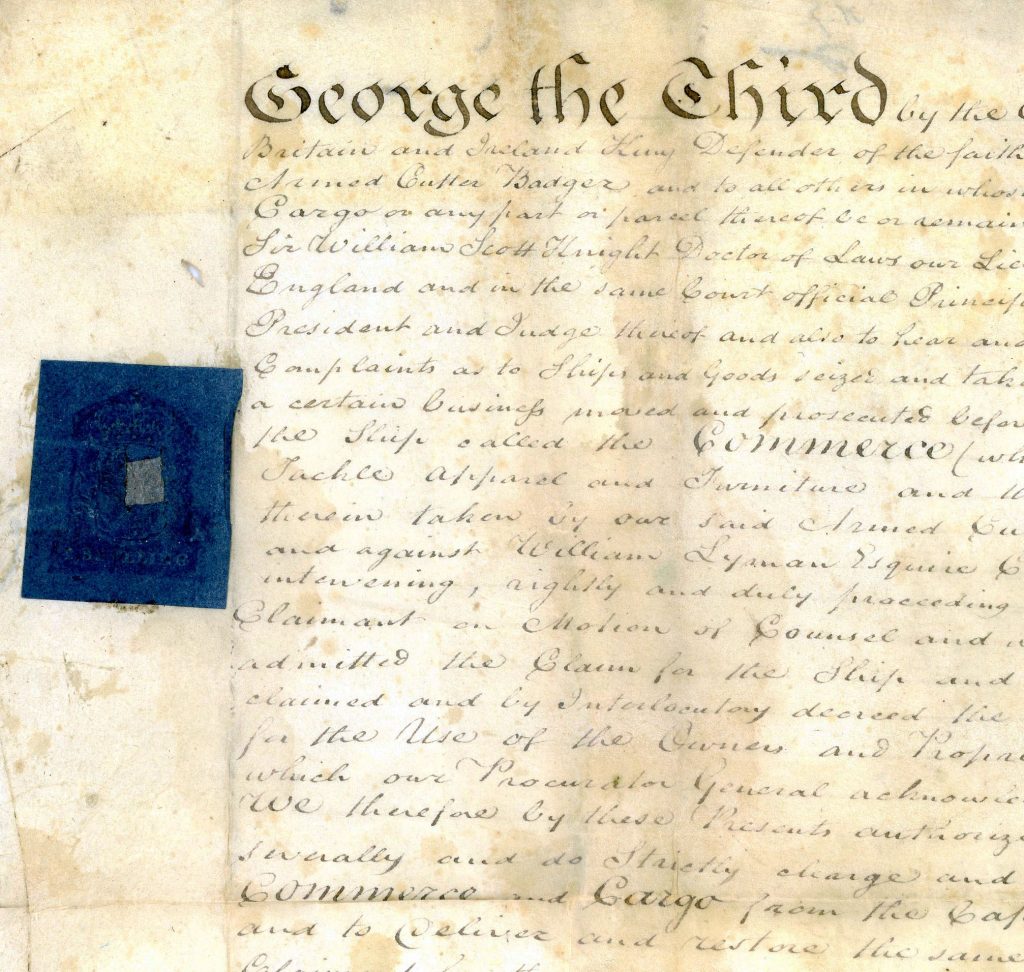
George III safe passage document issued to Brig COMMERCE that proved to be ineffectual.
In the first case, the Commerce sailed from Boston to Lisbon with a cargo of grain and merchandise. Cognizant of the dangers of carrying on trade in a wartime environment, the Commerce first made landfall in England and secured from the Government of George III a safe passage document. The ship proceeded to Lisbon without further incident and loaded a new cargo for Antwerp. Twice on the voyage British ships stopped the Commerce, but allowed it to proceed. Intercepted for a third time, however, the ship was captured by another British naval vessel and taken to England where it was detained until its case was resolved. The Commerce, and others, were caught in the confusing decrees and counter-decrees of the French and British.
In 1807 the Commerce once again set sail from Boston for Livorno, a customs free city in the Grand Duchy of Tuscany. Upon leaving Livorno with a new cargo the ship was seized by a Russian privateer and taken to the Island of Corfu, where it was condemned. Russia, of course, was at war with France. It was determined that the Commerce had unwittingly taken on a cargo of wheat in Livorno that had originated in Naples, a satellite kingdom of Napoleon. Legal proceedings taken against Russia by the United States in defense of American shipping dragged on until 1828 when the czar's government agreed to pay an indemnity of 50,000 rubles.
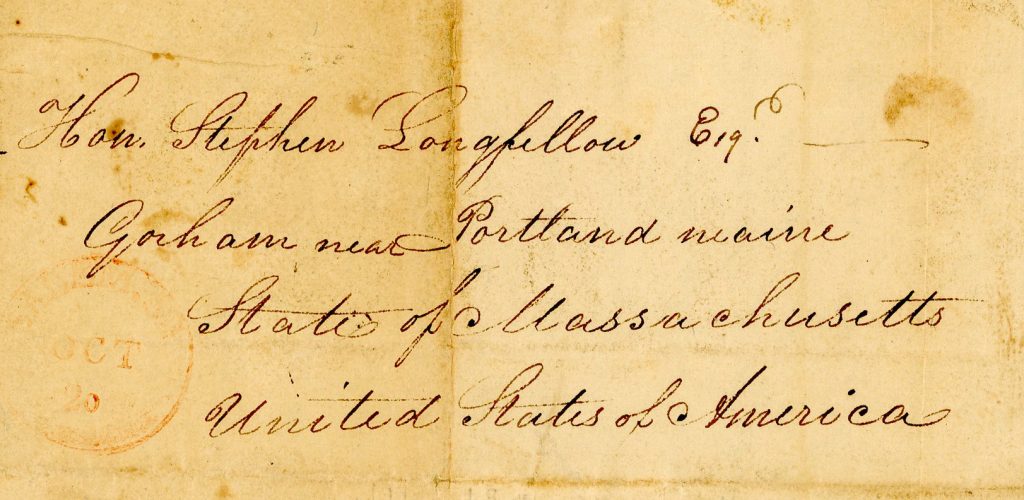
In the case of the merchant vessel North America, in 1809 it was seized, captured and detained in Norway. The Kingdom of Denmark and Norway (united from 1536-1814) had been allied with the French since 1807 which is why they intercepted and seized neutral shipping. Court proceedings then determined if they had violated French decrees or if they were not in fact neutral vessels. If the Danish court was satisfied with the vessel's papers they were cleared to trade. But if it was determined that they had touched at a British port or if the ships were not owned by a neutral country they were condemned and their ships and cargoes forfeited. The North America was one of 26 United States vessels detained in Norway at the time. In this instance, letters regarding the seizure were written by Samuel Longfellow, uncle of Henry Wadsworth Longfellow, to his father Stephen and his brother in Gorham, Maine and John Quincy Adams was enlisted in attempts to free the ships.
Letter addressed to Stephen Longfellow, grandfather of Henry Wadsworth Longfellow, from H.W> Longfellow's uncle Samuel in 1809.
These few instances allow an insight into the larger problem of neutral trade in wartime and the profound disruptions to commerce that ensued.
A crossing-the-line ceremony is something that many naval and merchant seamen have experienced. Traditionally, when a vessel passes over the equator, anyone aboard that is also crossing for the first time is initiated into the brotherhood of shellbacks by King Neptune himself, attended by his lovely court, of course. Duckings, being "shaved" with giant implements, … Continue reading
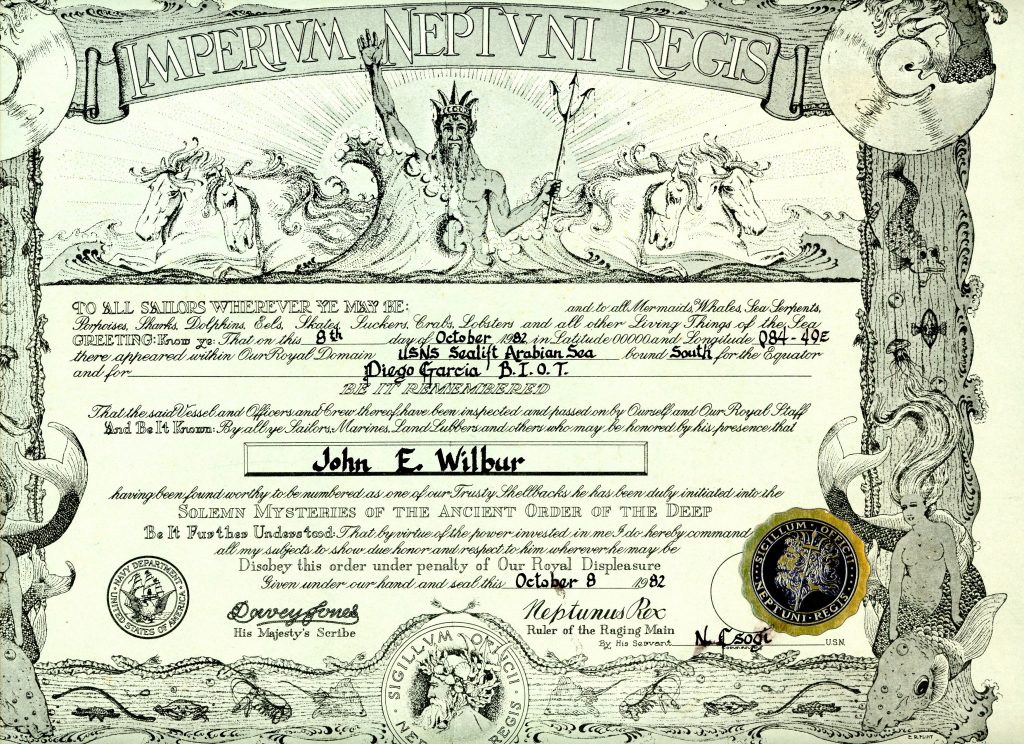
A crossing-the-line ceremony is something that many naval and merchant seamen have experienced. Traditionally, when a vessel passes over the equator, anyone aboard that is also crossing for the first time is initiated into the brotherhood of shellbacks by King Neptune himself, attended by his lovely court, of course. Duckings, being "shaved" with giant implements, dosing with some sort of medicinal potion and being smeared with tar are just some of the events that might take place during a mandatory appearance at the good King's court. Nowadays, even certificates of such a graduation into the ranks are made available to the "lucky" inductee. Below is one such certificate from 1982 issued to the recipient by Neptunus Rex and Davey Jones.
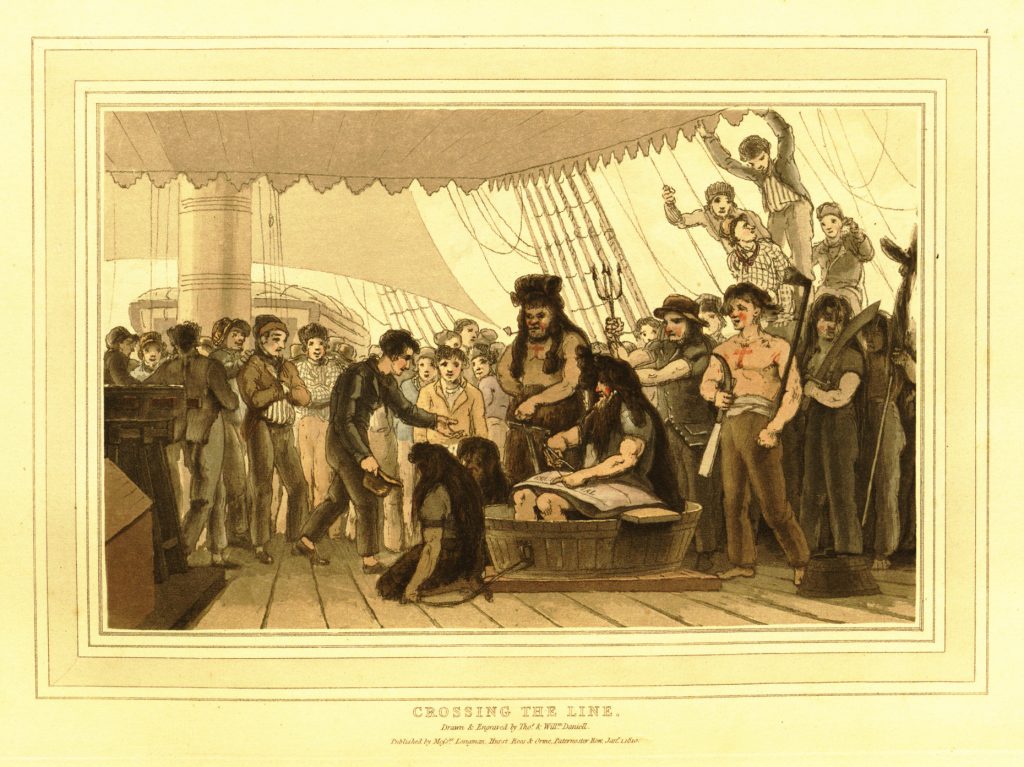
However, the tradition is a long one going back centuries. Looking back, we find the accompanying image in a rare book in the G.W. Blunt White Library's collection at Mystic Seaport. "Crossing the Line" is from A Picturesque Voyage to India : by the Way of China, by Thomas Daniell and William Daniell published in London in 1810. Imagine the surprise of the passengers aboard as Neptune himself makes an appearance on deck to welcome new members to his company.
The following transcript from a journal 76 years later, in 1886, lays out the scene in dramatic fashion as the naval ship makes its way across the equator in the Atlantic Ocean. The author and inductee,William E. Safford, an ensign aboard the USS VANDALIA, appeared in an earlier post. The manuscript journal is part of the collection of the G.W. Blunt White Library.
"Sept. 23 '86
Crossing the Equator.
As we were to "cross the line" preparations were made for receiving Neptune on board; and for initiating all those on board who had not been across the line before. At half past nine in the forenoon, a grotesque procession issued from under the top gallant forecastle, headed by an old man with a long white beard and hair, wearing on his head a glittering crown and bearing in his hand a trident. He was all bedewed with the salty spray of the ocean from which he had just risen. Seated on a chariot drawn by ocean nymphs was his blushing bride Amphitrite whose fair curly locks were surmounted by a diadem. In her arms she held little Rhodi, her baby, wrapped up in her sea-blue mantle to screen her from the vulgar gaze of mortal eyes. The royal couple were attended by their Lord High Chamberlain and in their wake followed the barber and hairdresser to his majesty, his court physician, four Knights of the bath, and a train of attendants.
They were received by the officer of the deck and the Executive officer on the weather side of the quarter deck; and a number of officers who had not before been in his Majesty's realm were presented with imposing ceremonies to both the King and his royal spouse by the Lord High Chamberlain. As they expressed their appreciation of the honor conferred upon them, and begged his Majesty that he would deign still further to add to their happiness by accepting some slight refreshment for himself and his retinue after their long journey from their palace beneath the sea; the gracious sovereign not only accepted the hospitality tendered him, but presented the officers with the following credentials, headed by a portrait of his majesty sitting in a shell and drawn over the blue sea by a pair of classic dolphins:
"Our Realm surrounds the World".
Latitude 00 00
Longitude 30 33 West.
Know all men by these presents that Ensign W.E. Safford, U.S.N. having crossed our Realm on board the U.S.S. "Vandalia" in the service of his country and for honorable purposes and having complied with all the usages rules and customs in so visiting us, he is now declared
"Free of the Ocean" Given under our hand in the Reign of wind and water on this the 23 day of September 1886.
(Signed) Neptune, Rex.
After giving us our diplomas, the procession continued on its way, stopping at the bridge on the lee-side (port) of the deck. Here a throne had been erected for Neptune, Amphitrite remaining on her chariot with her baby in her arms. Just forward of the bridge a reservoir had been constructed out of a large tarpaulin (an awning coated with tar) by stopping its margin up to a height of about four feet above the deck, and allowing it to sag down in the middle. This was nearly filled with water. Just off of this, to the right of the throne was a stool mounted on a box.
Those of the crew who had never before crossed the Equator were brought in succession before the throne. Neptune waved them aside, and Amphitrite still seated on her chariot and with a pipe in her mouth, made them kiss the baby, whose face had been coated with a mixture of shoe-blacking and grease.
They were then seated in a chair where the court dentist examined their teeth with a huge pair of forceps and the court physician administered to them some physic from a bottle armed with a bunch of needles which stuck into their faces. They were then placed in the barbers chair on the margin of the pool; their faces were lathered with a disgusting black sticky mixture and then scraped by an enormous razor of wood. Suddenly they were tumbled heels over head into the pool and after having been held under for a short while by the Knights of the bath were allowed to clamber out, in the sorriest plight one could well imagine. Some of the victims went through the ordeal good naturedly. Others hid themselves in different parts of the ship but were ferreted out by the detectives of the court. One coal-heaver afforded much amusement by trying to escape into the fore-top. Before he was half way up the rigging he had two of the police hanging from his legs and a number of others forcing him down from above. When finally dragged to the chair, he submitted with very bad grace, grappling with the barber and trying to pull him into the pool. He was vigorously smeared with the lather, receiving an extra dose in the mouth, and was tumbled writhing and kicking into the water receiving an extra ducking for his resistance. When he emerged from the water he fairly roared like a wild beast.
Every one of the crew on board ship who had not before crossed the line underwent the initiation, the majority with very good grace. The ship's corporal insisted that he had been across, but being brought before the board of inquisition, he could not bring forward sufficient evidence to convince them. Of the entire marine guard but a single man had before crossed the line—and beginning with the Orderly Sergeant, they all submitted to the ordeal. Taking the ceremony altogether it was very amusing and it did much to relieve the monotony of our voyage. No real indignity was offered the subjects of initiation. After every man had been declared a son of Neptune, the chief actors in the function proceeded to unmask themselves. Neptune and Mrs. Neptune tore off their beard and tresses of manilla, the baby proved to be a swab dressed for the occasion, and the various retainers jumped into the pool and began to scrub off the lamp-black and vermillion with which their faces were liberally smeared. Mrs. Neptune's face especially was a work of art, so delicately were her cheeks tinted.
Crossed the line between 11.30 and noon.
Lat. at noon 0 03 S.
Long. " " 30 54 W.
Temperature between 78 and 80 F. Saw a number of flying fish. Scarcely realize that we had passed under equator from delightful trip."
Ensign Safford's journal is a study in keen observation, especially of the natural world. Here his ability to examine and understand a situation does us well with his description of a ceremony that is legendary in nature yet rarely described in full. And as can be seen from his description and the image from 1810, the ceremony had changed little to that point.
Thank you Paul Goodwin for a faithful transcription.
This silvery alloy of chromium, cobalt and nickel is the toughest known material
Easo George/Oak Ridge National Laboratory
An alloy of chromium, cobalt and nickel (CrCoNi) is the toughest material ever tested, and its characteristics could make it useful in the construction of aircraft or spacecraft.
Toughness is a measure of a material's resilience against fracturing, and it isn't the same thing as hardness, which is a measure of a material's ability to withstand deformation. For instance, you can't put a dent in a diamond, famously known to be the hardest material yet discovered, but you might be able to crack one. …