Learn how to make kuih bahulu (kue bolu kering) that is soft and spongy and not too sweet. Perfect as an afternoon tea snack or to celebrate the Chinese new year or raya. The kuih bahulu can be made without using the special bahulu mould.
Both hubby and the kids know by now that I love making chiffon cakes and sponge cakes. I'm not a cake with an icing person or any overly sweet and cake. I love the simplicity of the cake itself without much frostings, fondants, etc. Kuih bahulu or what we call kue bolu kering or bolu klemben or bolu jadul in Indonesia, is one of my favorite mini egg sponge cakes. They are cute, delish, soft, and spongey.
What is kuih bahulu?
Kuih bahulu is Malay-style egg sponge cake made with simple ingredients like eggs, flour, sugar, and a leavening agent. There is no oil used in traditional bahulu recipe, other than to grease the mould. This recipe I'm sharing here uses a bit of oil and it makes a difference! I actually prefer it with some oil as the crumbs are tighter and fluffier. The texture is soft and spongy on the inside and slightly crusty on the outside, similar to those of French madeleines (hence the name Asian madeleines). Traditionally, the cake batter is baked in a special brass-mould with a decorative pattern over an open fire. In this modern-day, they are baked in the oven.
The recipe rundown
Taste: They are not too sweet with a nice eggy aroma Texture: Crusty on the outside and soft and spongy inside. Traditional bahulu is more on the dry side, which is fine if you dunk it in a coffee, BUT, I prefer to have a moister crumb and this recipe does it Level: medium
Crumb comparison
The kuih bahulu on the left had oil in the recipe and the one on the right did not. You can see softer and fluffier crumbs on the left. The cake doesn't feel dry compared to the one on the right.
Left: bahulu with oil. RIght: bahulu without oil
Ingredients
1. Eggs I use large eggs, about 58-60 grams each with the shell 2. Sugar I use granulated sugar. You can use caster sugar too. I do not recommend cutting down further on the sugar, as this is already being cut down. If you cut down too much, the kuih bahulu won't have that crisp exterior on the outside 3. All-purpose flour All-purpose flour has medium content gluten. 4. Cornstarch Cornstarch (also known as corn flour in Singapore/Malaysia). In the U.S., corn starch and corn flour are totally different things. Cornstarch is a starch extracted from corn. Corn flour is obtained by grinding the whole corn kernels. You want to make sure you use the starch (whatever it is called where you are) 5. Baking powder It helps to leaven the cake 6. Salt A small pinch of salt brings the flavour out even more 7. Oil Traditional kuih bahulu doesn't use any oil, but by adding some oil, really contributes to softer and moist crumbs, unlike the traditional, which is dry
How to make kuih bahulu without the bahulu mould
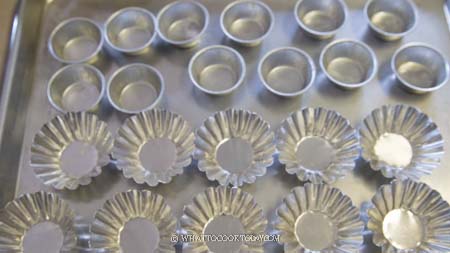
1. I don't have the special bahulu mould, but I do have a madeleine pan and egg tart moulds and some little cups used to steam or bake muffin or huat kueh. Arrange these on top of a baking tray and brush generously (like really generous or the cake will stick to the mould) with some cooking oil
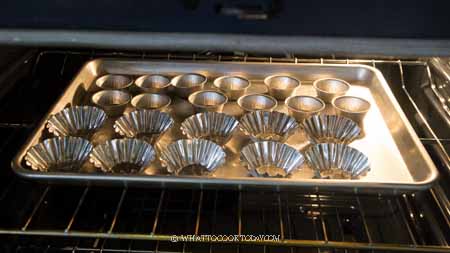
2. Preheat oven to 410 F (210 C) for a conventional oven. For a convection oven, preheat to 390 F (200 C) . When it reaches that temperature, put the baking tray on the middle rack and let them preheat for at least 15 minutes. This is very important so the cake won't stick to the mould.
3. Beat egg and sugar over the high speed with a hand mixer or a stand mixer with a paddle attachment until they are pale, creamy, and thick (or they like to call it the ribbon stage). The volume should triple in size, in about 10 minutes (with my kitchen aid on speed 8) or 15 minutes with a hand mixer
5. Sift in the flour mixture, and use a spatula to swipe down from the side and fold over to combine. Repeat this motion until you don't see any pockets of flour.
6. Then drizzle in the oil from the side of the bowl and use a spatula to swipe down and fold over motion again to combine. 6. Transfer the cake batter to a piping bag it's easier to fill up the mould that way. Alternatively, you can use a spoon to scoop, which can be a bit messier.
7. Take the preheated moulds out from the oven and carefully but quickly pipe in the cake batter or use a spoon or ice cream scoop to scoop the cake batter into the mould. Fill them up about 3/4 full.
8. Use a toothpick to pop any large bubbles inside the batter. I bang the pan on the countertop 2-3 times to pop any large bubbles
9. I recommend baking one tray at a time for the best result. I place the baking sheet on 3rd rack from the top and bake the cake for 7 minutes in small cups like this. My madeleine mould is almost twice the capacity of these, so I baked it for 9-10 minutes. The time is just a reference, this depends on the size of the cake too.
8. Use a skewer or toothpick to pick up the cake from the mould to a cooling rack. Clean up the moulds if anything sticks to eat and then grease and preheat again before baking the next batch
Kuih bahulu gets stuck to the mould
-Make sure you generously grease the moulds or muffin cups (or whatever you use) with some oil, especially if the moulds are pretty new. If the problem persist, you can coat with some flour -Preheat the moulds for at least 15 minutes -When you take the moulds out to fill them up with cake batter, you may have taken too long and the moulds have lost most of the heat and the cake batter sticks to the pan -Clean up the moulds if anything sticks to eat and then grease the pan/cups generously with oil and preheat again before baking the next batch
How to bake kuih bahulu without using special mould
These were kuih bahulu baked in egg tart shells and mini cups I used to steam huat kueh
How to store kuih bahulu
1. Let them cool down completely on a cooling rack 2. Transfer to an air-tight container and they can be kept for 2-3 days. The longer they sit, the drier they get
Did you make this kuih bahulu recipe?
I love it when you guys snap a photo and tag to show me what you've made 🙂 Simply tag me @WhatToCookToday #WhatToCookToday on Instagram and I'll be sure to stop by and take a peek for real!
This post was last published in January 2021 and has been updated with an improved recipe, techniques, and photos on January 16, 2023.
I don't recommend making a big batch. The cake batter may deflate if it sits for too long waiting for its turn being baked in the oven
Preheat the bahulu mould (or in my case cups and egg tart moulds):
I don't have the special bahulu mould, but I do have madeleine pan and egg tart moulds and some little cups used to steam or bake muffin or huat kueh. Arrange these on top of a baking tray and brush generously (like really generous or the cake will stick to the mould) with some cooking oil
Preheat oven to 410 F (210 C) for conventional oven. For a convection oven, preheat to 390 F (200 C) . When it reaches that temperature, put the baking tray on the middle rack and let them preheat for at least 15 minutes. This is very important so the cake won't stick to the mould.
Prepare the cake batter:
Combine all-purpose flour, cornstarch, baking powder, and pinch of salt. Whisk to combine
Beat egg and sugar over a high speed with a hand mixer or a stand mixer with a paddle attachment until they are pale, creamy, and thick (or they like to call it ribbon stage). The volume should triple in size, about 10 minutes (with my kitchen aid on speed 8)
Sift in the flour mixture, and use a spatula to swipe down from the side and fold over to combine. Repeat this motion until you don't see any pockets of flour. Then drizzle in the oil from the side of the bowl and use a spatula to swipe down and fold over motion again to combine. Transfer the cake batter to a piping bags it's easier to fill up the mould that way. Alternatively, you can use a spoon to scoop, can be a bit messier
Fill up the mould:
Take the preheated moulds out from the oven and carefully but quickly pipe in the cake batter or use a spoon or ice cream scoop to scoop the cake batter, fill it up about 3/4 full
Use a toothpick to pop any large bubbles inside the batter. I bang the pan on the countertop 2-3 times to pop any large bubbles
Bake the cake:
I recommend baking one tray at a time for best result. I place the baking sheet 3rd rack from the top and bake the cake for 7 minutes in small cups like this. My madeleine mould is almost twice the capacity of these, so I baked them for 9-10 minutes.
If you prefer much crispier on the outside, you can add a minute or two, but be careful not to overbake. They dry up quickly. The time is just a reference, this depends on the size of the cake and your oven too
Use a skewer or toothpick to pick up the cake from the mould to a cooling rack
Clean up the moulds if anything sticks to eat and then grease and preheat again before baking the next batch
Cooling down:
The crust is crispy when they are still warm but they will soften as they cool down and that's normal.
Serving:
Kuih bahulu is best served on the same day they were made. Any leftover can be stored in an air-tight container at room temperature for 2-3 days. I do not recommend storing in the fridge as the cake dries out very quickly
Kuih Bahulu (Baked Mini Egg Sponge Cake/Ji Dan Gao)
Learn how to make kuih bahulu (kue bolu kering) that is soft and spongy and not too sweet. Perfect as an afternoon tea snack or to celebrate the Chinese new year or raya. The kuih bahulu is made without using the special bahulu mould.
In the race to electrify the automobile industry, Toyota won by not winning.
The Japanese automaker announced record profits Tuesday, thanks to incredibly strong sales of gas-electric hybrid vehicles. Now, Toyota is hoping the timing is finally right to drive full-steam into an all-EV future.
Rules of the Hybrid Road
Unlike rivals General Motors, Ford, and Volkswagen, Toyota has been relatively hesitant to jumpstart the transition to EVs. Instead, the company has leaned into what most of its rivals are just now realizing: many consumers aren't ready to make the full EV transition yet, but they're willing — and excited — to embrace a hybrid car. In October, for instance, Ford said that it expects its hybrid sales to quadruple over the next half-decade, after its third quarter saw a nearly 42% year-over-year increase in hybrid sales, far surpassing the growth of its EVs. In the US overall last year, hybrid sales eclipsed EVs, 1.4 million to 1.1 million, according to data from car-shopping website Edmunds, with hybrids seeing sales growth of about 64% compared to EVs' 51% bump.
But Toyota was already in on the pivot to hybrids, which US dealers tend to say they can't keep on their lots. It's led to one of the best quarters in company history — with executives saying they're likely to maintain their position as leaders of the hybrid pack:
Hybrid sales increased 46% in Toyota's year-end quarter, fueling 11% growth in overall vehicle sales. Hybrids also accounted for over one-third of the 11.2 million cars Toyota sold in 2023, the company said.
That led the company to forecast an overall record $30.3 billion profit for the fiscal year ending in March. Investors responded by sparking a nearly 5% boost to its shares on the Tokyo Stock Exchange, nearing a record high for the company.
Toyota executive Yoichi Miyazaki says he expects hybrid sales to reach around 8 million vehicles by 2025. And Toyota has been able to achieve profit-margin parity with combustion engine vehicles, something competitors have struggled with.
Need a Jolt: While Toyota Chairman Akio Toyoda predicted last year that EVs could soon attain a 30% market share, electric cars made up just 1% of the company's total sales last year. This may explain why the company also announced it is boosting its investment in a Kentucky EV plant by $1.3 billion — bringing its total investment to about $10 billion — as it prepares to start production on a new three-row all-electric SUV in 2025. Better late than never.
Universe Today has explored the potential for sending humans to Europa, Venus, Titan, and Pluto, all of which possess environmental conditions that are far too harsh for humans to survive. The insight gained from planetary scientists resulted in some informative discussions, and traveling to some of these far-off worlds might be possible, someday. In the final installment of this series, we will explore the potential for sending humans to a destination that has been the focus of scientific exploration and science folklore for more than 100 years: Mars aka the Red Planet.
Dr. Jordan Bretzfelder, who is a Postdoctoral Fellow in the Department of Earth, Planetary, and Space Sciences at the University of California, Los Angeles (UCLA), shares her insights on the viability of sending humans to Mars and how we should do it. So, should we send humans to Mars?
"Yes, I think there is immense value in sending humans to engage in scientific exploration on Mars," Dr. Bretzfelder tells Universe Today. "Humans can make quick decisions about sampling and data acquisition and can move around certain obstacles and terrain with more ease and freedom than many types of robotic vehicles. This would also provide opportunities to study and develop technology to facilitate future planetary exploration."
Countless robotic pioneers have explored the surface and atmosphere of Mars in incredible detail and continue to teach us whether Mars once had—or currently has—life. However, humans could provide an extra level of exploration since they won't be hindered by waiting for instructions from Earth ground controllers, which can take anywhere from 5 to 20 minutes one way. If something goes wrong, human explorers can make on-the-spot decisions to find solutions, whereas robot explorers are faced with waiting for engineers back on Earth to find solutions, followed by sending instructions, and more waiting. Regarding technological advancements, a human mission will undoubtedly teach us how to live and work on Mars, and this includes testing shelters, food, bathroom facilities, and even combating the mental fatigue from being so far from Earth for a prolonged period. All things considered, what are the pros and cons of sending humans to Mars?
Dr. Bretzfelder tells Universe Today, "Pros are as above, and many examples of the benefits of humans in the field can be found in the history of the Apollo missions; instances where certain scientifically valuable rocks were collected due to the quick thinking and judgement of the astronauts. Cons include the difficulties involved in keeping astronauts alive and safe on a distant and environmentally complicated planetary surface. Additionally, the possibility of accidentally introducing terrestrial microbes to Mars is a potential risk."
Whether it's a robotic or human mission, NASA's Office of Planetary Protection is responsible for ensuring that microbes don't hitch a ride and contaminate extraterrestrial environments that we wish to explore, but especially to protect us from any microbes that could potentially be brought back to Earth.
Regarding the ongoing robotic exploration of Mars, there are presently seven active Mars orbiters from several nations teaching us more and more about the Red Planet and unlocking its secrets. On the surface, there are currently three active missions: NASA's Curiosity and Perseverance rovers, and China's Zhurong rover. Past successful surface missions include NASA's Viking 1 and Viking 2 landers, Mars Pathfinder, Spirit and Opportunity rovers, Phoenix lander, and InSight lander. From marsquakes to finding evidence for past surface liquid water, each of these missions spent years unlocking the secrets of Mars, both above and below the surface. But what additional science could be conducted by a human mission compared to a robotic mission?
"As above, humans (within limits based on their suits and other equipment) have the ability to navigate terrain that may not be suitable for a rover or helicopter," Dr. Bretzfelder tells Universe Today. "They also can make real time decisions in the field about sampling etc., meaning there is less delay in waiting for signals from mission control to guide the rovers. Humans are also very adaptable to changing conditions and can respond quickly to address any issues or unexpected situations during a mission."
In terms of an actual human habitat on Mars, countless images, videos, movies, and television shows have depicted a human habitat on the Martian surface, with very little depiction of a human habitat below the surface. While this depiction might be for aesthetics, a habitat on the surface would provide ideal surveying and sampling conditions, along with far better communications with Earth. However, a habitat on the surface would also expose the crew to dangerous amounts of solar radiation since Mars does not possess either an ozone layer or magnetic field like the Earth, both of which protect us from solar storms and other cosmic rays.
Artist's concept for a crewed mission on Mars. (Credit: NASA/Clouds AO/SEArch)
In contrast, another type of human habitat could be below the surface, with past studies identifying the use of lava tubes for human settlements to shield them from the harmful solar radiation. However, any surface ventures could become tedious, along with communications with Earth becoming more complicated, even if a communications array was above-ground. Therefore, if humans were to travel to Mars, should it be above the surface or below?
Dr. Bretzfelder tells Universe Today, "An above surface mission, similar to the Apollo and upcoming Artemis missions would be the most feasible given the technology available and would limit impact to the Martian surface by simply operating above ground rather than excavating below ground. Samples or cores taken from depth may be scientifically valuable though."
This discussion comes as NASA prepares to send humans back to the Moon as part of its Moon to Mars Architecture while SpaceX develops its Starship with the goal of sending humans to Mars, someday. China announced plans in 2021 to send their own astronauts to the Red Planet in 2033, with follow-up launches occurring every two years afterwards. Additionally, NASA has the goal of sending humans to Mars sometime in the 2030s.
"It is an exciting time to be able to seriously consider this type of exploration, and as we return to the Moon, we will likely learn valuable lessons to enable human exploration of Mars," Dr. Bretzfelder tells Universe Today.
Will we ever send humans to Mars? Will such a mission achieve greater scientific objectives than the myriad of robotic missions sent to the Red Planet, and what could a human mission to Mars teach us about living and working so far from Earth? Only time will tell, and this is why we science!
Consumer Reports shows Tesla Autopilot works with no one in the driver's seat
Consumer Reports argues Tesla needs a better driver-monitoring system.
Last Saturday, two men died when a Tesla Model S crashed into a tree in a residential neighborhood. Authorities said they found no one in the driver's seat—one man was in the front passenger seat, while the other was in the back. That led to speculation that the car might have been under the control of Tesla's Autopilot driver-assistance system at the time of the crash.
Elon Musk has tweeted that "data logs recovered so far show Autopilot was not enabled." Tesla defenders also insisted that Autopilot couldn't have been active because the technology doesn't operate unless someone is in the driver's seat. Consumer Reports decided to test this latter claim by seeing if it could get Autopilot to activate without anyone in the driver's seat.
It turned out not to be very difficult.
Sitting in the driver's seat, Consumer Reports' Jake Fisher enabled Autopilot and then used the speed dial on the steering wheel to bring the car to a stop. He then placed a weighted chain on the steering wheel (to simulate pressure from a driver's hands) and hopped into the passenger seat. From there, he could reach over and increase the speed using the speed dial.
Autopilot won't function unless the driver's seatbelt is buckled, but it was also easy to defeat this check by threading the seatbelt behind the driver.
"In our evaluation, the system not only failed to make sure the driver was paying attention, but it also couldn't tell if there was a driver there at all," Fisher wrote in a post on the Consumer Reports website.
Consumer Reports calls for more robust driver monitoring
Fisher sees these problems as evidence that Tesla has fallen behind other companies with more robust driver-monitoring systems. Companies like GM and Ford use driver-facing cameras to detect the driver's face and ensure they are looking at the road. Such a system would have made it much more difficult to use Autopilot from the passenger seat.
Consumer Reports also suggested that Tesla could "use the weight sensor in the vehicle's driver's seat to determine whether there is a human sitting behind the wheel. These sensors are already used for seat belt warnings and airbags, among other things, so it wouldn't be a major leap to program a vehicle to turn off features like cruise control if it senses that the driver's seat is empty."
At the same time, the investigation makes clear that activating Autopilot without being in the driver's seat requires deliberately disabling safety measures. Fisher had to buckle the seatbelt behind himself, put a weight on the steering wheel, and crawl over to the passenger seat without opening any doors. Anybody who does that knows exactly what they're doing. Tesla fans argue that people who deliberately bypass safety measures like this have only themselves to blame if it leads to a deadly crash.
Still, Consumer Reports argues that government regulators should require more robust safety checks that would make it almost impossible to activate Autopilot without someone in the driver's seat. The group notes that European regulators will require driver-monitoring systems in cars starting in 2023 and urges US regulators to adopt similar rules.
Defense attorneys argue that this is an improper rushing of proceedings.
(Left) Special Counsel Jack Smith delivers remarks in Washington on Aug. 1, 2023. (Right) Former President Donald Trump attends his trial in New York State Supreme Court in New York City on Dec. 7, 2023. (Drew Angerer, David Dee Delgado/Getty Images)
A federal appeals court on Wednesday agreed to special prosecutor Jack Smith's request to expedite former President Donald Trump's appeal to dismiss his Washington, D.C., election case based on presidential immunity.
The U.S. Court of Appeals for the District of Columbia issued an order outlining a streamlined briefing schedule and calling for oral arguments, with the date to be set later.
According to the order, President Trump's opening brief is due by Dec. 23. The order emphasized that issues and arguments should be raised in the opening brief, discouraging new points in the reply brief for consideration.
Advertisement - Story continues below
"The court ordinarily will not consider issues and arguments raised for the first time in the reply brief," reads the order (pdf).
This decision follows statements by the attorneys representing President Trump accusing the special counsel's office of election interference in a recent appeals court filing after Mr. Smith requested to expedite the appeal so that the case can go to trial on March 4, 2024. March 4 is Super Tuesday, the U.S. presidential primary election day.
"The prosecution has one goal in this case: To unlawfully attempt to try, convict, and sentence President Trump before an election in which he is likely to defeat President Biden," the defense attorneys wrote.
"This represents a blatant attempt to interfere with the 2024 presidential election and to disenfranchise the tens of millions of voters who support President Trump's candidacy."
In response, prosecutors swiftly filed a court document asserting that President Trump's legal team failed to present any valid reasons for the appeals court not to proceed on an expedited schedule. They argued that further delays in the case would "entail serious costs to the judicial system."
This week, prosecutors already asked three separate courts to affirm a March 4 trial date. Prosecutors are arguing that it's in the interest of the public to settle this case quickly, as it pertains to issues "at the heart of our democracy."
Earlier, U.S. District Judge Tanya Chutkan paused court proceedings on Wednesday in the case pending President Trump's appeal.
"The court agrees with both parties that Defendant's appeal automatically stays any further proceedings that would move this case towards trial or impose additional burdens of litigation on Defendant," she wrote. "The court hereby stays the deadlines and proceedings scheduled by its Pretrial Order."
Advertisement - Story continues below
Judge Chutkan clarified that this would pause the pretrial deadlines, not vacate them.
Attorneys for President Trump have sought to push the trial date back, citing the 13 million pages of discovery material they intend to review.
Meanwhile, prosecutors have stressed the importance of the case going to trial soon.
Advertisement - Story continues below
Defense attorneys now argue that the prosecution's repeated requests for a March 4 trial date reveal their motives, having brought charges during President Trump's campaign despite investigating for more than two years.
Defense attorneys have denounced this repeated reference to a March 4, 2024, trial in the prosecution's recent court filings, arguing that their rationale shows "strategic gamesmanship" rather than "reliance on the law."
In a major shake-up in the case last week, President Trump appealed Judge Chutkan's denial of his motion to dismiss based on presidential immunity. The same day, defense attorneys filed a notice of appeal and a motion to stay proceedings in the district court because an appeals court decision could throw out the case.
Regardless of a favorable appeals court ruling for the defense, this would have thrown off the district court schedule, preventing the prosecution from securing their desired trial date.
Prosecutors have also asked the U.S. Supreme Court to review President Trump's presidential immunity defense so that it may inform the appeals court decision in a timely manner and allow for a March 4, 2024, trial date.
It is unclear how the pause in the district court pretrial schedule and the appeals court's schedule will impact a potential March 4, 2024, trial date.
Important Information About Directed Blood Donations that are Not Medically Indicated
October 23, 2023
The Food and Drug Administration (FDA) is advising consumers and health care providers that directed blood donations requested for certain donor characteristics (e.g., vaccination status, gender, sexual orientation, religion) lack scientific support and to be cautious about websites that offer memberships for delivery of blood and blood components from individuals who have not been vaccinated for COVID-19.
Summary of the Issue
FDA is aware that some blood establishments and hospitals have received requests from patients who need a blood transfusion and wish to receive directed donations only from personally chosen relatives, friends, or other individuals with certain characteristics (e.g., specific gender, sexual orientation, vaccination status, or religion). Such directed blood donations lack scientific support.
There is no evidence that directed donation provides safer blood and blood components for transfusion. All blood donors must be found eligible to donate blood for others under FDA regulations (21 CFR Part 630) and all donations intended for transfusion are tested for relevant transfusion transmitted infections (21 CFR 610.40). Studies suggest that directed donations may carry greater risk of transmitting infectious diseases than the general blood supply1. In addition, the selection of blood or blood components based on donor characteristics that are not supported by scientific evidence might delay or interfere with appropriate medical intervention and life-saving blood transfusion.
This issue has recently received increased attention due to requests for directed blood donations from individuals who have not received COVID-19 vaccines. In addition, FDA is aware of several different websites purporting to offer blood and blood components from donors who have not been vaccinated against COVID-19 and charging individuals for membership to receive such services in the future. The justification for such requests and services may be based on misinformation and is not supported by any medical or scientific evidence. In addition, such practice has been denounced in a joint statement by the American Red Cross, the American Association of Blood and Biotherapies and America's Blood Centers.2
Information for Healthcare Providers, Consumers and Blood Establishments
We advise consumers and health care professionals to exercise caution about websites offering memberships for delivery of blood and blood components from COVID-19 unvaccinated blood donors. Further, FDA reminds all owners or operators of establishments that manufacture blood products that they must register with the FDA, pursuant to section 510 of the Federal Food, Drug, and Cosmetic Act, and must comply with the requirements for registration and blood product listing in FDA regulations (21 CFR Part 607). Blood and blood components must be labeled according to the requirements of 21 CFR Part 606.121 and 606.122. Blood and blood components labeled in a manner that is false or misleading are misbranded and are in violation of section 502(a) of the Federal Food, Drug, and Cosmetic Act.
The agency will continue to closely monitor this issue and take additional actions, as appropriate.
Consumers and healthcare providers who have questions may contact FDA's Center for Biologics Evaluation and Research (CBER) at ocod@fda.hhs.gov.
Establishments that wish to manufacture blood and blood components and have questions about FDA regulations may contact CBER at industry.biologics@fda.hhs.gov.
1 Dorsey KA, Moritz ED, Steele W, Eder AF and Stramer SL. A comparison of human immunodeficiency virus, hepatitis C virus, hepatitis B virus and human T-lymphotropic virus marker rates for directed versus volunteer blood donations to the American Red Cross during 2005 to 2010, Transfusion 2013;53:1250-1256.
FDA continues to work closely with CDC and other federal and international agencies to monitor the coronavirus disease 2019 (COVID-19) pandemic caused by the virus, SARS-CoV-2. Respiratory viruses, in general, are not known to be transmitted by blood transfusion. There have been no reported cases of transfusion-transmitted coronavirus, including SARS-CoV-2, worldwide. (S'ok, here's my concern, there's so much more to the story b/c of the Treatments, aka-jabs, that the jabbed are the ones with tainted blood…?)adt.
Routine measures used to determine blood donor eligibility prevent individuals with clinical respiratory infections from donating blood. For example, blood donors must be in good health and have a normal temperature on the day of donation (21 CFR 630.10).
It is imperative that healthy individuals continue to donate blood and blood components, including Source Plasma.
Considerations
FDA does not recommend using COVID-19 laboratory tests to screen routine blood donors.
The blood establishment's responsible physician must evaluate prospective donors and determine eligibility (21 CFR 630.5). The donor must be in good health and meet all donor eligibility criteria on the day of donation (21 CFR 630.10). The responsible physician may wish to consider the following:
individuals diagnosed with COVID-19 or who are suspected of having COVID-19, and who had symptomatic disease, refrain from donating blood for at least 10 days after complete resolution of symptoms,
individuals who had a positive diagnostic test for SARS-CoV-2 (e.g., nasopharyngeal swab), but never developed symptoms, refrain from donating at least 10 days after the date of the positive test result,
individuals who are tested and found positive for SARS-CoV-2 antibodies, but who did not have prior diagnostic testing and never developed symptoms, can donate without a waiting period and without performing a diagnostic test (e.g., nasopharyngeal swab),
individuals who received a nonreplicating, inactivated, or mRNA-based COVID-19 vaccine can donate blood without a waiting period,
individuals who received a live-attenuated viral COVID-19 vaccine, refrain from donating blood for a short waiting period (e.g., 14 days) after receipt of the vaccine,
individuals who are uncertain about which COVID-19 vaccine was administered, refrain from donating for a short waiting period (e.g., 14 days) if it is possible that the individual received a live-attenuated viral vaccine.
FDA will continue to monitor the situation and issue updated information as it becomes available.
Communities can track the presence of SARS-CoV-2, the virus that causes COVID-19, in wastewater samples. These data can provide an early warning of COVID-19's spread in communities. For more information, visit the Wastewater Surveillance System page.
Monitoring Wastewater Surveillance Data
Wastewater surveillance for COVID-19 is a rapidly developing field. State, tribal, local, and territorial health departments participating in the National Wastewater Surveillance System (NWSS) submit testing data to CDC. CDC then standardizes and interprets these data and presents them in the COVID Data Tracker. How often sites collect wastewater samples and how frequently data are reported to CDC varies by health department.
Wastewater data are meant to be used with other COVID-19 surveillance data to better understand COVID-19's spread in a community. Learn more about wastewater data by exploring each of the charts and maps. To see a map of which SARS-CoV-2 variant is the most dominant at each wastewater sampling site, see CDC COVID Data Tracker: Summary of Variant Surveillance.
"It's always important to know when something has reached its end. Closing circles, shutting doors, finishing chapters, it doesn't matter what we call it; what matters is to leave in the past those moments in life that are over." Paulo Coelho
Feel the energy fields shift this week as Mercury crosses the Black Hole of the Great Attractor on November 19 and the Sun and Mars leave Scorpio for Sagittarius on November 22 and 24. As they align with Pluto and Saturn, it's a good time to pause and take a deep inbreath instead of jumping straight into the holiday season.
We've all been shaken by the scale and brutality of events following October's eclipses and the recent Scorpio New Moon- we're all feeling ragged, raw and emotionally depleted.
The past is withdrawing from us and we are in the process of disabling the past- the magnetics that once held it together are starting to weaken and disperse - energetically dust to dust. If you're feeling - as so many of us sensitives are - down, depleted, drained, alone or in a void like floating on the Dead Sea, understand that you are not fading, falling or failing but energetically detaching during Pluto's extended move from top -down Capricorn to collective Aquarius. It is now impossible to miss the separation of time-lines as you witness the withdrawal and ending of many of your previous creations - roles, labels, careers, relationships, alliances, beliefs.
Instead of focusing on what is happening around you or what you're not doing, allow yourself as much rest, retreat and non -doing as you can as the physical and psychic cleansing builds. Your body is a messenger with feedback about your current operating system. Be present and allow outworn debris, illusions, attachments and patterns to dissolve while absorbing the incoming deep space energies at cellular level.
Stop looking back at What Was, telling yourself What Should be and wake up to What Is.
We are learning that the more we become true to our Selves and the more we withdraw our energy from anything external that leads to soul defragmentation, the more energy we will have available to self -sustain, self -generate and self-support.
Researchers Find Pfizer Excluded Clinical Trial Deaths From FDA COVID Vaccine EUA Request
An accurate reporting by Pfizer would have shown equal numbers of clinical trial deaths in the vaccine and placebo groups and thus, no benefit of vaccination.
(Pascal Pochard-Casabianca/AFP via Getty Images)
To obtain emergency use authorization (EUA) for its COVID-19 vaccine, Pfizer and BioNTech submitted a data package in 2020 to the U.S. Food and Drug Administration (FDA) so the agency could evaluate the safety and efficacy of its vaccine. A recently published peer-reviewed study by the DailyClout Pfizer/BioNTech Documents Investigations Team suggests Pfizer excluded known deaths in the vaccine arm of its clinical trial from its data filing and withheld information from the agency that could have resulted in a denial of EUA.
Delayed reporting of the subject deaths into the Case Report Forms (CRFs) obscured the cardiac adverse event signal and allowed Pfizer/BioNTech's request for EUA to proceed unchallenged, according to the study.
As reported by The Epoch Times prior to the study's publication in the International Journal of Vaccine Theory, Practice, and Research, a group of researchers conducted a forensic analysis of Pfizer/BioNTech's early COVID-19 vaccine trial data and found significant inconsistencies between data in the companies' six-month interim report and publications authored by Pfizer/BioNTech trial site administrators.
The forensic analysis showed trial subjects vaccinated with Pfizer's COVID-19 vaccine experienced a 3.7 times increase in cardiovascular deaths compared to placebo controls and that this "significant adverse event signal" was not disclosed by Pfizer when the FDA was evaluating its vaccine for emergency use. Additionally, researchers identified numerous instances where Pfizer/BioNTech attributed potential vaccine-associated deaths to other causes and undermined vaccine safety data.
Altered Pfizer Data Favored Vaccine Approval
Pfizer altered their data at a critical decision point to favor EUA approval, study co-author Corinne Michels, Professor Emerita at Queens College in New York told The Epoch Times in an email. According to the study, Pfizer had a Nov. 14, 2020, data cutoff for its COVID-19 vaccine EUA application. In its filing, the company presented data showing four deaths in the placebo arm of its clinical trial and two deaths in the vaccine arm, which inflated the positive impact of the vaccine on death outcomes.
On Dec. 10, 2020, one day prior to the FDA granting EUA for Pfizer's COVID-19 vaccine, Dr. Susan Wollersheim, a clinical reviewer with the FDA's Center for Biologics Evaluation and Research, presented data showing only two vaccine deaths during the clinical trial and four placebo deaths, which was used to support the claim that Pfizer's COVID-19 vaccine if authorized, would save lives.
However, Pfizer documents obtained by the Public Health and Medical Professionals for Transparency through a Freedom of Information Act lawsuit and analyzed by the researchers show four additional deaths in the vaccine arm of the clinical trial and an additional death in the placebo arm, none of which were included in the FDA's presentation on the efficacy and safety of Pfizer/BioNTech's COVID-19 vaccine.
Pfizer's "narrative descriptions of the deaths" show that it knew at least two deaths (#11141050 and #11201050) occurred in the vaccine arm of its clinical trial before the EUA data cutoff. However, Pfizer did not report the deaths in its data filing for EUA despite clear evidence it had been notified immediately of the deaths, according to Professor Emerita Michels.
Pfizer's clinical trial protocol states, "All SAEs [serious adverse events] occurring in a participant during the active collection period as described in Section 8.3.1 are reported to Pfizer Safety on the Vaccine SAE Report Form immediately upon awareness and under no circumstance should this exceed 24 hours."
Furthermore, all nonserious and severe adverse events that occur during the "active collection period" that begins after obtaining informed consent from the participant are recorded in the adverse event section of the CRF, and the investigator is to "record on the CRF all directly observed and all spontaneously reported AEs [adverse events] and SAEs reported by the participant."
As part of its protocol, Pfizer was to record deaths in the CRFs used to capture clinical trial data and submit the CRFs with its data file to the FDA. Instead, Pfizer delayed recording the deaths despite having knowledge that they had occurred.
"According to the trial protocol, Serious Adverse Events (SAEs) are supposed to have been reported within 24 hours into the Case Report Form upon being notified," study co-author Dr. Jeyanthi Kunadhasan told The Epoch Times in an email. "Death is the most serious SAE. Had the FDA been in receipt of the data in a timely manner, they would have had to ponder the approval of a drug, of which the first four deaths in the vaccinated arm were in patients in their mid-50s and mid-60s being found dead."
'Cardiac Event Signal' Was Obscured
The Pfizer documents show the first known but excluded death involved a 63-year-old female who experienced sudden cardiac death on Oct. 19, 2020, which was 41 days after receiving her second Pfizer dose. The death was reported to Pfizer on Oct. 19, and an autopsy confirmed she experienced "sudden cardiac death." Yet the woman's death was not reported on the CRFs until Nov. 25, 2020, which was 37 days after the patient's death.
The second death occurred in a 58-year-old female who died from cardiac arrest on Nov. 7, 2020, which was 72 days after receiving her second Pfizer dose. Yet Pfizer did not enter the death into the CRF until Dec. 3, 2020, which was 26 days after the patient died—despite being informed by her husband of her death on the day she died.
According to the researchers, because Pfizer delayed recording participant deaths in their case report file and did not use the "actual date of death," these deaths were "not discoverable at a critical juncture of the EUA approval process, and the cardiac event signal was obscured."
"If Pfizer/BioNTech had reported the actual date of death instead of the date the deaths were recorded in the Case Report Forms, Subjects #11141050 and #11201050 would have been included in the EUA application," Professor Emerita Michels said. "Given this scenario, there would have been four vaccinated and four placebo subjects who died prior to the November 14th data cutoff date and whose deaths should have been included in the EUA application."
Of these deaths, four deaths were due to cardiac events in vaccinated subjects compared with two in the placebo group. While the numbers are small, they represent a twofold increase in cardiac events in vaccinated participants.
"The delay in notification of the two critical patient deaths (#11141050 and #11201050) has to be investigated," Dr. Kunadhasan said. "The patients' families did the right thing and informed the clinical site immediately. They deserve answers, as do all of us."
According to the study, if the accurate number of deaths Pfizer had knowledge of were included in its data package and presented during the FDA's EUA Authorization Request meeting, it would have at least shown an equal number of deaths in the vaccine and placebo arms of the clinical trial and thus, no benefit of vaccination.
The Epoch Times contacted Pfizer for comment but has not received a response.
6. Transfer the cake batter to a piping bag it's easier to fill up the mould that way. Alternatively, you can use a spoon to scoop, which can be a bit messier.