Wednesday, July 10, 2024

How to Read a VIN (Vehicle Identification Number)


How to Read a VIN (Vehicle Identification Number)

How to Read a VIN Number

There are many practical applications for using your VIN, but first you need to know how to locate and read your vehicle identification number, or VIN for short. Your insurance company uses it, as does your auto repair specialist. If your vehicle is ever stolen, the authorities will use it to determine if they've found your car, and you can use VINs to check out the history of a vehicle before purchasing it or verify if it was involved in any recalls. What many people don't realize, however, is that the string of characters isn't randomly generated. Each character, or small groups of characters, can provide insights about the vehicle and its origins.

How to Locate Your VIN

Auto manufacturers include VINs on several parts of the vehicle in order to make sure it can be identified easily and to ensure the integrity of the VIN. If you don't already know what your VIN is, check:

Your Vehicle Paperwork: The easiest way to get your VIN is to check your auto insurance card, title, or registration.

Driver's Side Dash: If you don't have your paperwork, you'll find your VIN on the dashboard facing up toward the windshield on the driver's side.

Driver's Side Door: All vehicles should have information about the vehicle, including the VIN, on an information plaque on the driver's door or frame.

Engine Block: The engine block is stamped with a lot of information as well. If you're sure the engine has not been changed out, you may be able to find a full or partial VIN there.

How to Decode Your VIN

There are many sites devoted to VIN decoding. Some are free, while others charge money and may give you a report about the vehicle's history as well. You may opt to use a site or decode your VIN manually, using the information outlined here.

The 1st character tells you the vehicle's origin.

Most auto manufacturers have a World Manufacturer Identifier (WMI) assigned by the Society of Automotive Engineers (SAE). It's three characters (numbers and/or letters) long. These will be the first three characters of your VIN, with the first one denoting the location of the plant.

If the First Character Is... Your Vehicle Was Made In...
A-H Africa
J-R Asia
S-Z Europe
1-5 North America
6-7 Australia or New Zealand
8-9 South America

The 2nd and 3rd characters tell you the vehicle's manufacturer and the vehicle type.

There are many combinations, though the second denotes the manufacturer while the third relates to the division of the company that made the vehicle or clarifies what type of vehicle it is. For example, if the first three characters are 1G1, the 1 refers to the vehicle being made in the United States, the G indicates it's made by General Motors, and the final 1 means that it's a passenger car. A few of the most common codes are detailed below.

If the Second Character Is... Your Vehicle Was Made By...
H Honda
T Toyota
M Hyundai
G General Motors
1 Chevrolet
C Chrysler
J Jeep
4 Buick
6 Cadillac

The 4th-9th characters are referred to as the vehicle descriptors.

Every auto manufacturer utilizes a different coding system. With information from your auto manufacturer, you can decode your vehicle's model, engine type, safety/ restraint information, and other details using the fourth through eighth characters. The ninth character, on the other hand, is assigned by the Department of Transportation. DOT has an algorithm which calculates the ninth character as a means to prevent VIN fraud.

If the Tenth Character Is... Your Vehicle Was Made In...
A 2010
B 1981 or 2011
C 1982 or 2012
D 1983 or 2013
E 1984 or 2014
F 1985 or 2015
G 1986 or 2016
H 1987 or 2017
J 1988
K 1989
L 1990
M 1991
N 1992
P 1993
R 1994
S 1995
T 1996
V 1997
W 1998
X 1999
Y 2000
1 2001
2 2002
3 2003
4 2004
5 2005
6 2006
7 2007
8 2008
9 2009

The remaining characters (10-17) are referred to as the vehicle identifier section, with the 10th character denoting the model year.

The 11th character identifies the plant.

Each manufacturer assigns its own plant different characters, which may be a letter or number.

The final 6 characters identify the vehicle, itself.

As each car rolls off the assembly line, it's given a sequential number.

Kimberlea Buczeke is an automotive expert at RepairPal, the leading online source of auto repair resources and estimates. With many ASE Master certified mechanics on staff who have decades of experience, RepairPal knows all the fine points of car repair.

Thursday, July 04, 2024

A home buyer's guide to easements and property rights | Trulia

A home buyer's guide to easements and property rights | Trulia

Easements: know your property rights

Found out the home you're planning to buy has an easement on the property? That could be a good thing, a bad thing, or an entirely neutral thing. Here's what easements are, and how they affect your property rights.

What are property easements?

An easement gives a person or organization a legal right to use someone else's land—but only for a needed purpose. A utility company may have an easement on your property to access an electrical pole. Or if your driveway overlaps your property line, you might rely on an easement on your neighbor's property to get to your garage.

  1. 1. Does this property have easements?

    Legally, sellers must disclose easements on their property during the sale, so you should know if an easement exists by the time you have a purchase agreement, if not sooner. But if you're buying a bank-owned home being sold as-is, you should do some extra research yourself. Your real estate agent can help you decide if there's reason to suspect a property might have an easement on it, but contact the city to find out for sure. Find out exactly where and what type of easements they are. Some easements, for example, remain after you buy the house, but others don't.

  2. 2. What types of easements are there?

    The property rights an easement allows depends on the rules of your specific easement. There are many types, but these are some of the features that help define them:

    • Appurtenant versus gross easements: An appurtenant easement allows a property owner access to land that's only accessible through a neighbor's land. These technically benefit a property. An easement in gross benefits an individual or entity, whether that's a neighbor, a utility company, or other organization.
    • Public versus private: Both appurtenant and gross easements can grant access to public or private entities or properties. A private easement might allow a neighbor to access your property, and a public one might allow any member of the public to walk through your yard.
    • Affirmative versus negative: Most easements allow something to happen, which are affirmative. But they can prevent actions, too, like blocking someone's solar panels with a line of trees, which would be a negative easement. (That's right: easements can cover rights to air space, area underground, and the surface of land.)

    Prescriptive easement: Prescriptive describes the way in which an easement comes into being. This is when someone is using a property owner's land regularly for a certain period of time (set by state law) without being restricted by the owner. This is commonly known as "squatter's rights."

  3. 3. What are your property rights and easement rights?

    If you buy a house with an easement, odds are, you'll need to abide by the rules of the easement—because they're not often put in place lightly. Let's say you bought beachfront property, and the only way the neighbors can access the public beach is through a path in your yard. You'd legally need to let them use it, because they have a right to access the public beach. Similarly, if a utility company has an easement to access a pipe under your yard, there's not much you can do to change that.

    Otherwise, you have the right to use your property in any way you'd like — so long as that doesn't include anything that prevents the easement from being accessed in its intended way.

  4. 4. What if you're buying a property that relies on an easement on someone else's property?

    If you fall in love with a home that's perfect and in the right neighborhood, but it has an extremely narrow driveway, you might be pleased to find out that you have an easement that allows you use a few feet of your neighbor's property to get in and out of your car. Just make sure the terms of the easement guarantee it will stay with the property after you buy it, and be open and friendly with your neighbor about the rules of the easement. They have to let you use it, but if they'd prefer you to treat their property in a certain way, respecting their wishes will help keep things neighborly.

  5. 5. How can easements affect my renovations or additions?

    If you plan to build a new construction home or an addition, it's especially important to know whether there are any easements on a property before you buy. You can find out by looking over your paperwork. You'll find easements on deeds, plats, and other homeowner documents. If your neighbor received an easement to ensure a view of a lake, for example, you couldn't renovate, expand, or even plant a tree that would block your neighbor's view.

  6. 6. Can easements be challenged?

    They can. But you would need to go to court to challenge an easement, so it's not easy to do in the middle of home buying. If the easement holder agrees to terminate, it could be a smoother process. And in some cases, easements have an expiration date (this would be stated in your deed), so that could be good news.

    Other cases are challengeable, but harder. For instance, if there's a prescriptive easement that's not in continuous use (like a shed was built over your property line, but it's no longer used), you could challenge it. However, there's no guarantee you would win.

Easements aren't the only legal constraints that could be on a potential property. Next, learn about how homeowner's association rules might affect the home you want to buy.


~A.

Property Easement Agreement - Template - Word & PDF

Property Easement Agreement - Template - Word & PDF

Property Easement Agreement

A Property Easement Agreement is a document used by the owner of a property, known as a grantor, to give permission for another person, known as the grantee, to use that property, often for a limited or specific purpose. This document is an easy way to grant temporary or long-term access to land without transferring ownership entirely. For example, if neighbors share a driveway but access to the main road is only possible through a portion of the driveway owned by one of the neighbors, they could create an easement to give their neighbor limited permission to use their portion of the driveway to access the road.

This document can create two different types of easements, depending on the circumstances:

  • If the grantee has a property that shares a boundary with the grantor's property where the easement is being granted, this document will create an easement appurtenant. An easement appurtenant is an easement that is not limited to a specific owner but is instead tied to the property itself. This is often referred to as "running with the land," since it remains in place even when the owners change. An example of an easement appurtenant is a property that offers the only access to a private beach shared by two neighbors. If an easement is created, when the home is sold, the new owners must allow their neighbors access to the beach via their property because the easement stays with the home. An easement appurtnant may be terminated by the parties, but if it is not terminated, it passes automatically to each successive owner of the property.
  • The other type of easement is known as an easement in gross. An easement in gross is tied to a specific person or entity, not the property itself, and benefits the person who holds the easement. An easement in gross might be someone allowing their friend permission to use their property for hunting or giving a neighbor access to use their pond for fishing. Since this easement is tied only to the original grantee and grantors who make the agreement, it will not pass automatically to another party if the property is sold and its ownership changes.

A Property Easement Agreement creates clear and precise boundaries and specifies the purpose for the easement and any limitations to how it can be used. This is crucial to avoid any future miscommunication or dispute, especially since easements are often put in place for a long time and can last long enough that the parties no longer remember the original terms of their agreement. This document works for all types of properties, whether they are rural or urban, commercial or residential, as long as the person granting the easement is the owner of the property.

How to use this document

This document includes all of the information necessary to create a thorough and comprehensive Property Easement Agreement. This Agreement can be created by either the grantor or the grantee but its terms must be agreed to and signed by both parties. The document includes various options to tailor the Agreement to meet the parties' needs. The Agreement allows the Parties to specify the following important details that will guide their grantor/grantee relationship:

  • Name and contact information for both Parties
  • Legal description of the property where the easement is being created and a specific description of the easement itself
  • Length of the agreement and how long the grantee will have access
  • Whether the grantee will pay any money to the grantor in exchange for access to the easement and how that money will be paid
  • Specifying the purpose for the easement and whether there are any limitations to when and how the grantee may use it
  • Whether the grantee will have exclusive access to the easement or the grantor is free to grant others the same access

After inputting the required information, the Agreement is printed out and signed by both Parties, and then kept on file by both Parties for the duration of the Agreement as well as for a reasonable period of time thereafter. The completed agreement should be filed according to local rules which are different from county to county. For example, in Philadelphia, an easement should be filed with the city clerk of courts in the recorder of deeds department. Contact the local county Register of Deeds to get information about which government agency should be given the easement to file and record before being returned to the parties.

Applicable law

Easement Agreements are governed by state law. Different states have different requirements for whether and how the easement should be filed.

How to modify the template

You fill out a form. The document is created before your eyes as you respond to the questions.

At the end, you receive it in Word and PDF formats. You can modify it and reuse it.


~A.

Civil Cases | United States Courts

Civil Cases | United States Courts

Civil Cases

The Process

To begin a civil lawsuit in federal court, the plaintiff files a complaint with the court and "serves" a copy of the complaint on the defendant. The complaint describes the plaintiff's damages or injury, explains how the defendant caused the harm, shows that the court has jurisdiction, and asks the court to order relief. A plaintiff may seek money to compensate for the damages, or may ask the court to order the defendant to stop the conduct that is causing the harm. The court may also order other types of relief, such as a declaration of the legal rights of the plaintiff in a particular situation.

Case Preparation

There may be "discovery," where the litigants must provide information to each other about the case, such as the identity of witnesses and copies of any documents related to the case. The purpose of discovery is to prepare for trial by requiring the litigants to assemble their evidence and prepare to call witnesses. Each side also may file requests, or "motions," with the court seeking rulings on the discovery of evidence, or on the procedures to be followed at trial.

Discovery may include a deposition, requiring a witness to answer questions about the case before the trial. The witness answers questions from the lawyer under oath, in the presence of a court reporter, who produces a word-for-word account called a transcript.           

Settling Differences

To avoid the expense and delay of having a trial, judges encourage the litigants to try to reach an agreement resolving their dispute. The courts encourage the use of mediation, arbitration, and other forms of alternative dispute resolution, designed to produce a resolution of a dispute without the need for trial or other court proceedings. As a result, litigants often agree to a "settlement." Absent a settlement,  the court will schedule a trial. In a wide variety of civil cases, either side is entitled under the Constitution to request a jury trial. If the parties waive their right to a jury, then a judge without a jury will hear the case.

Trial Process

By applying rules of evidence, the judge determines which information may be presented in the courtroom. So that witnesses speak from their own knowledge and do not change their story based on what they hear another witness say, they are kept out of the courtroom until they testify. A court reporter keeps a record of the trial proceedings, and a deputy clerk of court keeps a record of each person who testifies and any documents, photographs, or other items introduced into evidence.

The opposing attorney may object if a question it invites the witness to say something that is not based on the witness's personal knowledge, is unfairly prejudicial, or is irrelevant to the case. Generally, the judge either overrules or sustains – allows – the objection. If the objection is sustained, the witness does not answer the question, and the attorney must move on to his next question. The court reporter records the objections so that a court of appeals can review the arguments later if necessary.

Closing

After evidence is heard, each side gives a closing argument. In a jury trial, the judge will explain the law that is relevant to the case and the decisions the jury needs to make. The jury generally is asked to determine whether the defendant is responsible for harming the plaintiff in some way, and then to determine the amount of damages that the defendant will be required to pay. If the case is tried before a judge without a jury, known as a "bench" trial, the judge will decide these issues or order some kind of relief to the prevailing party. In a civil case, the plaintiff must convince the jury by a "preponderance of the evidence" (i.e., that it is more likely than not) that the defendant is responsible for the harm the plaintiff has suffered.


~A.

Saturday, June 29, 2024

Saturday, June 22, 2024

Dear Nick

I wanted to get you something for your birthday (Your are 34?already?) but Everything I have come up with over the years you have rejected, including me.
I can't bring myself to suffer further rejection by way of trying to please you in any way, so I guess I will keep the Rabbit that I ordered about a year ago when it was announced. It just came yesterday, a little box in the mail for $200.
It seems like it could begin to solve Big problems and I thought that you would be a great trainer.
I was hoping that we could figure out some new stuff together.

But NO, you're still on the other side of the wall you jumped over…. have fun in that life.

I don't want anything to do with it either

Cut, cut , cut…..

Thursday, June 20, 2024

Tuesday, June 18, 2024

Register the GIRLS!!! Send 'em to War!?


https://www.armed-services.senate.gov/imo/media/doc/fy25_ndaa_executive_summary.pdf


  • Amends the Military Selective Service Act to require the registration of women for Selective Service.

 ðŸ‘Ž

Sunday, June 16, 2024

Sunday, June 02, 2024

Dream Garage Setup

https://youtube.com/shorts/KHuEcHuK9_I?si=yL8jNvkj_9ANheqL

~A.

How to Amend a Contract | Kira Systems

How to Amend a Contract | Kira Systems

How to Amend a Contract

Written by: Brittainy Boessel
Legally Reviewed by: David Curle

July 30, 2020

7 minute read

Parties to a contract strive to get all the essential details in writing the first time, but life happens. Parties must amend contracts when they obtain new information or discover gaps in the agreement, or if unanticipated situations arise. For instance, the rapid and unexpected spread of the Covid-19 virus around the globe in the spring of 2020 prompted many businesses to amend existing contracts, whether due to shortages in supplies or an inability to perform due to government shutdowns, travel prohibitions, or other consequences of the pandemic. This article will provide businesses and attorneys with guidance on the typical steps used to amend a contract, both before and after executing an agreement.

What Is an Amendment?

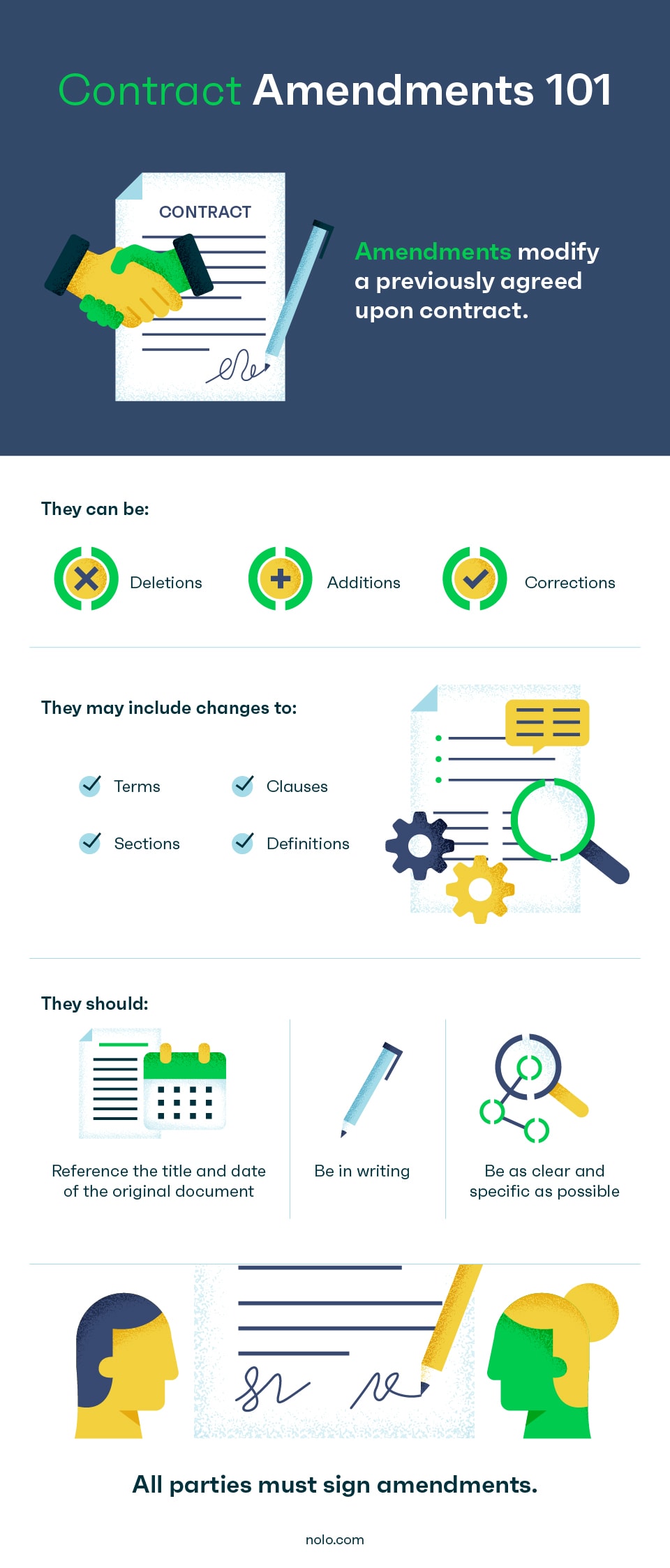
An amendment is a mutually agreed change — whether an addition or deletion or both — to the original contract. It includes the terms, clauses, sections, and definitions to be changed in the original contract. It also references the title and date of the original contract. All parties must sign amendments.

Contract Amendments 101 Infographic

How to Amend a Contract Before Signing

Amendments to a contract before signing are not technically amendments, given that the parties have not finalized the agreement. When a party provides its standard contract to a counterparty, that contract is often relatively — or substantially — biased toward the drafting party. Therefore, to make an agreement more equitable, parties receiving the initial draft of a contract need to create a list of modifications and negotiate those requests with their counterparties.

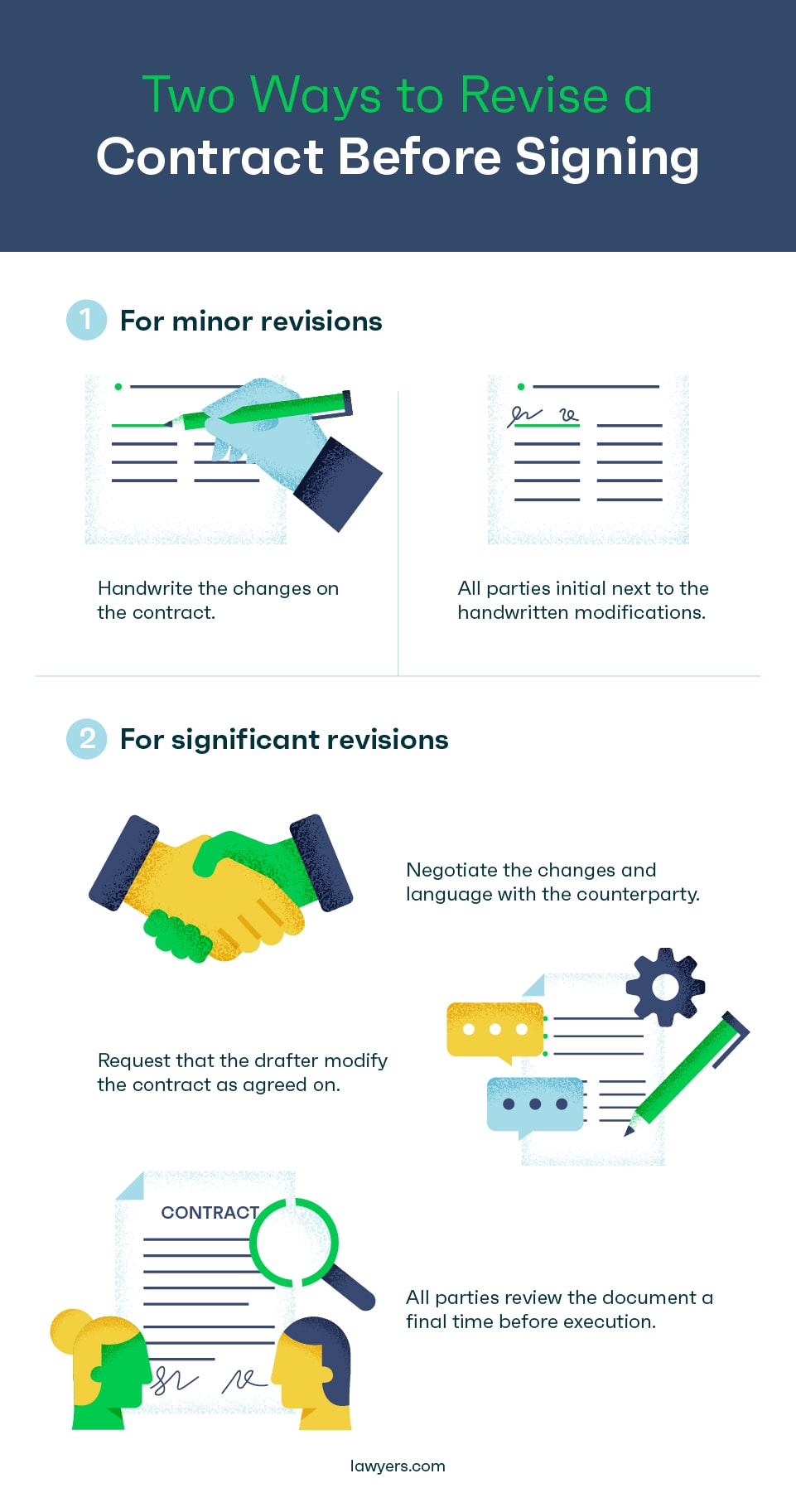
Parties have two options for making changes before execution. First, if a party wants to make minor modifications to a contract just before signing, the party can handwrite the changes and sign their initials next to each change. The party making the amendments should inform the counterparty and make sure the counterparty also initials next to the handwritten modifications.

If a party wishes to make more significant modifications, they should first negotiate the changes and language with their counterparty. Once the parties agree upon changes, the party seeking the alterations can request that the drafter of the document modify the previous version to include the agreed-upon modifications. All parties should review the document one final time before execution to ensure that the changes are correct and that all the previously agreed upon language from the prior version is intact. Microsoft Word's "Compare Documents" is a helpful tool that allows users to compare two versions by showing the changes to the original document. Kira System's powerful contract analysis tools also make it easy to compare contracts.

Two Ways to Revise a Contract Before Signing Infographic

How to Create an Amendment to a Contract After Signing

Can a contract be amended once signed? The short answer is yes, provided the counterparty agrees to the amendment. Whenever a relationship between two parties begins to deviate from the outlines provided in the initial contract, or when outside forces — such as regulatory changes or component scarcities — significantly impact the contract, then it becomes time to amend the original agreement to more accurately reflect the new reality. When creating a contract amendment, the chief aim is to be as clear and specific as possible to avoid potential misunderstanding and conflict down the road.

First, look at the existing contract. Typically, a clause exists that describes how the parties may amend the contract. Usually, the clause looks something like this:

This Agreement may be amended, supplemented, or modified only by a written instrument duly executed by both Parties.

Sometimes, a contract may require additional approvals, such as from a party's Board of Directors. Determine precisely what the contract requires before requesting the amendment. Most contracts state that future amendments must be in writing, but it's always a good idea to put changes in writing even if the applicable contract doesn't mandate it. By placing the contract modifications in writing, a party helps prevent future disputes about the nature or wording of the amendments.

Next, draft the necessary changes. As suggested above for changes before execution, a party may informally make changes to the contract by redlining and striking through provisions. The party amending the contract can cross out the rejected language and handwrite the new clause. Then, each party must initial and date beside each alteration to show their approval to the changes.

How to Amend a Contract Infographic

Another option — one which is more formal and generally preferred in the legal world — is to create a new document. In the document, clearly define which sections are to be modified, which portions are to be struck, which definitions are to be updated, and which clauses are to be added to the original contract.

The drafter of the amendment should title and date this document, preferably using the current date, the title of the original agreement, and the date of the original agreement (for example, "11 June 2020 Amendment to Master Services Agreement, dated 7 May 2020"). List the party names and roles. Next, include which clause or clauses are to be altered by referencing the paragraph, section, or subsection. For example, "This amendment modifies 'Section III, subsection B, paragraph i, subparagraph c, from the original agreement, dated 7 May 2020."

When creating a separate document, the following choices exist for describing the altered language.

  • Strikethroughs and redlines

The first option is that the drafter of the amendment can modify certain parts of a section by striking out deleted sections and underlining added sections. For example:

The parties agree to amend the Agreement dated 7 May 2020 by the following deletions (indicated by strikethroughs) and additions (indicated in italics):

11(a). Warranty claims. To make a warranty claim, the Buyer must notify the Seller in writing within 24 hours five business days of discovery of a defect.

  • Replacement of the entire clause

Alternatively, if the entire clause or section must be replaced, the party can state that an entire clause has been substituted. Sample language would look like this:

Section 7 (c) of the Agreement dated 7 May 2020 is replaced in its entirety with the following:

7(c). Quantity. Seller shall deliver Products to Buyer FOB (Incoterms 2010).

  • Describing the amendment

Finally, the drafter of the amendment can describe what is being added or deleted from the original agreement. For example, if a party wants to replace a sentence from the original contract, the party can write:

This amendment strikes Section IV, subsection B, paragraph iii, subparagraph e, which reads: "The Goods to be purchased under this agreement are furnished as is, with all faults and without warranty of any kind, express or implied, including any warranty of merchantability or fitness for any particular purpose" and replaces it with, "Seller warrants that the Goods will be free from defects in materials and workmanship (the "Warranty") for a period of six (6) months (the "Warranty Period"). Seller disclaims all other warranties, express or implied, including any warranty of merchantability or fitness for any particular purpose."

If the amendments to the contract are extensive, attorneys may find it easier, and perhaps necessary, to rewrite the contract entirely to replace the older version.

For all types of amendments, add that only the referenced section(s) will be replaced and that everything else in the original contract remains as it was. For instance, the drafting party can write, "All other terms and conditions not changed by this Amendment or prior Amendments remain in full force." Ensure that all parties sign and date the amendment. The parties can use witnesses or notarize the amendment, if needed. Provide copies to all parties once signed.

Difference Between Addendums and Amendments

Amendments are distinct from addendums, although sometimes people interchange these terms. While an amendment changes an existing contract, an addendum is a document added to an existing agreement, possibly adding terms or requirements previously left out of the initial contract.

If the terms of an addendum may potentially conflict with the terms of the original agreement, then the parties should also create an amendment regarding precedence that states which terms will prevail. For example, write:

In the event of a discrepancy between the addendum labeled "Exhibit C" and the original agreement dated 7 May 2020, the terms of Exhibit C will take precedence.

Conclusion

Just as humans constantly face change, so, too, do contractual agreements. Failure to recognize the consequences of relevant changes can lead to future confusion, misunderstandings, or lost value. By crafting clear, simple amendments to contracts, parties can help protect their interests, clarify the business relationship, and prevent future disputes.

Learn how to tackle Due Diligence projects more efficiently and free up your (and your associates') time more effectively!

Read the whitepaper

~A.

Thursday, May 30, 2024

Everest Base Camp is a DUMP!

oh boy, Joey…you were there in the day….

Friday, May 24, 2024

Maui….stolen.

Huh? This was in the public presentation extolling the virtues of Fascist development programs in Hawaii… last week!…

like AI took over Mother Nature.

It won't work in the long run….but it will exterminate a lot along the way.

Friday, May 03, 2024

Wednesday, April 17, 2024

Saturday, April 13, 2024

Sleep Tight...not

Pesticides are an enormous group of chemicals designed to kill unwanted insects (insecticides), weeds (herbicides), rodents (rodenticides), and fungi (fungicides). Many pesticides endanger human health or damage ecosystems, creating risk for companies that buy or produce food and other crops.

The vast majority of Genetically Modified Organisms (GMOs) grown in the U.S. are engineered to produce their own pesticides, or survive direct application of pesticides. For example, Monsanto's Roundup Ready crops are engineered to survive direct application of glyphosate (the primary ingredient in Roundup). Glyphosate is the world's most heavily used herbicide, and in 2015 it was classified as a probable human carcinogen by the world's leading cancer authority.

To learn more about glyphosate, read our report: Roundup Revealed: Glyphosate in our Food System.

Genetic Engineering

As investor advocates, we are concerned that many companies are exposed to material financial risk from the economic, environmental, and public health issues associated with genetic engineering in the food system.

About 90% of corn, soybeans, and cotton in the U.S. is genetically engineered to be herbicide-resistant. Independent researchers have documented the increasing environmental impacts and negligible benefits of commercially grown GMOs and the significant and growing consumer preference to avoid them.
In the wake of the defeat of Washington state's ballot measure to require GMO labeling, As You Sow filed resolutions asking the top corporate donors to the opposition of the California GMO labeling ballot initiative to refrain from using corporate funds to influence political elections. Investors noted that many of the companies that contributed to defeat California's Prop 37 and other GMO-labeling measures experienced significant consumer backlash and were the subject of consumer boycotts. As You Sow filed resolutions with E.l DuPont de Nemours and Dow Chemical Company, who combined to spend over $11.2 million to defeat the California and Washington GMO labeling initiatives. These resolutions were withdrawn after each company increased disclosure of political lobbying practices and policies.

From 2013 to 2015, As You Sow filed a shareholder resolution with Abbott Laboratories requesting that the company introduce non-GMO Similac infant formula. Shortly after the 2015 annual meeting, Abbott introduced the first non-GMO Similac products; in the years since, it has become a large and very successful product line.

In 2014, Whole Foods' commitment to require mandatory GMO labeling for products sold in its stores marked a second victory in As You Sow's decade-long engagement with the company.

Read our FAQs about GMOs to learn more.

Glyphosate

Glyphosate is the world's most heavily used herbicide. It is sold in proprietary blends that contain other compounds, such as Monsanto's Roundup. Glyphosate is most frequently used in agriculture to kill weeds in crops that have been genetically engineered to survive glyphosate use (particularly corn, soybeans, and cotton). The herbicide has been classified as a probable human carcinogen by the world's leading cancer authority.

Pre-harvest glyphosate use (also known as "desiccation" or "harvest-aid") is a lesser known use of glyphosate that has begun receiving greater scrutiny, since it may be greatly increasing glyphosate residues on a wide range of crops.
Regulation of glyphosate lacks transparency and is unlikely to sufficiently protect farmworkers, communities, and consumers from harm. As You Sow is engaging companies across the food, agriculture, and restaurant industries to investigate the risks posed by glyphosate.

Read our report: Roundup Revealed to learn more about glyphosate in the food system.

Dicamba

This herbicide is also the center of a national controversy: it drifts far from application sites onto nearby farms, destroying crops that are not engineered to resist it. Monsanto's Roundup Ready Xtend crops are engineered to resist both glyphosate and dicamba; the company expects that farmers will quickly adopt Xtend and that dicamba will become the world's second largest selling herbicide, behind glyphosate. Widespread reliance on herbicide-dependent crops poses massive risks for biodiversity and soil health, and the security of the entire food system.

Chlorpyrifos

This highly toxic insecticide causes learning disabilities and developmental delays in children, and it is widely used on fruit and vegetable crops. People are exposed to chlorpyrifos through residues on food, drinking water contamination, and toxic spray drift from pesticide applications. In March 2017, U.S. EPA chief Scott Pruitt reversed an Obama-era recommendation to ban the chemical.

Food Companies Trapped on Pesticide Treadmill

U.S. Food Companies Trapped on Pesticide Treadmill, New Scorecard Finds

Global Food companies fail to address pesticide risk, reliance, and growing harm

FOR IMMEDIATE RELEASE

MEDIA CONTACT: Sophia Wilson, swilson@asyousow.org, (341) 600-1832

BERKELEY, CALIFORNIA—NOV. 8, 2023—As You Sow released its third "Pesticides in the Pantry " report today, ranking 17 major food manufacturing companies on their progress in pesticide reduction and the adoption of regenerative agricultural practices. 

Compared to As You Sow's 2021 report, the overall average scores dropped from a "D" to an "F" due to continued heavy pesticide use in major food supply chains and a lack of progress in reducing harm to farmworkers, fenceline communities, ecosystems, pollinators, farm resiliency, and climate health. 

While overall and individual scores were low, General Mills achieved the highest score of "C." ADM's overall grade jumped from an "F" in 2021 to a "C-" in 2023 and received the highest score for pesticide risk reduction strategies. ADM was also the only company that has effectively banned glyphosate as a pre-harvest desiccant across its supply chain. General Mills and Conagra adopted, maintained, or improved their pesticide reduction practices, with Conagra also significantly improving its pesticide risk-reduction strategies from 2021 to 2023. Kellanova, previously Kellogg, lost ground this year as it eliminated its goal of phasing out glyphosate as a pre-harvest desiccant by 2025.

"Low company scores highlight the industry's stagnation in making the systemic changes necessary to increase the resilience of our food supply chain and reduce the destructiveness of the current chemical-based agribusiness system," said Andrew Behar, CEO of As You Sow. "Shareholders, policymakers, communities, workers, and advocates want cleaner, healthier foods. As the documentary Common Ground points out, the time to transition to regenerative agriculture is now or never."

The report grades 17 companies under seven pillars, including Pesticide Reduction Policies, Regenerative Agriculture, and Farmworker Health and Safety. The report relies on a grading curve to determine companies' letter grades, as no companies received more than ten out of 27 possible points.  

"Current farming practices that depend on monocrops and high pesticide use deplete the soil, allow dangerous levels of topsoil loss, harm people and ecosystems, and put food production at increasing risk under current climate-altered, high-risk weather patterns," said Cailin Dendas, lead author and As You Sow's environmental health coordinator. "These practices also continue to harm farmworkers. In the U.S., 83% of farmworkers are Hispanic, and many are likely to experience pesticide poisoning. This creates reputational risk associated with environmental racism as well as litigation risk to food companies."

"These companies are at a crossroads that will determine the health of our land, our communities, and their own viability as an industry," said Dendas. "All companies need to monitor pesticide use in their supply chain strictly. But they can't stop there. Food companies must ensure that regenerative agriculture policies are adopted to protect farmworkers and nearby communities and reduce harm to soil, waters, ecosystems, and climate." 

# # #


As You Sow is the nation's leading shareholder representative, with a 30-year track record promoting environmental and social corporate responsibility and advancing values-aligned investing. Its issue areas include climate change, ocean plastics, pesticides, racial justice, workplace diversity, and executive compensation. Click here for As You Sow's shareholder resolution tracker.

Monday, April 08, 2024

7 Tips For Navigating ADHD In Retirement - ADHD Online


7 Tips For Navigating ADHD in Retirement

By Cathy Cassata

The average age of retirement in the U.S. for men is 64 and for women is 62. And researchers estimate that 2 to 4 percent of adults older than 60 have symptoms consistent with having ADHD.

If you're living with ADHD in your retirement years, navigating this life change can be both exciting and challenging. Ari Tuckman, PsyD, psychologist and former member of the board of directors of the Children and Adults with Attention-Deficit/Hyperactivity Disorder, or CHADD, says retirement for those with ADHD can be a double-edged sword.

"On the one hand, it's wonderful to have a lot more control over your schedule. (But) because it's so open and unstructured, it means you have to manage your schedule much more actively," he says. "For folks who have ADHD, that could be more of a struggle."

Kathleen Nadeau, PhD, a psychologist and author, says in all her research on older adults with ADHD, she found the most common complaint to be that people can't seem to accomplish anything — despite having more time. Common statements she says she has heard include:

  • "I don't know where the time goes."
  • "It feels like I'm busy all day, but I'm just not getting anything done."
  • "I'm not doing the things I dreamed I'd do in retirement."
  • "I'm just sort of fiddling around."

While similar feelings are common among retired people without ADHD, the inability to develop structure throughout the day seems to be more pronounced in those with ADHD, says Nadeau.

"Once you lose structure of having family in the house or a job to go to, this can be difficult for any older adult," she says. "(For) adults with ADHD, the normal challenges are magnified significantly by the ADHD."

Both experts share tips to help navigate retirement with ADHD:

1. Be the master of your schedule

Tuckman says a good place to start is to determine what you want to do with your time, what's important to you and what you find interesting. Then carve out time for the mundane things that need to get done — like laundry, cleaning and grocery shopping.

"Accept that there will be a love and hate with (structure), so find the best balance that you can," he says. "Find activities that are meaningful and interesting. And if you get bored, switch it up."

2. Move into a retirement community

For many of her clients, Nadeau says, living in a retirement community helped them flourish during their retirement years.

"Depends on the interests, personality, values and finances of the person," she says. "But I think in many ways, a retirement community in which there are organized activities that you can just show up for with built-in socializing is ideal for people with ADHD."

3. Prioritize health maintenance activities

Taking medication as prescribed, getting refills when needed and complying with healthcare appointments takes planning and organization that Tuckman says becomes crucial during retirement.

He points out that people with ADHD who are not treated for symptoms and those have hyperactive-impulsive symptoms can have negative health outcomes, and even shorter life spans when health maintenance activities are not being met.

4. Nourish your mind and body

Nadeau says research points to the importance of engaging in brain-healthy daily habits as people age. To help older adults with ADHD nourish the brain, she coined the acronym MENDSS.

M: Meditation or other de-stressing activities like yoga and deep breathing can help combat stress, which has a negative impact on cognitive function.

E: Exercise, particularly aerobic, can help with brain function. "What I recommend to seniors is brisk walking as fast as you're able to for about 20 minutes every day," Nadeau says.

N: Nutrition. "It's very damaging to the brain to eat a poor diet that includes alcohol, high glycemic foods, sugars, and starches," says Nadeau. She suggests a healthy diet of lean meat and fruits and vegetables. "One of the challenges as we get older and live alone is we don't feel like cooking, so now there are great options for pre-delivered meals or you can go to Trader Joe's and buy a pre-packaged meal — whether frozen or fresh."

D: Daily interaction with others. Because loneliness can have a negative impact on physical and mental health, including cognitive decline, Nadeau suggests making it a priority to pick a friend or family member to text, email, video chat or call each day.

S: Sleep. "We now understand that cerebrospinal fluid flows in and out of our brains during the night, but only if we get deep restorative sleep," Nadeau says. "And that process is cleansing our brain of the plaque, among other things, that can lead to dementia."

S: Societal connection. "I think it's so important for all of us to feel like there is some purpose in our lives," Nadeau says. "One of the most powerful ways to feel better is to help someone else." She says volunteering for a cause you care about can bring that connection and purpose.

5. Join a support group

Finding a group of people who can relate to what you're going through can help you cope with retirement.

"Support groups have always been beneficial in terms of social contact and normalizing that other people have similar struggles," Tuckman says.

While ADHD support groups with older adults may be harder to find, creating your own is an option.

During the pandemic, Nadeau offered to lead a free online support group for older adults with ADHD. After holding the group for 15 months, she suggested that the nine women participating continue leading their own sessions. They took the reins and continue to meet virtually a year and a half later, she says.

"One of the most therapeutic processes that females with ADHD can go through is to find their tribe," Nadeau says. "Because older women with ADHD have felt all their lives that they don't fit in, have to hide their troubles, and feel judged for being late or disorganized or forgettable — all the things people tend to be when they have ADHD — it's such a relief to be in a group with other females who are the same way and don't judge, but provide emotional support.

6. Learn something new

Keeping the brain engaged and stimulated with new activities is something Nadeau encourages her clients to practice.

"(One) of the reasons why people start to rapidly deteriorate when they retire is that it's hard to recreate that same level of engagement — where you're problem-solving and interacting," she says.

Seek out in-person and online classes and lectures that are often given for free or for a minimal fee at senior centers, libraries, and colleges and universities. An example of a great resource: Northwestern University's Osher Lifelong Learning Institute.

7. Advocate for your ADHD

One of the challenges for people with ADHD in older life is that it's easy for themselves, family members or providers to assume that ADHD symptoms are those of dementia, Tuckman says.

"But if you have ADHD and are 80 and forgetful, you were forgetful when you were 20," he says. "It hasn't changed. It's an important difference for someone who has always been forgetful, versus someone who has become forgetful in the last five to 10 years."

Informing providers about your ADHD can help ensure you're cared for during retirement years.

"The challenge is that the providers who see older adults probably don't know a lot about ADHD," Tuckman says. "And those who know a lot about ADHD probably haven't seen a lot of older adults because they haven't sought services."

The bottom line is this: As you live out your retirement years, finding ways to care for your ADHD and fill your time with meaning and purpose can make this stage of life enjoyable.