Sunday, November 29, 2020

Five Faces Behind the Incomparably Seductive Vintage and Antique Jewelry Found on 1stDibs - 1stDibs Introspective

Five Faces Behind the Incomparably Seductive Vintage and Antique Jewelry Found on 1stDibs - 1stDibs Introspective

Five Faces Behind the Incomparably Seductive Vintage and Antique Jewelry Found on 1stDibs

When you are sparkle-scrolling through 1stDibs, browsing for just the right vintage jewel, do you ever wonder about the places or people offering these treasures? Do you envision an old-world type of establishment — a shop handed down through generations? Well, often you'd be correct. Lots of vintage-jewelry firms are family businesses. One of the oldest such enterprises on 1stDibs, Joseph Saidian and Sons, can trace its history back to 1850.

But not all vintage dealers on 1stDibs are generational businesses. Some sellers were drawn to the field by their individual interests. Running with Scissors author Augusten Burroughs, for instance, channeled his passion for jewelry into a part-time profession last year with his exclusive-to-1stDibs shop, The Blue Paisley Fox. 

Read on to find out more about five vintage-jewelry dealers, their most exceptional pieces and their holiday gift ideas. 

Clockwise from top left: Van Cleef & Arpels pearl and diamond lion necklace, earrings and ring set, 1970s; Peter Skubic gold geometric ring, 1978; Cazzaniga ruby, sapphire, diamond, enamel and gold sautoir, ca. 1970; Black Starr and Frost pearl and diamond ring, ca. 1905; Buccellati diamond and gold bangle bracelet, 1960


Eleuteri

Established: 1897 • Dealer: Wagner Eleuteri

Wagner Eleuteri
Wagner Eleuteri learned the jewelry business from his father at the family's flagship store in Rome. Photo courtesy of Eleuteri

What attracted you to jewelry?

I was born into a jewelry dynasty, if you will. My maternal grandfather was the jeweler Erminio Rizzoli, known as Herriz, whose Venice boutique housed a magnificent collection of antique jewels and important gemstones. My father Carlo's firm [Eleuteri] is recognized around the world as the go-to source for high-end vintage jewelry. Growing up, I spent a lot of time watching and learning from him in his flagship store in Rome and realized early on that I had an innate love for vintage jewels. 

How do you describe your inventory?

We've always described our inventory as a Wunderkammer, or cabinet of curiosities, filled with precious treasures! The only criterion that applies to every single piece is that we must be drawn to it. That said, we specialize in twentieth-century Art Deco jewelry and exceptional Bulgari items from the nineteen forties through the nineteen eighties. 

What is one of the most impressive jewels in your collection now?

We have an exquisite Bulgari necklace composed of fourteen oval and cushion-shaped cornflower-blue Burmese sapphires, pigeon's-blood-red cabochon rubies and circular-cut diamonds. It is a marvelous example of iconic Bulgari design from the La Dolce Vita era, which many consider to have been Bulgari's heyday. It was the nineteen sixties, and celebrities were flocking to Rome because of the famous film studio Cinecittà. They all fell in love with Bulgari, especially the bold color combinations and voluminous designs that characterized its jewels.    


The Blue Paisley Fox

Established: 2019 • Dealer: Augusten Burroughs

Augusten Burroughs
Augusten Burroughs has a successful career as an author, but his longtime love of jewelry led him to launch The Blue Paisley Fox last year. Photo courtesy of The Blue Paisley Fox

What attracted you to jewelry?

I have collected jewelry since childhood. My grandparents were jade collectors, and it became one of my favorite gems. They were in love with the Gump's store in San Francisco. Whatever horrible thing happened, their idea of a resolution was to get yourself something from Gump's. I internalized that message of gifting, and it was almost always jewelry. All the jewelry I accumulated inspired me to launch the store. I thought, "Go retail, or be buried with it."

How do you describe your inventory?

I like things that have a soul. They have something going on where you can feel the goldsmith's fingertips right through the piece. I like gems that change. Diamonds have one trick: They sparkle. That's cute, but chrysoberyl is dynamic. It is described as milk and honey. There is a cream- or milk-colored eye that slides through the honey.  

What is one of the impressive jewels in your collection now?

I have this exceedingly rare and ravishing mid-century suite by Mario Buccellati. It displays the kind of craftsmanship that couldn't be re-created today. 

Left: Citrine ring, ca. 1965. Right: Elmer Seidler ring, ca. 1940

I also have an extraordinary nineteenth-century Kashmir sapphire ring. The gem never goes to sleep. The color is always there. Kashmir sapphires were found by accident in the Himalayan mountains at an elevation twenty-three hundred feet higher than any other sapphire had ever been found before.


Stephen Russell

Dealer: Russell Zelenetz •  Established: 1984

Russell Zelenetz, left, launched Stephen Russell with his friend Stephen Feuerman after some jewelry classes he took at FIT convinced him not to go to dental school. Photo courtesy of Stephen Russell

What attracted you to jewelry?

I actually had plans to be a dentist. But I had some time before attending dental school, so I began taking jewelry classes at the Fashion Institute of Technology. There were some amazing professors in the department, including Samuel Beizer, who worked with Elsa Peretti on developing her mesh collection, and Tiffany & Co. designer Donald Claflin, who made so many iconic jewels. I fell in love with jewelry immediately and never went to dental school. After a few years working in the jewelry business, I and my friend Stephen Feuerman, who had been working in the trade in London, launched Stephen Russell. 

How do you describe your inventory?

Our collection spans four centuries, but we are known for our Art Deco jewelry. We like it because the designs are clean, and that makes them timeless. You don't need to think about it too much to understand it. Art Deco is just there for you.  

We also have several jewels that we make under our own label, such as platinum and collet-set diamond chains of various lengths. It was a move we made out of necessity, because there is a limited supply of proper period jewelry. 

What is one of the most impressive jewels in your collection now? 

Wow! That's like asking who's your favorite kid. We have quite a few things that are special, but the Tiffany & Co. ring set with a 7.31-carat Asscher-cut diamond that comes in the original box is exceptional. The gem could have been cut by the Asscher brothers themselves, and it comes from the period around 1915 when they invented it. Looking into the gem is like staring into an infinity mirror.


Mahnaz Collection

Dealer: Mahnaz Ispahani •  Year established: 2012

Mahnaz Ispahani
Mahnaz Ispahani specializes in jewelry from the 1960s and '70s. As a scholar, she brings her strong research skills to the study of pieces in her inventory. Photo by Adam Bartos

What attracted you to jewelry?

Jewelry always stood out to me as an ancient and central artifact of all human cultures. I have lived, traveled and worked across continents, finding small, portable, sculptural objects along the way — in Russia, the former Yugoslavia, Brazil, Guatemala, Iran, India, Pakistan, Sri Lanka, Nigeria, Senegal, Mali. I have collected jewelry for the last fourteen years in the American Southwest as well, because of my lifelong appreciation of turquoise, which comes from my Persian heritage, and for the special peace I find in the beauty of the ancient, monumental landscapes of the region.

My family heritage includes the art, design and architecture of the Mughal, Persian and Western modernist worlds. My childhood home in Pakistan was designed by an Italian modernist at a time when Giò Ponti was working in the country. My mother herself was a refined modernist and gave me, first, a single-stone tiger's-eye ring encased in gold when I was a preteen and, then, an Andrew Grima–designed Omega watch in the early nineteen seventies. I later collected antique Mughal-era kundan and meenakari jewelry. Finally, I am also a scholar and hold a Ph.D. in international relations and war studies, so I bring strong research skills to the study of the jewelry in our collection. We not only sell but also seek to educate the broader field of jewelry by formally exhibiting the jewelry and producing original scholarship in our accompanying catalogues. 

How do you describe your inventory? 

We carry jewelry from the mid-twentieth century onwards, specializing in the nineteen sixties and nineteen seventies, made by forward-looking independent jewelers whose work has stood the test of time. We also carry sophisticated, wearable design classics by heritage brands, particularly Hemmerle, and works by a few contemporary jewelers who share our values.

Left: Fred Paris diamond and gold Aries zodiac pendant, 1970s. Right: Cartier white and yellow gold Maltese cross pendant, 1970s

What is one of the most impressive jewels in your collection now? 

The gold China Sea earrings with a fitted brass stand by the late British artist-jeweler Wendy Ramshaw are striking and collectible. The earrings move gently on the ear, look stunning when worn and focus your attention on the circle and the square, Ramshaw's core obsessions. She was a true innovator and one of the first jewelers to experiment with the concept of jewelry as sculpture. 


Joseph Saidian and Sons

Dealer: Ariel Saidian • Established: 1850

Ariel Saidian
Ariel Saidian of Joseph Saidian and Sons has family roots in the jewelry business going back to 1850. Photo courtesy of Joseph Saidian and Sons

What attracted you to jewelry?

My grandfather, father and uncle were all in the business, and the company my grandfather established in Iran has roots going back to 1850. After brief forays in London, Israel and Geneva, the family moved the business to New York City in 1988. Jewelry is in my blood. A few of the many treasures that have passed through my family's hands include the Westminster tiara and the Cartier Mughal emerald brooch, which is now part of the permanent collection of the Metropolitan Museum of Art. We produced a book with Rizzoli a couple of years ago, The History of Jewelry, that shows highlights of what we have handled, what we have and what we love. 

How do you describe your inventory?

Our specialty is colorful twentieth-century signed jewelry. We specialize in Van Cleef & Arpels from all periods. My father once said, "Van Cleef & Arpels is the most important jewelry brand of all time," and of course, I agree. Right now we have an amazing Zipper necklace. But we also have a lot of other areas of unexpected expertise, like Mughal jewelry and objects of virtue. The work put into all these jewels is astonishing. It's not comparable to anything made today. 

Left: Pair of Indian bangles, ca. 1870. Right: Emerald and diamond chandelier earrings, 2019

What is one of the most impressive jewels in your collection now.

We have this incredible David Webb jade, diamond and enamel necklace. It screams at the top of its lungs, "I was made by David Webb." 


Holiday Gifting Picks

"This whimsical and beautiful signet ring is by the Italian jeweler Faraone, master goldsmiths since the sixteenth century. It is a bold yellow gold band mounted with an almost luminescent aquamarine that is engraved with a tiny butterfly and surrounded by brilliant diamonds. In my opinion, it would be the perfect symbol of love to give someone, just because." —Wagner Eleuteri

"We have a very charming and endearing Victorian pearl and diamond heart locket. The pearls are natural, found in the ocean before the invention of cultured pearls. The diamonds are beneath the pearls in the crevices. And it is a locket, so you can put a picture of a loved one inside." —Russell Zelenetz

"This antique Indian enamel bangle depicts makaras, sea creatures in Hindu mythology. Makaras are guardians of the gateways and thresholds. This mid-nineteenth-century jewel is in the style that inspired Cartier, Van Cleef & Arpels and David Webb to make bracelets in the same mode." —Ariel Saidian


~A.

Agenda - Back to Work: Functional Furniture for Home and Shop

https://web.cvent.com/event/e315d77c-c4df-4db6-ab42-5712a47870bb/websitePage:645d57e4-75eb-4769-b2c0-f201a0bfc6ce


~A.

Fixed vs. Growth: The Two Basic Mindsets That Shape Our Lives – Brain Pickings

Fixed vs. Growth: The Two Basic Mindsets That Shape Our Lives – Brain Pickings
Change is the Order of the Universe, I say.......
https://www.brainpickings.org/2014/01/29/carol-dweck-mindset/

Fixed vs. Growth: The Two Basic Mindsets That Shape Our Lives

How to fine-tune the internal monologue that scores every aspect of our lives, from leadership to love.

"If you imagine less, less will be what you undoubtedly deserve," Debbie Millman counseled in one of the best commencement speeches ever given, urging: "Do what you love, and don't stop until you get what you love. Work as hard as you can, imagine immensities…" Far from Pollyanna platitude, this advice actually reflects what modern psychology knows about how belief systems about our own abilities and potential fuel our behavior and predict our success. Much of that understanding stems from the work of Stanford psychologist Carol Dweck, synthesized in her remarkably insightful Mindset: The New Psychology of Success (public library) — an inquiry into the power of our beliefs, both conscious and unconscious, and how changing even the simplest of them can have profound impact on nearly every aspect of our lives.

One of the most basic beliefs we carry about ourselves, Dweck found in her research, has to do with how we view and inhabit what we consider to be our personality. A "fixed mindset" assumes that our character, intelligence, and creative ability are static givens which we can't change in any meaningful way, and success is the affirmation of that inherent intelligence, an assessment of how those givens measure up against an equally fixed standard; striving for success and avoiding failure at all costs become a way of maintaining the sense of being smart or skilled. A "growth mindset," on the other hand, thrives on challenge and sees failure not as evidence of unintelligence but as a heartening springboard for growth and for stretching our existing abilities. Out of these two mindsets, which we manifest from a very early age, springs a great deal of our behavior, our relationship with success and failure in both professional and personal contexts, and ultimately our capacity for happiness.

The consequences of believing that intelligence and personality can be developed rather than being immutably engrained traits, Dweck found in her two decades of research with both children and adults, are remarkable. She writes:

For twenty years, my research has shown that the view you adopt for yourself profoundly affects the way you lead your life. It can determine whether you become the person you want to be and whether you accomplish the things you value. How does this happen? How can a simple belief have the power to transform your psychology and, as a result, your life?

Believing that your qualities are carved in stone — the fixed mindset — creates an urgency to prove yourself over and over. If you have only a certain amount of intelligence, a certain personality, and a certain moral character — well, then you'd better prove that you have a healthy dose of them. It simply wouldn't do to look or feel deficient in these most basic characteristics.

[…]

I've seen so many people with this one consuming goal of proving themselves — in the classroom, in their careers, and in their relationships. Every situation calls for a confirmation of their intelligence, personality, or character. Every situation is evaluated: Will I succeed or fail? Will I look smart or dumb? Will I be accepted or rejected? Will I feel like a winner or a loser? . . .

There's another mindset in which these traits are not simply a hand you're dealt and have to live with, always trying to convince yourself and others that you have a royal flush when you're secretly worried it's a pair of tens. In this mindset, the hand you're dealt is just the starting point for development. This growth mindset is based on the belief that your basic qualities are things you can cultivate through your efforts. Although people may differ in every which way — in their initial talents and aptitudes, interests, or temperaments — everyone can change and grow through application and experience.

Do people with this mindset believe that anyone can be anything, that anyone with proper motivation or education can become Einstein or Beethoven? No, but they believe that a person's true potential is unknown (and unknowable); that it's impossible to foresee what can be accomplished with years of passion, toil, and training.

At the heart of what makes the "growth mindset" so winsome, Dweck found, is that it creates a passion for learning rather than a hunger for approval. Its hallmark is the conviction that human qualities like intelligence and creativity, and even relational capacities like love and friendship, can be cultivated through effort and deliberate practice. Not only are people with this mindset not discouraged by failure, but they don't actually see themselves as failing in those situations — they see themselves as learning. Dweck writes:

Why waste time proving over and over how great you are, when you could be getting better? Why hide deficiencies instead of overcoming them? Why look for friends or partners who will just shore up your self-esteem instead of ones who will also challenge you to grow? And why seek out the tried and true, instead of experiences that will stretch you? The passion for stretching yourself and sticking to it, even (or especially) when it's not going well, is the hallmark of the growth mindset. This is the mindset that allows people to thrive during some of the most challenging times in their lives.

This idea, of course, isn't new — if anything, it's the fodder of self-help books and vacant "You can do anything!" platitudes. What makes Dweck's work different, however, is that it is rooted in rigorous research on how the mind — especially the developing mind — works, identifying not only the core drivers of those mindsets but also how they can be reprogrammed.

Dweck and her team found that people with the fixed mindset see risk and effort as potential giveaways of their inadequacies, revealing that they come up short in some way. But the relationship between mindset and effort is a two-way street:

It's not just that some people happen to recognize the value of challenging themselves and the importance of effort. Our research has shown that this comes directly from the growth mindset. When we teach people the growth mindset, with its focus on development, these ideas about challenge and effort follow. . . .

As you begin to understand the fixed and growth mindsets, you will see exactly how one thing leads to another—how a belief that your qualities are carved in stone leads to a host of thoughts and actions, and how a belief that your qualities can be cultivated leads to a host of different thoughts and actions, taking you down an entirely different road.

[…]

The mindsets change what people strive for and what they see as success. . . they change the definition, significance, and impact of failure. . . they change the deepest meaning of effort.

Dweck cites a poll of 143 creativity researchers, who concurred that the number-one trait underpinning creative achievement is precisely the kind of resilience and fail-forward perseverance attributed to the growth mindset. She writes:

When you enter a mindset, you enter a new world. In one world — the world of fixed traits — success is about proving you're smart or talented. Validating yourself. In the other — the world of changing qualities — it's about stretching yourself to learn something new. Developing yourself.

In one world, failure is about having a setback. Getting a bad grade. Losing a tournament. Getting fired. Getting rejected. It means you're not smart or talented. In the other world, failure is about not growing. Not reaching for the things you value. It means you're not fulfilling your potential.

In one world, effort is a bad thing. It, like failure, means you're not smart or talented. If you were, you wouldn't need effort. In the other world, effort is what makes you smart or talented.

But her most remarkable research, which has informed present theories of why presence is more important than praise in teaching children to cultivate a healthy relationship with achievement, explores how these mindsets are born — they form, it turns out, very early in life. In one seminal study, Dweck and her colleagues offered four-year-olds a choice: They could either redo an easy jigsaw puzzle, or try a harder one. Even these young children conformed to the characteristics of one of the two mindsets — those with "fixed" mentality stayed on the safe side, choosing the easier puzzles that would affirm their existing ability, articulating to the researchers their belief that smart kids don't make mistakes; those with the "growth" mindset thought it an odd choice to begin with, perplexed why anyone would want to do the same puzzle over and over if they aren't learning anything new. In other words, the fixed-mindset kids wanted to make sure they succeeded in order to seem smart, whereas the growth-mindset ones wanted to stretch themselves, for their definition of success was about becoming smarter.

Dweck quotes one seventh-grade girl, who captured the difference beautifully:

I think intelligence is something you have to work for … it isn't just given to you.… Most kids, if they're not sure of an answer, will not raise their hand to answer the question. But what I usually do is raise my hand, because if I'm wrong, then my mistake will be corrected. Or I will raise my hand and say, 'How would this be solved?' or 'I don't get this. Can you help me?' Just by doing that I'm increasing my intelligence.

Things got even more interesting when Dweck brought people into Columbia's brain-wave lab to study how their brains behaved as they answered difficult questions and received feedback. What she found was that those with a fixed mindset were only interested in hearing feedback that reflected directly on their present ability, but tuned out information that could help them learn and improve. They even showed no interest in hearing the right answer when they had gotten a question wrong, because they had already filed it away in the failure category. Those with a growth mindset, on the other hand, were keenly attentive to information that could help them expand their existing knowledge and skill, regardless of whether they'd gotten the question right or wrong — in other words, their priority was learning, not the binary trap of success and failure.

These findings are especially important in education and how we, as a culture, assess intelligence. In another study of hundreds of students, mostly adolescents, Dweck and her colleagues gave each ten fairly challenging problems from a nonverbal IQ test, then praised the student for his or her performance — most had done pretty well. But they offered two types of praise: Some students were told "Wow, you got [X many] right. That's a really good score. You must be smart at this," while others, "Wow, you got [X many] right. That's a really good score. You must have worked really hard." In other words, some were praised for ability and others for effort. The findings, at this point, are unsurprising yet jarring:

The ability praise pushed students right into the fixed mindset, and they showed all the signs of it, too: When we gave them a choice, they rejected a challenging new task that they could learn from. They didn't want to do anything that could expose their flaws and call into question their talent.

[…]

In contrast, when students were praised for effort, 90 percent of them wanted the challenging new task that they could learn from.

The most interesting part, however, is what happened next: Dweck and her colleagues gave the students a subsequent set of harder problems, on which the students didn't do so well. Suddenly, the ability-praised kids thought they weren't so smart or gifted after all. Dweck puts it poignantly:

If success had meant they were intelligent, then less-than-success meant they were deficient.

But for the effort-praised kids, the difficulty was simply an indication that they had to put in more effort, not a sign of failure or a reflection of their poor intellect. Perhaps most importantly, the two mindsets also impacted the kids' level of enjoyment — everyone enjoyed the first round of easier questions, which most kids got right, but as soon as the questions got more challenging, the ability-praised kids no longer had any fun, while the effort-praised ones not only still enjoyed the problems but even said that the more challenging, the more fun. The latter also had significant improvements in their performance as the problems got harder, while the former kept getting worse and worse, as if discouraged by their own success-or-failure mindset.

It gets better — or worse, depending on how we look at it: The most unsettling finding came after the IQ questions were completed, when the researchers asked the kids to write private letters to their peers relaying the experience, including a space for reporting their scores on the problems. To Dweck's devastation, the most toxic byproduct of the fixed mindset turned out to be dishonesty: Forty percent of the ability-praised kids lied about their scores, inflating them to look more successful. She laments:

In the fixed mindset, imperfections are shameful — especially if you're talented — so they lied them away. What's so alarming is that we took ordinary children and made them into liars, simply by telling them they were smart.

This illustrates the key difference between the two mindsets — for those with a growth one, "personal success is when you work your hardest to become your best," whereas for those with a fixed one, "success is about establishing their superiority, pure and simple. Being that somebody who is worthier than the nobodies." For the latter, setbacks are a sentence and a label. For the former, they're motivating, informative input — a wakeup call.

But one of the most profound applications of this insight has to do not with business or education but with love. Dweck found that people exhibited the same dichotomy of dispositions in their personal relationships: Those with a fixed mindset believed their ideal mate would put them on a pedestal and make them feel perfect, like "the god of a one-person religion," whereas those with the growth mindset preferred a partner who would recognize their faults and lovingly help improve them, someone who would encourage them to learn new things and become a better person. The fixed mindset, it turns out, is at the root of many of our most toxic cultural myths about "true love." Dweck writes:

The growth mindset says all of these things can be developed. All — you, your partner, and the relationship — are capable of growth and change.

In the fixed mindset, the ideal is instant, perfect, and perpetual compatibility. Like it was meant to be. Like riding off into the sunset. Like "they lived happily ever after."

[…]

One problem is that people with the fixed mindset expect everything good to happen automatically. It's not that the partners will work to help each other solve their problems or gain skills. It's that this will magically occur through their love, sort of the way it happened to Sleeping Beauty, whose coma was cured by her prince's kiss, or to Cinderella, whose miserable life was suddenly transformed by her prince.

This also applies to the myth of mind-reading, where the fixed mindset believes that an ideal couple should be able to read each other's minds and finish each other's sentences. She cites a study that invited people to talk about their relationships:

Those with the fixed mindset felt threatened and hostile after talking about even minor discrepancies in how they and their partner saw their relationship. Even a minor discrepancy threatened their belief that they shared all of each other's views.

But most destructive of all relationship myths is the belief that if it requires work, something is terribly wrong and that any discrepancy of opinions or preferences is indicative of character flaws on behalf of one's partner. Dweck offers a reality check:

Just as there are no great achievements without setbacks, there are no great relationships without conflicts and problems along the way.

When people with a fixed mindset talk about their conflicts, they assign blame. Sometimes they blame themselves, but often they blame their partner. And they assign blame to a trait — a character flaw.

But it doesn't end there. When people blame their partner's personality for the problem, they feel anger and disgust toward them.

And it barrels on: Since the problem comes from fixed traits, it can't be solved. So once people with the fixed mindset see flaws in their partners, they become contemptuous of them and dissatisfied with the whole relationship.

Those with the growth mindset, on the other hand, can acknowledge their partners' imperfections, without assigning blame, and still feel that they have a fulfilling relationship. They see conflicts as problems of communication, not of personality or character. This dynamic holds true as much in romantic partnerships as in friendship and even in people's relationships with their parents. Dweck summarizes her findings:

When people embark on a relationship, they encounter a partner who is different from them, and they haven't learned how to deal with the differences. In a good relationship, people develop these skills and, as they do, both partners grow and the relationship deepens. But for this to happen, people need to feel they're on the same side. . . . As an atmosphere of trust developed, they [become] vitally interested in each other's development.

What it all comes down to is that a mindset is an interpretative process that tells us what is going on around us. In the fixed mindset, that process is scored by an internal monologue of constant judging and evaluation, using every piece of information as evidence either for or against such assessments as whether you're a good person, whether your partner is selfish, or whether you are better than the person next to you. In a growth mindset, on the other hand, the internal monologue is not one of judgment but one of voracious appetite for learning, constantly seeking out the kind of input that you can metabolize into learning and constructive action.

In the rest of Mindset: The New Psychology of Success, Dweck goes on to explore how these fundamental mindsets form, what their defining characteristics are in different contexts of life, and how we can rewire our cognitive habits to adopt the much more fruitful and nourishing growth mindset.

Public domain photographs via Flickr Commons


On my list.
~A.

Friday, November 27, 2020

Mauritshuis becomes first gigapixel museum in the world - DutchNews.nl

Mauritshuis becomes first gigapixel museum in the world - DutchNews.nl

Mauritshuis becomes first gigapixel museum in the world

Virtual visitors get the museum to themselves. Photo: Mauritshuis

At 1000 megapixels, Vermeer's Girl with a Pearl Earring shows intimate details that visitors to the Mauritshuis museum in The Hague are not normally allowed close enough to see. Two casual dabs of paint are enough to bring moisture and shine to the corners of her slightly parted lips, and the famous earring itself is surprisingly translucent – more skin-toned than nacreous white.

On Thursday, the Mauritshuis in The Hague, home to 17th century masterpieces by Rembrandt, Vermeer and Jan Steen, became the first ever gigapixel museum in the world, inviting visitors across the globe to get up close and personal with the entire collection via their mobile phone or computer.

The 1000 megapixel images, which are 100 times sharper than a smartphone can achieve, were created in partnership with Spanish art digitisation company Madpixel, who mapped every inch of the former city palace using a robot, the Madpixel ROB.

Multi-media

Via Madpixel's Second Canvas app, visitors can enjoy a virtual 360° tour of the listed building and its world-famous works, supported by texts and an audio commentary. The app includes a zoom option for 36 of the pieces, including Van Haecht's epic Apelles Painting Campaspe – 40+ paintings within a painting – where echoes of the love story between artist and subject in the foreground are revealed when the intricate artworks surrounding them are magnified.

Some of the museum's masterpieces also have an infrared option, allowing the viewer to peer beneath the paint and see original sketches and changes that the artist has made. In Rubens' The Garden of Eden with the Fall of Man, for example, two dogs are visible which were later edited out by the painter.

Several museums were eager to pioneer the technology on this scale, but for Madpixel CEO Iñaki Arredondo, the Mauritshuis had the edge. 'The Mauritshuis offers the perfect combination of the ability to move quickly, tremendous content and openness to innovation,' he said.

'We were the lucky ones,' Mauritshuis director Martine Gosselink told a press conference on Thursday, describing the new app as 'a fantastic invention'.

Hard hit

The app comes at a time when many museums, hit hard by the Covid-19 pandemic, have been forced to find alternative ways to attract visitors. According to a survey by museum association NMV published earlier this month, 260 museums in the Netherlands risk closure within a year. In September, the Dutch government promised a further €482m for the cultural sector, on top of the €300m earmarked in April.

While the technology has an important role to play during the corona crisis, Gosselink sees the new app as a tool for broadening engagement longer term. 'Some people cannot travel, for whatever reason, either they live far away or they are ill,' she said. 'But also for scholars and students … So many people study Dutch 17th century art, and for them it's also very helpful too.'

High resolution

Digitalising an entire museum is a world first, but the high-resolution technology is not new in the sector. In 2016, the Museum Boijmans van Beuningen in Rotterdam teamed up with the Google Cultural Institute to create gigapixel images of major works using Google's 'Art Camera', while this May, the Rijksmuseum published the most detailed photograph ever of Rembrandt's Night Watch.

Sandra Verdel, project manager for digital engagement at the Mauritshuis, sees the Second Canvas app as complementing, rather than replacing, a physical tour of the museum.

'We are not afraid that less people will go to the museum – we are convinced it's the opposite: everyone will want to visit the museum after this tour,' she told DutchNews.nl.

'Nothing beats seeing a Vermeer in real life, when you are standing in front of it. But at the same time, this tour gives you the opportunity to discover our collection in a whole new way.'

Thank you for donating to DutchNews.nl

The DutchNews.nl team would like to thank all the generous readers who have made a donation in recent weeks. Your financial support has helped us to expand our coverage of the coronavirus crisis into the evenings and weekends and make sure you are kept up to date with the latest developments.

DutchNews.nl has been free for 14 years, but without the financial backing of our readers, we would not be able to provide you with fair and accurate news and features about all things Dutch. Your contributions make this possible.

If you have not yet made a donation, but would like to,
you can do so via Ideal, credit card or Paypal.


~A.

Red dawn

Sunspot Cycle 25 could be among the strongest ever | Amateur Radio News

Sunspot Cycle 25 could be among the strongest ever | Amateur Radio News

Sunspot Cycle 25 could be among the strongest ever

The ARRL reports a research paper has concluded that Solar Cycle 25 will stronger than the just-ended Solar Cycle 24 and likely stronger than Solar Cycle 23

The League says:

A research paper, "Overlapping Magnetic Activity Cycles and the Sunspot Number: Forecasting Sunspot Cycle 25 Amplitude," by Scott W. McIntosh, Deputy Director of the National Center for Atmospheric Research in Boulder, et al., has concluded that Solar Cycle 25 could be among the strongest sunspot cycles ever observed, and will almost certainly be stronger than the just-ended Solar Cycle 24 (sunspot number of 116). The scientists say it will also most likely be stronger than Solar Cycle 23 (sunspot number of 180). As the abstract explains:

"The sun exhibits a well-observed modulation in the number of spots on its disk over a period of about 11 years. From the dawn of modern observational astronomy, sunspots have presented a challenge to understanding -- their quasi-periodic variation in number, first noted 175 years ago, stimulates community-wide interest to this day. A large number of techniques are able to explain the temporal landmarks, (geometric) shape, and amplitude of sunspot 'cycles;' however, forecasting these features accurately in advance remains elusive.

"Recent observationally motivated studies have illustrated a relationship between the sun's 22-year magnetic cycle and the production of the sunspot cycle landmarks and patterns, but not the amplitude of the sunspot cycle. Using (discrete) Hilbert transforms on more than 270 years of (monthly) sunspot numbers, we robustly identify the so-called 'termination' events that mark the end of the previous 11-year sunspot cycle, the enhancement/acceleration of the present cycle, and the end of 22-year magnetic activity cycles. Using these, we extract a relationship between the temporal spacing of terminators and the magnitude of sunspot cycles.

"Given this relationship and our prediction of a terminator event in 2020, we deduce that Sunspot Cycle 25 could have a magnitude that rivals the top few since records began. This outcome would be in stark contrast to the community consensus estimate of Sunspot Cycle 25 magnitude."

McIntosh's recorded presentation of the paper is available at this link
Use passcode z7qCn@3G

The research paper is at
https://arxiv.org/pdf/2006.15263.pdf

Source ARRL Letter November 19, 2020
http://www.arrl.org/arrlletter


~A.

Monday, November 23, 2020

Scientists discover how to use time crystals to power superconductors - Big Think

Scientists discover how to use time crystals to power superconductors - Big Think

Scientists discover how to use time crystals to power superconductors

Physicists propose using time crystals to bring about a quantum computing revolution.

Scientists discover how to use time crystals to power superconductors
  • A team of scientists proposes using time crystals to power topological superconductors.
  • The approach could lead to error-free quantum computers.
  • Time crystals appear to break laws of physics.

The concept of time crystals comes from the realm of counterintuitive mind-melding physics ideas that may actually turn out to have real-world applications. Now comes news that a paper proposes merging time crystals with topological superconductors for applications in error-free quantum computing, extremely precise timekeeping and more.

Time crystals were first proposed as hypothetical structures by the Nobel-Prize winning theoretical physicist Frank Wilczek and MIT physicists in 2012. The remarkable feature of time crystals is that they would would move without using energy. As such they would appear to break the fundamental physics law of time-translation symmetry. They would move while staying in their ground states, when they are at their lowest energy, appearing to be in a kind of perpetual motion. Wilczek offered mathematical proof that showed how atoms of crystallizing matter could regularly form repeating lattices in time, while not consuming or producing any energy.

Time crystals have since been experimentally created in various labs.

Now researchers at the California Institute of Technology (Caltech) and the Weizmann Institute in Israel found that theoretically you can create a system that combines time crystals with so-called topological superconductors.

The field of topology looks at the properties of objects that are unchangeable (or "invariant') despite deformations like stretching, twisting, or bending. In a topological insulator, the properties linked to the electron wave function would be considered topologically invariant.

As the scientists themselves explain, "Time crystals form when arbitrary physical states of a periodically driven system spontaneously break discrete time-translation symmetry." What the researchers noticed is that when they introduced "one-dimensional time-crystalline topological superconductors" they found a fascinating interaction where "time-translation symmetry breaking and topological physics intertwine—yielding anomalous Floquet Majorana modes that are not possible in free-fermion systems."

Majorana fermions are particles that have their own anti-particles.

How to tie a quantum knot

"Physicists Gil Refael and Jason Alicea explain the unique properties of electrons constrained to a 2 Dimensional world, and how they can be used to make noise-proof Quantum Computers."

The research was led by Jason Alicea and Aaron Chew from CalTech, as well as David Mross from the Weizmann Institute in Israel.

While studying Majorana fermions, the team observed that it is possible to enhance topological superconductors by coupling them to magnetic degrees of freedom that could be controlled. "Then we realized that by turning those magnetic degrees of freedom into a time crystal, topological superconductivity responds in remarkable ways," shared Alicea.

Aaron Chew (left) and David Mross (right).

Credit: Jason Alicea

One way the phenomen noticed by the scientists could be potentially exploited is to create more stable qubits - the bit of quantum information in quantum computing. The race to create qubits is at the threshold of bringing on a true quantum technology revolution, as writes Popular Mechanics.

"It's tempting to imagine generating some useful quantum operations by controlling the magnetic degrees of freedom that intertwine with the topological physics. Or perhaps certain noise channels can be suppressed by exploiting time crystals," said Alicea.

Check out their new paper in Physical Review Letters.


~A.

U.S. Government Makes New Nuclear Fuel - Uranium vs. Thorium

U.S. Government Makes New Nuclear Fuel - Uranium vs. Thorium

The U.S. Government Made a Powerful New Kind of Nuclear Fuel

It's part uranium, part thorium, and it may just save America's nuclear program.

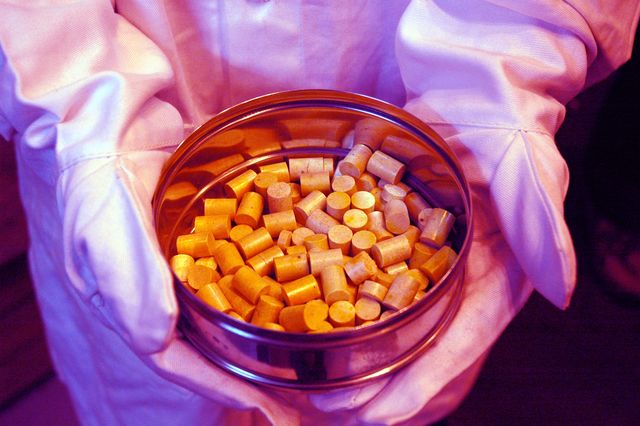
thorium pellets

Could a new blended thorium fuel improve U.S. nuclear power's outlook? Scientists at the Department of Energy's Idaho National Laboratory have a new fuel called Advanced Nuclear Energy for Enriched Life, or ANEEL. It's a proprietary mix of thorium and low-enriched uranium, and Forbes's James Conca says it could help close the gap in a near future where nuclear seems like the only option.

☢️ You like nuclear. So do we. Let's nerd out over it together.

The mix itself is a secret, but thorium—pictured above in pellet form—has continued to gain momentum as an alternative nuclear fuel.

"[T]horium has a higher melting point and lower operating temperature which makes it inherently safer than straight U and more resistant to core meltdowns," Conca explains:

"The ANEEL fuel has a very high fuel burn-up rate[, which] means the fuel stays in the reactor longer and gets more energy out of the same amount of fuel. [It's] prohibitively difficult to make into a weapon. [And] ANEEL fuel will reduce the waste by over 80% and end up with much less plutonium. Less spent fuel means less refueling, less cost, less fuel handling and less volume to dispose."

Thorium has a number of advantages over uranium, and especially over highly enriched uranium. Yes, thorium must be paired with at least a small amount of a fissile material, because it isn't naturally fissile on its own. But it's much more plentiful than uranium and found in high quantities in the kinds of developing markets where Conca says nuclear will be clutch in coming decades—starting with India.

Advertisement - Continue Reading Below

"India itself has more Th than U, particularly as monazite sands, a reason they have been pursuing Th in nuclear reactors for decades," Conca writes. This, he suggests, lends itself to a more mutually beneficial arrangement where Indian thorium can be turned into U.S.-made ANEEL fuel and then exported to India.

In turn, this can lead to improved diplomacy. "Whenever the United States is involved in another country's nuclear program, that country signs various agreements related to security, weapons nonproliferation and nuclear materials, including nuclear fuel," Conca explains.


📚 Read Up: The Best Nuclear Books

Command and Control: Nuclear Weapons, the Damascus Accident, and the Illusion of Safety

Command and Control: Nuclear Weapons, the Damascus Accident, and the Illusion of Safety

Penguin Group amazon.com

$17.99

The Making of the Atomic Bomb

The Making of the Atomic Bomb

Simon & Schuster Amazon

$20.99

Midnight in Chernobyl: The Untold Story of the World's Greatest Nuclear Disaster

Midnight in Chernobyl: The Untold Story of the World's Greatest Nuclear Disaster

Simon & Schuster Amazon

$12.79

Rad Decision: A Novel of Nuclear Power

Rad Decision: A Novel of Nuclear Power

Impressive Imprint Amazon

$17.56


Idaho National Laboratory's partner in ANEEL include Texas A&M University and startup Clean Core Thorium Energy (CCTE). The company started fitting existing reactor designs to use ANEEL fuel, which it says can enter commercial use as early as 2024. Conca argues that having a ready-to-use solution will help clean up nuclear efforts in places where he believes nuclear is the only feasible option. Reactors also don't need to power down to refuel with ANEEL. He writes:

"[I]n developing nations, the need is urgent. Most do not have the infrastructure to install natural gas, wind or solar. Additionally, many do not have sufficient topography and river flow for hydro. So it's either coal or nuclear. If you care at all about the environment, then it better be nuclear."

One of the record holders for longest operating time for a nuclear plant, Conca says, is an Indian reactor that is already compatible with ANEEL. In a near future where humankind faces difficult energy decisions, he argues, this fuel is a good idea.


But they're shutting down the Indian plant......?
~A.