Sunday, January 11, 2026

Saturday, January 10, 2026

Saturday, January 03, 2026

Friday, December 26, 2025

Thursday, December 18, 2025

Friday, December 05, 2025

Wednesday, December 03, 2025

Legacy Systems Designer & Design Ethicist

Bio — Legacy Systems Designer & Design Ethicist

Adrienne is a Legacy Systems Designer & Design Ethicist whose work sits at the crossroads of human behavior, long-term stewardship, and responsible innovation. With a background that spans industrial design, system reliability, archival intelligence, and multi-generational estate continuity, she brings a rare ability to see both the full lineage of a problem and its future consequences.

Her practice centers on designing systems that hold up over time — systems that respect human limits, prevent avoidable harm, and create stability where others default to chaos. She specializes in diagnosing structural failure points, mapping long-arc patterns, and rebuilding environments so people can make better decisions without friction or overwhelm.

Adrienne's lens is grounded in ethics, clarity, and lived experience. She prioritizes transparency, human dignity, and long-horizon thinking. Whether she is analyzing inheritance structures, reorganizing complex information ecosystems, or shaping frameworks for responsible AI onboarding, her work is guided by a single driving question: How do we design choices, tools, and environments that protect the person using them — especially the vulnerable one?

Her approach blends technical understanding with generational awareness, treating every project as both a practical system and a legacy artifact. She operates with design intelligence, moral pragmatism, and an instinct for protecting people from the unseen edges of flawed systems.

This is not a title she adopted — it's the name that finally fits the work she has been doing for decades.


So there.

~A.

Saturday, November 29, 2025

Sunday, November 16, 2025

Nate’s worldview…

this video, Nate Hagens reflects on 11 fundamental discoveries that have shaped his worldview over the past 30 years, moving from a Wall Street perspective to a deeper understanding of human predicament and our place in the world. He shares personal anecdotes and insights, urging viewers to adopt a wider lens to understand civilization as a "superorganism" at a crossroads of abundance and depletion (0:00-1:34).

Here are the 11 discoveries:

• The Power, Finiteness, and Externalized Cost of Oil (1:47-5:26): Nate's initial deep dive into oil revealed its immense energy potential (equivalent to 5 years of human labor per barrel), its finite nature, and the unpriced ecological costs associated with its consumption. This understanding fundamentally changed his view of progress.
• Energy Primacy (5:26-7:24): He realized that every economy, technology, and civilization is essentially a physical process of transforming energy and materials. Money, he argues, is merely a measure of this energy transformation, and our culture is "energy blind" due to the abundance of cheap energy.
• Wanting is Stronger Than Having (7:24-11:23): Observing the anxiety of wealthy clients versus the contentment of lower-paid colleagues, Nate recognized that human desire is driven by dopamine and pursuit, not necessarily by fulfillment. This evolutionary loop, adaptive in ancestral times, now fuels an economy built on perceived scarcity.
• We Are All Made of Stars (11:23-14:28): This discovery broadened his perception of time and interconnectedness, understanding that the elements in our bodies were forged in dying suns billions of years ago. This realization connected him to deep time and the universe, leading him to study evolution and complexity.
• The Power of Natural Selection and Epigamic Traits (14:28-17:37): Through personal observation (attraction to blue eyes) and research, he learned about epigamic traits (features selected by attraction, not just survival). This led to an understanding of evolved psychology, revealing how our physical and mental structures are products of past preferences and adaptations, influencing behavior like social status and addiction.
• The Importance of Net Energy (17:37-20:45): Nate's PhD thesis focused on net energy – the surplus energy left after the energy cost of extraction and maintenance. He explains that civilization's expansion was fueled by a declining energy cost share, which is now rising again, akin to a cheetah needing to run further for smaller gazelles.
• Money is a Claim on Reality (20:45-24:05): He learned that money is created through loans, not from existing funds, and that credit expansion assumes future growth. This system creates abstractions (money) without necessarily increasing physical resources. Financial crises, he states, are physics catching up to finance, as the global economy runs on "joules, atoms, and functioning ecosystems," not just credit ledgers.
• Technology is a 'Straw' (24:05-26:54): Nate explains that technology doesn't create wealth but rather accelerates access to it from natural resources. It functions like a "straw" to extract wealth faster, increasing energy throughput and consumption (the rebound effect), ultimately burning through low-entropy stocks faster.
• Competition and Cooperation (Multi-Level Selection Theory) (26:54-29:40): He learned that evolution acts on groups as well as individuals. While competition drives innovation, cooperation sustains it. He argues that modern culture over-glorifies winning and neglects belonging, leading to societal tensions.
• More Than Our Share (Humanity as the Ecosystem) (29:40-32:15): A "gut punch" realization for Nate was that humans and their livestock now outweigh all wild land mammals by 80 to 1, a reversal from 10,000 years ago. This signifies a massive planetary reallocation where humanity has become the dominant ecosystem, consuming and remaking the world in its image.
• Humans, Humanity, and the Superorganism (32:15-35:40): The final and ongoing discovery is that humanity as a whole functions differently from individual humans. While individuals are often kind and cooperative, at scale, emergent systems (like markets) create a "mindless, unthinking economic superorganism" driven by its own need for energy and growth, often rewarding short-term power over long-term balance. However, he also finds hope in the possibility that this is an evolutionary transition, where self-aware cells (humans) can integrate this awareness and grow into something wiser.

Nate concludes by stating that these realizations have dismantled his naive worldview but have also instilled a sense of hope that humanity is approaching a "right of passage" to become "ecological adults" by integrating these truths and consciously rejoining the story of life on Earth (35:40-37:25).
~A.

Wednesday, November 12, 2025

Sandpaper in Chicago

I 've only had one chance to speak in front of any audience. It happened to be in Chicago at the Mart for a packaging convention, I headlined the Point of Purchase Display talks speaking about the display I designed that holds a whole hardware section of 3M sandpaper in a rack so functional it won 1st place in an unheard of area to jump out as a leader in 1) I redesigned the packaging altogether 2) the new selection guide on all packages defines use and choices in a way that really encouraged proper product use -and better results 3) the packages themselves correctly and effectively differentiate product variables 4) the display is a drop in = all ready to go when it gets there 5) has a guide built into the display as well 6) reusable display functions as a stand alone section...plenty to say about it but I hate to 'be that lady designer in this big tough biz" and on the drive over early that morning encountered a flock of hot air balloons doing it Wisconsin style over the cornfields - So I used the balloons to get to my presentation about the display. and Ive never had anyone to tell that to. 

Sunday, November 09, 2025

...when you die, you look like your decisions.

"When you're born, you look like your parents, but when you die, you look like your decisions."

50 yrs later...


Mate...awwwww....


an "….. " in NY

an "….. "  in NY

​

​

I don't drink coffee, I take tea, my dearI like my toast done on one sideAnd you can hear it in my accent when I talkI'm an Englishman in New York

See me walking down Fifth AvenueA walking cane here at my sideI take it everywhere I walkI'm an Englishman in New York

Oh, I'm an alien, I'm a legal alienI'm an Englishman in New YorkOh, I'm an alien, I'm a legal alienI'm an Englishman in New York

If "manners maketh man" as someone saidHe's the hero of the dayIt takes a man to suffer ignorance and smileBe yourself no matter what they say

Oh, I'm an alien, I'm a legal alienI'm an Englishman in New YorkOh, I'm an alien, I'm a legal alienI'm an Englishman in New York

Modesty, propriety can lead to notorietyYou could end up as the only oneGentleness, sobriety are rare in this societyAt night a candle's brighter than the sun

Takes more than combat gear to make a manTakes more than a license for a gunConfront your enemies, avoid them when you canA gentleman will walk but never run

If "manners maketh man" as someone saidHe's the hero of the dayIt takes a man to suffer ignorance and smileBe yourself no matter what they sayBe yourself no matter what they sayBe yourself no matter what they say

Be yourself no matter what they say (oh, I'm an alien, I'm a legal alien)Be yourself no matter what they say (I'm an Englishman in New York)Be yourself no matter what they say (oh, I'm an alien, I'm a legal alien)Be yourself no matter what they say (I'm an Englishman in New York)Be yourself no matter what they say (oh, I'm an alien, I'm a legal alien)Be yourself no matter what they say (I'm an Englishman in New York)Be yourself no matter what they say (oh, I'm an alien, I'm a legal alien)Be yourself no matter what they say (I'm an Englishman in New York)Be yourself no matter what they say

Saturday, November 08, 2025

134 unhoused people have died in Connecticut this year

134 unhoused people have died in Connecticut this year

134 unhoused people have died in Connecticut this year

Some built intricate encampments. Others sent meaningful gifts. All were more than their living situation.
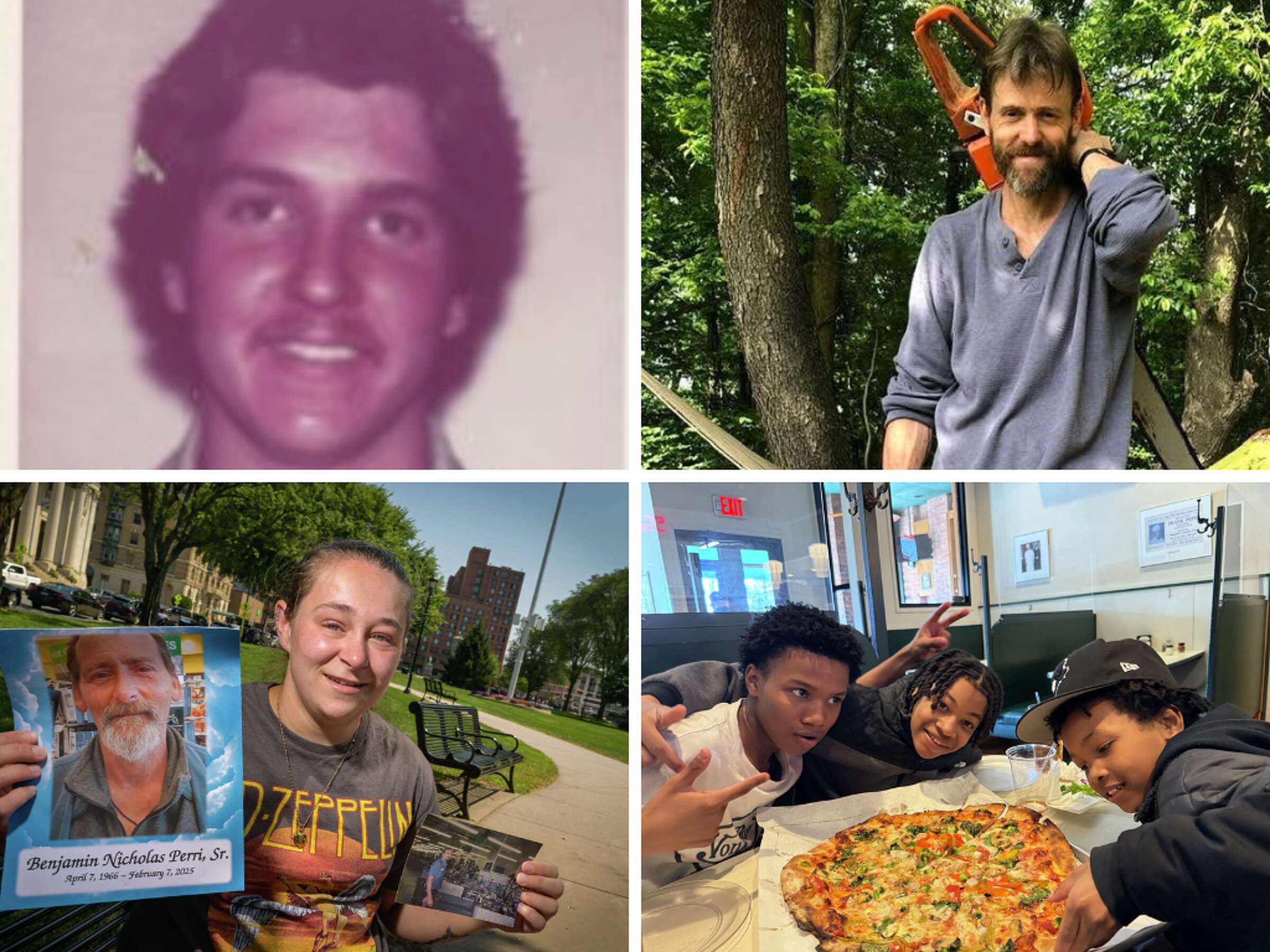
Four-photo collage: top left, a vintage portrait of a smiling young man; top right, a man with a small saw standing outdoors; bottom left, a person holding a photo of a bearded man outdoors; bottom right, three children smiling around a pizza at a restaurant.
Clockwise from top left: John Chapman; Joseph Kane; Jordan-Devon Lamar Hansley-Smith; Benjamin Perri Sr. Madelyn Chapman; Shirley Prendergast; Sal Renee Hansley; Jim Shannon / Hearst Connecticut Media.

These are the names and ages of those who died while homeless in Connecticut between Jan. 1 and Aug. 31. Click on any of the names in red to read about the lives they lived.

JANUARY | Ross Glasmann, 75 · Jose Navedo, 56 · Brian Killion, 58 · Frank Ryan, 74 · William Oyola, 51 · Edwin Gonzalez, 34 · Argenis Cabanas Mejia, 23 · Carlos Playa DeJesus, 53 · Sherman Thompson, 54 · Patricia Ayre, 73 · Carlos Rodriguez, 63 · Kandi Demars, 43 · McKinnell Morton, 50 · Robert Mancini, 70 · Shawn Carter, 46 · Kevin Buden, 33 · Jeremy Jablonowski, 43 · Miguel Braga, 52 · John Manolakakis, 43 · Unidentified Female · Nikolaos Spaniotis, 36 · Michael Lafountain, 58 · Avi Butler, 42 · Lucas Cruz, 56 FEBRUARY | Scott Troisi, 59 · Michele Rathbun, 47 · Deana Antonetti, 31 · Andre Tyrrell, 52 · · Joseph Jefferson, 64 · · · Luis Guzman, 56 · William Lowell, 37 · Megan Lacroix, 40 · · Jefree Tapia Baez, 28 · Mikki Patrick, 49 · Kevin Lynch, 75 · Wendy Shaw, 42 · George Williams, 57 MARCH | Corey Proctor, 34 · Nelson Felipe, 67 · Juliana de Sousa, 39 · Courtney Worthington, 37 · Pierrette Lefebvre, 51 · Andres Hernandez, 67 · Kybarris Taylor, 50 · David Brown, 65 · Patsy Matteo, 31 · Megan Long, 37 · Anthony Harrell, 56 · Shira Sangamuang, 34 · Cheryl Trumpetto, 54 · Janet Rivera, 45 · Justin McCabe, 41 · Tina Hart, 70 APRIL | Mario Vargas-Castillo, 60 · Darryl Isom, 62 · Wayne Damon, 62 · Joseph Benfante, 44 · · Miguel Najera Hernandez, 36 · Sok Heng, 52 · Darlene Coarts, 59 · William Adams, 42 · Richard Birge, 33 · Hermonaree Cowan, 44 · Tekejai Grigsby, 43 MAY | David Hedges, 58 · Douglas Richard, 64 · Josue Gonzalez, 43 · Ashley Von Britton, 65 · Efrain Morales Vargas, 65 · Kris Suco, 26 · Alyssa Insogna, 29 · Kenneth Gagnon, 61 · Dawn Salmon-Palmer, 56 · Baby Girl < 1 · Juan Marrero, 48 · Shannon Lee, 47 · · Lisa Gilbert, 53 JUNE | Thomas St. Pierre, 71 · Samantha Fidrych, 35 · Baby Boy < 1 · Edward Fernandez, 50 · Christine Tracy, 46 · Frank Boyd, 51 · Wanda Zboray, 60 · Salena Green, 46 · Jack Butler, 35 · Michael Antwi, 38 · Marvin Wilson, 63 · Zachary Riley, 63 · Joseph McCarthy, 40 · Heather Morales, 49 · Carlos Carbonell, 56 · Lucky Churchill, 53 · Michelle Paparello, 57 · Katherine Miller, 37 · Joanne Delfino, 48 · Manuel Guayllazaca-Yunga, 53 · Ella Whipple, 65 · Rosemary Connor, 52 · Tonya Robbins, 52 · Jana Saville, 58 JULY | David Gustave, 39 · Miroslaw Mikolajczuk, 69 · Ariel Troche, 26 · David Sabourin, 64 · Ivan Lee, 51 · Paul Hamernik, 62 · Michael Simon, 41 · Gary Lukosevage, 52 · Zandrea Harris, 49 · Zdzislaw Rycko, 69 AUGUST | Jamie Murphy, 39 · Steven Jarvis, 58 · Jaime Melendez Martinez, 58 · Robert Vasile, 77 · George Vlahos, 55 · Kristal Daniel, 37 · Amanda Williams, 39 · David Booth, 60 · Juan Tufino Copantitla, 38 · Dennis Delfino Lyga, 79 · Amy Pellerin, 46 · · Douglas Gray, 67 · MaryClaire Hartman, 56 · Mark Talmadge, 64 · Jessica Woodstock, 32 · Francis Thibodeau, 61 · Jessee Pond, 39


~A.

Wednesday, September 17, 2025

If you are the last living member...

If you are the last living member of your family line, you have several options for managing and preserving family records. These include curating, digitizing, and donating your archives to ensure your family's story is not lost
. 
1. Curate and organize your records
The first step is to sort and evaluate the materials you have. You don't need to keep everything, but focus on items that hold the most historical and personal significance. 
  • Take inventory: Gather all records and heirlooms into one central location. This includes paper documents, photos, and physical objects.
  • Decide what to keep:
    • Keep indefinitely: Vital records like birth, death, and marriage certificates, as well as military and immigration papers. Store them in a fireproof and waterproof safe.
    • Keep with discretion: Financial and medical documents can be shredded or securely deleted after a certain period, but consider saving items related to heirloom purchases or medical histories of ancestors.
    • Scan and discard: Documents like old newsletters, calendars, or newspaper clippings can be scanned and saved digitally, then discarded. The originals are often fragile and may be available in online archives.
  • Organize the physical items:
    • Documents: Place important papers flat in archival-quality folders or sleeves and label them clearly with names and dates.
    • Photos: Store photographs and negatives in acid-free boxes and sleeves to prevent yellowing. If they are unlabeled, try to identify the people and years on the back with a soft, archival pencil.
    • Heirlooms: For physical objects, create an inventory that includes a photo of each item, a description, and the story behind it. Store fabrics and other delicate items in a climate-controlled space, not an attic or basement. 
2. Digitize everything
Scanning your photos and documents is one of the most effective ways to preserve them for the long term and make them accessible to others. 
  • Scan your records: Use a high-resolution scanner for important documents and photos. If you're not tech-savvy, a professional archival company can perform this service.
  • Identify and add metadata: When you scan, be sure to note the names, dates, and locations associated with each item. This context is what makes a collection truly valuable.
  • Store digitally: Back up your digitized records to multiple locations, such as an external hard drive and cloud storage (like Google Drive or Dropbox), to ensure their safety.
  • Build a digital family tree: Use online genealogy websites like FamilySearch or Ancestry to upload records and photos. This can connect you with distant relatives who may be interested in your research. 
3. Share and tell your family's story
Bringing your ancestors' stories to life can be a deeply meaningful project and helps ensure the legacy is remembered.
  • Create a photo album or scrapbook: For a tangible keepsake, assemble a photo album with captions and stories. Services like Shutterfly or Mixbook make this easy.
  • Write a life story or memoir: Include stories, traditions, and anecdotes about your family. You can even create a family history kit with interviews and photos.
  • Narrate a video: Create a video tour of your family's physical and digital archives, walking viewers through the key artifacts and stories.
  • Publish a family website: Create a site to showcase your family tree, photos, and stories. A password-protected site can give distant relatives a place to interact and add their own memories. 
4. Donate your records to a repository
If no other family members are interested in taking the original records, you can ensure they are preserved and available for future research by donating them to an archive or historical society.
  • Find the right institution:
    • Genealogical societies: These organizations are focused on family history and often accept family files.
    • Local or state historical societies: These institutions collect materials relevant to their geographic area. A collection of a family's records can provide unique insights into local history.
    • Specialized archives: If your family has a unique history (e.g., related to a specific trade or an ethnic group), a specialized archive might be appropriate.
  • Contact the institution first: Don't just show up with a box of materials. Contact the archives team to discuss your potential donation. They will evaluate your collection based on their mission and might ask you not to rearrange items beforehand, as the original filing system can be historically significant.
  • Sign a deed of gift: If the donation is accepted, you will sign a deed of gift. This transfers ownership and, in many cases, copyright, to the institution so they can legally preserve and provide access to the collection. 


Saturday, September 13, 2025

Oh bouy,

Wherefore art thou?….