The Pros and Cons of GMO Crops: A Genetically Modified Organisms Infographic
Consuming Genetically Modified Organisms is a frightful thought to some people, whereas others think that it is the hope of the future. Some people think GMO products are killing the American public. Others think that without GMO products there would not enough food for the global population. This argument has huge political implications, as each side lobbies the government for more or less restriction. There is quite a bit of misinformation that floats around about GMOs.
Human beings have been modifying plants and animals through selective breeding for thousands of years. Some people argue that genetically modifying them is just the most recent advancement in animal and plant husbandry. Others think that we are playing "god" and messing around with things that we do not fully understand. Either way there is quite a bit of confusion surrounding the topic.
It is important to understand why GMOs may be harmful. It is also important to understand how they may be beneficial. GMOs are a reality, though a generation ago they were science fiction, and we need to deal with them. We need to either use them, or legislate them. People need to fully understand them, and not just fear them because they sound scary.
GMOs do have their positive attributes, and their drawbacks. It is true that with GMO crops the yield can typically be higher per square foot, but at what cost? Are we killing ourselves slowly, or is that merely conjecture or fear mongering? There are times where GMO crops have failed causing problems, and making food prices sky rocket. There are also times when GMO products were outlawed, and it caused a food shortage. If we look at the facts than we can come to a reasonable, rather than emotional, conclusion. The following infographic should help make the issue of genetically modified food argument more understandable.
Infographic by Sandra Mills Editor's Note: We felt this infographic is quite close to representing the current state of the GMO debate. One thing that should be noted about the pro-GMO argument is that it largely hinges on exactly how much you trust the corporations involved. It should also be noted that another side effect seen in GMO studies is that the sexual organs of the animals are attacked, possibly leaving them and usually the offspring, sterile.
The objective of this course is to introduce to students the forces that shape history and the consistency of human behavior over time and across space. By showing the connections that bind us with our past, students will gain a greater understanding of the present.
As a primary area of discussion, the course traces the development of socio-political arrangements and institutions from the earliest period of recorded history (and before) to the modern era. Human behavior is examined in the context of societal structure, with an emphasis on the nature of power and how hierarchical structures advance or thwart the forces of cooperation and competition. Also discussed are the dominant socio-political philosophies that both attacked and defended the socio-political structure of societies as they have undergone change.
Key concepts discussed include the distinction between a human rights doctrine versus assumed or delegated rights as the basis for systems of positive law, and the reliance on moral sense principles to establish objective criteria by which the socio-political arrangements and institutions of any society can be shown to be just or unjust.
The nineteenth-century reform activist, newspaper editor and self-taught political economist, Henry George (1839-1897), is presented as one of the significant socio-political philosophers and political economists of the nineteenth century. His life and activism are discussed in the context of the reform and Progressive era, contrasting the philosophy of cooperative individualism which he espoused with that of Fabian and Marxist socialism dominating the reform movement in Europe -- as well as how cooperative individualism differs from the compromise program of reform we think of as Liberalism.
Microsoft Report Shows Why You Should Abandon XP Now
Microsoft has recently released its latest Security Intelligence Report (SIR) which details, among other things, rates of malware infections across the various Windows operating systems. The report is entirely security related and not meant specifically as a vessel to encourage XP users to upgrade. However, that certainly is a side effect, unintentional or not – many of the report's findings do suggest that an immediate upgrade might be a prudent move for XP users.
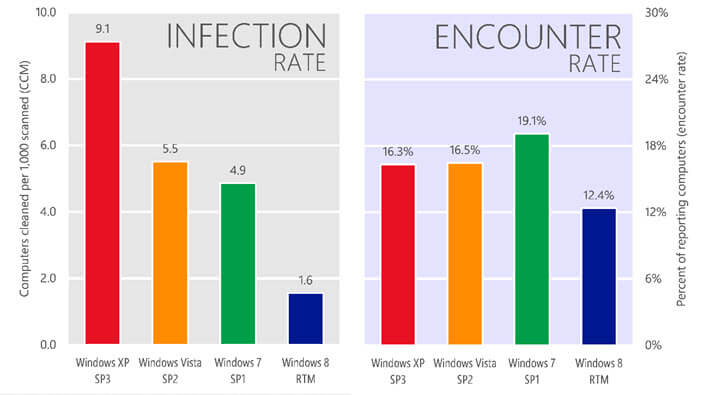
The comprehensive report is actually 160 pages long, but malware encounter and infection rate comparatives have been specifically highlighted in a separate Microsoft Technet blog article. The included infection rate chart appears to clearly indicate why users should replace XP as soon as possible:
Malware Infection and encounter rates for Windows operating systems during 2Q13
The infection rate chart shows computers cleaned up out of every thousand on which Microsoft's Malicious Software Removal Tool (MSRT) was used. The encounter rate shows computers on which malware was detected – and almost certainly prevented from infecting – out of every hundred protected by a Microsoft virus blocker. The side by side comparisons show that, while Windows XP SP3 computers encountered almost as much malware as other platforms, computers running Windows XP experienced a much higher overall infection rate.
On the surface at least, these statistics tend to confirm that users who went looking for possible malware via MSRT were 5.7 times more likely to find infections on XP than on Windows 8. On the other hand, MSRT has never been a broad spectrum anti-malware tool, mainly dealing with only the most commonly encountered malware families. As such, it could be argued that MSRT has perhaps developed a bias toward XP related malware in general, and the infection rate statistics shown may merely represent the level of MSRT's effectiveness per Windows version.
I suspect the truth may lie somewhere in between; while XP may not be exactly 5.7 times more dangerous than Windows 8, I do believe it is reasonable to accept that Microsoft's collected data supports a claim of heightened risk levels for users who continue on with XP. It's also apparent that enhanced security measures, such as Address Space Layout Randomization (ASLR), which were introduced into Windows and Internet Explorer post XP, have greatly bolstered overall security.
Managing Editor/Contest Coordinator of Daves Computer Tips - Jim is the resident freeware aficionado at DCT. A computer veteran with 30 years of experience. His first computer was a TRS-80 in the 1980s. He progressed through the Commodore series of computers before moving to PC's in the 1990s. Jim currently uses both XP and Win7. Jim has a passion for free software and hopes to share that passion with others during his tenure here!
Police forces around the country have developed the nasty habit of confiscating the phones of citizens who choose to film them, unilaterally deleting images and video of their actions. Whether that's a Fourth Amendment violation is still being decided by the courts; until that happens, here's how to protect your phone from the prying eyes of cops.
Know Your Rights
It sounds obvious, but the easiest way to protect what's on your phone is not to get it confiscated in the first place. And that starts by using some common sense. For example, don't be a nuisance or hinder the police action. Follow the orders the officer issues, including showing ID when asked or moving from you current location. Basically, don't do anything that will make the situation worse.
That's not to say you should be a complete pushover. Know that you aren't required to talk to the police without a lawyer present, or give them the passcode to your phone, or consent to any sort of search. They can hassle you and confiscate your property, but you're under no obligation to provide access just because they asked.
It's also critical to know whether—and where—police have the right to search your phone without a warrant in the first place. As the Electronic Frontier Foundation points out, your constitutional protection against unreasonable search and seizure should mean that police cannot simply rummage through your files without a warrant except when (a) you consent to the search or (b) give them probable cause that there's incriminating evidence in immediate danger of being deleted from the device.
A growing number of states, though, are allowing officers to search phones without a warrant upon arresting a suspect. As you can see in the map below, based on EFF information provided to Forbes, nearly half the states in the country—shown in red—allow for warrantless mobile device searches. Only those in blue explicitly require a warrant to search phones, while the yellows have no set precedent.
This means that if the red-state police arrest you on some trumped-up charge—say obstruction of justice, or obstructing official business—they don't need a warrant to comb through the hard drive of every piece of electronic equipment you have on you. Your laptops, phones, iPods, pagers, everything. And that's why you need to keep your data under strict cryptographic security.
Put Your Phone on Lock Down
The good news is that both iOS and Android phones and tablets come equipped with native data protection. To enable it on Android, first go to Settings > Security >Encrypt Device. From there, just enter a six or more character passcode, and the encryption process will begin. It can take over an hour, so you'll want to make sure your phone is plugged in.
While you're in there, lock your SIM card as well; that will ensure that no one can access your SIM without a predetermined PIN. It's especially helpful if you switch phones a lot for some reason, but it's also just a nice extra level of security.
It's even easier on iOS. For every model after the 3GS—iOS 4 and up basically—Apple offers built-in encryption; all you need to do to enable it is go to Settings > General > Passcode, enable the passcode option, turn off Simple Passcode, and turn on Erase Data (which will wipe your phone after 10 wrong code inputs).
There's another way to protect the photos and videos you're taking of a police action, though, so that it won't matter if the cops crack your PIN or not. And that's to save it—and share it—on the fly.
SExpand
Send It Up Into the Cloud
It's not just Instagram; modern social media sites of all stripes have granted journalists and concerned citizens alike immense empowerment, providing them a great big visual bully pulpit and a potentially unlimited global audience. They also give you a place to park your media that the cops have a much harder time touching.
If you're simply looking for a remote backup of your photos and video, enabling Camera Uploads on DropBox (iOS, Android) is the way to go. Select the Settings option from the Dropbox app on your device, and go to Camera Upload > Turn on Camera Upload.Now, everything that you capture on your mobile device is immediately and automatically shunted over to the cloud.
The same can be accomplished with Google Drive. On Android, open the Google+ app, go to the Menu > Settings >Auto Backup to toggle Google's Auto Backup on or off. For iOS, the sequence is menuicon > gear icon > Camera and Photos > Auto Backup. Google+ will not only upload these images to your Drive, it will retouch them as well.
Spend most of your time on Facebook? You can auto-upload there, too. Go to the Photos section of your mobile FB app, tap the Synced button at the bottom right of the screen, where you'll be given the option to automatically send photos from your phone to a (private by default) Facebook album. You'll get 2GB of storage to play with.
These methods are helpful for saving your photos remotely, but they still necessitate getting to a computer to disseminate—a tough thing to do if you're being detained. Luckily, for iOS users at least, one app can file and post every photo you take without your direct intervention. Known as AutoSnap (freemium, iOS only), this app will seamlessly upload any photo taken with it to Facebook, Dropbox, Evernote, Twitter, and Instagram. You simply have to link the app with your various social accounts.
Or, in a real pinch, you can just dispense with the selective sharing and just blast everything you're seeing out into the world in real time.
The easiest way to get your message out post haste is live streaming. Anything you record is pushed directly to the Internet, only using your mobile device as an input, not a storage medium. And the police can't mine what isn't there.
Justin.Tv
Jutin.Tv ($5, iOS & Android )is the biggest name in live streaming today, with more than 300 million live streams available worldwide. The $5 app promises virtually lag-free video feeds up to 720p, a superior quality what to its competitors offer at that price point. The service itself is free to use.
UStream
UStream (free, iOS & Android) is to Justin.TV what Vimeo is to YouTube, a more professional option with a focus on production quality more than easy access. UStream is employed by everyone from modern Wayne's World broadcasters working out of their basements to major media organizations operating out of Studio 6 in New York.
As such, the service offers a wide range of broadcasting options with an equally broad range of pricing plans and capabilities. The basic service, unfortunately, isn't very hearty. It's ad-supported, only records sub-720p video quality, lacks Twitter and Facebook integration, and gets pretty choppy when you aren't using a Wi-Fi connection. Still, it's better than shelling out between $100 and $1000/month for the Pro Plans.
Veetle
A lesser-known but equally handy option is Veetle (free, iOS & Android). A smaller company than either Justin.Tv or UStream, Veetle only gets about 10 million views a month on the whole but it does have one vital advantage over the others: It allows easy integration with social media for free. Not only can your live streams be viewed directly on the Veetle site and downloaded for eviden—I mean posterity—you can also easily and automatically share links on Facebook and Twitter and get the word out faster.
Under any circumstances, standing up to the police is an intimidating endeavor. And while the vast majority of cops around the country are honorable men and women putting their lives in danger every day to make our streets safer, it's your civic duty to bring their transgressions to light if and when they do happen. Because if you don't, who will? [Make Use of - TechHive - How IK - Apple - EFF - FB - iMore - Top image: Ap Images - bloomua]
This amazing fruit fly evolved to have pictures of ants on its wings
This is unbelievable, but the fruit fly G tridens has somehow evolved to have what looks like pictures of ants on its wings. Seriously, its transparent wings have an ant design on them complete with "six legs, two antennae, a head, thorax and tapered abdomen." It's nature's evolutionary art painted on a fly's wings.
Recently spotted by the New York Times, the fruit fly is just incredible. Other flies in its family of 5,000 species have other type of markings on its wings but it's the G tridens that has something so intricate and so specific.
The idea of the ant design, as explained to The National by Dr Brigitte Howarth of Zayed University who first discovered G tridens in the UAE, is that these flies use their wings to ward off predators. The fly flashes it wings back and forth to make it seem as if the ants are moving around and that movement would confuse the predator. Nature's version of a tattoo, I guess.
Center for Book Arts: Book Arts Certificate Program
certificate program
Starting in the Fall of 2012, the Center for Book Arts is proud to announce a new comprehensive certificate program in the book arts.
The Center for Book Arts' Education Program strives to engage a wide audience, providing beginning students and professional artists alike with a comprehensive and technically challenging curriculum. In addition to foundation classes in letterpress printing and bookbinding, we provide structured opportunities for working artists from other media to expand their creative practice in bookmaking.
For students who wish to fully immerse themselves in the study of book arts, we have created a structured program which encourages the study and creation of the art of the book. Our new certificate program consists of 210 total hours of class time, divided among 3 areas:
Binding (90 hours of required courses)
Required Courses:
Bookbinding I (30 hours)
Bookbinding II (30 hours)
Box Making (12 hours)
Independent Projects (15 hours)
Hot Stamping/Guillotine orientation (3 hours)
Printing (90 hours of required courses)
Required Courses:
Letterpress I (30 hours)
Letterpress II (30 hours)
Platen Press (12 hours)
Letterpress Lab (15 hours)
Printshop Orientation (3 hours)
Electives (30 hours minimum.)
Possibilities Include:
Bookbinding III
Book Restoration
Paper Treatments
Calligraphy
Paper Engineering
Artists Books
Printmaking-Woodcut, Drypoint, Wood Engraving
Benefits of registering for the certificate:
Preferred status when registering for new classes.
The opportunity to immerse yourself in the study of the medium with leaders in the book arts field.
The prestige of a certificate from the oldest and most well-known Center for the Book Arts in the nation;
Additional studio access outside of class time.
How To Register as a Certificate Student: There is a one-time Registration Fee of $100 to register as a Certificate Student, which includes one year of associate level membership. Students should register as certificate candidates within their first 72 hours of class time. Students who wish to apply previous coursework done at the Center towards a Certificate should contact the Programs Manager to discuss. Any past coursework will be applied on a case-by-case basis. Contact Sarah Nicholls at snicholls@centerforbookarts.org for more information and to register for the program. .
It is strongly recommended that students complete the program within 3 years. A final project must be presented and reviewed by the Education Committee in order receive the Certificate. The project may either be a culmination of work produced in classes, or an entirely new project. The Center for Book Arts Certificate Program is not approved by the New York State Board of Education Certificate Program.
NASA Kepler Results Usher in a New Era of Astronomy
From the first three years of Kepler data, more than 3,500 potential worlds have emerged. Since the last update in January, the number of planet candidates identified by Kepler increased by 29 percent and now totals 3,538, analysis led by Jason Rowe, a SETI research scientist.
Scientists from around the world are gathered this week at NASA's Ames Research Center in Moffett Field, Calif., for the second Kepler Science Conference, where they will discuss the latest findings resulting from the analysis of Kepler Space Telescope data.
Included in these findings is the discovery of 833 new candidate planets, which will be announced today by the Kepler team. Ten of these candidates are less than twice the size of Earth and orbit in their sun's habitable zone, which is defined as the range of distance from a star where the surface temperature of an orbiting planet may be suitable for liquid water.
At this conference two years ago, the Kepler team announced its first confirmed habitable zone planet, Kepler-22b. Since then, four more habitable zone candidates have been confirmed, including two in a single system.
New Kepler data analysis and research also show that most stars in our galaxy have at least one planet. This suggests that the majority of stars in the night sky may be home to planetary systems, perhaps some like our solar system.
"The impact of the Kepler mission results on exoplanet research and stellar astrophysics is illustrated by the attendance of nearly 400 scientists from 30 different countries at the Kepler Science Conference," said William Borucki, Kepler science principal investigator at Ames. "We gather to celebrate and expand our collective success at the opening of a new era of astronomy."
From the first three years of Kepler data, more than 3,500 potential worlds have emerged. Since the last update in January, the number of planet candidates identified by Kepler increased by 29 percent and now totals 3,538. Analysis led by Jason Rowe, research scientist at the SETI Institute in Mountain View, Calif., determined that the largest increase of 78 percent was found in the category of Earth-sized planets, based on observations conducted from May 2009 to March 2012. Rowe's findings support the observed trend that smaller planets are more common.
An independent statistical analysis of nearly all four years of Kepler data suggests that one in five stars like the sun is home to a planet up to twice the size of Earth, orbiting in a temperate environment. A research team led by Erik Petigura, doctoral candidate at University of California, Berkeley, used publicly accessible data from Kepler to derive this result.
Kepler data also fueled another field of astronomy dubbed asteroseismology -- the study of the interior of stars. Scientists examine sound waves generated by the boiling motion beneath the surface of the star. They probe the interior structure of a star just as geologists use seismic waves generated by earthquakes to probe the interior structure of Earth.
"Stars are the building blocks of the galaxy, driving its evolution and providing safe harbors for planets. To study the stars, one truly explores the galaxy and our place within it," said William Chaplin, professor for astrophysics at the University of Birmingham in the United Kingdom. "Kepler has revolutionized asteroseismology by giving us observations of unprecedented quality, duration and continuity for thousands of stars. These are data we could only have dreamt of a few years ago."
Kepler's mission is to determine what percentage of stars like the sun harbor small planets the approximate size and temperature of Earth. For four years, the space telescope simultaneously and continuously monitors the brightness of more than 150,000 stars, recording a measurement every 30 minutes. More than a year of the collected data remains to be fully reviewed and analyzed.
Ames is responsible for the Kepler mission concept, ground system development, mission operations, and science data analysis. NASA's Jet Propulsion Laboratory in Pasadena, Calif., managed Kepler mission development.
Ball Aerospace & Technologies Corp. in Boulder, Colo., developed the Kepler flight system and supports mission operations with the Laboratory for Atmospheric and Space Physics at the University of Colorado in Boulder.
The Space Telescope Science Institute in Baltimore archives, hosts and distributes Kepler science data. Kepler is NASA's 10th Discovery Mission and was funded by the agency's Science Mission Directorate.
For more information about the second Kepler Science Conference, visit:
Why So Many Of America's Teachers Are Leaving The Profession
John Owens in his book, Confessions of a Bad Teacher, shares that "America's public school teachers are being loudly and unfairly blamed for the failure of our nation's public schools." As a 2012 nominee for the Presidential Award for Excellence in Math and Science Teaching and a veteran of public and private schools for the last twenty years, I have to agree but I was glad to hear someone else say it in print.
The vast majority of teachers are working overtime without the tools or budget to manage the plethora of issues inside and outside the classroom. On top of that, administrators who only compound the situation by micromanaging the wrong things make the lives of teachers completely untenable with their lack of support.
Most teaching preparation programs including the one Mr. Owens attended do not adequately prepare anyone for life in the classroom. For many beginning teachers, "It was as though I had just joined the circus as an apprentice clown and was immediately required to juggle plates, bowling pins, butcher's knives, and axes all day long while walking along a tightrope in midair." Teachers make more decisions per hour than any other job including what to do with a student who falls behind, manage students with learning or emotional problems, tailor each lesson every day to up to 125 students or more who are somewhere between illiterate and highly gifted.
Sadly some administrators, students and parents instead of partnering with teachers, blame "teachers which is easier than doing a massive system overhaul."
We need "teachers who can present a passion for the greatness and potential of learning and the greatness and potential of America." I believe John Owens wanted to be one of those people. His unsuccessful attempt to complete one year in the classroom paints an ugly and honest picture of life in many American schools today. The statistics from the National Commission on Teaching and America's Future show that his experience is not unique as "in urban districts, close to 50 percent of newcomers leave the profession during their first five years of teaching."
Many non-teachers claim that teaching is an easy life with long vacations. However, as Owens shares his daily routine it is a job way past full time hours, "I spent virtually every waking hour -- 5 a.m. to 10 p.m. -- all week long on my teacher duties. Lessons, backup lessons, tutoring students during lunch and after school, PowerPoints, grading, inputting data, inputting more data, meeting with parents, observing experienced teachers to learn their techniques, meeting with my bosses, updating databases, writing reports, and trying to get help from someone for the struggling students in my classes." All teachers are familiar with the many hours required to keep lessons, grades and life engaging and organized.
Most of the teachers I have worked with have been caring and concerned both with doing a great job and meeting the needs of each student. However, "every second of the day was filled with demands and -- sadly -- students whose needs still weren't being addressed despite all the efforts I could put in." Even with the frustrations of not being able to do enough, Owens wishes to be a better teacher and contribute to his students and society but the principal is not interesting in supporting his contributions as a new teacher.
Owens creates an enthusiastic response from his students but he is reprimanding for his class being too noisy. He has many meetings and moments with the principal as he is warned that he will receive an unsatisfactory rating for his first year skills. He learns that "inspiring, empowering, really teaching these students" is not enough.
Many teachers are leaving the profession, as "America is demanding too much from its teachers without giving them the proper support to educate students effectively. Commitment, caring, pushing for results, and putting in a full work's day no longer seem to be enough...Often, I felt like a soldier dropped behind enemy lines with nothing more than orders. No weapon. No helmet. No hope of reinforcements." I was disappointed and frustrated to learn about his challenges, and it reminded me of many situations and schools were I have been forced to work with incompetent management.
Students want to share themselves and deserve teachers who can be present and focus on them from "Rikkie, the bright, defiant ninth grader, who did a long piece about how prison isn't so bad to a ninth-grade girl wrote about the day she saw her father get arrested in the neighborhood check-cashing store." Students need caring supportive teachers, not teachers who feel threatened that they will lose their job for showing enthusiasm and initiative. Teachers need to work in an environment where they can thrive.
In Los Angeles, new teachers and old can find mentorship and engaging lessons with the Los Angeles Science Teachers Network. In response to an overwhelming situation in 2009, I created this network for professional development, support and camaraderie. Administrators cannot do everything and we all must participate to improve learning for the children. Do not listen to the blame. Do something about it. We are each responsible to do what we can. Write a blog, start a network, help a child and find a way to feel supported in the classroom. America needs you.
About the Author: Lisa Niver Rajna was a 2012 nominee for the Presidential Award for Excellence in Math and Science Teaching. She was the first teacher to appear on Career Day. She and her husband George are on a career break sharing their world adventures on We Said Go Travel.