Friday, May 10, 2019

Climate change: 100 CEOs killing the planet - Big Think

Climate change: 100 CEOs killing the planet - Big Think

Are these 100 people killing the planet?

Controversial map names CEOs of 100 companies producing 71 percent of the world's greenhouse gas emissions.

Houston, we have a problem...

North American companies (and their CEOs) most responsible for the emission of CO2 and other greenhouse gases. Note the concentration of culprits in Houston. Image source: Jordan Engel, reused via Decolonial Media License 0.1

Do you carry your shopping home in a reusable bag? Close the tap while you brush your teeth? Well done! But saving the planet will require a more systemic approach.

A new UN-sponsored report (1,500 pages in full — consider the environment before printing!) details how the accelerating decline of biodiversity is threatening humanity's very survival.

It's not the first report of its kind, and despite their increasingly alarmist tones, unlikely to be the last.

What to do?

Between the relative futility of individual do-goodery and the seemingly unstoppable forces degrading earth's ecosystems lies a whole world of despair, paralysis, and tuned-out apathy.

But if those forces seem unstoppable, it's perhaps because they appear to be nameless and faceless. As this map points out, they aren't. The harm that's being done to the planet can be pinpointed, to a very specific list of companies. And those companies have CEOs that can be named and shamed.

The west vs. the rest

The bigger the country, the bigger its share of CO2 emissions since the start of the Industrial Revolution. Image source: Jordan Engel, reused via Decolonial Media License 0.1

This map shows the 100 companies responsible for the biggest share of the world's greenhouse gas emissions, and their CEOs. Countries are inflated to represent their share of CO2 emissions since the beginning of industrialisation.

If we want to make a serious dent in the amount of CO2 and other greenhouse gases we're emitting, this map suggests, it's these companies — and more specifically, these CEOs — we need to hold to account. Naming and shaming them is a first step.

The basis for this map is the Carbon Majors report from 2017 by CDP (formerly the Carbon Disclosure Project), listing the top 100 fossil fuel producers in the world, responsible for 71 percent of all greenhouse gas emissions since 1988.

In fact, more than 50 percent of all greenhouse gas emissions since 1988 can be traced to just the top 25 entities on that list.

Those are, in descending order: China (state coal production), Aramco, Gazprom, National Iranian Oil, ExxonMobil, Coal India, Pemex, Russia (state coal production), Shell, China National Petroleum, BP, Chevron, PDVSA, Abu Dhabi National Oil, Poland Coal, Peabody Energy, Sonatrach, Kuwait Petroleum, Total, BHP Billiton, ConocoPhilips, Petrobras, Lukoil, RioTinto, Nigerian National Petroleum.

The rogue's gallery of Europe

Even oil companies are now turning to invest in sustainable energy — but is it just window dressing? Image source: Jordan Engel, reused via Decolonial Media License 0.1

If fossil-fuel extraction over the next quarter century continues at the same rate as the previous 25 years, the Carbon Majors report claims we're on course for a 4°C rise in average temperatures by the end of this century — accelerating the loss of biodiversity and the rise of food insecurity, to name but two consequences.

Granted, even oil companies are aware that the wind is blowing from a different direction now and have initiated programmes to produce energy in a more sustainable way. But in many cases, the discrepancy between the size of those programmes and the attention they are given in corporate PR makes them little more than window dressing.

Jakarta beats Beijing as emissions capital

Jakarta, the capital of Indonesia, is the wider region's capital of greenhouse gas-emitting companies. Image source: Jordan Engel, reused via Decolonial Media License 0.1

This overview refocuses the attention on the main issue — the emission of CO2 and other greenhouse gases. And by naming each company's CEO, the issue is personalized.

That personalization should come with a few caveats.

First, these corporations thrive only because consumers buy their product — although it must be said that demand for energy is fairly inelastic: most people can't do without fuel to get from A to B, or to heat their homes.

Second, in all fairness: the true captains of industry are not the CEOs, but the majority shareholders. It's those shareholders' priorities — profit only or planet also — that drive corporate decision-making.

Those shareholders include large institutional investors, but also national governments. Up to 20 percent of investment in hydrocarbon extraction is done by public funding — i.e. us.

Clean Africa, dirty Middle East

Africa counts relatively little CO2 culprits, while the tally is much higher in the Middle East (as could have been expected). Image source: Jordan Engel, reused via Decolonial Media License 0.1

On the other hand, we're running into the same problem mentioned above again. Big institutions, even if they include you and me, are nameless/faceless. These CEOs are picked to run and represent their companies. Perhaps they should get used to a new job: being the lightning rod for our growing concern about global warming.

The Decolonial Atlas, which published this map, quotes U.S. folk artist and labor organizer Utah Phillips: "The earth is not dying, it is being killed, and those who are killing it have names and addresses."

On that list is your name and address, and mine; because we could all do a lot more. But not nearly as much as these 100 people. Let this map be an invitation to acquaint ourselves with their intentions, good or otherwise.


~A.

These secret Netflix codes unlock hidden show and movie categories

These secret Netflix codes unlock hidden show and movie categories

These secret Netflix codes unlock hidden show and movie categories

The recommended content on your Netflix account comes from a complicated algorithm analyzing your viewing history.

And unless you are sharing your profile with your roommates, most of the content is pretty suited to your personal taste.

But sometimes after endlessly scrolling through Netflix, you find yourself no closer to making a selection from the recommended content.

This is where a collection of "secret codes" will be a godsend.

By making a small tweak to the Netflix URL, you will be able to unlock hyper-specific genres such as religious documentaries or cerebral French-language dramas from the 1960s.

To manually explore categories usually hidden by the streaming service, you will need to enter the following URL: http://www.netflix.com/browse/genre/INSERTNUMBER

Then, simply replace the "INSERTNUMBER" component of the URL with one of the codes needed to access the alternative genres.

ACTION & ADVENTURE

1365 = Action & Adventure

77232 = Asian Action Movies

46576 = Classic Action & Adventure

43040 = Action Comedies

43048 = Action Thrillers

8985 = Martial Arts Movies

2125 = Military Action & Adventure

7442 = Adventures

10118 = Comic Book and Superhero Movies

7700 = Westerns

10702 = Spy Action & Adventure

9584 = Crime Action & Adventure

11828 = Foreign Action & Adventure

COMEDY

6548 = Comedies

869 = Dark Comedies

4426 = Foreign Comedies

1402 = Late Night Comedies

26 = Mockumentaries

2700 = Political Comedies

9702 = Screwball Comedies

5286 = Sports Comedies

11559 = Stand-up Comedy

3519 = Teen Comedies

4922 = Satires

5475 = Romantic Comedies

10256 = Slapstick Comedies

CULT

7627 = Cult Movies

8195 = B-Horror Movies

1252 = Campy Movies

10944 = Cult Horror Movies

4734 = Cult Sci-Fi & Fantasy

9434 = Cult Comedies

4195 = Independent Comedies

DOCUMENTARY

6839 = Documentaries

3652 = Biographical Documentaries

9875 = Crime Documentaries

5161 = Foreign Documentaries

5349 = Historical Documentaries

4006 = Military Documentaries

180 = Sports Documentaries

90361 = Music & Concert Documentaries

1159 = Travel & Adventure Documentaries

7018 = Political Documentaries

10005 = Religious Documentaries

2595 = Science & Nature Documentaries

3675 = Social & Cultural Documentaries

This trick works for all regions of Netflix.


~A.

Wednesday, May 08, 2019

Postscripts: The life of Gertrude Sanford Legendre was a series of really fortunate events | Guest Columns | thewesterlysun.com

Postscripts: The life of Gertrude Sanford Legendre was a series of really fortunate events | Guest Columns | thewesterlysun.com

Postscripts: The life of Gertrude Sanford Legendre was a series of really fortunate events

In the months ahead, two biographies will be published about Gertrude Sanford Legendre, late of Fishers Island, her 6,700-acre plantation near Charleston, S.C., called Medway, and big-game hunting country in Africa, India, Iran and Indochina.

She was a socialite born to vast wealth — she was a descendant of the Sanford family, which manufactured carpets in Amsterdam, N.Y., and raised thoroughbred racehorses — and she was a prisoner of war, armed with World War II secrets from her work at the Office of Strategic Services (OSS) and captured and held by the Nazis for six months.

She was also the mother of Landine Manigault, for many years a resident of Stonington, who declined to talk to me about her mother. For the record, she also declined to talk to the two biographers.

One is Peter Finn, national security editor at the Washington Post and author of the forthcoming "A Guest of the Reich: The Story of American Heiress Gertrude Legendre's Dramatic Captivity and Escape from Nazi Germany." It will be published by Pantheon and released in September.

The other biography, "The Fabulous Life of Gertrude Saanford Legendre: Heiress, Hunter, Socialite, Spy," is by Kathryn Smith, a writer and editor living in Anderson, S.C. Also to be out in September, it is being published by Evening Post Books in Charleston, S.C., co-founded by Pierre Manigault, son of Landine Manigault and grandson of Gertrude Legendre and chairman of the board of Evening Post Industries, publisher of Charleston's daily newspaper, the Post & Courier.

As a New York Times profile of Legendre's other daughter, the late Bokara Legendre, published in 2011, says about Gertie, as she was known: "Motherhood did not impinge on her quest for adventure.  ... Bokara says one of her earliest memories is of her governess answering a stranger's knock at the door. 'She said, 'Say hello to your mother, Bo.' And I thought, 'Who is this woman?'"

When Gertrude Legendre died, at age 97, in 2000 at her plantation in South Carolina, obituaries mentioned her regal home on Fishers Island, called Chocomount, which overlooked Long Island Sound from the island's high ground and where she lived for decades and kept as many as eight servants and two gardeners. It was not unusual to find 15 to 20 people gathered for lunch there on any given day.

Gertie's husband, and father of her daughters, was Sidney Legendre, scion of a prominent New Orleans family. Among the guests at their wedding in New York were Vanderbilts, Harrimans, Astors and Whitneys. Sidney Legendre died of a heart attack in 1948 at age 44.

As for Gertrude Legendre's now legendary heroics during the war, her daughter, Landine, likes to tell friends in Stonington that her mother went out for a picnic to see the war and was captured by the Germans.

According to Christopher Dickey, a veteran foreign correspondent writing for TheDailyBeast.com in September 2016, that's more or less what happened, with rather more intrigue involved. The headline: "The Socialite Spy Who Played So Dumb She Outsmarted the Nazis."

To try to keep this brief, Gertie began working for the OSS (precursor to the CIA) in Washington, D.C., in the summer of 1942. One of few women in a man's world, she worked closely with a top aide to Gen. William J. "Wild Bill" Donovan, head of OSS, and eventually was one of six women transferred to London. "She was assigned to the Central Cable Desk," wrote Dickey, "handling the communications from agents all over North Africa and Europe, including France and Germany. Few people in the organization saw more information about who was where and what they were learning."

In September 1944, three months after D-Day, she and several other women were ordered to join OSS operations in Paris. One evening she was in the Ritz Hotel where Ernest Hemingway, among other luminaries, had gathered, and made a plan with OSS officers she knew to try to find Gen. George Patton and the U.S. Third Army somewhere around Luxembourg.

The next day, Legendre and an officer set out in a banged-up Peugeot, met up that night with another officer and his driver, teamed up but ended up motoring on the wrong side of the small town of Wallendorf, Germany. German soldiers fired on the vehicle, wounding two men, and the group surrendered.

OSS leaders were panicked by Legendre's capture, dubious about her fortitude in keeping secrets,  but the Germans apparently bought her concocted story that she was a Red Cross volunteer merely along for the ride. She was moved around, eventually taken to a 13th-century castle overlooking the town of Dietz. She was interrogated for six weeks, but rather gently, and in fact befriended her interrogator and, after the war, found him, destitute with his family in Germany, a job in South Carolina.

She was moved to Frankfurt and then Berlin, and though still under guard, was treated kindly. In January 1945, wrote Dickey, she was sent to a hotel in a compound near Bonn where she encountered 42 French generals, 75 colonels, several diplomats and the sister of French leader Charles De Gaulle. They were deemed "honor detainees," and moved again as the Allies advanced. A short time later, after a bit more intrigue, some of it harrowing, she made her escape across the Swiss border.

Now her outsized life story will be told again, in not one, but two biographies.

Steven Slosberg lives in Stonington and was a longtime reporter and columnist. He may be reached at maayan72@aol.com.


~A.

Sunday, April 21, 2019

DailyOM - Speaking Your Truth in Relationships

DailyOM - Speaking Your Truth in Relationships

by Madisyn Taylor


A good relationship asks us to be more mindful of ourselves and how we show up with our partners.


Dear Friends,

You don't want to miss this interview I conducted recently with Lair Torrent, a psychotherapist, who I consider a relationship expert. Lair has an online course with us titled Speaking Your Truth in Relationships. Believe me when I tell you he really knows his craft, and I'm pretty sure you will learn some things you didn't know before. Read on to find out!


Madisyn Taylor: Hi Lair, thank you for joining me. Tell me, why do we humans have such a difficult time being in relationships, and what is the most common thing we are doing wrong?

Lair Torrent: We are not taught how to be in a relationship. Relationships seem to fall in the same category as getting a mortgage, purchasing a car, or filing your taxes. There are no courses in college and there are no curriculums in high school that offer a how-to in any of these subjects, but somehow we're supposed to know how to do them. However, statistics show that in fact, we don't really know how to be in a relationship.

The question I get asked all the time is, "Should my relationship be this difficult?" I think people are looking for me to say, "No, of course not. Relationships should be easy if they are meant to be." But my answer to their question is a firm YES! Yes, your relationship should be this difficult but not for the reasons you're currently experiencing. You see, relationships shouldn't be difficult because of communication issues, problems in the bedroom, differences about money or how to raise the kids - these are some of the reasons that couples experience problems.

I believe relationships should be difficult because they ask more of us. A good relationship asks us to be more mindful of ourselves and how we show up with our partners. Good relationships ask us to look at the internal stories or narratives that we create about our partners and ask, is that fair? Is it compassionate? Is it formed out of love? Or is it formed out of fear and resentment? A good relationship is challenging because it asks us to take responsibility in places where we might prefer to place blame.

We don't see relationships as growth opportunities, and that's where we are getting it wrong. This is why they can feel so hard. I can tell you personally that the most difficult times in my own relationship have also been the most rewarding. They were the moments when my wife asked more of me, to do better, to show up differently, to show up better. It wasn't always easy and I didn't always like it, but it made me a better man and a better husband. Ultimately it has made me a better parent as well. I like to think that I've done the same for her.

MT: What can people expect to discover about themselves in this course?

LT: People can expect to learn whether or not they are truly showing up for their partners. If a relationship is to thrive, learning how to "show up" in the most mindful, most mature, and most vulnerable parts of ourselves has to be the imperative. It is from this position, and this position only, that couples can begin to change their habits with one another, thus changing the very culture of their relationship. It has been my experience that our romantic partners are uniquely designed to bump into our wounds. The vulnerability of love typically demands that we cover up and protect our hearts from further injury. In this course, I teach individuals how to show up in the sides of themselves that can actually connect and can truly love and be loved in a new and profound way.

MT: You state: "Mindfulness-based courses like this one take advantage of the plasticity of the brain. After seven weeks of practice you will build new neural pathways and create new habits in your relationship." Tell me more about this.

LT: The latest research on the plasticity of the brain is pretty exciting. It basically states that in just six to eight short weeks of mindful practice, we begin to change our neural pathways, which means changing the way we think and the way we react. I fashioned this course and many of the exercises after the same mindfulness-based courses that were used in those studies. Mindfulness affords us the opportunity to stop, take a moment, and truly consider our old ways of thinking and behaving. From this place, we can make new and better choices that begin the process of changing those well-worn grooves in the brain. These studies on mindfulness and our ability to change our brains are blowing the roof off years of scientific dogma. We can change how we react and think, and we can do so in our romantic relationships. This course is the first I know of that puts these two pieces together in a way that is both digestible and actionable in real life for real couples.

MT: Your course has lots of homework. Please explain the "What Part Is Here" exercise.

LT: People often seek couples therapy because of poor communication. What most people don't understand, and what this course highlights, is that people rarely have communication problems. What they actually have is a part of self-problem. You see, we all have different parts of self that show up depending on the people, places, and things we come in contact with. For example, we are different at work than we are with family or at a cocktail party. The latest research on compartmentalization of the mind says that these aren't just moods but separate and distinct sub-personalities or parts of self.

In this course, I take advantage of this research and ask, "What part of you comes to the table in your relationship when things get difficult?" If you are having trouble relating or communicating, you are probably in a part of self that is charged with protecting or keeping you safe, and this side of yourself is not capable of intimacy. We can think of our parts as similar to apps on a cell phone, each with its own skills and abilities. With this idea in mind, you wouldn't want to be on Instagram if your goal was to send an email. Likewise, you don't want to be in a shutdown or protective part of self if intimacy and connection is your goal.

This course uses mindfulness-based practices to uncover the parts of self that come to play in your relationship. The age-old practice of "naming" gets practitioners in touch with what they are thinking and feeling on a moment-to-moment basis. I add another dimension to this practice by asking, "What parts of you show up and when?" Participants begin to get to know themselves in a new and profound way. They also learn to use the parts of themselves more skillfully and mindfully. This practice has the effect of breathing more compassion and kindness into couples discourse. Couples report being able to finally communicate about previously "off-limits" subjects.

For the most part, the couples-therapy industry has been putting the cart before the horse when dealing with couples communication. People simply cannot communicate effectively from wounded or protective sides of self. I believe that interactions between couples begin with knowing what part of you is here and if that part is open to connection. If the wrong part is present, any attempt at intimacy is dead in the water.

MT: In your course, you guide people through five guideposts plus two weeks of practical work. What I like about this is that you have people getting to work immediately on their relationship. Tell me more about this structure.

LT: If we want to be good at anything, we need to practice it, and this includes our love relationships. I tell couples in my practice that it's not about the time we spend in session as much as it is about what you do outside of session. Meaning, the more you practice the tools we discuss, the better off you and your partner will be. At the end of the day, we are trying to change habits, in some cases long-standing, long-held habits. I want to get the couples who are taking this course active, really investing in themselves and investing in their relationships by practicing these tools every day, all of the time. If they can do this, then they have a real opportunity to create something truly special.

MT: Who should take this course?

LT: The most obvious answer would be those whose relationship is in jeopardy. I created this method because I needed a way to work with couples that was sophisticated enough to tackle the often multilayered and complex issues they face, while also giving them tools that were simple enough to use in real-life situations when emotions run high. However, this course is actually for anyone. It has been my experience that couples who start working on their relationship early on tend to be happier and stay together longer. They don't incur the same "scar tissue" in their relationships that I see in so many who have waited to do their work, hoping that their problems would go away or work themselves out with time. This course offers couples the opportunity to build what I call a "culture" between partners that is centered in kindness, compassion, empathy, and reverence for one another. So couples who are just starting out really benefit from this course because they afford themselves the chance to form good habits early. It's an amazing premarital course for sure. Honestly, I wish I could put it on bridal registries!

Course Overview

Should relationships be this difficult? Yes, they should--but not for the reasons so many couples are experiencing. Relationships shouldn't be difficult because of communication issues, trouble in the bedroom, building or rebuilding trust, financial pressures--or any of the other problems that top the lists of reasons couples fail, seek counseling, or divorce. Those struggles are symptoms of a deeper issue that plagues almost every couple. If you think that's stated for dramatic effect, then why is the divorce rate holding steady at 50%? Why are more couples than ever reporting less overall happiness and satisfaction? Even with all of the self-help books and therapies out there, we have failed to move the needle on creating passionate, loving relationships that stand the test of time. Now's the time to change that. In this course, you'll discover The Five Guideposts to connection and how you can put them to use immediately in your relationship. Learn how to be a more mindful and present partner, to speak your truth even when it's uncomfortable, and to rebuild trust and love with this course.


How Does It Work?

Starting today, you will receive a new lesson every week for 7 weeks (total of 7 lessons). Each lesson is yours to keep and you'll be able to refer back to it whenever you want. And if you miss a lesson or are too busy to get to it that day, each lesson will conveniently remain in your account so you won't have to search for it when you're ready to get back to it.


Get Started Now

We are offering this course with the option of selecting how much you want to pay. No matter how much you pay, you'll be getting the same course as everybody else. We simply trust that people are honest and will support the author of the course with whatever they can afford. And if you are not 100% satisfied, we will refund your money.


How much do you want to pay?

$15$35$50

This is the total amount for all 7 lessons


Thank you, Lair. This conversation was so informative! Over 6,000 people have taken this course already and are well on their way to a more fulfilling relationship. Until next time.

Be well,

Madisyn Taylor
Cofounder, Editor-in-Chief
DailyOM


~A.

Regents move forward with merger plan; raise tuition

Regents move forward with merger plan; raise tuition

Regents move forward with merger plan; raise tuition

Board hires three new regional presidents to oversee community colleges

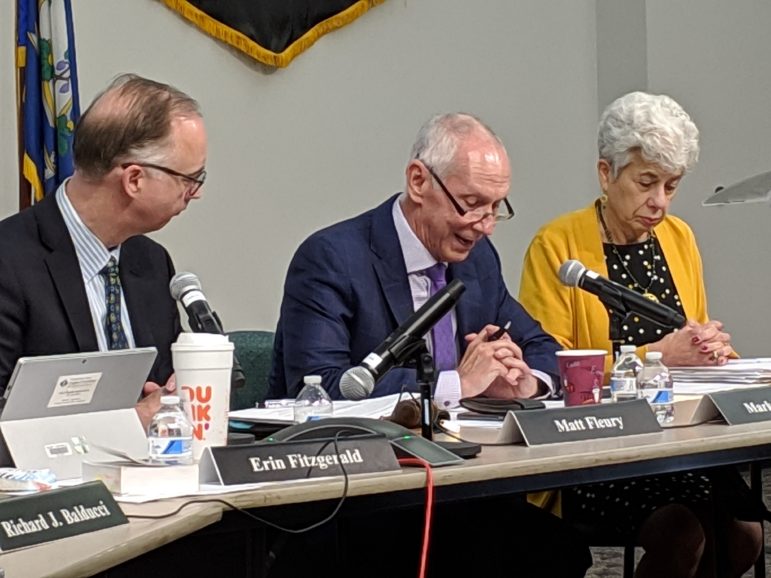
Connecticut State University President Mark Ojakian talks about the three regional presidents hired Thursday at a Board of Regents for Higher Education meeting. To his left is Regent Merle Harris and to his right is Matt Fleury, the chairman of the Board of Regents.

Kathleen Megan :: CT Mirror

Connecticut State University President Mark Ojakian talks about the three regional presidents hired Thursday at a Board of Regents for Higher Education meeting. To his left is Regent Merle Harris and to his right is Matt Fleury, the chairman of the Board of Regents.

The Board of Regents for Higher Education forged ahead Thursday with controversial plans to merge the state's 12 community colleges by hiring three regional presidents — newly created positions, each with yearly salaries of $220,000.

At the same meeting, the board approved a 2.1 percent increase in tuition and fees for community college students  that amounts to a $92 annual increase for full time students and is expected to bring in $2.7 million in additional revenue.

That added revenue comes nowhere near closing the projected budget gap for next year that was also announced Thursday: the shortfall for community colleges has grown in recent months from $22.7 million to $33 million.

Matt Fleury, the chairman of the board,  said of the financial trouble: "We can't do this with tuition. We have structural challenges here and we also just have got to advocate incredibly vigorously for the kind of public funding that these institutions need and deserve."

He said "it's clear this board has not shied away from taking accountability for the aspects of this over which we have something to say — our administrative structure …"

That is where the plan to merge the 12 colleges — proposed by Mark Ojakian, president of the Connecticut State Colleges and Universities and supported by the governing board of regents — is key, according to Ojakian and the regents.

Ojakian has said the plan, which includes consolidating administrative functions and aligning curriculum across the campuses, will not only save money  — $23  million — but will strengthen the number of students graduating successfully and going on to further education or careers.

That merger is years away, however. Accreditors did not approve the first plan for a merger submitted by CSCU last year and have yet to approve a new one. The full merger is not expected to take place until 2023.

Tallwood

Ojakian said Thursday that the hiring of the three regional presidents "is a critical first step in implementing" the merger plan called "Students First."

He has said that he feels the accreditors — the New England  Commission of Higher Education — will be more likely to approve the merger when it comes before them if the administrative structure is already in place.

"The hiring of three regional presidents is a critical first step in implementing Students First," Ojakian said, noting that the presidents will act as "change agents" to bring the college campuses together "to prepare for the new college structure and its mission."

A statement from the regents said the hiring of  presidents is  a "key component of the planning for the single college and puts in place a new structure that provides strategic leadership and centralized services at the system and regional level…"

Each new president will oversee one of three regions in the state with several colleges in each and will be responsible for — among many elements  — looking for ways to save costs by sharing services; aligning curriculum; bringing the campuses together around strategic goals; identifying students' needs and improving student outcomes; and working with businesses and community leaders.

The presidents hired Thursday and scheduled to start this summer are:

— Rob Steinmetz, who will become president of Region One which includes Capital, Manchester, Middlesex, Three Rivers and Quinebaug community colleges, is now serving as vice president for students affairs at Portland Community College in Oregon. He has more than ten years of educational and administrative experience, according to the regents, and holds a Bachelor of Science and a Master of Public Administration degree from the University of Tennessee, Chattanooga, and a Doctorate of Education from the University of Alabama.

He began his collegiate career at Chattanooga State Community College where he earned an Associate Science degree.

Advertisement

Pot - Week 8 - 970 x 250 Black

— James Lombella, who is now serving as president of both Asnuntuck and Tunxis community colleges, will become president of Region Two, which includes Asnuntuck and Tunxis as well as Naugatuck Valley and Northwestern community colleges.

He has had more than a decade of experience in the CSCU system and holds a Master of Management degree from Cambridge College and a Doctor of Education degree from Nova Southeastern University. He began his career at Holyoke Community College in Massachusetts.

James Lombella addresses the Board of Regents for Higher Education after he was selected by the board as a regional president in the community college system.

James Lombella, one of three new regional presidents hired Thursday, speaks to the board.

— Thomas Coley was selected to be the president of Region Three which consists of Gateway, Housatonic and Norwalk community colleges. He now serves as chancellor of the South Bend-Elkhart campus of Ivy Tech Community College in Indiana. He has had more than 30 years of educational and administrative experience and holds a Bachelor of Arts degree from Moorehead State University and a Masters of Arts and Ph.D from the University of Wisconsin. Coley announced in January that he is retiring from Ivy Tech as of May 31.

Ojakian said that the new presidents were selected from a field of 61 applicants by three regional advisory committees that included 50 participants. The 61 candidates came from an array of different backgrounds, Ojakian said, including 11 women, 15 African Americans and four Hispanics. The six finalists included one woman and one African-American man.

Of the three candidates selected, all are men and one, Coley, is African-American. The other two are white.

All three were elected unanimously and each addressed the board — Steinmetz and Coley over speaker phone and Lombella in person — and thanked them.

Steinmetz said that the board's vision "to create a long term solution to what the majority of community colleges are really experiencing across the country is quite frankly what drew me to the opportunity, to explore applying for this role and so I appreciated learning more about that vision as I've gone through the process."

He said it's clear to him that there is "a great deal of passion and pride for each community and for how they support their students."

Round 2

Opposition to the merger

Some faculty and legislators have spoken out strongly against the planned merger — fearing that the plan won't really save money, that it will undermine the strength and  identities of the colleges, and hurt student achievement.

They have particularly questioned the wisdom of hiring regional presidents before the proposed single college is approved by accreditors. In addition, legislators are considering a bill that would enable lawmakers to stop plans to merge the 12 community colleges. Senate Bill 749 is now awaiting action.

State Sen. Mae Flexer said of the hiring decision Thursday: "I think this is another example of the Board of Regents moving forward with a proposal despite the fact that the legislature has expressed its concern about trying to get  more scrutiny over the Student First proposal and Gov. Lamont has not weighed in.

"President Ojakian just thinks he can go full steam ahead with his proposal despite concerns expressed not only by the legislature but by students and faculty through-out the state," she continued. "I think they are perplexed and I am so perplexed as to why the components of this proposal are being put in place years before the accreditation would even be considered by NECHE. It's a bad thing to do. We are going to have duplicative structures."

Elle Van Dermark, a faculty member at Asnuntuck Community College, said she is disappointed the regents have "hired another layer of management and continue to implement a plan that has been so clearly refuted by a cadre of experienced higher education leaders in Connecticut and across the nation.

"More troublesome is the tens of millions of dollars  being wasted on an ever-growing CSCU administration…. and they have increased student tuition!  It is a sad testament to what is valued and important by the CSCU and BOR. "

Stephen Adair, a sociology professor at Central Connecticut State University, which is part of the CSCU system, said the "community college campuses are starved for resources" but the system administration "just continues to add more and more senior people on to an already bloated central administration."

He noted that the 12 community colleges will continue to be individually  accredited until 2023, which means that the departments on the campuses will continue to be overseen and directed by the campus president or a chief executive officers.

"It is hard to see what these Regional Presidents will be presiding over," Adair said.

Expertise

Ojakian said the regional presidents will not be duplicating the efforts of the presidents or chief executives on the campuses.

"I don't think there will be overlap at all," he said.  "I think a local campus president or leader is going to focus on their individual institution and continue to enhance the community connection of that local institution. The regional presidents will work with all of them to try to leverage expertise and scale best practices across the region."

And if the accreditors don't approve the single college, what  happens to the regional presidents?

"I think they stay in place," Ojakian said.

Kathleen Megan Kathleen Megan wrote for more than three decades for the Hartford Courant, covering education in recent years and winning many regional and national awards. She is now covering education and child welfare issues for the Mirror.


~A.

Monday, April 15, 2019

Why You Procrastinate (It Has Nothing to Do With Self-Control) - The New York Times


Why You Procrastinate (It Has Nothing to Do With Self-Control)

If procrastination isn't about laziness, then what is it about?

If procrastination isn't about laziness, then what is it about?

Erik Winkowski

If you've ever put off an important task by, say, alphabetizing your spice drawer, you know it wouldn't be fair to describe yourself as lazy.

After all, alphabetizing requires focus and effort — and hey, maybe you even went the extra mile to wipe down each bottle before putting it back. And it's not like you're hanging out with friends or watching Netflix. You're cleaning — something your parents would be proud of! This isn't laziness or bad time management. This is procrastination.

Etymologically, "procrastination" is derived from the Latin verb procrastinare — to put off until tomorrow. But it's more than just voluntarily delaying. Procrastination is also derived from the ancient Greek word akrasia — doing something against our better judgment.

"It's self-harm," said Dr. Piers Steel, a professor of motivational psychology at the University of Calgary and the author of "The Procrastination Equation: How to Stop Putting Things Off and Start Getting Stuff Done."

That self-awareness is a key part of why procrastinating makes us feel so rotten. When we procrastinate, we're not only aware that we're avoiding the task in question, but also that doing so is probably a bad idea. And yet, we do it anyway.

"This is why we say that procrastination is essentially irrational," said Dr. Fuschia Sirois, professor of psychology at the University of Sheffield. "It doesn't make sense to do something you know is going to have negative consequences."

She added: "People engage in this irrational cycle of chronic procrastination because of an inability to manage negative moods around a task."

Wait. We procrastinate because of bad moods?

In short: yes.

Procrastination isn't a unique character flaw or a mysterious curse on your ability to manage time, but a way of coping with challenging emotions and negative moods induced by certain tasks — boredom, anxiety, insecurity, frustration, resentment, self-doubt and beyond.

"Procrastination is an emotion regulation problem, not a time management problem," said Dr. Tim Pychyl, professor of psychology and member of the Procrastination Research Group at Carleton University in Ottawa.

In a 2013 study, Dr. Pychyl and Dr. Sirois found that procrastination can be understood as "the primacy of short-term mood repair … over the longer-term pursuit of intended actions." Put simply, procrastination is about being more focused on "the immediate urgency of managing negative moods" than getting on with the task, Dr. Sirois said.

Attention Management Week in Smarter Living

Read more from this series about taking back your attention — and spending it wisely.

The particular nature of our aversion depends on the given task or situation. It may be due to something inherently unpleasant about the task itself — having to clean a dirty bathroom or organizing a long, boring spreadsheet for your boss. But it might also result from deeper feelings related to the task, such as self-doubt, low self-esteem, anxiety or insecurity. Staring at a blank document, you might be thinking, I'm not smart enough to write this. Even if I am, what will people think of it? Writing is so hard. What if I do a bad job?

All of this can lead us to think that putting the document aside and cleaning that spice drawer instead is a pretty good idea.

[Like what you're reading? Sign up here for the Smarter Living newsletter to get stories like this (and much more!) delivered straight to your inbox every Monday morning.]

But, of course, this only compounds the negative associations we have with the task, and those feelings will still be there whenever we come back to it, along with increased stress and anxiety, feelings of low self-esteem and self-blame.

In fact, there's an entire body of research dedicated to the ruminative, self-blaming thoughts many of us tend to have in the wake of procrastination, which are known as "procrastinatory cognitions." The thoughts we have about procrastination typically exacerbate our distress and stress, which contribute to further procrastination, Dr. Sirois said.

But the momentary relief we feel when procrastinating is actually what makes the cycle especially vicious. In the immediate present, putting off a task provides relief — "you've been rewarded for procrastinating," Dr. Sirois said. And we know from basic behaviorism that when we're rewarded for something, we tend to do it again. This is precisely why procrastination tends not to be a one-off behavior, but a cycle, one that easily becomes a chronic habit.

Over time, chronic procrastination has not only productivity costs, but measurably destructive effects on our mental and physical health, including chronic stress, general psychological distress and low life satisfaction, symptoms of depression and anxiety, poor health behaviors, chronic illness and even hypertension and cardiovascular disease.

But I thought we procrastinate to feel better?

If it seems ironic that we procrastinate to avoid negative feelings, but end up feeling even worse, that's because it is. And once again, we have evolution to thank.

Procrastination is a perfect example of present bias, our hard-wired tendency to prioritize short-term needs ahead of long-term ones.

"We really weren't designed to think ahead into the further future because we needed to focus on providing for ourselves in the here and now," said psychologist Dr. Hal Hershfield, a professor of marketing at the U.C.L.A. Anderson School of Management.

Dr. Hershfield's research has shown that, on a neural level, we perceive our "future selves" more like strangers than as parts of ourselves. When we procrastinate, parts of our brains actually think that the tasks we're putting off — and the accompanying negative feelings that await us on the other side — are somebody else's problem.

To make things worse, we're even less able to make thoughtful, future-oriented decisions in the midst of stress. When faced with a task that makes us feel anxious or insecure, the amygdala — the "threat detector" part of the brain — perceives that task as a genuine threat, in this case to our self-esteem or well-being. Even if we intellectually recognize that putting off the task will create more stress for ourselves in the future, our brains are still wired to be more concerned with removing the threat in the present. Researchers call this "amygdala hijack."

Unfortunately, we can't just tell ourselves to stop procrastinating. And despite the prevalence of "productivity hacks," focusing on the question of how to get more work done doesn't address the root cause of procrastination.

Erik Winkowski

O.K. How do we get to the root cause of procrastination?

We must realize that, at its core, procrastination is about emotions, not productivity. The solution doesn't involve downloading a time management app or learning new strategies for self-control. It has to do with managing our emotions in a new way.

"Our brains are always looking for relative rewards. If we have a habit loop around procrastination but we haven't found a better reward, our brain is just going to keep doing it over and over until we give it something better to do," said psychiatrist and neuroscientist Dr. Judson Brewer, Director of Research and Innovation at Brown University's Mindfulness Center.

To rewire any habit, we have to give our brains what Dr. Brewer called the "Bigger Better Offer" or "B.B.O."

In the case of procrastination, we have to find a better reward than avoidance — one that can relieve our challenging feelings in the present moment without causing harm to our future selves. The difficulty with breaking the addiction to procrastination in particular is that there is an infinite number of potential substitute actions that would still be forms of procrastination, Dr. Brewer said. That's why the solution must therefore be internal, and not dependent on anything but ourselves.

One option is to forgive yourself in the moments you procrastinate. In a 2010 study, researchers found that students who were able to forgive themselves for procrastinating when studying for a first exam ended up procrastinating less when studying for their next exam. They concluded that self-forgiveness supported productivity by allowing "the individual to move past their maladaptive behavior and focus on the upcoming examination without the burden of past acts."

Another tactic is the related practice of self-compassion, which is treating ourselves with kindness and understanding in the face of our mistakes and failures. In a 2012 study examining the relationship between stress, self-compassion and procrastination, Dr. Sirois found that procrastinators tend to have high stress and low self-compassion, suggesting that self-compassion provides "a buffer against negative reactions to self-relevant events."

In fact, several studies show that self-compassion supports motivation and personal growth. Not only does it decrease psychological distress, which we now know is a primary culprit for procrastination, it also actively boosts motivation, enhances feelings of self-worth and fosters positive emotions like optimism, wisdom, curiosity and personal initiative. Best of all, self-compassion doesn't require anything external — just a commitment to meeting your challenges with greater acceptance and kindness rather than rumination and regret.

That may be easier said than done, but try to reframe the task by considering a positive aspect of it. Perhaps you remind yourself of a time you did something similar and it turned out O.K. Or maybe you think about the beneficial outcome of completing the task. What might your boss or partner say when you show them your finished work? How will you feel about yourself?

What are some other, healthier ways to manage the feelings that typically trigger procrastination?

Cultivate curiosity: If you're feeling tempted to procrastinate, bring your attention to the sensations arising in your mind and body. What feelings are eliciting your temptation? Where do you feel them in your body? What do they remind you of? What happens to the thought of procrastinating as you observe it? Does it intensify? Dissipate? Cause other emotions to arise? How are the sensations in your body shifting as you continue to rest your awareness on them?

Consider the next action: This is different than the age-old advice to break up a task you're tempted to avoid into bite-sized chunks. According to Dr. Pychyl, focusing only on the "next action" helps calm our nerves, and it allows for what Dr. Pychyl called "a layer of self-deception." At the start of a given task, you can consider the next action as a mere possibility, as if you were method acting: "What's the next action I'd take on this if I were going to do it, even though I'm not?" Maybe you would open your email. Or perhaps you would put the date at the top of your document. Don't wait to be in the mood to do a certain task. "Motivation follows action. Get started, and you'll find your motivation follows," Dr. Pychyl said.

Make your temptations more inconvenient: It's still easier to change our circumstances than ourselves, said Gretchen Rubin, author of "Better Than Before: What I Learned About Making and Breaking Habits." According to Ms. Rubin, we can take what we know about procrastination and "use it to our advantage" by placing obstacles between ourselves and our temptations to induce a certain degree of frustration or anxiety. If you compulsively check social media, delete those apps from your phone or "give yourself a really complicated password with not just five digits, but 12," Ms. Rubin said. By doing this, you're adding friction to the procrastination cycle and making the reward value of your temptation less immediate.

On the other side of the coin, Ms. Rubin also suggested that we make the things we want to do as easy as possible for ourselves. If you want to go to the gym before work but you're not a morning person, sleep in your exercise clothes. "Try to remove every, every, every roadblock," Ms. Rubin said.

Still, procrastination is deeply existential, as it raises questions about individual agency and how we want to spend our time as opposed to how we actually do. But it's also a reminder of our commonality — we're all vulnerable to painful feelings, and most of us just want to be happy with the choices we make.

Now go finish up alphabetizing that spice drawer before it becomes your next procrastination albatross.

Correction: 

An earlier version of this article incorrectly referred to the university at which Judson Brewer is employed.

A version of this article appears in print on , on Page B8 of the New York edition with the headline: Why You Procrastinate and How to Break the Habit. Order Reprints | Today's Paper | Subscribe

You have been logged out because your session expired. Log in here.


Adrienne L den Tex


Wednesday, April 03, 2019

IMPORTANT!!! Radiation Health Risks | RF Radiation From Electronic Devices In Your Home

This site won't reproduce in text, PLEASE go here to study the effects of wireless transmissions to our health, sanity, life expectancy, children and future......

https://www.radiationhealthrisks.com/

~A.

Why 5G Cell Towers Are More Dangerous - Get The Facts!

Why 5G Cell Towers Are More Dangerous - Get The Facts!
FIRST, they it is a system designed to support the takeover of Earth.... aided by the harm they do to earth's nature and human life forms.... 

Why 5G Cell Towers Are More Dangerous

 All cell towers emit Radio Frequency (RF) Radiation. This is what makes them dangerous. Plans to transition to the new 5G around the world is already underway.  Soon every city will be retrofitted with this technology. Mini cell stations will be placed all throughout our neighborhoods and cities. They will be installed on the sides or tops of buildings and on street light poles.

5G cell towers are more dangerous than other cell towers for two main reasons. First, compared to earlier versions, 5G is ultra high frequency and ultra high intensity. Second, since the shorter length millimeter waves (MMV) used in 5G do not travel as far (or through objects), with our current number of cell towers the cell signal will not be reliable. To compensate many more mini cell towers must be installed. It is estimated that they will need a mini cell tower every 2 to 8 houses. This will greatly increase our RF Radiation exposure.

1G, 2G, 3G and 4G use between 1 to 5 gigahertz frequency. 5G uses between 24 to 90 gigahertz frequency. Within the RF Radiation portion of the electromagnetic spectrum, the higher the frequency the more dangerous it is to living organisms. 

With RF Radiation, how close the source is to our physical bodies, is more important than the power level (or wattage) of the radiation. RF Radiation dissipates with distance. In other words, a low powered exposure right next to someone, is more dangerous than a more powerful exposure a long ways away. Also the longer the exposure time is, the more dangerous it is. 5G will be the worst of both worlds. We will have more sources around us, and closer to us. And they will be more powerful and continuous emissions. 

In the below video I explain in a bit more detail why 5G is more dangerous than previous technologies. I apologize for looking so beat in this video. I really should not have tried to do a video when I was so tired. This is a video I will be re-doing. However the information is very good and super important. It is a short video and very much worth watching. 

RF Radiation Dangers

There have been hundreds of peer reviewed scientific studies done on RF Radiation linking it to health problems such as cancer, DNA damage (especially in fetuses within the 1st 100 days after conception), and sterility in men. And even the World Health Organization classified RF Radiation as a possible "carcinogenic", meaning "cancer causing", in 2011. To research some of the actual peer reviewed scientific studies on both general RF Radiation, and 5G, see the "Scientific Studies" page of this website. We will also go over a few of these studies below in this article.

Mini 5G Cell Tower In Your Home

Many people do not realize that they already have a mini cell tower emitting high levels of RF Radiation in their homes and offices right now. Some even have a 5G mini cell tower. We call them WiFi routers. Just like a cell tower, a WiFi router emits at full power 24 hours a day 7 days a week, or as long as you have it turned on. It's range includes your entire home and beyond. It's radiation is the exact same RF Radiation that a cell tower emits, or that your microwave oven uses to cook your food.

For example, my WiFi router is a Netgear 5 GHz router that emits both at the 5 GHz and 2.4 GHz frequencies. A microwave oven uses 2.45 GHz frequency to cook food. The new 5G WiFi routers that are available now use the 60 GHz, 5 GHz and the 2.4 GHz frequencies. So having one of those routers is really like having a 5G mini cell tower inside of your home. 

WIFI Router Guard

WiFi Router In A WiFi Router Guard

WiFi Router Guard

It is possible to protect yourself from the RF Radiation emitted by your WiFi router. In the picture to the left you can see something called a Wifi Router Guard. By putting your WiFi router in one of these it will block between 90% and 95% of the RF Radiation they emit. And the amazing part is you will still be able to use the WiFi.  In my case our WiFi does not seem slow anywhere in our 3 bedroom home. 

In the below video I measure the amount of RF Radiation emitted by my 5 GHz Netgear WiFi router. Then I place it in a Wifi Router Guard and test it again so you can see how much RF Radiation it blocks. It is a short video but definitely worth watching.

If you don't have the ability or resources to hard wire internet through your house, or if for some reason you must have WiFi, a WiFi Router Guard is a very effective solution. For more information on the WiFi Router Guard click this link Wifi Router Guard. Also for more information about other RF Radiation dangers inside your home, please see my article "The 7 Worst Radiation Dangers in Your Home".

Electromagnetic Radiation

In the chart below you see what is called the "electromagnetic spectrum". The "Radio waves" and "Microwaves" part of the spectrum is what is referred to as RF Radiation. So microwaves are just a higher frequency radio wave. And remember that within the RF Radiation part of the electromagnetic spectrum, the higher the frequency the more dangerous the waves are to living organisms. (This is not the case in the infrared and visible light portions of the spectrum.)  

Electromagnetic Spectrum

RF Radiation Scientific Studies

In Germany, researchers studied 1000 residents who lived in close proximity to two cell phone towers for about 10 years. According to the study, during the last five years of the observations, researchers discovered neighbors living within 400 meters of the cell towers were diagnosed with cancer at a rate that was three times higher than those who lived much further away.

Another frightening study in 1994, well before 3G, 4G and 5G, links significant health problems with people living in a London apartment building with a cell phone mast on the roof. In this study, the cancer rate of those living on the top floor of the apartment building- the closet to the tower, had a cancer rate of 10 times the average in England.

If that isn't enough to convince you there is a significant link between cell phone towers and health problems consider a recent study in Italy. In March 2018, the researchers at the world-renowned Ramazzini Institute released the shocking results of a large-scale study of lab animals exposed to cell tower radiation over a lifetime.

"The Ramazzini study exposed 2448 Sprague-Dawley rats from prenatal life until their natural death to "environmental" cell tower radiation for 19 hours per day. RI exposures mimicked base station emissions like those from cell tower antennas, and exposure levels were far less than those used in the NTP studies of cell phone radiation."- ehtrust.com

NTP refers to the National Toxicology Program study that recently linked cell phone radiation to heart cancer in male rats.  The Ramazzini study is the first to complete a study of this scale, over a significant period of time. Together, the studies make a strong argument for more guidelines and standards to protect public health. Health experts from around the world are weighing in on the significance of the findings and urging the World Health Organization to act.

"This study raises concerns that simply living close to a cell tower will pose threats to human health. Governments need to take measures to reduce exposures from cell tower emissions. Cell towers should not be near schools, hospitals or people's homes.  Public health agencies need to educate the public on how to reduce exposure from all sources of wireless radiofrequency radiation- be it from cell towers or cell phones or Wi-Fi in schools," said Dr. David Carpenter, former Dean of the School of Public Health and the University of Albany.

"This is particularly urgent because current plans to place small 5G cell towers about every 300 meters in every street across the country.  These 5G "small cell' antennas will result in continuous exposure to everyone living nearby and everyone walking down the street.  The increased exposures will increase the risk of cancer and other diseases such as electro-hypersensitivity," said Dr. Carpenter.

The risk is very real. As Dr. Carpenter indicated, public health is at risk with plans for more and more smaller towers to go up on every street corner around the world.

According to experts, doctors and researchers, radiation has the power to change our bodies on the cellular level. These changes, as supported in several studies, create a perfect environment for cancer and other ailments to take over inside our body.

Other studies link cell phone and cell tower radiation to memory loss, headaches, changes in vision and mood, sleep disorders and leukemia. The rollout of 5G and the infrastructure to support it will only increase our risk of suffering major health issues down the road.

Cell Tower Radiation Measured

In the below video I am standing next to an office building that just had a huge cell tower built right next to it. From the office building I measure how much RF Radiation the cell tower is raining down upon the office building. I just cannot believe they build these things so close to people.

See also "Is 5G Safe or Dangerous? Here are the Facts."

5G: What Do The Studies Say?

As companies prepare to make 5G a reality, may doctors and scientists believe the technology will be a "massive public health experiment."

According to Dr. Joel Moskowitz, a public health professor at the University of California, the increase in mini-cell towers across towns and cities is only part of the concern. Dr. Moskowitz says the lower frequency millimeter waves used in 5G could cause major skin, eye, and nervous system problems.

"The deployment of 5G, or fifth generation cellular technology, constitutes a massive experiment on the health of all species… Because MMWs are weaker than microwaves, they are predominantly absorbed by the skin, meaning their distribution is quite focused there.  Since skin contains capillaries and nerve endings, MMW bio-effects may be transmitted through molecular mechanisms by the skin or through the nervous system," said Dr. Moskowitz.

Dr. Moskowitz also believes that MMV can make some pathogens resistant to antibiotics.

Dr. Moskowitz is not alone in his concern about 5G.  Dr. Yael Stein from Jerusalem's Hebrew University recently wrote a letter to the Federal Communications Commission outlining his major concerns about 5G, MMV and how it could impact human skin.

Dr. Stein argues the human skin has the ability to absorb more than 90% of microwave radiation and will cause major problems from head to toe- especially for the vulnerable such as kids, elderly and pregnant women.

MMVs are also believed to cause physical pain. A recent article in Eluxe Magazine takes a deeper look at the issue.  According to the article, MMVs could cause pain receptors to flare up in the human body, and cause great damage to our eyes, cell growth and compromise our immune system.

In fact, the U.S. Government currently uses MMV energy as a non-lethal weapon.  This weapon is direct and more intense than the MMVs from a 5G network, however, it's similar and concerning.  According to the U.S Department of Defense, the active denial system creates a focused MMV beam that is capable of penetrating the skin, which can create a burning or a stinging sensation.

Some experts even argue 5G will have a devastating impact on our environment as well. A 2010 linked aspen leaf damage to MMV exposure.  Some researchers also found MMV's can cause cell damage in wheat plants, impact wildlife and affect our atmosphere.

Only time will tell how the 5G network will impact our health and the environment. We know existing cell towers are dangerous and with plans to build thousands, if not millions more- it could become very interesting.  It's clear though, MMVs are not safe for the general public- especially considering we will be exposed everywhere we go, even at home.

Ways to Reduce Exposure to 5G

5G is expected to be ready to go by 2020 so you have plenty of time to prepare and make plans to reduce your exposure to MMVs and other cell towers. Because 5G towers will be everywhere it will be difficult to avoid all exposure, so you'll have to take care of your immune system and make healthy choices.

Boosting your immune system with natural fruits and vegetables is a great way to keep your cells healthy and keep diseases at bay. In addition to making healthy food choices, you can take several precautions around your home.

Some experts believe the best way to keep cell tower radiation from penetrating your home is to create a highly conductive enclosure around your home. So, what does this mean? It means first measuring the levels of radiation with HF35C meter. This meter will give you various levels throughout your home and determine what areas you need to focus on first.  Right now, there are various window coverings, paints that will keep radiation from penetrating your home.

Many doctors suggest keeping your distance from the cell towers in question. This could be very hard to do given these 5G towers will be on every corner on every building. Unless you never leave the house, I don't see this as being a realistic expectation.

I'm hoping there will be an app or map listing all the cell phone towers in every neighborhood, in every city across the world. This would certainly make it easier to know where the new 5G towers are located and how to avoid them when necessary. This information would be helpful to those who are exceptionally vulnerable to cell tower radiation such as children, infants, elderly and pregnant women.

Reducing Radiation In Your Home

While you can't control where the cell towers go, you can control how and when you use your own cell phone. By limiting your time on your phone and using radiation blocking cases and shielding headsets, you can greatly reduce your exposure to cell phone radiation. Every little bit helps. Please see also our article entitled "Why Are 5 GHz WiFi Routers More Dangerous?"

Also, if you have an office- make sure you turn off your Wi-Fi router when you're not using it. And keep your cell phone out of your room at night. Various studies link cell phone radiation to disruptive sleep patterns. When you don't sleep well, it can throw off your entire day.  By leaving your cell phone out of your room at night, you'll never have to count sheep again.

Take a closer look at your meter outside your house. Many power companies are switching to smart meters. These meters take the guesswork out of how much energy you are using. Smart meters wirelessly transmit data constantly throughout the day, giving the power companies real-time information about your energy consumption. Smart meters take the place of meter readers. Smart meters, however, transmit harmful levels of radiation. If you can, get a smart meter guard to protect you and your family from harmful radiation.  You can purchase a smart meter guard for your router and cell phone for under $100.

By reducing your risk of radiation, you can improve your chances of staying healthy and living a long and joyful life.

If you have kids, pay attention to the Wi-Fi situation at school and in their classrooms.  Some studies link ADD, ADHD, memory issues, and behavior problems with Wi-Fi routers and nearby cell towers.  Cell phone towers are a big business for school districts.  Many districts across the country are selling or renting land for cell phone towers. If this is happening in your neighborhood, speak up.  It's only going to become more prevalent with the rollout of 5G.

Why Are Companies Pushing 5G?

5G is the wave of the future. This advanced bandwidth will allow you to download movies in a matter of seconds and is expected to support at least a100 billion devices. That's a whole lot of devices one bandwidth.  In general, 5G will be up to 100 times faster than 4G. That's fast!

5G stands for 5th generation cellular technology.  This is the latest development in the cellular world.  Major cell phone companies and other tech giants are making progress right now to be ready to launch 5G capable devices by 2020.

I won't get over technical but in general, 5G will make technology faster, smarter and create a more connected world.  According to Tech Radar, 5G will have an average download speed of about 1GBps (1 gigabyte per second).

With faster connectivity, this network will be capable of supporting the Internet of Things, your personal devices and various networks without any delay. Plus, with 5G the connections will be more reliable as well. No more dropped calls or delays when trying to browse the internet.

"It's all about making better use of the radio spectrum and enabling far more devices to access the mobile internet at the same time"-BBC.

5G is being touted as the golden ticket to cellular connectivity. More speed, less waiting and more people and things connected than ever before.  However, as I mentioned earlier, advances in technology will no doubt have an impact on our health- impacts we may not even realize are happening until it's too late.

 How Will 5G Work?

5G is the super highway for speed, information, and connections.  To create this incredible speed and reliability, 5G uses the millimeter wave. This millimeter wave operates between 30GHZ and 300 GHz. According to the BBC, "The higher-frequency bands have a lot of capacity but their shorter wavelengths mean their range is lower." This means the 5G signal is easily blocked by buildings, cars, planes, plants and other objects.

Because the signal will face so many obstacles, an entire web of small-mini cell towers will need to go up in every city, on every block in every neighborhood around the world. No word yet on exactly how many towers or small masts will need to be installed to support this network.  It could easily add up to billions of towers.

A recent article in the UK estimated at least 400,000 extra phone masts would be needed to bring rural Britain to be 5G compatible. That's just the rural part of Britain.  It's estimated there could be thousands of extra small masts in every single city around the world.

According to experts, the 5G masts will be about four feet tall- not nearly the same height as needed with 4G and 3G networks. These towers will be around every corner and will make communicating with your house, car, and family a breeze. However, being that connected- with so many signals around may cause major health problems. I'll address this later on in this article.

So, who decides where these towers will go? That's a great question and one local government across the country and world are addressing right now. However, internet and cell phone providers have lobbyists working with state lawmakers to restrict how much say local government has as to where and when the 5G network cell towers will be placed.  As I write this article, 13 states have laws on the books to limit local governments from having a say in the 5G process.

The Difference Between 3G, 4G, and 5G

To understand why 5G cell towers are more dangerous than other cell towers, we need to take a closer look at how each network operates. As I mentioned earlier, 5G is the 5th generation of cellular technology and needs shorter waves to function at a high speed.  Shorter waves mean there's a greater need for more cell towers because these specific waves have lots of obstacles.

Let's start with 3G.  3G stands for the 3rd generation of cellular technology.  This advancement in technology was unveiled in 2003. 3G operates using cellular technology, as in the signals are passed from tower to tower.  Then onto the next cell phone tower and so on. This continues until you answer your phone, find your answer on Google and finish watching YouTube.

Cell phone companies strategically place the cell towers in various locations and different heights to give you the best signal possible.  3G was mostly used to make phone calls, texting, and limited internet use.

With 3G the signal can travel farther- however, there has to be another tower around to pick up the signal and you're moving.  If there isn't another tower then you experience a temporary interruption in service. With 3G you need fewer towers than 5G to operate. Fewer towers mean less exposure to potentially harmful cell tower radiation.

3G is also referred to as mobile broadband. This term became a catchy way to sell phones and tablets in the mid-2000s. Mobile broadband basically means there are enough cell towers to keep your signal connected while you're moving around town or traveling around the world!

The data speeds for 3G are much slower than 4G and certainly much slower than 5G.

Let's take a closer look at 4G.  4G is what most of us are using today. It's the reason you can Facetime with your best friend in Europe or download an entire movie on your tablet.  Some tech experts describe 4G as removing speed bumps in the cellular signal, "allowing traffic to move much faster."

4G uses cell towers, just like with 3G- however, the speed at which data and information can travel is much different.  4G uses more bandwidth than 3G, which means towers need to be more powerful.  The more powerful the cell phone towers, the more potential for radiation to be emitted into our environment.

Even though 4G is more powerful than the 3G network- it's not nearly as powerful as 5G. 5G is the super horse, a new wave of technology designed to connect everything via the internet.  It's a game changer.  This big shift could mean big health consequences as well.

Future of 5G

The future is here and companies are building the infrastructure needed to create a full world-wide rollout of 5G by 2020.  AT&T is leading the way in this major effort to make cities 5G compatible.  In July, the tech giant announced plans to have the 5G infrastructure in place and ready to go in 12 cities by the end of this year. Verizon and T-Mobile are also planning limited rollouts of 5G in the next year or so.

There is still a lot of work to be done on the 5G front.  In May, Verizon announced Los Angeles will be one of the first cities in America to make the move to 5G. This is not a small feat by any means. According to an article in Tech Crunch, Lowell McAdam, Chief Executive for Verizon, said the company purchased 36 million miles of fiber so they can support the hundreds of megahertz of bandwidth needed to deliver "the whole suite of 5G." McAdam said Verizon has added 1,000 extra cell sites in LA to make the 5G experience possible.

Verizon also has plans to bring Boston and other major cities into the 5G era as soon as possible. AT&T announced it's working on 5G capabilities in Atlanta, Dallas, and Waco, TX.  Sprint says its bringing 5G to NYC, Phoenix and Kansas City.

Right now, AT&T is running 5G trials in Waco, TX, and Dallas. South Korea unveiled its 5G system during the Winter Olympics this year.

South Korea, Sweden, Turkey, Japan, and China are also working hard to create a seamless transition to 5G. Some industry insiders are calling the 5G networks a technological revolution.  The information, data, and insights made possible by 5G will change how people interact with each other and how businesses operate. According to one article I recently read, 5G has the power to increase revenue across a variety of industries- to the tune of $12 trillion dollars. Yes, trillion dollars.

"Unlike its predecessors though, 5G is a technological paradigm shift, akin to the shift from typewriter to computer. And it isn't just a network. 5G will become the underlying fabric of an entire ecosystem of fully connected intelligent sensors and devices, capable of overhauling economic and business policies, and further blurring geographical and cultural borders. It will be capable of delivering at every rung of the ecosystem's ladder and will provide seamless, continuous connectivity for business applications," Technology Review.

"All industries will feel the effects of the shift to 5G. In particular, automotive, health care, and the Internet of Things (IoT) are expected to bring about dramatic transformations in our daily lives."- Technology Review.

Most companies in the United States hope to have the 5G infrastructure in place by 2020.  Each country has its own timeline on a 5G rollout.

Will I need a new Phone/Tablet?

Yes, you will most likely need to buy a new phone to take advantage of the speed and reliability promised by 5G. However, if you like your phone and don't want to spend the extra money, your current 4G phone will continue to work just fine- for now.

As I mentioned earlier, 5G offers more bandwidth- which means it can support more data.  This network is also more reliable. Some cell phone and tech companies are already offering 5G compatible phones and tablets that make the most out of the new technology.

Your phone is only part of the 5G equation. You may have to pay more for 5G service. It's unclear what the new plans will cost, but it's likely all the major carriers will be competitive to keep customers from jumping ship. In general, you get what you pay for.  Better service will mean you will have to pay at least more than your currently used to.  Time to start your 5G fund!

5G and You

There's no doubt 5G will change our physical and virtual landscape. However, it's clear this technology comes with major health concerns too. The wave of the future may also mean a wave of new cancers, illnesses, and disabilities.

More research and studies need to be completed before the entire 5G rollout is complete. The potential health consequences associated with the 5G infrastructure is too great to ignore.   If you can, stay in contact with your government and advocate for local control over where 5G mini cell towers are located. We must approach this new technology with respect and caution.

For more information on the dangers of cell phone tower radiation check out my blog, Is Cell Phone Tower Radiation Harmful?


~A.