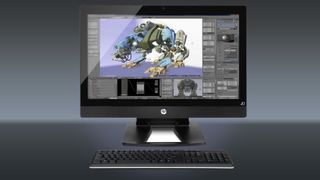
Welcome to our list of the best workstations of 2019. These are the very best, most powerful, workstation machines that can power your business.
These days, the best workstations are around the same size as normal PCs, and offer high quality designs, without sacrificing pure power and performance. Some, such as the iMac Pro and the Surface Studio, are slimline all-in-one PCs that offer brilliant performance whilst not taking up loads of room in your office.
The best workstations can handle any application you throw at it, and they are useful tools for designers, engineers, financial analysts and researchers running more demanding applications, like rendering complex graphics, financial analysis and computations and digital content creation
We've rounded up 10 of what we consider to be the best workstations currently on the market - in no particular order - from the main vendors.
From small form factor models to powerhouses, from all-in-ones to one for all, there's bound to be one for you if you're in the market.
At the bottom of this page you'll also find our list of the best online shops for buying workstations - so purchasing the perfect workstation for your business has never been easier!
CPU: Intel Core i9-9920X | Graphics: Nvidia GeForce RTX 2080 Ti | RAM: 32GB | Storage: 960GB SSD, 2TB HDD | Communications: Gigabit Ethernet | Dimensions (W x D x H): 20 x 17.6 x 38cm
Not all components are upgradable
The Corsair One Pro i180 is currently our pick for the best workstation in 2019. Not only is it one of the most powerful desktop PCs we've ever used, but it's also one of the most nicely designed. The dimensions of the Corsair One Pro i180 are 200 x 172.5 x 380mm, which is incredibly compact considering the amount of power it offers. This is a workstation that can easily fit on – or under – a desk, and it looks simply amazing. It manages to keep cool, and most of the components can be upgraded as well, though it's not as straightforward as in a traditional PC tower. Power-wise it comes with an Intel Core i9-9920X, Nvidia RTX 2080 Ti, 32GB of DDR4 RAM, 920GB NVMe M.2 SSD and 2TB hard drive. That's some seriously impressive and cutting-edge hardware. But this all comes at a cost. A very, very high cost.
This excellent all-in-one workstation from Dell comes with an imposing 27-inch 4K Ultra HD touchscreen display, as well as a set of six speakers. That makes for the ideal workstation for photographers, video editors and music producers.
The Dell XPS 27 performs admirably against industry-standard graphics-based benchmarks, no doubt thanks to the pacey 3.6GHz Intel Core i7-7700 processor under the casing. And this premium machine also gets premium peripheries in the form of a sleek and stylish wireless mouse and keyboard.
3. Apple Mac Pro
CPU: Intel Xeon E5-1650 v2 | Graphics: Dual AMD FirePro D500 | RAM: 16GB | Storage: 256GB SSD | Communications: 802.11ac, Gigabit Ethernet | Dimensions (W x D x H): 25 x 17 x 17cm
An upgrade to the Mac Pro is imminent so you might want to hold on. But when it comes to the quintessential workstation, nothing comes near to this monolith. How Apple has been able to pack so much firepower into such a small volume almost defies the laws of physics. The current model, though, is well past its prime.
It packs a 3-year old Intel Ivy-Bridge Xeon processor with up to 64GB DDR3 ECC RAM and 1TB storage (no RAID option though). Its two AMD FirePro D500 GPUs are likely to be the weakest link in the system, however, and even the top of the range model doesn't meet the minimum requirements to run the HTC Vive or Oculus Rift VR platform. It's also far more expensive than a comparable Windows-based workstation.
CPU: Intel Xeon W | Graphics: AMD Vega 64 (16GB HBM2 RAM) | RAM: 128GB | Communications: Gigabit Ethernet | Dimensions (W x D x H): 65 x 20.3 x 51.6cm
The Apple iMac Pro is the most powerful PC that Apple has ever made, so if you love the design of Apple's devices, while using its software, then the iMac Pro is an excellent workstation. Its all-in-one form factor gives you plenty of space on your desk, but it is very expensive, which turn some people off.
Microsoft has produced a brilliant all-in-one workstation that rival's Apple's iMacs for power and desirability. If you're wedded to the Windows 10 ecosystem, then this is a great alternative to the iMac Pro. Versatile and forward-thinking, Microsoft's all-in-one puts the iMac to shame by introducing an all-in-one that can not only replace your lingering desktop tower, but your Cintiq as well.
6. Mac Mini 2018
Same size, way more power
CPU: 8th-generation Intel Core i3 – Core i7 | Graphics: Intel UHD Graphics 630 | Storage: 128GB – 2TB PCIe Flash | Dimensions (W x D x H): 19.7 x 19.7 x 3.6cm
The Mac mini 2018 has finally been refreshed with modern hardware, bring Apple's tiniest Mac into the modern age. This thing is filled to the brim with 8th-generation desktop processors, a ton of RAM and some of the fastest SSDs we've seen – all while keeping the same beloved form factor. OK, while it's not as powerful as the other workstations on this list, it has a few tricks up its sleeve which makes this worth considering. First, you can add an external graphics card to the Mac mini for added graphical prowess. You can also chain several Mac minis together and offload tasks onto each machine, making it an expandable – and incredibly versatile – workstation.
7. HP Z240 SFF
CPU: Intel Core i7-6700 | Graphics: Intel HD Graphics 530 | RAM: 8GB | : | Communications: Gigabit Ethernet | Dimensions (W x D x H): 34 x 38 x 10cm
Surprisingly compact and powerful
This is HP's entry level workstation and one which is very keenly priced with a very compact form factor (about 11L). It's hard to believe that the Z240 has an Intel Core i7-6700 CPU with 8GB of RAM and a 1TB hard disk drive. There's even an optical drive. The company's engineers have managed to deliver a system that weighs less than 6Kg and somehow has 20 (yes, 20) connectors and expansion slots (not all of them empty of course).
It even has four DIMM slots to take full advantage of dual-channel technology. As for the rest of the HP workstation family, this one comes with the Remote Graphics Software as well as a three-year onsite warranty bundled. The only major compromise is the fact that it will only take low profile graphics cards. HP also offers the option to buy the workstation for as little as £16 per month excluding VAT.
8. Fujitsu Celsius J550
Quintessentially powerful
CPU: Intel Xeon E3-1275 v5 | Graphics: Nvidia Quadro K2200 | RAM: 16GB | Storage: 256GB SSD + 1TB HDD | Communications: Gigabit Ethernet | Dimensions (W x D x H): 33 x 34 x 8.9cm
More expensive than the traditional equivalent form factor
The small form factor market is attracting more manufacturers as they are vying to shed the bulky and wieldy image of the traditional workstation. Few, if any, however, can pride themselves on designing and manufacturing their products in the same area. Fujitsu can – take the J550.
It can take a Xeon E3 CPU, a full-size professional graphics card, 64GB of RAM, offering up to 13.5TB storage and nearly 20 ports and expansion slots including quite a few legacy ones. Fujitsu is also the only company to offer a three-year warranty (either onsite or bring-in) across the EMEIA region, which spans across the whole of Europe, into Africa and stretches as far as India.
To some degree, the term New World Order (NWO) seems to be falling out of vogue as the information war presses onward. With so much corruption and perversion being exposed in every sector of society, who has time to consider the over-arching idea that forms the ideological foundation of it all?
The New World Order has evolved into the unspoken of finish line that anyone in power strives for. It is not a particular group any longer, per se, but rather the supreme idea that total centralization of power is the forgone conclusion for the people of the earth.
"I don't think it's right to frame the New World Order as necessarily a policy or group. I think it's more part of an ideology of globalism that has been explicitly articulated in various ways by various people who are linked, but not always directly like we might think." ~James Corbett
To manifest an idea as big as this for the entire world requires sweeping changes to how people live, what they believe, what they value, and how they interact with each other. It is, in essence, a cultural revolution. This is being accomplished by the slow but steady normalization of ideas and practices into popular culture, so that in time, things once unacceptable become ubiquitous.
This is the proverbial boiling pot of water, slowly cooking the frog who won't notice the rise in temperature until it's already too late to jump for escape. We are slipping into to dangerous territory, and while there is a backlash brewing against many aspects of this, it is advantageous to take note of the full spectrum of societal alterations we are witnessing today.
As examples, here are six things that are being normalized, all around us. They are issues which drastically alter the psychology and behavior of people in ways which reduce personal liberty and individualism, so that the world is more easily led into global governance and top-down tyranny.
1. Permanent War
We've been warned by Orwell that totalitarianism requires permanent war, flipping the script so that war is peace. Randolph Bourne explained to us that war is the health of the state. We've been at war now continuously for sixteen years, and it has become such an ordinary part of life, that no one cares where the wars are or how we got involved. No one cares how dependent our economy has become on resupplying the bombs and weaponry which destabilize the world.
"The impact of war on 'society' is even more dramatic. Bourne writes, "…in general, the nation in war-time attains a uniformity of feeling, a hierarchy of values culminating at the undisputed apex of the State ideal, which could not possibly be produced through any other agency than war." Instead of embodying its peace time principle of functioning — 'live and let live,' society adopts the State's principle of "a group" acting "in its aggressive aspects." [Source]
2. The Denial of Human Nature and of Natural Law
Society is developing in such a way that values can no longer be agreed upon, and values which run counter to nature are being pressed to the top of public consciousness. Confusion over gender identity is perhaps the best example of this, as we now see government enacting laws to punish people who insist that our biological nature is and always will be indisputably clear.
"Nihilism occurs in a society after values have been devaluated. It feels as if values no longer exist. When the value system of society attempts to control the natural world in a way that it cannot be controlled, the system will fail, and then it will appear that society has a lack of values." ~Lauren Rose
3. The Cashless Society
Without micro-management of the individual's finances, humans are still free to act outside of the system by using cash to trade for goods and services without direct oversight from authoritarians. This is quickly coming to an end, however, as many advances toward a cashless society are being made, and at an ever-increasing pace.
If we don't have the ability to trade with one another without permission, then every purchase we make, even for food, is subject to the approval of an inhumane, exploitative government.
"Among the long list of items bundled by consensus reality merchants under the banner of 'conspiracy theory', is a world without cash – where technocrats rule over the populace, and everything and anything is exchanged via plastic and RFID chips.
In this sterile and controlled Orwellian hi-tech society, the idea of cash being passed from hand to hand would be as archaic as the thought of carrying around a rucksack of tally sticks today." ~Patrick Henningsen
Just as in Orwell's 1984 where telescreens watch over everyone with two-way communication, today's world is being engineered to accept and even love total surveillance. Fear has been the main tactic used to push this idea into public consciousness, and the drive for the end of privacy began in earnest after 9/11.
Today, with the ever-present threat of terror attacks surveillance seems like a good idea to many people, but privacy is almost non-existent now even at the consumer level as well. Products willingly purchased by happy customers include the most invasive technologies ever. People are actually paying to place devices in their own homes which listen and see everything and is in constant communication with corporate databases. The technocracy closes in.
"While they understand that connected platforms and devices can lead to negative outcomes, they figure the bad stuff will happen to someone else or, if they suffer in some regard, they will still land on their feet." [Source]
5. Cannibalism
This is almost too bizarre to even think about, but cannibalism is being normalized in mainstream culture. The theme has been recurring quite often in movies, programs and in music videos, and news stories involving cannibalism are frequently found in mainstream media as front page news.
Cannibalism seems like an outlier in the agenda of the NWO, but it plays an especially important role in devaluing human life, and encourages people to willfully participate in the zombification of the self.
"Writers and directors reframing cannibalism as an affliction of the mind rather than the body have turned it into a complex, often conflicted new archetype. Most of the new run of cannibal stories treat their subjects not as monsters, but as human beings wrestling with the all-consuming desire to do something revolting. They're like zombies with a conscience." [Source]
6. Radical Sexual Perversion and Perversion of the Human Body
In the midst of massive revelations about the sexual predation of Hollywood, it's imperative to recognize that sexual perversion and perversion of the self in general are quite already fully normalized today. It is a widely known and tacitly accepted part of the nihilism in our society today.
We are seeing an increase in the amount of busts pedophiles and sex-trafficking rings, and we are hoping to see more exposure of corporate and government pedophiles. The fact that so many busts are happening is an indication of just how big this issue is.
Meanwhile, mainstream news outlets continue to glorify and give ample coverage of extreme surgical body modifications and sex changes in children. This is reinforcing the idea that the human being is an imperfect invention and that to give oneself over so fully to the ego is perfectly acceptable. Once the individual is so totally lost inside of their own body, consciousness will have no center.
Final Thoughts
For the New World Order to be come to fruition, many, many people have to willingly acquiesce to ever-expanding usurpations of natural liberties by ever-growing government. In order for this to happen, people have to be programmed with the idea that individuals are lesser than the group, that human beings are somehow not worth saving. Our culture has to be radically altered to accept a new set of values.
Sigmund Fraud is a survivor of modern psychiatry and a dedicated mental activist. He is a staff writer for WakingTimes.com where he indulges in the possibility of a massive shift towards a more psychologically aware future for humankind.
We can detect subtle changes in our own bodies, by performing our own energy scan on a regular basis.
As the living vehicles for our spirits, our bodies deserve loving attention and care. We can positively affect our health, prevent illness, and heal injuries by regularly focusing our mental and spiritual energy on the workings of our bodies. This can be done by performing a body scan on yourself.
Begin by lying in a comfortable position and taking three deep cleansing breaths. Imagine, if you will, a sunbeam entering the top of your head. Feel this light slowly scanning each part of your internal body. Allow it to scan every cell in your body and keep breathing. Every time you exhale, blow out negative energy you may feel. Notice any changes in your body. Sensations may vary from person to person. You may feel a shift in body temperature, see a color or flash of light, or hear a voice offering you guidance. If you feel a block in a certain area of your body, sit with that block and feel into it. Ask your body why that block is there and what you need to do to release it. Try not to judge or analyze the wisdom that comes to you. Often, we experience energy blocks in our body because our body is trying to tell us something. You may want to breathe into that area until you feel the block dissolving. When you have finished your scan, take one last deep breath and exhale any energetic residue that you are ready to release.
The body doesn't lie, and it has much wisdom to share with us. Any injuries or blocks that exist in our bodies are there so that we can learn from having them in our bodies. An existing injury can teach us to slow down or help us recognize that something is out of balance in our bodies. The more you scan your body, the better you will become at it. If you sense that something is not right in your body, you may want to visit a doctor and tell them about your experience. When you have finished your scan, don't forget to thank your wonderful, amazing body.
Many centuries ago, Lao Tzu, spoke of the four cardinal virtues, teaching that when we practice them as a way of life, we come to know the truth of the universe. The ancient Chinese master said that living and practicing these teachings can open you to higher wisdom and greater happiness, as they realign you to the source and enable you to access all the powers that source energy has to offer.
"When you succeed in connecting your energy with the divine realm through high awareness and the practice of undiscriminating virtue, the transmission of the ultimate subtle truths will follow." Lao Tzu
Lao Tzu means 'Old Master,' and he was believed by some to be a God-realised being. The Four Cardinal Virtues are found in the Tao Te Ching, a collection of sayings expounding the principal Taoist teachings. It has 81 short poetic verses packed full of universal wisdom for politics, society, and personal life, and aims to support personal harmony through the right view and understanding of existence. The Tao (also known as the Way or the Dao) has baffled its readers for centuries with its cryptic and deliberate contradictions, yet it offers a profound contemplation to seekers, lending itself to varied interpretations and inner questioning.
Lao Tzu means 'Old Master,' and he was believed by some to be a God-realised being.
"The Tao that can be told is not the eternal Tao. The name that can be named is not the eternal name. The Tao is both named and nameless. As nameless it is the origin of all things; as named it is the Mother of 10,000 things. Ever desireless, one can see the mystery; ever desiring, one sees only the manifestations. And the mystery itself is the doorway to all understanding." ― Wayne W. Dyer, Change Your Thoughts – Change Your Life: Living the Wisdom of the Tao
The Tao Te Ching is the basic text of Taoism, but it has also influenced Confucianism and Chinese Buddhism, and is among some of the most translated works in world literature. This powerful text of the Tao, road or way of life, reflects the force of the universe and even the universe itself. While many have tried to make sense of its mystery, one man immersed himself in this text, literally living its wisdom, and then distilled the essence of these ancient mystery teachings for a modern audience.
In 2006, the late Wayne Dyer was inspired to spend his entire 65th year reading, researching, and meditating on Lao Tzu's messages, going into retreat to practice them and ultimately write down the insights he felt Lao Ttzu wanted us to know. Dr Dyer researched ten well respected translations of the text and the result of that life-changing year was his best-selling book Change Your Thoughts—Change Your Life: Living the Wisdom of the Tao.
Affectionately known as the Father of Motivation, Dr Dyer says Lao Tzu's four cardinal virtues represent the surest way to leave habits and excuses behind and reconnect to your original nature. "The more your life is harmonised with the four virtues, the less you're controlled by the uncompromising ego."
The Tao encourages us to be in touch with our own selves, particularly our deepest selves, for when you know who you really are, that is when you discover eternal peace. Lao Tzu liked to compare different parts of nature to different virtues. He said, "The best people are like water, which benefits all things and does not compete with them. It stays in lowly places that others reject. This is why it is so similar to the Way (Dao)." Each part of nature can remind us of a quality we admire and should cultivate ourselves—the strength of the mountains, the resilience of trees, the cheerfulness of flowers.
We enter life with a seemingly clean slate, a spectacular pathway ahead of us with unlimited potentials and choices. To navigate our lives and get a handle on the challenges and gifts life will throw at us, it is useful to have some sort of compass so that we don't end up on the rocks or lost at sea.
For many people this may be religion, morality, or the belief systems passed down by their family, and they may derive a sense of strength and direction through their strongly held inner compass sourced in this integrity. No matter what happens in life, they'll always fall back on that maxim, whether it be, for example, to lead from the heart, or to be kind.
"To realise the constancy and steadiness in your life is to realise the deep nature of the universe. This realisation is not dependent on any transitory internal or external condition, rather it is an expression of one's own immutable spiritual nature. The only way to attain the Universal Way is to maintain the integral virtues of the constancy, steadiness and simplicity in one's daily life." – Lao Tzu
The four cardinal virtues, or rules for living life, can provide a framework for a life filled with inner peace and purpose.
1. Reverence for all Life
This virtue manifests as having unconditional love and positive regard for all creatures in the universe, starting with ourselves, then this will naturally flow out to all others. This reverence is for all life, not just some forms. It is honouring all forms of life, and at its core has an innate spiritual understanding of how the universe truly works – that we are all sparks of the one fire. When we live with reverence for all life, we surrender our need to control and to dominate. We naturally come into heartfelt appreciation and gratitude for all of life. This first virtue is the key to diminishing the ego.
"Affirm this as often as you can, for when you see yourself in a loving way, you have nothing but love to extend outward. And the more you love others, the less you need old excuse patterns, particularly those relating to blame." Wayne Dyer
2. Natural Sincerity
This virtue encompasses kindness and authenticity. To me, it has a feeling of compassion and an all-encompassing love for all beings. When we are sincere and act with integrity, we move towards peace and inner tranquility. Our conscience clear, we don't have the inner niggles over our dishonest actions that can erode a peaceful mind. Much of these four pillars relate to karma, the law of cause and effect, and maintaining equilibrium and impeccability. This virtue is honesty, simplicity, and faithfulness, says Wayne Dyer. It is about being true to yourself and walking your talk.
According to Dyer, if you find this challenging, try affirming, "I no longer need to be insincere or dishonest. This is who I am, and this is how I feel."
3. Gentleness
Gentleness is a deeply powerful trait. Often interpreted as weakness, gentleness is sensitivity, respect, and reverence for all life. Perhaps this virtue can be summed up by the Dalai Lama who often says; "my religion is very simple, my religion is kindness." In life, it is far more important to be kind than to be right, and to be kind rather than important. Gentleness is an umbrella for forgiveness, acceptance and love. It is much like the yogic term ahimsa, or non-violence. When we give up being right and being superior, we start accepting ourselves and others, and so much conflict in our lives drops away.
"Gentleness generally implies that you no longer have a strong ego-inspired desire to dominate or control others, which allows you to move into a rhythm with the universe. You cooperate with it, much like a surfer who rides with the waves instead of trying to overpower them. Gentleness means accepting life and people as they are, rather than insisting that they be as you are. As you practice living this way, blame disappears and you enjoy a peaceful world." – Wayne Dyer
4. Supportiveness
When we are supportive of ourselves, with kind words, loving actions and self-care, we are naturally supportive of others. This virtue is the basic tenet of humanity. We are naturally social beings and, at our core, we want to be with others and to help others. Many experiments show how humans are motivated by connection and will move towards this rather than other things. When we give to others, share and support others, we become happy. Our lives become meaningful and our hearts full. Supportiveness is about service. Open hearted service for the sake of helping others and benefiting others, with no thought to our own gain. Supportiveness is also about holding space for another, listening to another, and being there for others. It is radical loving kindness in action. This quote by the poet, Hafiz, sums it up: "Even after all this time, the sun never says to the earth 'you owe me.'"
"The greatest joy comes from giving and serving, so replace your habit of focusing exclusively on yourself and what's in it for you. When you make the shift to supporting others in your life, without expecting anything in return, you'll think less about what you want and find comfort and joy in the act of giving and serving." Wayne Dyer
Let these four virtues fragrance your life, and notice the grace and ease that will come your way. For each one of these virtues brings in a way of being that is light, graceful and flowing and will help you shed destructive, self defeating patterns that sabotage your inner peace and happiness.
"The four cardinal virtues are a road map to the simple truth of the universe. To revere all of life, to live with natural sincerity, to practice gentleness, and to be in service to others is to replicate the energy field from which you originated." Dr Wayne Dyer
About the Author
Azriel ReShel is awWriter, editor, yoga Teacher & healing facilitator.
This article () was originally posted at Uplift Connect, and is reposted here with permission.
Russia has never acknowledged that any nuclear accident took place at the Mayak facility in the Chelyabinsk region in 2017.
Credit: U.S. Army/Carl Anderson
A vast cloud of nuclear radiation that spreadover continental Europe in 2017 has been traced to an unacknowledged nuclear accident in southern Russia, according to an international team of scientists.
The experts say the cloud of radiation detected over Europe in late September 2017 could only have been caused by a nuclear fuel-reprocessing accident at the Mayak Production Association, a nuclear facility in the Chelyabinsk region of the Ural Mountains in Russia, sometime between noon on Sept. 26 and noon on Sept. 27.
The lead author of the new research, nuclear chemist Georg Steinhauser of Leibniz University in Hanover, Germany, said that more than 1,300 atmospheric measurements from around the world showed that between 250 and 400 terabecquerels of radioactive ruthenium-106 had been released during that time.
In early October 2017, several European countries detected elevated levels of ruthenium-106 above the continent. Based on concentration levels, the likely source of contamination was located around the Ural Mountains.
Ruthenium-106 is a radioactive isotope of ruthenium, meaning that it has a different number of neutrons in its nucleus than the naturally occurring element has. The isotope can be produced as a byproduct during nuclear fission of uranium-235 atoms.
Although the resulting cloud of nuclear radiation was diluted enough that it caused no harm to people beneath it, the total radioactivity was between 30 and 100 times the level of radiation released after the Fukushima accident in Japan in 2011, Steinhauser told Live Science.
The cloud of radiation in September 2017 was detected in central and eastern Europe, Asia, the Arabian Peninsula and even the Caribbean.
Only radioactive ruthenium-106 — a byproduct of nuclear fission, with a half-life of 374 days — was detected in the cloud — Steinhauser said.
During the reprocessing of nuclear fuel — when radioactive plutonium and uranium are separated from spent nuclear fuel from nuclear power reactors — ruthenium-106 is typically separated out and placed into long-term storage with other radioactive waste byproducts, he said.
That meant that any massive release of ruthenium could only come from an accident during nuclear fuel reprocessing; and the Mayak facility was one of only a few places in the world that carries out that sort of reprocessing, he said.
New research shows a radioactive cloud that drifted over Europe in 2017 was caused by a nuclear fuel reprocessing accident at the Mayak facility in southern Russia.
Credit: U.S. Army/Carl Anderson
Advanced meteorological studies made as part of this new research showed that the radiation cloud could only have come from the Mayak facility in Russia. "They have done a very thorough analysis and they have pinned down Mayak — there is no doubt about it," he said.
In the 1957 accident, known as the Kyshtym disaster after a nearby town, a tank of liquid nuclear waste at the Mayak facility exploded, spreading radioactive particles over the site and causing a radioactive plume of smoke that stretched for hundreds of miles.
Nuclear accident
The study showed that the 2017 accident at Mayak was unlikely to have been caused by a relatively simple release of radioactive gas, Steinhauser said. Rather, a fire, or even an explosion, might have exposed workers at the plant to harmful levels of radiation, he added.
Researchers say the 2017 accident at the Mayak facility in Russia released between 30 and 100 times as much radiation as the 2011 nuclear accident at Fukushima in Japan.
Credit: U.S. Army/Carl Anderson
Russia has not acknowledged that any accident occurred at the Mayak facility, maybe because plutonium is made there for thermonuclear weapons. However, Russia had established a commission to investigate the radioactive cloud, Steinhauser said.
The Russian commission ruled that there was not enough evidence to determine if a nuclear accident was responsible for the cloud. But Steinhauser and his team hope it may look again at this decision in the light of the new research.
"They came to the conclusion that they need more data," he said. "And so we feel like, okay, now you can have all of our data — but we would like to see yours as well."
Any information from Russia about an accident at the Mayak facility would help scientists refine their research, instead of having to rely only on measurements of radioactivity from around the world, Steinhauser said.
The international team of scientists involved are keenly interested in learning more about its causes. "When everybody else is concerned, we are almost cheering for joy, because we have something to measure," he said. "But it is our responsibility to learn from this accident. This is not about blaming Russia, but it is about learning our lessons," he said.
The Rise of a Moderate (and Persecuted) Islamic Caliphate
Sophia Akram
Half a mile from South London's busy Morden station is the vast complex of Baitul Futuh Mosque, the largest Islamic place of worship in Europe. But the $19 million in donations that went into building the mosque didn't come from the Sunni or Shia communities that are the largest branches of Islam. Instead, it came from the Ahmadiyya, one of the most persecuted sects of the religion and one that is now emerging as the fastest-growing major strand of Islam.
Founded only in 1889, the relatively new sect that was born in India and is today headquartered in London isn't recognized as a part of Islam by many traditional Muslims, or by the world's two largest Muslim-majority nations, Indonesia and Pakistan. But it's quietly spreading faster than its older cousins, building a new network of Muslim missionaries who are winning over followers of other branches of Islam and people from outside the religion.
Just in 2018, the Ahmadiyya community established 180 new mission offices in 127 countries and built 198 new mosques. An even larger number — 213 — of preexisting mosques belonging to other sects shifted loyalties to the sect in 2018. The number of new members entering the Ahmadiyya fold is increasing each year — the community gained 647,000 new Ahmadis from 129 countries in 2018, compared with 550,000 in 2014, according to data from the headquarters in London.
In all, since 2014, the community has globally gained 2.4 million followers — more than the increase in the population of the U.K. and France in that period. That increase represents, at the minimum, a 13.5 percent growth in the Ahmadiyya population, which today is estimated to be as large as 20 million strong, by independent researchers and by the community's headquarters. By comparison, the estimated annual growth rate for the Shia sect is 1.6 percent and for Sunni Muslims is 1.7 percent — and a 2011 Pew study showed growth rates are dropping for both.
Unlike traditional Islamic beliefs, the Ahmadiyya sect believes that the Messiah has already come in the person of Mirza Ghulam Ahmad, who founded the movement and whose aide Hakeem Noor-ud-Din is considered the sect's first caliph — their supreme political and religious leader. But while that has made them targets of murders and attacks on their mosques, another point of divergence from more mainstream sects is helping them spread. The Ahmadiyya follow a model of international proselytization more common with Christian missionaries than with Shia or Sunni clerics. There are more and more imams graduating from the sect's Missionary Training College, a seven-year period of schooling that also asks students to take on charitable work in another country. Over the past two years, 416 missionaries have graduated from the college, which had only two branches — in India and Pakistan — until 2017. But in the past year, they've opened branches in 11 more countries.
Throughout history, we've seen when religion and politics mix, it's never a good idea.
Mansoor Clarke, British Ahmadi imam
That emphasis on charitable work — from street cleaning in the U.K. to disaster relief after the Houston floods — to grow their influence marks the sect as different from other more conservative streams of Islam that, in West Africa, for instance, are spreading through Arab-funded mosques and religious schools, says Gambian Ahmadiyya imam Abdullah Dibba.
And while the Ahmadiyya are also building mosques and offices in countries where they're growing, there are no known charges of members of the community spurring radicalism anywhere. The community's schools promote secular education. The community's current caliph, Mirza Masroor Ahmad, routinely condemns all acts of terrorism. That track record, attractive both for people seeking a more moderate Islam to follow and for governments that host the community, is part of a conscious practice of steering clear of politics, say clerics.
"Throughout history, we've seen when religion and politics mix, it's never a good idea," says Mansoor Clarke, an Ahmadi imam at the Baitul Faizullah Mosque.
The sect is growing fastest in Africa — and West Africa in particular. More than 120 of the new mosques that came up in 2018 are in Niger alone. Ghana has an estimated 500,000 Ahmadi Muslims, according to the 2017 book The Ahmadiyya in the Gold Coast, by Indiana University Bloomington history professor John H. Hanson. Sierra Leone, where Clarke has worked as a missionary, has a 700,000-strong Ahmadiyya community out of a total population of 7 million.
That isn't entirely surprising: Islam as a whole is growing fastest in Africa, with the fraction of Muslims living in sub-Saharan Africa expected to go up from 16 percent to 27 percent between 2015 and 2060, according to a Pew study. But the spread of the Ahmadiyya movement isn't just because of natural growth in numbers — and it isn't only physical proselytization they're relying on. The community has a TV network called MTA International, consisting of four channels — the latest, MTA Africa, was launched in 2016 — that broadcast sermons, prayers, news, cultural programs and talk shows to a global audience.
Imams back that soft TV messaging with hard charitable work on the ground, with foreign Ahmadiyya clerics and volunteers playing a key role in those services, says Dibba, who first joined religious education at the age of 18. Gambians, he says, recognize that there are people coming from different parts of the world, on a voluntary basis, "to live with them, dine with them, travel with them and essentially be brothers standing shoulder to shoulder, crying with them."
For sure, the community's expansion faces challenges, especially in Pakistan, home to between 2 and 5 million Ahmadis. There, followers must sign a declaration denouncing the Ahmadiyya Muslim prophet before they can get a passport or ID card. Pakistani law describes them as non-Muslims. More than 90 Ahmadis were killed in attacks on two community mosques in Lahore in 2010. As recently as May 2018, a mob demolished an Ahmadiyya mosque. Pakistan Prime Minister Imran Khan retracted his announcement of Princeton economist Atif Mian, who is Ahmadi, as his finance minister last September after criticism from Sunni leaders. "The status quo of decades-long legal discrimination and everyday bigotry remains intact," says Rabia Mehmood, Pakistan and South Asia researcher at Amnesty International.
But comparatively, the Ahmadiyya community in West Africa — despite discrimination from mainstream Muslim sects — has faced far less persecution, especially from governments, say experts, making the region attractive for the movement's expansion. Niger, for instance, has been relatively peaceful over the last 30 or 40 years, when it comes to interreligious tensions, says Adeline Masquelier, a professor of anthropology at the Aarhus Institute of Advanced Studies.
Ironically, the only other Muslim movement that today prescribes to the idea of a caliphate is the Islamic State, which recently lost its last stronghold in Syria. But the Ahmadiyya sect couldn't be more different from the extremist group that first gained notoriety through videotaped beheadings. Clarke credits the Ahmadiyya movement's caliphs for the sect's staunch position against extremism. "We haven't had a single person radicalized, thank God," he says.
The movement's apolitical nature means most governments don't see the Ahmadiyya sect's practices as a threat to their rule — unlike more militant groups that can galvanize violent mass action. All of which is why, while a particularly brutal Islamic caliphate appears to be on its way out, another more moderate version is on the rise.