You can plausibly say, today's virtual reality is a descendent of smartphones. The affordable sensors, chips, and high-resolution displays critical to rendering a decent VR experience were engineered for iPhones and Galaxys not Rifts and Vives. Early on, VR pioneer Oculus built prototypes with 1080p AMOLED displays from Samsung Galaxy S4 smartphones.
But after Facebook's $2 billion acquisition, the team had the wherewithal to begin dreaming up and ordering custom components. And of course, displays were first on their list.
Early Oculus Rift developer kits were like looking through a coarsely patterned screen door. But the ideal experience is one in which the eye discerns nary a pixel on the screen, a heavenly state referred to as retina resolution.
The best VR displays are somewhere between super-screen-door and retina resolution. High-end, tethered headsets offer higher resolution than early versions of the Rift. Yet, the image still isn't so crisp that the eye detects no pixelation at all. Not bad, not ideal.
Retina resolution depends on a number of factors, one of which is how close the display is to your eyes. The closer it is, the more pixels you need. That means for VR to hit retina resolution, we'll need displays with way more, way smaller pixels.
Luckily, science is on it, and with retina resolution laptops and phones yawn-worthy at this point, VR and AR are now key technologies driving cutting-edge research in high-res displays.
In a recent example, a team of scientists led by Samsung's Won-Jae Joo and Stanford's Mark Brongersma published a paper in Science describing a new meta-OLED display that can pack in 10,000 pixels per inch with room to scale. In comparison, today's smartphone and VR displays are less than 1,000 pixels per inch.
The team says current displays, sufficient for TVs or smartphones, can't meet the pixel density needs of near-eye VR and AR applications. They're looking beyond headsets too, writing, "An ultrahigh density of 10,000 pixels per inch readily meets the requirements for the next-generation microdisplays that can be fabricated on glasses or contact lenses."
Of course, they aren't alone in their quest for ultra-high-def, and the display is still firmly in the research phase, but it hints at what the future holds for stunning AR/VR experiences.
Very Meta: From Solar Panels to Virtual Reality
The new display was born from a breakthrough in solar cells, where Brongersma's lab used optical metasurfaces—these are surfaces with built-in nanoscale structures to control a material's properties—to manipulate light. Joo, who was visiting Stanford at the time, learned of Brongersma's approach in a presentation by graduate student Majid Esfandyarpour.
He realized the same approach could be useful in organic light-emitting diode (OLED) displays too.
Some of the top displays in the world—like the ones in high-end televisions and iPhones—use OLEDs because they're very thin and flexible and known for their deep, pure colors.
Currently, there are two ways to make OLED displays. For small screens like smartphones, the pixels are split into subpixels that emit red, green, or blue light. These are laid down by spraying dots of each material through a fine mesh. But the method has limitations both in how small the subpixels (and therefore pixels) can be and how large the display can go. If the mesh is too big, it has a tendency to sag.
So, for larger displays like televisions, manufacturers opt for white OLEDs with red, blue, and green filters sitting on top of them. The thing is, the filters absorb 70% of the light, thus requiring more power to keep them bright. Filtered OLEDs are also limited in how small you can make them.
A Nanoscale Skyline to Filter Light Into Pixels
The new Stanford and Samsung solves both problems at the same time.
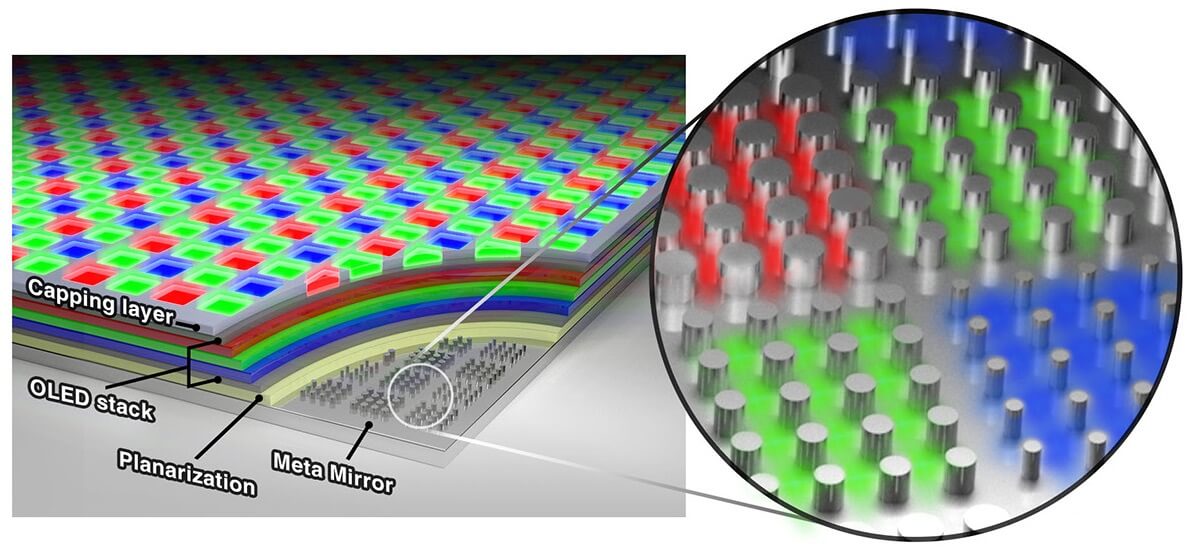
Instead of filters or color-specific OLED materials, the new display makes use of a surface bristling with tiny silver nanopillars 80 nanometers high.
When bathed in white light, the spacing between the pillars determines which wavelengths are transmitted. Each subpixel contains pillars of different widths. The widest pillars with the least spacing give off red light, the next widest, green, and least wide, blue. Larger squares—containing red, blue, and green subpixels—make up the display's pixels. Each is 2.4 microns wide or roughly 1/10,000th of an inch.
Illustration of meta-OLED display highlighting the metaphotonic layer, in which grids of nanopillars manipulate light to produce the desired color (red, green, or blue). Image credit: Samsung Advanced Institute of Technology
As the pixels are no longer shaded by filters—and due to a curious property of the metasurface that allows light to build up and resonate, a bit like sound in a musical instrument—the display's color is very pure and achieves greater brightness with less power.
The team estimates the approach could yield pixel density up to 20,000 pixels per inch. But as the pixels go below a micron, you begin to sacrifice brightness. The next step is to make a full-size display, something Samsung is currently working to make happen.
Of course, other research is going after ultrahigh resolution displays too.
MicroLED tech, a leading candidate, has achieved 30,000 pixels per inch. However, displays over 1,000 pixels per inch are monochromatic, and full-color displays remain challenging.
Whichever approach wins, computing power will have to scale too. More pixels equals more processing. One potential solution for AR/VR is called foveated rendering, where devices track our eyes and only serve up the highest resolution image where the gaze is directed. This makes use of the fact our peripheral vision is blurry, regardless of medium, thus saving precious processing power.
More Immersion = Better?
Of course, visuals are only part of the equation. Truly immersive, sci-fi-like VR will supply a sense of touch, muscular resistance, and maybe even direct manipulation of virtual worlds. And if we're to avoid only enjoying VR in huge warehouses, we'll need to figure out how to move in place.
One might wonder (quite rationally) if we really need to be more immersed in our devices. Many people have been spending a whole lot more time on screens, and it can be pretty draining. It's amazing what an afternoon spent sitting by a good old fashioned stream rendered by the laws of physics unfiltered can do for your sanity.
Still, quality virtual and augmented reality interfaces may solve a few of the less palatable side effects of 2D displays because it's better tailored to how our brains operate in the world. We very consciously have to teach ourselves to type and use a trackpad, but we learn to navigate the physical world almost by accident (just watch a baby move into toddlerhood).
Perhaps, as we spend more time in the digital world, making it immersive will also help make it a better experience (in some ways, at least). And regardless, the next round of interfaces is coming. So, wouldn't it be nice if they looked especially pretty?
We encourage you to make peace with everyone who opposes you and with everyone whom you oppose, not only because you cannot insist on their yielding to your perspective but because their opposing perspective is of tremendous benefit to you.
You see, because of your exposure to what you perceive as their wrong or bad or unwanted behavior or perspective—you have given birth to an improved situation. And just as they helped the problem side of the equation to come into focus, they helped the solution side of the equation to come into focus, also; and that solution waits for you in your Vortex of Creation.
Through our daily meditation process, you will come into alignment with those solutions and creations that are in your Vortex, and from inside your Vortex, you will feel appreciation for everyone who contributed to its becoming.
When you make peace with those who differ in desire and belief and behavior from your ideas of what is appropriate, you do not perpetuate what you consider to be wrong. Instead, you align with the solution side of the equation that has been waiting for you in your Vortex of Creation.
Excerpted from Getting into the Vortex Guided Meditation CD and User Guide on 11/1/10
There's something much more awesome and intimate about discovering a place from the seat of a bike. Pedaling around the turn to find a secluded stretch of beach, no car engine muffling out the sound of waves crashing against the shore. So it is here in Montauk, Long Island, where two wheels are far better than four. You'll be surprised by how much you can see without breaking a big sweat or having to wear those unflattering padded shorts.
I. The Bike
Take your Own: If you've got your own bike, you'll probably want to take it with you on the Long Island Railroad. Be advised, there are some strict rules, so be sure to read all regulations (or consult our travel bike guide) before visiting the website to print out your Bicycle Permit Application.
Rent: If your bike is getting fixed or in your home country, no problem. The Montauk Bike Shop on Main St. has rentals available for $10 per hour or $39 per day.
II. Where to Stay
Housed in an iconic American Tudor landmark building, Solé East (90 Second House Road) is located just far enough outside of town to feel like a true oasis. The hotel rents bikes at a low rate to guests, but be sure to reserve one in advance. There are 67 crisp white rooms, seven garden cabana suites, and a lush garden that keeps the pool and surrounding bed-lounges as private as can be. On the property, Backyard serves fresh organic fare and has a fully stocked bar that makes great margaritas to enjoy in a hammock. During the summer, expect live music at night and a weekly poolside DJ on Saturdays. Solé East also offers complimentary pick up from the Long Island Railroad and the Hampton Jitney.
All rides begin at Solé East from the main entrance.
Ride 1:Total Distance: 6 miles. Locals Only—visit a State Park, eat lobster for dinner, and catch a beautiful sunset.
To get to the park, make a right out of the hotel and take Second House Road. When you get to a sharp curve and 15mph sign, keep going straight (not right) and take the road over the train tracks. As you come down the hill make the left onto Navy Road. Follow the road as it hugs the bay and turns into Hither Woods Preserve Road. You'll now be in Hither Woods Preserve, which abounds with trails and scenic overlooks.
After your hike, head to Duryea's Lobster Deck (65 Tuthill Road) for some of the freshest seafood in town. Return to Navy Road and pedal east (don't cross over the train tracks again) almost to the end—the Sunset Saloon will be on your left, and a tennis court on your right. Cut to the right onto a gravel road that runs parallel to the train tracks. You'll pass the Shellfish Hatchery as you ride into the train station. When you exit the parking lot make a left and find the road (unmarked Tuthill Road) that heads towards the water—it will look like you're on the road to nowhere but just trust it. As you come around the corner, Duryea's will be on your left. Come on the early side to beat the crowds, plus there's a better place to watch the sunset.
As you exit Duryea's make a left and bike up the hill. The road will dive downhill and come up just as the Montauket Hotel (88 Firestone Road) appears on your left. Get here in time for the sun to work its magic on the sky. The views are beautiful and the beers are ice cold. A popular spot with tourists and locals alike, don't be surprised to make new pals who'll offer to give you and your bike a ride home in their pick-up truck.
Ride 2:Total Distance: 5 miles. The Beach Bum—take in a happening town beach, organic lunch, a sail on the pond, and root beer on tap at dinner.
To get to Nick's on the Beach (148 S Edison St.), exit the hotel and make a left onto Second House Road. Follow the road as it curves past the red Fort Pond Lodge. When you come to the intersection take S. Dewitt Place and cross Main St. (Montauk Hwy 27) onto Eton Road. The Oceanside Beach Resort will be on your left. When Eton Road ends take a left onto S. Emerson. Ride with the dunes on your right until you come to Nick's. With its live band and lively crowd (helped by great drink specials) it shouldn't be hard to miss. Find a good spot for your bike, grab your towel, and head onto the beach. If you're lucky, the lifeguards on break might ask you to join in on a pickup game of beach volleyball.
For lunch, leave your stuff on the beach and bike (or walk) over to Naturally Good Food and Café (38 S Etna Ave). Head north (away from the beach) on Edison St. and make your second right onto S Etna Ave. Eat in their shady backyard garden or take lunch back to the beach with you, but don't miss out on the local organic fare. The specials' board is always worth checking out, but the Bruce, a fresh (as in caught that morning) tuna sandwich with red onion, is the real mainstay. Just make sure to time your trip well as the kitchen closes from 11:00-11:30 daily.
Wind picking up? If you're leaving from the beach head north on Edison and then make your first left onto S Elmwood Ave. Follow S Elmwood until it ends at Main St. (Montauk Hwy 27) Veer to the left and join the main road for your next stop, the Puff and Putt Family Fun Center (659 Montauk Hwy.), which will be on your right, directly across from the IGA. Puff and Putt has an 18-hole mini-golf course, but it's really worth going for the boat rentals. Since there's a breeze, take a sunfish out for a tour of Fort Pond and chill out. If the air is calm, rent a peddle-boat and give your legs a workout.
Need a drink? Leave Puff and Putt, make a right onto Main St. (Montauk Hwy 27) and head west out of town. When the Oceanside Beach Resort is on your left (you can't miss the bright yellow smiley face on its façade) make the right onto S Dewitt Place and then another right onto Second House Road. You can stop at your room to wash the sand out of your hair before dinner, or head right to the Second House Tavern (161 Second House Road). Keep an eye out for its wooden sign and long driveway on the left, just a few minutes past Solé East. Whether you sit in the dining room or at the bar, you'll be satisfied with the fresh seafood, homemade mac and cheese, and foamy root beer. After dinner, make a right onto Second House and you'll be home in no time.
Ride 3:Total Distance: 7 miles.Surf 'n' Turf –the perfect hike, surfer's paradise, and the best drive-in burgers and ice cream.
Leave the hotel and make a left onto Second House Road, heading into town via a left on S Dewitt Place. Ride east on Main St., pass through and out of town. As you leave, St. Therese church will be on your right. Once you get up the hill the free wifi-bearing library will be on your left. Keep an eye out for a right-hand sign that reads Shadmoor State Park (about a quarter mile east of town). Pull over and leave your bike by the entrance. Here you can hike along breathtaking bluffs, through freshwater wetlands, and enjoy birdwatching from elevated platforms. Entrance to the park is free.
Post-hike head to Ditch Plains for a dip in the ocean. Get back on the main road (Montauk Hwy 27) and continue east. Ditch Plains Road will be your first paved road on the right, follow it to the beach. There are three parking lots for Ditch Plains and each one corresponds to a slightly different beach atmosphere. Go to Lot 1 (the first one on your right) if you want to be close to bathrooms. When you enter the beach, head right to eschew the crowds. Go to Lot 2 for the famous Ditch Witch: a concession stand selling everything from quesadillas to lemonade. Go to Lot 3 (the dirt lot) if you want to sunbathe and surf. Fair warning: the beach is smaller here, and if you're an unfamiliar face or without a board, the locals may wonder why you're there.
After a day at the beach, return to town via Ditch Plains Road and swing a left onto Montauk Hwy 27 for a burger and shake at John's Drive-In (695 Montauk Hwy). Located on Main St. you can't overlook the retro drive-in sign. John's is a great place to grab an inexpensive dinner, so try the John Burger with special sauce and indulge in the homemade ice cream—it's as good as it gets.
Ride 4:Total Distance 4 miles.Hampton Nights—tour a historical home, dine in style and rub shoulders with celebrities over caprihinias
When you leave Solé East make a left onto Second House Road and head into town via a left on S Dewitt Place. Instead of riding onto Main St. pull onto the grass on your left, where The Second House Museum (631.668.5340) is hiding behind the hedges. Built in 1797, Second House is the oldest building in Montauk and one cultural experience worth your while; take a tour and explore the lovely grounds for eight bucks.
After the museum, hop on your bike and head to dinner at Harvest on Fort Pond (11 S Emery). Make a left onto Main St., then take your first left onto S Emery. Easily Montauk's most famous and frequented restaurant, sit outside in the beautiful herb garden where sunflowers tower overhead. If there's a wait, order a mojito—the mint is picked from the garden each night—and take a stroll on the private dock overlooking the pond. Famous for its Mediterranean-influenced family-style dishes and expansive wine list, nothing is a miss on this menu, but the Seafood Brushcetta and Whole Red Snapper are particularly good.
After dinner, you'll be happy to have your bike when you see the parking (or lack thereof) at The Surf Lodge (183 Edgemere St). Leave the Harvest by heading east on S Euclid Ave (running parallel to Main St). Make the second left onto Edgemere St (County Rte 49) and head north. Stay on Edgemere until The Surf Lodge appears on your left. Grab a drink from the inside bar before joining the famous faces outside. Check the website for a full schedule of live music and movie screenings. When you're ready to head home, make a left out of the parking lot and your first left onto Industrial Road. Follow Industrial over the train tracks and as it winds to the left and turns into Second House Road.
All these spots are within close proximity so be sure to mix and match and create your perfect itinerary!
How to get to Montauk from NYC
Montauk is easily accessible by rail and road. The Long Island Railroad offers daily trains to and from Penn Station. Check out MTA for a full schedule. Two tips: Be prepared for crowds on the weekend and pack a sweatshirt for the relentless air conditioning. The Hampton Jitney also offers daily service to the east end and departs from various locations in Manhattan and Brooklyn. Check out hamptonjitney.com for a full schedule and be sure to make a reservation. Check out the Chamber of Commerce at www.MontaukChamber.com for more information.
The more data becomes available about SARS-CoV-2, the more obvious it becomes that the response to this pandemic has been grossly overblown. Fatality statistics1,2,3,4,5,6,7 from multiple sources, calculated in a variety of ways, show the risk of dying from COVID-19 is lower than your risk of dying from conventional influenza, at least if you're under the age of 60.
Overall, the data8,9 also show that the overall all-cause mortality has remained steady this year and doesn't veer from the norm. In other words, COVID-19 has not killed off more of the population than would have died in any given year anyway.
Several studies also suggest immunity against SARS-CoV-2 infection is far more widespread than anyone imagined, and that the threshold for herd immunity is far lower than previously estimated.
Most Are Already Immune to SARS-CoV-2 Infection
Studies supporting the claim that widespread immunity against SARS-CoV-2 already exists include:
• Cell, June 202010,11— This study found 70% of samples from patients who had recovered from mild cases of COVID-19 had resistance to SARS-CoV-2 on the T-cell level. Importantly, 40% to 60% of people who had not been exposed to SARS-CoV-2 also had resistance to the virus on the T-cell level.
According to the authors, this suggests there's "cross-reactive T cell recognition between circulating 'common cold' coronaviruses and SARS-CoV-2." In other words, if you've recovered from a common cold caused by a particular coronavirus, your humoral immune system may activate when you encounter SARS-CoV-2, thus rendering you resistant to COVID-19.
• Nature Immunology, September 202012— This German study was initially posted on a preprint server in June 2020 under the title, "SARS-CoV-2 T-cell Epitopes Define Heterologous and COVID-19-Induced T-Cell Recognition."13
It's now published in the September 2020 issue of Nature Immunology with the slightly altered title, "SARS-CoV-2-Derived Peptides Define Heterologous and COVID-19-Induced T Cell Recognition."14 Much like the Cell study above, this investigation also found that that:
"Cross-reactive SARS-CoV-2 peptides revealed pre-existing T cell responses in 81% of unexposed individuals and validated similarity with common cold coronaviruses, providing a functional basis for heterologous immunity in SARS-CoV-2 infection."
In other words, even among those who were unexposed, 81% were resistant or immune to SARS-CoV-2 infection. The term "heterologous immunity" refers to immunity that develops against a given pathogen after you've been exposed to a nonidentical pathogen.
Typically, this occurs when viruses are sufficiently similar or from closely related species. In this case, SARS-CoV-2 appears to be sufficiently similar to coronaviruses that cause the common cold, so that if you've been exposed to any of those coronaviruses, your immune system is also able to combat SARS-CoV-2.
• The Lancet Microbe, September 202015,16— This study found that rhinovirus infection, responsible for the common cold, largely prevented concurrent influenza infection by triggering the production of natural antiviral interferon.
The researchers speculate that the common cold virus could potentially help protect against SARS-CoV-2 infection as well. Interferon is part of your early immune response, and its protective effects last for at least five days, according to the researchers. Co-author Dr. Ellen Foxman told UPI:17
"Infection with the common cold virus protected cells from infection with a more dangerous virus, the influenza virus, and [this] occurred because the common cold activated the body's general antiviral defenses.
This may explain why the flu season, in winter, generally occurs after the common cold season, in autumn, and why very few people have both viruses at the same time. Our results show that interactions between viruses can be an important driving force dictating how and when viruses spread through a population.
Since every virus is different, we still do not know how the common cold season will impact the spread of COVID-19, but we now know we should be looking out for these interactions."
• Nature, July 202018,19,20— Originally posted on a preprint server in May 2020,21 this Singaporean study was published in the July 2020 issue of Nature.22 Here, they found that common colds caused by the betacoronaviruses OC43 and HKU1 might make you more resistant to SARS-CoV-2 infection, and that the resulting immunity could potentially be long-lasting.
Patients who recovered from SARS infection back in 2003 still had T cell reactivity to the N protein of SARS-CoV now, 17 years later. These patients also had strong cross-reactivity to the N protein of SARS-CoV-2.
The authors suggest that if you've beaten a common cold caused by a OC43 or HKU1 betacoronavirus in the past, you may have a 50/50 chance of having defensive T-cells that can recognize and help defend against SARS-CoV-2. According to the authors:
"These findings demonstrate that virus-specific T cells induced by infection with betacoronaviruses are long-lasting, supporting the notion that patients with COVID-19 will develop long-term T cell immunity.
Our findings also raise the possibility that long-lasting T cells generated after infection with related viruses may be able to protect against, or modify the pathology caused by, infection with SARS-CoV-2."
• Cell August 202023,24— This Swedish study, initially posted on a preprint server in June 202025 and now published in the October 2020 issue of the journal Cell,26 found that SARS-CoV-2-specific memory T cells likely provide long-term immune protection against COVID-19. According to the authors:27
"Acute-phase SARS-CoV-2-specific T cells displayed a highly activated cytotoxic phenotype that correlated with various clinical markers of disease severity, whereas convalescent-phase SARS-CoV-2-specific T cells were polyfunctional and displayed a stem-like memory phenotype.
Importantly, SARS-CoV-2-specific T cells were detectable in antibody-seronegative exposed family members and convalescent individuals with a history of asymptomatic and mild COVID-19.
Our collective dataset shows that SARS-CoV-2 elicits broadly directed and functionally replete memory T cell responses, suggesting that natural exposure or infection may prevent recurrent episodes of severe COVID-19."
Innate and Adaptive Immunity
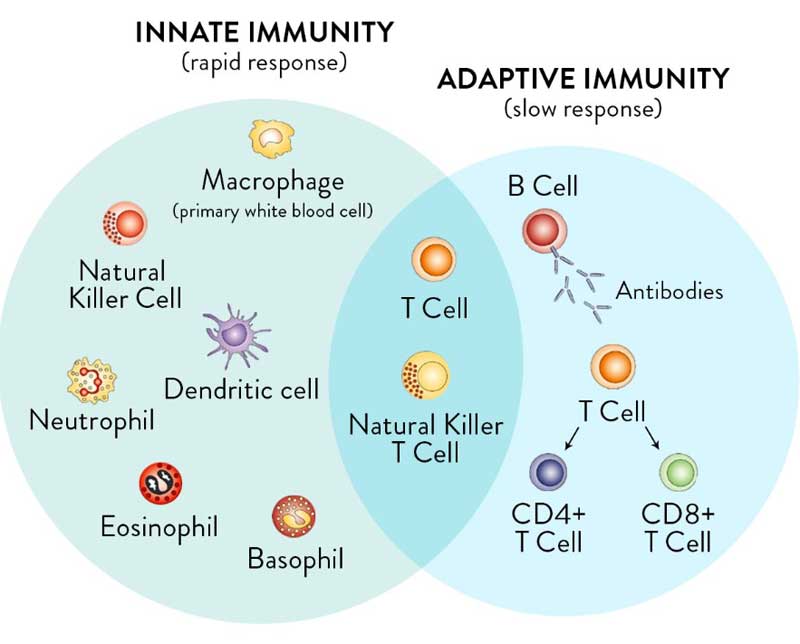
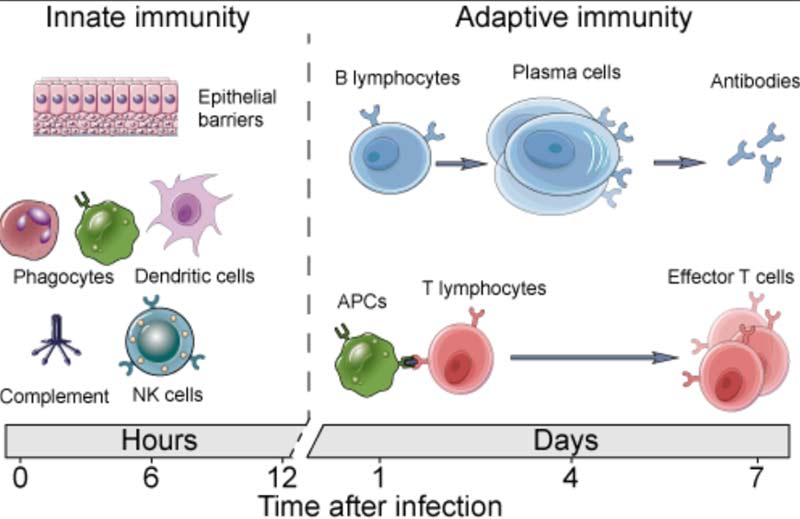
It's important to realize you have two types of immunity. Your innate immune system is primed and ready to attack foreign invaders at any moment and is your first line of defense. Your adaptive immune system,28 on the other hand, "remembers" previous exposure to a pathogen and mounts a response when an old foe is recognized.
Your adaptive immune system is further divided into two arms: humoral immunity (B cells) and cell mediated immunity (T cells). The B cells and T cells are manufactured as needed from specialized stem cells. The graphs below are from my vitamin D report and will help you understand the components of these systems and their timing.
If you have never been exposed to a disease but are given antibodies from someone who got sick and recovered, you can gain humoral immunity against that disease. Your humoral immune system can also kick in if there's cross-reactivity with another very similar pathogen.
As you can see from the list above, in the case of COVID-19, evidence29 suggests exposure to other coronaviruses that cause the common cold can confer immunity against SARS-CoV-2.
On the flip side, there's a phenomenon known as viral interference, where exposure to one virus makes you more susceptible to another virus. Importantly, research30 has found that those who received the influenza vaccine were 36% more susceptible to coronavirus infection.
Mathematical Models Add Support for Widespread Immunity
If it's true that a majority already have some measure of immunity against COVID-19 due to previous exposure to other coronaviruses, then we've probably already reached the threshold for herd immunity, and vaccinating every human on the planet (or close to it) will not be necessary.
Added support for the idea that herd immunity may already have been achieved in most countries comes from statisticians working with mathematical models. In June 2020, Freddie Sayers, executive editor of UnHerd, interviewed31 professor Karl Friston, a statistician who claims immunity against SARS-CoV-2, globally, might be as high as 80%, as reviewed in the video interview above.
Friston is credited with inventing a statistical parametric mapping technique that is now the standard for understanding brain imaging. As the pandemic erupted, he began applying this method of analysis (which he refers to as "dynamic causal modeling") to COVID-19 data, coming up with a model that predicts far lower mortality rates than earlier models.
The reason for this is because the "effective susceptible population," meaning those who are not already immune to COVID-19 and therefore at risk of infection, was never 100%. At most, it was 50% and most likely only around 20%.
Friston's model effectively vaporizes claims that social distancing is necessary, because once sensible behaviors such as staying home when sick are entered into it, the positive effect of lockdown efforts on "flattening the curve" simply vanish. In all likelihood, the global lockdowns were completely unnecessary, and certainly should not continue, now or in the future.
Signs of Herd Immunity Emerge in Sweden
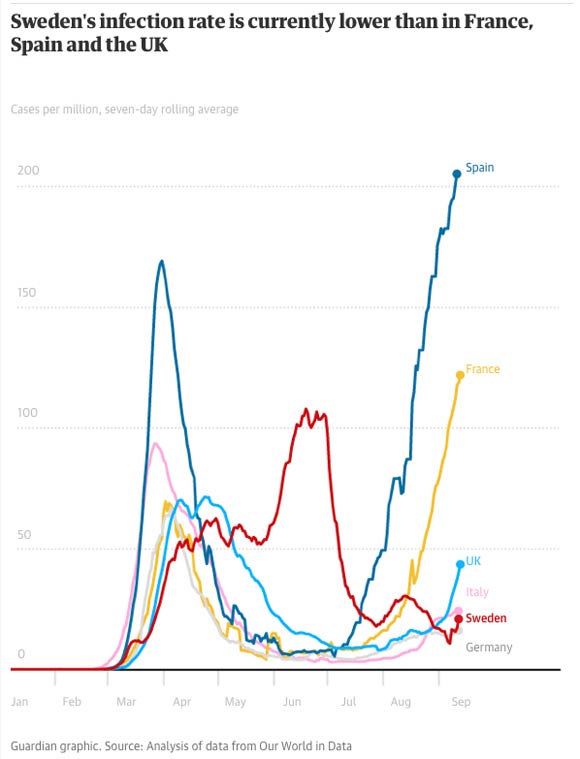
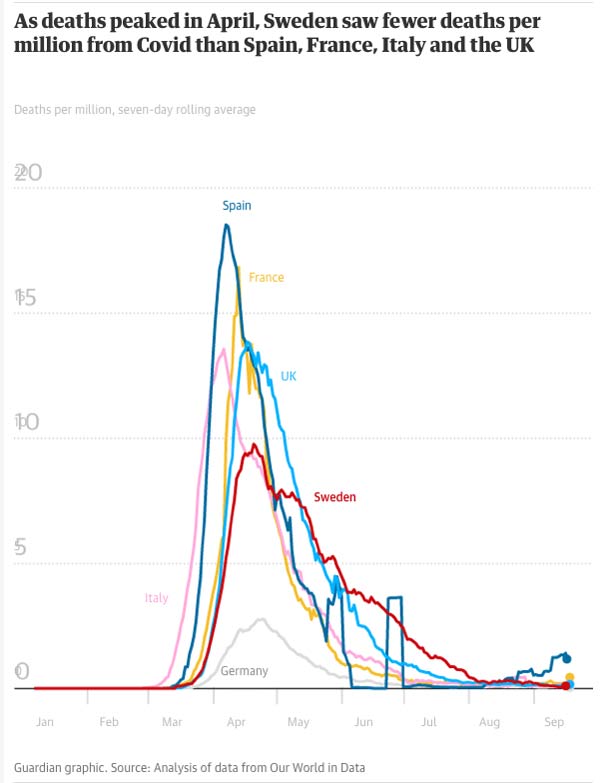
One country that bucked the global lockdown trend was Sweden, and they now appear to be head and neck ahead of most other countries in terms of herd immunity, while having a death toll that is very similar to nations that destroyed their economy and sacrificed the population's mental health in the name of infection control.
Anders Tegnell, the chief epidemiologist in charge of Sweden's coronavirus response, has stated32 he does not believe Sweden will see a second wave with widespread contagion as the country is seeing a rapid decline in positive tests, indicating herd immunity has been achieved.33
He told The Guardian34 that the primary goal was always merely to slow the spread to avoid overwhelming medical services. The intention was never to prevent infection from spreading altogether, which has indeed proven impossible.
This was in fact the original plan just about everywhere. But while Sweden stuck to the original goal, and by mid-September boasted all-time low infection rates,35 other nations have twisted response plans to prevent infection transmission altogether, even among those for whom the risk of such an infection is vanishingly minor, such as school-aged children.
The two graphs from The Guardian,36 below, show Sweden's infection rate and deaths per million, compared to other countries that enforced stricter lockdown rules.
Herd Immunity Threshold Likely Below 50%
As reported in "Herd Immunity 'Ahead of Schedule'" experts initially estimated that 70% of the population or more would need to be immune before herd immunity would be achieved. Now, more than a dozen scientists claim the herd immunity threshold is likely below 50%.
As stated earlier, if this is true — and as you can see by the studies reviewed, it appears a majority do have some level of immunity — then the need for a vaccine more or less vanishes.
Herd immunity is calculated using reproductive number, or R-naught (R0), which is the estimated number of new infections that may occur from one infected person.37 R0 of below 1 (with R1 meaning that one person who's infected is expected to infect one other person) indicates that cases are declining while R0 above 1 suggests cases are on the rise.
It's far from an exact science, however, as a person's susceptibility to infection varies depending on many factors, including their health, age and contacts within a community. The initial R0 calculations for COVID-19's herd immunity threshold were based on assumptions that everyone has the same susceptibility and would be mixing randomly with others in the community.
"That doesn't happen in real life," Dr. Saad Omer, director of the Yale Institute for Global Health, told The New York Times.38 "Herd immunity could vary from group to group, and subpopulation to subpopulation," or even zip code. When real-world scenarios are factored into the equation, the herd immunity threshold drops significantly, with some experts saying it could be as low as 10% to 20%.
Researchers from Oxford, Virginia Tech and the Liverpool School of Tropical Medicine are among those that found39,40 when individual variations in susceptibility and exposure are taken into account, the herd immunity threshold dips below 10%.
Independent news source Off-Guardian also cited41 data from Stockholm County, Sweden, which shows a herd immunity threshold of 17%,42 as well as an essay by Brown University professor Dr. Andrew Bostom, who noted:43
"Lead investigator Dr. Gomes, from the Liverpool School of Tropical Medicine, and her colleagues concluded: "naturally acquired immunity to SARS-CoV-2 may place populations over the herd immunity threshold once as few as 10-20% of its individuals are immune."44
Separate HIT [herd immunity threshold] calculations of 9%,45 10-20%,46 17%,47 and 43%48,49 — each substantially below the dogmatically asserted value of ~70%50 — have been reported by investigators from Tel-Aviv University, Oxford University, University College of London, and Stockholm University, respectively."
Declaration Urges Implementation of Herd Immunity Approach
All in all, there are many reasons to suspect that continued lockdowns, social distancing and mask mandates are completely unnecessary and will not significantly alter the course of this pandemic illness, or the final death count.
As reported by British Sky News,51 October 7, 2020, many respected scientists are now calling for a herd immunity approach to the pandemic, meaning governments should allow people who are not at significant risk of serious COVID-19 illness to go back to normal life. According to the article:52
"The so-called Great Barrington declaration, signed by leading experts from the universities of Oxford, Nottingham, Edinburgh, Exeter, Cambridge, Sussex and York, suggests herd immunity as a way forward.
The declaration states: 'The most compassionate approach that balances the risks and benefits of reaching herd immunity, is to allow those who are at minimal risk of death to live their lives normally to build up immunity to coronavirus through natural infection, while better protecting those who are at highest risk. We call this focused protection."
The declaration points out that current lockdown policies are having "devastating effects on short and long-term public health" that will result in excess mortality in the future, primarily among younger people and the working class.
Ivo Zdarsky has lived alone in an airplane hangar in Lucin, Utah, since 2007. Ivo Zdarsky
Ivo Zdarsky has been living alone in an airplane hangar in a ghost town in Utah since 2007.
He escaped Communist-era Czechoslovakia in a homemade hang glider in 1984, then founded a propeller company in California in 1986.
In 2007, he bought an abandoned airport in Lucin, Utah, to have the space to work on various projects.
He spends his days tinkering in his workshop, hiking, hunting, fishing, and flying himself around the country.
"I enjoy it," he told Insider about his solitary life in Lucin. "If I didn't like it, I wouldn't be here.
Ivo Zdarsky has been social distancing since before that became common vernacular.
Zdarsky has lived alone in an airplane hangar in the abandoned town of Lucin, Utah, since 2007.
When asked why he moved to the desert, he dryly explained, with the raspy voice of a man who doesn't speak much, "I escaped from Czechoslovakia, then I was in California, and then I moved here."
But that's a very simplistic version of events. As he warms up to me, he reveals that, in 1984, he escaped the KGB in communist-era Czechoslovakia by building himself a hang glider and flying into Austria in the dead of night, where he was granted political asylum. He didn't even tell his family about his plan to escape.
He has fond memories of the Austrian guards that took him in, recalling that they gave him coffee and doughnuts and let him sleep in an unlocked jail cell before moving him around the country to keep the KGB from finding him.
Zdarsky, pictured in Austria in front of the hang glider he built and escaped with. Ivo Zdarsky
In the 1980s, Czechoslovakia, now the countries of Slovakia and the Czech Republic, was communist-ruled. According to Britannica, during this time Czechoslovakia was "one of the more prosperous but also one of the more repressive countries in eastern Europe."
Zdarsky wanted out: He wanted the freedom to build planes, start a business, and do as he pleased.
After only six weeks as a political refugee in Austria, he was sent to Long Beach, California, where he founded a propeller manufacturing company in 1986.
When asked about his business, his answer is equally simplistic. "I was flying these ultra-light hang gliders, and I couldn't find a good propeller, so I just made one," he said. "People liked it, so I sold the propeller, and then I had money to make two propellers. Then I sold two propellers and had money to make three propellers…"
In 2007, Ivo Zdarsky traded California for Utah, describing it as yet another 'escape'
.......cya
The Lucin International Airport, aka Zdarsky's home and workshop. Ivo Zdarsky
In 2007, Zdarsky bought an airport in Lucin, Utah, which was founded as a railroad community in the 1860s when the First Transcontinental Railroad was built, according to Atlas Obscura. The town was abandoned in 1936, briefly resettled by a group of retired railroad workers, but once again empty by 1972. The area is now managed by the Utah Division of Wildlife Resources. According to Deseret News, a local news outlet, Zdarsky spent $99,000 to buy 400 acres there.
The "airport" was not much more than a runway when he bought it. He had a 100-by-50-feet steel hangar built and moved in shortly after. The hangar, one giant open space with no walls or windows, is his workshop, garage, and home in one. He calls it Lucin International Airport, and that's what shows up on my screen when I call him.
A screenshot of our call. Sophie-Claire Hoeller/Insider
He said he's always been drawn to abandoned places, and that he was sick of Long Beach's "high-density population" and traffic on the freeways. But he also needed room to work on his various projects — for one, a sort of helicopter and plane hybrid.
"I kinda like it here," he says in his trademark frankness.
He describes Lucin as a 'ghost site' as opposed to a ghost town, since he says that most buildings were razed, leaving almost nothing behind
Lucin was once a railroad community. J.R. Eyerman/The LIFE Picture Collection/Getty Images
Zdarsky isn't lonely though. While otherwise tight-lipped about her, he said he has a girlfriend in Ogden, which is 163 miles away, that visits regularly, as well as friends that occasionally drop by to do some exploring, and that "you always run into people." When pressed to describe how often "always" is he retorts, "If you define seeing people by seeing a car driving by, maybe once a week."
However, he adds that the F.A.A., which leases a navigational beacon from him, must maintain it and regularly sends employees to check on it. He said he often sees people from the phone company, and that there are always explorers around.
He flies 45 minutes to Ogden around once a month to stock up on groceries
The plane/helicopter he is working on. Ivo Zdarsky
Zdarsky also regularly flies himself around the country to explore it, from the New Mexico desert to lava caves in Idaho and South Dakota's badlands.
He speaks of wildfires and earthquakes as frequent occurrences but non-events. He spends his days tinkering around his workshop, busying himself with different projects — he recently built himself a speargun which he used to go fishing in Micronesia — and doing maintenance on his fence and the airport runway, which he says the badgers like getting into. He also loves hiking and exploring his own backyard, hunting, and fishing, and says that there are tons of beautiful spots around him.
He said while the post office won't deliver to his remote location, UPS and FedEx will, and there's a Schwan's food delivery truck that used to bring him prepared meals, which he canceled after gaining too much weight. He also brags that his internet speed is much higher than most people's with 90 megabits per second. "So I'm on Amazon ordering stuff and then UPS will bring it to me in the middle of nowhere," he said gleefully.
From the Iron Curtain to the Utah desert, Zdarsky has found himself the kind of freedom most people only dream of. He can do what he wants, when he wants, and can even fly wherever he wants.
"I enjoy it," he said dryly. "If I didn't like it, I wouldn't be here."
We offer two hardware options for using Canvas with the iPad: using a LiDAR-enabled iPad, or adding a Structure Sensor to a compatible iPad model.
In short, for most users, Scan To CAD results will be highly comparable with either option, but using Canvas with Structure Sensor will generate higher-detailed 3D meshes (which is helpful if you intend to make heavy use of the 3D scan data itself). You can learn more about the difference between using Canvas with a LiDAR-enabled iPad or a Structure Sensor here: Should I use Canvas with a LiDAR-enabled iPad or a Structure Sensor?
For most users, if you don't have an iPad, the absolute easiest and cheapest way to get started will be with the 11-inch iPad Pro 2nd Generation, which starts at $799 and, as it has a LiDAR sensor embedded into the device, doesn't require a Structure Sensor. You can simply download Canvas and start scanning.
If you already have an iPad, you can "upgrade" any of models listed below to be able to 3D scan by attaching a Structure Sensor. The iPad 7th Generation (starts at $329) is a great trade-off for cost vs. experience and speed, and we offer it by request as a bundled option in the Total Set-Up for Canvas package (which includes an iPad 7th Generation, 32GB, Wi-Fi Only for $899 and comes pre-assembled, pre-calibrated, and delivered scan-ready with a custom foam carrying case). You will need to do a few extra steps to assemble and calibrate your sensor to your iPad, but this process is quick, and you can see it in detail here: Getting Started with Canvas.
Canvas is currently only compatible with the iPad. If you would like to be notified about support for other devices (including iPhone, Android, or Windows), please reach out to us at support@canvas.io! We can't promise any immediate plans (as support for each new device requires totally new brackets, a very large amount of software changes, and additional support infrastructure), but knowing which devices are most in-demand helps us prioritize efforts to bring Canvas to them.
The Long Answer
Canvas is compatible with the following iPad models:
11-inch iPad Pro 2nd Generation (2020, LiDAR-enabled and doesn't require a Structure Sensor): Models A2228, A2068, A2230, A2231 (A12Z Processor)
iPad 5th Generation: Models A1822 and A1823 (A9 Processor)
9.7-inch iPad Pro: Models A1673, A1674 or A1675 (A9X Processor)
12.9-inch iPad Pro 4th Generation (2020, LiDAR-enabled and doesn't require a Structure Sensor): Models A2229, A2069, A2233 (A12Z Processor)
12.9-inch iPad Pro (pre-2020): Models A1584 or A1652 (A9X Processor) for 1st Generation; 1670, or 1671 (A10X Processor for A1670 or A1671) for 2nd Generation; (A12X, A1876, A1983) for 3rd Generation;
iPad Air 2: Models A1566 and A1567 (A8X Processor)
iPad mini 4: Models A1538 and A1550 (A8 Processor)
iPad Air (not recommended): Models A1474, A1475, A1476
To identify what iPad you have, take a look at the model number on the back cover:
The "right iPad" will be different depending on the use case, but the biggest factors to consider are RAM, storage,portability, and integrated sensing.
RAM:
This stands for "random-access memory," and it basically means "How much can your iPad do at once?" 3D scanning is a very memory-intensive process, so having sufficient RAM is important to ensure good iPad doesn't run out of RAM while scanning (if it does, your scan will be auto-saved, but it will take more scans to cover a given area).
Most iPads have 2GB of RAM, though some of the iPad Pro models have 4GB of RAM. 2GB of RAM will be able to handle most residential-sized rooms just fine, but if you want the absolute top-line hardware, a 4GB-RAM model is a good option. We always recommend scanning on a room by room basis for the best, most accurate results, regardless of whether or not your iPad can technically scan more with more RAM.
It is for this reason that we don't recommend buying the iPad Air (1st Generation) for use with Canvas. With only 1GB of RAM, you may have trouble scanning full rooms in one scan, and as it is an older device the iPad itself will be slower.
Storage:
Storage refers to the amount of data your iPad can hold at one time, and the options typically range from 16GB to 256GB. When using Canvas, it affects the number of scans or homes you can hold on the device at one time.
While the total storage footprint for a home can be all over the place, in our experience the average typically ranges from 500MB to 2GB. Since the operating system usually takes up 8-11GB (according to Apple's website), that means that if you have only 16GB of storage, in the worst case you might have only 5GB available for Canvas, which may correspond to only a few homes. If you had a 256GB iPad, you would be able to store several hundred homes.
Generally speaking, this is rarely a practical concern for our customers, unless you are using the iPad for a lot of other photo, video, or audio files that also take up space, or scanning multiple full homes every day. If you're using Scan To CAD, the scans are emailed to you along with your CAD models, so most customers clear their iPad of a home after it goes through Scan To CAD (2 business days). If you are clearing your scans regularly after they go through Scan To CAD (or exporting via email or Airdrop if you are using them in other workflows), then you shouldn't have to worry much about storage unless you are scanning multiple full homes every day. We do recommend going for at least the 32GB models for convenience, but even with the 16GB you should have enough storage to scan a few homes, upload/export your scans for safe-keeping, and then delete them to make room for more.
Many customers prefer to keep their scans on-device for the duration of a project. If this is the case, you may want to choose an iPad with more storage, so that you can hold more scans on your iPad at one time.
Portability:
If you're traveling from job site to job site, using Canvas multiple times per week or month, portability is also something to factor into your decision.
The 12.9-inch iPad Pro models are very big devices, and this can make them fairly clunky to transport. Additionally, because the iPad is so large, we had to make a special adhesive bracket for Structure Sensor that sticks to the back of the iPad instead of our normal, latch-on precision bracket, meaning that taking Structure Sensor on and off is less convenient. You can see the difference on our accessories page.
The iPad mini 4 is probably the easiest to transport, but in our experience, it's not a huge benefit vs. other models.
Set-Up Ease:
NEW: Canvas now supports the LiDAR sensor onboard the new iPad Pros released in March 2020. As the LiDAR sensor is integrated into the device itself, there is no extra hardware required, and using this iPad means you can skip all assembly, calibration and basically skip ahead to Step 4b in our Getting Started with Canvas guide.
If you have any questions, please don't hesitate to drop us a line at support@canvas.io. Happy scanning!





 The "right iPad" will be different depending on the use case, but the biggest factors to consider are RAM, storage, portability, and integrated sensing.