Friday, December 25, 2020

For Wendell Castle, Furniture and Sculpture Were One and the Same - 1stdibs Introspective

This is for John Belt.....design educator extraordinaire.
For Wendell Castle, Furniture and Sculpture Were One and the Same - 1stdibs Introspective

For Wendell Castle, Furniture and Sculpture Were One and the Same

The furniture designer Wendell Castle changed the way we think about making chairs, tables and other objects. For Castle, furniture and sculpture, form and function were one and the same. Unlike his predecessors in the American studio furniture movement — designers like George Nakashima and Sam Maloof, who used traditional methods of carving and joinery — Castle favored stack lamination, gluing together thin, horizontal layers of wood and then carving them; at first, he used a chainsaw, later a robot, to create organic, sometimes whimsical volumes. Castle made his most powerful pieces using this method, in the late 1960s and early '70s and in the years before his death, at age 85, in 2018. (In between, he produced trompe l'oeil works, like a carved-wood grandfather clock that appeared to be wrapped in a cloth; Pop art–influenced plastic furniture and lights; even a postmodern piano for Steinway.) These key chapters of Castle's six-decade-long career are the subject of the show "Wendell Castle: A New Vocabulary," at the New York gallery Friedman Benda through October 12.

American studio furniture movement designer Wendell Castle Friedman Benda A New Vocabulary
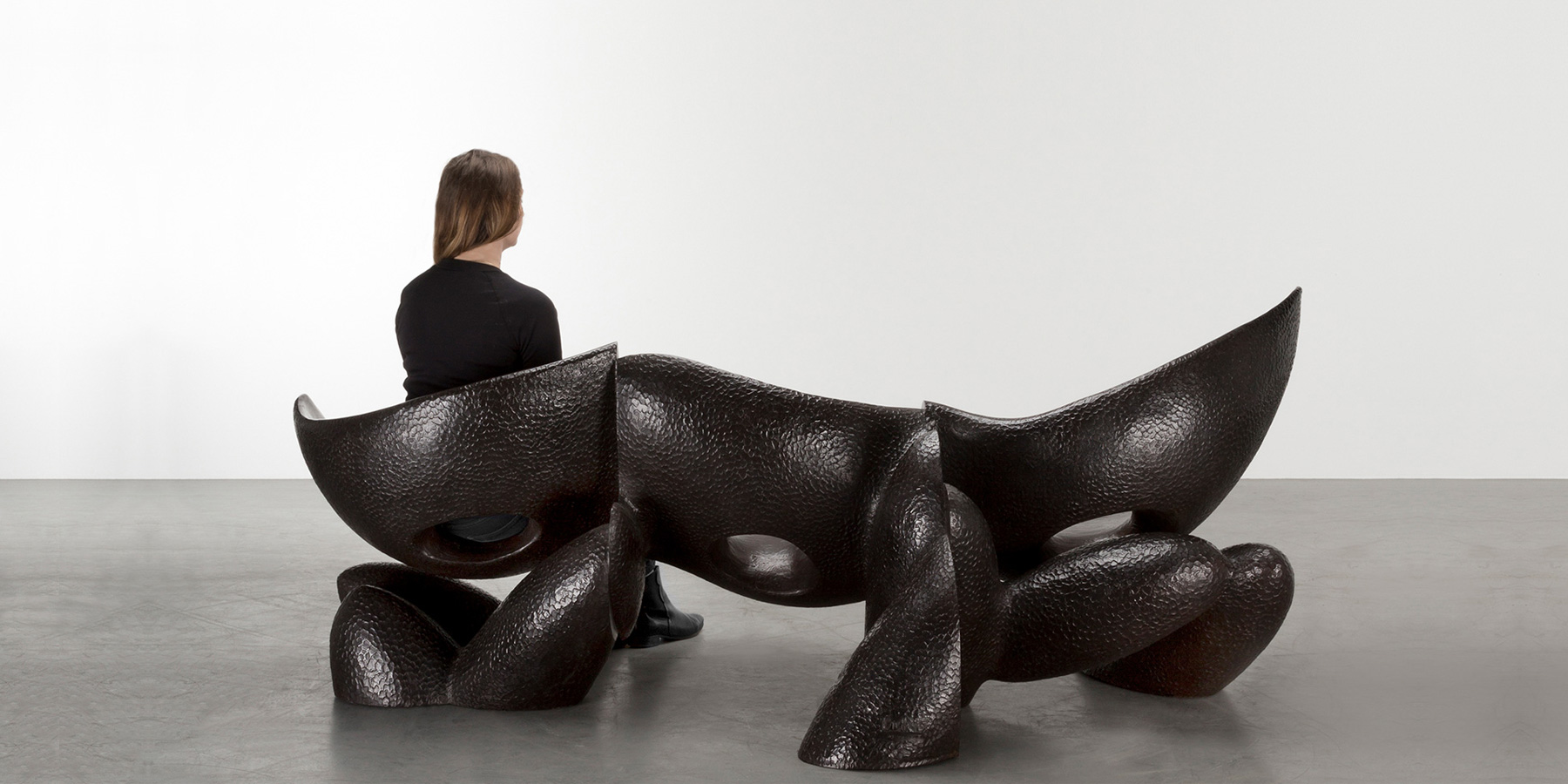
American studio furniture movement designer Wendell Castle (above) is the subject of a new show — the first conceived since Castle's death, in 2018 — up through October 12 at Manhattan's Friedman Benda gallery. Top: Among the pieces on view at Friedman Benda is A New Seeing, 2015. All photos by Daniel Kukla, courtesy of Friedman Benda and Wendell Castle Inc., unless otherwise noted
American studio furniture movement designer Wendell Castle Friedman Benda A New Vocabulary Walnut Sculpture
Castle created his Walnut Sculpture between 1958 and 1959, when he was in graduate school at the University of Kansas.

This is "the first exhibition that was fully conceived after Wendell Castle's death. It's the first look back," says gallery cofounder Marc Benda, noting that Castle "always wanted to look forward." The idea, he adds, "was to examine two key periods of his career — the early stack-lamination pieces and the late stack-lamination pieces — and to compare them, although not literally."

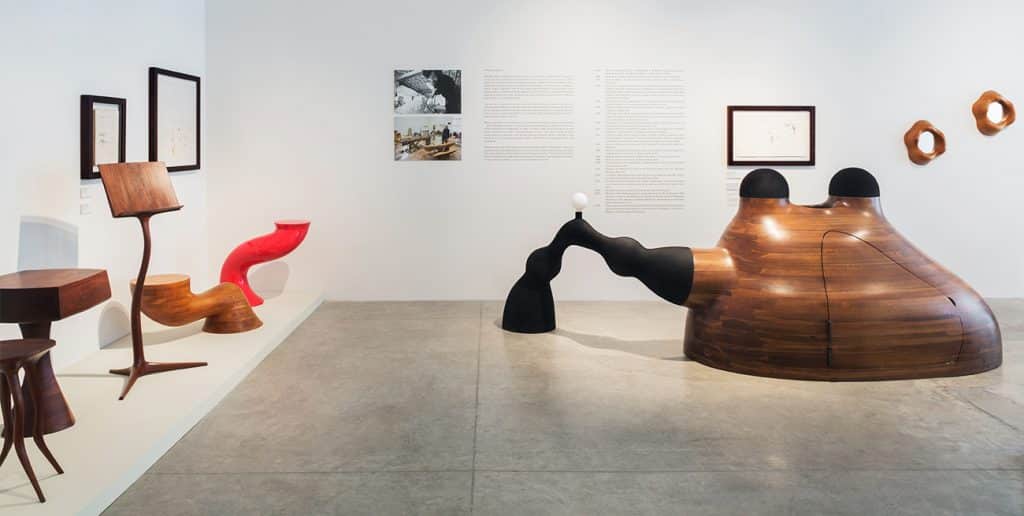
The show, which also includes drawings and models, highlights seminal pieces like the Environment for Contemplation, a blob-like form in laminated wood with a flocked fiberglass "tail." The 1970 work — designed to sit on the floor, with a small, shag-carpet-lined space you could crawl into — was first seen in "Contemplation Environments," an exhibition held that year at the Museum of Contemporary Crafts in New York. "It is both cartoonish and profound, a thought bubble and a hand-crafted monument," writes author, curator and former Museum of Arts and Design director Glenn Adamson, describing the piece in the catalogue for the Friedman Benda exhibition.

American studio furniture movement designer Wendell Castle Friedman Benda A New Vocabulary A New Seeing
A detail shot of A New Seeing shows of the texture of its bronze surfaces.

There are also very early works, like Walnut Sculpture of 1958–59 (when Castle was in graduate school), a delicate but dynamic composition carved from discarded rifle stocks, and the 1964 Music Stand. One of Castle's early experiments with lamination, this still looks fairly traditional, in contrast to the more abstract pieces he would soon make. As the designer said in the 2018 television documentary Wendell Castle: A Portrait, "I moved the legs [of chairs] out from under the seat, to be sculpture."

"Wendell Castle: A New Vocabulary," on view at the New York gallery Friedman Benda through October 12, displays the iconoclastic work of the late, great American studio furniture movement designer.

Castle created Lazy Bones in 2017 out of stained ash.

His Chaise Rocker, of leather and oak, was created in 1962, shortly after he received his MFA in sculpture from the University of Kansas.

In 2013, he crafted his stained-ash Blowin' in the Wind table.

Another early work in the show is Music Stand, from 1964.

Castle incorporated a lighting element into the design of 2015's Runaway.

Table, from 1968, seems to defy gravity.

American studio furniture movement designer Wendell Castle Friedman Benda A New Vocabulary

For Wendell Castle, Furniture and Sculpture Were One and the Same

1/7

View Slideshow

American studio furniture movement designer Wendell Castle Friedman Benda A New Vocabulary Curving Table No. 8
Castle's Curving Table No. 8, ca. 1969, is made of gel-coated fiberglass, wood and automobile paint.

Pieces from the last years of Castle's career include the 2016 Motown in stained ash, from the "Misfits" series, in which he took existing models, cut them apart and remixed them, in this case creating a seat with two mismatched halves. Lazy Bones, from 2017, comprises two stained-ash forms that bend and overlap to create what Adamson calls "a defiance of conventional wisdom: a seating form without a seat, which dares to be almost not a piece of furniture at all, nor even really a sculpture, yet somehow a masterpiece." The later laminated pieces were carved by a robot, but Castle made the models, which were then scanned by a laser. "I never wanted to design on a computer," he said. "I wanted to keep the blips."

Castle noted that his process mostly began with drawing — a passion that dated back to his childhood. The designer, who was dyslexic, was quoted in his New York Times obituary as saying that when he was young, he was good at "drawing and daydreaming, neither of which was valued." Still, he earned a bachelor of fine arts degree in industrial design and a master's in sculpture from the University of Kansas. As he says in the documentary, though, "I did not want to be a woodworker. I wanted to be a designer."

American studio furniture movement designer Wendell Castle Friedman Benda A New Vocabulary Environment for Contemplation
Castle created his Environment for Contemplation — which contains a small, shag-carpeted space that one could crawl into — for a 1970 show at the Museum of Contemporary Crafts in New York.

In the exhibition catalogue essay, Adamson points out that, throughout his career, Castle "invented new vocabularies of form, as well as the means to realize them. That he did so in the seemingly restrictive context of furniture design makes his achievement all the more remarkable. He was able to rethink functional objects — tables, chairs, cabinets — into wholly unprecedented gestural compositions."

American studio furniture movement designer Wendell Castle Friedman Benda A New Vocabulary Motown Misfits
Motown, 2016, is from the "Misfits" series of Castle's later years, for which he cut apart existing models and then mixed and matched them to create new pieces.

Concludes Benda: "The word sculptural is so overused, but it's a good way to describe his work. The takeaway is that we want to show the versatility of his work, and have people think about the arc of sixty years and what it means for an artist to go that far and that deep with one 


Hello, saw this and wondered how you are...
~A.

Dinoto Funeral Home - Mystic, Connecticut - Obituaries

play this one again, too. Dear Jack, we miss you so.
John "Jack" Maxim Lee Obituary - Mystic CT - Dinoto Funeral Home

Dinoto Funeral Home - Mystic, Connecticut - Obituaries

John Maxim Lee died on Easter Sunday, April 12, 2020, of Parkinson's Disease. He was 93. He was the oldest son of Percy Maxim Lee and John Glessner Lee of Farmington and Mystic Connecticut. He attended the Junior School, now Renbrook School, followed by Phillips Academy Andover, Massachusetts where he met Rosalie Benton, his wife of 73 years. He served as a sergeant in the U.S. Army Airforce before entering the Massachusetts Institute of Technology where he earned a B.S. in economics and chemical engineering. He then worked for E.I. DuPont in Wilmington, Delaware as a Development Engineer specializing in developing a process for extracting refractory metals such as, zirconium and niobium from their ores. After briefly working on the development of vacuum processes and equipment for the National Research Corporation in Massachusetts, he joined Pratt Whitney Aircraft in East Hartford, Connecticut where he worked until he retired in 1990.

Jack's career at Pratt & Whitney was devoted to the development of alternative energy systems such as solar, wind and thermal conversion. In 1960 Pratt & Whitney became involved in the planning and development of the Apollo Fuel Cell Program to land a man on the moon. After working on the development, design, manufacture and testing of fuel cells, Jack became Program Manager of Pratt & Whitney Aircraft Fuel Cells, which became International Fuel Cells Corporation and provided power for the Command and Service Modules on all of the Apollo missions and then the Space Shuttles. Later he became Director of Engineering, Power Systems Division of International Fuel Cells Corporation in a joint venture with Toshiba to develop commercial fuel cell direct energy conversion systems.

Jack and Rosalie's shared love for cruising took them on many adventures. After both retired in 1990, they sailed their ketch, Aurora, to Florida and soon thereafter spent four years sailing throughout the Caribbean as far as Venezuela. Both of them became Commodores in the Seven Seas Cruising Association. Upon returning from the Caribbean, they explored the rivers and canals of Europe in a motor sailor, Aurora II and over the next five years they motor sailed from Stockholm through Europe to Naples.

Jack is a former Corporator of Renbrook School and served as the first president of the Board of Friends of CT Public Television. He was President of the Hartt School of Music Board, a member of the University Club of Hartford, the Amateur Radio Relay League, the U.S. Power Squadron and the Mystic Harbor Commission. He is a member of the Ram Island Yacht Club and has been a member of the Mystic Seaport Museum for over 60 years.

Jack was predeceased by his son Stephen Maxim Lee and is survived by his wife, Rosalie, their daughters Virginia (Gigi) Lee and her partner, Mark Hinkley, of Charleston, R.I. and Martha (Molly) Lee and her husband Michael Winitsky, of Barrington, R.I., daughter-in-law Barbara Palm Lee of Plympton, MA., four grandchildren Julia and Emma Winitsky of Barrington, RI., Adam Lee of Cranston, RI., Peter Lee and his wife Lyndsay of Plympton, MA., and four great grandchildren, Tyler, Morgan, Matthew and Christopher Jay Lee.

A gathering in celebration of his life will be held at a later date. If you choose to make a gift in his memory, one to Doctors Without Borders is one he would have liked. Doctors Without Borders USA P.O. Box 5030 Hagerstown, MD 21741-5030 https://donate.doctorswithoutborders.org/onetime.cfm

To share a message of condolence or remembrance with his family, please click the link below.


~A.

DailyOM - Finding Deep Strength

Play it again...
DailyOM - Finding Deep Strength

by Madisyn Taylor

When we look back on our lives, we see that we have survived many trials, and often to our own amazement.

We have all faced moments in our lives when the pressure mounts beyond what we feel we can handle, and we find ourselves thinking that we do not have the strength to carry on. Sometimes we have just gotten through a major obstacle or illness only to find another one waiting for us the moment we finally catch our breath. Sometimes we endure one loss after another, wondering when we will get a break from life's travails. It does not seem fair or right that life should demand more of us when we feel we have given all we can, but sometimes this is the way life works.

When we look back on our lives, we see that we have survived many trials and surmounted many obstacles, often to our own amazement. In each of those instances, we had to break through our ideas about how much we can handle and go deeper into our hidden reserves. The thought that we do not have the strength to handle what is before us can be likened to the hard surface of a frozen lake. It appears to be an impenetrable fact, but when we break through it, we find that a deep well of energy and inspiration was trapped beneath that icy barrier the whole time. Sometimes we break through by cutting a hole into our resistance with our willpower, and sometimes we melt the ice with compassion for our predicament and ourselves. Either way, each time we break through, we reach a new understanding of the strength we store within ourselves.

When we find ourselves up against that frozen barrier of thinking we cannot handle our situation, we may find that the kindest choice is to love ourselves and our resistance too. We can simply accept that we are overwhelmed, exhausted, and stretched, and we can offer ourselves loving kindness and compassion. If we can extend to ourselves the unconditional warmth of a mother's love, before we know it, the ice will begin to break.


~A.

Thursday, December 24, 2020

COVID-19 Destroys the Weakest and Poorest

COVID-19 Destroys the Weakest and Poorest

COVID-19 Destroys the Weakest and Poorest

COVID-19 has been called the great equalizer, but nothing could be further from the truth. The disease clearly affects certain groups far worse than others, and the countermeasures implemented to quell the outbreak have been a phenomenal boon for wealthy globalists while decimating the livelihood, and perhaps even the will to live, of the average person. As reported by IPS News:1

"According to the latest ILO reports,2 as job losses escalate due to lockdowns, nearly half of the global workforce is at risk of losing livelihoods, access to food and the ability to survive.

The World Economic Forum states that 'With some 2.6 billion people around the world in some kind of lockdown, we are conducting arguably the largest psychological experiment ever.'3

As governments and corporations tighten political authoritarianism4 and technological surveillance, curtailing privacy and democratic protest, much of humanity is succumbing to anxiety, depression and a sense of powerlessness."

Pandemics Highlight Pre-Existing Health Inequalities

An ever-growing number of doctors, academics and scientists are now questioning the origin of the virus, the validity of using PCR tests to diagnose "cases," the usefulness of face masks, the questionable classification of COVID-19 deaths, the suppression of scientifically verified methods of prevention and treatment, and the safety and usefulness of COVID-19 vaccines.

There are clear problems in all of these areas, yet questions and logical thinking have been, and continue to be, met with harsh resistance and denial.

Those leading the charge in terms of pandemic responses — most notably the World Health Organization, media companies and Big Tech — have not been shy about their censoring of counter-narratives, almost without exception. Even military information warfare units are being deployed in the fight against "anti-vaccine propaganda."5

When it comes to the disease itself, we now know certain comorbidities significantly raise your risk of complications and deaths. Among the top ones are obesity, insulin resistance and vitamin D deficiency.

While these conditions are exceptionally common overall, they're particularly prevalent in Black and indigenous communities, and when combined with inadequate access to health care, these groups also end up being disproportionally affected by COVID-19. As noted by IPS News:6

"The disproportionately higher rates of COVID deaths among American Indians and Alaska Natives,7 for example, are due to higher rates of obesity, diabetes, asthma and heart disease than among more privileged U.S. communities."

Research8 suggests even mild obesity can influence COVID-19 severity, raising the risk of respiratory failure by 2.5 times and the risk of needing intensive care by nearly five times. Inflammation triggered by obesity is also thought to be responsible for the threefold greater risk of pulmonary embolism (blood clots in the lungs) seen in obese COVID-19 patients.9,10

Certain groups — particularly the elderly and those with darker skin — are also far more prone to the illness due to the fact that they're also at highest risk for vitamin D deficiency.

COVID-19, the Great Inequity

While the media and political and economic institutions claim the pandemic narrative is based on scientific consensus, this clearly isn't the case. There's no evidence supporting universal mask use, for example, and there's even less scientific support for lockdowns — a strategy based on a high school project that won third place.11

James Corbett of the Corbett Report discusses this shocking revelation in the video above. As it turns out, the young girl's father is Robert Glass, a senior researcher at Sandia National Laboratories, who worked on pandemic emergency response plans for the U.S. Department of Homeland Security.

His proposal to shut down schools and businesses in the case of an influenza pandemic was published in the November 2006 issue of the journal of Emerging Infectious Diseases.12

Now, as many small businesses are failing thanks to months-long shutdowns and employment opportunities look bleak in many areas, government leaders around the world are suddenly joining the World Economic Forum in calling for a Great Reset of the economy.13

This hardly seems like a random coincidence. This plan, which has been brewing for decades, will further empower and enrich wealthy, unelected powerbrokers while enslaving and impoverishing everyone else.

COVID-19 Is a Class War

The fact that the pandemic has been used to shift wealth from the poor and middle class to the ultra-wealthy is clear for anyone to see at this point. As reported by IPS News:14

"The combined wealth of U.S. billionaires 'surpassed $1 trillion in gains since March 2020 and the beginning of the pandemic,' according to a study by the Institute for Policy Studies.15"

While 45.5 million Americans filed for unemployment, 29 new billionaires were created, the Institute for Policy Studies reported in June 2020,16 and the five richest men in the U.S. — Jeff Bezos, Bill Gates, Mark Zuckerberg, Warren Buffett and Larry Ellison — grew their wealth by a total of $101.7 billion (26%), between March 18 and June 17, 2020, alone.17

Pandemic profiteers include big tech companies like Zoom and Skype, along with some of the largest retailers. Walmart and Target report record sales this year.18 And no wonder, when they've frequently been the only places that haven't been shut down. Online retailers like Amazon19 and Wayfair20 are also boasting record revenues.

The disparity in treatment of big box stores and small retailers is striking — and illogical. Why is it safe to shop with hundreds of people in a Walmart but unsafe to shop in a store that can only hold a fraction of that? Why has the largest retailers been allowed to remain open while mom and pop shops have been forcibly shut down? It makes no sense, yet the targeted destruction of small businesses continues. As noted by IPS News:21

"The COVID pandemic has not been the 'Great Equalizer' as suggested by the likes of New York Governor Andrew Cuomo and members of the World Economic Forum. Rather, it has exacerbated existing inequalities along gender, race and economic class divides across the world.22"

Hypocrisy Abounds

That the COVID-19 pandemic is a form of class war is also evident in the way rules are enforced. While citizens are told what to do, those who lay down the rules repeatedly break them. It's "rules for thee, not for me."

In the eight-minute video above, YouTuber Joey B. Toonz highlights the hypocrisy of government officials who restrict public gatherings but keep a different set of rules for themselves.

From telling people they have to wear masks between bites to closing down indoor gatherings at dining establishments and small businesses across the country, the hypocrisy of different states' governors is blatant.

Threatening criminal citations and even arrest, these governors demand obedience "for the public good." It's all about "saving lives," they say. Yet these same governors continue living life more or less normally, socializing and traveling as they always have, without repercussions. 

White House news reporters don't get off the hook, either, as the video shows how they, too, have one standard for the president and the public and a different set of rules when they think the cameras are off.

The hypocrisy of the ruling class makes the restrictions all the more difficult to bear, as it's becoming increasingly clear that there really are two sets of rules, and they're based on class.

There's the haves and the have nots, and those with meager finances are also disproportionally robbed of their freedom to socialize and travel, which is just as devastating as not being allowed to make a living. The video highlights the case of an elderly woman who asked to be euthanized because she just couldn't take the restrictions any longer.

The Global Restructuring

At this point, it should be obvious for anyone paying attention that the pandemic is being prolonged and exaggerated for a reason, and it's not because there's concern for life. Quite the contrary.

It's a ploy to quite literally enslave the global population within a digital surveillance system23 that is not of our own choosing — a system so unnatural and inhumane that no rational population would ever voluntarily go down that road.

"The 'Great Reset' seeks to … expand corporate control of natural resources and state surveillance of individuals," IPS News writes.24 "In the post-pandemic 'Great Reset,' there would not be much life left outside the technological-corporate nexus dominated by monolithic agribusiness, pharmaceutical, communication, defense and other inter-connected corporations, and the governments and media serving them.

The proponents of the 'Great Reset'25 envisage a Brave New World where, 'You will own nothing. And you will be happy. Whatever you want, you will rent, and it will be delivered by drones.'

But it is more likely that this elite-led revolution will make the vast majority of humanity a powerless appendage of technology with little consciousness and meaning in their lives."

It should also be clear that most if not all pandemic restrictions to freedom are meant to become permanent. Indeed, they're bound to become even more restrictive and invasive once plans for health passports, an all-digital currency, standard basic income, debt forgiveness in return for relinquishing all future rights to private ownership, digital IDs and a social scoring system are fully implemented.

If this is the first time you're hearing any of this, be sure to review "Who Pressed the Great Reset Button?" "The Pressing Dangers of Technocracy," "The Global Takeover Is Underway" and "Coronavirus Fraud Scandal — The Biggest Fight Has Just Begun."

Now's the Time to Fight Back

It's important to understand that now's the time to fight back: to resist any and all unconstitutional edicts. Once the "new world order" is in place, you will no longer be able to do a thing about it.

Your life — your health, educational and work opportunities, your finances and your very identity — will be so meshed with the automated technological infrastructure that any attempt to break free will result in you being locked out or erased from the system, leaving you with no ability to learn, work, travel or engage in commerce.

It sounds far-fetched, I know, but when you follow the technocratic plan to its inevitable end, that's basically what you end up with. The warning signs are all around us, if we're willing to see them for what they actually are. The only question now is whether enough people are willing to resist it to make a difference.

We must keep pushing for transparency and truth. We must insist on medical freedom and personal liberty. Do not allow yourself to be bullied into silence.

And, even more importantly, release the fear. It's a fearful public that allows the technocratic elite to dictate the future and rip away our personal freedoms. It's fear that allows tyranny to flourish. Really look at the data, so you can see for yourself that panic is unwarranted.

For practical strategies on how you can respond in light of all the tyrannical interventions that have been imposed on us, check out James Corbett's interview with Howard Lichtman below. I also recommend reading "Constitutional Sheriffs Are the Difference Between Freedom and Tyranny."

Take Control of Your Health

Last but not least, now is also the time to take control of your own health. Remember, insulin resistance, obesity and vitamin D deficiency top the list of comorbidities that significantly raise your risk complications and death from COVID-19. These are also underlying factors in a host of other chronic diseases, so by addressing them, you'll improve your health overall.


~A.

Wednesday, December 23, 2020

from The Day..,😳

Bitter💊

The Paris Review - Blog Archive From Woe to Wonder - The Paris Review

The Paris Review - Blog Archive From Woe to Wonder - The Paris Review

From Woe to Wonder

Gwendolyn Brooks, in a 1977 interview, describes an ongoing argument with her husband about the fate of a running Black child:

Once we were walking down a road and we saw a little Ghanaian boy. He was running and happy in the happy sunshine. My husband made a comment springing from an argument we had had the night before that lasted until four in the morning. He said, 'Now look, see that little boy. That is a perfect picture of happy youth. So if you were writing a poem about him, why couldn't you just let it go at that? Write a poem about running boy-happy, happy-running boy?' […]

So I said if you wrote exhaustively about running boy and you noticed that the boy was black, you would have to go further than a celebration of blissful youth. You just might consider that when a black boy runs, maybe not in Ghana, but perhaps on the Chicago South Side, you'd have to remember a certain friend of my daughter's in high school—beautiful boy, so smart, one of the honor students, and just an all-around fine fellow. He was running down an alley with a friend of his, just running and a policeman said 'Halt!' And before he could slow up his steps, he just shot him. Now that happens all the time in Chicago. There was all that promise in a little crumpled heap. Dead forever.

*

For every sorrow I write, also I press my forehead to the ground. Also I wash the feet of our beloveds, if only in my mind, in the waters of the petals of the flowers.

I cross my arms and bow to you.
I cross my arms in armor wishing you protection.

*

On August 23, 2014, I joined thousands to march for the life of Eric Garner and against the police who murdered him one month before. The blastocyst that would become my son was multiplying inside my darkest me unbeknownst to me.

Time moved through us. It is now 2020. Ramsey Orta, who filmed Garner's death and bravely shared that record, is imprisoned on trumped-up charges and beaten by guards. Eric Garner's eldest child, the activist Erica Garner, has passed at the age of twenty-seven from an enlarged heart after giving birth just three months before.

It is summer, then all the leaves are falling. My kids are two and four, then they are nearly three and nearly five. My son's birthday, now I know, falls between the birthdays of young Ahmaud Arbery and the poet Kamau Brathwaite. I hear Gwendolyn Brooks: "You just might consider that when a black boy runs…" My partner and I teeter in that argument between Brooks and her husband, our own sight touched by both things: the happy in the happy sunshine and the policeman saying halt. We dance in the circle following both these men—Ahmaud Arbery, ever-becoming, and Kamau Brathwaite, the elder, who wrote in Elegguas:

How all this wd have been one kind of world. perhaps—no—certainly—
kindlier—you wd have been bourne happy into yr entitlement of silver hairs
and there wd have been no threat

My partner and I do not yet speak to our children about racism and such threats here looming. We speak of justice, diversity, fairness. The kids love the story of Malcolm Little: The Boy Who Grew Up to Become Malcolm X. They read a little at first, then a little more. We give them the large brushstrokes of the burning house, but we talk for long about Malcolm's brilliant family, their commitments and work, the ladybugs in the garden. In Mae Among the Stars, when the teacher dismisses Mae's dream to become an astronaut, our son is shocked. "Why would a teacher say that to a child?" He asks this very question, out of what seems to us the blue, over several weeks, then months. We do not mention that the teacher is White. We do not mention that the people who burn Malcolm Little's house are White.

My partner and I talk to other Black parents, including our own. We get advice, ask questions, work and think about how to nourish and fortify our children. It does not occur to us to talk to our kids about Whiteness just yet, but increasingly I think we must. For example, I am startled, in February, by my son's White schoolmate who runs into the hall to announce to his parent that Martin Luther King Jr. was killed because of the color of his skin. These months later I am again startled by the very young White children who speak openly and, it seems, without fear about George Floyd's murder.

We are on a Zoom call with my child's class. One of his White classmates has gone to a march with her family, in the middle of a pandemic, to march for Black Lives. The power of this is not lost on me. I am moved by their family's investment and risk, a risk I do not take. I study the child's face. The baby still in her voice, her cheeks, the way she holds her mouth. She says, "George Floyd was killed because…" And I click the sound off. My youngest says, "I can't hear, Mommy." Just a second, I tell them both, just a second.

The rest of that sentence might go a hundred different ways, might say something about the brutality, profit, and racialized terror on which the police state is founded, but this is not the sentence I expect. The sentence I expect is a variation on a theme: George Floyd was killed because of the color of his skin. People are mistreated because of the color of their skin. George Floyd was killed because his skin was brown.

Our skin is brown.

We stand in the light of the sentence but the perpetrator is under cover, cloaked. But by what, and in whose service?

It occurs to me in an instant that we have insufficiently prepared our child for the threat inside this fog.

I imagine a seesaw. My children are on one side and this White child, my son's same age, same height and weight, is on the other side. She is one child, my children are two. And yet they are the ones hovering in the air, ungrounded. He was killed because his skin was brown. So goes the sentence that holds my children, dangling and subject, and that grants the White child her ground, her safety, her natural habitat, and close-to-the-earthness. The consequences of White supremacy are named only in terms of my child's suffering or potential suffering, named only in terms of the suffering of our beloveds, but not in terms of the causes, the perpetrators, the inheritors, not in terms of the consequences on the minds of the White children who have already been failed, have already been taught wrongly to stand outside of the equation with their families.

Our son already knows the basic principles of physics on which a seesaw is designed. He knows that one and one is two. He knows: from the chicken, the egg; from the apple tree, the apple; and so on. So why should we teach him such a distorted logic that goes out of its way not to name the other subject in the sentence? If we do, the sentence itself becomes a kind of captivity. If we do, he will have no chance of knowing what it is he's trying to get free from, and White children, too, will think the problem is out there, someone else's, even his, and not the water they drink, the cleanish air they breathe.

Gwendolyn Brooks writes, in this excerpt from the persona poem "The Near-Johannesburg Boy," written during apartheid:

My way is from woe to wonder.
A black boy near Johannesburg, hot
in the Hot Time.

Those people
do not like Black among the colors.
They do not like our
calling our country ours.
They say our country is not ours.

Those people.
Visiting the world as I visit the world.
Those people.
Their bleach is puckered and cruel.

She begins to pull Whiteness into the frame. And there is something here for us I think.

When a White person with a White child points to my child, even lovingly, as an example of a Black life who matters, I would also like that person to teach their White child about White life and history, and about how they are going to have to work really hard to make sure that they are not taking up more air, more space, more sidewalk because they have been taught wrongly that the world is more theirs. I would like to give my five-year-old words so that when he is told "George Floyd was killed because his skin was brown," he is able to say something like, "Well, actually, there is an idea called Whiteness. Some people think that they are better and deserve more of everything because they are White and their ancestors are from Europe. Their ancestors hurt people and hurt the land to get the power that they gave to their children and that their children keep keeping, and keep using to hurt, even today. Isn't that terrible?"

I want him to be able to say something like, "Those people. Visiting the world as I visit the world."

*

This spring, we are, in our apartment, two kids and two parents, always together. By the time the last minutes of Ahmaud Arbery's life are all over the internet, and we have begun to mourn the news of police officers killing Breonna Taylor inside her bedroom, and the news of the police murdering George Floyd, and the people, including children small as my children, have begun marching in the streets, my son and his sister are in their parent's skin again, consuming only what we want them to consume. For a few months nobody, not even the puppets on Sesame Street, say in front of our children, "He was killed or she was killed or they were treated unfairly because of how they look or act or who they are." There is a little more time to work on our children's armor before they go again out into the further world, which, yes, we also love and want them to be in. We want them in the world with our family. We want them running in the sunlight with their laughing friends.

Ahmaud Arbery. Breonna Taylor. George Floyd. I move fast through the house, then slow, trying to listen for my mothers. The kids and I spend an afternoon boiling peony petals in water, then they take turns mashing them in the pilón. We wash the paper in the pigment and the color goes from a nearly invisible violet to a purple so strong it is like medicine. It gets darker and darker through the night, even in our sleep. They know this now. And they know how to pull the smoke over their heads in blessing. But more protection, more. And not just protection, also truth, also dreaming. Violet inside the petal. Purple inside the violet. Truth inside the purple. Dreaming inside the truth. Freedom inside the dreaming.

*

Time repeats through us. Time moves. My son was born, then he was two, and then my daughter was born. This spring they are almost three and five. In April I begin to say, as I do each year, "Right about now we were getting ready for you to be born. My stomach was enormous. My heart was pumping so much blood. The buds were bursting from the trees. The grass was high and green." I do not mention Eric Garner. I do not mention Mike Brown or Tamir Rice. "Five years ago now we were getting ready." I do not mention Walter Scott. "Papa put the stroller together, we went on walks, we were followed by a squirrel. We waited for you to be born." He likes to hear this story and asks questions about the squirrel, the dark, the ice cream, the blood. He asks for all kinds of details from his gestation.

This year we go to the marsh. It is cold and so windy that almost no one else is out there, so we take off our masks and turn our backs to the wind. What was here before us? Who was here? What is here still though we maybe cannot see it? We are teaching the children to ask. This is Lenni Lenape land. There was a wilderness once. When the Dutch arrived in the seventeenth century, they began their colonial project by waging war with the land and its people. The tide is high, and we do not see the crabs or clams or snails, but we know that they are there.

Days later, it is warm again. The kids move up and down the marsh quietly seeing what they can see. The scurrying of the crabs. Their father says, "Gentle, gentle, you don't want to frighten them."

*

When I was eleven, I watched a crab scurry upright and frantic across the cobblestones in a small plaza in Colima where my aunt lived. I remember still its panic, how I felt seized by it somehow. With it I shared a skin. I swear, I thought something like, "You are my ancestor. I am you. Until I learned to also become the one who hunted, no longer feeling for your loss of life. At first I said, no, no, and was so sad, crying and snotting into my hands. My parent told me, Shh, eat, because we were hungry, and so then eventually I did. I began to eat your meat not just out of hunger but out of greed, without thanks, without prayer, without guilt, as something to do."

*

My way is from woe to wonder.
A black boy near Johannesburg, hot
in the Hot Time.

Those people
do not like Black among the colors.
They do not like our
calling our country ours.
They say our country is not ours.
Those people.
Visiting the world as I visit the world.
Those people.
Their bleach is puckered and cruel.

I try to follow the boy from woe to wonder, but these years move often from wonder to woe. It is the thing that animates my quiet. It blazes like lightning through all of my branches. Wonder to woe. LaQuan McDonald, age seventeen. Kwame Jones, age seventeen. Trayvon Martin, age seventeen. Ramarley Graham, age seventeen. Tamir Rice, age twelve. Aiyana Mo'Nay Stanley Jones, age seven. Given names by their families. Names to be called from another room. Names to be taught to write and read. Names to, maybe, be shouted in a circle while their beloveds clap and clap for them to dance.

*

Woe to wonder. Needing to survive and to survive—my country—for my children: Get up. Put the water in the pot and boil the egg. Wash the faces. Empty the trash. "Where are your shoes?" I say. "Let's count your fingers. Mommy loves you," I say, and across our lines I hear the other mothers coming through.

My mother, for example, used to tell us, "Death and life is in the power of the tongue."

Death and life, our mother said, about any number of things and in any number of ways. Part of what I understood was that language could help us to live and could help us to die. That rebuking Satan and anointing our heads and house with oil actually meant something. Whether Satan lasted was not the point, though, yes, we wanted Satan gone. The point was she was teaching us to fight.

*

This spring our son begins to read. He works on words, their smallest sounds, sometimes guessing, sometimes repeating what he hears us say about English: You know laugh is a funny word. It looks like it would sound one way but it really sounds another way. "Without" has two words inside it. He is tickled by what surprises. How the silence of some e's is not so silent because they change the sound of the vowel before. Hose is one letter away from nose. I begin to imagine that to learn to read English is to begin to know something also about this country. Something hidden, something shown. Something sinister, something joyful. Some things are not what they seem. Other things are what they seem. In the letters I find the shapes my brother's body makes uprocking inside the circle. I trace the shapes my sister's body makes as she plants trees. And a million configurations of this letter in front of that one, marching in the streets this spring, this day. My son teaches his sister. W looks like water. This letter looks like that one. Maybe they are a family, maybe not.

With the pigment my son makes a birthday card to mail to his beloved friend. He writes treehouse very neatly in nine brown letters on the bottom of the paper, I don't know why. Maybe because it is the most wonderful idea he can think of to offer. He asks me, "Have you ever seen a treehouse!?" I am tickled beside his joy that such a thing exists. I take note with my own paper and pencil. A house inside a tree. Oops, it looks like I wrote free.

*

I am late in my thirties when I hear for the first time, from my friend Ross, that one of the strategies of petit marronage for enslaved people was to go into the tops and trunks of trees, finding and keeping a refuge there.

Whenever it is that my partner and I begin to teach our children about the brutality, by design, of this moment and this country, the continuum of catastrophe we are alive and loving and breathing in, I know now that a vital part of what we teach them must have to do with the beauty and power of the imaginative strategies of Black people everywhere. Maroons planting cassava and sweet potato, easily hidden, growing secret in the ground. My best friend's godsister, Brandy, who, when we were small, knew how to disappear into thin air by opening a book. Tegadelti freedom fighters on the front lines in Eritrea, making pigment out of flower petals, to paint. Palestinians who, when Israeli forces criminalized the carrying of the Palestinian flag in 1967, raised the watermelons up as their flags. Red, black, white, green. The mind that attempts, and attempts again, to find a way out of no way.

It occurs to me that what I right now want for my children is to equip them with fight and armor and space for dreaming in the long, constant work of our trying to get free. I am trying to think like a poet, like a maroon—to tell our children that there were people who, even while under the most unimaginable duress, had the mind to find and keep refuge in the trees. That they are all around us still. Some of them are named Gwendolyn. Some of them are named Kamau.

I am trying to learn with and for the sake of my children. To help them move, even in their woe, toward wonder. To resist the seal of a sentence so complete, and to find, in the syntax, openings through—so onto a ground of their own dreamings, again and again, they alight.

Among the communities doing the vital, brilliant work of tending the dreaming and strength of young people is Little Maroons. For the past fifteen years, they have focused on child-led, African-centered cooperative learning for very young children. If you'd like to support their transition to curriculum development please find them here: http://www.littlemaroonscommunity.com/donate/

Aracelis Girmay is the author of three books of poems, most recently the black maria (BOA Editions, 2016), for which she was a finalist for the Neustadt Prize. She is the editor of How to Carry Water: Selected Poems of Lucille Clifton (2020).


~A.

Mac Christopher | Adventure 2017

This and 4 great little paintings of himself skiing like a madman - my Dad picked them out to keep as reminders of his crazed desire to keep the slats on, from Montana to Ct with Aspen, Vt, Switzerland, Austria and the Tyrol in between….(oh, me too 🤪)...


Mac Christopher

Check out “The Wandering Troll” from PFO Media on Vimeo.
The video is available for your viewing pleasure at https://vimeo.com/201987565
If you like this video, make sure you share it, too!
Vimeo is filled with lots of amazing videos. See more at https://vimeo.com.

https://vimeo.com/201987565 

                The Wandering Troll: A Story on Thomas Reilly Dibble


If my words did glow with the gold of sunshine
And my tunes were played on the harp unstrung
Would you hear my voice come through the music
Would you hold it near as it were your own?


Scene I: 1/1/1987


            A short, wiry artist with hairy feet and a thick, grey beard sits in his studio in the small Vermont village of Peru. The man is wearing tattered jeans and a green flannel with his feet propped up on the desk as he glances outside a small window. Across the street, at the J.J. Hapgood General Store, there is the routine morning traffic: a group of kids jump off the towering snowbanks, a plowman stomps his boots as he enters for his third coffee of the day, and the painter's spaniel, Patrick, chases a red Ford pickup down the street.

The studio is cluttered but there is methodical system at place. A full bookshelf contains works by Keats, Abbey, Yates, Hemingway, and Stegner. Manilla envelopes are scattered around fully stacked with sketches and drafts. In the far corner, next to a blazing wood fired stove, there is a small workshop area with a fly-tying vice and various tools neatly sorted in different boxes. On the opposite end, a flat staircase matches the uneven and shallow nature of the wood-beamed ceiling. Pinned to the wall are various notes, newspaper clippings, and drawings. The windows that show full perspective of both sides of the room are halfway submerged in fluffy snowbanks that sprinkle the glass with every slight breeze.

The artist pulls out a tobacco wallet and pack his pipe with a strong vanilla blend. He walks to the other side of the room where is easel is setup and Alexandra, the falcon, is perched on the top corner of the canvas. The artist organizes his drawing utensils and starts to work on his latest "troll".

Troll (noun): a caricature of an individual in which the subject is portrayed as a jovial, white-bearded man doing a certain hobby of choice.

Commissioned by a chef, the artist draws the "troll" wearing white cooking attire, masterfully utilizing a wide range of pots and pans. Right next to the artist is Net the Labrador and his best pal Mr. Mallard the domesticated duck who are snuggled on a dog bed. Without waking the wacky duo, the artist shuffles to the stove and puts another log on the fiery coals. Just as he about to sit down, Alexandra flies, perfectly gliding with the fluctuating heights of the ceiling, and lands on the artist's shoulder. As the bird and man both look at the newest piece, the artist says, "What do you think, my old friend? Not the best you've seen me do, eh?"

The artist then wraps up the "troll" in thick paper and his shaky hands slowly make a bow of twine. After placing the drawing down, the artist looks out the window to the rambunctious children playing on the banks. One of the boys is a neighbor of the artist who is dressed in a hooded wool snowsuit and awkwardly large bean boots that almost make up to the knees. The small boy has taken an interest in visiting the old artist and they discuss things such as the proper way to filet a fish, how to tie a bowline, and why Ted Williams was the best ballplayer to ever play the game. Once the school bus arrives, the small boy gives Patrick a belly scratch and lunges up to the lofty first step as the mechanical door swings open. Stalling the line of kids awaiting the warmth of the bus, the small boy turns around and gives a wave to the studio, for he knows that his artist pal is having his morning pipe and cup of tea: the artist nods his head and smiles.

——+——

Thirty years later, I emerge out of the same studio with a burlap sack of fatwood on one shoulder and a stuffed pack on the other. With no precision, I throw everything in the bed of my Tacoma, and the air mattress subsequently deflates: "thank god I'm not sleeping in there," I mutter to myself.

As I pull out of the driveway, I take a glance back at the studio and reflect on the artist who used to live there and how some of the remnants of his life are in my pack in the form of letters. I then zip off in four-wheel drive and the frosted pavement transitions into a dark shadow of dirt signifying the slightly quieter and rustic village of Landgrove. The home for the night is a cabin aligned with the narrow and rapid Utley Brook. I park on a snowbank next to a private sign that is the entrance to a dark trail marked by small animal tracks. Without the luxury of back country plows, I latch on my snow shoes and head into the black. With a thirty-pound log carrier, my arm throbs and I begin to get the irrational anger you only experience when lugging an awkward object. The route seems far longer than in comparison to my childhood days of hopping rocks upstream, but I eventually make out a chimney in the distance.

The cabin looks uninviting initially as the cloudy night shows no reflection on the black windows. I round the corner and step up to the decaying porch and open the slide door to a dark and unlived area. The temperature inside is almost identical to outside and the constant sound of the roaring brook reminds of the bitter fifteen degree winds making its way through the uninsulated construction. My headlamp beams pointed light all over the room as I scramble to lay an excessive foundation of fatwood so to thaw my white hands. The room lights up instantly and I start to feel at home: alone with the rushing river and thoughts of the artist.

The task of dinner then begins to come to fruition: a small bottle of sake clouds up in boiling water and a mashed potatoes concoction chars in overflowing oval of tin foil. As I wait for everything to cool down, I do some light reading and the characters of my graphic novel accompany me as delicious smells of dehydrated vegetables and makeshift seasoning occupy the small space. After a hefty, post-meal, American-Spirit, I glance down at my watch and see a digitized "8:30": I am now up to my own devices for entertainment with a wildly awake mind. Without an extensive hike in or tiring setup process, I lack the heavenly fatigue in which your strained legs only feel at home stretched out in a sleeping bag.

Two cups of sake are successful in relaxing my aching shoulders but unfortunately daze my eyes to the point where the collection of the artist's letters only resemble smudged Sanskrit. In complete frustration, I try to make out the ramblings to his longtime friend, and outdoor ally, Sam Ogden. Not all is lost, however, as I'm able to squint my way through the translation of the final line: "Sam, it seems that our intense interest into the details of trout fishing-the intricacies of the pattern, the art of the set, the insight of micro-stream structure-can often be overshadowed by a loyal companion to us both: dumb luck. Love, Tommy." The fragment is a caption for a detailed drawing of rising brown-trout and the alternative methods of tying hackle for a dry fly. I begin to lose full concentration of the letters as the words and drawings begin to take corporeal form. Instead of trying to decipher the writing, I relish in the thought that I am entering a spot in time in which two friends passionately discussed a hobby. With a full on, sake-fueled buzz, I walk around the corner to the dusty lower bunkbed and roll out my sleeping bag. With the muffled sound of the roaring brook outside the window, I begin to doze off, but right before my eyes fully close, I see "TRD" etched into the panel above.

The artist went by the name Thomas Reilly Dibble. A man who you would find painting landscapes next to a multitude of animal companions. A man who would play his harmonica late into the night. A man who livened all settings with his stories and cheer. A man who touched the lives of many. A man who truly lived. Thomas Reilly Dibble was my grandfather and this is the part of my life when I try to find him.

Scene II: 8/4/1937

Tom and Sam pack the bed of the pickup with their fly rods, some dry logs of wood, and a sixer of Genesee. On their way down the mountain of Peru into the flatlands of Manchester, Vermont, the friends talk about the predicted hatch activity and what section of the Battenkill to fish first. Although the Battenkill River is known for being the settlement of the esteemed British angler, Charles Francis Orvis, Tom and Sam do not see the stream as a symbol of buckled shoes, button down shirts, and well-manicured creoles, but rather a home for the "Manchester Outlaws" who they always possessed a fond interest for. A fascinating dichotomy is at place between great depression ramblers and the foundation point for the aristocratic, pure angling that would spread outwards across the United States from Manchester: even though it was the epicenter, there were always some form of desperados.

Manchester Outlaw (noun): Like the characters of Steinbeck's Canary Row, these individuals were ramblers of the Southern Vermont landscape and would almost always be found next to a campsite with a can of worms, a case of beer, and no real attachments to society.

The pair stop at the road sign labeled "Duffesne Pond Road" which leads to a newly constructed dam. The concrete structure offers alternative fishing conditions below and above the dam, and the location is sure to be productive because on the other side of the river, the outlaws are well established on the bank. As Tom and Sam begin to cast, one of the outlaws yells, "How long did it take you boys to whip up those bugs? You know they're gonna' end up on a log or bush and not on no fish's mouth!" Tom laughs and responds, "We will just see who ends up winning the day. Who knows, I may be switching to worms before the hour ends."

Tom and Sam possess a conflicting ideology on fishing: while they are intensely interested in the art of fly fishing and researching the endless literature brought westward from England, they equally enjoy placing bait on a line overnight so to wake up and have convenient breakfast char. Their mentality follows the "if you're catching fish and having fun, then you're catching fish and having fun" principle.

On his third cast, Tom places his light-Cahill fly a few yards above a feeding brown trout. With one large mend, Tom flicks his wrist and sends a spiral loop through the line and the fly begins to drift perfectly towards the slurping fish. Just as he doubts the attempt, the trout makes an acrobatic dive for the fly, and Tom's fiberglass rod displays the hefty bend that signifies someone is on to something. As he nets the native, eleven-inch brown, Tom looks up to the outlaw across the river and yells, "What do you think?" The outlaw takes a puff of his cigarette and remarks, "Wouldn't want you to go home empty handed after all dem' arts and crafts," and Tom walks over with the fish wrapped in a red bandana, and says, "How about we share it and you pour the bourbon."

The group congregate by the fire and after deboning the thick trout, they wrap the filet in tin foil and let it char on the open flames. With the sun setting on the mountains above, Sam and Tom sit with the outlaws and share provisions, beer, and bourbon as the day turns to night.

——+——

My aunt, Anna Dibble, and I drive down the long dirt road to the Duffesne Dam and she states how it seems very similar to the days in which her father, Tom, would spend summer nights chasing trout. The concrete of the dam is a dark grey, almost like the hue of an elderly gentleman's beard, and there is a long-abandoned workshop that has a micro smokestack with the label "H.M. SAMSON" written vertically down the rusted metal.

As we both gaze into the riffles of the stream, Anna tells me about her experience frogging and "trout tickling" with her father and how those are some of the most vivid memories of her life: time stood still as the family would escape to the dense forests of the Green Mountains.

Trout Tickling (verb): A gentle massage of a trout near the gill and above the pectoral fin which relaxes the fish to the point where it will succumb to the hand of a fisherman without the use of a lure.

With vivid thoughts of my grandfather fishing the pocket water of the dam, I decide that I need to go fishing. Vermont trout fishing ended November 1st, and although I could fish for trout on the New York side of the Battenkill, there is only one place that is beckoning me to stand in the thirty-three-degree, January water: the Salmon River.

Not to be confused with the picturesque river of Idaho, the Salmon River of New York is a haven of salmon, steelhead, and brown trout fishing when the "trout bums" of the Northeast are able to feed their addiction during the winter months.

In the fall months, the Salmon River is known for a momentous salmon spawn from Lake Ontario, hence the name. Crowds of anglers swarm the river and try to secure as many of the rushing fish as possible. A common scene of the Salmon River is shoulder to shoulder traffic with one fisherman of the surrounding twenty hooking on; once the roar of the reel begins, everyone directs their attention to the single angler as the salmon pulls the lure through a mess of dozens of neon-colored fly-line. As the angler attempts to quickly land the spastic and aggressive motions of the fish, neighbors on the river yell "Stop messing with my shit," or "Land that sucker already, Pal!" I have been told, but have never witnessed, that fist fights erupt over fish envy.

Once the frigid winter months roll in so do the steelhead and brown trout of Lake Ontario as they follow the spawning salmon and the abundance of scrumptious eggs they leave behind on their journey upstream. Although steelhead fishing is equally, or in many ways more, fun than the hectic salmon spawn, the freezing conditions keep the river calm and only entice the true psychopaths or the kids like me who still possess some childhood dimwittedness.

I convince my close friend, Ben, to accompany me, and we speed up the interstate to our steelhead calling. Our initial plan was to setup camp and fish the sunset, but with the organization skills of twenty somethings, we arrive to Pulaski, New York without the faintest clue where to sleep, in the pitch dark of night. With the assistance of the local McDonald's WIFI, we scramble through google earth and find an empty meadow, ironically, behind the Salmon River fly fishing museum. The dirt path takes us a couple of miles off the highway, and we eventually end up in the white circle of pixels that we chose on our iPhone.

The location is perfect, for all the wind is suppressed by dense forest wherever you look. After setting up a fire, Ben makes a steak sandwich and I demolish two boxes of Annie's mac and cheese, as we sit on the tailgate discussing what is new in our lives. When the fire starts to dim and we are extremely reluctant to search for more wood, we close the tailgate and lean back into our deflated mess of an air mattress. Inside the truck is no more than two degrees warmer, so I regretfully decide not to reposition the sandbag that is digging into my lower back: when I get into my sleeping bag, there is nothing that will move me. We then slowly squirm into a Jim Beam-fueled sleep not knowing that we had made a crucial mistake. We did not check the forecast.

Ben's alarm makes the miserable atomic bomb warning noise, and we look up to see the windows are fully covered in a deep white hue. Once the tailgate cover opens, we see our campsite has been submerged in 18 inches of lake-effect snow. Unknown to us, the cold front that passed over Lake Ontario in the night gathered evaporated air from the warmer lake water temperatures and dumped on two idiots in a Toyota Tacoma. I say to Ben, "At least we can still fish, the river is only a hundred yards away," and he quickly responds with, "No, we are getting out of here. This isn't the hole I want to fish."

The task of digging out the tires drags on for forty-five minutes and we both agree to just wing it: I will drive and he will push. With my head out the window, I yell, "Start pushing!" and he screams back, "I am, asshole!" After a couple of seconds of delay, with the tires barely making a quarter rotation, I thrust my 150 pound frame forwards, and moments later the truck takes off. I look back to Ben and he successfully dives into the bed as we both erupt with cheers just praying that we are able to make it up the treacherous hill. With the fly fishing museum on our left and the amazing sight of a paved highway in front of us, Ben comes into the cab and we take a five-minute breather of intense relief.

After the debacle, we almost forget why we are in the middle of upstate New York anyway, and then the excitement of what dwells in the roaring river hits us simultaneously. Although my wading boots are almost completely frozen and the laces resemble thick, metal wire than hemp, I don't think about the cold: I just tie on my fly and smile.

With the thought of the Outlaws fresh in my mind, I consciously avoid having any highbrow mentality towards the crotchety spinner fishermen who give me scowls underneath their thick mustaches. I think, "if you're catching fish and having fun, then you're catching fish and having fun."

The first fly I put on is a massive streamer that resembles both the flesh of salmon and their colored eggs.

Streamer (noun): Large flies that instead of resembling bug life, imitate baitfish, crayfish, or larger entities of a fish' diet.

On my third cast, I feel a slight hesitation at my rod tip, so I aggressively set the hook, but instead of the charging force of a steelhead, I only sense the power of what has to be a small trout. After I guide the fish to the shore, I net the ten-inch brown trout that had attempted to eat a streamer half its size. The hook had gone upwards through the mouth and out the eye. I keep the fish in the comfort of the water, as I slowly take the debarbed hook out of the pupil. Throughout the delicate process, I gently "tickle" the trout as my grandfather used to do and it begins to accept my help. Once free, the fish slowly swims around my hand and then bolts back into to the warmer depths from which it came. The "trout tickle" actually works. I'll be damned.

Scene III: 7/6/1967

On a warm summer day, Tom sits at his usual perch in the studio. His young daughter, Alice Dibble, sits underneath his feet. All of Alice's friends have gone off to summer camp or are on some form of summer vacation, so Tom makes his best effort to transform the Peru home into a playground. Alice has her collection of dolls and stuffed animals piled in a corner of a fort that Tom constructed. A blanket is a stapled to the wood frame of the desk, and a tunnel, made from couch pillows, leads to the doorway. When Tom yells, "Brigid", Alice knows to go and scurry to the house and grab a Genesee from the fridge.

Brigid (noun): a character that Thomas Reilly Dibble created for his daughter stemming from the Irish Saint. Of the many characters that Tom has created in the Dibble household, Brigid was a cue for the retrieval of a beverage.

Alice pokes her head through the blanket and looks up to her father. She sees a man who is intently concentrating on a whittling project. "Dad, where did you get your scar?" Alice knows the story behind the scar, but she always likes to hear it. Tom doesn't look away from his wood block, as the shavings slowly fall to the ground, but replies in a deep accent, "Well, funny you ask. I was just walking along one day and Bam! The largest tiger I've ever seen pounced on my back. I quickly grabbed the beast by the legs and looked deep into his snarl. I thought my life was going to be handed to the gods at this point, but I never gave in. Once I flipped the cat onto her back, I stood up and stretched my coat out with my arms." Alice, lying down with her hands on her cheeks, listens keenly. "The cat looked close into my eyes, and I looked closely into hers. Without any hesitation in my scowl, the tiger ran back into the dense forest from which she came. The only mark of that spot in time lies with this here scar. I just wait for the day when I run into her again."

In actuality, the scar came from a dog bite when Tom was a young boy, but his imagination had run wild on a past bedtime story: the scar was from then on, and always, a scratch from a fierce tiger. Alice begins to doze off at her fathers' feet and he smiles as he finishes his new knife handle. Across the room, Alexandria, who is also asleep, is settled on the wood handle of Tom's toolbox: a strategy so she never misses out on any adventure.

Tom sneaks away from his chair and begins to pack his Kelty pack for the journey that will ensue the following morning: he and Alice will venture to Big Branch for a night of camping.

Big Branch (noun): a camping location on the Utley Brook in Landgrove, Vermont. The entryway to the nook is a brushy hill, perpendicular to the river, that requires intense focus. Once the incline is completed, a heavenly river scene lies with a camping stove carved into one of the large boulders.

He places fatwood, newspaper, canned beans, fishing bait, and the rest of the Genesee next to a space blanket for himself and an old military sleeping bag for Alice. The Dibble family may be the first individuals to camp this place in centuries, but they don't ponder that idea. All they know is that whole world could go to a hell in a handbasket, but they would be safe and at home on the rambling brook.

——+——

My mother, Alice, and I linger at the kitchen table after a grapefruit and yogurt breakfast. While she begins to knit a "secret" hat for an upcoming birthday, I tie flies for an upcoming fishing excursion. Our spry and charismatic bulldog, Leo, is fast asleep in between us, adding a constant snores to the conversation.

My loose threads and feathers begin to pile up and I can tell my mom-an interior decorator-has a building irritation with the mess. I stand up to get another glass of orange juice, and with my quick movement, all of the stray materials float through the air and shower over Leo. "Get some newspaper while you're up, we will cover the table like in the old days," my mom says with a chuckle as she looks down to see her pup covered in quills, still snoring away.

"When I was young, this table would, more often than not, be covered in a thick layer of newspaper. My father would have all of his crafts sprawled out and there was always one his animal friends that followed him into the house," my mom recounts. "I remember he would fill a cup with ice, and the racoons would stand and play with the blocks with their small paws."

In front of me is my grandfathers' old fly tying box, wicker basket, head cement, and tying materials. I visualize a chaotic scene in which these items are next to a mess of wood shavings, palettes, charcoal, fluttering birds, mouse houses, and furry critters. A different time indeed.

Mouse House (noun): Multi-leveled, cardboard maze constructions. These miniature buildings would possess all facets of a regular home even to the detail of ancestral mouse paintings in the micro living rooms.

My mom continues to knit with a slight grin at the corner of her mouth and I can tell she is thinking of her past in the Peru house. Even though her father tried is hardest not to be a "believer" in the mystical, I ask my mom where she thinks he is today. She looks up and looks at me closely and replies, "All I know is that when I take the dogs out at night and look to the windows of his studio, I can sense something. There will be a starry night and I can tell that he is happy that we are here and living in the place the loved the most."

I ponder a highlighted section of D.H. Lawrence in my grandfathers' book shelf which spoke of a "Spirit of Place". Although it might just be such a joy to be doing crafts next to my mom, our conversation that recalls vivid memories seems to bring out a certain energy, or spirit you could say.

Scene IV:  6/8/1991

After his morning pipe, Tom gets up from his stool and walks out of the studio with Patrick right on his hip. He knows that it is time for one last ramble, or possibly, the start to a whole new era of adventures. Tom cracks the passenger seat door and Patrick leaps up into the cab.

They arrive to the Danby Road in Landgrove and slowly roll to the Big Branch pathway. Tom turns on his Walkman- a birthday gift from his children that he cherishes-and Patrick leads the way down the steep incline, exploring every new smell.

Once they arrive to the camping rock, Tom takes out a paper crane that he had fashioned that morning and places it in the rushing stream. Patrick jumps from rock to rock, chasing the miniature naval vessel downstream. It eventually, like they always do, ends up in a back eddy where it slowly spins in the soft current and wind. Tom daydreams of his favorite novels-Moby Dick and Huckleberry Finn- and as he glances down at the twirling papier-mâché, he envisions the open sea. Although he was somewhat isolated to his landlocked, home state, his pipedream was to be deep in the rolling waves of the Atlantic. Similar to a Winslow Homer scene, just and a man, his dog, and distant horizon.

All day, the duo just walk the stream and Tom tries to sight trout in the various pools, until the sunset begins to beam through the dense hardwoods. After a supper of green beans, whiskey, and a banana, Tom sets up a fire and the tarp as a light drizzle begins to come down. With the comforting noise of small rain drops striking the black shelter, Tom stares into the moonlit swirls of the brook. The man covers himself with his space blanket and sets up his boot as a pillow: he then falls into a deep sleep with his canine companion resting on his chest.

—-+—-

On a wet, mid-January, day, I take a drive through the rolling dirt roads of Landgrove, passing the many homes of friends and family, until I arrive at the overgrown path down to Big Branch.

The descent down to the stream is not ideal to say the least. With a complete ice cover, I maneuver from sapling to sapling and just murmur to myself, "Do not fall", the whole way down. Right as the slope begins to transfer to a flat, I chug water and take off my sweat-soaked, Eddie Bauer pullover.

Once I get to the river, I recognize that it has changed dramatically. The intense hurricanes of recent years, especially Irene in 2011, has transformed the layout of the pools, the shape of the bank, and the overall flow of the stream. I still can make out the waterfall where I experienced my first euphoric experience in the wild; when I first began to swim without my parents' assistance, I explored the depths of the river with my brother. When we got to the turbulence of the falls, which seemed so very powerful in those days, we, with our small statures, could fit behind the waterfall and watch the fluctuating colors of the falling water.

I begin to think of my experience here and then it extends to broad thoughts of my childhood and of family. I ponder the lives of my relatives and their experiences as children and young adults. I consider my future in this area, and how I would be so grateful to have years upon years of memories in this place moving forward. I then envision the old man that impelled my visit to Big Branch.

Just as those before me have passed into the unknown, so will I. Yet, when I reflect on my grandfather and the time and place in which he lived, I don't envision death. Just like the trolls he would illustrate, I imagine these characters that transcend time and space and will forever be doing the things that they love in the places they most cherished. I just hope that my life will contain some of that magic, but all I can do is proceed as the way opens.


It's a hand-me-down, the thoughts are broken
Perhaps they're better left unsung
I don't know, don't really care
Let there be songs to fill the air

Dedicated to the Wandering Trolls, wherever they may be….